Showing posts with label Maria Theresa. Show all posts

Tuesday, 14 October 2014

Habsburg maps of Kisolova and Frey Hermersdorf online


Thanks to an international co-operation between a number of archives, including the Austrian State Archives, historical maps of the Habsburg Empire are now available in both 2D and 3D as layers on top of current Google Earth maps. The maps are searchable, so you can seek out a number of places that are e.g. relevant to the history of vampires and posthumous magic, including those shown below: Kisolova, the site of the first 'vampire case' concerning a certain Peter Plogojowitz, and Frey Hermersdorf, the site of an instance of magia posthuma that was investigated by the court physicians Johannes Gasser and Christian Wabst, described and analyzed by Gerard van Swieten, before prompting Empress Maria Theresa's decree concerning magia posthuma and other superstitions.

Historical Maps of the Habsburg Empire is an excellent resource worth investigating.


Sunday, 20 October 2013

The Dark Side of the Enlightenment


'The reading of any work of literature becomes richer and more intelligible when conducted against the background of the intellectual climate in which it was created, but for the period of the Enlightenment the historical "background" is often indispensable. First in preparing to write the book and then again while actually writing it, I spent several years pursuing such apparently disparate topics as alchemy, epistolary culture, Renaissance Egyptology, Jansenism, Pietism, the spread of Freemasonry in France, and the rise and decline of the literary salon. I say "apparently" disparate because one at length discovers in the period of the Enlightenment, as of course in other historical periods, some convincing overarching unities.'

Medievalist John V. Fleming explores The Dark Side of the Enlightenment in his recently published book at at the educated general reader. He 'chose the title The Dark Side of the Enlightenment, which is meant to be goo-humored as well as lighthearted, for probably obvious reasons. It seems rather catcy. It plays against the flattering idea of intellectual and spiritual illumination that gave birth to the word "Enlightenment," as well as its principal European equivalents, the French Lumières and the German Aufklärung. Since the period of the Enlightenment witnessed, among other things, a remarkable efflorescence of occultism and mysticism, and since such topics occupy much of my attention, the title seemed to me not merely appropriate but inevitable.'

The subtitle alludes to wizards, alchemists, and spiritual seekers in the Age of Reason, including convulsionists, the Rosy Cross, the Freemasons, and Cagliostro. The latter 'performed feats of clairvoyance ranging from the humdrum (locating mislaid peices of property) to the sensational. The empress Maria Theresa, the mother of the French queen, died on November 19, 1780. It is about eight hundred miles from Vienna to Paris. Ordinary carriage travel might be as slow as thirty miles a day, and even the fastest express relay couriers would require upward of a week. Cagliostro, newly arrived in Strassburg, had quite publicly (and daringly) predicted her death to Cardinal Rohan, with whom he had already ingratiated himself. "He even foretold the hour at which she would expire," writes Madame d'Oberkirch. "Monsier de Rohan told it me in the evening, and it was five days after that the news arrived."'

Fleming also provides a substrate of what alchemy was about, a subject nowadays hard to penetrate, but at the time still part of the intellectual context: 'Literary and iconographic evidence alike attest to the very widespread cultural diffusion of alchemical ideas and images throughout the Enlightenment period. It is true that among many thinkers, alchemy had a musty and medieval whiff about it. Yet insofar as there was a "popular" idea of a scientist, it found its expression in the image of a learned man laboring amid his exotic implements with their exotic names. In the year 1700 almost anybody interested in "the advancement of science" was likely to have an interest in alchemy; and even as experimental science developed during the eighteenth century, the alchemical dream remained vivid for many scientists.'

The Dark Side of the Enlightenment is published by W. W. Norton & Company. The cover is taken from a painting by Pietro Longhi.

Wednesday, 27 February 2013

Austria or Serbia?

Roxanne Hellman and Derek Hall's Vampire Legends and Myths published in a series of books about the supernatural in 2012 by Rosen Publishing is a very attractive book about vampires aimed at adolescent readers. It is attractive because of a variety of colour illustrations from a broad range of places and sources, a selection that reflects an unusual variety of topics, which however are somewhat marred by a lack of precision. E.g. Kisiljevo or Kisilova is described as 'an Austrian village' and the text is accompanied by a nice photo of what looks precisely like that: a village in Austria instead of a village in Serbia. At the same time, Peter Plogojowitz is clearly characterized as 'a Serbian peasant'. It is, however, still a joy to flick through the pages of this book to study a great number of photos from Romania and other places around the world.

Kisilova: 'an Austrian village'
The Morava river, and Kosovo, 'in the vicinity of which Arnold Paole was seemingly troubled by a vampire'
Voltaire and Empress Maria Theresa
'Gerard van Swieten, whose investigations put an end to vampire hysteria in Austria' (sic)

Friday, 11 May 2012

"Calmet had corresponded with Maria Theresa"


To me there is something anachronistic about forteana in the twenty first century. Charles Fort's collections of strange phenomena remind me of my youth when theories about biblical myths being inspired by UFO visits, claims that the Egyptians knew about electromagnetics, and various parapsychological notions of telekinesis were popular. Still, the magazine The Fortean Times, apparently has an avid audience, and judging from its current issue, some of the articles are pretty well written and researched.

This issue - no 288 - is a special on the 'creatures of the night', including an article on the historical origin of the interest in vampires, i.e. the Serbian vampires of the 1730's, by Dr. Leo Ruickbie. I doubt that readers of this blog will be surprised by most of what he writes, except a claim that Dom Calmet corresponded with Empress Maria Theresa. This is certainly an intriguing angle that I would never have considered. Ruickbie, unfortunately, does not quote any source for this information.

Other articles include an analysis of 'vampire killing kits' and a history of two men who played a key role in  Romanian Dracula tourism.

The Fortean Times is available for purchase and reading digitally.


Tuesday, 10 April 2012

The Archbishop's Vampires


'If I were to permit myself to investigate the holy mysteries of divine Providence, I would say: why do these apparitions and tricks of the Devil only take place today in poor Moravia and northern Hungary, and not elsewhere in Spain, France and our Italy?'

The Dissertazione sopra i vampiri by the Archbishop of Trani, Giuseppe Davanzati, to my knowledge has never been translated in toto into any language, although it is relatively easy to come by an Italian copy. So you may have a hard time finding extracts and more than just cursory information in English. Montague Summers dedicated a couple of pages to Davanzati, but most of it is biographical information, and he is quick to dismiss the Archbishop’s conclusion.

Fortunately, Francesco Paolo de Ceglia of the University of Bari Aldo Moro in Italy (not far from Trani), the author of a.o. a book on Georg Ernst Stahl, has remedied the lack of information in English with his paper The Archbishop’s Vampires: Giuseppe Davanzati’s Dissertation and the reaction of “scientific” Italian Catholicism to the “Moravian events”, published in Archives internationales d’histoire des sciences vol. 61, no 166-167, Juin-Décembre 2011.

Written about 1739, when Davanzati heard of the Moravian episodes of posthumous magic from e.g. Cardinal Wolfgang Schrattenbach, Bishop of Olomouc from 1711 to 1738, the Dissertazione was published posthumously in 1774, long time after the initial vampire debates. Still, manuscript copies appear to have rapidly been spread and read shortly after it was written, even in the Netherlands.

In the late seventeenth and early eighteenth century the area under clerical jurisdiction of the Consistory in Olomouc saw several cases of what Karl Ferdinand von Schertz had coined magia posthuma, and in the 1730’s the interest in this kind of phenomenon had exploded with the news of the Serbian vampires. Some fifteen years later, Empress Maria Theresa aided by her physician, Gerard van Swieten, would take matters into her own hands, when news reached Vienna of how the Catholic authorities handled the instances of posthumous magic, no doubt further eroding the position of the Jesuits in the Austrian lands.

Davanzati, writes de Ceglia, 'was a man of that Catholic Aufklärung which, shaking off the visionary excesses of Baroque mysticism, was responsible for the classics of the Italian “anti-superstitious” school of thought. Concentrating, above all, on the theme of witches and celestial apparitions, these publications were circumscribing the space that, until that time, had been conceded, above all, to the action of the Devil, but in part to God as well, in this way drastically reducing the group of phenomena that tradition had considered preter- and supernatural. The imperative was to explain the phenomena through the laws of nature, without unnecessarily involving the Devil, as had, instead, been done until just a few decades prior.'


Believing in the invariability of the laws of nature, Davanzati was of the opinion that if vampires should exist, they could not be something new. Consequently, he identified vampires with ghosts, and even elves common to the mythology of Southern Italy. The Church accepted the existence of ghosts as souls from the Purgatory, but they were souls temporarily allowed by God to return and still under his jurisdiction. So from a theological point of view, ghosts were not allowed to carry out evil acts, for which reason vampires could not exist.

The Protestants, on the other hand, denying the existence of Purgatory, believed that ghosts, if not illusory, had to be the work of the Devil. Davanzati’s response to various theological counterarguments was to point out that vampires had apparently only been encountered in Moravia and Hungary, and not in Spain, France and Italy. Perhaps it was rather the work of priests taking advantage of the local populace’s fear that led people to believe in the excessive power of the Devil?

De Ceglia sums up Davanzati’s strategy, ‘much drier, more debonair and, above all, less gullible than Calmet’, briefly this way:

‘1) first of all, he “rationally” – that is, without making recourse to the authority of the conciliar decrees – minimised the Devil’s actual ability to influence nature and people, being nonetheless careful not to slip into the Pyrrhonism of Pierre Bayle or the radical Cartesianism of Balthasar Bekker. 2) The operation succeeded in temporarily identifying the vampire-ghosts as souls from Purgatory. Someone had already noticed that the belief in vampires prospered mostly in areas where the existence of the third realm of the afterlife was denied. Moreover, like souls from Purgatory, vampires could be interpreted as an intermediate state between saved and damned souls. It was nonetheless inexpedient to go on with this identification, dangerous from a theological point of view. 3) At this point, it was only necessary to prove that these apparitions had no goals of spiritual elevation to set aside their supernatural origin. 4) Once all this was done, the last obstacle to overcome was the naturalistic interpretation of the phenomenon:

“Anyone with a little common sense, so to speak, can clearly realise that the Devil plays no role in a story like that of these vampires; it is all a human creation, or at most a sort of tiresome illness, such as the plague, or some other epidemic disease.”’


As for the questions concerning the incorruptibility of corpses and whether a corpse is still alive, de Ceglia notes that ‘Davanzati was working in a period in which the Roman Church was redefining its ambivalent relationship with uncorrupted bodies,’ and compares the canonisations manual that was in use at the time of the incidents of posthumous magic in Moravia, Bishop Carlo Felice de Matta’s Novissimus de sanctorum canonizatione tractatus from 1678 with the later one by Prospero Lambertini, De servorum Dei beatificatione (1734-8), which in its second edition also deals with vampires.

‘The chapter “De incorruptione” in the first handbook, gave credence to the most improbably tales,’ de Ceglia notes and sums up its views briefly: ‘a) a holy body is soft and flexible; b) nevertheless, it is important to pay attention to the Devil’s nasty jokes; c) as well as to the intimate vitality of the cadaver (whatever its origin may be),’ adding that: ‘All three of these positions were scaled down by the new “regulated devotion” of the 18th century.’

Ultimately it becomes a matter for the theologians to decide whether an uncorrupted corpse is in fact a miracle, as Davanzati states: ‘And although it would not be difficult for me to believe that said circumstance could be a purely natural thing in some cadavers, I demand it be a supernatural and miraculous thing in those servants of God whose moral virtues in heroic status have been proved as such by the Holy Mother Church and by the Sacred Roman Rota.’

Davanzati, however, admits the importance of the imagination as a real operative force that could produce effects outside the body of the imaginer, a kind of action at a distance. Vampires consequently are, in de Ceglia's words, 'the result of a collective suggestion, in which, however, the imagination of one person "effectively" acted on that of another, triggering a "spiritual epidemic".' This kind of argument surely could easily undermine the notion of true miracles, so Davanzati decided to subordinate medicine to theology:

‘From this it can be deduced that fear of the adversary is pointless, so by attributing so many almost miraculous operations to the imagination, damage is done to the virtue of real miracles and the canonisation of saints. The miracles of the latter will always be real miracles, each time, as previously said, when they happen concurrently with heroic virtues. When this is not the case, these same supposed miracles will always be considered the natural effects of fantasy.’

A miracle for Davanzati, as de Ceglia writes, ‘tautologically remained what theologically was decreed to be a miracle. The recognition of the efficient cause – natural vs. preter- and supernatural – depended on the individuation of the final cause: aetiology was subordinate to teleology (and theology). Vampires, in conclusion, were for him figments of the imagination, not because they were otherwise inexplicable from a scientific point of view, so much as because the miracle of their existence made no sense theologically. Nonetheless, had the foundations de fide of the reasoning been disowned, as was possible for the Protestants, the whole logical construction would have collapsed.’

Saturday, 13 August 2011

Of bats, rats, mummified corpses and Schlagobers


The olde blogger spent some days in Vienna this Summer. Actually, we hoped to escape the rain here in Denmark, but on the airplane I read in the Österreich that the Austrians themselves were fleeing the rain to go to Spain and Italy. Anyway, we arrived at our hotel just around the corner from the Stephansdom and Graben, and the Viennese weather was actually quite OK during most of our stay.

This time I got to visit the crypt under the Michaelerkirche, which was a creepy, but in some ways also enlightening experience. Photography was not allowed, so I must refer you to e.g. this web site for a view of the coffins and mumified corpses that are stored there. Much has happened to the human remains over the years, and we were told that the floor we were walking on top of was actually a layer of about 1,5 m of a mix of soil and human bones! Recently they have had problems with a bug (that has somehow come to Austria from New Zealand) which is devouring the old wooden coffins, so they have to cool part of the crypt to make it less attractive to the insects.

Less creepy is the Kaisergruft, where you can see the development of 'sarcophagus fashion' from Baroque, macabre ornaments to more almost plain sarcophagi, most notably in the difference from Maria Theresia to her son Joseph II.
Of particular interest to the subject of posthumous magic, one finds Karl Joseph von Lothringen in the Neue Gruft. He was bishop at Olomouc from 1694 to 1711, and Karl Ferdinand von Schertz dedicated his book Magia Posthuma to him.

I had also hoped to see the burial site of Gerard van Swieten in the Augustinerkirche, but unfortunately could not get access to that part of the church when I was there. I did, however, see the so-called Kaiserstöckl where he lived from 1751 until his death in 1772. This house, which Maria Theresia built for van Swieten, is located at one of Schönbrunn's gates, in Hietzing, a yellow building which is apparently a post office these days.

Apropos of medicine, there is a nice little guide book for those interested in the subject (and this was where I read about Kaiserstöckl): Wien für Mediziner: 15 Spaziergänge durch das alte medizinisches Wien by Wolfgang Regal and Michael Nanut, and it is also available in English as Vienna: A Doctor's Guide).


The zoological gardens at Schönbrunn, Tiergarten, was a particular surprise. I have never seen so large bats before, nor have I ever stood in the midst of a lot of small bats flying all around me. This was in the rain forest house, but there were also bats in a part of the zoo simulating life at night. There is even a detailed exhibition on bats, including the vampire bat, at the Naturhistorisches Museum, and we saw a couple of bats flying around in the Stadtpark one evening. Unfortunately, there was also a great number of rats walking around in the park, although mostly under the trees and bushes.

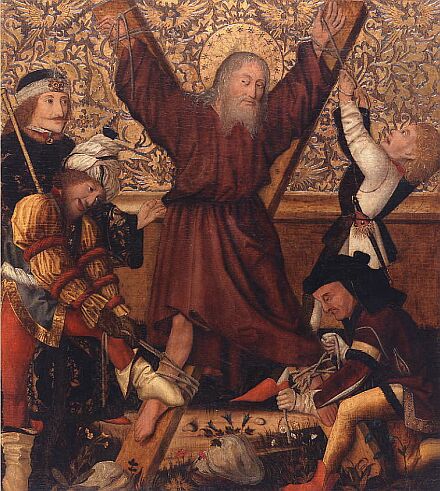
Apart from various zoological creatures, Frankenstein and Boris Karloff turned up in an installation at the Botanical Gardens, and Vlad Tepes lent a helping hand to the crucifixion of St. Andrew in the medieval section of the Unteres Belvedere. And, of course, Fuseli's Nightmare could famously be seen in Sigmund Freud's waiting room in BerggasseErnest Jones, who gave Freud the Nightmare black and white reproduction, was the author of On the Nightmare which includes a chapter on vampires. Considering how influential and recognized Freud was in my own country as well as in so many other places, I was surprised to learn that Freudianism had little impact in Austria until decades after WWII.


Otherwise it was a holiday not too dissimilar to that of other tourists. I saw the Hundertwasserhaus and a few other sights, and I certainly feel that I had enough Schlagobers for some time.


In central Vienna - as in many other large cities - a number of people try to amuse and entertain tourists and shoppers, including the guy in the photo above who appears to defy gravity. This to me shows that, perhaps, almost anything is possible in this city? Vienna is a pleasant place to stay, people are polite, and I haven't encountered any scams like the ones that you find in e.g. Rome and Paris.


Saturday, 9 July 2011

De sagis magisque posthumis

For some years tranquil peace ruled in Moravia, but then ...

As Google Books put more and more books online, one can get to check up on some more references, and I recently noticed the Moraviæ historia politica et ecclesiastica from 1787 by Adolf Pilarz and František Adolf Moravec, i.e. a political and church history of Moravia. In the third part of the book, Pilarz and Moravetz note that after The War of the Austrian Succession, peace ruled in Moravia, and the area flourished for some years. However ... two kinds of superstitions infested Moravia, one of them being what 'the Hungarians call Vampires'. More precisely, Moravetz writes: 'de sagis magisque posthumis, quos Hungari passim Vampyros vocant,' which links posthumous witches and magicians with vampires.


The authors call this superstition an ancient (vetustus) error which has moved from the East (Oriens) to Poland, Hungary and Moravia, and defines it is a common belief that corpses of witches and magicians buried in cemetries return animated by a demon to suck the blood of the living. And, as we would expect, this belief is related to the find of cadavers full of blood and incorrupted (sanguine plena, atque incorrupta), although these signs can be explained through natural means.

Pilarz and Moravetz  then refer to a specific case, the well-known incident dated December 22 1754 concerning a woman of Polish background, Rosina Polakin, whose body was hardly corrupted after thirty days, and consequently cremated along with a number of other corpses. Baron and court physician van Swieten, however, refuted the belief, and Empress Maria Theresia in 1755 ordered these acts of superstition to be stopped.


Sunday, 2 January 2011

Swieten's Vampyrismus as paperback

'Wo sind die Gesetze, welchen einen solchen Auspruch rechftertigen? Man bekennet, es seyen keine Gesetze vorhanden, hingegen zieht man zur Rechfertigung ganz kaltsinnig an: es sey also der Gebrauch.'

I recall having to wait some time and pay a lot of money to get a microfilm copy of the Abhandlung des Daseyns der Gespenster (Augsburg, 1768) some years ago, because I wanted to read the Gerard van Swieten's appended remarks on vampires. I later found them included on the Vampir Prinzessin DVD and reprinted in the 100 Jahre Dracula issue of Maske und Kothurn (41. Jahrgang Heft 1-2) edited by Rainer M. Köppl and published in 1998.
Now, a paperback of the text has been published by Europaïscher Hochschulverlag. 40 pages for € 16.90, it is certainly much cheaper to obtain than the prints I made from a microfilm. But cheaper still is the Wikisource edition of the whole book that I link to in the right hand panel.

Of particular interest is the Italian edition of Swieten's text reprinted by S. F. Flaccovio Editore in 1988. It contains an essay on I Vampiri di Maria Teresa by Pietro Violante, as well as of Italian translations of some of her decrees on superstitious acts. It is actually still available at the price of € 9.30.

You can take a look inside the new book on German Amazon.

Sunday, 18 October 2009

The Belgrade Vampire

I bought a couple of books while in London. One of them being Theresa Cheung's volumionus The Element Encyclopedia of Vampires: An A-Z of the Undead (Harper Element, 2009) 'dedicated to the memory of Montague Summers'.

Curiously it refers to a number of books in German, including those by Peter Mario Kreuter and Peter Kremer, but I doubt that Cheung has actually read them, as she, unfortunately, makes a number of errors in writing the history of vampires. She e.g. refers to 'The Belgrade Vampire', 'a vampire case that took place in Belgrade, Serbia in 1732,' that 'was recorded by Dr. Herbert Mayo in his esteemed 1821 work: On the Truths Contained in Popular Superstition.' A comparison with Mayo's book shows that this 'Belgrade vampire' is in fact the Medvedja vampire case recounted in the Visum et Repertum, that Cheung writes about in an entry on 'Arnold Paole'.

She also claims that Augustin Calmet triggered 'an outbreak of panic in the Austro-Hungarian Empire. This infuriated the Empress Maria Theresa, who sent her personal physician to investigate.'. We learn that 'In 1755 the town of Olmutz in Austria was also the scene of several vampire reports, and in the region of Styria there were also two cases of reported vampire killings,' of which the last one was mentioned 'in a 1909 edition of the Occult Review.'

Obviously, the book is an inaccurate mix of information taken from various sources, blending fact and fiction and presenting the most fantastic subjects like 'Ethics, among Vampires':

'By any system of law every single vampire is a multiple-murderer without ethics. But if there is such a thing as a real vampire it is for all intents and purposes a different species to humans; a species that requires fresh blood, preferably human, in order to survive, and as such, a species that should perhaps be judged by its own standards. The ethics for real vampires are therefore a matter for them. However, when it comes to sanguinarians, people who have a need to drink blood, psychic vampires, people who feed on the energy or life force of others, and modern vampires, people who simply like to model their lives on the vampire lifestyle, there is without doubt a place for a code of vampire ethics.'

The book also includes a list of 'Vampire Organizations, Societies, Fan Clubs, and Websites'. This blog is not included.

Theresa Cheung apparently 'has been involved in the serious study of the psychic arts for over twenty-five years. She writes full time and is the author of a variety of books, including The Element Encyclopedia of 20,000 Dreams.' I hope that her other books are more consistent in dealing with their topics than the mix of fact and fiction that is The Element Encyclopedia of Vampires.

Monday, 8 June 2009

Wikisource

I have received this kind e-mail that I thought I might as well just publish here. I am sure some of you will be interested in the links courtesy of Cecil:

My name is Cecil and I'm an active contributor at German Wikisource, where we started our own collection of sources about Vampires a little more than one year ago (http://de.wikisource.org/wiki/Vampire). Your blog is fascinating and in the last month it got my mayor source to expand our own page with more German public domain texts about the topic. Your blog helps me to find more texts previously unknown to me and also helps me understand the historical connections. I don't know how you do it, but thanks a lot. So I thought to tell you that at the beginning of this month, the ALEX-collection has finally published all the scans from the Theresianische Gesetzbuch (http://alex.onb.ac.at/gesetze_tgb_fs.htm). Among them also the one law which Maria Theresia did against superstition (http://de.wikisource.org/wiki/Der_Aberglauben_ist_abzustellen). So know everybody can read about it without needing to travel to Vienna or searching hard-to-get books which refer to it.

Sunday, 11 January 2009

240 years ago

Although the title page actually says 1769, on December 31st it was 240 years since the Constitutio Criminalis Theresiana was published. This criminal law passed by Empress Maria Theresa was her attempt at unifying criminal law throughout the countries under Austrian rule, thereby putting an end to various local judicial practices. E.g. the Theresiana aimed at limiting the use of torture for judicial purposes, and consequently it contains various descriptions in text and figures on the minutiae of the methods of torture. The parts of the book describing these methods are available in a German book publish by Reprint-Verlag in Leipzig: Folterwerkzeuge und ihre Anwendung 1769. This is not pleasant reading, and the pain inflicted by the torture is clearly visible on the faces of the victims in the illustrations.


The Theresiana also deals with cases of witchcraft and in that sense sums up Maria Theresa's previous endeavours to fight acts of superstition like the burning of corpses suspected of magia posthuma, see e.g. this post, although the Theresiana apparently had to be more conservative than the actual practice. Witchcraft trials had actually been abolished in 1766.

Fortunately, less than twenty years later torture was abolished with the criminal law passed by Maria Theresa's son Joseph II in 1787.

Online the Theresiana is available as a PDF file.

Saturday, 29 November 2008

Hortus Medicus

I am not botanically inclined, but botanical gardens can be pleasant to visit. In Vienna I had even more reason to go to the Botanical Garden of the Vienna University, as it was Gerard van Swieten who as Direktor of the Medical Faculty suggested to Empress Maria Theresa to found a 'Hortus Medicus', a medical garden. This was in 1754, i.e. the year before both the Empress and van Swieten became involved in the matter of Magia Posthuma and vampirism.

To be honest, I wasn't impressed with the Botanische Garten, but that is probably because of my lack of personal interest in botanics, and because I had spent hours at the Heeresgeschichtliches Museum and at the Upper and Lower Belvedere before I went to visit it.

Actually, I had more pleasure from visiting the Botanischer Garten in Halle earlier this year. I don't know if it has any particular connection with some of the learned men related to the 18th century 'secret capital of vampire theory'. This garden predates the one in Vienna, as it was founded in 1698. It contains several greenhouses that are open to the public, whereas most of the greenhouses in Vienna are only open to researchers. It's a very pleasant and relatively quiet place, at least when I visited it this summer.

The first two photos above are from Vienna, whereas the photos just above and below are from Halle.

Sunday, 4 May 2008

1755

The above shot is from the opening of Sofia Coppola's Marie Antoinette (2006), where Empress Maria Theresa (Marianne Faithfull) admonishes the future queen of France (Kirsten Dunst). Marie Antoinette was born on November 2 1755, i.e. almost a year after the empress got concerned with magia posthuma and sent a couple of court physicians to investigate a Moravian case that had astounded Vienna.

Certainly, the court in France was ahead of the Austrian court with respect to witchcraft and related matters that Maria Theresa had to concern herself with - aided by a certain Gerhard van Swieten. The movie, of course, has nothing to do with those matters, and takes off in 1770 when Marie is handed over to the French.

Those who enjoy that sort of thing should check out the November 5 1755 edition of the Wienerisches Diarium to read how the birth of the future Marie Antoinette was reported: "... Gegen halb 8. Uhr sodann wurden wir mit der höchst-erfreulichen Nachricht beglücket, daß Höchst-gedacht Ihre Majestät eine gesunde und Wolgestaltete Erz-herzogin, GOtt sey Dank! glücklich zur Welt geboren. ...'

Sunday, 6 April 2008

Another bogus documentary

I'm sorry, but I'm about to reiterate my usual tirade about why people prefer to contruct speculative fictions about vampires rather than telling the actual story. I honestly find it very hard to understand why people don't care to tell the true story when making a documentary about vampires, but rather prefer to invent their own fiction. Why don't they care about the facts? Why do they presume that we, the public, don't want to know the facts, but are willing to be deluded by their fictions? Do they prefer to tell us how superstitious people of the past were rather than try to explain why they did what they actually did?

How come that it is OK to blur the boundaries between fact and fiction when dealing with the (historical) subject of vampires, when no serious historian or documentarist would attempt to do so when dealing with e.g. various episodes in 20th Century history?

Consequently, I am pretty much surprised that scholars and academics are willing to lend their names and professional reputations to bogus historical docudrama like Die Vampir Prinzessin, which is the subject of this post.

The premises of this documentary are:

  1. 3 skeletons from the first half of the 18th Century are found by archaeologists in Cesky Krumlov in the Czech republic. They are buried North-South, and show signs which could be interpreted as if they had been treated for Magia Posthuma (decapitation, stone in a mouth, impaling)
  2. In Cesky Krumlov, a princess called Eleonore Amalie von Schwarzenberg resided in the 18th Century. She suffered from a mysterious illness (actually, cancer), a seemingly mysterious autopsy was carried out on her corpse, and she was buried beneath the floor of a local church.
  3. Bram Stoker quotes Bürger's famous poem, Lenore, in his tale Dracula's Guest, and an Austrian noble woman is referred to.
Based on speculations concerning these three facts, the documentary claims that the princess was suspected of becoming a vampire, and that Bram Stoker was inspired by her tale to create a noble man vampire, Dracula.

Well, today Stoker's working notes have been studied by various authors and scholars, and it is quite certain that Stoker was not inspired by this Bohemian princess but rather by a literary tradition instigated by John William Polidori's character Lord Ruthven. So this whole idea is certainly humbug.

What about the rest of this documentary?


Well, I assume that some of the facts concerning e.g. the three skeletons and princess Eleonore are in fact correct, but I don't find the conclusions very convincing.

Were the three corpses actually treated to prevent them from becoming vampires? The evidence presented is not so convincing that alternative explanations are ruled out.

Furthermore, it is claimed that a certain Dr. Frantz von Gerstorff inspected many cases of vampirism and that he also examined princess Eleonore. Oh, well, Frantz von Gerstorff was actually an Inspector at a mining facility in Transylvania who was involved in examining the case of a certain Dorothea Pihsin who was claimed to be a vampire in 1753. So he wasn't a doctor, and he probably had nothing to do with Eleonore Amalie who died in 1741. So this is even more humbug!

It is also claimed that Stoker probably based his character Abraham van Helsing on Gerard van Swieten, but to my knowledge there is no evidence that he had ever heard of van Swieten. So it's pure speculation.

As for 18th Century doctors, we are required to believe that some of them seriously believed in vampires, whereas the fact is that hardly any enlightened and well educated physician of that day believed in vampires. So when we furthermore are presented with the hypothesis that the autopsy conducted on Eleonora Amalie may have been carried out to prevent her from becoming a vampire, we are required to suspend our disbelief more than anyone can expect.

But then we are assumed to believe that her coffin was put into a specially walled up cavity beneath the church floor to prevent her from coming back, whereas this as far as I'm told isn't a particularly unique way of placing coffins in crypts and church floors.

Well, there's a lot more I could say about the speculations and nonsense that is presented in this documentary, but the above should suffice. What is perhaps even more strange is the appearance of various scholars from universities in e.g. Vienna, whose presence lends credibility to this ludicrous documentary.

So why do they do it? Why don't they tell the true story of the vampires of Serbia, the Magia Posthuma of Bohemia and Moravia, of van Swieten, Maria Theresa, Augustin Calmet etc.? In my opinion the true story will always be more fascinating and interesting than the speculative fantasies presented in documentaries like this one.

It actually really worries me that documentarists don't feel that they owe the public a true understanding of history? Do they really believe that it doesn't matter if we are told the true story or not?

The only redeeming thing about this documentary are the bonus features on the DVD which I have mentioned in an earlier post.

The photo shows Rainer Köppl from the University of Vienna, who hosts the documentary.

Thursday, 24 January 2008

Wir Maria Theresia

Some time ago I was asked if I knew of any web site containing Maria Theresa's announcements concerning magia posthuma. I found a site that contains an excerpt of one here, but this might be an opportunity to copy this text in toto:

Wir Maria Theresia etc., liebe Getreue etc.

Wir haben eine zeitlang müßfällig wahrnehmen müssen, daß nicht allein Verschiedene von unseren Landes Innwohneren in ihrer Leichtglaubigkeit so weith gehen, daß Sie dasjenige, was Ihnen ein Traum, oder Einbildung vorstellet, oder durch andere betrügerische Leute vorgespiegelt wird, für Gespenste und Hexerey halten, nicht minder denen für Besessen sich ausgebenden Leüthen, alßoglich den Glauben beymessen, sondern daß sie auch in dieser ihrer Leichtglaubigkeit offtmahls von einigen mit Vorurtheil eingenohmenen Geistlichen gestärcket worden, wie dann letzthin in unserem Marggraffthum Mähren die Sache so weith getrieben worden, daß von der Geistlichkeit verschiedene Cörper unter dem Vorwand, daß sie mit der sogenannten magia posthuma behafftet gewesen, aus dem Freüdhof ausgegraben, und einige davon verbrennet worden, wo doch hiernächst bey der erfolgten Untersuchung sich nichts anderst, als was natürlich ware, befunden hat. Wie zumahlen aber hierunter mehrentheils Aberglauben und Betrug stecken, und wie dergleichen sündliche Müßbräuche in unseren Staaten künfftighin keinesweegs zu gestatten, sondern vielmehr mit denen empfindlichsten Straffen anzusehen gemeynet seyn, alß ist under gnädigster Befehl, daß künftig in allen derley Sachen von der Geistlichkeit ohne Concurrenz des Politici nichts vorgenohmen, sondern allemahl, wann ein solcher Casus eines Gespenstes, Hexerey, Schatz-Graben, oder eines angeblich vom Teüffel Besessenen vorkommen sollte, derselbe der politischen Instanz soforth angezeiget, mithin von dieser mit Beyziehung eines vernünfftigen Physici die Sache untersuchet, und eingesehen werden solle, ob, und was für Betrug darunter verborgen, und wie sodann die Betrüger zu Bestraffen seyn werden. Ihr werdet solchemnach diese unsere allerhöchste Anordnung nicht allein dorten, wo ihr es nöthig erachtet, kundmachen, sondern dieselbe auch vornehmlich denen geistlichen Ordinariis mit dem Beysatz intimiren, daß sie ihren untergebenden Consistoriis und Geistlichen diesfalls die erforderliche Pastoral-Instruction ertheilen, und sie dadurch von ihren Vorurtheilen, mit welchen einige behafftet seyn könnten, ableiten, als auch vor allen dahin anweisen sollen, in vorbesagten Fällen allemahl die Sach denen pollitischen Stellen anzuzeigen, und die genaue Untersuchung vorgehen zu lassen, worüber sodann de casu in casum der Bericht Uns zu erstatten seyn wird.

Hieran beschiehet etc. und Wir verbleiben.

Geben Wienn den 1. Martij 1755.

Saturday, 6 October 2007

Magic and Superstition in Europe

On a trip to London last weekend I picked up a book called Magic and Superstition in Europe: A Concise History from Antiquity to the Present by Michael D. Bailey, assistant professor of history at Iowa State University.

I have not read the book yet, but in about 250 pages Bailey attempts to survey the history of concepts like magic, superstition and witchcraft, even including a few references to vampires like this one:

After 1736, officials in the English government and church were effectively enjoined against expresing any credence in the new superstitious belief in witchcraft. Needless to say, widespread belief in witchcraft and other forms of magic did not vanish in England in this year, nor in France in 1862, nor anywhere else in Europe as witch hunting came to an end. In some areas, other beliefs that might explain unexpected death or misfortune arose or took on renewed strength. For example, in the Hungarian region of Transylvania, belief in vampires may well have taken on new life even as central authorities became increasingly skeptical about witchcraft. Debates about vampires circulated around the Habsburg court in Vienna and may have influenced Maria Theresa's mid-eighteenth-century legislation effectively ending witch trials. Mostly, though, belief in witchcraft and magic simply endured, and continued to be expressed in local communities as it always had been. For despite all the sound and fury attached to the great witch hunts of Europe, witch hunts and witch trials were never the way most common people dealt with witchcraft. (p. 174)

The painting on the book cover is The Magic Circle by John William Waterhouse (1886).

Monday, 16 July 2007

Von Born's Curious account

I mentioned Ignaz von Born and his letters on Banat in a recent post. Although his Briefe über mineralogische Gegenstände auf seiner Reise durch das Temeswarer Bannat, Siebenbürgen, Ober- und Niederhungarn, an den Herausgeber derselben, J. J. Ferber, geschrieben, does not contain much material on vampires, it is an interesting read because of its general description of the customs of the people in the area, where a few known cases of Magia Posthuma took place.

The online edition of the Allgemeine deutsche Bibliothek contains a review by P. D. Giseke of the Briefe from 1777, in which Giseke notes that:

"So klein auch die Zahl der Seiten ist (und auf Einer Reise drey und zwanzig solche Briefe zu schreiben, ist in der That genug:) so voll Merkwürdigkeiten sind sie." (As small as the number of pages is (and to write twenty three letters like these on one journey should suffice), as full of curiosities they are).

Giseke mainly discusses the mineralogical content of the book, but briefly comments on the wildness of the customs of the people living in Banat:

"Sollten die Stubenphilosophen es wohl glauben, daß in Europa Leute gefunden würden, die so malabarisch dächten, daß sie Sonnenfinsternisse für Streite des hollischen Drachen mit der Sonne halten? - Hr. v. B. hat sie im Temeswarer Bannat gefunden." (Should the parlour philosophers really believe that in Europe people could be found, whose thinking is so wild, that they believe that the solar eclipse is caused by a hellish dragon fighting the sun? Mr. von Born has found them in the Banat of Temeswar).

Ignaz von Born
A very nice paper has been written on Born and his Briefe by Alex Drace-Francis: A Provincial Imperialist and a Curious Account of Wallachia in European History Quarterly vol. 36 (2006), p. 61-89. Drace-Francis is particularly interested in how 'East European' areas, in particular those of present day Romania, were represented by Born and other writes. From the above quote, it is quite obvious that some of them were considered as wild, superstititious, and uneducated. He traces von Born's journey, and the various editions of his Briefe and finds that:

"The Habsburgs' conquest, colonization, exploitation and representation of their south-eastern frontier is, I argue, best understood not as part of a process of defining Eastern Europe, nor as a 'semi-' or 'para' imperial enterprise, but one that bears legitimate comparison with colonial experiences elsewhere."

It is, I hope, obvious that this is interesting for us who wish to understand the context of the Magia Posthuma. The cases of vampirism reported to the Vienna court of Charles VI and Maria Theresa usually took place on the borders of the empire, in the military buffer zones occupied by Austrian military forces or in mining towns, so in most cases we have encounters between representatives of the empire and the locals and their beliefs. The curiosity about these parts of Europe was increasing in these years, travelogues were avidly read. This included an anonymous and abridged version of Born's Briefe published in London in 1779 under the title A very entertaining, comical and curious account of the manners and customs of the inhabitants of Wallachia, with a particular description of that country.

The word 'entertaining' is telling, because entertainment and amusement were very important to the people of that day. Even many of the more learned periodicals of the 17th and 18th centuries aimed to entertain, and it is to some extent in that context that we should see the printing of news on vampires and other curiosities in a number of these journals. In fact, a reviewer of von Born's Briefe even reminds his readers of the old Horatian dictum "Omne tulit punctum, qui miscuit utile dulci." (He gets every vote, who mixes the useful with the pleasant).

Anyway, Drace-Francis finds that Born's representation of the people of Banat should be seen in the light of a tension between province and empire. He finds that there are some similarities between Born's work and that of contemporary German scholars who define Jews and Gypsies in what we term as a racist way, but he ensures us that "it would be reductive to identify him with any movement towards theories of immutable ethnic distinction."

Although Austria considered taking over more areas of present day Romania, it seems that Maria Theresa decided not to. Drace-Francis quotes her for this view:

"Unhealthy provinces, without culture, depopulated or inhabited by perfidious and ill-intentioned Greeks, would be more likely to exhaust than to augment the forces of the monarchy."

One would, in fact, also think that she had plenty to do with reforming the empire than to expand it with further "malabarisch" people and their outlandish beliefs in e.g. vampires and revenants.

Sunday, 8 July 2007

Mozart related trivia

Oh well, June passed by quickly and there were so many other things on my mind, that I didn't get around to writing much in this blog. Perhaps there will be time for a few more entries this month? Certainly, I keep searching for new material and studying various sources for information on the Magia Posthuma, so the lack of new posts only reflects that I have had to concentrate on other matters than writing Magia Posthuma posts.

Anyway, here is a bit of trivia that can relate Wolfgang Amadeus Mozart (1756-1791) to persons who are somehow relevant to the history of Magia Posthuma.

Viewers of Amadeus may have noticed a sensible character at the court of Emperor Joseph II called Baron van Swieten who is played by Jonathan Moore in the film version. This van Swieten was the son of Gerard van Swieten whose name should be well known to readers of this blog because he played a key role in establishing the Austrian law against Magia Posthuma put forth by Maria Theresa. Joseph II himself was, of course, the son of Maria Theresa.

Amadeus: Baron van Swieten and SalieriThe baron van Swieten was a patron of many composers in Vienna of that day, including Haydn and Mozart. His full name was Gottfried van Swieten, and he lived from 1733 to 1803. His name and legacy is commemorated today by e.g. The Van Swieten Society. The photo above is from Amadeus with van Swieten in the background and F. Murray Abraham as Salieri in the foreground.
Ignaz von Born Another link between Magia Posthuma and Mozart is Ignaz von Born (1742-1791) who was an Austrian mineralogist. He traveled through Banat, parts of present day south western Romania, researching mining and mineralogy, and wrote letters about his findings in 1770. The letters were published in 1774 as Briefe über Mineralogische Gegenstände. Some of the letters describe the habits and culture of the people living in the area. Here von Born includes a short description of burial practices carried out to prevent the dead from returning as vampires:

"Man scharrt ihn [den Todten] ein, setzt ihm ein Kreutz und einen großen Stein zum Kopfe, damit er kein Blutsäuger (Vampyr) werde, gießet Wein und räuchert um das Grab, um die Unholden und Zauberer zu vertreiben, und dann geht man nach Hause." (They scratch the corpse and put a cross on him and a big stone on his head to prevent him from becoming a bloodsucker (vampire), pour wine and burn incense around the grave to drive away witches and sorcerers, and then they go home.)

Like Mozart, von Born was a freemason and is usually considered to be the inspiration for the character Sarastro in Mozart's famous opera The Magic Flute.

On his travels Mozart also visited places that play a role in the history of the Magia Posthuma, e.g. Olomouc (Olmütz), where 11 year old Mozart got infected with smallpox in 1767, just 12 years after Viennese court physicians investigated a case of Magia Posthuma in the vicinity. It was also at Olomouc that Karl Ferdinand von Schertz published his Magia Posthuma.

So Mozart obviously lived an age when vampires were not quite a terror from the past. In fact, it seems that an author of popular fiction even has imagined Mozart as a vampire. In I, Vampire by Michael Romkey, not only Mozart turns out to be a vampire, the same goes for Cesare Borgia and Hitler!

Sunday, 27 May 2007

Erna Lesky on Gerard van Swieten

After writing about van Heuveln's thesis on Gerard van Swieten, I feel compelled to quote a passage from a nice essay on van Swieten's role in Maria Theresia's Austria: Heilkunde und Gesundheitswesen by Erna Lesky published in a delightful volume on Maria Theresa, Maria Theresia und ihre Zeit: Eine Darstellung der Epoche von 1740-1780 aus Anlaß der 200. Wiederkehr des Todestages der Kaiserin edited by Walter Koschatzky (Residenz Verlag, 1979). Here Lesky also uses the word Kampf in connection with van Swieten, but without the connotations that you will get from reading van Heuveln.

"Völlig freie Hand hat Maria Theresia ihrem 'Gesundheitsminister' in seinem reformerischen Kampf gegen den finstersten Aberglauben gelassen. Weite Bevölkerungsteile in der Walchei, in Siebenbürgen, Banat, Kroatien, Schlesien und Mähren glaubten noch an die aus den Gräbern aufsteigenden und Menschenblut saugenden Vampyre. Gegen diese Magia posthuma hat van Swieten 1755 ebenso eine eigene Aufklärungsschrift erlassen, wie er auf Verordnungswege in das Kalenderunwesen mit seinen Aderlaß- und Schröpftafeln eingriff. Alle diese Maßnahmen gipfeln in dem Verdienst, das sich van Swieten bei der Abschaffung der Hexenprozesse in Österreich erwarb. Ihm ist an die Seite zu stellen die Afhebung der Folter, die der Jurist Sonnenfels im verein mit dem Chirurgen Ferdinand Leber durchsetze." (p. 195)

Erna Lesky compiled a number of papers on van Swieten with A. Wandruszka: Gerard van Swieten und seine Zeit (1973).

Statue of van Swieten as part of the Maria Theresien Denkmal in Vienna.

Friday, 4 May 2007

Gerard van Swieten commemorated

Earlier this year the Münze Österreichs, the Austrian Mint, issued a 50 Euro gold coin commemorating Gerard van Swieten (1700-1772). The coin is the first in a series called Großen Mediziner Österreichs, i.e. Great Austrian Physicians, and it seems only fitting that the first coin is dedicated to the memory of van Swieten who played a major role in developing medicine and medical education in 18th Century Austria.


However, as those of us who are interested in the history of magia posthuma of the 18th Century know, van Swieten played an important role in trying to stop the belief in magia posthuma. In a recent book on vampire slayers, Slayers and their Vampires: A Cultural History of Killing the Dead by Bruce McClelland (University of Michigan Press, 2006), he is even called "the Lowlands slayer", and it is claimed that "in 1755, Maria Theresa dispatched Van Swieten to Hermersdorf, Moravia, to investigate the postmortem treatment of a certain 'Rosina Polackin'".

However, I can find no evidence of Van Swieten playing this active role in the investigation himself.

In his written remarks on the affair and on vampirism in general, Van Swieten only mentions that the Empress sent two other physicians to investigate this case of magia posthuma: the Professor of Anatomy, Johannes Gasser, and the court physician, Christian Wabst. As has been noted by vampire historians, this was the first time physicians of this calibre were sent to investigate a vampire case, which in itself is a testament to the progress of medicine during the few decades that had passed since the famous Serbian vampire cases. It was the report of Gasser and Wabst to Empress Maria Theresa that prompted Van Swieten to write about vampires and to recommend to the Empress that she should pass a law against digging up corpses and burning them because of beliefs in magia posthuma.

The role of Van Swieten and Maria Theresa in the history of the magia posthuma has only recently been recognized in vampire books in English, no doubt aided by Gábor Klaniczay's paper on The Decline of Witches and the Rise of Vampires under the Eighteenth-Century Habsburg Monarchy which has become a standard text in the historical study of witchcraft.

Related Posts Plugin for WordPress, Blogger...