Showing posts with label Calmet. Show all posts

Sunday, 8 June 2014

Vampyrismus & Magia posthuma


By chance, years ago I watched part of a programme on History Channel about vampires in which anthropologist Giuseppe Maiello from the Charles University, Univerzita Karlova, in Prague was interviewed about vampires. I recall contacting Maiello who responded that he had himself not seen that interview. At the same time I learned about the book he had written on vampires, Vampyrismus v kulturních dĕjinách Evropy, which had been published in 2004, and got hold of it to see what a Czech researcher would include in a book on this subject.

Now Maiello has published a new edition of the book, this time titled Vampyrismus & Magia posthuma, and the new title indicates the major addition that has been made in this edition: A Czech translation of Karl Ferdinand von Schertz’s Magia Posthuma has been added to the sources at the end of the book!

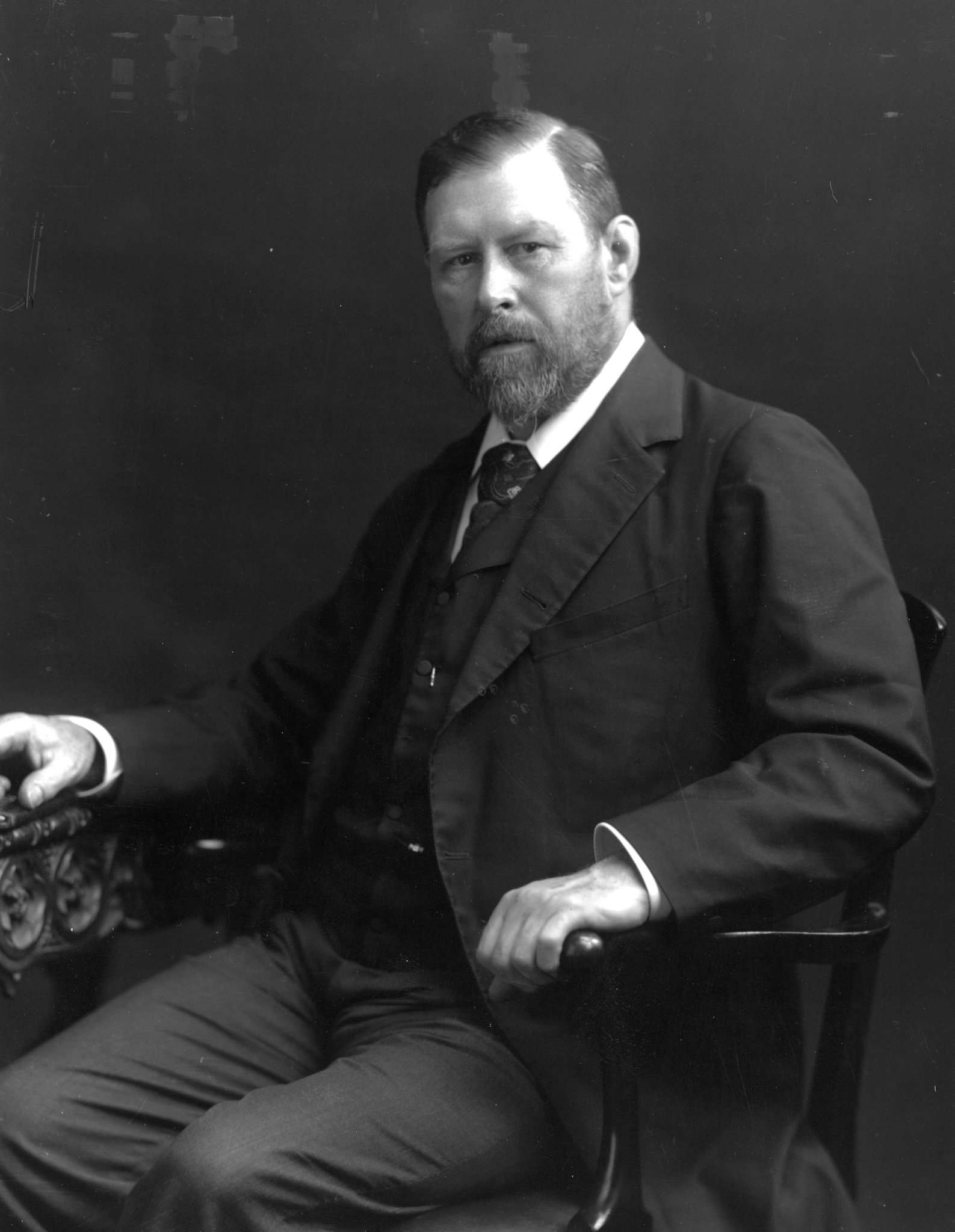
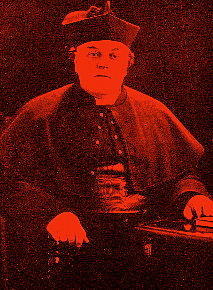
The new edition also includes a foreword mentioning some of the work that has been published since the first edition, as well as summaries in English, French and Italian that can be helpful to those of us who are not proficient in the Czech language. Furthermore, a number of illustrations have been added, in particular of some key persons, including one of Schertz, which is unfortunately not of the best quality.


According to the English summary, 'Vampyrismus a Magia posthuma [Vampirism and Magia posthuma] is an updated version of Vampyrismus v kulturních dějinách Evropy [Vampirism in the cultural history of Europe], which had first appeared in bookstores back in 2005. The book describes the phenomenon of Vampirism from an etymological, cultural-historical, ethnographic and anthropological point of view.

Up until now, the sources of the book were found primarily in the libraries of the Czech Republic. For this reason the book includes both classic examples from the literature of Western countries, transmitted through the intermediation of Abbot Augustine Calmet, as well as examples taken from the ethnographic literature of Central and Eastern European countries and the Balkans; lesser known or completely unknown to wider audiences and to western European and northern American specialists.

The second part of the book deals with the main theories on the origins of vampirism through the comparison between different cultures, and across temporal space, from classical antiquity up to the late nineteenth century. These theories concentrate on three areas: universal theories of the origins and prehistory of vampirism; theories (less probable) that derive vampirism by social and cultural changes that took place in modern Europe; and theories related to the analysis of agrarian cults and their struggles for the fertility of the fields.

In addition to other texts already published or translated into other languages, this is the first time that there is published in a modern language the Karl Ferdinand Schertz's study
Magia posthuma, which had been released only once in a printed Latin edition in 1704 (but which had the date 1706 written on the title page).'

Maiello has also published a paper on Schertz in 2012 in Slavica litteraria, Racionalismus Karla Ferdinada Schertze a Magia posthuma (Karl Ferdinand Schertz's rationalism and Magia posthuma). Written in Czech, it does however include an English abstract:

'Karl Ferdinand Schertz is at home a no well known author. On the contrary, his name is known around the world thanks to his work Magia posthuma, which was quoted by Augustin Calmet. Because of his not well available biography and books, Schertz is unfortunately wrong understood and around him circulate various rumors or negative critics. Karl Ferdinand Schertz was on the contrary highly cultured author, who could enjoy a good reputation among the european intellectuals of his time.'

The paper briefly deals with Schertz's life and works, and discusses his approach to magia posthuma, which in Maiello's view make Schertz more of a rationalist than a man of the Baroque period. Maiello actually finds that the rationalistic approach of Schertz is comparable to that of Calmet. Cf. what I have myself written in Vampirismus und magia posthuma im Diskurs der Habsburgermonarchie edited by Augustynowiz and Reber (or as part of Kakanien Revisited).


Giuseppe Maiello talks about vampires on this Czech talk show

I thank Giuseppe Maiello for providing me with a copy of his book. He informs me that the publisheres are considering publishing an edition in English.

Monday, 14 October 2013

Calmet returns in German


From the ever productive Nicolaus Equiamicus comes a new German edition of the second volume of Augustin Calmet's Dissertation on apparitions and vampires. Soon to be published, this 160 page volume is available for pre-order from German amazon at € 14.95.

"Seit ungefähr sechzig Jahren hat sich in Ungarn, Polen, Schlesien und Mähren ein neues Schauspiel hervorgetan, indem dort Leute, die schon mehrere Jahre oder Monate zuvor verstorben sind, wieder zurückkommen, reden, gehen, die Dörfer beunruhigen, Menschen und Tiere misshandeln, ihren Verwandten das Blut aussaugen, ihnen Krankheiten und schließlich gar den Tod verursachen, und sich auch von solchen überlästigen und schädlichen Besuchen nicht zurückhalten lassen, bis man ihre Leiber wieder ausgräbt, spießt, ihnen das Haupt abschlägt, das Herz ausreißt, oder sie verbrennt..." (Augustin Calmet) Augustin Calmet (1672-1757), den gelehrten Geschichtsschreiber und Abt des Klosters Senones/Lothringen, würde heute kaum mehr eine Menschenseele kennen, hätte er nicht im Jahre 1746 dieses Buch über Vampire geschrieben. Er behandelt darin die Vampirthematik in 59 Kapiteln aus theologischer und historischer Sicht und geht dabei detailliert auf zahlreiche überlieferte und aktenkundig gewordene Vampirfälle ein. Das für Calmets Verhältnisse eher kleine Werk übertraf den Erfolg seiner anderen Bücher – unter anderem verfasste er einen dreiundzwanzigbändigen Bibelkommentar - bei weitem und erschien bereits im 18. Jahrhundert in vier französischen und drei deutschen Auflagen. Die vorliegende Neuausgabe soll dazu beitragen, dass dieser Klassiker der Vampirologie auch weiterhin nicht in Vergessenheit gerät.

Friday, 18 May 2012

The Philosophy of Spirits, Apparitions, Etc.


Cambridge University Press has reissued Henry Christmas's translation of Calmet, The Phantom World, as a set of two paperbacks. Available at at RRP of £39.00, it appears that there is no new material, like e.g. an introduction:

'The Benedictine monk and biblical scholar Antoine Augustin Calmet (1672–1757) published this work in 1746; it was translated into English in 1850 by Henry Christmas (1811–68). It examines a wide selection of supernatural tales and beliefs from across Europe. Taking the stance of a scientific enquirer, Calmet sought to understand the truth behind stories of good and bad angels, vampires, witchcraft, possession by demons, and the dead who come back to life. He compiled accounts of the supernatural from official reports, newspapers, eyewitness accounts and travel writing, and this two-volume anthology of his collected data analyses the material, noting problems and inconsistencies. Volume 1 investigates the appearance of good and bad angels, magic among the Greeks and Romans, sorcerers and witches, and possession by demons. Volume 2 investigates tales of vampires and ghosts across many different European countries.'

Henry Christmas (1811–1868), according to Wikipedia, 'at the end of his life going by the surname Noel-Fearn, was an English clergyman, a man of letters and editor of periodicals, known also as a numismatist.'

Also in the Cambridge Library Collection is a two volume edition of Emily Gerard's The land Beyond the Forest.

Friday, 11 May 2012

"Calmet had corresponded with Maria Theresa"


To me there is something anachronistic about forteana in the twenty first century. Charles Fort's collections of strange phenomena remind me of my youth when theories about biblical myths being inspired by UFO visits, claims that the Egyptians knew about electromagnetics, and various parapsychological notions of telekinesis were popular. Still, the magazine The Fortean Times, apparently has an avid audience, and judging from its current issue, some of the articles are pretty well written and researched.

This issue - no 288 - is a special on the 'creatures of the night', including an article on the historical origin of the interest in vampires, i.e. the Serbian vampires of the 1730's, by Dr. Leo Ruickbie. I doubt that readers of this blog will be surprised by most of what he writes, except a claim that Dom Calmet corresponded with Empress Maria Theresa. This is certainly an intriguing angle that I would never have considered. Ruickbie, unfortunately, does not quote any source for this information.

Other articles include an analysis of 'vampire killing kits' and a history of two men who played a key role in  Romanian Dracula tourism.

The Fortean Times is available for purchase and reading digitally.


Sunday, 15 April 2012

We had thought that vampires were extinct

’… One of the most curious legacies ever bequeathed to anybody is perhaps that of £1000 left by the late Mrs Olivia Flint, of Pittsburg, to her doctor: Mrs Flint was very fond of novel reading, and, although very ill, began to read Bram Stoker’s thrilling romance, ”Dracula.” So interested did the dying woman become in it, that when she had read a chapter or two, she turned to her nurse, and, asking for pen and ink, wrote a few words to the effect that if Dr Allardyce could keep her alive long enough for her to finish the tale he was to receive a legacy of £1000. Mrs Flint lived for several hours after the last words had been read.’

This, an excerpt from the Marlborough Express Nov 2 1909, is one of the more curious examples of the early reception of Bram Stoker’s Dracula that have now been collected in a slim volume, Bram Stoker’s Dracula: The Critical Feast. An annotated reference of early reviews and reactions, 1897-1913, compiled and annotated, with an introduction, by John Edgar Browning (Apocryphile Press, 179 pages, $18.95).

Aiming at both dispelling the misconception that Dracula received a mixing critical reception and providing literary scholars and the public with the documentation, Browning compiles 91 examples of reviews and letters, along with book covers and ads, from the English languaged part of the world where most of the initial editions were published. Only two translations appeared in Stoker’s lifetime, and a ‘bibliographical afterword’ by J. Gordon Melton presents of a list of non-English editions of Dracula.

The tale of a ‘human vampire’, as many reviewers call Count Dracula, is generally favourably received, and apparently made the blood of many critics curl. ‘We had thought that vampires were extinct,’ notes the Saturday Review of Politics, Literature, Science and Art, ‘but Mr. Bram Stoker has set himself to prove to us the contrary. Or rather he has recreated them with considerable ingenuity and a distinct gift for story-writing of the blood-curdling order.’ ‘There are a hundred nightmares in “Dracula,” and each is more uncanny than the last,’ writes St. James’ Gazette, while a reviewer in The Daily Mail is reminded of the author of a number of gothic novels: ‘It is said of Mrs. Radcliffe that, when writing her now almost forgotten romances, she shut herself up in absolute seclusion, and fed upon raw beef, in order to give her work the desired atmosphere of gloom, tragedy and terror. If one had no assurance to the contrary, one might well suppose that a similar method and regimen had been adopted by Mr. Bram Stoker while writing his new novel Dracula.’


Some critics found that the transition of the vampire from the more gothic Transylvanian setting to contemporary London did not work so well.‘Vampires need a Transylvanian background to be convincing,’ wrote The Academy: A Weekly Review of Literature, Science, and Art, adding: ‘The witches in “Macbeth” would not be effective in Oxford-Street.’ Still, there was no doubt that Dracula’s castle is not a place to visit, in the words of The Glasgow Herald: ‘Henceforth we shall wreathe ourselves in garlic when opportunity offers, and firmly decline all invitations to visit out-of-the-way clients in castles in the South-East of Europe. Dracula is a first rate book of adventure.’

What will strike modern day readers as odd, is that some critics saw Dracula as a werewolf book. ‘Mr. Bram Stoker, in his remarkable novel “Dracula”, has gone to the old legends of the were-wolf for the inspiration of his story,’ writes The Speaker, calling the novel ‘the first introduction of the were-wolf to English soil.’ Similarly, The Daily Telegraph finds that Bram Stoker illustrates and modernises ‘a revival of a mediaeval superstition, the old legend of the “were-wolf”,’ and traces this ‘old legend’ and its literature more closely, as the critic asks: ‘What has Mr. Bram Stoker been reading?’

Indeed, what has Stoker been reading? Today, we tend to forget how small the existing ‘canon’ of vampire literature in the English language was when Stoker wrote the novel. In fact, the deluge of books on the subject only dates back to the 1960’s or 1970’s, and the 'classics' by Ernest Jones, Dudley Wright and Montague Summers were all published after Stoker’s death. So in the 1890’s, one might have found the translations of Dom Calmet, Herbert Mayo’s letters, and a bit here and there, including the Rev. Sabine Baring-Gould’s The Book of Werewolves, Being an Account of a Terrible Superstition from 1865, which is in fact mentioned by the reviewers of both The Daily Telegraph and The Stage, the latter apparently finding some pleasure in describing the horrors of the novel:

‘Those who know the Rev. S. Baring Gould’s little volume on the Were-Wolf, a theme also touched on here and there by Kipling, may possibly not be repelled by the grisly details of two beautiful and virtuous women having the veins in their throats sucked by the red lips, and lacerated by the gleaming white teeth of this centuries-old Transylvanian warrior and statesman, who often appears as a gaunt wolf and a huge bat.’

In his notes, Browning writes that the convention of seeing vampires transform into wolves ‘was to fin de siècle readers relatively unfamiliar – practically an innovation at the hands of Stoker.’ His other vampiric innovations are humourously commented on by Longman’s Magazine, when reviewing an inexpensive reissue in 1901: ‘The rules of vampirizing, as indicated by Mr. Stoker, are too numerous and too elaborate. One does not see why the leading vampire, Count Dracula, could not bolt out of the box where was finally run to earth by a solicitor named Jonathan. If he could fly about as a bat, why did he crawl down walls head foremost? The rules of the game of Vampire ought to be printed in appendix: at present the pastime is as difficult as Bridge.’ The reviewer then lays down eight chief rules like e.g. this sixth rule: ‘No vampire can vamp a person protected by garlic.’


Fortunately, an interview with Stoker himself was published in The British Weekly, allowing him to comment on both his sources and the vampire belief itself. Asked, ‘Is there any historical basis for the legend?’ he answers:

‘It rested, I imagine, on some such case as this. A person may have fallen into a death-like trance and been buried before the time. Afterwards the body may have been dug up and found alive, and from this a horror seized upon the people, and in their ignorance they imagined that a vampire was about. The more hysterical, through excess of fear, might themselves fall into trances in the same way; and so the story grew that one vampire might enslave many others and make them like himself. Even in the single villages it was believed that there might be many such creatures. When once the panic seized the population, their only thought was to escape.’

He apparently thought that the vampire belief was particularly prevalent in certain parts of Styria (where he originally set Dracula), and added, that ‘the legend is common to many countries, to China, Iceland, Germany, Saxony, Turkey, the Cersonese, Russia, Poland, Italy, France, and England, besides all the Tartar communities. Two sources are mentioned in the interview: Baring-Gould’s book and Emily Gerard’s Essays on Roumanian Superstitions.

Interestingly, not many reviewers go into detail regarding the subject of vampires. The National Observer, and British Review of Politics, Economics, Literature, Science, and Art, briefly mentions that ‘More awful even than the ghoul of the Arabian Nights is the Slavonic superstition of the human vampire, which, dead to all intent and purposes during the day, is supposed to prowl around by night and gorge itself with the blood of living man,’ adding that ‘this fearful legend, which flourished in Eastern Europe a century ago, and still finds credence among the ignorant.’ The Liverpool Mercury claims that it is ‘An old Eastern superstition, still having weight in Hungary.’

On the whole, the only reviewer to deal with ‘vampiredom’ in more detail is actually the one writing for the Australian Argus in 1897, who states that ‘Vampires – the “living dead,” whose corpses cannot decay, but who have the power of rising from their graves at night to batten upon the blood of human beings – are the Vroucolakas of the Greeks,' and then goes on to mention that 'They have been treated of by an old German writer, Michael Raufft (sic!), in his learned book “De Masticatione Mortuorum in Tumulis,” by the Frenchman Calmet, and by many another grave-faced sifter of mediæval superstitions,' before supplying more information about 'these unpleasant noctural prowlers.'

Upon Stoker’s death one hundred years ago on April 20 1912 , The Outlook found reason to note that ‘The lamented death of the author should direct fresh attention to the most imaginative creation of his pen. For weird force and picturesque horror Dracula deserves to rank with the classics of morbidity.’

For that reason, as well as for the novel's role in keeping ‘vampiredom’ alive and well in modern popular culture, the centenary of Stoker's death is good reason to read or re-acquaint oneself with the novel. For those interested in getting a better understanding of the literary reception of this, the single most important piece of vampire fiction, John Edgar Browning’s reference book is highly recommended.

Finally, a few words regarding the bibliography of translations: It is quite a daunting task to compile a complete and faultless bibliography of this task, and judging by the Scandinavian language editions mentioned, it is not a completely or a fully correct list. The Danish translations are all listed under the title ‘Drakula,’ but have actually all been titled Dracula, and I doubt that the list of adaptations is complete. The list of Swedish editions is, unfortunately, incomplete, and it is not correct that the first English translation of the preface to the Icelandic translation was published in 1993.

Sometime in the mid-Eighties, I was in contact with Richard Dalby, author of the first Stoker bibliography (published by the aptly named Dracula Press in 1983), and supplied him with information on the translation and copies of the preface. He subsequently had it translated and published by Guild Publishing in 1986 in a one-volume edition of both Dracula and The Lair of the White Worm, this also being the first time the latter novel was reprinted in its original length, as it had been absolutely butchered in all previous reprints.


Sunday, 4 December 2011

An important exception

I recently mentioned Paul Barber's preface to the second edition of his Vampires, Burial & Death, as well as Rob Brautigam's Shroudeater site in another post. Paul Barber calls attention to that web site, while mentioning that 'theories sometimes crowd out the facts, especially on the Internet,' adding in a footnote:

'An important exception is Rob Brautigam, whose site (shroudeater.com) contains a valuable collection of material from many countries over many years. Brautigam has gone to great trouble to verify sources in the accounts he publishes there, some of which have evolved in moving from one book to the next. In one case (that of William Doggett) he demonstrates that a vampire was eventually inserted into a story that originally wasn't about vampires at all.' (p. v-vi)

Brautigam recently updated the site with a large number of 'cases', this time including an index by place name instead of by country alone, even indicating alternative names for various places.

I have only taken a brief look at some of the new entries. One of them concerns Marienburg and is placed in Poland. Curiously, Montague Summers in The Vampire in Europe refers this to Tyrol:

'In his chronicle under the year 1343 Sebastian Moelers relates that during a terrible visitation of the Black Death cases of vampirism were numerous in the Tyrol, and the Benedictine abbey of Marienberg was much infested, one at least of the monks, Dom Steino von Netten, being commonly reputed to have been slain by a vampire.' (p. 160)

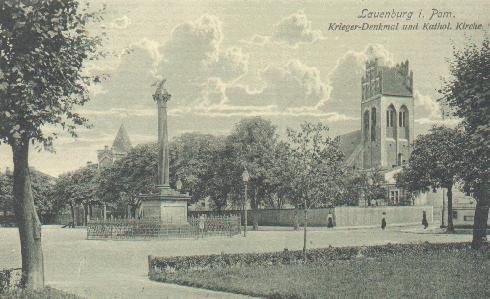
As is sometimes the case, the original source text is not easy to locate online, in this case Sebastian Möler's Prussian chronicle. Brautigam refers to a book from 1837 that clearly places the occurrence in Lauenburg (today Lębork), and not Marienburg (today Malbork), both near Danzig (Gdansk) in Northern Poland. I found a bit on it on p. 53-4 in Reinhold Cramer's Geschichte der Lande Lauenburg und Bütow (1858) (see below), which clearly shows that this has to do with a dead person's corpse that keeps turning up outside the grave, until it is forced to stay there by being punished with a sword and reminded of an oath taken by the deceased while alive. As such, it is certainly farfetched to claim that it is an example of a vampire per se. Unfortunately, Montague Summers's vampiric version set in Tyrol must be considered a figment of his (or charitably, perhaps someone else's) imagination, as Brother (not Dom) Steino von Retten died from the epidemic illness that he tried to flee, not because he had been 'slain by a vampire.'

As Cramer says, this story is so wonderful that it sounds more like a fairy tale than a true story, but must be considered one of the stories concerning Medieval miracula mortuorum that are recounted by various authors, including Dom Calmet.


Those interested in factual background information may find it worth taking a look at the appendices in Cramer's book.

Saturday, 24 September 2011

A Delayed Demonologist

In the early 20th century the British Egyptologist Margaret Murray claimed that the witch trials were actually aimed at a pagan, pre-Christian religion. Evaluating Murray's work in 1994, Jacqueline Simpson wrote (as quoted on the English Wikipedia entry on Murray):

'So what was the appeal of her work? Part of the answer lies in what was at the time perceived as her sensible, demystifying, liberating approach to a longstanding but sterile argument between the religious minded and the secularists as to what witches had been. At one extreme stood the eccentric and bigoted Catholic writer Montague Summers, maintaining that they really had worshipped Satan, and that by his help they really had been able to fly, change shape, do magic and so forth… In the other camp, and far more numerous at least among academics, were sceptics who said that all so-called witches were totally innocent victims of hysterical panics whipped up by the Churches for devious political or financial reasons; their confessions must be disregarded because they were made under threat of torture. When The Witch-Cult in Western Europe appeared in 1921, it broke the deadlock.' (Margaret Murray: Who believed her, and why? in Folklore, 105 (1994): 89-96)

In a recent introduction to the subject published in Germany, Hexen und Magie (Campus Verlag, 2007), Dr. phil. habil. Johannes Dillinger talks of 'Verspätete Dämonologen', delayed demonologists, and mentions 'Summers who in the first third of the 20th century besides anthologies of horror stories published several monographs about magic as well as English translations of some demonological treatises with chatty introductions. Whether Summers, as he claimed, was really a priest has yet to be proved. His spleen or perhaps rather his sales trick consisted in posing as an ultra conservative Catholic. Summers wrote as if he literally accepted witchcraft as a reality. His works are at best of interest as a curiosity of historiography.' (p. 114) *


That Summers was controversial I have previously shown examples of, and more can be found in his books. In the introduction to A Popular History of Witchcraft he e.g. states that ‘the present study aims at presenting a clear view of the Practice and Profession of Witchcraft, as it was carried on in former centuries and now prevails amongst us. I am convinced that it is most necessary to realize that this is no mere historical question, but a definite factor in politics of to-day, as well as in social life and the progress of humanity.
The Black International of Satan – that is the canker which is corrupting and destroying the world.’ (p. xvi)

Such extreme statements are perhaps easier to find in his books on witches and witchcraft, so perhaps his books on vampires are a different kettle of fish? If, however, you read an interesting letter that is reproduced on pp. 391-3 of the new, critical edition of The Vampire: His Kith and Kin, you can see that Summers himself in September 1934 wrote:

'Scholars have been generous enough to recognize me as the greatest living English authority upon historical witchcraft. My HISTORY OF WITCHCRAFT is accepted as the standard book upon the subject. I have written six books upon witchcraft, and I have further translated and edited nine treatises, some of great length, covering the whole area of historical and mediaeval witchcraft.'

So what were these 'six books upon the subject of witchcraft'? Checking with the bibliography by Timothy d’Arch Smith, I suppose the books are: The History of Witchcraft and Demonology (1926), The Geography of Witchcraft (1927), The Discovery of Witches: A Study of Master Matthew Hopkins (1928), The Vampire: His Kith and Kin (1928), The Vampire in Europe (1929), and The Werewolf (1933). So to Summers himself, his two books on vampires must be treated as part of his oeuvre upon witchcraft, and not as something distinct from those books. Actually, vampires are briefly mentioned in The Geography of Witchcraft (p. 503-4), and in the introduction to The Werewolf, he calls it ‘a successor to my study, The Vampire’ (p. ix)

Apparently these subjects are not separate, but according to Summers really just different themes within the overall subject of witchcraft. Subjects whose reality he claimed to believe in, while at the same time stressing their universality: 'A subject as old as the world and as wide as the world' according to his The History of Witchcraft and Demonology (p. ix), and a subject that had not lost its relevance in the early twentieth century:

‘My aim throughout my new work has been to show how the profession and practice of witchcraft are the same always and in all places, be it in some remote English village, in a quiet cathedral city, in the sweltering hinterland of Jamica, or in savage Africa.’ ‘Up and down England there is hardly a village without a witch. In our great cities, our larger towns, our seats of learning, Satanists abound and are organized (as of old) into covens of wickedness. Black Masses are celebrated in Mayfair and Chelsea; in Wapping and Shoreditch; in Brighton; in Birmingham; in Liverpool; in Edinburgh.’ (A Popular Introduction to Witchcraft, p. xiii and 258)

The Werewolf echoes his words on witchcraft: 'As old as time and as wide as the world, the belief in the werewolf by its very antiquity and its universality affords accumulated evidence that there is at least some extremely significant and vital element of truth in this dateless tradition, however disguised and distorted it may have become in later days by the fantasies and poetry of epic sagas, roundel, and romance.' (The Werewolf, p. 1)

And of course, vampires according to Summers are as universal as werewolves and witches: 'The tradition is world wide and of dateless antiquity.' (The Vampire: His Kith and Kin p. ix), although it may not be quite as prevalent in Summers’s own time as the Black Mass: 'Cases of vampirism may be said to be in our time a rare occult phenomenon. Yet whether we are justified in supposing that they are less frequent to-day than in past centuries I am far from certain. One thing is plain: - not that they do not occur but that they are carefully hushed up and stifled.' (The Vampire in Europe, p. xx-xxi).

Summers, however, does note in places that the vampire – at least in its more strict sense – can be located to certain parts of Europe at a certain period, but overall his universal vampire concept is one of the most influential aspects of his books.

Examples from anthropology and archaeology are provided as proof and foundation for the antiquity and universality of the phenomena. So when specialists decide to use the word ‘vampire’ in translations of e.g. cuneiform texts from Sumer and Babylonia, Summers can appropriate these ‘vampires’ to conform to his ancient vampire concept.

Although prevalent in many popular vampire books, universality is not at the heart of many modern studies that rather stress the vampire's historicity by discussing whether the vampire is unique, and if the vampire was really of Slavic origin. In a recent - and excellent - book on magic and witchcraft published in Denmark, it is stated that the Romans 'did not have a specific term for the category revenant. Indeed, the concept 'revenant' in the meaning 'walking corpse' appears to have been unknown to them. The examples that are usually shown hereof, in my opinion do not concern walking corpses, but apparently dead people. It should be added that further categories like bloodsucking vampires, zombies and poltergeists in antiquity were unknown phenomena, notions and phantasies. They have all been invented more recently, i.e. within the last couple of centuries.' (Allan A. Lund: Magi og hekseri: Fra den romerske oldtid til og med middelalderen (Gyldendal, 2010), p. 106)

And writing of Summers and other 'vampirologists' in 2010, Erik Butler in Metamorphoses of the Vampire in Literature and Film says: ‘Because they have bought into the fiction of vampire antiquity, many popular and scholarly discussions of the vampire fall victim to a lure posed by vampire stories, and they accept the monster as a near-eternal being whose existence reaches back to the ancient world.’ (p. 3)

As Summers was a professed Catholic, it is interesting to compare his work to those of prominent Roman Catholics who wrote on the subject of e.g. vampires, most notably Dom Calmet and Giuseppe Davanzati. Both Calmet and Davanzati responded to the scepticism of 18th century Enlightenment. Calmet tried to uphold Catholic dogma while at the same time approaching the subject from a sceptical and historical point of view, whereas Davanzati basically dismissed the vampire belief as ignorance and superstition. No wonder then that Summers could not abide by Davanzati, saying without further explanation: Nor can we accept “Che l’apparizione de’ Vampiri non sia altro che paro effetto di fantasia.” The truth lies something deeper than that as Leone Allacci so well knew.' (The Vampire: His Kith and Kin, p. 25) Obviously, it was hard for Summers to accept that a prominent Catholic dismissed the vampire as an effect of the imagination.

Compared to Calmet and Davanzati, Summers's project might be termed anti-Enlightenment, as he attempts to establish his own mythological pseudo-Orthodox Catholicism, apparently wishing to revert to some (probably unhistorical) Christian fervor in opposition to witches, Satanists, vampires and werewolves.

Similarly, he probably would not have sympathised with Gerard van Swieten and Empress Maria Theresa, who were both Catholics opposing superstition. In the bibliography of The Vampire: His Kith and Kin, Summers refers to the 1768 Abhandlung des Daseyns der Gespenster Nebst einem Anhange vom Vampyrismus (the first entry in the bibliography), but I doubt that he read it, because he does not refer to the incident that Gerard van Swieten dealt with in the Anhang.

Re-reading parts of Summers’s The Vampire: His Kith and Kin, I honestly can not help wondering whether he really believed what he wrote. Was he confident in his belief that evil forces, Satanists, vampires and shapeshifters were lurking in the shadows of contemporary Britain? Or was it to some extent merely a fictional ploy to make the reader’s blood curl, perhaps inspired by the penny dreadfuls and Gothic horrors he enjoyed?

His 'occult' books are in their construction and style not dissimilar to Baroque books: anthologising various curious stories to make some points, e.g. of a philosophical nature, but essentially entertaining the reader with strange and marvellous stories. I suppose one could remove most of a book like The Vampire: His Kith and Kin and still provide enough material to say what Summers essentially has to say about the vampire, its origins, generation, traits and practices. A summary could be stated in perhaps a few pages. That, of course, would remove a lot of the entertainment value, as well as the supposed documentation.

Fortunately, there is more to be found in the follow up, The Vampire in Europe, and no doubt, much of the value of Summers’s books on the subject stems from his interest in collecting stories and documents. His analysis and his beliefs, on the other hand, are at best mostly ephemeral.

I myself am no Summers buff. I admired his books when I was much younger, which was also at a time when I had little access to much of the material on vampires that is now available. It was also at a time when witchcraft literature was still bogged down by Gerard Gardner, Erica Jong and others whose approach to the subject - like that of Montague Summers - mixed historical fact with fiction. Summers’s books contain a lot of material, which can be used for inspiration and entertainment, but I would recommend people to check the sources before trusting old Montague’s research and analysis.

Gerard O'Sullivan writes about Summers in a paper published in 2009 in The Antigonish Review (No. 159, p. 111-131):

'The mere mention of Montague Summers's name calls to mind Erving Goffman's trenchant "managed stigma" (Goffman [Stigma. Notes on the management of spoiled Identity] 1963). Summers was, and at the very same time, both victim and beneficiary of a spoiled public persona - one which he stage-managed with great skill and, evidently, no little glee. Rumors of bad behavior, occult dabbling, and a purported friendship with none other than Aleister Crowley (they were not friends, but acquaintances, and dined together only twice) swirled around Summers through most of his life.

Summers did little if anything to dispel the rumors. He was alsways, as Fr. Sewell noted,
mal vu in the eyes of London's Catholic clerisy, who had no doubt that Summers was in holy orders, but could not be certain as to their origin, liceity, or canonical regularity. And Summers's very public literary battles with academic critics and scholars whom he perceived as encroaching upon his fields of specialization - the Restoration stage, gothic literature, and the supernatural - left him a figure alternately loathed and praised in the British press.' (p. 113)

Recently, Summers has even been called a ‘freak’ by Florian Kührer in his recent book on vampires, Vampire: Monster - Mythos - Medienstar (2010): ‘A “freak” of a special kind, Montague Summers (1880-1948) – in popular lexica described as a “literary historian, demonologist and occult author” – must be numbered among the leading creators of the modern vampire mythos. His admirers, who have immortalized him biographically, but also Summers himself have ensured that the story of his life moves between legend, rumour and serious information.’ (p. 244) **

More specifically, Kührer has this to say about Summers's work on vampires: ‘In his zeal of (false) piety lay also the weakness of Summer’s oeuvre: He read his folkloric sources only from the perspective of a demon hunter and classified almost every phenomenon, that only slightly fitted the profile, as a vampire. Consequently, Summers left us with not only an entertaining panoptikon of monsters, but also succeeded in contributing significanttly to an inflation of the vampire mythos. A great number of “vampirologists” to this day crib from the occult “reverend” and duplicate unreflectingly his phantasms. The World Wide (Vampire) Web has once more duly reinforced the tendency.’ (p. 246) ***

So we are back at Summers’s invention of an ancient and universal vampire. Hagen Schaub in Vampire: Dem Mythos auf der Spur (here quoted from the 2011 edition) talks of the misunderstanding of mixing up living corpses with gods and demons, for which Summers is the main perpetrator, ‘who as the first collected an infinite number of international bloodsuckers, which even today infest many vampire books. Furthermore, one must be cautious because not everything is well researched, and many of Summers’s entities have little in common with a vampire. And when you know that the man was convinced of the existence of vampires, his work relativises itself, and one must ask the question if his oft-quoted works really ought to be the basis of current books and not least internet sites about vampires.’ (p. 32-3) ****

David Keyworth in Troublesome Corpses (2007) simply notes that ‘Montague Summers’ oft-quoted The Vampire in Europe (1929), for example, although scholarly and interesting to read, is often inaccurate in many regards.’ (p. 6) In fact, nearly 35 years ago Christopher Frayling in 1978 noted in The Vampyre: Lord Ruthven to Count Dracula noted that both Summers’s books and Dudley Wright’s single book on vampires ‘are unreliable, and have for too long been treated as gospel. Tony Faivre’s Les Vampires (1962) and Sturm and Volker’s Von denen Vampiren oder Menschensaugern (1973) are both much more scholarly, and can be trusted more than the (many) Summers derivatives.’ (p. 331)

All these critical comments are in a way a testament to the influence of Montague Summers on the field, but at the same time they show how ridiculous it would be to uphold him and his work as an authority on vampires in the 21st century. His research is flawed and erroneus. His project is idiosyncratic and dated. His concept of the vampire as 'world-wide and of dateless antiquity' was extremely influential in the past, but today it must be considered a dead end.

Klaus Hamberger, of course, mentions Summers's two books on vampires in his bibliography of secondary literature in Mortuus non mordet from 1992, one of the most important books on vampire history published in the 20th century. But it is quite obvious, that Summers play little or no role in the book, and that there are so many other sources that are far more important than Montague Summers will ever be.

In many ways, I think the writer(s) of German Wikipedia nailed it, when writing of Summers:

‘Characteristic of Summers’s books is his style that is reminiscent of baroque literature. Scholars found Summers’s occult themes unfit as academic research, because his books about the occult did not meet the demands of academic precision. The works of Montague Summers is a testament to a unique passion for collecting, whose ambition for completion is paired with a lack of critical discrimination. In his efforts to track down as many proofs as possible of the acts of bloodsuckers, he placed any ghost that fulfilled just one of the fundamental criteria of the phenomenon “Vampire”, under this denomination, so that in his works on the subject one also find monsters that in no way belong to the category of “living corpses”. In his remarkable industry he searched in all kinds of works of folklore and ethnology for vampires and werewolves, not only from a scientific interest, but also to prove the existence of Evil and its innumerable variants. Montague Summers was convinced of the existence of witches, vampires and werewolves, and maintained the point of view that these were known and feared by all people at all times. This explains why Summers considered eyewitness accounts of vampires and werewolves, as they were published in the occult literature and the sensationalist press of his time, to be genuine.

Despite his erudition it was impossible for Summers to put the incredible amount of collected material into order. With long quotes in various foreign languages, in particular Latin, he wished to give an air of scholarship. Thanks to Summers’s research, both copies of the otherwise lost leaflet about the Werewolf from Bedburg, the in 1589 executed Peter Stübbe, were rediscovered.’ *****


Original quotes in German

*) 'Die Hexenlehre hat auch noch im 20. Jahrhundert Befürworter gefunden: dummdreiste Reaktionäre und Autoren, die den auflagensteigernden Effekt extremer Meinungen erkannt haben (Laven 1907/08; Petersdorff 1995). Summers legte im ersten Drittel des 20. Jahrhunderts neben Anthologien von Horrorstories mehrere Monografien über Magie sowie mit geschwätzigen Einleitungen ausgestattete englische Übersetzungen einiger dämonologischer Traktate vor. Ob Summers, wie er behauptete, tatsächlich Priester war, mag dahingestellt bleiben. Sein Spleen oder wohl eher noch sein Verkaufstrick bestand darin, sich als ultrakonservativer Katholik zu gebärden. Summers schrieb, als akzeptiere er Hexerei im dämonologischen Vollsinn als Wirklichkeit. Sein Œvure ist allenfalls als Kuriosum der Wissenschaftsgeschichte von Interesse.'

**) Ein “Freak” der besonderen Art war Montague Summers (1880-1948) – in populären Nachschlagewerken als “Litteraturwisscenschaftler, Dämonologe und okkultistischer Schriftsteller” beschrieben, der zu den maßgeblichen Schöpfern des modernen Vampir-Mythos gezählt warden kann. Seine Verehrer, die ihn biographisch verewigt haben, aber auch Summers selbst, sorgten dafür, dass sich die Geschichten über sein Leben zwischen Legenden, Gerüchten und seriösen Informationen bewegen.’

***) ‘In seinem (schein)heiligen Eifer liegen aber auch die Nachteile von Summers Oeuvre: Er las seine volkskundlichen Quellen nur aus der Perspektive des Dämonenjägers und klassifizierty nahezu jades Phänomen, das auch nur im Ansatz auf das Profil paste, als Vampir. Summers hinterließ uns somit nicht nur einunterhaltsames Panoptikum von Monstern, sondern leistete auch einen großen Beitrag zur Aufblähung des Vampir-Mythos. Ein Gutteil der “Vampirologen” schreibt bis heute vom okkulten “Reverend” ab und vervielfältigt unreflektiert seine Phantasmen. Das World Wide (Vampire) Web hat diese Tendenz noch einmail gehörig verstärkt.’

****) ‘Für diese Vermischung ist vor allem der selbst ernannte Reverend und Okkultist Montague Summers (1880-1948) verantwortlich, der als Erster eine unendlich große Zahl von internationalen Blutsaugern zusammengetragen hat, die auch heute noch in vielen Vampirbüchern ihr Unwesen treiben. Mitunter ist hier aber Vorsicht geboten, denn nicht alles ist wirklich gut recherchiert, und manche von Summers angeführte Figur hat mit einem Vampir wenig gemeinsam. Und wenn man weiß, dass der mann von der Existenz von Vampiren überzeugt war, relativiert sich seine Arbeit ohnehin und es stellt sich die Frage, ob seine noch immer viel zitierten Werke wirklich Basis aktueller Bücher und vor allem von Internetauftritten über Vampire sein sollten.’

*****) 'Summers an Barockliteratur erinnernder Schreibstil prägt seine Publikationen. Der Fachwelt galten Summers Okkult-Themen als akademischer Forschung unangemessen, darüber hinaus entsprachen seine Bücher über Okkultismus nicht den Anforderungen akademischer Genauigkeit. Das Œuvre von Montague Summers stellt sich als Zeugnis einer einzigartigen Sammelleidenschaft dar, die sich bei allem Streben nach Vollständigkeit mit einem vollständigen Mangel an Kritikfähigkeit paart. In seinem Bemühen, möglichst viele Belege für das Treiben von Blutsaugern aufzustöbern, packte er jedes Spukwesen, das auch nur eins der Grundkriterien für das Phänomen „Vampir“ erfüllte, unter diesen Begriff, so dass sich in seinen diesbezüglichen Werken auch Schreckensgestalten finden, die keineswegs unter die Rubrik „lebender Leichnam“ fallen. In erheblicher Fleißarbeit durchforstete Summers alle nur denkbaren volks- und völkerkundlichen Werke nach Vampiren und Werwölfen, nicht nur aus wissenschaftlichem Interesse, sondern um den Beweis für die Existenz des Bösen und seiner unzähligen Varianten zu erbringen. Montague Summers war von der Existenz von Hexen, Vampiren und Werwölfen überzeugt und verfocht die Ansicht, dass diese bei allen Völkern und zu allen Zeiten bekannt und gefürchtet gewesen seien. So erklärt sich, weshalb Summers angebliche Augenzeugenberichte von Werwolf- und Vampirerscheinungen, wie sie in der okkultischen Literatur seiner Zeit und in der Sensationspresse publiziert worden waren, für bare Münze nahm.

Trotz Gelehrsamkeit war es Summers unmöglich, die Unmassen an gesammeltem Material zu ordnen. Lange Zitate aus diversen Fremdsprachen, vornehmlich aus dem Lateinischen, wollen Wissenschaftlichkeit vermitteln. Dem Forscherfleiß von Summers ist zu verdanken, dass die beiden einzigen Exemplare der ansonsten verlorenen Flugschrift über den „Werwolf von Bedburg“, dem 1589 hingerichteten Peter Stübbe, wiederentdeckt wurden.'

Thursday, 21 July 2011

The 'first' vampire

Anthony Hogg, in a comment to a recent post, asks: Who was the first vampire? Giure Grando, Peter Plogojowitz, or perhaps the vampires mentioned in Mercure Galant as quoted by Calmet.

As I wrote in an earlier post, there is a museum dedicated to Giure (or: Jure) Grando, commemorating him as the first vampire. As it says here: 'Jure Grando (1656) was the first classical Vampire to be mentioned in documented records.' Still, I would myself refer to Peter Plogojewitz (or however you prefer to spell his name) as the 'first' vampire, because that term is used in Provisor Frombald's report from Kisiljevo.

As for bloodsucking, well, most of these revenants tend to either strangle or by other means affect the living, and blood itself generally first turns up on the corpses that are exhumed, and it is then interpreted as blood drawn from the unfortunate victims of the revenant. But some kind of bloodsucking is actually mentioned in connection with the Mercure Galant article on the Polish Upiertz that Hogg also refers to in his comment. Still, the term 'vampire' is apparently not used, although Calmet claims that the articles 'parlent des oupires, vampires ou revenants'. There appears to be an excerpt from the 1693 issue in question on the web site of this author of a book on vampires, i.e. here, and it actually says that this Demon draws blood from the body of a living person or of cattle.

A Google search, of course, provides a number of other answers like Cain, Lilith, Vlad Tepes, George Bush...

Saturday, 2 July 2011

Macabre speculations

I recently mentioned Andrew Miller's new novel Pure, which in the meantime I have read. It certainly is a macabre tale, but also a gripping story of the people involved in the destruction of the Les Innocents cemetery a couple of years before the French Revolution. Most of the characters are fictional, but some historical persons crop up, in particular the well-known physician Joseph-Ignace Guillotin, who in the novel is studies the various stages of human decomposition that are found during the unpleasant exhumation of thousands of bodies in the cemetery. The novel provides entertainment as well as an interesting view of the period. That the story of a young engineer destroying an ancient church and its cemetery can be interpreted as a metaphor for a major change in society is lost neither on the reader nor the engineer himself.

A paper from 1997 on Deadly Fears: Dom Augustin Calmet's Vampires and the Rule Over Death by Marie-Hélène Huet, published in Eighteenth-Century Life Vol. 21 (May 1997), p. 222-232, speculates on  both Calmet's work on vampires and the move of cemeteries from central Paris to its outskirts. Personally, I think Huet overinterpretes this conjunction, but she provides some interesting information on e.g. the cemeteries:

'Toward the end of the century, when new legislation finally authorized the closing of overcrowded cemeteries and new locations were chosen, one of the primary concerns was to find a soil where the bodies would decompose quickly. Long before the Cemetery of the Innocents was closed, officials complained that "the soil has difficulty absorbing the bodies buried there" (qtd. in Thibaut-Payen, p. 211). A similar anxiety would spread through Paris during the Revolution, with endless complaints that the guillotined bodies failed to decompose and were rejected by the clay of the Madeleine cemetery where they were first buried.

In the second half of the century, one notices a growing repulsion toward and dread of the dead as the sacred respect due them seemed to be superseded by a rising fear of their nefarious powers. Michel Vovelle quotes a 1781 Lettre du Baron de *** à son ami sur l'affaires des cimetières, from an anonymous author protesting a proposed "lieu de dépôts" or "temporary storage" of the dead in Paris:

"A sick person dies and is kept at home twenty four, sometimes forty eight hours: shall we have to keep it uncovered for another twelve hours? ... Here is a corpse that casts its most dangerous infection into the air; the many moves one will be obliged to make, to take it to church, onto the cart, moving and emptying the cart, will increase this infection, letting it escape into the air. What will be the scope of this infection, already so dangerous when it comes from a single body, when it is multiplied by all the corpses of Paris and air temperatures? ... All of Paris, at all times and in all its quarters, will be filled with cadaverous and pestilential putrefaction." (pp. 202-3)

A growing antipollution movement brought together village priests and villagers, as well as members of the Academy of Medicine and of the Academy of Sciences, all of whom were anxious to relocate cemeteries outside the cities, far from the living. The famous decision in 1785 to close the Cemetery of the Innocents testifies to several concerns, writes Thibaut-Payen, chief among them, "the dangers of insalubrity presented by the presence of a necropolis inside the city limits" (p. 221).' 

Particularly far-fetching are in my opinion Huet's comments on the 'deep Christianity' of the 1732 story of 'Arnold Paul', Calmet being her prime source:

'Undoubtedly, most of the elements of the classical vampire story are here. But the most striking part of the story lies in its deep Christianity, in its hardly disguised evocation of Christ's life: the forty days reminiscent of the days spent fasting in the desert, fighting the devil's temptations, the ressurection from the dead. But at the same time, everything is reversed: the vampire's public life starts after his death, and, instead of fasting and resisting temptation, he indulges in blood feasts that cannot be stopped until forty days after his life as a vampire has started. Like an inverted image of Christ, the vampire wins disciples who will, in turn, make their victims into new converts. Vampirism is not just a plague, it is a false religion. The sacrificial burning of vampires cannot fail to evoke the burning at the stake of heretics and devil worshippers.'

I object to this analysis, because I cannot recall reading any contemporary 18th century speculations along these lines. For more or less the same reason, I also find her thoughts regarding the name of 'Arnold Paul' speculative:

'Moreover, the name of the deadly vampire, Arnold Paul (which Calmet remarked himself was a most unlikely name for a Hungarian vampire), must have immediately reminded readers of the great Jansenist Arnauld. Certainly, vampire stories, articulated on countless episodes of grave profanation and extraordinary attacks on Jansenists, provided the Benedictine monk with a thinly disguised religious parable.'

Sunday, 19 June 2011

Martin Zeiller's original account of the revenant who left his shroud

Anyone interested in vampires and revenants will have noticed that certain tales or reports are repeated again and again in the literature, sometimes in a number of variations that may even be presented as occurring at different locations. One of these stories was mentioned in a post a couple of months on shrouds, but at the time I was unable to cite the original. I refer to the story of a revenant who left his shroud when leaving his grave, which was the inspiration for Goethe's Totentanz. It was, as far as I know, originally recounted in Martin Zeiller's comments to his German translation of Francois de Rosset's Les histoires tragiques de notre temps. I have recently had access to two editions of Zeiller's Theatrum tragicum, the earliest being the fourth edition published in Tübingen in 1634.

Commenting on the first story in Rosset's book, Zeiller adds a number of stories about the Devil's works, among them a few concerning spectres and apparitions of the dead. He notes that the learned have differing opinions on the nature of these apparitions, but that his concern is not to discuss whether they are indeed the deceased people or merely the Devil's deceit. His concern is but to a few of the stories of these apparitions. Among them are the omnipresent stories of the shepherd from Blov and the 'witch' from Levin as told by Wenzel Hajek in his Böhmische Chronica. Continuing from the last of these stories, Zeiller writes:

'Fast ein gleiche Geschicht has sich vor ettlichen Jaren zu Eywanschitz in Mähren (wie ish solche Anno 1617. und 18. zu unterschiedlichen malen von glaubwürdigen Burgern allda habe erzehlen hören / mir auch der Ort ist gewiesen) begeben / in deme / dem ansehen nach / ein ehrlicher Burger daselbst auff den Kirchhof in der Statt ist begraben worden / welcher stets bey der Nacht auffgestanden ist / und ettliche umbgebracht hat : seinen Sterbküttel liesse er allzeit bey dem Grab ligen / und wann er sich wider niderlegte / so zoge er den Sterbküttel wider an. Einsmals aber / da er also vom Grab hinweg gienge / und die Wächter auff dem Kirchenthurn solches ersahen / haben sie ihme den Sterbküttel unter dessen hinweg getragen : als er nun wider zum Grab kame / und seinen Küttel nicht fande / ruffte er den Wächtern / sie sollen ihme den Küttel geben / oder er wolle sie alle erwürgen : welches sie haben thun müssen : hernach aber wurde er vom Hängcker außgegraben / und zu Stucken zerhawen / da hörete das Ubel auff / und da er auß dem Grab genommen worden / sagte er : sie hätten es jetzt wol recht getroffen : sonsten / weil sein Weib auch gestorben / und zu ihme gelegt worden war / wolten sie beede die halbe Staat umbgebracht haben. Der Hängcker zoge ihm auß dem Maul einen langen grossen Schleyer / welchen er seinem Weib vom Kopff hinweg gessen hatte / den selben hat der Nachrichter dem beystehendem Volck gezeigt / und gesagt : schawet / wie der Schelm so geizig gewesen.'

So this is probably the oldest known version of this story which not only inspired Goethe, but also later on turned up in Le Fanu's Carmilla , as a story from Breslau and, probably, most notably in the 'vampire' story from Liebava in Moravia in Calmet's Traité. Zeiller's original does not differ much from the retelling in Der höllische Proteus which I quoted in my post on the subject, but portions of the story are left out or changed in various versions.


Zeiller travelled in various parts of the German territories. In 1650 he authored an interesting topographical work on Bohemia, Moravia and Silesia, Topographia Bohemiae, Moraviae et Silesiae, which also contains information on Eywanschitz (today called Ivančice or Eibenschütz) and other locations of interest. Under Lewin/Levin, Zeiller once again tells the tale of the witch. He is, however, not certain that Hajek actually refers to the same Lewin, as the passage below shows.

Sunday, 27 February 2011

On shrouds, vampires and the dance of the dead


This prologue to the well-known Hammer vampire movie The Vampire Lovers from 1969 based on Joseph Sheridan Le Fanu's famous short story Carmilla, has its roots in vampire or revenant lore.

In Le Fanu's story it is told by a woodman in chapter 13:

"How came the village to be deserted?" asked the General.

"It was troubled by
revenants, sir; several were tracked to their graves, there detected by the usual tests, and extinguished in the usual way, by decapitation, by the stake, and by burning; but not until many of the villagers were killed.

"But after all these proceedings according to law," he continued - "so many graves opened, and so many vampires deprived of their horrible animation - the village was not relieved. But a Moravian nobleman, who happened to be travelling this way, heard how matters were, and being skilled - as many people are in his country - in such affairs, he offered to deliver the village from its tormentor. He did so thus: There being a bright moon that night, he ascended, shortly after sunset, the towers of the chapel here, from whence he could distinctly see the churchyard beneath him; you can see it from that window. From this point he watched until he saw the vampire come out of his grave, and place near it the linen clothes in which he had been folded, and then glide away towards the village to plague its inhabitants.

"The stranger, having seen all this, came down from the steeple, took the linen wrappings of the vampire, and carried them up to the top of the tower, which he again mounted. When the vampire returned from his prowlings and missed his clothes, he cried furiously to the Moravian, whom he saw at the summit of the tower, and who, in reply, beckoned him to ascend and take them. Whereupon the vampire, accepting his invitation, began to climb the steeple, and so soon as the had reached the battlements, the Moravian, with a stroke of his sword, clove his skull in twain, hurling him down to the churchyard, whither, descending by the winding stairs, the stranger followed and cut his head off, and next day delivered it and the body to the villagers, who duly impaled and burnt them."


The inspiration no doubt is Dom Calmet, who in chapter 51 of the second part of his 1751 Traité writes:

'Un prêtre de bon esprit m'a raconté il y a peu de temps que voyageant dans la Moravie, il fut invité par M. Jeanin, chanoine de la cathédrale d'Olmuz, de l'accompagner à leur village nommé Liebava, où il était nommé commissaire par le consistoire de l'évêché, pour informer sur le fait d'un certain fameux vampire, qui avait causé beaucoup de désordre dans ce village de Liebava, quelques années auparavant.

L'on procéda, l'on ouît des témoins; on observa les règles ordinaires de droit. Les témoins déposèrent qu'un certain habitant notable du lieu de Liebava avait souvent inquiété les vivants dudit lieu pendant la nuit, qu'il était sorti du cimetière et avait paru dans plusieurs maisons, il y avait environ trois ou quatre ans; que ses visites importunes étaient cessées parce qu'un étranger hongrois passant par le village dans le temps de ces bruits, s'était vanté de les faire passer et de faire disparaître le vampire. Pour satisfaire à sa promesse, il monta sur le clocher de l*église et observa le moment auquel le vampire sortait de son tombeau, laissant auprès de sa fosse les linges dans lesquels il était enseveli, puis allait par le village, inquiéter les habitants.

Le Hongrois l'ayant vu sortir de sa fosse, descend promptement du clocher, enlève les linges du vampire et les emporte avec lui sur la tour. Le vampire étant revenu de faire ses tours et ne trouvant plus ses habits, crie beaucoup contre le Hongrois, qui lui fait signe du haut de la tour, s'il veut revoir ses habits, qu'il vienne les cherchere. Le vampire se met en devoir de monter au clocher, mais le Hongrois le renverse de l'échelle et lui coupe la tête avec une bêche. Telle fut la fin de cette tragédie.

Celui qui m'a raconté cette histoire n'a rien vu; ni lui ni ce seigneur qui était envoyé pour commissaire. Ils ouïrent seulement le rapport des paysans du lieu, gens fort ignorants, fort supersticieux, fort crédules et infiniment prévenus sur le fait du vampirisme'


Or in the English translation of Henry Christmas:

'A sensible priest related to me, a little while ago, that, travelling in Moravia, he was invited by M. Jeanin, a canon of the cathedral at Olmutz, to accompany him to their village, called Liebava, where he had been appointed comissioner by the consistory of the bishopric, to take information concerning the fact of a certain famous vampire, which had caused much confusion in this village of Liebava some years before. The case proceeded. They heard the witnesses, they observed the usual forms of the law. The witnesses deposed that a certain notable inhabitant of Liebava had often disturbed the living in their beds at night, that he had come out of the cemetery, and had appeared in several houses three or four years ago; that his troublesome visits had ceased because a Hungarian stranger, passing through the village at the time of his reports, had boasted that he could put an end to them, and make the vampire disappear. To perform his promise, he mounted on the church steeple, and observed the moment when the vampire came out of his grave, leaving near it the linen clothes in which he had been enveloped, and then went to disturb the inhabitants of the village. The Hungarian, having seen him come out of his grave, went down quickly from the steeple, took up the linen envelopes of the vampire, and carried them with him up the tower. The vampire having returned from his prowlings, cried loudly against the Hungarian, who made him a sign from the top of the tower that if he wished to have his clothes again he must fetch them; the vampire began to ascend the steeple, but the Hungarian threw him down backwards from the ladder, and cut his head off with a spade. Such was the end of this tragedy. The person who related this story to me saw nothing, neither did the noble who had been sent as commissioner; they only heard the report of the peasants of the place, people extremely ignorant, superstitious and credulous, and most exceedingly prejudiced on the subject of vampirism.'

However, going back to one of the most popular German (and consequently Protestant) works on apparitions of the 17th century, Erasmus Francisci Der Höllische Proteus, first published in 1690, one can find this story in his chapter on the masticating dead, Der schmätzende Todte:

'Es gedenckt auch Zeilerus, in seinen Trauer-Geschichten: Er habe / zu Eywanschitz in Mähren / im Jahr 1617 und 18 / zu unterschieclichen Malen / von glaubwürdigen Bürgern des Orts / erzehlen hören daß daselbst / vor etlichen Jahren / (nemligch von selbiger Zeit zuruckzurechenen) ein / dem Ansehn nach ehrlicher / Bürger / auf dem Kirchhofe selbiger Stadt beerdigt worden; aber stets / bey der Nacht / aufgestanden sey / und Leute umgebracht habe. Dieser ließ allezeit seinen Sterb-Kittel / bey dem Grabe / ligen : und wann er sich wiederum niderlegte; zoch er denselben wieder an. Es wurden aber einsmals die Wächter / auf dem Kirch-Thurn / gewahr / als er vom Grabe wegging; eilten derhalben hinab / und trugen ihm den Sterb-Kittel hinweg. Da er nun / wieder zum Grabe kommend / seinen Kittel nich antraff; rief er ihnen zu / sie sollten ihm den Kittel wiedergeben / oder er wollte ihnen Allen die Hälse brechen. Welches sie auch / in grossem Schrecken / gethan.

Aber nochmals musste der Hencker ihn ausgraben / und zu Stücken zerhauen. Worauf man witer nichts gespúhrt. Der Scharffrichter zoch ihm einen langen grossen Schleyer / aus dem Maul / hervor / welchen er seinen Weibe vom Kopff hinweg gefressen hatte. Diesen zeigte der Nachrichter dem umherstehenden Volck / und rieff: Schauet! wie der Schelm so geizig gewesen! Nachdem er aus dem Grabe genommen war / sagte er: Sie hetten es jetzo wol recht getroffen; sonst / weil sein Weib auch gestorben / und zu ihm gelegt wäre / wollten sie Beyde die halbe Stadt umgebracht haben.'


Zeilerus according to Francisci is 'Zeiler. im I Theil der Trauer-Geschichte p.25.seqq.', i.e. Les Histoire Tragiques de Nostre Temps: Das ist Newe/Warhafftige/trawrig/kläglich und wunderliche Geschichten/die wegen Zauberey/Diebstal und Rauberey/ Ehrgeitz / und anderer seltzamen und denckwürdigen Zufälle from 1624, a translation by Martin Zeiller of Francois de Rosset's popular Les Histoires tragiques de notre temps from 1615. I have looked at a digital scan of Rosset's work, and could not find the story. I may have overlooked it, but I think that the story may have been included by Zeiller in his edition. Unfortunately, I have not (yet) had Zeiller's translation at hand. For more on editions of Rosset's book, check here. The story, however, can also be found in Valvasor's famous book and elsewhere.


That Calmet's Liebava story is a variation on Zeiller's has been observed by others, cf. also Rob Brautigam's Shroudeater , and I think the earliest remark on it is made by Stefan Hock in 1900 who also referred to Ralston's Russian Folktales, and wrote (in a footnote):

'Eine ganz ähnliche Sage erzählt Calmet (II: 255 f.) aus Liebava in Mähren nach mündlichen Berichten von Zeugen, wo aber der Ungar, der die Rolle des Wächters spielt, das Gespenst hinunterstürzt und so das Dorf rettet. Diese Form steht Goethes Ballade viel näher.' (p. 32)

As noted by Hock, this tale was an inspiration for Goethe's Totentanz from 1815 which can be found here in the original and in an English translation. Speaking of the dance of the dead, there are some interesting web sites on the subject: The web site of the Europäische Totentanz-Vereinigung, and a fellow Dane's exploration of the Danish term: 'to look like Death from Lübeck'.

So you can follow this thread (of shroud, so to speak) back from a Hammer movie to earlier revenant concepts and the dance of the dead. And, appropriately, coming back to our 21st century, here is a recent version of Goethe's poem (re)animated by Lego bricks!

Sunday, 7 November 2010

Books and reviews

My apologies to all for first posting a review of Florian Kührer's book at this point. I have a couple of other books that I will post reviews of shortly. First of which is Vampire: Von damals bis(s) heute by Nicolaus Equiamicus (Ubooks).

Apropos of books, the forthcoming book on Calmet that I mentioned here, has been postponed until February 2011.

Sunday, 31 October 2010

Another Halloween

I find that I rarely get around to writing blog posts because other activities tend to take up a lot of my time. But I just received an e-mail from someone who had found this blog because of a search inspired by Halloween, so I thought I would just post of a photo of the pumpkin head I made from this year's harvest in my own garden.

I have a few blog posts that I have left unfinished, e.g. one regarding the new digital books, like Calmet's Phantom World which is easily available for Kindle on a smartphone as seen in the photo above.

In the photo below are three pretty rare vampire books that took me some time to get hold of: Otto Steiner's Vampirleichen: Vampirprozesse in Preussen (1959), Aribert Schroeder's Vampirismus (1973), and Tony Faivre's Les Vampires (1962). Who knows, with the advent of e-books, they will perhaps be accessible for next to nothing on a phone, Kindle or iPad?

Wednesday, 28 July 2010

The influence of Calmet


Apparently Gilles Banderier, known for his edition of Ildefonse Cathelinot's comments on Calmet's Traité, spoke on De saint Benoît à Dom Calmet : permanences de la culture bénédictine last Saturday July 24 at Senones, and was accompanied by Aurélie Gérard who spoke on Les bibliothèques - Senones milieu littéraire au XVIIIe siècle. It was a part of the Festival des Abbayes en Lorraine.

Gerard is the author of a forthcoming book on Calmet and his influence on his contemporaries: Dom Augustin Calmet et l'abbaye de Senones (Vosges): Un milieu littéraire. It is published in October, and more information can be found here:

'Les milieux littéraires fleurissent au siècle des Lumières sous la forme de cafés, de clubs, de salons, ou de façon plus institutionnalisée avec les académies et les sociétés savantes dont le nombre ne cesse de croître, tandis que les célèbres Congrégations de Saint-Vanne et de Saint-Maur exhortent leurs religieux à poursuivre l’oeuvre des illustres académies monastiques mises en place au siècle précédent. Cette dernière mission tient tout particulièrement à coeur à Dom Augustin Calmet, bénédictin lorrain connu dans toute l’Europe pour son oeuvre littéraire monumentale qui aborde à la fois l’exégèse, l’histoire et les curiosités, et pour les dignités qu’il a occupées au sein de la Congrégation de Saint-Vanne.

Son élection à l’abbatiat de la riche et influente abbaye de Senones, dans les Vosges, le 9 juillet 1728, lui permet de concrétiser toutes ses ambitions. Le monastère, déjà ouvert sur le monde des Lettres par ses prédécesseurs, notamment Dom Mathieu Petitdidier, accueille l’érudit qui va développer dans ce foyer de spiritualité toutes les activités propres à un milieu littéraire : écriture, copie de textes, échange et commerce de livres, gestion de la bibliothèque, critique littéraire, liens avec l’édition. Qui mieux est, ces activités littéraires participent à l’ouverture de l’abbaye sur le monde qui l’entoure déjà favorisée par sa situation géographique et politique. Les correspondances de Dom Calmet et de son neveu et coadjuteur, Dom Fangé, témoignent du rayonnement de l’abbé de Senones auprès de ses contemporains religieux ou laïques, en Lorraine, en France et en Europe, et de ses relations avec les Grands et avec les académies. L’influence de Dom Calmet sur les philosophes des Lumières, notamment Voltaire, et son intérêt porté aux principales controverses de son siècle sur la Bible, le surnaturel et l’histoire, transforment ce milieu « littéraire » en un milieu éclairé digne de son temps.'
Related Posts Plugin for WordPress, Blogger...