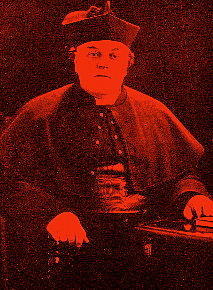
At the conference on vampirism and magia posthuma in Vienna in 2009 I had the opportunity to talk to Professor Marco Frenschkowski about Montague Summers, so it was interesting to read what he had to say about the subject in a delightful and inexpensive introduction to the cultural history of witches published last year, Die Hexen: Eine kulturgeschichtliche Analyse (Marix Verlag). In fact, what he writes is very much like the opinion he told me back then: that he thought many scholars denounced Summers, but still read his books, albeit discreetly.
Frenchowski’s book is dedicated to Henry Charles Lea, whose collection of sources, Materials toward a History of Witchcraft, was published posthumously in 1939, a work that Frenschkowski praises for its scope and Lea’s understanding of ecclesiastical history. Montague Summers on the other hand is Lea’s diametrical antipole, although in Frenchowski's opinion not a mere crank. Nor did Summers represent a remnant of conservative Catholic conviction, as his homosexuality was an unconcealed part of his life as well as his work. What Summers, however, is to Frenschkowski, is an anti-modernist, whose 'quaint, sultry and baroque language, his evocation of a magical alternative reality to the Modern, in which witches are absolutely real, can hardly be considered a case of misguided scholarship, but rather as a piece of art, as decadently poethical evocations of a (fictious, and faux authentic) Pre-Modern.' (my translation)
Frenschkowski also admits that the reader may doubt whether Summers actually did believe fully in the reality of the vampires, werewolves, witches, and demons that he claimed, but finds he use of sources solid and learned, while his style and subject matters have made his books desired collector's items.
Die Hexen: Eine kulturgeschichtliche Analyse is one of three books by Frenschkowski published in the series Marix Wissen.
On vampires of mythology and folklore Frenschkowski has written an article in the anthology Draculas Wiederkehr edited by Thomas Le Blanc, Clemens Ruthner, and Bettina Twrsnick that was published in 2003.
On several occasions, particularly on the periphery of the Habsburg Empire during the 17th and 18th centuries, dead people were suspected of being revenants or vampires, and consequently dug up and destroyed. Some contemporary authors named this phenomenon Magia Posthuma. This blog is dedicated to understanding what happened and why.
Showing posts with label witchcraft. Show all posts
Saturday, 19 October 2013
Sunday, 25 August 2013
Witchcraft in Early Modern Poland
Out in November from palgrave macmillan: Witchcraft in Early Modern Poland, 1500-1800 by Wanda Wyporska, who has studied the documents from witchcraft trials stored at Polish court archives. According to the publishers, 'Witchcraft in Early Modern Poland, 1500-1800 is the first comprehensive study of Polish demonology examined together with the records of witchcraft trials in Wielkopolska. Wyporska's detailed exploration reveals many different versions of the witch: from harbinger of evil to much-admired housewife, shattering the assumption that the witch was universally loathed. Contemporary voices reveal an awareness of the dynamics behind the persecution and an intensely critical attitude towards abuses rife in the courtroom. This groundbreaking new work looks at the many reasons why individuals used witchcraft, accused each other and admitted to carrying out witchcraft. It goes behind the trials to discover narratives of abuse, power struggles, and the relationships between men and women in the early modern period.'
Tuesday, 11 June 2013
English Catholics and the Supernatural, 1553-1829
Ashgate has published a volume in their series on Catholic Christendom, 1300-1700, titled English Catholics and the Supernatural, 1553-1829 by Francis Young. In his preface Young writes:
'In 2009, in the course of research for an article on Catholic exorcisms, I was struck by the absence of any literature on the relationship between Catholicism and belief in witchcraft. This was a surprising omission, since possession was so often blamed on 'bewitchment'. As there was no literature integrating the study of the Catholic community with the history of English witchcraft, I felt it necessary to write this book if Catholic exorcism was to be fully understood.'
According to the publishers: 'In spite of an upsurge in interest in the social history of the Catholic community and an ever-growing body of literature on early modern 'superstition' and popular religion, the English Catholic community's response to the invisible world of the preternatural and supernatural has remained largely neglected. Addressing this oversight, this book explores Catholic responses to the supernatural world, setting the English Catholic community in the contexts of the wider Counter-Reformation and the confessional culture of early modern England. In so doing, it fulfils the need for a study of how English Catholics related to manifestations of the devil (witchcraft and possession) and the dead (ghosts) in the context of Catholic attitudes to the supernatural world as a whole (including debates on miracles). The study further provides a comprehensive examination of the ways in which English Catholics deployed exorcism, the church's ultimate response to the devil.
Whilst some aspects of the Catholic response have been touched on in the course of broader studies, few scholars have gone beyond the evidence contained within anti-Catholic polemical literature to examine in detail what Catholics themselves said and thought. Given that Catholics were consistently portrayed as 'superstitious' in Protestant literature, the historian must attend to Catholic voices on the supernatural in order to avoid a disastrously unbalanced view of Catholic attitudes. This book provides the first analysis of the Catholic response to the supernatural and witchcraft and how it related to a characteristic Counter-Reformation preoccupation, the phenomenon of exorcism.'
'In 2009, in the course of research for an article on Catholic exorcisms, I was struck by the absence of any literature on the relationship between Catholicism and belief in witchcraft. This was a surprising omission, since possession was so often blamed on 'bewitchment'. As there was no literature integrating the study of the Catholic community with the history of English witchcraft, I felt it necessary to write this book if Catholic exorcism was to be fully understood.'
According to the publishers: 'In spite of an upsurge in interest in the social history of the Catholic community and an ever-growing body of literature on early modern 'superstition' and popular religion, the English Catholic community's response to the invisible world of the preternatural and supernatural has remained largely neglected. Addressing this oversight, this book explores Catholic responses to the supernatural world, setting the English Catholic community in the contexts of the wider Counter-Reformation and the confessional culture of early modern England. In so doing, it fulfils the need for a study of how English Catholics related to manifestations of the devil (witchcraft and possession) and the dead (ghosts) in the context of Catholic attitudes to the supernatural world as a whole (including debates on miracles). The study further provides a comprehensive examination of the ways in which English Catholics deployed exorcism, the church's ultimate response to the devil.
Whilst some aspects of the Catholic response have been touched on in the course of broader studies, few scholars have gone beyond the evidence contained within anti-Catholic polemical literature to examine in detail what Catholics themselves said and thought. Given that Catholics were consistently portrayed as 'superstitious' in Protestant literature, the historian must attend to Catholic voices on the supernatural in order to avoid a disastrously unbalanced view of Catholic attitudes. This book provides the first analysis of the Catholic response to the supernatural and witchcraft and how it related to a characteristic Counter-Reformation preoccupation, the phenomenon of exorcism.'
Monday, 22 April 2013
America Bewitched
Owen Davies, Professor of Social History at the University of Hertfordshire and author of a.o. The Haunted: A Social History of Ghosts, has written America Bewitched: Witchcraft after Salem that has just been published by Oxford University Press. According to the publisher, it 'explodes the myth that the story of witchcraft in America ended with the Salem witch trials', and 'reveals how the story of witchcraft continued to sour the American dream for many until well into the twentieth century':
'The infamous Salem witch trials of 1692 are etched into the consciousness of America. Nineteen people executed, one tortured to death, four others perished in jail--the tragic toll of Salem remains a powerful symbol of the dangers of intolerance and persecution. As time passed, the trials were seen as a milepost measuring the distance America had progressed from its benighted past. Yet the story of witchcraft did not end in Salem. As Owen Davies shows in America Bewitched, a new, long, and chilling chapter was about to begin.
Davies, an authority on witches and the supernatural, reveals how witchcraft in post-Salem America was not just a matter of scary fire-side tales, Halloween legends, and superstitions: it continued to be a matter of life and death. If anything, witchcraft disputes multiplied as hundreds of thousands of immigrants poured into North America, people for whom witchcraft was still a heinous crime. Davies tells the story of countless murders and many other personal tragedies that resulted from accusations of witchcraft among European Americans-as well as in Native American and African American communities. He describes, for instance, the impact of this belief on Native Americans, as colonists-from Anglo-American settlers to Spanish missionaries-saw Indian medicine men as the Devil's agents, potent workers of malign magic. But Davies also reveals that seventeenth-century Iroquois--faced with decimating, mysterious diseases--accused Jesuits of being plague-spreading witches. Indeed, the book shows how different American groups shaped each other's languages and beliefs, sharing not only our positive cultural traits, but our fears and weaknesses as well.
America Bewitched is the first book to open a window on this fascinating topic, conjuring up new insights into popular American beliefs, the immigrant experience, racial attitudes, and the development of modern society.'
'The infamous Salem witch trials of 1692 are etched into the consciousness of America. Nineteen people executed, one tortured to death, four others perished in jail--the tragic toll of Salem remains a powerful symbol of the dangers of intolerance and persecution. As time passed, the trials were seen as a milepost measuring the distance America had progressed from its benighted past. Yet the story of witchcraft did not end in Salem. As Owen Davies shows in America Bewitched, a new, long, and chilling chapter was about to begin.
Davies, an authority on witches and the supernatural, reveals how witchcraft in post-Salem America was not just a matter of scary fire-side tales, Halloween legends, and superstitions: it continued to be a matter of life and death. If anything, witchcraft disputes multiplied as hundreds of thousands of immigrants poured into North America, people for whom witchcraft was still a heinous crime. Davies tells the story of countless murders and many other personal tragedies that resulted from accusations of witchcraft among European Americans-as well as in Native American and African American communities. He describes, for instance, the impact of this belief on Native Americans, as colonists-from Anglo-American settlers to Spanish missionaries-saw Indian medicine men as the Devil's agents, potent workers of malign magic. But Davies also reveals that seventeenth-century Iroquois--faced with decimating, mysterious diseases--accused Jesuits of being plague-spreading witches. Indeed, the book shows how different American groups shaped each other's languages and beliefs, sharing not only our positive cultural traits, but our fears and weaknesses as well.
America Bewitched is the first book to open a window on this fascinating topic, conjuring up new insights into popular American beliefs, the immigrant experience, racial attitudes, and the development of modern society.'
Sunday, 13 November 2011
Historical Library of Witchcraft and Magic
As this app is so far only available for the iPad, and I do not own one, I am unable to tell you how this app really works. But according to this favourable review, it works very well as a 'virtual book shelf'.
The Historical Library of Witchcraft and Magic app is made by Bibliolife, and includes a number of out of print and obscure books on the subject of witchcraft. According to Bibliolife's own promotional material, the texts include The Magic Staff: An Autobiography of Andrew Jackson Davis, The Witch, The Magic of Jewels and Charms, Modern Magic, A Short History of the Salem Village Witchcraft Trials, Mysticism and Magic in Turkey, and many more, probably including a number of those available from Bibliolife subsidiary Bibliobazaar.
It looks like an interesting app, and possibly a brilliant ressource of a mix of fictional and non fictional books on the subject that may be worth reading or at least having at hand if you are particularly interested in older books on the subject. In that respect, I suppose it could be very interesting if a similar app was made that included various books and texts relating to the subject of vampires, e.g. the rarely seen first English translation of Calmet's Dissertation which is available as a print on demand book from Bibliobazaar.
However, if the library app does not include any current information on the books and the subject, I am somewhat worried that the casual reader will be more misinformed than informed on the subject. This is apparently still a relevant issue in certain circles that have a particular interest in the subject, as a so-called 'Neopagan' writes in an interesting essay on Recent Developments in the Study of the Great European Witch Hunt:
‘We Neopagans now face a crisis. As new data appeared, historians altered their theories to account for it. We have not. Therefore an enormous gap has opened between the academic and the “average” Pagan view of witchcraft. We continue to use of out-dated and poor writers, like Margaret Murray, Montague Summers, Gerald Gardner, and Jules Michelet.
We avoid the somewhat dull academic texts that present solid research, preferring sensational writers who play to our emotions. For example, I have never seen a copy of Brian Levack’s The Witch Hunt in Early Modern Europe in a Pagan bookstore. Yet half the stores I visit carry Anne Llewellyn Barstow’s Witchcraze, a deeply flawed book which has been ignored or reviled by most scholarly historians.
We owe it to ourselves to study the Great Hunt more honestly, in more detail, and using the best data available. Dualistic fairy tales of noble witches and evil witch hunters have great emotional appeal, but they blind us to what happened.’
I heartily welcome any new technological advance in making books and information easily available, but at the same time I find it paramount to stress how important it is that outdated information and views are not presented as if they are still valid. The easier it gets to find all sorts of old books and material, the more important it is to be able to view this material in a contemporary and informed perspective.
Saturday, 24 September 2011
A Delayed Demonologist
In the early 20th century the British Egyptologist Margaret Murray claimed that the witch trials were actually aimed at a pagan, pre-Christian religion. Evaluating Murray's work in 1994, Jacqueline Simpson wrote (as quoted on the English Wikipedia entry on Murray):
'So what was the appeal of her work? Part of the answer lies in what was at the time perceived as her sensible, demystifying, liberating approach to a longstanding but sterile argument between the religious minded and the secularists as to what witches had been. At one extreme stood the eccentric and bigoted Catholic writer Montague Summers, maintaining that they really had worshipped Satan, and that by his help they really had been able to fly, change shape, do magic and so forth… In the other camp, and far more numerous at least among academics, were sceptics who said that all so-called witches were totally innocent victims of hysterical panics whipped up by the Churches for devious political or financial reasons; their confessions must be disregarded because they were made under threat of torture. When The Witch-Cult in Western Europe appeared in 1921, it broke the deadlock.' (Margaret Murray: Who believed her, and why? in Folklore, 105 (1994): 89-96)
In a recent introduction to the subject published in Germany, Hexen und Magie (Campus Verlag, 2007), Dr. phil. habil. Johannes Dillinger talks of 'Verspätete Dämonologen', delayed demonologists, and mentions 'Summers who in the first third of the 20th century besides anthologies of horror stories published several monographs about magic as well as English translations of some demonological treatises with chatty introductions. Whether Summers, as he claimed, was really a priest has yet to be proved. His spleen or perhaps rather his sales trick consisted in posing as an ultra conservative Catholic. Summers wrote as if he literally accepted witchcraft as a reality. His works are at best of interest as a curiosity of historiography.' (p. 114) *
That Summers was controversial I have previously shown examples of, and more can be found in his books. In the introduction to A Popular History of Witchcraft he e.g. states that ‘the present study aims at presenting a clear view of the Practice and Profession of Witchcraft, as it was carried on in former centuries and now prevails amongst us. I am convinced that it is most necessary to realize that this is no mere historical question, but a definite factor in politics of to-day, as well as in social life and the progress of humanity.
The Black International of Satan – that is the canker which is corrupting and destroying the world.’ (p. xvi)
Such extreme statements are perhaps easier to find in his books on witches and witchcraft, so perhaps his books on vampires are a different kettle of fish? If, however, you read an interesting letter that is reproduced on pp. 391-3 of the new, critical edition of The Vampire: His Kith and Kin, you can see that Summers himself in September 1934 wrote:
'Scholars have been generous enough to recognize me as the greatest living English authority upon historical witchcraft. My HISTORY OF WITCHCRAFT is accepted as the standard book upon the subject. I have written six books upon witchcraft, and I have further translated and edited nine treatises, some of great length, covering the whole area of historical and mediaeval witchcraft.'
So what were these 'six books upon the subject of witchcraft'? Checking with the bibliography by Timothy d’Arch Smith, I suppose the books are: The History of Witchcraft and Demonology (1926), The Geography of Witchcraft (1927), The Discovery of Witches: A Study of Master Matthew Hopkins (1928), The Vampire: His Kith and Kin (1928), The Vampire in Europe (1929), and The Werewolf (1933). So to Summers himself, his two books on vampires must be treated as part of his oeuvre upon witchcraft, and not as something distinct from those books. Actually, vampires are briefly mentioned in The Geography of Witchcraft (p. 503-4), and in the introduction to The Werewolf, he calls it ‘a successor to my study, The Vampire’ (p. ix)
Apparently these subjects are not separate, but according to Summers really just different themes within the overall subject of witchcraft. Subjects whose reality he claimed to believe in, while at the same time stressing their universality: 'A subject as old as the world and as wide as the world' according to his The History of Witchcraft and Demonology (p. ix), and a subject that had not lost its relevance in the early twentieth century:
‘My aim throughout my new work has been to show how the profession and practice of witchcraft are the same always and in all places, be it in some remote English village, in a quiet cathedral city, in the sweltering hinterland of Jamica, or in savage Africa.’ ‘Up and down England there is hardly a village without a witch. In our great cities, our larger towns, our seats of learning, Satanists abound and are organized (as of old) into covens of wickedness. Black Masses are celebrated in Mayfair and Chelsea; in Wapping and Shoreditch; in Brighton; in Birmingham; in Liverpool; in Edinburgh.’ (A Popular Introduction to Witchcraft, p. xiii and 258)
The Werewolf echoes his words on witchcraft: 'As old as time and as wide as the world, the belief in the werewolf by its very antiquity and its universality affords accumulated evidence that there is at least some extremely significant and vital element of truth in this dateless tradition, however disguised and distorted it may have become in later days by the fantasies and poetry of epic sagas, roundel, and romance.' (The Werewolf, p. 1)
And of course, vampires according to Summers are as universal as werewolves and witches: 'The tradition is world wide and of dateless antiquity.' (The Vampire: His Kith and Kin p. ix), although it may not be quite as prevalent in Summers’s own time as the Black Mass: 'Cases of vampirism may be said to be in our time a rare occult phenomenon. Yet whether we are justified in supposing that they are less frequent to-day than in past centuries I am far from certain. One thing is plain: - not that they do not occur but that they are carefully hushed up and stifled.' (The Vampire in Europe, p. xx-xxi).
Summers, however, does note in places that the vampire – at least in its more strict sense – can be located to certain parts of Europe at a certain period, but overall his universal vampire concept is one of the most influential aspects of his books.
Examples from anthropology and archaeology are provided as proof and foundation for the antiquity and universality of the phenomena. So when specialists decide to use the word ‘vampire’ in translations of e.g. cuneiform texts from Sumer and Babylonia, Summers can appropriate these ‘vampires’ to conform to his ancient vampire concept.
Although prevalent in many popular vampire books, universality is not at the heart of many modern studies that rather stress the vampire's historicity by discussing whether the vampire is unique, and if the vampire was really of Slavic origin. In a recent - and excellent - book on magic and witchcraft published in Denmark, it is stated that the Romans 'did not have a specific term for the category revenant. Indeed, the concept 'revenant' in the meaning 'walking corpse' appears to have been unknown to them. The examples that are usually shown hereof, in my opinion do not concern walking corpses, but apparently dead people. It should be added that further categories like bloodsucking vampires, zombies and poltergeists in antiquity were unknown phenomena, notions and phantasies. They have all been invented more recently, i.e. within the last couple of centuries.' (Allan A. Lund: Magi og hekseri: Fra den romerske oldtid til og med middelalderen (Gyldendal, 2010), p. 106)
And writing of Summers and other 'vampirologists' in 2010, Erik Butler in Metamorphoses of the Vampire in Literature and Film says: ‘Because they have bought into the fiction of vampire antiquity, many popular and scholarly discussions of the vampire fall victim to a lure posed by vampire stories, and they accept the monster as a near-eternal being whose existence reaches back to the ancient world.’ (p. 3)
As Summers was a professed Catholic, it is interesting to compare his work to those of prominent Roman Catholics who wrote on the subject of e.g. vampires, most notably Dom Calmet and Giuseppe Davanzati. Both Calmet and Davanzati responded to the scepticism of 18th century Enlightenment. Calmet tried to uphold Catholic dogma while at the same time approaching the subject from a sceptical and historical point of view, whereas Davanzati basically dismissed the vampire belief as ignorance and superstition. No wonder then that Summers could not abide by Davanzati, saying without further explanation: Nor can we accept “Che l’apparizione de’ Vampiri non sia altro che paro effetto di fantasia.” The truth lies something deeper than that as Leone Allacci so well knew.' (The Vampire: His Kith and Kin, p. 25) Obviously, it was hard for Summers to accept that a prominent Catholic dismissed the vampire as an effect of the imagination.
Compared to Calmet and Davanzati, Summers's project might be termed anti-Enlightenment, as he attempts to establish his own mythological pseudo-Orthodox Catholicism, apparently wishing to revert to some (probably unhistorical) Christian fervor in opposition to witches, Satanists, vampires and werewolves.
Similarly, he probably would not have sympathised with Gerard van Swieten and Empress Maria Theresa, who were both Catholics opposing superstition. In the bibliography of The Vampire: His Kith and Kin, Summers refers to the 1768 Abhandlung des Daseyns der Gespenster Nebst einem Anhange vom Vampyrismus (the first entry in the bibliography), but I doubt that he read it, because he does not refer to the incident that Gerard van Swieten dealt with in the Anhang.
Re-reading parts of Summers’s The Vampire: His Kith and Kin, I honestly can not help wondering whether he really believed what he wrote. Was he confident in his belief that evil forces, Satanists, vampires and shapeshifters were lurking in the shadows of contemporary Britain? Or was it to some extent merely a fictional ploy to make the reader’s blood curl, perhaps inspired by the penny dreadfuls and Gothic horrors he enjoyed?
His 'occult' books are in their construction and style not dissimilar to Baroque books: anthologising various curious stories to make some points, e.g. of a philosophical nature, but essentially entertaining the reader with strange and marvellous stories. I suppose one could remove most of a book like The Vampire: His Kith and Kin and still provide enough material to say what Summers essentially has to say about the vampire, its origins, generation, traits and practices. A summary could be stated in perhaps a few pages. That, of course, would remove a lot of the entertainment value, as well as the supposed documentation.
Fortunately, there is more to be found in the follow up, The Vampire in Europe, and no doubt, much of the value of Summers’s books on the subject stems from his interest in collecting stories and documents. His analysis and his beliefs, on the other hand, are at best mostly ephemeral.
I myself am no Summers buff. I admired his books when I was much younger, which was also at a time when I had little access to much of the material on vampires that is now available. It was also at a time when witchcraft literature was still bogged down by Gerard Gardner, Erica Jong and others whose approach to the subject - like that of Montague Summers - mixed historical fact with fiction. Summers’s books contain a lot of material, which can be used for inspiration and entertainment, but I would recommend people to check the sources before trusting old Montague’s research and analysis.
Gerard O'Sullivan writes about Summers in a paper published in 2009 in The Antigonish Review (No. 159, p. 111-131):
'The mere mention of Montague Summers's name calls to mind Erving Goffman's trenchant "managed stigma" (Goffman [Stigma. Notes on the management of spoiled Identity] 1963). Summers was, and at the very same time, both victim and beneficiary of a spoiled public persona - one which he stage-managed with great skill and, evidently, no little glee. Rumors of bad behavior, occult dabbling, and a purported friendship with none other than Aleister Crowley (they were not friends, but acquaintances, and dined together only twice) swirled around Summers through most of his life.
Summers did little if anything to dispel the rumors. He was alsways, as Fr. Sewell noted, mal vu in the eyes of London's Catholic clerisy, who had no doubt that Summers was in holy orders, but could not be certain as to their origin, liceity, or canonical regularity. And Summers's very public literary battles with academic critics and scholars whom he perceived as encroaching upon his fields of specialization - the Restoration stage, gothic literature, and the supernatural - left him a figure alternately loathed and praised in the British press.' (p. 113)
Recently, Summers has even been called a ‘freak’ by Florian Kührer in his recent book on vampires, Vampire: Monster - Mythos - Medienstar (2010): ‘A “freak” of a special kind, Montague Summers (1880-1948) – in popular lexica described as a “literary historian, demonologist and occult author” – must be numbered among the leading creators of the modern vampire mythos. His admirers, who have immortalized him biographically, but also Summers himself have ensured that the story of his life moves between legend, rumour and serious information.’ (p. 244) **
More specifically, Kührer has this to say about Summers's work on vampires: ‘In his zeal of (false) piety lay also the weakness of Summer’s oeuvre: He read his folkloric sources only from the perspective of a demon hunter and classified almost every phenomenon, that only slightly fitted the profile, as a vampire. Consequently, Summers left us with not only an entertaining panoptikon of monsters, but also succeeded in contributing significanttly to an inflation of the vampire mythos. A great number of “vampirologists” to this day crib from the occult “reverend” and duplicate unreflectingly his phantasms. The World Wide (Vampire) Web has once more duly reinforced the tendency.’ (p. 246) ***
So we are back at Summers’s invention of an ancient and universal vampire. Hagen Schaub in Vampire: Dem Mythos auf der Spur (here quoted from the 2011 edition) talks of the misunderstanding of mixing up living corpses with gods and demons, for which Summers is the main perpetrator, ‘who as the first collected an infinite number of international bloodsuckers, which even today infest many vampire books. Furthermore, one must be cautious because not everything is well researched, and many of Summers’s entities have little in common with a vampire. And when you know that the man was convinced of the existence of vampires, his work relativises itself, and one must ask the question if his oft-quoted works really ought to be the basis of current books and not least internet sites about vampires.’ (p. 32-3) ****
David Keyworth in Troublesome Corpses (2007) simply notes that ‘Montague Summers’ oft-quoted The Vampire in Europe (1929), for example, although scholarly and interesting to read, is often inaccurate in many regards.’ (p. 6) In fact, nearly 35 years ago Christopher Frayling in 1978 noted in The Vampyre: Lord Ruthven to Count Dracula noted that both Summers’s books and Dudley Wright’s single book on vampires ‘are unreliable, and have for too long been treated as gospel. Tony Faivre’s Les Vampires (1962) and Sturm and Volker’s Von denen Vampiren oder Menschensaugern (1973) are both much more scholarly, and can be trusted more than the (many) Summers derivatives.’ (p. 331)
All these critical comments are in a way a testament to the influence of Montague Summers on the field, but at the same time they show how ridiculous it would be to uphold him and his work as an authority on vampires in the 21st century. His research is flawed and erroneus. His project is idiosyncratic and dated. His concept of the vampire as 'world-wide and of dateless antiquity' was extremely influential in the past, but today it must be considered a dead end.
Klaus Hamberger, of course, mentions Summers's two books on vampires in his bibliography of secondary literature in Mortuus non mordet from 1992, one of the most important books on vampire history published in the 20th century. But it is quite obvious, that Summers play little or no role in the book, and that there are so many other sources that are far more important than Montague Summers will ever be.
In many ways, I think the writer(s) of German Wikipedia nailed it, when writing of Summers:
‘Characteristic of Summers’s books is his style that is reminiscent of baroque literature. Scholars found Summers’s occult themes unfit as academic research, because his books about the occult did not meet the demands of academic precision. The works of Montague Summers is a testament to a unique passion for collecting, whose ambition for completion is paired with a lack of critical discrimination. In his efforts to track down as many proofs as possible of the acts of bloodsuckers, he placed any ghost that fulfilled just one of the fundamental criteria of the phenomenon “Vampire”, under this denomination, so that in his works on the subject one also find monsters that in no way belong to the category of “living corpses”. In his remarkable industry he searched in all kinds of works of folklore and ethnology for vampires and werewolves, not only from a scientific interest, but also to prove the existence of Evil and its innumerable variants. Montague Summers was convinced of the existence of witches, vampires and werewolves, and maintained the point of view that these were known and feared by all people at all times. This explains why Summers considered eyewitness accounts of vampires and werewolves, as they were published in the occult literature and the sensationalist press of his time, to be genuine.
Despite his erudition it was impossible for Summers to put the incredible amount of collected material into order. With long quotes in various foreign languages, in particular Latin, he wished to give an air of scholarship. Thanks to Summers’s research, both copies of the otherwise lost leaflet about the Werewolf from Bedburg, the in 1589 executed Peter Stübbe, were rediscovered.’ *****
Original quotes in German
*) 'Die Hexenlehre hat auch noch im 20. Jahrhundert Befürworter gefunden: dummdreiste Reaktionäre und Autoren, die den auflagensteigernden Effekt extremer Meinungen erkannt haben (Laven 1907/08; Petersdorff 1995). Summers legte im ersten Drittel des 20. Jahrhunderts neben Anthologien von Horrorstories mehrere Monografien über Magie sowie mit geschwätzigen Einleitungen ausgestattete englische Übersetzungen einiger dämonologischer Traktate vor. Ob Summers, wie er behauptete, tatsächlich Priester war, mag dahingestellt bleiben. Sein Spleen oder wohl eher noch sein Verkaufstrick bestand darin, sich als ultrakonservativer Katholik zu gebärden. Summers schrieb, als akzeptiere er Hexerei im dämonologischen Vollsinn als Wirklichkeit. Sein Œvure ist allenfalls als Kuriosum der Wissenschaftsgeschichte von Interesse.'
**) Ein “Freak” der besonderen Art war Montague Summers (1880-1948) – in populären Nachschlagewerken als “Litteraturwisscenschaftler, Dämonologe und okkultistischer Schriftsteller” beschrieben, der zu den maßgeblichen Schöpfern des modernen Vampir-Mythos gezählt warden kann. Seine Verehrer, die ihn biographisch verewigt haben, aber auch Summers selbst, sorgten dafür, dass sich die Geschichten über sein Leben zwischen Legenden, Gerüchten und seriösen Informationen bewegen.’
***) ‘In seinem (schein)heiligen Eifer liegen aber auch die Nachteile von Summers Oeuvre: Er las seine volkskundlichen Quellen nur aus der Perspektive des Dämonenjägers und klassifizierty nahezu jades Phänomen, das auch nur im Ansatz auf das Profil paste, als Vampir. Summers hinterließ uns somit nicht nur einunterhaltsames Panoptikum von Monstern, sondern leistete auch einen großen Beitrag zur Aufblähung des Vampir-Mythos. Ein Gutteil der “Vampirologen” schreibt bis heute vom okkulten “Reverend” ab und vervielfältigt unreflektiert seine Phantasmen. Das World Wide (Vampire) Web hat diese Tendenz noch einmail gehörig verstärkt.’
****) ‘Für diese Vermischung ist vor allem der selbst ernannte Reverend und Okkultist Montague Summers (1880-1948) verantwortlich, der als Erster eine unendlich große Zahl von internationalen Blutsaugern zusammengetragen hat, die auch heute noch in vielen Vampirbüchern ihr Unwesen treiben. Mitunter ist hier aber Vorsicht geboten, denn nicht alles ist wirklich gut recherchiert, und manche von Summers angeführte Figur hat mit einem Vampir wenig gemeinsam. Und wenn man weiß, dass der mann von der Existenz von Vampiren überzeugt war, relativiert sich seine Arbeit ohnehin und es stellt sich die Frage, ob seine noch immer viel zitierten Werke wirklich Basis aktueller Bücher und vor allem von Internetauftritten über Vampire sein sollten.’
*****) 'Summers an Barockliteratur erinnernder Schreibstil prägt seine Publikationen. Der Fachwelt galten Summers Okkult-Themen als akademischer Forschung unangemessen, darüber hinaus entsprachen seine Bücher über Okkultismus nicht den Anforderungen akademischer Genauigkeit. Das Œuvre von Montague Summers stellt sich als Zeugnis einer einzigartigen Sammelleidenschaft dar, die sich bei allem Streben nach Vollständigkeit mit einem vollständigen Mangel an Kritikfähigkeit paart. In seinem Bemühen, möglichst viele Belege für das Treiben von Blutsaugern aufzustöbern, packte er jedes Spukwesen, das auch nur eins der Grundkriterien für das Phänomen „Vampir“ erfüllte, unter diesen Begriff, so dass sich in seinen diesbezüglichen Werken auch Schreckensgestalten finden, die keineswegs unter die Rubrik „lebender Leichnam“ fallen. In erheblicher Fleißarbeit durchforstete Summers alle nur denkbaren volks- und völkerkundlichen Werke nach Vampiren und Werwölfen, nicht nur aus wissenschaftlichem Interesse, sondern um den Beweis für die Existenz des Bösen und seiner unzähligen Varianten zu erbringen. Montague Summers war von der Existenz von Hexen, Vampiren und Werwölfen überzeugt und verfocht die Ansicht, dass diese bei allen Völkern und zu allen Zeiten bekannt und gefürchtet gewesen seien. So erklärt sich, weshalb Summers angebliche Augenzeugenberichte von Werwolf- und Vampirerscheinungen, wie sie in der okkultischen Literatur seiner Zeit und in der Sensationspresse publiziert worden waren, für bare Münze nahm.
Trotz Gelehrsamkeit war es Summers unmöglich, die Unmassen an gesammeltem Material zu ordnen. Lange Zitate aus diversen Fremdsprachen, vornehmlich aus dem Lateinischen, wollen Wissenschaftlichkeit vermitteln. Dem Forscherfleiß von Summers ist zu verdanken, dass die beiden einzigen Exemplare der ansonsten verlorenen Flugschrift über den „Werwolf von Bedburg“, dem 1589 hingerichteten Peter Stübbe, wiederentdeckt wurden.'
'So what was the appeal of her work? Part of the answer lies in what was at the time perceived as her sensible, demystifying, liberating approach to a longstanding but sterile argument between the religious minded and the secularists as to what witches had been. At one extreme stood the eccentric and bigoted Catholic writer Montague Summers, maintaining that they really had worshipped Satan, and that by his help they really had been able to fly, change shape, do magic and so forth… In the other camp, and far more numerous at least among academics, were sceptics who said that all so-called witches were totally innocent victims of hysterical panics whipped up by the Churches for devious political or financial reasons; their confessions must be disregarded because they were made under threat of torture. When The Witch-Cult in Western Europe appeared in 1921, it broke the deadlock.' (Margaret Murray: Who believed her, and why? in Folklore, 105 (1994): 89-96)
In a recent introduction to the subject published in Germany, Hexen und Magie (Campus Verlag, 2007), Dr. phil. habil. Johannes Dillinger talks of 'Verspätete Dämonologen', delayed demonologists, and mentions 'Summers who in the first third of the 20th century besides anthologies of horror stories published several monographs about magic as well as English translations of some demonological treatises with chatty introductions. Whether Summers, as he claimed, was really a priest has yet to be proved. His spleen or perhaps rather his sales trick consisted in posing as an ultra conservative Catholic. Summers wrote as if he literally accepted witchcraft as a reality. His works are at best of interest as a curiosity of historiography.' (p. 114) *
That Summers was controversial I have previously shown examples of, and more can be found in his books. In the introduction to A Popular History of Witchcraft he e.g. states that ‘the present study aims at presenting a clear view of the Practice and Profession of Witchcraft, as it was carried on in former centuries and now prevails amongst us. I am convinced that it is most necessary to realize that this is no mere historical question, but a definite factor in politics of to-day, as well as in social life and the progress of humanity.
The Black International of Satan – that is the canker which is corrupting and destroying the world.’ (p. xvi)
Such extreme statements are perhaps easier to find in his books on witches and witchcraft, so perhaps his books on vampires are a different kettle of fish? If, however, you read an interesting letter that is reproduced on pp. 391-3 of the new, critical edition of The Vampire: His Kith and Kin, you can see that Summers himself in September 1934 wrote:
'Scholars have been generous enough to recognize me as the greatest living English authority upon historical witchcraft. My HISTORY OF WITCHCRAFT is accepted as the standard book upon the subject. I have written six books upon witchcraft, and I have further translated and edited nine treatises, some of great length, covering the whole area of historical and mediaeval witchcraft.'
So what were these 'six books upon the subject of witchcraft'? Checking with the bibliography by Timothy d’Arch Smith, I suppose the books are: The History of Witchcraft and Demonology (1926), The Geography of Witchcraft (1927), The Discovery of Witches: A Study of Master Matthew Hopkins (1928), The Vampire: His Kith and Kin (1928), The Vampire in Europe (1929), and The Werewolf (1933). So to Summers himself, his two books on vampires must be treated as part of his oeuvre upon witchcraft, and not as something distinct from those books. Actually, vampires are briefly mentioned in The Geography of Witchcraft (p. 503-4), and in the introduction to The Werewolf, he calls it ‘a successor to my study, The Vampire’ (p. ix)
Apparently these subjects are not separate, but according to Summers really just different themes within the overall subject of witchcraft. Subjects whose reality he claimed to believe in, while at the same time stressing their universality: 'A subject as old as the world and as wide as the world' according to his The History of Witchcraft and Demonology (p. ix), and a subject that had not lost its relevance in the early twentieth century:
‘My aim throughout my new work has been to show how the profession and practice of witchcraft are the same always and in all places, be it in some remote English village, in a quiet cathedral city, in the sweltering hinterland of Jamica, or in savage Africa.’ ‘Up and down England there is hardly a village without a witch. In our great cities, our larger towns, our seats of learning, Satanists abound and are organized (as of old) into covens of wickedness. Black Masses are celebrated in Mayfair and Chelsea; in Wapping and Shoreditch; in Brighton; in Birmingham; in Liverpool; in Edinburgh.’ (A Popular Introduction to Witchcraft, p. xiii and 258)
The Werewolf echoes his words on witchcraft: 'As old as time and as wide as the world, the belief in the werewolf by its very antiquity and its universality affords accumulated evidence that there is at least some extremely significant and vital element of truth in this dateless tradition, however disguised and distorted it may have become in later days by the fantasies and poetry of epic sagas, roundel, and romance.' (The Werewolf, p. 1)
And of course, vampires according to Summers are as universal as werewolves and witches: 'The tradition is world wide and of dateless antiquity.' (The Vampire: His Kith and Kin p. ix), although it may not be quite as prevalent in Summers’s own time as the Black Mass: 'Cases of vampirism may be said to be in our time a rare occult phenomenon. Yet whether we are justified in supposing that they are less frequent to-day than in past centuries I am far from certain. One thing is plain: - not that they do not occur but that they are carefully hushed up and stifled.' (The Vampire in Europe, p. xx-xxi).
Summers, however, does note in places that the vampire – at least in its more strict sense – can be located to certain parts of Europe at a certain period, but overall his universal vampire concept is one of the most influential aspects of his books.
Examples from anthropology and archaeology are provided as proof and foundation for the antiquity and universality of the phenomena. So when specialists decide to use the word ‘vampire’ in translations of e.g. cuneiform texts from Sumer and Babylonia, Summers can appropriate these ‘vampires’ to conform to his ancient vampire concept.
Although prevalent in many popular vampire books, universality is not at the heart of many modern studies that rather stress the vampire's historicity by discussing whether the vampire is unique, and if the vampire was really of Slavic origin. In a recent - and excellent - book on magic and witchcraft published in Denmark, it is stated that the Romans 'did not have a specific term for the category revenant. Indeed, the concept 'revenant' in the meaning 'walking corpse' appears to have been unknown to them. The examples that are usually shown hereof, in my opinion do not concern walking corpses, but apparently dead people. It should be added that further categories like bloodsucking vampires, zombies and poltergeists in antiquity were unknown phenomena, notions and phantasies. They have all been invented more recently, i.e. within the last couple of centuries.' (Allan A. Lund: Magi og hekseri: Fra den romerske oldtid til og med middelalderen (Gyldendal, 2010), p. 106)
And writing of Summers and other 'vampirologists' in 2010, Erik Butler in Metamorphoses of the Vampire in Literature and Film says: ‘Because they have bought into the fiction of vampire antiquity, many popular and scholarly discussions of the vampire fall victim to a lure posed by vampire stories, and they accept the monster as a near-eternal being whose existence reaches back to the ancient world.’ (p. 3)
As Summers was a professed Catholic, it is interesting to compare his work to those of prominent Roman Catholics who wrote on the subject of e.g. vampires, most notably Dom Calmet and Giuseppe Davanzati. Both Calmet and Davanzati responded to the scepticism of 18th century Enlightenment. Calmet tried to uphold Catholic dogma while at the same time approaching the subject from a sceptical and historical point of view, whereas Davanzati basically dismissed the vampire belief as ignorance and superstition. No wonder then that Summers could not abide by Davanzati, saying without further explanation: Nor can we accept “Che l’apparizione de’ Vampiri non sia altro che paro effetto di fantasia.” The truth lies something deeper than that as Leone Allacci so well knew.' (The Vampire: His Kith and Kin, p. 25) Obviously, it was hard for Summers to accept that a prominent Catholic dismissed the vampire as an effect of the imagination.
Compared to Calmet and Davanzati, Summers's project might be termed anti-Enlightenment, as he attempts to establish his own mythological pseudo-Orthodox Catholicism, apparently wishing to revert to some (probably unhistorical) Christian fervor in opposition to witches, Satanists, vampires and werewolves.
Similarly, he probably would not have sympathised with Gerard van Swieten and Empress Maria Theresa, who were both Catholics opposing superstition. In the bibliography of The Vampire: His Kith and Kin, Summers refers to the 1768 Abhandlung des Daseyns der Gespenster Nebst einem Anhange vom Vampyrismus (the first entry in the bibliography), but I doubt that he read it, because he does not refer to the incident that Gerard van Swieten dealt with in the Anhang.
Re-reading parts of Summers’s The Vampire: His Kith and Kin, I honestly can not help wondering whether he really believed what he wrote. Was he confident in his belief that evil forces, Satanists, vampires and shapeshifters were lurking in the shadows of contemporary Britain? Or was it to some extent merely a fictional ploy to make the reader’s blood curl, perhaps inspired by the penny dreadfuls and Gothic horrors he enjoyed?
His 'occult' books are in their construction and style not dissimilar to Baroque books: anthologising various curious stories to make some points, e.g. of a philosophical nature, but essentially entertaining the reader with strange and marvellous stories. I suppose one could remove most of a book like The Vampire: His Kith and Kin and still provide enough material to say what Summers essentially has to say about the vampire, its origins, generation, traits and practices. A summary could be stated in perhaps a few pages. That, of course, would remove a lot of the entertainment value, as well as the supposed documentation.
Fortunately, there is more to be found in the follow up, The Vampire in Europe, and no doubt, much of the value of Summers’s books on the subject stems from his interest in collecting stories and documents. His analysis and his beliefs, on the other hand, are at best mostly ephemeral.
I myself am no Summers buff. I admired his books when I was much younger, which was also at a time when I had little access to much of the material on vampires that is now available. It was also at a time when witchcraft literature was still bogged down by Gerard Gardner, Erica Jong and others whose approach to the subject - like that of Montague Summers - mixed historical fact with fiction. Summers’s books contain a lot of material, which can be used for inspiration and entertainment, but I would recommend people to check the sources before trusting old Montague’s research and analysis.
Gerard O'Sullivan writes about Summers in a paper published in 2009 in The Antigonish Review (No. 159, p. 111-131):
'The mere mention of Montague Summers's name calls to mind Erving Goffman's trenchant "managed stigma" (Goffman [Stigma. Notes on the management of spoiled Identity] 1963). Summers was, and at the very same time, both victim and beneficiary of a spoiled public persona - one which he stage-managed with great skill and, evidently, no little glee. Rumors of bad behavior, occult dabbling, and a purported friendship with none other than Aleister Crowley (they were not friends, but acquaintances, and dined together only twice) swirled around Summers through most of his life.
Summers did little if anything to dispel the rumors. He was alsways, as Fr. Sewell noted, mal vu in the eyes of London's Catholic clerisy, who had no doubt that Summers was in holy orders, but could not be certain as to their origin, liceity, or canonical regularity. And Summers's very public literary battles with academic critics and scholars whom he perceived as encroaching upon his fields of specialization - the Restoration stage, gothic literature, and the supernatural - left him a figure alternately loathed and praised in the British press.' (p. 113)
Recently, Summers has even been called a ‘freak’ by Florian Kührer in his recent book on vampires, Vampire: Monster - Mythos - Medienstar (2010): ‘A “freak” of a special kind, Montague Summers (1880-1948) – in popular lexica described as a “literary historian, demonologist and occult author” – must be numbered among the leading creators of the modern vampire mythos. His admirers, who have immortalized him biographically, but also Summers himself have ensured that the story of his life moves between legend, rumour and serious information.’ (p. 244) **
More specifically, Kührer has this to say about Summers's work on vampires: ‘In his zeal of (false) piety lay also the weakness of Summer’s oeuvre: He read his folkloric sources only from the perspective of a demon hunter and classified almost every phenomenon, that only slightly fitted the profile, as a vampire. Consequently, Summers left us with not only an entertaining panoptikon of monsters, but also succeeded in contributing significanttly to an inflation of the vampire mythos. A great number of “vampirologists” to this day crib from the occult “reverend” and duplicate unreflectingly his phantasms. The World Wide (Vampire) Web has once more duly reinforced the tendency.’ (p. 246) ***
So we are back at Summers’s invention of an ancient and universal vampire. Hagen Schaub in Vampire: Dem Mythos auf der Spur (here quoted from the 2011 edition) talks of the misunderstanding of mixing up living corpses with gods and demons, for which Summers is the main perpetrator, ‘who as the first collected an infinite number of international bloodsuckers, which even today infest many vampire books. Furthermore, one must be cautious because not everything is well researched, and many of Summers’s entities have little in common with a vampire. And when you know that the man was convinced of the existence of vampires, his work relativises itself, and one must ask the question if his oft-quoted works really ought to be the basis of current books and not least internet sites about vampires.’ (p. 32-3) ****
David Keyworth in Troublesome Corpses (2007) simply notes that ‘Montague Summers’ oft-quoted The Vampire in Europe (1929), for example, although scholarly and interesting to read, is often inaccurate in many regards.’ (p. 6) In fact, nearly 35 years ago Christopher Frayling in 1978 noted in The Vampyre: Lord Ruthven to Count Dracula noted that both Summers’s books and Dudley Wright’s single book on vampires ‘are unreliable, and have for too long been treated as gospel. Tony Faivre’s Les Vampires (1962) and Sturm and Volker’s Von denen Vampiren oder Menschensaugern (1973) are both much more scholarly, and can be trusted more than the (many) Summers derivatives.’ (p. 331)
All these critical comments are in a way a testament to the influence of Montague Summers on the field, but at the same time they show how ridiculous it would be to uphold him and his work as an authority on vampires in the 21st century. His research is flawed and erroneus. His project is idiosyncratic and dated. His concept of the vampire as 'world-wide and of dateless antiquity' was extremely influential in the past, but today it must be considered a dead end.
Klaus Hamberger, of course, mentions Summers's two books on vampires in his bibliography of secondary literature in Mortuus non mordet from 1992, one of the most important books on vampire history published in the 20th century. But it is quite obvious, that Summers play little or no role in the book, and that there are so many other sources that are far more important than Montague Summers will ever be.
In many ways, I think the writer(s) of German Wikipedia nailed it, when writing of Summers:
‘Characteristic of Summers’s books is his style that is reminiscent of baroque literature. Scholars found Summers’s occult themes unfit as academic research, because his books about the occult did not meet the demands of academic precision. The works of Montague Summers is a testament to a unique passion for collecting, whose ambition for completion is paired with a lack of critical discrimination. In his efforts to track down as many proofs as possible of the acts of bloodsuckers, he placed any ghost that fulfilled just one of the fundamental criteria of the phenomenon “Vampire”, under this denomination, so that in his works on the subject one also find monsters that in no way belong to the category of “living corpses”. In his remarkable industry he searched in all kinds of works of folklore and ethnology for vampires and werewolves, not only from a scientific interest, but also to prove the existence of Evil and its innumerable variants. Montague Summers was convinced of the existence of witches, vampires and werewolves, and maintained the point of view that these were known and feared by all people at all times. This explains why Summers considered eyewitness accounts of vampires and werewolves, as they were published in the occult literature and the sensationalist press of his time, to be genuine.
Despite his erudition it was impossible for Summers to put the incredible amount of collected material into order. With long quotes in various foreign languages, in particular Latin, he wished to give an air of scholarship. Thanks to Summers’s research, both copies of the otherwise lost leaflet about the Werewolf from Bedburg, the in 1589 executed Peter Stübbe, were rediscovered.’ *****
Original quotes in German
*) 'Die Hexenlehre hat auch noch im 20. Jahrhundert Befürworter gefunden: dummdreiste Reaktionäre und Autoren, die den auflagensteigernden Effekt extremer Meinungen erkannt haben (Laven 1907/08; Petersdorff 1995). Summers legte im ersten Drittel des 20. Jahrhunderts neben Anthologien von Horrorstories mehrere Monografien über Magie sowie mit geschwätzigen Einleitungen ausgestattete englische Übersetzungen einiger dämonologischer Traktate vor. Ob Summers, wie er behauptete, tatsächlich Priester war, mag dahingestellt bleiben. Sein Spleen oder wohl eher noch sein Verkaufstrick bestand darin, sich als ultrakonservativer Katholik zu gebärden. Summers schrieb, als akzeptiere er Hexerei im dämonologischen Vollsinn als Wirklichkeit. Sein Œvure ist allenfalls als Kuriosum der Wissenschaftsgeschichte von Interesse.'
**) Ein “Freak” der besonderen Art war Montague Summers (1880-1948) – in populären Nachschlagewerken als “Litteraturwisscenschaftler, Dämonologe und okkultistischer Schriftsteller” beschrieben, der zu den maßgeblichen Schöpfern des modernen Vampir-Mythos gezählt warden kann. Seine Verehrer, die ihn biographisch verewigt haben, aber auch Summers selbst, sorgten dafür, dass sich die Geschichten über sein Leben zwischen Legenden, Gerüchten und seriösen Informationen bewegen.’
***) ‘In seinem (schein)heiligen Eifer liegen aber auch die Nachteile von Summers Oeuvre: Er las seine volkskundlichen Quellen nur aus der Perspektive des Dämonenjägers und klassifizierty nahezu jades Phänomen, das auch nur im Ansatz auf das Profil paste, als Vampir. Summers hinterließ uns somit nicht nur einunterhaltsames Panoptikum von Monstern, sondern leistete auch einen großen Beitrag zur Aufblähung des Vampir-Mythos. Ein Gutteil der “Vampirologen” schreibt bis heute vom okkulten “Reverend” ab und vervielfältigt unreflektiert seine Phantasmen. Das World Wide (Vampire) Web hat diese Tendenz noch einmail gehörig verstärkt.’
****) ‘Für diese Vermischung ist vor allem der selbst ernannte Reverend und Okkultist Montague Summers (1880-1948) verantwortlich, der als Erster eine unendlich große Zahl von internationalen Blutsaugern zusammengetragen hat, die auch heute noch in vielen Vampirbüchern ihr Unwesen treiben. Mitunter ist hier aber Vorsicht geboten, denn nicht alles ist wirklich gut recherchiert, und manche von Summers angeführte Figur hat mit einem Vampir wenig gemeinsam. Und wenn man weiß, dass der mann von der Existenz von Vampiren überzeugt war, relativiert sich seine Arbeit ohnehin und es stellt sich die Frage, ob seine noch immer viel zitierten Werke wirklich Basis aktueller Bücher und vor allem von Internetauftritten über Vampire sein sollten.’
*****) 'Summers an Barockliteratur erinnernder Schreibstil prägt seine Publikationen. Der Fachwelt galten Summers Okkult-Themen als akademischer Forschung unangemessen, darüber hinaus entsprachen seine Bücher über Okkultismus nicht den Anforderungen akademischer Genauigkeit. Das Œuvre von Montague Summers stellt sich als Zeugnis einer einzigartigen Sammelleidenschaft dar, die sich bei allem Streben nach Vollständigkeit mit einem vollständigen Mangel an Kritikfähigkeit paart. In seinem Bemühen, möglichst viele Belege für das Treiben von Blutsaugern aufzustöbern, packte er jedes Spukwesen, das auch nur eins der Grundkriterien für das Phänomen „Vampir“ erfüllte, unter diesen Begriff, so dass sich in seinen diesbezüglichen Werken auch Schreckensgestalten finden, die keineswegs unter die Rubrik „lebender Leichnam“ fallen. In erheblicher Fleißarbeit durchforstete Summers alle nur denkbaren volks- und völkerkundlichen Werke nach Vampiren und Werwölfen, nicht nur aus wissenschaftlichem Interesse, sondern um den Beweis für die Existenz des Bösen und seiner unzähligen Varianten zu erbringen. Montague Summers war von der Existenz von Hexen, Vampiren und Werwölfen überzeugt und verfocht die Ansicht, dass diese bei allen Völkern und zu allen Zeiten bekannt und gefürchtet gewesen seien. So erklärt sich, weshalb Summers angebliche Augenzeugenberichte von Werwolf- und Vampirerscheinungen, wie sie in der okkultischen Literatur seiner Zeit und in der Sensationspresse publiziert worden waren, für bare Münze nahm.
Trotz Gelehrsamkeit war es Summers unmöglich, die Unmassen an gesammeltem Material zu ordnen. Lange Zitate aus diversen Fremdsprachen, vornehmlich aus dem Lateinischen, wollen Wissenschaftlichkeit vermitteln. Dem Forscherfleiß von Summers ist zu verdanken, dass die beiden einzigen Exemplare der ansonsten verlorenen Flugschrift über den „Werwolf von Bedburg“, dem 1589 hingerichteten Peter Stübbe, wiederentdeckt wurden.'
Monday, 16 November 2009
Witchcraft, werewolves and masculinity
'Men and masculinities are still incorporated inadequately into the history of early modern witch-trials, despite the fact that 20-25% of all the people accused of witchcraft across early modern Europe were male. This book redresses this imbalance by making men the main focus of analysis. What sort of men risked being accused of witchcraft in early modern Europe, and why did some regions persecute more men as witches than others? Did the numbers of male victims increase during large-scale witch-panics? What ideas about masculinity underpinned the zeal of the men who acted as witch-hunters? To what extent were beliefs about the practice of magic gendered, and how did gender shape the ways in which werewolves were imagined and demonic possession was experienced? In this groundbreaking collection of essays, leading historians of early modern European witchcraft offer answers to these questions through original case-studies from England, Germany, Scotland, Italy and France.'
This is the description of a new anthology, Witchcraft and Masculinities in Early Modern Europe edited by Alison Rowland and published on November 20.
Sunday, 19 July 2009
Witchcraft Reader sans Klaniczay
Having now had the chance to look at the second edition, I can see that Oldridge has not only replaced some of the papers in the first edition but has also thoroughly reworked the introductory texts. In particular, the general introduction has changed quite a lot, as Oldridge apparently no longer feels the need to explicitly distance current research from previous efforts like those of Margaret Murray or ‘reprints of eccentric but still popular publications like Montague Summers’ History of Witchcraft’. Instead he simply introduces the reader to ‘the magical beliefs that saturated pre-modern communities’ and ‘the interaction between ordinary people and educated demonologists and lawyers’, before confronting the present-centredness (‘the tendency to explain the past in terms that relate mainly to the present’) and moral judgements with which the subject is frequently approached.
Of particular interest here is part nine of the book, the one dealing with the decline of witchcraft. In the first edition it contained Brian P. Levack’s The decline of witchcraft prosecutions, Klaniczay’s paper, and Owen Davies’ Urbanization and the decline of witchcraft: An examination of London. In the new edition Klaniczay’s paper has been replaced by The decline of the witchcraft pamphlet by Marion Gibson and Witchcraft after the witch trials by Marijke Gijswijt-Hofstra. I suppose that by doing so, a more general picture of the decline is drawn than in the original.
This, however, means that the word ‘vampire’ no longer is in the book. Whatever one may think of Klaniczay’s theory – Peter Mario Kreuter reiterated his critique of it at the conference in Vienna – it has established a link between beliefs in witchcraft and revenants or posthumous magic, cf. e.g. the volume 5 of The Athlone History of Witchcraft and Magic in Europe, that might lead to more research on the connection. This link now is no longer evident from Oldridge’s anthology.
But there is plenty of interesting reading anyway, and I find it well worth quoting the view of 17th century witchcraft sceptic Friedrich Spee as mentioned by Oldridge in his general introduction: ‘the threat of appalling and secret conspiracies requires the highest standards of justice from those who seek to defeat them. If the crime ‘is difficult to prove then there is need for stronger, not weaker proofs’, and ‘if it is hidden and shrouded in shadows, then there is need for more light, not less, in order to illuminate it’.
Sunday, 26 April 2009
Using the internet
Very few books really incorporate the internet as a kind of appendix. One example, though, is Johannes Dillinger's Hexen und Magie (Campus Verlag, 2007). On various places in the book, a mouse icon is printed, which means that the reader can go to the publisher's web site to read an extract of the source that is referred to.The book e.g. contains a short section on spirits of the dead ('Totengeister') which in very few lines reviews the historical vampire and some of the prevalent theories. The reader is referred to an extract from Johann Christoph Harenberg's Vernünftige und christliche Gedanken über die Vampirs oder blut-saugende Toten (1733) which can be found as source text no 13 here.
Monday, 9 February 2009
Sixteenth Century Conference
The Sixteenth Century & Conference hosts a conference in Geneva on May 28-30 this year. Among the talks listed in the preliminary program is The Construction of the Vampire in Eighteenth-Century Europe by Michael Pickering from The University of Melbourne!
There is also a talk by a fellow Dane, Louise Nyholm Kallestrup, on Looking for the Devil: Lay and Inquisitorial Witchcraft Persecution in the Seventeenth Century.
Sunday, 11 January 2009
240 years ago
Although the title page actually says 1769, on December 31st it was 240 years since the Constitutio Criminalis Theresiana was published. This criminal law passed by Empress Maria Theresa was her attempt at unifying criminal law throughout the countries under Austrian rule, thereby putting an end to various local judicial practices. E.g. the Theresiana aimed at limiting the use of torture for judicial purposes, and consequently it contains various descriptions in text and figures on the minutiae of the methods of torture. The parts of the book describing these methods are available in a German book publish by Reprint-Verlag in Leipzig: Folterwerkzeuge und ihre Anwendung 1769. This is not pleasant reading, and the pain inflicted by the torture is clearly visible on the faces of the victims in the illustrations.
The Theresiana also deals with cases of witchcraft and in that sense sums up Maria Theresa's previous endeavours to fight acts of superstition like the burning of corpses suspected of magia posthuma, see e.g. this post, although the Theresiana apparently had to be more conservative than the actual practice. Witchcraft trials had actually been abolished in 1766.
Fortunately, less than twenty years later torture was abolished with the criminal law passed by Maria Theresa's son Joseph II in 1787.
Online the Theresiana is available as a PDF file.
Wednesday, 12 November 2008
Nicolaus and Nicolas
Nicolaus Equiamicus has been a bit quiet lately, but it's probably because he's been working on another one of his books. He's just announced that next year a new edition of Nicolas Rémy's famous Daemonolatria is published by Ubooks. The above links are in German, but here is the English Wikipedia entry on Remy.
Sunday, 26 October 2008
Black and white myths and the not so clear-cut facts
Unlike the talkative and humorous book on vampires mentioned recently, Rita Voltmer's Hexen. Wissen was stimmt (Herder) is succinct and to the point. It is short - just 128 pages - and practically layouted in two colours to make it easy to find and understand the information you need. In that sense, it's an exemplary example of how to communicate the current knowledge of a historical topic.A majority of the book focuses on debunking a number of myths, misperceptions and manipulations. Voltmer exposes and confronts each of them with a short overview of current knowledge and explains the practice and thinking of contemporary experts and laymen of the early modern period.
Typically, the myths are very clear-cut, but the facts are not. However, in many cases we are familiar with the myths from comics, novels or movies about witches or from e.g. feminist neopaganist literature. But precisely our familiarity with the more or less fictional constructs about witches and the witch hunters is all the more reason why Voltmer's book is a welcome chance to disseminate a more correct understanding of the subject.
Some of the myths concern the pretty fantastic claims that several millions were accused of witchcraft and executed, that it was a medieval phenomenon, that the persecutions were largely of a misogynistic nature, that a witch was easily identifiable as either an old hag with warts or as a sexy midwife with red hair etc. etc.
Although debunking some of the more ridiculous myths about the torture - as seen in e.g. torture museums - it is quite unpleasant to read about this aspect of the judicial procedures against serious crimes like witchcraft. Voltmer provides a brief explanation of the views that justified the procedures, namely concerning the transcendent aspect of the torment, because the court was not only fighting the witch, but also the Devil by saving the witch's soul from eternal damnation.
Voltmer also questions the simplified explanations that have been provided for the whole phenomenon, yes, she even debunks the construction 'witch hunt'. For the purposes of this blog, it is particularly interesting to note that the Enlightenment (itself a construct) did not expose the witch hunt as a miscarriage of justice, and that it was not disbelief in witchcraft or fear of witches that stopped the witch hunt, but rather other concerns like e.g. considerations concerning the judicial use of torture. She also discards with the simple way of opposing rationalism and belief that is still so common, but not very useful when applied to history, cf. also my posts on the rationality of the past.
Finally, people might think that there is no witch hunt today, but Voltmer reminds us that, although not a witch hunt per se in the Christian sense, around the world, e.g. in some parts of Africa, people are still being persecuted for various sorts of witchcraft or magic, including vampirism!
However, Voltmer is worried that the historians who are researching the history of the early modern witch hunt may suffer the fate of a Don Quijote fighting wind mills in their attempt to put an end to all the popular myths, manipulations and conspiration theories about witches that are prevalent in movies, novels and the media in general. Hopefully, her book will be read and help fight the common myths. I heartily recommend it to anyone who needs a brief, but precise overview of the subject.
Sunday, 19 October 2008
Compact history
One of the books I have brought back with me from Vienna is a 136 page introduction to the history of witches and the witch persecution of the Early Modern Period, Hexen und Hexenverfolgung in der Frühen Neuzeit, by Walter Rummel and Rita Voltmer and published this year by WBG in a series called Geschichte kompakt. It aims at giving a lucid and precise overview of the history based on recent research, which sounds very welcome considering the number of more specialised books on the subject that has published over the last decade or so. Rita Voltmer is also the author of a small paperback, which I didn't purchase, that provides short and clear answers on some of the most popular and important questions concerning this subject: Hexen. Wissen was stimmt (Herder). Both books will hopefully serve to correct some of the myths and misconceptions about this subject that still persist, e.g. concerning the number of witches that were executed.Sunday, 17 August 2008
But my interests lie elsewhere...
Following up on my recent autobiographical note, I should perhaps say a bit more about my current interest in the subject.
I have frequently stressed my interest as 'historical'. I find that it is important to place vampires and magia posthuma in time and space instead of in some Neverland reminiscent of the Transylvania of our fictional or 'symbolic' geography. The people who were afraid of revenants were 'real' people, and it was 'real' people who were doctors, military personnel, priests and other persons in authority who had to find a way to deal with this 'superstition'. Also, it was well-educated and learned people who were involved in debating the incorruptibility of the corpses exhumed and the illness that the supposed victims were suffering from. In my opinion, it is more fascinating to try to understand these people, their concerns, notions, theories, beliefs and fears, and why they spent time on this strange subject, than to perpetuate the vampire mythology of Stoker or Summers, cf. some old posts here, here, and here.
So one of my interests is simply to place vampires and 'posthumous magic' in a historical context by asking relatively simple questions like: What did it look like in 'Medvegia', when people were afraid of vampires in the winter of 1731-32? How were the people dressed? Who were they? What medical background did a field surgeon like Flückinger have? Oh, and where is 'Medvegia' anyway? So I've tried to find out about the Habsburg Militärgrenze, looked for books on soldiers and military uniforms from the 18th century, and have been reading about the development of medicine in those years, but still some of the questions are pretty hard to answer when you're not familiar with the history of those regions, and the amount of information available here in Denmark on the region and period is far from impressive. You can for instance not find a copy of the only modern biography of Charles VI (Bernd Rill: Karl VI. Habsburg als barocke Großmacht) in any Danish library, so I had to get it on loan from Sweden...
On top of such practical obstacles, even historians can have a hard time understanding e.g. the history of the Habsburg Empire, cf. the preface to Charles Ingrao's The Habsburg Empire 1618-1815. Certainly, there are other aspects of the relevant period of European period that is far from described and understood, but then it is intriguing to see how e.g. the research into the witch hunt has developed over the past few years. What is particularly interesting is to see how muddled the picture really is, and how the stereotypical mythology of the progress of enlightened rationality and secularism isn't in harmony with the actual historical development. But then that is one of the aspects that might whet one's appetite for figuring out was going on and why :-)
This particularly goes for the great vampire debate of 1732. Very few studies place this debate in the context of the contemporary scientific and philosophical discourses, and consequently it is hard for most people to get an understanding of why learned people found it necessary to discuss revenants and incorruptibility. I am grateful for the hard work laid down by people like Klaus Hamberger to help understanding the various theories and discussions, because it's frequently hard to understand the context of a past debate.
In this respect, I see the vampire debate as an interesting case for illustrating and understanding the developments in science and academia in those years, as well as in other aspects of society, in an era when science and society developed pretty rapidly. From a more theoretical point of view on the development of the sciences, it is also very interesting to see how phenomena are discriminated and organized in new ways, new theoretical frameworks built, allowing for new institutions and methods. Here the various ways to deal with the 'miracula mortuorum', including incorruptibility and tales of revenants, are an interesting and pretty pertinent example.
No doubt, a lot of interest has been given to some of these subjects over the past decades, e.g. on burial practices, cf. not only the well-known work by Philippe Aries, but later work like that found in the anthologies Körper ohne Leben: Begegnung und Umgang mit Toten edited by Norbert Stefenelli, and The Place of the Dead: Death and Remembrance in Late Medieval and Early Modern Europe edited by Bruce Gordon and Peter Marshall.
Another aspect that has been stressed in the later years, is the relation between vampires and the magia posthuma on one hand and the witchcraft beliefs on the other. Gabor Klaniczay has contributed to this understanding leaving an easily detectable fingerprint on the current understanding of the history of the witch hunt, cf. e.g. volume 5 of The Athlone History of Witchcraft and Magic in Europe: The Eighteenth and Nineteenth Centuries, but I believe that a better understanding of the magia posthuma in e.g. Moravia and Silesia is required, see e.g. the work of Karen Lambrecht, to fully link the history of magia posthuma with that of Central European witchcraft.
This way, the history of vampires and magia posthuma is probably also an interesting case for illustrating and understanding the 'decline of magic' and the development of the modern secular society.
In fact, the 'complete' synthesis of the current knowledge of folklore, archaeology, evidence of revenant beliefs and apotropaics, etc. with the documents and books on vampires and magia posthuma of the 17th and 18th centuries, in my opinion still requires some work. However, with the opening up of borders within Europe, and the easier access to books and archival material, it should be possible to fill in the gaps. So I'm pretty optimistic, and maybe that elusive 'vampire book to end all vampire books' that I mentioned in my recent post, will get published in the near future :-)
Due should of course be given to the people who have put in important work in the later years and have inspired me in my own endeavours. Some have been mentioned in this post, some elsewhere in previous posts on this blog.
I have frequently stressed my interest as 'historical'. I find that it is important to place vampires and magia posthuma in time and space instead of in some Neverland reminiscent of the Transylvania of our fictional or 'symbolic' geography. The people who were afraid of revenants were 'real' people, and it was 'real' people who were doctors, military personnel, priests and other persons in authority who had to find a way to deal with this 'superstition'. Also, it was well-educated and learned people who were involved in debating the incorruptibility of the corpses exhumed and the illness that the supposed victims were suffering from. In my opinion, it is more fascinating to try to understand these people, their concerns, notions, theories, beliefs and fears, and why they spent time on this strange subject, than to perpetuate the vampire mythology of Stoker or Summers, cf. some old posts here, here, and here.
So one of my interests is simply to place vampires and 'posthumous magic' in a historical context by asking relatively simple questions like: What did it look like in 'Medvegia', when people were afraid of vampires in the winter of 1731-32? How were the people dressed? Who were they? What medical background did a field surgeon like Flückinger have? Oh, and where is 'Medvegia' anyway? So I've tried to find out about the Habsburg Militärgrenze, looked for books on soldiers and military uniforms from the 18th century, and have been reading about the development of medicine in those years, but still some of the questions are pretty hard to answer when you're not familiar with the history of those regions, and the amount of information available here in Denmark on the region and period is far from impressive. You can for instance not find a copy of the only modern biography of Charles VI (Bernd Rill: Karl VI. Habsburg als barocke Großmacht) in any Danish library, so I had to get it on loan from Sweden...
On top of such practical obstacles, even historians can have a hard time understanding e.g. the history of the Habsburg Empire, cf. the preface to Charles Ingrao's The Habsburg Empire 1618-1815. Certainly, there are other aspects of the relevant period of European period that is far from described and understood, but then it is intriguing to see how e.g. the research into the witch hunt has developed over the past few years. What is particularly interesting is to see how muddled the picture really is, and how the stereotypical mythology of the progress of enlightened rationality and secularism isn't in harmony with the actual historical development. But then that is one of the aspects that might whet one's appetite for figuring out was going on and why :-)This particularly goes for the great vampire debate of 1732. Very few studies place this debate in the context of the contemporary scientific and philosophical discourses, and consequently it is hard for most people to get an understanding of why learned people found it necessary to discuss revenants and incorruptibility. I am grateful for the hard work laid down by people like Klaus Hamberger to help understanding the various theories and discussions, because it's frequently hard to understand the context of a past debate.
In this respect, I see the vampire debate as an interesting case for illustrating and understanding the developments in science and academia in those years, as well as in other aspects of society, in an era when science and society developed pretty rapidly. From a more theoretical point of view on the development of the sciences, it is also very interesting to see how phenomena are discriminated and organized in new ways, new theoretical frameworks built, allowing for new institutions and methods. Here the various ways to deal with the 'miracula mortuorum', including incorruptibility and tales of revenants, are an interesting and pretty pertinent example.
No doubt, a lot of interest has been given to some of these subjects over the past decades, e.g. on burial practices, cf. not only the well-known work by Philippe Aries, but later work like that found in the anthologies Körper ohne Leben: Begegnung und Umgang mit Toten edited by Norbert Stefenelli, and The Place of the Dead: Death and Remembrance in Late Medieval and Early Modern Europe edited by Bruce Gordon and Peter Marshall.
Another aspect that has been stressed in the later years, is the relation between vampires and the magia posthuma on one hand and the witchcraft beliefs on the other. Gabor Klaniczay has contributed to this understanding leaving an easily detectable fingerprint on the current understanding of the history of the witch hunt, cf. e.g. volume 5 of The Athlone History of Witchcraft and Magic in Europe: The Eighteenth and Nineteenth Centuries, but I believe that a better understanding of the magia posthuma in e.g. Moravia and Silesia is required, see e.g. the work of Karen Lambrecht, to fully link the history of magia posthuma with that of Central European witchcraft.
This way, the history of vampires and magia posthuma is probably also an interesting case for illustrating and understanding the 'decline of magic' and the development of the modern secular society.
In fact, the 'complete' synthesis of the current knowledge of folklore, archaeology, evidence of revenant beliefs and apotropaics, etc. with the documents and books on vampires and magia posthuma of the 17th and 18th centuries, in my opinion still requires some work. However, with the opening up of borders within Europe, and the easier access to books and archival material, it should be possible to fill in the gaps. So I'm pretty optimistic, and maybe that elusive 'vampire book to end all vampire books' that I mentioned in my recent post, will get published in the near future :-)
Due should of course be given to the people who have put in important work in the later years and have inspired me in my own endeavours. Some have been mentioned in this post, some elsewhere in previous posts on this blog.
Monday, 28 April 2008
H-Sonderauftrag documentary
I recently wrote about the SS H-Sonderauftrag and mentioned the German documentary Hexen which dramatizes part of the history of this special research unit of the SS. Now I have noticed that an excerpt is available in an English languaged edition on youtube here:
Sunday, 20 April 2008
A stone's throw away

I don't live near places that are known from the history of magia posthuma, but close to my home in the Danish town Køge you can find this plaque on a house just round the corner from the town square. The plaque commemorates the house where one of the most famous Danish witchcraft cases occurred, and as you can see, this year it's exactly 400 years since it began.
The Devil himself was claimed to have been at large in the house, and a certain Johanne Thommeses was accused of having invoked him. Strange sounds were heard in the house, and the Devil was claimed to have been seen several times in different guises over the years in that haunted house. At court, Johanne Thommeses confessed to being a sorceress and accused other women of the same crime. All in all 12 women, including Johanne Thommeses herself, were condemned to be burned at the stake over the next few years as a consequence of the hauntings which occurred more or at less a stone's throw away from my home.
The plaque was placed on the house in 1911.
Monday, 24 March 2008
H-Sonderauftrag
The archive consisting of about 33.000 A4-sized entries was found at the end of the war and is now located in an archive in Poznan in Poland. A copy of the archive is also stored in Frankfurt in Germany. In Poznan, the archive also comprises a library of books and pictorial material.
Himmler hasn't left any clear statement on his motives for initiating this large scale research into the witch hunt cases. However, it seems that he wasn't motivated by studying the witch hunters, but rather by sympathy for the Germans persecuted by one nationalsocialism's enemies, the Church.
In 1986, the archive was brought to the attention of historians by Gerhard Schormann in a work on the witchcraft cases in Germany, and since then researchers have studied the archives. In 1999, a collection of papers on the arhive was published, Himmlers Hexenkartothek: Das Interesse des Nationalsozialismus an der Hexenverfolgung (Verlag für Regionalgeschichte).The verdict on the use of the archive for modern historical research is not unanimous. Some find it useful, whereas others are less positive. For instance, Wolfgang Behringer, known for his research into Bavarian witchcraft cases, is adamant in his critique of the quality of the research. It also seems that the methods and insistence of the various H-Sonderauftrag researchers varied a lot, allowing for some parts of the archive to be more useful than others.
Karen Lambrecht who has studied Silesian witchcraft cases, including a few cases of Magia Posthuma, however, found the archive useful for her research. This probably particularly goes for the cases where the original source material that the SS researchers studied, unfortunately no longer exists.
The archive and the H-Sonderauftrag was dealt with in a German three part TV documentary on witches, Hexen - Magie, Mythen und die Wahrheit which is released on DVD this April. It was shown on Danish television last summer, and I include a couple of shots from it here.
Finally, here is a Polish web page in English concerning the H-Sonderauftrag with four examples of archival material: 1, 2, 3 and 4.
Saturday, 6 October 2007
Magic and Superstition in Europe
On a trip to London last weekend I picked up a book called Magic and Superstition in Europe: A Concise History from Antiquity to the Present by Michael D. Bailey, assistant professor of history at Iowa State University.
I have not read the book yet, but in about 250 pages Bailey attempts to survey the history of concepts like magic, superstition and witchcraft, even including a few references to vampires like this one:
After 1736, officials in the English government and church were effectively enjoined against expresing any credence in the new superstitious belief in witchcraft. Needless to say, widespread belief in witchcraft and other forms of magic did not vanish in England in this year, nor in France in 1862, nor anywhere else in Europe as witch hunting came to an end. In some areas, other beliefs that might explain unexpected death or misfortune arose or took on renewed strength. For example, in the Hungarian region of Transylvania, belief in vampires may well have taken on new life even as central authorities became increasingly skeptical about witchcraft. Debates about vampires circulated around the Habsburg court in Vienna and may have influenced Maria Theresa's mid-eighteenth-century legislation effectively ending witch trials. Mostly, though, belief in witchcraft and magic simply endured, and continued to be expressed in local communities as it always had been. For despite all the sound and fury attached to the great witch hunts of Europe, witch hunts and witch trials were never the way most common people dealt with witchcraft. (p. 174)
The painting on the book cover is The Magic Circle by John William Waterhouse (1886).
I have not read the book yet, but in about 250 pages Bailey attempts to survey the history of concepts like magic, superstition and witchcraft, even including a few references to vampires like this one:After 1736, officials in the English government and church were effectively enjoined against expresing any credence in the new superstitious belief in witchcraft. Needless to say, widespread belief in witchcraft and other forms of magic did not vanish in England in this year, nor in France in 1862, nor anywhere else in Europe as witch hunting came to an end. In some areas, other beliefs that might explain unexpected death or misfortune arose or took on renewed strength. For example, in the Hungarian region of Transylvania, belief in vampires may well have taken on new life even as central authorities became increasingly skeptical about witchcraft. Debates about vampires circulated around the Habsburg court in Vienna and may have influenced Maria Theresa's mid-eighteenth-century legislation effectively ending witch trials. Mostly, though, belief in witchcraft and magic simply endured, and continued to be expressed in local communities as it always had been. For despite all the sound and fury attached to the great witch hunts of Europe, witch hunts and witch trials were never the way most common people dealt with witchcraft. (p. 174)
The painting on the book cover is The Magic Circle by John William Waterhouse (1886).
Wednesday, 8 August 2007
'A veritable bombshell'
In his autobiography The Galanty Show, published posthumously in 1980, Montague Summers (1880-1948) wrote a short chapter about the reception of his books on witchcraft, vampires and werewolves. The first book, The History of Witchcraft and Demonology, was published in October 1926, and Summers claims that no less than 'a veritable bombshell exploded amid the anti-christian and nihilst rabblement':'The edition sold out in two or three days. Within less than a week copies were at a premium. Men awoke to the danger still energizing and active in their midst. The evil which many had hardly suspected, deeming it either a mere historical question, long dead and gone, of no interest save to the antiquarian, or else altogether fabled, was shown to be very much alive, potent in politics, potent in society, corrupting the arts, a festering, leprous disease and decay.
France knew the foul thing, Satanism, and so did Italy, and other countries beside, but it was, perhaps, the first time there had been in English a History of Witchcraft since the days of the learned Glanvil, the philosophic More, and of Dr Richard Boulton's Compleat History of Magick, which appeared in 1715. True, Dr F. G. Lee had raised a solemn voice during the decade 1875-1885; but the hour proved unpropitious, and his warnings were largely unheeded.Not so in 1926. Facts were facts. The sensation was immense.
Men realized that spiritism, so vaunted, so advertised, so mysteriously attractive, so praised and tenselled by such highly placed writers as Sir Oliver Lodge and Sir Arthur Conan Doyle was nothing else than demoniality in masquerade.' (p. 156-7)
A companion volume, The Geography of Witchcraft, was published in May 1927, before he published books on 'allied themes', including his two influential volumes on vampires: The Vampire, His Kith and Kin (1928) and The Vampire in Europe (1929). Summers only has this to say in The Galanty Show:

'An angry reviewer writing in Time and Tide for January 1929 declared that in The Vampire, His Kith and Kin I had quoted Bram Stoker's romance Dracula as an authority, and that further my 'favourite evidence ... comes from Montague Summers on Withcraft (previously published), and Montague Summers on Werewolves (in preparation).' I was constrained to point out in that paper on January 18th 1929 that in the whole course of my book, 340 pages, I had only one bare reference of a couple of lines to my History of Witchcraft. In the Introduction to my The Vampire I stated (p. 13) that I was devoting a separate study to the werewolf. There is no further reference. Surely, I asked, it is a little exaggerated to describe this mention, once in the Introduction and once on page 195, of two books as 'favourite evidence'? In fact this sort of thing might not untruly be characterized as unscrupulous, the more so as I nowhere quoted Dracula as an authority, but, on the contrary, when dealing with this sensational romance in a survey of 'The Vampire in Literature' I went to some pains to point out that Bram Stoker far too recklessly availed himself of those more extravagant legends of vampirism which frankly have no place outside the stories told round a winter's heart.' (p. 158-9)
Summers later on points out that
'There is room, there always will be, for studies of witchcraft, of hauntings, of the occult. We only ask that these books should be written seriously, and with knowledge. The ignorant may posture and pose as authorities upon art, upon poetry, upon literature generally, and there is no vital mischief done. True, they lower the standards of culture and of taste. This many will consider harm enough. But there the dilettante is not playing with the eternal issues of life and death. The amateurs, and alas! there are all too many of them, who invade the occult are awaking forces of which they have no conception.' (p. 163-4)
Well, Summers certainly had a system of belief, within which the existence of e.g. witchcraft could not be denied based on arguments not unlike those of Dr. Johnson in my previous post. As he writes in The Galanty Show:
'Faith, the Bible, actual experience, all taught that witchcraft had existed and existed still. There could be and there is no sort of doubt concerning this.'
Few modern readers, if any, will agree with Summers on this point, and there is no doubt that many 'dilettantes' have attempted to write about witchcraft and the vampire from a more 'sceptical' or 'entertaining' point of view. However, this blogger too prefers that writings on the subject of e.g. Magia Posthuma are 'written seriously, and with knowledge', even if that knowledge is not - in fact: preferably not! - informed by Summers' (system of) belief which prompts him to end his chapter on Witchcraft by stating:
'The world invisible is infinite. How many there are whose sight is blindly bounded by their own horizons, the wall they have builded of the bricks of gross materialism and denial. If they but guessed what lay beyond that barrier and bourne!'
Certainly, this blogger will be content in getting the historical facts correct and trying to understanding what happened and why, in stead of trying to grasp any 'world invisible', let alone interpret the historical Magia Posthuma within a belief like that of Montague Summers!
The illustrations are fragments of a well-known cartoon of Montague Summers drawn by 'Matt' (Matthew Sandsford) and published in the Evening Standard ca. 1925.
Subscribe to:
Posts (Atom)