Showing posts with label Peter Mario Kreuter. Show all posts

Saturday, 4 October 2014

Styrian settings

Styrian Schloss Hainfeld from German Wikipedia
’Vampire stories are generally set in Styria,’ wrote Eric, Count Stenbock in 1894 in A True Story of A Vampire, adding that ’Styria is by no means the romantic kind of place described by those who have certainly never been there. It is a flat, uninteresting country, only celebrated by its turkeys, its capons, and the stupidity of its inhabitants.’ Only a couple of decades later, Romuald Pramberger wrote of the revenant beliefs of Styria, but noted that the vampire as it is now from Slavic areas is alien to Styria.

A new book published in connection with the current exhibition Carmilla, der Vampir und wir at the GrazMuseum in Styria, explores how Styria became the location of fictional vampire tales, as well as the general evolution of the vampire from the early Eighteenth Century to the mass media of our day.

Hans-Peter Weingand discusses some of the sources for Carmilla that must have inspired Sheridan Le Fanu in setting his vampire tale only about 50 km from Graz, while Elizabeth Miller explores the Stoker connection, as Count Dracula (or was that Count Wampyr?) originally was meant to live in Styria. Peter Mario Kreuter writes about the vampire investigations of the Eighteenth Century and vampire beliefs, while Clemens Ruthner lines out the development of the vampire theme. Most contributions are in German, but three are actually in English.

Overall, a nice read about Le Fanu, vampires and Styria, with notes and bibliography for further reading. Included is also a set of photos from the exhibition, serving as either a souvenir from the exhibition or a substitute for traveling to Graz.

The contents are:

Annette Rainer, Christina Töpfer, Martina Zerovnik: Grenzerfahrung, Vampirismus
Brian J. Showers: The Life and Literature of Joseph Sheridan Le Fanu
Hans-Peter Weingand: Den leisen Schritt Carmillas … Wie die Vampire in die Steiermark kamen
Elizabeth Miller: From Styria to Transylvania
Peter Mario Kreuter: Vampirglaube in Südosteuropa einst und jetzt
Clemens Ruthner: Untot mit Biss: Kurze Kultur- und Erfolgsgeschichte des Vampirismus in unseren Breiten
Theresia Heimerl: Unsterblich und (un)moralisch? Der Vampir als Repräsentationsfigur von Wert- und Normierungsdiskursen
Laurence A. Rickels: Integration of the Vampire
Sabine Planka: Der Vampir in der Kinder- und Jugendliteratur
Martina Zerovnik: Zwischen Vampir und Vamp: Auf der Suche nach der ”Neuen Frau” in Carmilla, Dracula, Twilight & Co
Auswahlbibliographie

Carmilla, der Vampir und Wir is published by Passagen Verlag in Vienna and is available from GrazMuseum, the publishers, and Amazon.


A collection of books exhibited at the GrazMuseum.

Saturday, 6 April 2013

The Horrid Looking Glass

Peter Mario Kreuter and Paul L. Yoder edited The Horrid Looking Glass: Reflections on Monstrosity (Inter-Disciplinary Press, £19.99) back in 2011. It compiles a number of papers on monsters and monstrosity. Among the papers are The Eternal Changeling: Dracula’s Transformations through the 1970s by Sorcha Ní Fhlainn, and The Nymph and the Witch: Female Magical Figures in the Works of Paracelsus by Kreuter.

'From the fictional world of vampires, zombies, and invaders from other worlds, to the very real world of revolutionary France and in between, the nature of the monster encompasses the very quality that makes them so believable – that which we perceive as ‘other’. While there is a commonality in this otherness, the monster lurking in the shadows, concealed in darkness or conjured with a few lines from a horror novel suggests the monster as one onto which we are free to project the most distorted and un-human features. In each chapter of this volume, you will discover that the way in which we project what is monstrous is not a singular other but is in fact a part of our own self-identity. The greatest horror of the monster is not that it stands apart, but that once we pull it from the shadow of our own projected imagination; we discover that that the monster we fear is also bound to our own mirror image. To look at the monster, to name that which must never be named, is to look upon a reflection and embrace a part of our nature we do not wish to see.

As the fourth gathering of scholars to bring light to this darkened world of Monsters and the Monstrous, the goal is not to turn away in fear, but to confront, explore, and ask questions of them. Within the pages of this volume are the results of the conversations that took place among them.'

Sunday, 26 August 2012

Dr. Kreuter: Vampire Hunter

This WDR German documentary follows Peter Mario Kreuter on a visit to Romania in 2003 in search of first and second hand witnesses of vampire and werewolf beliefs. The journalist ultimately asks Kreuter himself if he - like some of the people he meets - actually believes in such things...


A more recent interview with Kreuter in which he e.g. discards with the fictional notions of bloodsucking, canines, and good vampires...

Saturday, 10 December 2011

Interviews

That not everyone with an interest in the subject of vampires is enthusiastic about the Twilight phenomenon, is a fact clearly stated by Mark Benecke in a recent interview about the 'vampire subculture', where he remarks that: 'Die Leute, die denken sie wären Vampire, die haben «Twilight» nicht gesehen.', The people who think they are vampires haven't seen Twilight.

Personally, I did work my way through the first film, but must admit that I had to press fast forward to get through the next two. But then, I doubt that I belong to the target audience of those books and films...

Well-known vampire expert, Peter Mario Kreuter is being interviewed by Anthony Hogg on his Vampirologist blog. In the first installment Kreuter tells how he first got interested in vampires, a road that curiously begins with an interest in this blogger's native country, Denmark: 'Danish history fascinates me...'

Apropos of Kreuter, he contributed a paper to a book on Theophrastus Paracelsus that was published last year, Paracelsus im Kontext der Wissenschaften seiner Zeit: Kultur- und mentalitätsgeschichtliche Annäherungen. The paper (Paracelsus und die deutsche Sprache. Nebst Anmerkungen zur deutsch-lateinischen Mischsprache temporibus Theophrasti et Lutheri) concerns the language of Paracelsus, which is apparently usually critized, but Kreuter has another view on the matter.


Monday, 4 July 2011

Vampyre and Vampire Meeting

I just noticed this 'vampire meeting' which takes place at the so-called Pulp - das Event-Schloss in Duisburg, Germany this Saturday July 9. The programme includes talks by Mark and Lydia Benecke, and Peter Mario Kreuter:

15 Uhr: Einleitung: Vampire dieser Welt (Mark Benecke)
16 Uhr: Vampire der Vergangenheit (Peter Mario Kreuter)
17 Uhr: Vampyrvereinigungen nebst verwandten Gestalten der Nacht und der Wälder
18 Uhr: Psychologie des Bluttrinkens (Lydia Benecke)
19 Uhr: Interviews mit Vampyren
20 Uhr bis in die Puppen: Wein, Blut und (von uns) kein Gesang im Wintergarten, Biergarten oder auf der Dachterrasse und bei der um 22 Uhr beginnenden Schlossparty auf drei Areas.

Sunday, 6 March 2011

A Vampire Chronology: Von damals bis(s) heute


Although, as I stated recently, changes in my personal life should allow me more time for this blog, and although I have promised to review this book, it has taken me some time to go back to my notes and finish the review I had started writing a couple of months ago. I apologize to the author and anyone else who have been curious to read my comments.

I suppose that over the past few decades the books by Klaus Hamberger, Peter Mario Kreuter, and Hagen Schaub have been the most comprehensive collections of information on vampires. Hamberger, of course, has the advantage that his first volume is an anthology of source texts, whereas Kreuter and Schaub present the vampire in the context of e.g. folklore and archaeology. More recently, Florian Kührer has written succinctly on the whole vampire phenomenon, and we have, of course, the specialist study by Aribert Schroeder from 1973 which, however, lacks the reprints of key texts available in Hamberger’s volume.

Now we can add Nicolaus Equiamicus to the list of authors who provide us with a useful resource for information on vampires. The backbone of the Nicolaus his recent book Vampire Von damals bis(s) heute (U Books, 288 pages, 14.95 €) is a chronological account of vampires based on a great number of sources. This chronology constitutes the first part of the book: ‘Der historische Vampirismus’, which is actually more than half the book.

Beginning with classical antiquity, we are introduced to some of the well-known texts on lamiae and empusae, as well as some information on related entities: the Alb and the Nachtmahr. Various types of revenants are dealt with, including the Nachzehrer, and also regional variants are described, partially based on Bernhard Stern’s Medizin, Aberglaube und Geschlechtsleben in der Türkei (1903). Finally, the scene is set for the famous vampire cases of the 18th century: Serbia 300 years ago: ‘Krieg und Elend – das Leben vor 300 Jahren in Serbien’. Equiamicus treats the cases in detail and follows them up with various other examples from contemporary and recent literature with particular emphasis on the two important cases from the 1750’s in Kapnick and Hermersdorf, respectively.

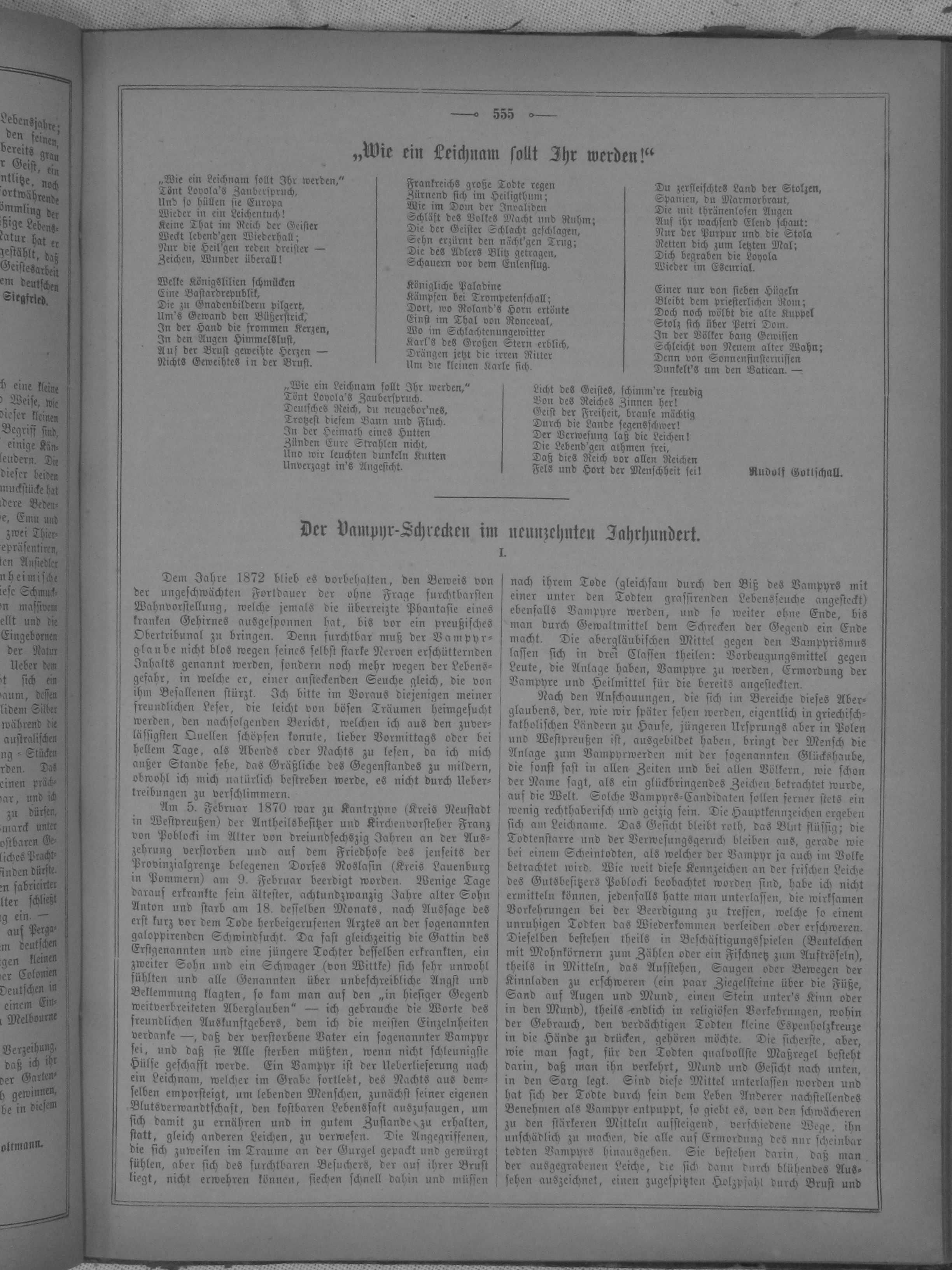
As we know, the vampire would not remain quiet despite the efforts of Empress Maria Theresa and the Enlightenment philosophers, and Equiamicus includes several interesting examples from the 19th and early 20th century of the ongoing belief in vampires or vampirelike revenants, including those from West Prussia in the 1870’s that are not particularly known in the English language vampire literature. All of them instances of beliefs and practices to protect the living from supposed vampires or revenants not too dissimilar from those that are known from other parts of Europe up to this day. Equiamicus even includes the weird ‘Highgate Vampire’ which is treated succinctly and soberly.

Some of these cases are only known through a few purported facts, whereas others can be supported by more detailed accounts. In several instances, Equiamicus shows his well-known expertise in digging up various old texts to illuminate the subject. He e.g. uses a contemporary article from a magazine called Die Gartenlaube to tell the story of a family from Kantrzyno who in February 1872 dug up the corpse of the family father, cut off his head and placed it face down at the corpse’s feet. This article can be read online here, and I can not help thinking that this would make for an interesting movie :-)

The chronology of vampire cases is then followed by a reasonably thorough review of the vampire debates from the 17th to the 20th century with emphasis on the ‘Leipziger Vampirdebatte’, von Görres and modern medical explanations, including Christian Reiter’s anthrax theory. Of particular interest here is also the couple of pages devoted to von Schertz’s Magia posthuma, which must make Equiamicus’s book the first one to deal with it since Calmet!

The rest of the book is devoted to the vampire in fairy tales and fiction, as well as some of the historical persons popularly related to the subject: Vlad Tepes, Elisabeth Bathory, Peter Kürten etc.

The book is illustrated throughout, mostly in black and white, but also including a section of colour photos, most illustrations being movie stills, including a fair number from Twilight. This seems to contradict the historical aim of the book, but will no doubt attract many younger readers. And honestly, if teenagers and other readers of popular vampire novels will be reading the book, and I think quite a few will – if only to dip into some of the interesting stories – quite a few people will become aware of the historical background to what has ended up as Dracula, Twilight and Buffy, and I think that is quite a laudable goal.

As with some of the best books on the subject, it is always a delight to read a book that is free of the Montague Summers tradition so prevalent in the literature until recently. Methodologically though, Equiamicus is first and foremost a collector of information on vampires, vampire cases and the vampire debates. His emphasis is on these subjects per se rather than on the broader historical context of the beliefs which is the focus of a number of historians (cf. academical anthologies like the Gespenster und Politik book and the Kakanien Revisited online collection of papers). But I am impressed by the lengths Equiamicus has gone to in order to read original documents and books. This means that there is something here for both the novice and the expert, and I must say that I have myself used it a few times to look up information. In my opinion it works well as both an introduction to the subject and as a reference book.

So if you have not bought it yet, do get hold of it. And if you know some young reader with a penchant for vampires, and who can read German, consider this as a gift. Even if the reader may only know a little German, why not give it anyway? There are many good reasons to learn to read German, and vampires is one of them, as the best books on the subject tend to written in that language. And Equiamicus's Vampire Von damals bis(s) heute should whet the appetite for anyone with an interest in vampires.

Sunday, 19 July 2009

Witchcraft Reader sans Klaniczay

I recently needed to quote Gabor Klaniczay’s paper on The decline of witches and the rise of vampires, and decided to refer to the edition in Darren Oldridge’s The Witchcraft Reader. I then found out that a second edition of this anthology of witchcraft papers was published in 2008, and that Klaniczay’s paper is no longer in it.

Having now had the chance to look at the second edition, I can see that Oldridge has not only replaced some of the papers in the first edition but has also thoroughly reworked the introductory texts. In particular, the general introduction has changed quite a lot, as Oldridge apparently no longer feels the need to explicitly distance current research from previous efforts like those of Margaret Murray or ‘reprints of eccentric but still popular publications like Montague Summers’ History of Witchcraft’. Instead he simply introduces the reader to ‘the magical beliefs that saturated pre-modern communities’ and ‘the interaction between ordinary people and educated demonologists and lawyers’, before confronting the present-centredness (‘the tendency to explain the past in terms that relate mainly to the present’) and moral judgements with which the subject is frequently approached.

Of particular interest here is part nine of the book, the one dealing with the decline of witchcraft. In the first edition it contained Brian P. Levack’s The decline of witchcraft prosecutions, Klaniczay’s paper, and Owen Davies’ Urbanization and the decline of witchcraft: An examination of London. In the new edition Klaniczay’s paper has been replaced by The decline of the witchcraft pamphlet by Marion Gibson and Witchcraft after the witch trials by Marijke Gijswijt-Hofstra. I suppose that by doing so, a more general picture of the decline is drawn than in the original.

This, however, means that the word ‘vampire’ no longer is in the book. Whatever one may think of Klaniczay’s theory – Peter Mario Kreuter reiterated his critique of it at the conference in Vienna – it has established a link between beliefs in witchcraft and revenants or posthumous magic, cf. e.g. the volume 5 of The Athlone History of Witchcraft and Magic in Europe, that might lead to more research on the connection. This link now is no longer evident from Oldridge’s anthology.

But there is plenty of interesting reading anyway, and I find it well worth quoting the view of 17th century witchcraft sceptic Friedrich Spee as mentioned by Oldridge in his general introduction: ‘the threat of appalling and secret conspiracies requires the highest standards of justice from those who seek to defeat them. If the crime ‘is difficult to prove then there is need for stronger, not weaker proofs’, and ‘if it is hidden and shrouded in shadows, then there is need for more light, not less, in order to illuminate it’.

Sunday, 12 July 2009

Some notes on the Conference on Vampirism and Magia Posthuma

So, finally, here are the notes on the conference on vampirism and magia posthuma in the discourse of the Habsburg monarchy in the 18th and 19th centuries I have promised you. As it is always difficult to provide a detailed account of the presentations at a conference, so I will simply highlight the themes and theories presented.

First of all, I would once again like to thank the organizers, Ursula Reber and Christoph Augustynowicz, for making the conference possible and for inviting me! It was an extraordinary experience to spend three days in the company of people who share this peculiar interest and who can speak with familiarity of Frombald, Glaser and Flückinger.

Held at the Institute for East European History which is located in the buildings of the former Alte Allgemeine Krankhaus (AKH) that now house the Viennese Unicampus, we were close to the Josephinum and Van Swieten Gasse. In fact, right outside the windows of the auditorium we could see the Narrenturm. All in all I think that around fifty people participated with a nucleus of some 25 participants, many of whom presented papers during the conference in sunny and hot Vienna.

The conference started on the evening of Thursday 2 July, when Christoph Augustynowicz, Ursula Reber and the head of the institute bid us welcome. I then spoke for about an hour about this blog: Why I started the blog, my approach to vampires, my search for the book Magia Posthuma, the blog itself, its visitors and the feedback I have received. I finished my talk with some information about von Schertz’s Magia Posthuma. The evening ended with a reception and a copious supply of food, beer and wine.

Next day Peter Mario Kreuter, author of Der Vampirglaube in Südosteuropa and currently at the Südost-Institute in Regensburg, compared the state of the interest in vampires to that of the unscientific attitude towards witch research until 1970s. He recommended that researchers should examine the original documents at the Hofkammerarchiv in Vienna. As for the use of the word vampire in the documents, he interpreted the differences in the use of the word from Frombald’s 1725 document (unfortunately only known in a copy) to Flückinger’s 1732 Visum et Repertum, and posed the theory that the term 'Vampyr' must have become well-known in the years following 1725, but that the cases of vampirism in the intermediate years apparently have not been documented.

The 18th century documents on vampires were also the focus of Christian Reiter, professor extraordinarius in forensic medicine, as he delivered an analysis of the Visum et Repertum from the point of view of forensic medicine. He convincingly argued that the epidemic in Medvedja in 1731-32 was caused by anthrax. Furthermore he concluded that Flückinger and co. had falsified their report concerning the corpses not in a ‘vampire state’ with the intent of obtaining remuneration for their examination of the corpses. Clearly a number of the participants wanted to exonerate Flückinger of this charge, but was unable to oppose the theory, so no doubt Reiter’s paper will be closely studied when published.


Another kind of documentation that is often taken as evidence of vampire beliefs are archaeological finds of human remains that appears to have been treated to prevent the deceased to harm the living. Author of Blutspuren: Die Geschichte der Vampire, Hagen Schaub, presented his thoughts on these finds, including the recent excavation in Venice. Overall his analysis left little or no positive evidence that any of these archaeological finds convincingly can be taken as proof of beliefs in vampires or similar revenants. Some of the interpretations of the archaeological evidence are just far too fantastic, and alternative explanations can not be ruled out. The verdict did not seem to surprise to anyone, but it was nice to hear a clear presentation of the various founds and the theories that are frequently claimed to support them as evidence of vampire beliefs.

The interpretation of human corpses were also the topic of Marco Frenschowski, protestant theologian and associate professor with an impressive knowledge of vampires and related subjects, as he spoke on various notions concerning incorruptibility, in particular from the point of view of various Christian churches, and their relation to ‘living corpses’.

As for other aspects of vampire beliefs, Christa Tuczay, lecturer and associate professor at the Institute for German Studies in Vienna as well as author of several books including this one, discussed various examples of nightmare entities, e.g. in the works of Philostratus, Füssli and Sacher-Masoch, and how they were perceived throughout particularly the 19th century. In the following discussion, Christian Reiter mentioned that the experiences related by victims of the “alptraum” could be explained as an asthmatic attack. Hans Richard Brittnacher should have talked on blood magic, but was unfortunately unable to attend.

The development of vampire or vampire related cases and tales, as well as of the term vampire, was the topic of several papers.

Clemens Ruthner, lecturer at Trinity College in Dublin, discussed Herbert Mayo’s fictionalization of Flückinger’s Visum et Repertum with an emphasis on the literary aspects of the version.

Thomas M. Bohn, professor in History of Eastern and Middle Europe at the University of Regensburg, in detail traced the interesting development of the original 1718 posthumous execution of Michael Kasparek in Lubló in present day Slovakia into various tales and interpretations, including that of a vampire ('ein Vorläufer der Serbischen Vampyrs, und von allen das abenteuerlichste dieser Spuckgespenster' according to in Georg Conrad Horst in his Zauber-Bibliothek). Apparently the story of Michael Kasparek has even inspired a Czecko-Slovak movie, Kisertet Lublon (1976).

Christoph Augustynowicz, professor extraordinarius at the University of Vienna, discussed the portrayal of vampires by Sacher-Masoch, Karl Emil Franzos and Bertha Pappenheim in the 19th century, and the views of Jews in Galicia in these texts.

Karin Barton, associate professor at Laurier University in Canada, is particularly interested in insects and their role in cultural history and literature, currently with emphasis on the flea. She presented a paper on The Habsburg Flea: Notes on the Cultural and Literary History of an Insect Vampire with numerous examples of how the flea has been presented in various media, including some that related it to vampires. Remarkably, she presented a source from 1866 that mentions the word 'nosferatu', a term otherwise usually perceived as constructed by Emily Gerard in her Transsylvanian Superstitions from 1885!


Ursula Reber spoke on Klaus Hamberger’s original thesis on vampires, and on Michel Serres’ La Légende des Anges. Apparently Hamberger, author of the seminal collection of source material Mortuus non mordet: Vampirismus 1689-1791 (1992), in his voluminous thesis wrote in a now obsolete discourse that makes it rather difficult to read today. The organizers had actually tried to contact Hamberger to invite him to the conference, but without being able to localize him. He probably is no longer interested in the subject, but there was a general consensus that a reprint of Mortuus non mordet is long overdue. (I was by the way relieved to find during the conference that I am not the only one who has had difficulty in reading volume 2 of Hamberger’s work on vampires: Über Vampirismus: Krankengeschichte und Deutungsmuster 1801-1899).

Sigrid Janisch, Ph.D. student in Vienna, talked about various definitions of vampires from 18th and 19th century encyclopedias, the subject of her Ph.D. work, and Bernhard Unterholzner, Master student in Munich, traced the vampire debates from 1732 and onwards.

Another aspect of the topic brought vampire beliefs into our present day as we were presented with two different kinds of field work on Balkan. Assistant professor for languages and cultures of the Balkan region, Thede Kahl, talked about his field work in Albania and Northern Greece, where he got about 200 tales about vampires, revenants and other entities. He discussed the various types and divided the tales into five narrative categories depending on how the narrator referred to a belief in vampires. The interesting findings will be published later this year.

Whereas the work of Kahl is that of an outsider investigating vampires in areas of Balkan, Vlado Vlacic, a student from Munich, has carried out his field work in the parts of Bosnia where he himself grew up. So Vlacic actually has first hand experience of vampire beliefs from his native community. He struggled somewhat with presenting the beliefs and their framework to us outsiders, as he apparently found it hard to put into words and terms the ‘silent’ knowledge he has grown up with. I think that many of us who were present hope that he overcomes his frustrations and keeps working on how to communicate to us the concrete vampire beliefs of Bosnia.

Obviously the conference touched upon various aspects of the subject, all of which contribute to a better understanding of vampire beliefs, their history and reception, as well as the development of the concept of a vampire into a metaphor and a fictional character that can be used for almost any purpose. For a detailed insight into the topics presented you must wait until the papers are published on the Kakanien Revisited web site. The plan is, however, that they will ultimately be published as a regular book.

Considering e.g. Stephanie Meyer’s current bestselling books, it is amazing that a topic that is so ‘hot’ in the popular media, attracts only a relatively limited number of scholars. Peter Mario Kreuter told us about an attempt at making a TV documentary series that presented the actual historical facts on vampires and other matters. Unfortunately, no one was willing to support the project, as you apparently have to compromise historical facts to highlight fictional vampires if you want to get in the media!

Originally Kreuter himself had to win money in a quiz show to be able to finance the publication of his book on vampires. Publishers apparently are not queuing up to publish this kind of book, but fortunately he is currently working on an updated edition of his book which will be published in English!

If we accept the parallel to witch research, we may hope that the research into vampires and other revenants will follow a route similar to that of witch research within the next couple of decades. The papers from this conference should contribute to that, and I hope that this blog in some way can also contribute to this end. Before the end of the conference there was some slight discussion of a future conference, and hopefully it will be possible to arrange one in a not too distant future!

I thank participants for good company and support, as well as for interesting presentations discussions. The conference also allowed me to visit a Heuriger with traditional food and wine on the outskirts of Vienna. And most curiously, I found out that Peter Mario Kreuter speaks Danish, so to my surprise I found myself talking in my native tongue a few times with this German authority on vampires!

Wednesday, 8 July 2009

Vampires found...

You will have to bear with me, as I have simply yet to find the time to write at more length on the conference in Vienna. In the meantime I may mention a magazine and a book that I found on my trip.

At the airport I stumbled on a special issue on vampires of the UK magazine SFX. It was pretty expensive as the Danish price is more than twice that of the original price (£7.99), but I thought I had better buy it now that I was on my way to spend a few days about vampires anyway :-)

The special issue comes with a poster, a set of Buffy coasters (!) and a book containing Le Fanu's Carmilla and Polidori's The Vampyre. The magazine itself contains mostly articles about vampire movies and TV series like True Blood and Twilight, but also Hammer's Dracula movies area featured, including a special on the making of The Legend of the Seven Golden Vampires. In a 'Top 50' of the greatest screen vampires of all time, Christopher Lee's count is only no 2, as one of the vampires (Spike) from the Buffy series is voted no 1 by readers of the magazine! There is even an interview with Elizabeth Miller on the genesis of Bram Stoker's Dracula, unfortunately marred by the interviewer's lack of knowledge of Austrian geography, as it is claimed that: 'Originally he was going to have the Count come from Astoria, not Transylvania.' In short, if you are into recent vampire fiction, you will probably find this magazine pretty entertaining.

Slightly more information on vampire beliefs can be found in a new coffee table book that I bought in Vienna: Transsylvanien im Reich von Dracula by Gerald Axelrod, appropriately printed in Leipzig. The major asset of this book is a large number of remarkably gloomy photos from various places in Romania, as the text itself probably will not surprise those familiar with the subject: A biography of Vlad Tepes, a relatively short chapter on Balkan vampire beliefs and a similarly short biography of Bram Stoker with emphasis on the origins of Dracula. At the end of the book a map of South Eastern Europe even has Medwegya marked in the mid 15th century. The short list of recommended reading mentions just two books on vampire beliefs, but certainly also two of the best books written on the subject: Peter Mario Kreuter's Der Vampirglaube in Südosteuropa, and Klaus Hamberger's Mortuus non mordet.

Wednesday, 22 October 2008

Another kind of heart eater

'Step into the world of your grandparents,' a Danish travel agency promises when advertising trips to Romania. Eating the heart of a dead man probably wasn't practised in the days of my grandparents, but that's another example of heart eating mentioned by Christa Tuczay in her book. I have actually posted about the incident she refers to, because it's the case of a suspected vampire in Marotinu de Sus in late 2003, but in my post I wrote that 'they cut up the corpse and removed the heart which they burnt at the cross roads.'

A later report on the incident was published in The Independent in October 2007, when Dr. Timothy Taylor recounted what happened when he visited the village and talked to an elderly villager who claimed to have witnessed the exhumation of other presumed vampires (strigoi). He told Taylor that 'The men took the heart, spiked aloft, to the crossroads outside the village. There they roasted it over a brazier and, as far as I could understand, stuffed glowing coals into the ventricles. Held up in the night sky, the heart shed charred flakes that were caught in a tea towel. These were taken to the niece's house [supposedly a victim of the vampire], ground up and mixed in a glass of water. "The niece drank it," Fifor [an anthropologist] confirmed, "and in the morning she said she felt better... in this way she was cured."'

Tuczay comments that according to Fifor the eating of the heart of a vampire is neither a well-known nor old Romanian remedy against strigoi.

Taylor, unfortunately, seems to subscribe to the improbable theory of Juan Gomez-Alonso that the vampire cases of the 17th and 18th centuries might have been caused by rabies. To quote Peter Mario Kreuter: 'Doch alle diese Versuche erwiesen sich als Fehlschläge, denn die Mediziner bedienten sich des Vampirglaubens als eine Art Steinbruch und pickten sich nur diejenigen Elemente des Volkglaubens heraus, die ihre Theorie zu stützen schienen, wobei sie oft noch nicht einmal zwischen Elementen des Volksglaubens und erfundenen Details der Belletristik sauber unterscheiden konnten.' (Der Vampirglaube in Südosteuropa, p. 12-13)

Below is the last part of the True Blood episode about vampires including footage from Marotinu de Sus as found on youtube. As mentioned in my old post, the series is available on DVD.

Friday, 15 August 2008

Kakanien Revisited

The Kakanien Revisited web site referred to in my previous post contains some excellent articles and a bibliography (which I have previously linked to). All of them are in German, so I can only suggest that those of you who are interested in the subject and are unable to understand this language, should consider studying the language :-)

Sexualität Macht Tod: Prolegomena zu einer Literaturgeschichte des Vampirismus by Clemens Ruthner, 'sketches, how the vampire has turned from a blood-sucking ghost of (South-)Easteuropean folklore into a popular myth especially in Westeuropean literature/s and culture/s. Since there is only little scholarly work done about the vampire in German literature, this article will focus especially on texts in this language which played an important role as a "transmitter" in the cultural transfer of vampirism from the (South-)East to the West.'

It says that this paper is 'meant as the outline of an exhaustive monograph on vampirism in German literature the author is working on,' but unfortunately I can't remember having seen any mention of this promising monograph so far.

The other contributions, Der Vampir, ein Fremder? Ethnische Minderheiten im Vampirglauben Südosteuropas by Peter Mario Kreuter, "Trag mich nach Südamerika". Schauplätze der osteuropäischen Vampirliteratur des 19. Jahrhunderts und ihre Konnotationen by Christoph Augustynowicz, and Süd/Osteuropäer als Vampire: Draculas Karriere vom blutrünstigen Tyrannen zum mythischen Blutsauger. Prolegomena zu einer Literaturgeschichte des Vampirismus II by Clemens Ruthner focus on e.g. the fictional aspects of the topic.

Finally, Forschungsliteratur: Vampirismus. Kommentierte interdisziplinäre Auswahlbibliografie is a comprehensive and annotated bibliography on the subject. This bibliography was updated for the anthology Poetische Wiedergänger edited by Julia Bertschik and Christa Agnes Tuczay.

Thursday, 27 December 2007

Worth longing for?

When looking at ebay, one German book keeps popping up numerous times. I have so far resisted buying it, but it keeps turning up so I have considered buying it: Norbert Borrmann's Vampirismus oder die Sehnsucht nacht Unsterblichkeit (Vampirism or the longing for immortality). So why have I resisted? Well, Peter Mario Kreuter in his Der Vampirglaube in Südosteuropa calls it "einfach nur eine literarische Gemischtwarenhandlung" (simply just a literary mixed bag), and adds: "Bei der Lektüre dieses Buches muß man sich manchmal sogar fragen, ob Borrmann überhaupt verstanden hat, über was er da schreibt." (While reading this book one must often ask if Borrmann has at all understood what it is he is writing about). On the other hand, Rob Brautigam writes of the book on his Shroudeater web site: "This nice hardbound book was published at such a ridiculously low price that I was afraid that the quality of its contents would be of the same low level. I was wrong. Norbert Borrmann presents us with an interesting overview of Vampirism in which most vampire aspects seem to get a mention.". So, perhaps, it is not as bad as Kreuter would have us believe? Comments are welcome.

Sunday, 11 November 2007

Peter Mario Kreuter talks about vampires

Peter Mario Kreuter, author of Der Vampirglaube in Südosteuropa (Weidler Buchverlag, 2001), can be seen lecturing about vampires (in German, of course) here. You can e.g. hear how he got into researching vampires and he also discusses the question of blood drinking/blood sucking. So if you understand German, this is an interesting opportunity to experience Kreuter "live".

The video is from 2004, so this is "old news", but still interesting.

Saturday, 1 September 2007

Wickedness

I recently posted about the book Vampires: Myths and Metaphors of Enduring Evil. The papers in that book were compiled from the contributions to a conference on vampires arranged in Budapest in May 2003. Since that annual conferences on a theme called Monsters and the Monstrous have been arranged. More information is available at the web site of this academic project, wickedness.net. Looking at the archives from the conferences it is obvious that not much has been said on the subject of this blog since the first conference in 2003. Later this month, on September 17-20, it is time for the 2007 conference, and at some time the program will probably be available on the web site. Peter Mario Kreuter, author of Der Vampirglaube in Südosteuropa, is a member of the steering group.

Wednesday, 1 August 2007

The Historical Context of Vampire Beliefs

I have written a few posts (The rationality of the strange past, Strange cover and Strange Histories) about Darren Oldridge's book Strange Histories, and I have mentioned that Oldridge refers to the Medvedja vampire case from 1732. He elaborates a bit on this subject in his contribution to an anthology called Vampires: Myths and Metaphors of Enduring Evil edited by Peter Day and published by Rodopi, Amsterdam, in 2006. The text is pretty short, just 11 pages, and is entitled "Dead Man Walking": The Historical Context of Vampire Beliefs.

Here Oldridge again discusses the historical construction of belief, as he asks the question: "If perfectly rational, well-educated people could accept the existence of roaming corpses three hundred years ago, why is the same idea inconceivable today?" To answer this question, he borrows the concept of a system of belief from the antropologist Clifford Geertz: "the framework of beliefs, expressive symbols, and values in terms of which individuals define their world, express their feelings, and make their judgments." As a system of belief constitutes the framework within which the facts of the world are perceived, and as it also changes over time, our concept of rationality and "common sense" will change depending on our "historically defined standards of judgments." Oldridge gives a number of examples and also shows how certain phenomena can be either interpreted within a framework where the existence of revenants is accepted or within the framework of scientific medicine, where they are not.

As for our own 21st century system of belief, Oldridge puts it like this: "We live in a culture that does not permit corpses to stir; and this basic assumption has condemned vampires to the realm of fiction."

I'm pretty surprised to find that Oldridge states that in the Medvedja vampire case, "the doctors concluded that several of the bodies [of suspected vampires] posed a threat to the living," as I don't remember a statement of this kind in the Visum & Repertum report. The military doctors (if we can call them doctors?) were certainly surprised by the apparently uncorrupted state of the bodies, but in my opinion they did not agree with the local people on the reality of the revenants.

Considering the sleep paralysis which is the term frequently used to describe the state of supposed victims of e.g. vampires, Oldridge writes that 'sufferers also report visual hallucinations, often in the form of a threatening figure standing at their bedside,' a phenomenon that would seem to be better described by a 'system of belief' within which such figures exist, than by the 'system of belief' of modern medicine. Oldridge doesn't discuss this interesting aspect, but as he says:

"The point of these observations is not to 'explain away' vampire beliefs in terms of modern science. On the contrary, it is to suggest that prior assumptions often determine our understanding of what we see. (...) In a world that believes in demons, 'the hag' presents clear evidence of their power; in a society that does not, it needs to be explained in terms of other acceptable ideas, such as the psychology of sleep disorders. The social construction of belief is most obvious when we step outside our own culture."

The book contains a couple of other contributions that may be of interest to readers of this blog, in particular Peter Mario Kreuter's The Name of the Vampire: Some Reflections on Current Linguistic Theories on the Etymology of the Word Vampire. There is also a nice and short overview of the genesis of Bram Stoker's Dracula by Elizabeth Miller.


I couldn't resist showing the above scene from Mario Bava's Italian horror film Operazione paura from 1966 (in English known under various titles like Curse of the Living Dead and Kill Baby Kill). Curiosly, in this film the local people do not want the bodies of the dead disinterred, in fact, they don't even want to discuss the subject for fear of the revenant of a little girl that haunts the place. As you can see, the authorities and men of modernity, including the doctor at the left who has been called upon to examine the bodies, discuss the system of belief of the local people. As outsiders they meet the local people in a way similar to how we read the 'strange histories' of the past, but as it goes, the good doctor can not escape the terrifying 'system of belief' that determines how the local people live and act.

Saturday, 12 May 2007

Languages and barriers

Gustav Henningsen and Bengt Ankarloo introduce their 1987 anthology on witchcraft, Häxornas Europa 1400-1700 (English translation 1990: Early Modern European Witchcraft, Oxford Univ. Press), by pointing out that:

"The study of early modern European witchcraft has to a great extent been the domain of English and American scholars, and this has affected our general understanding and formulation of problems. Some of the questions in the current debate are simply wrong or have to be redefined because they were raised from an oblique, Anglo-Saxon angle." (p. 1)

Certainly, much of what has been published on vampires during the past hundred years has been dominated by English speaking authors as well. This may have been because of the success of Bram Stoker's Dracula and the subsequent adaptations in various media, but the two volumes by Montague Summers on vampires have also played a key role in establishing the route the literature on vampires has followed during several decades.

Nowadays most of the literature on vampires in the English language seems to focus on either the fictional vampire or the vampire as part of popular culture in general. The vampires of folklore and mythology are usually referred to, but even in longer treatments of the subject the course of attack generally goes along the lines set out by Montague Summers.

However, unlike Summers it is usually quite obvious that most authors and scholars from Great Britain or U.S.A. have not studied the source material in the original languages, but in many cases just copy e.g. Summers, even including his errors. One of the reasons is of course that many authors on the subject patently can not read German. Curiously enough, even if a scholar can read the original, there can be a language barrier.


This is illustrated by reading how Paul Barber characterizes the 1732 Visum et Repertum about the vampire case at the Serbian village Medvedja in his book Vampires, Burial, and Death: Folklore and Reality (Yale Univ. Press, 1988). He writes that it is "a curious document", and continues:

“Hardly a literary masterpiece, it has seldom made its way in complete form into English-language books on the vampire, and this may be because it is difficult to translate: the language is stilted, the author is indifferent to questions of grammatical parallelism, and several versions are extant, each of which, incidentally, gives a different spelling of the author’s name, the most innovative of which (Clickstenger) is to be found in the English translation of Calmet.” (p. 15)

The opposite verdict on the text is offered by the German historian Peter Mario Kreuter in his thesis on the South East European vampire, Der Vampirglaube in Südosteuropa (Weidler Buchverlag, 2001). He writes that the report is “gut formuliert und logisch im Aufbau,” i.e.: “well formulated and logical in construction”.

So obviously the familiarity with the German language greatly affects how the two scholars view the document.

It is quite patent from many other books, that the authors have very little knowledge of the historical, geographical or ethnic context of the vampire cases. In general, in most popular works on the subject there is usually no attempt at establishing a credible connection between the vampire cases and their context, no doubt because the aim is rather to entertain and frighten than to try to understand by asking the essential questions: What happened and why?

Fortunately, a number of Continental scholars and authors are attempting to answer these questions, and with the general integration of those South and East European countries where the Magia Posthuma was observed, hopefully other barriers for our understanding are overcome. It is my hope that this blog can be of some service in this process.
Related Posts Plugin for WordPress, Blogger...