Showing posts with label Aribert Schroeder. Show all posts

Saturday, 5 January 2013

A terrible incident ...

The fourth annual edition of Austria, an Austrian universal calendar or almanac for the year 1843, contains a wealth of information for erudition and entertainment, including a short article on vampires by one J. P. Kaltenbaeck. The main part of this short article reproduces the text of a leaflet from 1725 entitled Entsetzliche Begebenheit, welche sich in dem Dorff Kisolova, ohnweit Belgrad in der Ober-Ungarn, von einigen Tagen zugetragen, published without a place of printing.

The text itself is not identical with, but overall very close to the version of Frombald's report from Kisiljevo reprinted in the Wienerisches Diarium on July 21 1725. As the Diarium was closely connected to the Viennese court, one would suppose that the report was first published in the Diarium and then made available as a flyer or leaflet, even though the title of the flyer claims that the incident happened only days before the printing.

Copies of such flyers are usually pretty scarce, as Kaltenbaech himself also notes: 'Der folgende Bericht ist einem fliegenden Blatte entnommen, das wohl jetzt zu den Seltenheiten gehören dürfte.' Personally, I cannot recall seeing any more recent writer dealing it with more than its title - until I was recently contacted by a reader of this blog, who kindly told me of an item that a Scottish dealer of antiquarian books had for sale a couple of years ago:

Kayserl Provisor in Gradicker District.: Entsetzliche Begebenheit, welche sich in dem Dorff Kisolova ohnweit Belgard in Ober-Ungarn vor einigen Tagen zugertragen. 1725. n.p., n.d. single sheet folded , pp.4, 20 x 16 cms., Gothic type , sl. worn at edges and with a few small marginal tears not affecting text, light age staining. Not noted in Caillet and not traced in any major search engine. Concerns the celebrated case of Peter Plogojowitz, an alleged vampire. See Paul Barber : Vampires, Burial, and Death. pp.5-9

And the price? £350.

I contacted the dealer who informed me that it had been bought by another dealer, and he was unable to tell me anything about its whereabouts. So either that other dealer has sold it on, probably at a price substantially higher than £350, or it awaits a buyer somewhere willing to part with a nice sum.


Apart from the leaflet, Frombald's report appears to have attracted only limited interest. It was reprinted in  the so-called Breslauische Sammlungen under the title 'Abentheuerliche Begebenheit mit einem vermeyntlich wieder gekommenen Todten' where it is noted that it is taken from the public gazettes in Holstein: 'in den öffentlichen Holsteinischen Gazetten', but no one seems to have identified these periodicals or perhaps flyers. Apart from discussing the substance of the report itself, Michael Ranft's De masticatione mortuorum in tumulis is dealt with. Ranft himself was himself inspired by the report from Kisiljevo to write his dissertation, as he read of it in a Leipzig journal, cf. e.g. Aribert Schroeder's Vampirismus from 1973.

Monday, 13 June 2011

Vampyres according to an English Gentleman and a German Director

One of the most frequently quoted descriptions of vampires in English is referred to as a translation from a dissertation on vampires published in Duisburg in 1733, the only German book on vampires written and published in this part of German territory. The original translation of the description is found in an anonymous manuscript, The Travels of three Gentlemen, from Venice to Hamburgh, being the grand Tour of Germany, in the Year 1734, first published in volume IV of The Harleian Miscellany: A Collection of Scarce, Curious, and Entertaining Pamphlets and Tracts, as well in Manuscript as in Print in 1745, and continued in the subsequent volume.

When in Lubljana in Slovenia, the author mentions Valvasor: 'All persons of taste and learning in Carniola have in high esteem the piece of Baron Valvasor, intitled 'Gloria Ducatus Carniolæ,' which, they say, is wrote with the utmost truth, accuracy, and exactness.'

The landlord of the three gentlemen, 'a cheerful agreeable person, and a man of very good sense and understanding,' 'seemed to pay some regard to what Baron Valvasor has related of the Vampyres, said to infest some parts of this country'. In this connection, the author mentions a dissertation upon vampires written by the director of the gymnasium in Essen in Germany, M. Jo. Henr. Zopfius, 'from whence we shall beg leave to transcribe the following paragraph'.

This paragraph is quoted in various books and on many web sites, but it may be worthwhile to quote it in toto:

'The Vampyres, which come out of the graves in the night-time, rush upon people sleeping in their beds, suck out all their blood, and destroy them. They attack men, women, and children; sparing neither age nor sex. The people, attacked by them, complain of suffocation, and a great interception of spirits; after which, they soon expire. Some of them, being asked, at the point of death, what is the matter with them? say they suffer in the manner just related from people lately dead, or rather the spectres of those people; upon which, their bodies (from the description given of them, by the sick person,) being dug out of the graves, appear in all parts, as the nostrils, cheeks, breast, mouth, &c. turgid and full of blood. Their countenances are fresh and ruddy; and their nails, as well as hair, very much grown. And, though they have been much longer dead than many other bodies, which are perfectly putrified, notthe least mark of corruption is visible upon them. Those who are destroyed by them, after their death, become Vampyres; so that, to prevent so spreading an evil, it is found requisite to drive a stake through the dead body, from whence, on this occasion, the blood flows as if the person was alive. Sometimes the body is dug out of the grave, and burnt to ashes; upon which, all disturbances cease. The Hungarians call these spectre Pamgri, and the Servians, Vampyres; but the etymon or reason of these names is not known.'

Montague Summers quotes the passage in his 1929 The Vampire in Europe, but one year earlier, on the first page of the first chapter of The Vampire: His Kith and Kin, this is how he quotes Zopf(ius):

'Vampires issue forth from their graves in the night, attack people sleeping quitely in their beds, suck out all their blood from their bodies and destroy them. They beset men, women and children alike, sparing neither age nor sex. Those who are under the fatal malignity of their influence, complain of suffocation and a total deficiency of spirits, after which they soon expire. Some who, when at the point of death, have been asked if they can tell what is causing their decease, reply that such and such persons, lately dead, have arisen from the tomb to torment and torture them.'


Not being satisfied with just quoting either of these English translations (or transcriptions?), I have looked up what the director of the gymnasium in Essen actually wrote. Zopf's Dissertatio de Vampyris Serviensibus consists of 27 pages written in Latin, and when you start looking for a text like the ones in English, you find that it is actually adapted from two bits of text on pp. 6-7.

On page 6, the dissertation is introduced with some comments on the word 'vampire', which includes this passage:

Apud Hungaros etiam PAMGRI audiunt, cuius de vocabuli notione atque etymo non magis constat, quam de obscuro Vampyrorum nomine. Germanico idiomate dici solent Todten-Freßer/Blut-Sauger/vulgoque habentur pro hominum defunctorum spectris, quæ nocte intempesta de sepulcris prodeant, in dormientes insiliant, & sanguine exhaustos, leto tradant.'

It is the last sentence that refers to the spectres of dead people, who come forth from their graves at the dead of night, throw themselves upon sleeping people, and leave them to die, drained of blood.

The main description of vampires and their characteristics than be found as § III on page 7:

'Ex iis relationibus, quae de Vampyris Seruiensibus adhuc emanarunt in vulgus, haec potissimum phaenomena nobis innotuerunt: tradunt nimirum (1) apparere in Seruia, praesertim in pago Medvedia, non procul Beraxino, spectra personarum, quae paucis ante diebus, septimanis, mensibus, e vita discesserint; (2) spectra isthaec adoriri homines vtriusque sexus, neque etiam infantibus parcere; (3) personas ab eiusmodi incubis infestatas, de suffocatione & spiritus interceptione grauiter conqueri, ac breui post exspirare; (4) rogatos a suis moribundos, ecquid malae rei ipsis acciderit, a spectro hominis nuper defuncti sibi illatum, profiteri; (5) quo facto cadauer personae a moribundo designatae e sepulcro effodi, in quo crudus adhuc vigor, capilli vnguesque recens prognati, nares, bucca, pectus, ventriculus, & reliqua corporis vasa, recenti sanguine turgida deprehendantur, cumque alii post eos extincti iam putrescant, in his ne minimam corruptionis notam conspici; (6) eos, qui ab eiusmodi Vampyris necentur, eandem post fata naturam induere, atque alios pari leto adficere; (7) quod ne latius malum serpat, hominis enecti praecordia palo transfigi praeacuto, vnde cruor largus, quasi ab homine viuo, profluat; (8) saepe cadauer e sepulcro erui, rogoque impositum in cineres redigi, quo ipso malum sopiatur.'

In short, the English translations are close to the original text, but not literal. Also, if you take a look at the beginning of the previous paragraph, you can see that both the anonymous gentleman and Summers chose to omit the reference to Medvedja ('Medvedia') in Serbia.

Michael Ranft was not happy with Zopf's dissertation and his idea of a 'contagium quoddam magicum', a kind of magical contagious disease. As translated into German in Klaus Hamberger's Mortuus non mordet:

'Es scheint uns nicht völlig unwahrscheinlich, daß die ganze Vampyrpest bei Serben und anderen in einere magischen Ansteckung (contagium magicum) besteht, die nach dem gerechten Ratschluß Gottes die Bewohner jener Gegend heimsucht. Wir sagen Ansteckung, weil sie sich gleich einer Seuche weiter ausbreitet und mit ihrem Anhauch nicht nur einzelne Mesnchen, sondern ganze Familien infiziert und ausrottet; und wir nennen sie magisch, weil der Teufel sein Wirken unter die Kräfte der Natur mischt, und so einige widernatürliche Effekte erzielt.' (p. 204)

As for the three gentlemen, I have referred to the author of the manuscript as the anonymous gentleman. Aribert Schroeder in his Vampirismus: Seine Entwicklung vom Thema zum Motiv from 1973 discusses the identity of the anonymous gentleman at length and identifies three persons as possible matches: The astronomer James Bradley, the botanist Johann-Jakob Dillenius, and the physician Frank Nicholls. However, a paper from 1999 by T. Shaw, John Swinton, F.R.S., identified as the author of a 1734 travel journal, identifies the author as John Swinton, whose entry in the wikipedia succinctly says:

John Swinton (1703–1777) was a British writer, academic, Fellow of the Royal Society, Church of England clergyman and orientalist. In 1731 he was a fellow of Wadham College, Oxford, but migrated to Christ Church in 1745. He contributed to George Sale's Universal History. Swinton also contributed articles on the transcription of the 'Ruins of Palmyra'. Beginning in 1749, Swinton donated a number of Roman coins to the collection at Christ Church. From 1767 until the year of his death he was Keeper of the Archives at Oxford University.

As Schroeder remarks, the English gentleman (the Rev. John Swinton, apparently) probably could not read most of the books on vampires, because they were written in German. For that reason he referred to Zopf's dissertation in Latin, and his transcription and the later adaption by Montague Summers made Zopf a household name of vampire books and web sites in English.

Johann Heinrich Zopf himself was born in 1691 and died in 1774, and you can easily find biographical info like this, as well as a number of books by him on the internet.


Friday, 18 March 2011

Aribert Schroeder

I recently noticed the above copy of Aribert Schroeder's study Vampirismus: Seine Entwicklung vom Thema zum Motiv from 1973 on German ebay and decided to buy it. I was a bit surprised on receiving it to find that the introduction and most of the chapter on the vampire superstition as a problem of folklore and semantics are full of writing as well as various crosses and deletions. To me it looks as if someone has been editing the text for some purpose, maybe even the author himself. See the photo below for an example.

As for Schroeder, I have only seen one other book containing a text written by him: Der Krieg der Bilder: Ausgewählte Dokumentarfilme zum Zweiten Weltkrieg und zum Vietnamkrieg edited by Barchet, Diedrich and Hölbling and published by WVT Wissenschaftlicher Verlag Trier in in 1993. It contains a paper by Schroeder called The Burden of the War in Vietnam Was on the Grasshoppers and Not the Elephants: David Bradbury's Front Line (1979). I.e. the paper concerns a documentary about a cameraman and journalist who had worked in Vietnam (if you are curious, watch this video).

The book has this to say about Schroeder:

'Aribert Schroeder, Dr.phil., M.A., Oberstudienrat am Anglistischen Institut der Universität Düsseldorf, studierte Anglistik und Geschichtswissenschaft an den Universitäten Köln und Bonn sowie an der Bucknell University, Lewisburg, PA; 1985/86 Austauschprofessor am English Department der San José State University, San José, CA. Forschungsschwerpunkte: Die Literatur U.S.-amerikanischer ethnischer Minderheiten; die Verstehensproblematik bezogen auf fremdsprachliche Texte; Medienwissenschaft. Veröffentlichungen und Rezensionen in den Schwerpunkten.'

Obviously Schroeder moved on to other subjects after rummaging archives and libraries in search of vampires.

Sunday, 6 March 2011

A Vampire Chronology: Von damals bis(s) heute


Although, as I stated recently, changes in my personal life should allow me more time for this blog, and although I have promised to review this book, it has taken me some time to go back to my notes and finish the review I had started writing a couple of months ago. I apologize to the author and anyone else who have been curious to read my comments.

I suppose that over the past few decades the books by Klaus Hamberger, Peter Mario Kreuter, and Hagen Schaub have been the most comprehensive collections of information on vampires. Hamberger, of course, has the advantage that his first volume is an anthology of source texts, whereas Kreuter and Schaub present the vampire in the context of e.g. folklore and archaeology. More recently, Florian Kührer has written succinctly on the whole vampire phenomenon, and we have, of course, the specialist study by Aribert Schroeder from 1973 which, however, lacks the reprints of key texts available in Hamberger’s volume.

Now we can add Nicolaus Equiamicus to the list of authors who provide us with a useful resource for information on vampires. The backbone of the Nicolaus his recent book Vampire Von damals bis(s) heute (U Books, 288 pages, 14.95 €) is a chronological account of vampires based on a great number of sources. This chronology constitutes the first part of the book: ‘Der historische Vampirismus’, which is actually more than half the book.

Beginning with classical antiquity, we are introduced to some of the well-known texts on lamiae and empusae, as well as some information on related entities: the Alb and the Nachtmahr. Various types of revenants are dealt with, including the Nachzehrer, and also regional variants are described, partially based on Bernhard Stern’s Medizin, Aberglaube und Geschlechtsleben in der Türkei (1903). Finally, the scene is set for the famous vampire cases of the 18th century: Serbia 300 years ago: ‘Krieg und Elend – das Leben vor 300 Jahren in Serbien’. Equiamicus treats the cases in detail and follows them up with various other examples from contemporary and recent literature with particular emphasis on the two important cases from the 1750’s in Kapnick and Hermersdorf, respectively.

As we know, the vampire would not remain quiet despite the efforts of Empress Maria Theresa and the Enlightenment philosophers, and Equiamicus includes several interesting examples from the 19th and early 20th century of the ongoing belief in vampires or vampirelike revenants, including those from West Prussia in the 1870’s that are not particularly known in the English language vampire literature. All of them instances of beliefs and practices to protect the living from supposed vampires or revenants not too dissimilar from those that are known from other parts of Europe up to this day. Equiamicus even includes the weird ‘Highgate Vampire’ which is treated succinctly and soberly.

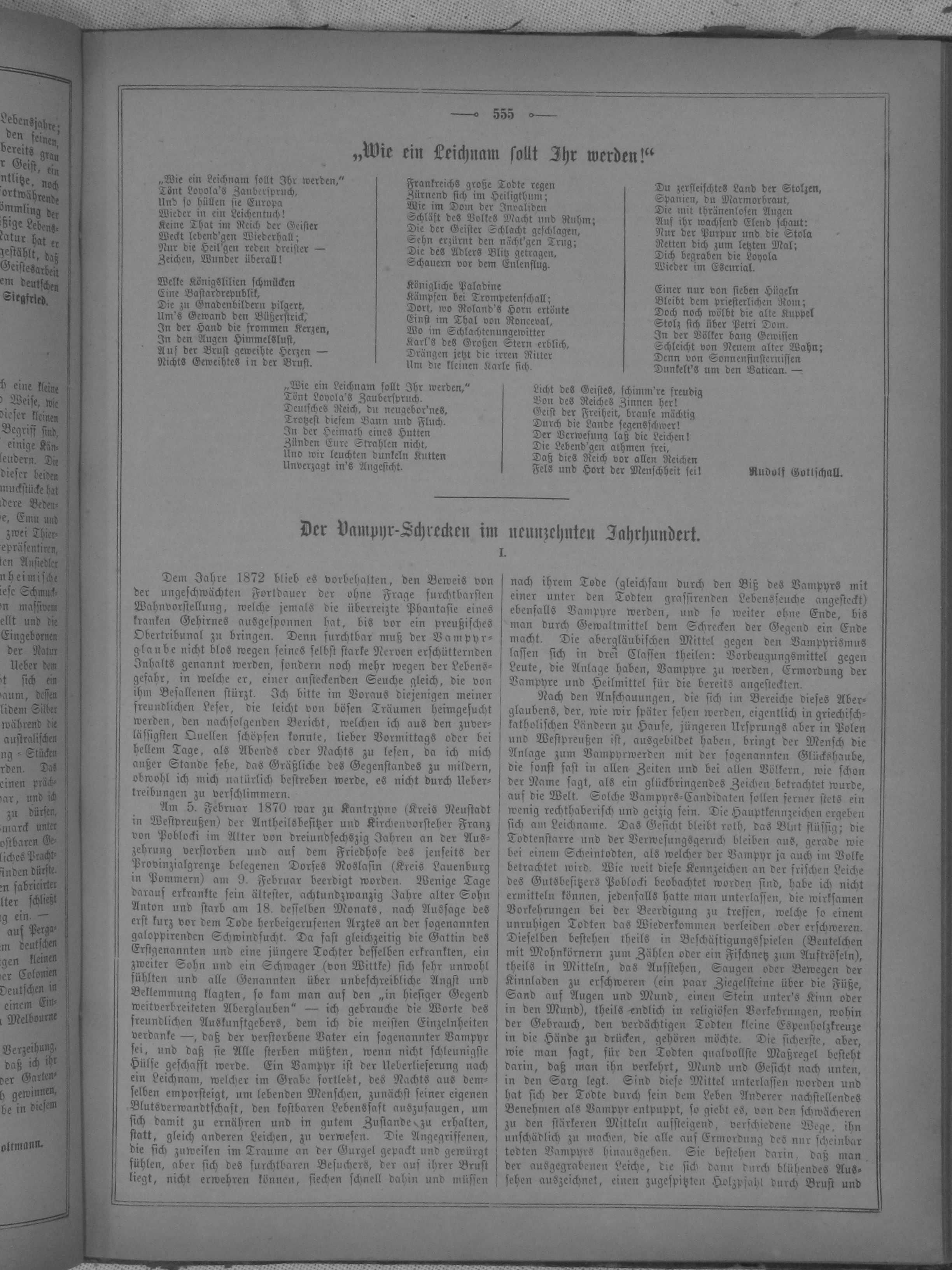
Some of these cases are only known through a few purported facts, whereas others can be supported by more detailed accounts. In several instances, Equiamicus shows his well-known expertise in digging up various old texts to illuminate the subject. He e.g. uses a contemporary article from a magazine called Die Gartenlaube to tell the story of a family from Kantrzyno who in February 1872 dug up the corpse of the family father, cut off his head and placed it face down at the corpse’s feet. This article can be read online here, and I can not help thinking that this would make for an interesting movie :-)

The chronology of vampire cases is then followed by a reasonably thorough review of the vampire debates from the 17th to the 20th century with emphasis on the ‘Leipziger Vampirdebatte’, von Görres and modern medical explanations, including Christian Reiter’s anthrax theory. Of particular interest here is also the couple of pages devoted to von Schertz’s Magia posthuma, which must make Equiamicus’s book the first one to deal with it since Calmet!

The rest of the book is devoted to the vampire in fairy tales and fiction, as well as some of the historical persons popularly related to the subject: Vlad Tepes, Elisabeth Bathory, Peter Kürten etc.

The book is illustrated throughout, mostly in black and white, but also including a section of colour photos, most illustrations being movie stills, including a fair number from Twilight. This seems to contradict the historical aim of the book, but will no doubt attract many younger readers. And honestly, if teenagers and other readers of popular vampire novels will be reading the book, and I think quite a few will – if only to dip into some of the interesting stories – quite a few people will become aware of the historical background to what has ended up as Dracula, Twilight and Buffy, and I think that is quite a laudable goal.

As with some of the best books on the subject, it is always a delight to read a book that is free of the Montague Summers tradition so prevalent in the literature until recently. Methodologically though, Equiamicus is first and foremost a collector of information on vampires, vampire cases and the vampire debates. His emphasis is on these subjects per se rather than on the broader historical context of the beliefs which is the focus of a number of historians (cf. academical anthologies like the Gespenster und Politik book and the Kakanien Revisited online collection of papers). But I am impressed by the lengths Equiamicus has gone to in order to read original documents and books. This means that there is something here for both the novice and the expert, and I must say that I have myself used it a few times to look up information. In my opinion it works well as both an introduction to the subject and as a reference book.

So if you have not bought it yet, do get hold of it. And if you know some young reader with a penchant for vampires, and who can read German, consider this as a gift. Even if the reader may only know a little German, why not give it anyway? There are many good reasons to learn to read German, and vampires is one of them, as the best books on the subject tend to written in that language. And Equiamicus's Vampire Von damals bis(s) heute should whet the appetite for anyone with an interest in vampires.

Sunday, 31 October 2010

Another Halloween

I find that I rarely get around to writing blog posts because other activities tend to take up a lot of my time. But I just received an e-mail from someone who had found this blog because of a search inspired by Halloween, so I thought I would just post of a photo of the pumpkin head I made from this year's harvest in my own garden.

I have a few blog posts that I have left unfinished, e.g. one regarding the new digital books, like Calmet's Phantom World which is easily available for Kindle on a smartphone as seen in the photo above.

In the photo below are three pretty rare vampire books that took me some time to get hold of: Otto Steiner's Vampirleichen: Vampirprozesse in Preussen (1959), Aribert Schroeder's Vampirismus (1973), and Tony Faivre's Les Vampires (1962). Who knows, with the advent of e-books, they will perhaps be accessible for next to nothing on a phone, Kindle or iPad?

Related Posts Plugin for WordPress, Blogger...