Showing posts with label Montague Summers. Show all posts

Saturday, 3 January 2015

A disinterested appraisal of Summers-ism

Back in 2011, I wrote two posts on ’a critical edition’ of Montague Summers’s The Vampire: His Kith and Kin edited by John Edgar Browning: A sustained study in projection and A Delayed Demonologist. These posts allowed me to once and for all collect some of the assessments that have been made of Summers’s work on ’the subject of witchcraft’, which includes the books on vampires and werewolves.

Recently, The Apocryphile Press has published The Vampire in Europe: A Critical Edition, once again edited by Browning, who in his preface remarks on the mission of these critical editions: ’Our approach, as literary critic Maurice Hindle noted after the fact, was instead a ”disinterested appraisal,” one aimed at re-visiting a familiar yet widely unexplored work with renewed perspective and interest in order that we may situate the book and its author in their historical context.’

I think that I have stated my mind on the matter in the aforementioned posts, but I am also happy to note that the new book does in fact include voices that comment on the style and contents of Summers’s work, because Browning has included excerpts from original reviews of The Vampire in Europe, both from 1929 when it was originally published and from 1960 onwards when it was reprinted.


Thus, according to a reviewer in The Yorkshire Post and Leeds Intelligencer on November 27, 1929, Summers’s ’new book, like its predecessor, ”The Vampire: His Kith and Kin,” reveals an astonishing learning hand-in-hand with an utter neglect of scientific method or knowledge,’ while August Derleth in 1962 similarly notes that ’The Vampire in Europe is a curious work, a volume of pseudo-scholarship written with a fascinating air of authority, offering between two covers a great deal of the lore Dr. Summers assembled from various sources.’

Reviewing the reprint in The Catholic Historical Review the following year, Ruth B. Dinbergs finds that: ’Much interesting material is included in this monograph, but it is presented in a dispersed and unsystematic way. The book seems written in haste. Legends and tales are related which show only the vaguest connection with vampirism as defined in this work. The book is divided into chapters according to countries, yet the author does not stay consistently within these confines. The numerous notes following each chapter testify to the broad erudition of the author, but it is frequently difficult to judge where notes begin and the text leaves off.’

A more in-depth review of Summers’s approach to the subject and his use and neglect of sources was undertaken by Gustave Leopold Van Roosbroeck of Columbia University in The Romanic Review in 1930. He mentions several sources that Summers has neglected, while at the same time he criticizes the sources that Summers does actually take into account, before stating that: ’This study seems to rest on a vague notion of the meaning of Vamprism. It is impossible to explain, for instance, the inclusion (with an illustration) of Huysmans’ Black Mass from À Rebours among vampire lore, when it is evidently a case of devil-worship; the illustrations from Goya’s Los Caæprichos deal with the Sabbath and witchcraft, and not with vampires; and it is strange to find a description of popular superstition from D’Annunzio’s Trionfo della Morte in this miscellaneous collection. With this lack of discrimination, the author could have included the entire history of witchcraft and half of folklore.’

Bringing it up to our day, Carol A. Senf in her afterword characterizes Summers's work along the same line as the just quoted reviewers:

’Summers moves casually from the ancient world to the medieval and from one part of the globe to another, cavalierly mising legends, literature, and folktales and treating even the most improbable cases with total seriousness. The experience is a bit like listening to a garrulous old uncle who interrupts himself and moves cavalierly from one story to the next, not stopping to take breaths between anecdotes.

His organization is equally eccentric. Even though his table of contents suggests that he is organizing his cases geographically, they are actually a hodge-podge of materials collected from literature, folklore, and personal anecdote.'

Adding that ’despite my criticism of his organization and his aesthetics, I was (and am) grateful for Summer’s research,’ she states exactly that ambivalence that many people have with regards to Summers: On the one hand, he is an unrealiable and inconsistent researcher, on the other he can be fascinating to read, and for a long time he was probably the main, if not sole, source for information on vampires and related subjects.

This ambivalence was nicely phrased by Marco Frenschkowski, as I mentioned in a post in 2013, that many of the scholars who denounce Summers’s books on witchcraft probably read his books discreetly.
Decadence and Catholicism (1997) by Ellis Hanson, p. 346
So Summers has his particular, quaint fascination and charm, and Gerard P. O’Sullivan coins a phrase for it in a prologue to The Vampire in Europe: A Critical Edition: Summers-ism.

Claiming that The Vampire in Europe is a casebook modelled on the work of Summers's friend and intellectual mentor, the Edwardian sexologist Havelock Ellis, he firmly states that the roots of Summers's views on vampires and related subjects are not in orthodox Catholicism, but in ’a strange syncretism’:

’Those who praise or blame Summers for his putative ultra-orthodoxy are missing an essential point: Summers believed in Summers-ism, and even long after his covert ordination to the Catholic priesthood. Dig deeply enough into the footnotes of Summers’s studies and you will find Tertullian and St. Thomas Aquinas rubbing elbows with the sexologist Havelock Ellis, the German physician and occultist Franz Hartmann, practitioners of Victorian parlor mysticism, and trance mediums and spiritualists of all kinds. If reading Summers appears to stretch a reader’s credulity, it is because the writer himself believed so many contradictory notions simultaneously. He accepted as established fact many things which any skeptic, rationalist or even conventional Catholic would dismiss out of hand.’

Personally, I feel unsure to what extent Summers actually believed in the existence of vampires, or if his claims to do so were rather a gimmick, a way of setting himself up to sell his pseudo-baroque collections of witchcraft, vampire and werewolf stories? In any case, it should be obvious that one cannot expect Summers to be systematic, consistent or reliable, but rather the opposite, and even self-contradictory. Summers-ism makes for fascinating reading and a vast resource to dip into, but not a voice of scholarship in any traditional sense.

Saturday, 19 October 2013

An anti-modernist

At the conference on vampirism and magia posthuma in Vienna in 2009 I had the opportunity to talk to Professor Marco Frenschkowski about Montague Summers, so it was interesting to read what he had to say about the subject in a delightful and inexpensive introduction to the cultural history of witches published last year, Die Hexen: Eine kulturgeschichtliche Analyse (Marix Verlag). In fact, what he writes is very much like the opinion he told me back then: that he thought many scholars denounced Summers, but still read his books, albeit discreetly.

Frenchowski’s book is dedicated to Henry Charles Lea, whose collection of sources, Materials toward a History of Witchcraft, was published posthumously in 1939, a work that Frenschkowski praises for its scope and Lea’s understanding of ecclesiastical history. Montague Summers on the other hand is Lea’s diametrical antipole, although in Frenchowski's opinion not a mere crank. Nor did Summers represent a remnant of conservative Catholic conviction, as his homosexuality was an unconcealed part of his life as well as his work. What Summers, however, is to Frenschkowski, is an anti-modernist, whose 'quaint, sultry and baroque language, his evocation of a magical alternative reality to the Modern, in which witches are absolutely real, can hardly be considered a case of misguided scholarship, but rather as a piece of art, as decadently poethical evocations of a (fictious, and faux authentic) Pre-Modern.' (my translation)

Frenschkowski also admits that the reader may doubt whether Summers actually did believe fully in the reality of the vampires, werewolves, witches, and demons that he claimed, but finds he use of sources solid and learned, while his style and subject matters have made his books desired collector's items.

Die Hexen: Eine kulturgeschichtliche Analyse is one of three books by Frenschkowski published in the series Marix Wissen.

On vampires of mythology and folklore Frenschkowski has written an article in the anthology Draculas Wiederkehr edited by Thomas Le Blanc, Clemens Ruthner, and Bettina Twrsnick that was published in 2003.


Saturday, 16 February 2013

Waking the German Undead


The development of the literary vampire from John William Polidori’s The Vampyre over Varney the Vampire and Carmilla to Bram Stoker’s Dracula is well-known. This development highlights the vampire as an English language phenomenon, but this is, perhaps, due to lack of knowledge of the German language vampire fiction of the nineteenth century. According to Oliver Kotowski, this view probably stems from both Stefan Hock and Montague Summers, the latter claiming that ‘in Germany sensational fiction was long largely influenced by Polidori’, but it is a view that underestimates the number of vampire stories actually written during the nineteenth century.

Kotowski collects a dozen of these stories in his recent anthology Lasst die Toten ruhen: Deutsche Vampirgeschichten aus dem 19. Jahrhundert (Atlantis Verlag, 368 pages, paperback and hardcover at 14.90 € and 19.90 € respectively). Spanning the whole century, the stories are stylistically different, and Kotowski also includes two stories from parts of Eastern Europe that were available in German at the time.

Some texts are relatively well-known, e.g. Hoffmann’s Cyprians Erzählung, while others see their first modern reprint in this volume. Ernst Benjamin Salomo Raupach’s Lasst die Toten ruhen is among the latter, although it has been frequently reprinted in English as Wake Not The Dead where it is usually attributed to Johann Ludwig Tieck. An appendix reprints another story that is popular in English, The Mysterious Stranger, but as the original in German is so far unknown, Kotowski here has translated it from the English short story.

Each story is accompanied by biographical and bibliographical information as well as an afterword on the story and its use of the vampire motif. At the end of the book is a short summary of tendences in the German vampire literature of the nineteenth century and a bibliography.

Sunday, 24 June 2012

'It takes at least two centuries to judge a painter.'


On a rainy Friday in Brussels, I recently visited the Wiertz Museum, situated next to the European Parliament in 62 Rue Vautier. Championed by Montague Summers, who used no less than three of Wiertz's paintings as illustrations in The Vampire: Hit Kith and Kin, half a dozen of the paintings by Antoine-Joseph Wiertz keep turning up in books on various macabre subjects like vampires. So, of course, I had good reason to head straight for the museum, part of the Royal Museum of Fine Arts of Belgium, despite getting soaked by the rain.

Born in Dinant in 1806, Wiertz clearly was unusual, not only as a painter, but as an individual. In the leaflet on sale at the museum - the only text on his life and work currently available - he is described as 'a visionary artist, a champion of monumental painting, a 'pictorial philosopher', an often powerful sculptor, and prolific writer - who was also endowed with a quite extraordinary personality.' Visiting the museum, located in a huge building, one immediately wonders why he chose the subjects of many of his paintings: Death, cruelty, suicide, a mother whose child is badly burned, children mourning the loss of their father, the devil, hell, a head severed from the body, and a prematurely buried person. Why should someone have this extraordinarily macabre craving for spending his time meticulously painting such visions?

Part of an answer was given me by the museum attendant, himself an artist, who was keeping an eye out on the few visitors to the museum and on the raindrops entering through the roof, while also answering questions from me and the two or three other visitors. Clearly very much interested in the work of Wiertz, he told me that Wiertz used his paintings as social commentary to attract the public eye to concrete problems and to help people in need. This was the case of the woman who had left her child at home while she was out to work, only to return to find that her house was on fire and her child had been badly burned. Wiertz painting the scene in all its horror, exhibited the painting, L'Enfant brûlé, and donated the revenue to the mother. At the same time, Wiertz suggested that one should take care of children at nurseries when their mothers had to go out, to prevent small children from being left home alone. A novel and progressive idea at the time.


The building that houses the museum is a huge studio, apparently patterned on the ruins of the temple of Poseidon in Paestum in Italy, bequeathed by the Belgian government to Wiertz in 1850, enabling the artist to work on his gigantic paintings, one of them appropriately portraying a giant. In fact, the famous Danish sculptor Bertel Thorvaldsen said of Wiertz, when both men were in Rome: 'This young man is a giant'.


Wiertz lived for his art, never desiring neither marriage nor wealth. Despite his many portrayals of naked women, the woman who mattered most to him appears to have been his mother. Most famous of all is his portrayal of female vanity, a naked model studying the skeletal remains of a beautiful woman, La Belle Rosine, but the same vanity is also the motif of a the twin paintings of Le miroir du Diable, Satan's mirror.


The Devil hiding behind the mirror is very similar to the face peeping in on the naked woman reading in her bed, apparently a painting causing a scandal at the time, not because of the woman being naked, but because of her posture, the mirror image and the theme of the book on her bed: adultery. According to the attendant, the painting was simply considered pornographic.


One is left in no doubt of the singularity of the vision of Wiertz, but was he a great artist? Views differ, but Wiertz has very few champions these days. His taste for the gigantic, the sensational and the macabre certainly lends him no favours, unless if you are particularly interested in those things.

Indeed, while one is accustomed to various horrors in the cinema, one rarely goes to an art museum to see a suicidal man literally blowing his head off, a woman who is raving so much from hunger that she kills her child to supper on its limbs, or the horrors of the prematurely buried who awakens in his or her coffin, a painting inspired by the find of the skeleton of a person who had clearly been buried too hastily.


The three paintings by Wiertz chosen to illustrate The Vampire: His Kith and Kin were Faime, folie, crime, Le Suicide, and, of course, L'inhumation precipitée. The attendant told me that the latter - so famous or infamous from numerous vampire books - was originally exhibited in a tent where you had to look at the painting through a kind of telescope, so you would get the feeling that you were yourself looking out of your own coffin to see the person peering out of a coffin.

Standing in front of this painting, exhibited in a frame probably not too dissimilar to that of the wooden coffin depicted, I was again left contemplating what kind of person would spend his time painting this motif. Years before pulp novels, EC comics and recent horror films, sometimes simply exploring horror for its own sake, it is really a strange and unpleasant painting. No doubt, Wiertz had his own philosophical - as he coined it - reasons to choose the motif, showing us the folly and unfortunate fate of humans, but the effect nevertheless is macabre and horrifying.

The ubiquitous presence of Wiertz's painting in books on vampires goes to show how singular and effective the work is. Has any other painter before the twentieth century created anything like this? I for one cannot think of anything like it.


Wiertz himself claimed that 'it is impossible to condemn or absolve a man's work before his demise; it takes at least two centuries to judge a painter.' Less than that time has passed since his death, but it is clear that he has very few champions these days. In many ways, Wiertz has what it takes to become a genuine cult. The leaflet on sale at the museum concludes with the words: 'Wiertz annoys or seduces, but never leaves one indifferent.'

Writing in The Economist in 2009, Charlemagne certainly was not indifferent. He considered Wiertz 'perhaps the worst painter to have a government-funded museum all to himself, at least in the free world,' and wrote of his fate:

'For a while, posterity’s judgment was kind. In 1927, six decades after his death, his studio received 46,000 visitors. Belgian art-lovers thrilled to the melodrama of “Premature Burial”, in which an anguished figure peeps out from a coffin in which he is trapped. They relished the social commentary of “Hunger, Madness and Crime”, depicting a destitute peasant waving a bloody knife as the leg of her murdered infant peeps from a cooking pot. Nor was patriotism forgotten. In “Ravishing of a Belgian woman”, Wiertz breaks with convention by equipping his heroine with a pistol (although not with any clothes). She duly shoots the soldier molesting her, causing his head to explode, an event Wiertz depicts in gory detail.

Alas, modern audiences have proved less tolerant of such cod-Gothic nonsense. In recent years the Wiertz Museum has attracted an average of just ten visitors a day, many of them dragooned in school parties (the museum is currently closed for a few months, while its roof is replaced). The curator, Brita Velghe, concedes that Wiertz is “no Rubens”, but defends the museum as a rare example of a 19th-century studio, with a unique history. Ms Velghe adds that Wiertz might flourish today as a performance artist (he once turned up in Paris with a 28 square-metre painting of the Trojan wars, demanding that it be displayed in a tent outside the Louvre).'


Quasimodo and Esmeralda
Dissatisfied with traditional techniques of oil painting, Wiertz had created his own technique, peinture mat, mat painting, that recreates the look of a fresco. Unfortunately, the mix of colours, terpentine and petrol deteriorated the artist's own health, leading to his death in 1865. He had requested to be embalmed in accordance with ancient Egyptian burial rites and buried in the garden of his atelier, now the Wiertz museum. He was in fact embalmed, but the authorities had him buried at a local cemetery in Brussels. His heart, however, was embalmed separately and sent to his native town, Dinant.

Obviously, in death, as well as in life, he was a singular person.


The collected writings of Wiertz, published in 1870, are available on Google Books.

The Royal Museum of the Fine Arts of Belgium houses several famous paintings, including some by Breughel and Bosch that might be of interest to readers of this blog, and those interested in the art of another artist whose works have adorned books on e.g. vampires, Felicien Rops (1833-98), may wish to travel to Namur, south west of Brussels, to the Musée Rops. Whereas the works of Wiertz are to remain at the museum in Brussels, the drawings and painting by Rops have been exhibited abroad. I myself saw a selection exhibited in Denmark some years ago.

Plus philosophique qu'on ne pense (More philosophical than one thinks)

Sunday, 20 May 2012

A Study in Survivals and Greek folklore a century ago

'Mr. Lawson informs us that in Thessaly he was actually told of a family in the neighbourhood of Domoko, who reckoned a vrykolakas among their ancestors of some two or three generations ago, and by virtue of such lineage they inherited a certain skill which enables them to deal most efficaciously with the vrykolakas who at intervals haunt the country-side, indeed so widely was their power esteemed that they had been on occasion summoned as specialists for consultation when quite remote districts were troubled in this manner.'

Yet two more recent reprints from Cambridge University Press are of some interest in connection with the subject of this blog, in both cases with Greek folklore and anthropology. These two books from the early twentieth century are among the works studied and referred to by Montague Summers (cf. the above passage from The Vampire: His Kith and Kin, p. 230), so they will no doubt be familiar to many people.

Macedonian Folklore by George Frederick Abbott, was originally published in 1903. Abbott, born 1874, 'spent two years at the turn of the twentieth century studying the cultural beliefs and folklore of Greek-speaking Macedonia. His results are formulated in this 1903 book and include accounts of such varying topics as the folk-calendar, funeral rites and bird legends among many other observations. Filled with anecdotes of his adventure and reports from local inhabitants, this work is a highly engaging travelogue with many ethnographic insights. Those interested in the development of anthropology will find Abbott's study a telling example of Victorian methods while the general reader will find his prose style warm and enjoyable.'

Abbott died in 1947, cf. Wikipedia.

Modern Greek Folklore and Ancient Greek Folklore by John Cuthbert Lawson was published in 1910, and 'analyses the customs and superstitions of modern Greece as a means of gaining a greater understanding of ancient Greek belief structures. Analogies and coincidences between ancient and modern Greece had been pointed out prior to the publication of this edition, but no large attempt had been made to trace the continuity of the life and thought of the Greek people, and to exhibit modern Greek folklore as an essential factor in the interpretation of ancient Greek religion. The text is highly accessible, and all quotations from ancient and modern Greek are translated into English. This is a fascinating book that will be of value to anyone with an interest in anthropology and the classical world.'

A recent assessment of Lawson's work - which is still frequently referred to in various books - can be found in 'On the Beliefs of the Greeks' by Karen Hartnup:

'His Modern Greek Folklore and Ancient Greek Religion is immensely learned, and his treatment of beliefs and practices in this work is often sensitive and perceptive, but the title of his work indicates his underlying concern. He argued that although Christianity altered the ethical standards and imposed a religiously sanctioned morality on ancient Greece, practically all ancient religious customs continued up to his own day. Christianity was merely grafted on to paganism and the conciliatory practices of the early church meant that the Christinaity of the masses became polytheistic. Lawson concluded that the inhabitants of modern Greece "with all this external Christianity ... are as pagan and as polytheistic in their hearts as were ever their ancestors." In fact, for him modern Greek Christianity was just a thin cover for the continuing system of paganism.

Although Lawson's work follows the prevailing methodology of his time, it typifies the archaeological and romantic folkloric approach to Greek popular religion, which until recently held sway in Greek studies. In such studies the aim was to strip away the modern 'accretions' in order to extract information on the classical period and to reveal a 'pristine Hellenic past'. No attempt was made to trace the practices through the intervening periods and the impact of such momentous events as the conversion to Christianity, the conquest of Constantinople, and the fall of the Ottoman Empire was ignored.' (p. 7-8)


Tuesday, 10 April 2012

The Archbishop's Vampires


'If I were to permit myself to investigate the holy mysteries of divine Providence, I would say: why do these apparitions and tricks of the Devil only take place today in poor Moravia and northern Hungary, and not elsewhere in Spain, France and our Italy?'

The Dissertazione sopra i vampiri by the Archbishop of Trani, Giuseppe Davanzati, to my knowledge has never been translated in toto into any language, although it is relatively easy to come by an Italian copy. So you may have a hard time finding extracts and more than just cursory information in English. Montague Summers dedicated a couple of pages to Davanzati, but most of it is biographical information, and he is quick to dismiss the Archbishop’s conclusion.

Fortunately, Francesco Paolo de Ceglia of the University of Bari Aldo Moro in Italy (not far from Trani), the author of a.o. a book on Georg Ernst Stahl, has remedied the lack of information in English with his paper The Archbishop’s Vampires: Giuseppe Davanzati’s Dissertation and the reaction of “scientific” Italian Catholicism to the “Moravian events”, published in Archives internationales d’histoire des sciences vol. 61, no 166-167, Juin-Décembre 2011.

Written about 1739, when Davanzati heard of the Moravian episodes of posthumous magic from e.g. Cardinal Wolfgang Schrattenbach, Bishop of Olomouc from 1711 to 1738, the Dissertazione was published posthumously in 1774, long time after the initial vampire debates. Still, manuscript copies appear to have rapidly been spread and read shortly after it was written, even in the Netherlands.

In the late seventeenth and early eighteenth century the area under clerical jurisdiction of the Consistory in Olomouc saw several cases of what Karl Ferdinand von Schertz had coined magia posthuma, and in the 1730’s the interest in this kind of phenomenon had exploded with the news of the Serbian vampires. Some fifteen years later, Empress Maria Theresa aided by her physician, Gerard van Swieten, would take matters into her own hands, when news reached Vienna of how the Catholic authorities handled the instances of posthumous magic, no doubt further eroding the position of the Jesuits in the Austrian lands.

Davanzati, writes de Ceglia, 'was a man of that Catholic Aufklärung which, shaking off the visionary excesses of Baroque mysticism, was responsible for the classics of the Italian “anti-superstitious” school of thought. Concentrating, above all, on the theme of witches and celestial apparitions, these publications were circumscribing the space that, until that time, had been conceded, above all, to the action of the Devil, but in part to God as well, in this way drastically reducing the group of phenomena that tradition had considered preter- and supernatural. The imperative was to explain the phenomena through the laws of nature, without unnecessarily involving the Devil, as had, instead, been done until just a few decades prior.'


Believing in the invariability of the laws of nature, Davanzati was of the opinion that if vampires should exist, they could not be something new. Consequently, he identified vampires with ghosts, and even elves common to the mythology of Southern Italy. The Church accepted the existence of ghosts as souls from the Purgatory, but they were souls temporarily allowed by God to return and still under his jurisdiction. So from a theological point of view, ghosts were not allowed to carry out evil acts, for which reason vampires could not exist.

The Protestants, on the other hand, denying the existence of Purgatory, believed that ghosts, if not illusory, had to be the work of the Devil. Davanzati’s response to various theological counterarguments was to point out that vampires had apparently only been encountered in Moravia and Hungary, and not in Spain, France and Italy. Perhaps it was rather the work of priests taking advantage of the local populace’s fear that led people to believe in the excessive power of the Devil?

De Ceglia sums up Davanzati’s strategy, ‘much drier, more debonair and, above all, less gullible than Calmet’, briefly this way:

‘1) first of all, he “rationally” – that is, without making recourse to the authority of the conciliar decrees – minimised the Devil’s actual ability to influence nature and people, being nonetheless careful not to slip into the Pyrrhonism of Pierre Bayle or the radical Cartesianism of Balthasar Bekker. 2) The operation succeeded in temporarily identifying the vampire-ghosts as souls from Purgatory. Someone had already noticed that the belief in vampires prospered mostly in areas where the existence of the third realm of the afterlife was denied. Moreover, like souls from Purgatory, vampires could be interpreted as an intermediate state between saved and damned souls. It was nonetheless inexpedient to go on with this identification, dangerous from a theological point of view. 3) At this point, it was only necessary to prove that these apparitions had no goals of spiritual elevation to set aside their supernatural origin. 4) Once all this was done, the last obstacle to overcome was the naturalistic interpretation of the phenomenon:

“Anyone with a little common sense, so to speak, can clearly realise that the Devil plays no role in a story like that of these vampires; it is all a human creation, or at most a sort of tiresome illness, such as the plague, or some other epidemic disease.”’


As for the questions concerning the incorruptibility of corpses and whether a corpse is still alive, de Ceglia notes that ‘Davanzati was working in a period in which the Roman Church was redefining its ambivalent relationship with uncorrupted bodies,’ and compares the canonisations manual that was in use at the time of the incidents of posthumous magic in Moravia, Bishop Carlo Felice de Matta’s Novissimus de sanctorum canonizatione tractatus from 1678 with the later one by Prospero Lambertini, De servorum Dei beatificatione (1734-8), which in its second edition also deals with vampires.

‘The chapter “De incorruptione” in the first handbook, gave credence to the most improbably tales,’ de Ceglia notes and sums up its views briefly: ‘a) a holy body is soft and flexible; b) nevertheless, it is important to pay attention to the Devil’s nasty jokes; c) as well as to the intimate vitality of the cadaver (whatever its origin may be),’ adding that: ‘All three of these positions were scaled down by the new “regulated devotion” of the 18th century.’

Ultimately it becomes a matter for the theologians to decide whether an uncorrupted corpse is in fact a miracle, as Davanzati states: ‘And although it would not be difficult for me to believe that said circumstance could be a purely natural thing in some cadavers, I demand it be a supernatural and miraculous thing in those servants of God whose moral virtues in heroic status have been proved as such by the Holy Mother Church and by the Sacred Roman Rota.’

Davanzati, however, admits the importance of the imagination as a real operative force that could produce effects outside the body of the imaginer, a kind of action at a distance. Vampires consequently are, in de Ceglia's words, 'the result of a collective suggestion, in which, however, the imagination of one person "effectively" acted on that of another, triggering a "spiritual epidemic".' This kind of argument surely could easily undermine the notion of true miracles, so Davanzati decided to subordinate medicine to theology:

‘From this it can be deduced that fear of the adversary is pointless, so by attributing so many almost miraculous operations to the imagination, damage is done to the virtue of real miracles and the canonisation of saints. The miracles of the latter will always be real miracles, each time, as previously said, when they happen concurrently with heroic virtues. When this is not the case, these same supposed miracles will always be considered the natural effects of fantasy.’

A miracle for Davanzati, as de Ceglia writes, ‘tautologically remained what theologically was decreed to be a miracle. The recognition of the efficient cause – natural vs. preter- and supernatural – depended on the individuation of the final cause: aetiology was subordinate to teleology (and theology). Vampires, in conclusion, were for him figments of the imagination, not because they were otherwise inexplicable from a scientific point of view, so much as because the miracle of their existence made no sense theologically. Nonetheless, had the foundations de fide of the reasoning been disowned, as was possible for the Protestants, the whole logical construction would have collapsed.’

Sunday, 4 December 2011

An important exception

I recently mentioned Paul Barber's preface to the second edition of his Vampires, Burial & Death, as well as Rob Brautigam's Shroudeater site in another post. Paul Barber calls attention to that web site, while mentioning that 'theories sometimes crowd out the facts, especially on the Internet,' adding in a footnote:

'An important exception is Rob Brautigam, whose site (shroudeater.com) contains a valuable collection of material from many countries over many years. Brautigam has gone to great trouble to verify sources in the accounts he publishes there, some of which have evolved in moving from one book to the next. In one case (that of William Doggett) he demonstrates that a vampire was eventually inserted into a story that originally wasn't about vampires at all.' (p. v-vi)

Brautigam recently updated the site with a large number of 'cases', this time including an index by place name instead of by country alone, even indicating alternative names for various places.

I have only taken a brief look at some of the new entries. One of them concerns Marienburg and is placed in Poland. Curiously, Montague Summers in The Vampire in Europe refers this to Tyrol:

'In his chronicle under the year 1343 Sebastian Moelers relates that during a terrible visitation of the Black Death cases of vampirism were numerous in the Tyrol, and the Benedictine abbey of Marienberg was much infested, one at least of the monks, Dom Steino von Netten, being commonly reputed to have been slain by a vampire.' (p. 160)

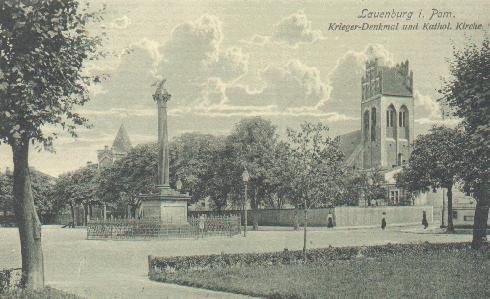
As is sometimes the case, the original source text is not easy to locate online, in this case Sebastian Möler's Prussian chronicle. Brautigam refers to a book from 1837 that clearly places the occurrence in Lauenburg (today Lębork), and not Marienburg (today Malbork), both near Danzig (Gdansk) in Northern Poland. I found a bit on it on p. 53-4 in Reinhold Cramer's Geschichte der Lande Lauenburg und Bütow (1858) (see below), which clearly shows that this has to do with a dead person's corpse that keeps turning up outside the grave, until it is forced to stay there by being punished with a sword and reminded of an oath taken by the deceased while alive. As such, it is certainly farfetched to claim that it is an example of a vampire per se. Unfortunately, Montague Summers's vampiric version set in Tyrol must be considered a figment of his (or charitably, perhaps someone else's) imagination, as Brother (not Dom) Steino von Retten died from the epidemic illness that he tried to flee, not because he had been 'slain by a vampire.'

As Cramer says, this story is so wonderful that it sounds more like a fairy tale than a true story, but must be considered one of the stories concerning Medieval miracula mortuorum that are recounted by various authors, including Dom Calmet.


Those interested in factual background information may find it worth taking a look at the appendices in Cramer's book.

Sunday, 13 November 2011

Historical Library of Witchcraft and Magic


As this app is so far only available for the iPad, and I do not own one, I am unable to tell you how this app really works. But according to this favourable review, it works very well as a 'virtual book shelf'.

The Historical Library of Witchcraft and Magic app is made by Bibliolife, and includes a number of out of print and obscure books on the subject of witchcraft. According to Bibliolife's own promotional material, the texts include The Magic Staff: An Autobiography of Andrew Jackson Davis, The Witch, The Magic of Jewels and Charms, Modern Magic, A Short History of the Salem Village Witchcraft Trials, Mysticism and Magic in Turkey, and many more, probably including a number of those available from Bibliolife subsidiary Bibliobazaar.

It looks like an interesting app, and possibly a brilliant ressource of a mix of fictional and non fictional books on the subject that may be worth reading or at least having at hand if you are particularly interested in older books on the subject. In that respect, I suppose it could be very interesting if a similar app was made that included various books and texts relating to the subject of vampires, e.g. the rarely seen first English translation of Calmet's Dissertation which is available as a print on demand book from Bibliobazaar.

However, if the library app does not include any current information on the books and the subject, I am somewhat worried that the casual reader will be more misinformed than informed on the subject. This is apparently still a relevant issue in certain circles that have a particular interest in the subject, as a so-called 'Neopagan' writes in an interesting essay on Recent Developments in the Study of the Great European Witch Hunt:

‘We Neopagans now face a crisis. As new data appeared, historians altered their theories to account for it. We have not. Therefore an enormous gap has opened between the academic and the “average” Pagan view of witchcraft. We continue to use of out-dated and poor writers, like Margaret Murray, Montague Summers, Gerald Gardner, and Jules Michelet.

We avoid the somewhat dull academic texts that present solid research, preferring sensational writers who play to our emotions. For example, I have never seen a copy of Brian Levack’s
The Witch Hunt in Early Modern Europe in a Pagan bookstore. Yet half the stores I visit carry Anne Llewellyn Barstow’s Witchcraze, a deeply flawed book which has been ignored or reviled by most scholarly historians.

We owe it to ourselves to study the Great Hunt more honestly, in more detail, and using the best data available. Dualistic fairy tales of noble witches and evil witch hunters have great emotional appeal, but they blind us to what happened.’


I heartily welcome any new technological advance in making books and information easily available, but at the same time I find it paramount to stress how important it is that outdated information and views are not presented as if they are still valid. The easier it gets to find all sorts of old books and material, the more important it is to be able to view this material in a contemporary and informed perspective.

Saturday, 24 September 2011

A Delayed Demonologist

In the early 20th century the British Egyptologist Margaret Murray claimed that the witch trials were actually aimed at a pagan, pre-Christian religion. Evaluating Murray's work in 1994, Jacqueline Simpson wrote (as quoted on the English Wikipedia entry on Murray):

'So what was the appeal of her work? Part of the answer lies in what was at the time perceived as her sensible, demystifying, liberating approach to a longstanding but sterile argument between the religious minded and the secularists as to what witches had been. At one extreme stood the eccentric and bigoted Catholic writer Montague Summers, maintaining that they really had worshipped Satan, and that by his help they really had been able to fly, change shape, do magic and so forth… In the other camp, and far more numerous at least among academics, were sceptics who said that all so-called witches were totally innocent victims of hysterical panics whipped up by the Churches for devious political or financial reasons; their confessions must be disregarded because they were made under threat of torture. When The Witch-Cult in Western Europe appeared in 1921, it broke the deadlock.' (Margaret Murray: Who believed her, and why? in Folklore, 105 (1994): 89-96)

In a recent introduction to the subject published in Germany, Hexen und Magie (Campus Verlag, 2007), Dr. phil. habil. Johannes Dillinger talks of 'Verspätete Dämonologen', delayed demonologists, and mentions 'Summers who in the first third of the 20th century besides anthologies of horror stories published several monographs about magic as well as English translations of some demonological treatises with chatty introductions. Whether Summers, as he claimed, was really a priest has yet to be proved. His spleen or perhaps rather his sales trick consisted in posing as an ultra conservative Catholic. Summers wrote as if he literally accepted witchcraft as a reality. His works are at best of interest as a curiosity of historiography.' (p. 114) *


That Summers was controversial I have previously shown examples of, and more can be found in his books. In the introduction to A Popular History of Witchcraft he e.g. states that ‘the present study aims at presenting a clear view of the Practice and Profession of Witchcraft, as it was carried on in former centuries and now prevails amongst us. I am convinced that it is most necessary to realize that this is no mere historical question, but a definite factor in politics of to-day, as well as in social life and the progress of humanity.
The Black International of Satan – that is the canker which is corrupting and destroying the world.’ (p. xvi)

Such extreme statements are perhaps easier to find in his books on witches and witchcraft, so perhaps his books on vampires are a different kettle of fish? If, however, you read an interesting letter that is reproduced on pp. 391-3 of the new, critical edition of The Vampire: His Kith and Kin, you can see that Summers himself in September 1934 wrote:

'Scholars have been generous enough to recognize me as the greatest living English authority upon historical witchcraft. My HISTORY OF WITCHCRAFT is accepted as the standard book upon the subject. I have written six books upon witchcraft, and I have further translated and edited nine treatises, some of great length, covering the whole area of historical and mediaeval witchcraft.'

So what were these 'six books upon the subject of witchcraft'? Checking with the bibliography by Timothy d’Arch Smith, I suppose the books are: The History of Witchcraft and Demonology (1926), The Geography of Witchcraft (1927), The Discovery of Witches: A Study of Master Matthew Hopkins (1928), The Vampire: His Kith and Kin (1928), The Vampire in Europe (1929), and The Werewolf (1933). So to Summers himself, his two books on vampires must be treated as part of his oeuvre upon witchcraft, and not as something distinct from those books. Actually, vampires are briefly mentioned in The Geography of Witchcraft (p. 503-4), and in the introduction to The Werewolf, he calls it ‘a successor to my study, The Vampire’ (p. ix)

Apparently these subjects are not separate, but according to Summers really just different themes within the overall subject of witchcraft. Subjects whose reality he claimed to believe in, while at the same time stressing their universality: 'A subject as old as the world and as wide as the world' according to his The History of Witchcraft and Demonology (p. ix), and a subject that had not lost its relevance in the early twentieth century:

‘My aim throughout my new work has been to show how the profession and practice of witchcraft are the same always and in all places, be it in some remote English village, in a quiet cathedral city, in the sweltering hinterland of Jamica, or in savage Africa.’ ‘Up and down England there is hardly a village without a witch. In our great cities, our larger towns, our seats of learning, Satanists abound and are organized (as of old) into covens of wickedness. Black Masses are celebrated in Mayfair and Chelsea; in Wapping and Shoreditch; in Brighton; in Birmingham; in Liverpool; in Edinburgh.’ (A Popular Introduction to Witchcraft, p. xiii and 258)

The Werewolf echoes his words on witchcraft: 'As old as time and as wide as the world, the belief in the werewolf by its very antiquity and its universality affords accumulated evidence that there is at least some extremely significant and vital element of truth in this dateless tradition, however disguised and distorted it may have become in later days by the fantasies and poetry of epic sagas, roundel, and romance.' (The Werewolf, p. 1)

And of course, vampires according to Summers are as universal as werewolves and witches: 'The tradition is world wide and of dateless antiquity.' (The Vampire: His Kith and Kin p. ix), although it may not be quite as prevalent in Summers’s own time as the Black Mass: 'Cases of vampirism may be said to be in our time a rare occult phenomenon. Yet whether we are justified in supposing that they are less frequent to-day than in past centuries I am far from certain. One thing is plain: - not that they do not occur but that they are carefully hushed up and stifled.' (The Vampire in Europe, p. xx-xxi).

Summers, however, does note in places that the vampire – at least in its more strict sense – can be located to certain parts of Europe at a certain period, but overall his universal vampire concept is one of the most influential aspects of his books.

Examples from anthropology and archaeology are provided as proof and foundation for the antiquity and universality of the phenomena. So when specialists decide to use the word ‘vampire’ in translations of e.g. cuneiform texts from Sumer and Babylonia, Summers can appropriate these ‘vampires’ to conform to his ancient vampire concept.

Although prevalent in many popular vampire books, universality is not at the heart of many modern studies that rather stress the vampire's historicity by discussing whether the vampire is unique, and if the vampire was really of Slavic origin. In a recent - and excellent - book on magic and witchcraft published in Denmark, it is stated that the Romans 'did not have a specific term for the category revenant. Indeed, the concept 'revenant' in the meaning 'walking corpse' appears to have been unknown to them. The examples that are usually shown hereof, in my opinion do not concern walking corpses, but apparently dead people. It should be added that further categories like bloodsucking vampires, zombies and poltergeists in antiquity were unknown phenomena, notions and phantasies. They have all been invented more recently, i.e. within the last couple of centuries.' (Allan A. Lund: Magi og hekseri: Fra den romerske oldtid til og med middelalderen (Gyldendal, 2010), p. 106)

And writing of Summers and other 'vampirologists' in 2010, Erik Butler in Metamorphoses of the Vampire in Literature and Film says: ‘Because they have bought into the fiction of vampire antiquity, many popular and scholarly discussions of the vampire fall victim to a lure posed by vampire stories, and they accept the monster as a near-eternal being whose existence reaches back to the ancient world.’ (p. 3)

As Summers was a professed Catholic, it is interesting to compare his work to those of prominent Roman Catholics who wrote on the subject of e.g. vampires, most notably Dom Calmet and Giuseppe Davanzati. Both Calmet and Davanzati responded to the scepticism of 18th century Enlightenment. Calmet tried to uphold Catholic dogma while at the same time approaching the subject from a sceptical and historical point of view, whereas Davanzati basically dismissed the vampire belief as ignorance and superstition. No wonder then that Summers could not abide by Davanzati, saying without further explanation: Nor can we accept “Che l’apparizione de’ Vampiri non sia altro che paro effetto di fantasia.” The truth lies something deeper than that as Leone Allacci so well knew.' (The Vampire: His Kith and Kin, p. 25) Obviously, it was hard for Summers to accept that a prominent Catholic dismissed the vampire as an effect of the imagination.

Compared to Calmet and Davanzati, Summers's project might be termed anti-Enlightenment, as he attempts to establish his own mythological pseudo-Orthodox Catholicism, apparently wishing to revert to some (probably unhistorical) Christian fervor in opposition to witches, Satanists, vampires and werewolves.

Similarly, he probably would not have sympathised with Gerard van Swieten and Empress Maria Theresa, who were both Catholics opposing superstition. In the bibliography of The Vampire: His Kith and Kin, Summers refers to the 1768 Abhandlung des Daseyns der Gespenster Nebst einem Anhange vom Vampyrismus (the first entry in the bibliography), but I doubt that he read it, because he does not refer to the incident that Gerard van Swieten dealt with in the Anhang.

Re-reading parts of Summers’s The Vampire: His Kith and Kin, I honestly can not help wondering whether he really believed what he wrote. Was he confident in his belief that evil forces, Satanists, vampires and shapeshifters were lurking in the shadows of contemporary Britain? Or was it to some extent merely a fictional ploy to make the reader’s blood curl, perhaps inspired by the penny dreadfuls and Gothic horrors he enjoyed?

His 'occult' books are in their construction and style not dissimilar to Baroque books: anthologising various curious stories to make some points, e.g. of a philosophical nature, but essentially entertaining the reader with strange and marvellous stories. I suppose one could remove most of a book like The Vampire: His Kith and Kin and still provide enough material to say what Summers essentially has to say about the vampire, its origins, generation, traits and practices. A summary could be stated in perhaps a few pages. That, of course, would remove a lot of the entertainment value, as well as the supposed documentation.

Fortunately, there is more to be found in the follow up, The Vampire in Europe, and no doubt, much of the value of Summers’s books on the subject stems from his interest in collecting stories and documents. His analysis and his beliefs, on the other hand, are at best mostly ephemeral.

I myself am no Summers buff. I admired his books when I was much younger, which was also at a time when I had little access to much of the material on vampires that is now available. It was also at a time when witchcraft literature was still bogged down by Gerard Gardner, Erica Jong and others whose approach to the subject - like that of Montague Summers - mixed historical fact with fiction. Summers’s books contain a lot of material, which can be used for inspiration and entertainment, but I would recommend people to check the sources before trusting old Montague’s research and analysis.

Gerard O'Sullivan writes about Summers in a paper published in 2009 in The Antigonish Review (No. 159, p. 111-131):

'The mere mention of Montague Summers's name calls to mind Erving Goffman's trenchant "managed stigma" (Goffman [Stigma. Notes on the management of spoiled Identity] 1963). Summers was, and at the very same time, both victim and beneficiary of a spoiled public persona - one which he stage-managed with great skill and, evidently, no little glee. Rumors of bad behavior, occult dabbling, and a purported friendship with none other than Aleister Crowley (they were not friends, but acquaintances, and dined together only twice) swirled around Summers through most of his life.

Summers did little if anything to dispel the rumors. He was alsways, as Fr. Sewell noted,
mal vu in the eyes of London's Catholic clerisy, who had no doubt that Summers was in holy orders, but could not be certain as to their origin, liceity, or canonical regularity. And Summers's very public literary battles with academic critics and scholars whom he perceived as encroaching upon his fields of specialization - the Restoration stage, gothic literature, and the supernatural - left him a figure alternately loathed and praised in the British press.' (p. 113)

Recently, Summers has even been called a ‘freak’ by Florian Kührer in his recent book on vampires, Vampire: Monster - Mythos - Medienstar (2010): ‘A “freak” of a special kind, Montague Summers (1880-1948) – in popular lexica described as a “literary historian, demonologist and occult author” – must be numbered among the leading creators of the modern vampire mythos. His admirers, who have immortalized him biographically, but also Summers himself have ensured that the story of his life moves between legend, rumour and serious information.’ (p. 244) **

More specifically, Kührer has this to say about Summers's work on vampires: ‘In his zeal of (false) piety lay also the weakness of Summer’s oeuvre: He read his folkloric sources only from the perspective of a demon hunter and classified almost every phenomenon, that only slightly fitted the profile, as a vampire. Consequently, Summers left us with not only an entertaining panoptikon of monsters, but also succeeded in contributing significanttly to an inflation of the vampire mythos. A great number of “vampirologists” to this day crib from the occult “reverend” and duplicate unreflectingly his phantasms. The World Wide (Vampire) Web has once more duly reinforced the tendency.’ (p. 246) ***

So we are back at Summers’s invention of an ancient and universal vampire. Hagen Schaub in Vampire: Dem Mythos auf der Spur (here quoted from the 2011 edition) talks of the misunderstanding of mixing up living corpses with gods and demons, for which Summers is the main perpetrator, ‘who as the first collected an infinite number of international bloodsuckers, which even today infest many vampire books. Furthermore, one must be cautious because not everything is well researched, and many of Summers’s entities have little in common with a vampire. And when you know that the man was convinced of the existence of vampires, his work relativises itself, and one must ask the question if his oft-quoted works really ought to be the basis of current books and not least internet sites about vampires.’ (p. 32-3) ****

David Keyworth in Troublesome Corpses (2007) simply notes that ‘Montague Summers’ oft-quoted The Vampire in Europe (1929), for example, although scholarly and interesting to read, is often inaccurate in many regards.’ (p. 6) In fact, nearly 35 years ago Christopher Frayling in 1978 noted in The Vampyre: Lord Ruthven to Count Dracula noted that both Summers’s books and Dudley Wright’s single book on vampires ‘are unreliable, and have for too long been treated as gospel. Tony Faivre’s Les Vampires (1962) and Sturm and Volker’s Von denen Vampiren oder Menschensaugern (1973) are both much more scholarly, and can be trusted more than the (many) Summers derivatives.’ (p. 331)

All these critical comments are in a way a testament to the influence of Montague Summers on the field, but at the same time they show how ridiculous it would be to uphold him and his work as an authority on vampires in the 21st century. His research is flawed and erroneus. His project is idiosyncratic and dated. His concept of the vampire as 'world-wide and of dateless antiquity' was extremely influential in the past, but today it must be considered a dead end.

Klaus Hamberger, of course, mentions Summers's two books on vampires in his bibliography of secondary literature in Mortuus non mordet from 1992, one of the most important books on vampire history published in the 20th century. But it is quite obvious, that Summers play little or no role in the book, and that there are so many other sources that are far more important than Montague Summers will ever be.

In many ways, I think the writer(s) of German Wikipedia nailed it, when writing of Summers:

‘Characteristic of Summers’s books is his style that is reminiscent of baroque literature. Scholars found Summers’s occult themes unfit as academic research, because his books about the occult did not meet the demands of academic precision. The works of Montague Summers is a testament to a unique passion for collecting, whose ambition for completion is paired with a lack of critical discrimination. In his efforts to track down as many proofs as possible of the acts of bloodsuckers, he placed any ghost that fulfilled just one of the fundamental criteria of the phenomenon “Vampire”, under this denomination, so that in his works on the subject one also find monsters that in no way belong to the category of “living corpses”. In his remarkable industry he searched in all kinds of works of folklore and ethnology for vampires and werewolves, not only from a scientific interest, but also to prove the existence of Evil and its innumerable variants. Montague Summers was convinced of the existence of witches, vampires and werewolves, and maintained the point of view that these were known and feared by all people at all times. This explains why Summers considered eyewitness accounts of vampires and werewolves, as they were published in the occult literature and the sensationalist press of his time, to be genuine.

Despite his erudition it was impossible for Summers to put the incredible amount of collected material into order. With long quotes in various foreign languages, in particular Latin, he wished to give an air of scholarship. Thanks to Summers’s research, both copies of the otherwise lost leaflet about the Werewolf from Bedburg, the in 1589 executed Peter Stübbe, were rediscovered.’ *****


Original quotes in German

*) 'Die Hexenlehre hat auch noch im 20. Jahrhundert Befürworter gefunden: dummdreiste Reaktionäre und Autoren, die den auflagensteigernden Effekt extremer Meinungen erkannt haben (Laven 1907/08; Petersdorff 1995). Summers legte im ersten Drittel des 20. Jahrhunderts neben Anthologien von Horrorstories mehrere Monografien über Magie sowie mit geschwätzigen Einleitungen ausgestattete englische Übersetzungen einiger dämonologischer Traktate vor. Ob Summers, wie er behauptete, tatsächlich Priester war, mag dahingestellt bleiben. Sein Spleen oder wohl eher noch sein Verkaufstrick bestand darin, sich als ultrakonservativer Katholik zu gebärden. Summers schrieb, als akzeptiere er Hexerei im dämonologischen Vollsinn als Wirklichkeit. Sein Œvure ist allenfalls als Kuriosum der Wissenschaftsgeschichte von Interesse.'

**) Ein “Freak” der besonderen Art war Montague Summers (1880-1948) – in populären Nachschlagewerken als “Litteraturwisscenschaftler, Dämonologe und okkultistischer Schriftsteller” beschrieben, der zu den maßgeblichen Schöpfern des modernen Vampir-Mythos gezählt warden kann. Seine Verehrer, die ihn biographisch verewigt haben, aber auch Summers selbst, sorgten dafür, dass sich die Geschichten über sein Leben zwischen Legenden, Gerüchten und seriösen Informationen bewegen.’

***) ‘In seinem (schein)heiligen Eifer liegen aber auch die Nachteile von Summers Oeuvre: Er las seine volkskundlichen Quellen nur aus der Perspektive des Dämonenjägers und klassifizierty nahezu jades Phänomen, das auch nur im Ansatz auf das Profil paste, als Vampir. Summers hinterließ uns somit nicht nur einunterhaltsames Panoptikum von Monstern, sondern leistete auch einen großen Beitrag zur Aufblähung des Vampir-Mythos. Ein Gutteil der “Vampirologen” schreibt bis heute vom okkulten “Reverend” ab und vervielfältigt unreflektiert seine Phantasmen. Das World Wide (Vampire) Web hat diese Tendenz noch einmail gehörig verstärkt.’

****) ‘Für diese Vermischung ist vor allem der selbst ernannte Reverend und Okkultist Montague Summers (1880-1948) verantwortlich, der als Erster eine unendlich große Zahl von internationalen Blutsaugern zusammengetragen hat, die auch heute noch in vielen Vampirbüchern ihr Unwesen treiben. Mitunter ist hier aber Vorsicht geboten, denn nicht alles ist wirklich gut recherchiert, und manche von Summers angeführte Figur hat mit einem Vampir wenig gemeinsam. Und wenn man weiß, dass der mann von der Existenz von Vampiren überzeugt war, relativiert sich seine Arbeit ohnehin und es stellt sich die Frage, ob seine noch immer viel zitierten Werke wirklich Basis aktueller Bücher und vor allem von Internetauftritten über Vampire sein sollten.’

*****) 'Summers an Barockliteratur erinnernder Schreibstil prägt seine Publikationen. Der Fachwelt galten Summers Okkult-Themen als akademischer Forschung unangemessen, darüber hinaus entsprachen seine Bücher über Okkultismus nicht den Anforderungen akademischer Genauigkeit. Das Œuvre von Montague Summers stellt sich als Zeugnis einer einzigartigen Sammelleidenschaft dar, die sich bei allem Streben nach Vollständigkeit mit einem vollständigen Mangel an Kritikfähigkeit paart. In seinem Bemühen, möglichst viele Belege für das Treiben von Blutsaugern aufzustöbern, packte er jedes Spukwesen, das auch nur eins der Grundkriterien für das Phänomen „Vampir“ erfüllte, unter diesen Begriff, so dass sich in seinen diesbezüglichen Werken auch Schreckensgestalten finden, die keineswegs unter die Rubrik „lebender Leichnam“ fallen. In erheblicher Fleißarbeit durchforstete Summers alle nur denkbaren volks- und völkerkundlichen Werke nach Vampiren und Werwölfen, nicht nur aus wissenschaftlichem Interesse, sondern um den Beweis für die Existenz des Bösen und seiner unzähligen Varianten zu erbringen. Montague Summers war von der Existenz von Hexen, Vampiren und Werwölfen überzeugt und verfocht die Ansicht, dass diese bei allen Völkern und zu allen Zeiten bekannt und gefürchtet gewesen seien. So erklärt sich, weshalb Summers angebliche Augenzeugenberichte von Werwolf- und Vampirerscheinungen, wie sie in der okkultischen Literatur seiner Zeit und in der Sensationspresse publiziert worden waren, für bare Münze nahm.

Trotz Gelehrsamkeit war es Summers unmöglich, die Unmassen an gesammeltem Material zu ordnen. Lange Zitate aus diversen Fremdsprachen, vornehmlich aus dem Lateinischen, wollen Wissenschaftlichkeit vermitteln. Dem Forscherfleiß von Summers ist zu verdanken, dass die beiden einzigen Exemplare der ansonsten verlorenen Flugschrift über den „Werwolf von Bedburg“, dem 1589 hingerichteten Peter Stübbe, wiederentdeckt wurden.'
Related Posts Plugin for WordPress, Blogger...