Writing recently of Jordi Ardanuy, it is worth mentioning the quarterly journal L'Upir which frequently publishes articles by Ardanuy. Although written in Catalan, those of us who cannot read the language may still get something from looking at it anyway.
The December 2011 issue was recently distributed and focuses on vampires in Bulgaria. It includes an article by Ardanuy that a.o. deals with a 'vampire case' from Tirnova in Bulgaria mentioned by Rob Brautigam on his Shroudeater site:
'The corpses (who are refered to as witches) were rising from their graves after sunset. Just like some of the vampires that we know from Romania, they would spoil the food, mess up people's belongings and - remaining invisible - throw dirt and stones at people. They knocked people down and sat on them. Some of the people were so scared that they decided to leave the town.
An exorcist called Nikola was called to the rescue and was offered the price of 800 Kurus to do his job. Apparently he used a stick with a picture (possibly a Saint ?) on it to locate the troublesome graves. He found two of them. Both graves contained the bodies of soldiers that had been Yeniceri (better known in our part of the world as Yanitsaries or Janitsaries). The graves were opened and the corpses looked inflated, with hair and nails that had grown. Nikola decided that a stake should be driven through the stomach, the heart should be cut out and boiled. And then - for good measure and just to make sure - the bodies would have to be cremated.'
On several occasions, particularly on the periphery of the Habsburg Empire during the 17th and 18th centuries, dead people were suspected of being revenants or vampires, and consequently dug up and destroyed. Some contemporary authors named this phenomenon Magia Posthuma. This blog is dedicated to understanding what happened and why.
Showing posts with label Rob Brautigam. Show all posts
Monday, 16 January 2012
Sunday, 4 December 2011
An important exception
I recently mentioned Paul Barber's preface to the second edition of his Vampires, Burial & Death, as well as Rob Brautigam's Shroudeater site in another post. Paul Barber calls attention to that web site, while mentioning that 'theories sometimes crowd out the facts, especially on the Internet,' adding in a footnote:
'An important exception is Rob Brautigam, whose site (shroudeater.com) contains a valuable collection of material from many countries over many years. Brautigam has gone to great trouble to verify sources in the accounts he publishes there, some of which have evolved in moving from one book to the next. In one case (that of William Doggett) he demonstrates that a vampire was eventually inserted into a story that originally wasn't about vampires at all.' (p. v-vi)
Brautigam recently updated the site with a large number of 'cases', this time including an index by place name instead of by country alone, even indicating alternative names for various places.
I have only taken a brief look at some of the new entries. One of them concerns Marienburg and is placed in Poland. Curiously, Montague Summers in The Vampire in Europe refers this to Tyrol:
'In his chronicle under the year 1343 Sebastian Moelers relates that during a terrible visitation of the Black Death cases of vampirism were numerous in the Tyrol, and the Benedictine abbey of Marienberg was much infested, one at least of the monks, Dom Steino von Netten, being commonly reputed to have been slain by a vampire.' (p. 160)
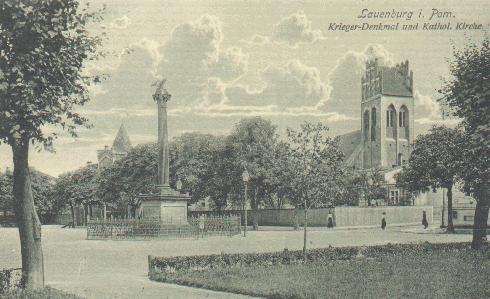
As is sometimes the case, the original source text is not easy to locate online, in this case Sebastian Möler's Prussian chronicle. Brautigam refers to a book from 1837 that clearly places the occurrence in Lauenburg (today Lębork), and not Marienburg (today Malbork), both near Danzig (Gdansk) in Northern Poland. I found a bit on it on p. 53-4 in Reinhold Cramer's Geschichte der Lande Lauenburg und Bütow (1858) (see below), which clearly shows that this has to do with a dead person's corpse that keeps turning up outside the grave, until it is forced to stay there by being punished with a sword and reminded of an oath taken by the deceased while alive. As such, it is certainly farfetched to claim that it is an example of a vampire per se. Unfortunately, Montague Summers's vampiric version set in Tyrol must be considered a figment of his (or charitably, perhaps someone else's) imagination, as Brother (not Dom) Steino von Retten died from the epidemic illness that he tried to flee, not because he had been 'slain by a vampire.'
As Cramer says, this story is so wonderful that it sounds more like a fairy tale than a true story, but must be considered one of the stories concerning Medieval miracula mortuorum that are recounted by various authors, including Dom Calmet.
Those interested in factual background information may find it worth taking a look at the appendices in Cramer's book.
Thursday, 1 December 2011
Vampertione infecta
I have always found it strange how various 'black metal' bands take up names and quotes from all sorts of literature on e.g. vampires and posthumous magic for their band names and song titles, cf. this post. According to the Wikipedia entry on Black Metal,
'The most common and founding lyrical theme is opposition to Christianity and other organized religions. As part of this, many artists write lyrics that could be seen to promote atheism, antitheism, paganism or Satanism. The hostility of many secular or pagan black metal artists is in some way linked to the Christianization of their countries. Other oft-explored themes are depression, nihilism, misanthropy, death and other dark topics. However, over time, many black metal artists have begun to focus more on topics like the seasons (particularly winter), nature, mythology, folklore, philosophy and fantasy.'
Certainly not to my own taste in music and aesthetics, it is curious to find that sometimes searches on the internet directly lead to web sites about black metal bands. One such search concerned the phrase 'vampertione infecta', which has been used as a song title by Italian metal band Riul Doamnei. The phrase is probably mainly known to people with a special interest in Moravian magia posthuma, as it supposedly appears in an 18th century parish register of deaths in Moravia or the North East of present day Czech Republic.
At least, so Christian d'Elvert claimed when writing about vampires and posthumous magic in 1859, see e.g. Die Wiedergänger von Bärn/Mähren 1662-1740 or this recent entry on Rob Brautigam's Shroudeater site, quoting an entry from the parish register of Bärn, present day Moravsky Beroun:
'Anno 1725 den 28. Februar ist Anna des seligen Andreas Berge, gewesene Ehewirtin verschieden, ihres Alters 48 Jahr, hat keine Ruhe in der Erden gehabt, Vampertione infecta, und ist letztlich verbrannt worden.'
In English: A.D. 1725 on February 28, Anna, the widow of the blessed Andreas Berge, deceased at the age of 48. She found no peace in the earth, Vampertione infecta, and was finally cremated.
Klaus Hamberger notes the word 'Vampertione' when commenting on the incident in his Mortuus non mordet: 'Das Fremdwort in der Eintragung zum 28. 2. 1725 verweist gleichwohl auf einen bemerkenswerten Bruch.' (p. 77) So I have always been somewhat intrigued by the term, and when I had the chance, I looked for it in the original (as shown below), and - to my eyes - there is no trace of the infection!
So, one might wonder how those two Latin words ended up among d'Elvert's otherwise reasonably reliable passages from the parish register. Just as one may wonder what 'Vampertione' was supposed to mean.
At face value this is clearly an example of the burning of a corpse suspected of posthumous magic that appears to have been relatively common in those parts during the 17th and 18th centuries. The entry in the parish register contains no description of how people determined that she should have found no rest in the grave. For that reason it seems farfetched to talk of a vampire per se. Still, as we know, the term 'vampire' was quickly linked to various kinds of revenants and (supposedly) uncorrupted corpses. For that reason, Gregor Wolny had no qualms using the term when mentioning the examples of posthumous magic in Bärn in his Die Markgraffschaft Mähren topographisch, statistisch und historisch geshildert from 1839, as shown in the excerpt at the bottom of this post.
Looking at the reproduction of the text above, even as shown here, I think you can see that there is a difference in the shade of the ink from the first to the last sentence, but the style of writing looks similar. Clearly, the last sentence was added later, as one would expect. Unfortunately, we know nothing of what happened in between, only that it apparently did not involve 'Vampertione infecta' ...
View Larger Map
Monday, 1 March 2010
Euroghost
Rob Brautigam, known for the Shroudeater web site, recently created another web site: Euroghost, devoted to 'his side interest in ghosts and hauntings and other paranormal phenomena'. Check his introduction, if you find this intriguing.
Sunday, 22 March 2009
An even smaller vampire booklet
Rob Brautigam has sent me a couple of scans of a vampire book that is even smaller than the one mentioned in my previous post.


Wednesday, 8 October 2008
Amsterdam
I was away for a few days over the weekend going to Brussels, Northern France, and Amsterdam. In Amsterdam I had the pleasure of meeting the web master of the Shroudeater web site, Rob Brautigam. Not much else of relevance to this blog to report from that city, but I strolled past these two guys at Dam square.
Friday, 25 July 2008
Die Geisterwelt
Nicolaus Equiamicus has kindly recommended both this blog and Rob Brautigam's Shroudeater web site. Another book edited by Equiamicus has just been published, Die Geisterwelt. Apparently, a book originally published around the middle of the 18th Century, it deals with witches, werewolves, vampires, fairies and much more. More information is available at the blog of Equiamicus.
Wednesday, 23 July 2008
International Vampire
So what could this blogger be doing? Well, it would probably be too boring to mention all that has kept me busy lately, but currently I'm going through a lot of my books and papers to try and clear out what I might do without so I can get a little more room for, say, new and interesting books on the subject of posthumous magic :-) Anyway, this business has also led to a few discoveries of interesting stuff. I am particularly amazed at how many magazines (fanzines?) on vampires I have lying around, mostly from the Eighties and Nineties. And as I had come to believe that it was an error on my part to think that I had a couple of issues of International Vampire, it was very nice to find three issues. This was a magazine published by Rob Brautigam, the webmaster of the Shroudeater web site. The final issue, no 20, is shown on top of the other issues in the photo below, and was published in May 1996. I notice that my name is mentioned in that issue :-)
A few other magazines or fanzines were mentioned in a post that I wrote one year ago.
Thursday, 27 December 2007
Worth longing for?
When looking at ebay, one German book keeps popping up numerous times. I have so far resisted buying it, but it keeps turning up so I have considered buying it: Norbert Borrmann's Vampirismus oder die Sehnsucht nacht Unsterblichkeit (Vampirism or the longing for immortality). So why have I resisted? Well, Peter Mario Kreuter in his Der Vampirglaube in Südosteuropa calls it "einfach nur eine literarische Gemischtwarenhandlung" (simply just a literary mixed bag), and adds: "Bei der Lektüre dieses Buches muß man sich manchmal sogar fragen, ob Borrmann überhaupt verstanden hat, über was er da schreibt." (While reading this book one must often ask if Borrmann has at all understood what it is he is writing about). On the other hand, Rob Brautigam writes of the book on his Shroudeater web site: "This nice hardbound book was published at such a ridiculously low price that I was afraid that the quality of its contents would be of the same low level. I was wrong. Norbert Borrmann presents us with an interesting overview of Vampirism in which most vampire aspects seem to get a mention.". So, perhaps, it is not as bad as Kreuter would have us believe? Comments are welcome.
Subscribe to:
Posts (Atom)