Showing posts with label czech republic. Show all posts

Sunday, 8 June 2014

Vampyrismus & Magia posthuma


By chance, years ago I watched part of a programme on History Channel about vampires in which anthropologist Giuseppe Maiello from the Charles University, Univerzita Karlova, in Prague was interviewed about vampires. I recall contacting Maiello who responded that he had himself not seen that interview. At the same time I learned about the book he had written on vampires, Vampyrismus v kulturních dĕjinách Evropy, which had been published in 2004, and got hold of it to see what a Czech researcher would include in a book on this subject.

Now Maiello has published a new edition of the book, this time titled Vampyrismus & Magia posthuma, and the new title indicates the major addition that has been made in this edition: A Czech translation of Karl Ferdinand von Schertz’s Magia Posthuma has been added to the sources at the end of the book!

The new edition also includes a foreword mentioning some of the work that has been published since the first edition, as well as summaries in English, French and Italian that can be helpful to those of us who are not proficient in the Czech language. Furthermore, a number of illustrations have been added, in particular of some key persons, including one of Schertz, which is unfortunately not of the best quality.


According to the English summary, 'Vampyrismus a Magia posthuma [Vampirism and Magia posthuma] is an updated version of Vampyrismus v kulturních dějinách Evropy [Vampirism in the cultural history of Europe], which had first appeared in bookstores back in 2005. The book describes the phenomenon of Vampirism from an etymological, cultural-historical, ethnographic and anthropological point of view.

Up until now, the sources of the book were found primarily in the libraries of the Czech Republic. For this reason the book includes both classic examples from the literature of Western countries, transmitted through the intermediation of Abbot Augustine Calmet, as well as examples taken from the ethnographic literature of Central and Eastern European countries and the Balkans; lesser known or completely unknown to wider audiences and to western European and northern American specialists.

The second part of the book deals with the main theories on the origins of vampirism through the comparison between different cultures, and across temporal space, from classical antiquity up to the late nineteenth century. These theories concentrate on three areas: universal theories of the origins and prehistory of vampirism; theories (less probable) that derive vampirism by social and cultural changes that took place in modern Europe; and theories related to the analysis of agrarian cults and their struggles for the fertility of the fields.

In addition to other texts already published or translated into other languages, this is the first time that there is published in a modern language the Karl Ferdinand Schertz's study
Magia posthuma, which had been released only once in a printed Latin edition in 1704 (but which had the date 1706 written on the title page).'

Maiello has also published a paper on Schertz in 2012 in Slavica litteraria, Racionalismus Karla Ferdinada Schertze a Magia posthuma (Karl Ferdinand Schertz's rationalism and Magia posthuma). Written in Czech, it does however include an English abstract:

'Karl Ferdinand Schertz is at home a no well known author. On the contrary, his name is known around the world thanks to his work Magia posthuma, which was quoted by Augustin Calmet. Because of his not well available biography and books, Schertz is unfortunately wrong understood and around him circulate various rumors or negative critics. Karl Ferdinand Schertz was on the contrary highly cultured author, who could enjoy a good reputation among the european intellectuals of his time.'

The paper briefly deals with Schertz's life and works, and discusses his approach to magia posthuma, which in Maiello's view make Schertz more of a rationalist than a man of the Baroque period. Maiello actually finds that the rationalistic approach of Schertz is comparable to that of Calmet. Cf. what I have myself written in Vampirismus und magia posthuma im Diskurs der Habsburgermonarchie edited by Augustynowiz and Reber (or as part of Kakanien Revisited).


Giuseppe Maiello talks about vampires on this Czech talk show

I thank Giuseppe Maiello for providing me with a copy of his book. He informs me that the publisheres are considering publishing an edition in English.

Thursday, 24 October 2013

'Vampire' burials that can change a research life

Anthropology PhD student and blogger, Katy Meyers, recently wrote of a symposium on The Odd, the Unusual, and the Strange: Human Deviant Burials and their Cultural Contexts arranged by the Canadian Association of Physical Anthropologists:

'[Sandra] Garvie-Lok discussed the finding of a potential ‘vampire’ burial in Byzantine and Ottoman Greece. This was interesting because she examined first the ethnographic and historical evidence for the belief in vampires and the behavior towards them. Next, she used this information to interpret a burial from Ottoman-era Mytilene that due to the presence of stakes through the skeleton may indicate that people believed the deceased individual was a ‘vampire’. [Lauren] Hosek discussed a similar topic, the fear of revenants- individuals who rise from the dead. She discussed historic legends of revenants and archaeological evidence from two fortified settlement sites in what is now the Czech Republic. Several of these graves are consistent with the descriptions of potential revenants.'


Sandra Garvie-Lok, an anthropologist from the University of Alberta, according to that university's web site was aided in her career by a 'vampire': 'It really did change my research life.'

'Garvie-Lok, an osteologist, was set to study North American sites until a fateful opportunity took her to the island of Lesbos in Greece, where she found herself with the skeleton of an alleged vampire from the Ottoman Empire. She became embroiled in ethnocultural history and vampire lore that would play a small part in her focusing on Greece and ancient civilizations. She says the vampire tales from that region and the pop-culture iterations of the undead bear little resemblance, especially when it comes to disposing of a vampire. And as for her own adventure as a vampire hunter, she says it’s an experience she’ll never forget.'

'She says the regional accounts of vampires are consistent from Greece all the way through to the Slavic states, and none of the stories had anything to do with bats, biting or blood loss. Instead, she says, the vampire was believed to be a demon-animated corpse who would chase and physically attack the living—much closer to current popular culture images of zombies. And unlike the Dracula lore, it was the vampire’s look—or even his breath—that could be deadly. Vampires were often blamed for weird noises and unexplained phenomena that would occur in towns.'

News story from the University of Alberta
Garvie-Lok has also told her story in the Huffington Post.

Monday, 29 April 2013

Austrian Books Online


Österreichische Nationalbibliothek, the Austrian National Library, now cooperates with Google Books in a joint venture called Austrian Books Online aiming at making the library's collection available online in digital format. 600.000 books are planned to be included in the online collection, and so far 100.000 are online.

Among the books is the Kronyka Czeska by Waclaw Hajekz Libocan aka Hagecius, one of the sources for two well-known tales concerning revenants: the shepherd from Blov and the 'witch' from Levin. Both were originally published in the Kronika Neplachov, but Hajekz embellished them in his chronicle. For more information about those revenant or vampire 'cases', follow the above links.

Sunday, 25 December 2011

A Christmas Card

With the above look at part of a postcard from Freihermersdorf, I wish readers of this blog a merry christmas.

This was the site of the exhumation and cremation of several bodies suspected of posthumous magic in the winter of 1754-55. When news of the events arrived in Vienna, the court of Maria Theresa sent two prominents physicians, Wabst and Gasser, to investigate. Their report on this and similar incidents in the vicinity of Olomouc (Olmütz) led to Gerard van Swieten's famous commentaries on vampirism and the Empress' proscription of the superstitious handling of corpses.

Some years ago I spent a lot of time perusing texts and maps to locate Herm(er)sdorf. At the time not an easy task, because texts tend to only mention an approximate position, and there are more than one place that has been called something like Hermersdorf. Unfortunately, this uncertainty is also found in as recent a work as Anja Lauper's Die phantastische Seuche. Lauper follows Heiko Haumann'a opinion that Hermersdorf must be Temenice, today a part of Šumperk (in German Mährisch Schönberg) in Northern Moravia.

Haumann actually just states his opinion in a note ('Bei Hermesdorf handelt es sich vermutlich um ein Dorf bei Mährisch-Schönberg, das Heute Temenice heißt und mit Sumperk zusammengewachsen ist), adding that the research was done by Thomas Bürgisser. (Zeitschrift für Siebenbürgische Landeskunde 28 (2005) 1, p. 8)

Bernard Unterholzner, on the other hand, in his paper on the incident in Vampirismus und magia posthuma im Diskurs der Habsburgermonarchie, clearly identifies Hermersdorf as Svobodné Hermanice: 'Bei dem Ort in Oberschlesien, nahe der mährischen Grenze, handelte es sich um das heutige Svobodné Hermanice, das rund zehn Kilometer westlich von Opava liegt.' (p. 91)

Suffice it to say, it can be proved beyond doubt that Hermersdorf was Svobodné Hermanice, later on known as Freihermersdorf. In fact, if you look at other villages and towns associated with incidents of posthumous magic in the areas near Olomouc/Olmütz and Bruntál/Freudenthal, many of them are situated within a relatively small part of present day Poland and Czech Republic. E.g. just some ten kilometers to the North East you find Velké Heraltice (Groß Herrlitz), and some fifty kilometers to the South West Moravsky Beroun (Bärn) that I recently mentioned in a post on the term vampertione infecta. Both sites of the exhumation and destruction of bodies suspected of harming the living.

Thursday, 1 December 2011

Vampertione infecta


I have always found it strange how various 'black metal' bands take up names and quotes from all sorts of literature on e.g. vampires and posthumous magic for their band names and song titles, cf. this post. According to the Wikipedia entry on Black Metal,

'The most common and founding lyrical theme is opposition to Christianity and other organized religions. As part of this, many artists write lyrics that could be seen to promote atheism, antitheism, paganism or Satanism. The hostility of many secular or pagan black metal artists is in some way linked to the Christianization of their countries. Other oft-explored themes are depression, nihilism, misanthropy, death and other dark topics. However, over time, many black metal artists have begun to focus more on topics like the seasons (particularly winter), nature, mythology, folklore, philosophy and fantasy.'

Certainly not to my own taste in music and aesthetics, it is curious to find that sometimes searches on the internet directly lead to web sites about black metal bands. One such search concerned the phrase 'vampertione infecta', which has been used as a song title by Italian metal band Riul Doamnei. The phrase is probably mainly known to people with a special interest in Moravian magia posthuma, as it supposedly appears in an 18th century parish register of deaths in Moravia or the North East of present day Czech Republic.

At least, so Christian d'Elvert claimed when writing about vampires and posthumous magic in 1859, see e.g. Die Wiedergänger von Bärn/Mähren 1662-1740 or this recent entry on Rob Brautigam's Shroudeater site, quoting an entry from the parish register of Bärn, present day Moravsky Beroun:

'Anno 1725 den 28. Februar ist Anna des seligen Andreas Berge, gewesene Ehewirtin verschieden, ihres Alters 48 Jahr, hat keine Ruhe in der Erden gehabt, Vampertione infecta, und ist letztlich verbrannt worden.'

In English: A.D. 1725 on February 28, Anna, the widow of the blessed Andreas Berge, deceased at the age of 48. She found no peace in the earth, Vampertione infecta, and was finally cremated.

Klaus Hamberger notes the word 'Vampertione' when commenting on the incident in his Mortuus non mordet: 'Das Fremdwort in der Eintragung zum 28. 2. 1725 verweist gleichwohl auf einen bemerkenswerten Bruch.' (p. 77) So I have always been somewhat intrigued by the term, and when I had the chance, I looked for it in the original (as shown below), and - to my eyes - there is no trace of the infection!


So, one might wonder how those two Latin words ended up among d'Elvert's otherwise reasonably reliable passages from the parish register. Just as one may wonder what 'Vampertione' was supposed to mean.

At face value this is clearly an example of the burning of a corpse suspected of posthumous magic that appears to have been relatively common in those parts during the 17th and 18th centuries. The entry in the parish register contains no description of how people determined that she should have found no rest in the grave. For that reason it seems farfetched to talk of a vampire per se. Still, as we know, the term 'vampire' was quickly linked to various kinds of revenants and (supposedly) uncorrupted corpses. For that reason, Gregor Wolny had no qualms using the term when mentioning the examples of posthumous magic in Bärn in his Die Markgraffschaft Mähren topographisch, statistisch und historisch geshildert from 1839, as shown in the excerpt at the bottom of this post.

Looking at the reproduction of the text above, even as shown here, I think you can see that there is a difference in the shade of the ink from the first to the last sentence, but the style of writing looks similar. Clearly, the last sentence was added later, as one would expect. Unfortunately, we know nothing of what happened in between, only that it apparently did not involve 'Vampertione infecta' ...


View Larger Map


Tuesday, 19 July 2011

Last minute

Haven't decided where to go this summer? Or are you just planning a trip later this year or next year?

If you need a bit of inspiration, then this German site might help you out, at least if you like a bit of the horrific. I happened to find it when I read about this Horor bar in Cesky Krumlov, the town known from e.g. the Vampir Prinzessin documentary. At least, it looks like a pretty unique place to have a drink :-)

The woman behind this 'Gothic' site has, apparently, visited a number of other places that might interest readers of this blog, e.g. in Prague, Vienna or Cachtice. Just click on her Gothic Reisetipps for more information.

Reading about her lifestyle, I am reminded that I was recently interviewed by a guy who thought that being interested in vampires and revenants had to be a kind of lifestyle. I hope I convinced him that my interest in magia posthuma and similar subjects does not reflect in my tastes in life in general. :-)


Video via Outside Prague.

Sunday, 10 July 2011

Bohemia anno 1567

One of the examples of the inaccuracy of Montague Summers is his retelling of the incident concerning 'the vampire of Treautenau' Stephen Hubner in The Vampire in Europe (p. 159 and 327). Summers probably learned of it from Dudley Wright who mentions Hubner on p. 168 of his Vampires and Vampirism with Jacob Döpler as his source. Döpler's Theatrum poenarum, suppliciorum et executionum criminalium, oder Schau-Platzes derer Leibes- und Lebens-Strafen, however, is from 1697, but the story can be found elsewhere. E.g. in Thomas Bromhall's A Treatise of Specters (1658), as David Keyworth points to in his book from 2007 Troublesome Corpses, and even earlier in Andreas Hondorff's Theatrum historicum (1598), which Thomas Schürmann quotes in Nachzehrerglauben in Mitteleuropa (1990).


There is no reason to waste more time and space on Summers here. What I find particularly interesting in the text, is the description of Hübner's haunting. Apart from the explanation that it was, in fact, Satan who made the cadaver roam about, it says:

'corpus eius ... plurimos hominum arctis adeo complexibus compressit, vt multi eorum morentur, multi etiam ex morbo reualescerent, qui omnes vno ore confessi sunt, se ab opulento isto viro, eo corporis habitu, quo viuum ipsum vidissent, compressos esse.'

So the victims all said that they had been pressed by the body of the opulent man. In fact he had pressed them down with so tight clasps or embraces (arctis complexibus compressit), that many of them died, whereas others recovered. As one would expect, there is no mention of blood sucking, although blood (cruor) flows from the corpse during the posthumous execution.


View Larger Map


As Stephan Hübner was a wealthy and well-known citizen of Trautenau (today: Trutnov), we know more about him. On the internet there is an excerpt of a town history, Aus der Geschichte der Stadt Trautenau by Ernst Kröhn-Gießdorf, which mentions an incident in Oktober 1563 when a formidable house recently erected by Stephan Scholz or Stephan Hübner just across from the Town Hall in Trautenau collapsed.

'Am 22. Oktober stürzte um 17 Uhr der steinerne Neubau des Stephan Scholz oder Stephan Hübner gegenüber dem Rathause zu Trautenau ein, welcher von dem Baumeister Orban Hirsch aus Lemberg in Schlesien aufgeführt und schon in allem, auch mit dem Erker, Gesims usw., 3 Schwibbogen lang, vorn auf 4 Steinsäulen ruhend, fertig war. Der Bau hatte 71 Schock gekostet. Auf Geheiß des Bauherrn hatte der Baumeister die Errichtung des hölzernen Baugerüsts unterlassen, weshalb der Schaden entstand. Stephan Scholz verdingte den Baumeister den Abraum wieder wegzuräumen und gab dafür den Maurern 7 Schock, einen Scheffel Korn und 1 Fass Bier. Darnach aber ließ er das Haus von einem böhmischen Maurer Simon N. aus Königinhof wieder aufbauen.'

However, the house was rebuilt and later on became the Town Hall. According to a local and contemporary chronicler, Simon Hüttel, people claimed that Stephan had allied himself with the Devil (this suspicion probably had to do with his success as a businessman, and would also explain why he returned as a revenant) and died on June 6 1567. Hüttel no doubt is the original source for later writers. Unfortunately, I have not had access to his chronicle (some excerpts can be found here, cf. also this Czech page). An excerpt concerning Hübner, however, is online on - of all things - the web site of a restaurant situated in the heart of Trutnov, so if you happen to be in that town, maybe you should visit the Radnice (i.e. town hall) grill restaurant. Their web site says that Stephan Scholz/Hübner continued haunting the town despite his posthumous execution. Apparently, he became part of local lore.

The use of two alternate surnames for Stephan is, I guess, because Hübner signified a farmer owning an allotment of land, cf. this entry on German Wikipedia. Scholz might be a variant of Schulz, in Czech Šolc.

Sunday, 14 November 2010

The source of Oder

Here is a short review of one Karl Ferdinand von Schertz' books from the Leipzig journal Acta eruditorum from September 1715. Apparently, von Schertz traces the sources of the river Oder, Odra, to the mountain Sauberg, Svini hora, currently in the Czech Republic: 'In ejus montis apice & fere meditullio inter obumbrantes sagos prosilit Odera, ex humo uvida, non lapide, proveniens, primo exiguus, post ad rivi magnitudiunem perveniens, & sic porro magis ac magis excrescens.'

Sunday, 9 May 2010

Yet another Czech 'vampire' found


Show large map

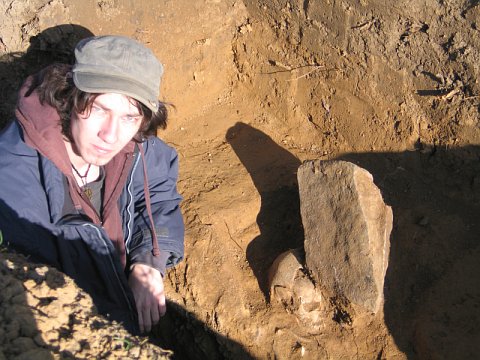
Javier Arries points out to me that there are in fact no less than two recent archaeological finds that may document beliefs in revenants. Apart from the find in Hradék nad Nisou, a more recent one was done in Modrá, known in German as Neudorf, located in Moravia in the South Eastern part of the Czech Republic. You can find more information on the history of Modrá here.

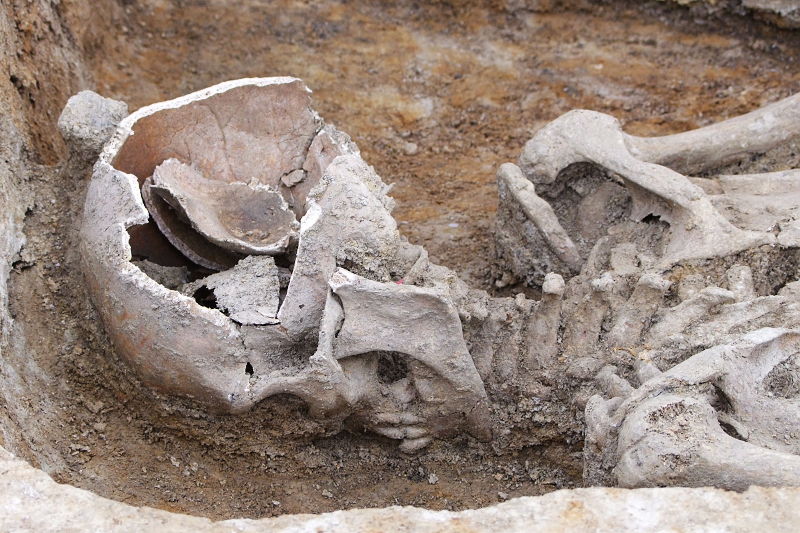
The news about this find is, unfortunately, not available in English, but here is the Czech news story dated May 4 2010: 'V Modré objevili archeologové hrob tzv. vampýra', an interview with the archaeologist Miroslav Vaškových, so here the word vampire, and not upir, is actually used. From what I can gather, the indications of revenant belief includes that the corpse was prevented by stones from exiting the tomb, and that the skull should have been crushed on purpose.

Saturday, 8 May 2010

Another 'vampire' skeleton found

Javier Arries has kindly pointed me to news from Radio Prague concerning a recent archaeological discovery of a skeleton in Hrádek nad Nisou (known in German as Grottau) in the Czech Republic close to the borders to both Germany and Poland

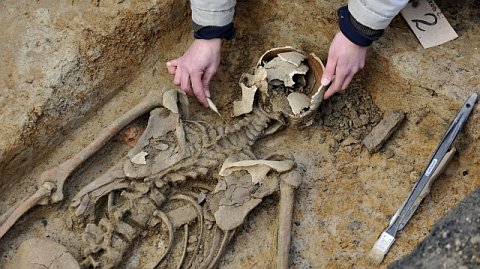
Archeologists in Hrádek nad Nisou are excited about an archeological find uncovered during street repair work in the city centre. Workers digging under the surface of the cobbled street came upon a grave just 20 centimeter below the surface. The skeleton was that of a woman dating around 1310. She was found lying head down with a handful of coins clasped in her hand.

Her position and the location of the grave suggests that she was either considered a witch or a vampire or suffered from a severe physical anomaly and was buried far from the local cemetery in order to prevent her coming back to haunt or harm members of the local community after her death. The skeleton is reported to be surprisingly well preserved given how shallow the grave was and archeologists are hoping to glean much more from the remains. When the research is over the skeleton will be displayed at the local museum.


A couple of news stories in the native language with a few photos can be found here and here, including a close up of the skull. But you should go to this site to watch a TV news story on the vampire (upir), showing both the skeleton and views of the excavations!


Apparently, the five coins found in her hand date from the years 1310-30, and that is why the find is estimated to be from that period. If we should hazard to assume that the body was actually buried in this fashion to prevent it from returning to harm the living, the find is contemporary to the shepherd from Blov and the 'witch' from Levin, the most famous cases of magia posthuma before the 17th and 18th centuries. Both cases were located in the same part of Europe, which makes this find more interesting than the skeleton found in Venice a couple of years ago. Still, I think it pertinent to be sceptical when reading these sensational news stories of supposed 'vampires'.


Show large map

Thursday, 31 July 2008

Vampyrismus v kulturních dejinách Evropy

Giuseppe Maiello, whom I mentioned in a recent post, published a book in 2004 called Vampyrismus v kulturních dejinách Evropy (Vampirism in the cultural history of Europe). As it's written in the Czech language, I can only look at names, references and more or less guess at parts of the text, which is certainly useful for me, but isn't quite enough to really estimate the qualities of the book as a whole. It does, however, look like a really nice book, and fortunately Maiello is much more focused on the historical aspects of vampirism, i.e. e.g. the 18th century debates, than the usual mixture of Stoker, Vlad Tepes, Bathory etc. found in so many books. So I will be carefully studying the text and literature list, in particular for material concerning Moravian magia posthuma.

Sunday, 13 July 2008

Czech magia posthuma

Incredibly, almost a month has passed since my last post. I hope to be more active in the future.

Anyway, I happened to switch to the History Channel last weekend and found myself watching Michael Bell in a documentary about vampires. Unfortunately, I haven't identified the title of this documentary, but it's from 2007, and the major part concerns vampires and magia posthuma in the Czech republic, featuring anthtropologist Giuseppe Maiello and archaeologist Jaroslav Spacek. You can read about both and listen to an interview in English with Maiello here.


The documentary is a bit inaccurate on the sources for the interest in vampires in 18th Century Europe, but otherwise it contains some interesting insights into the Czech archaeological evidence of magia posthuma.

Sunday, 6 April 2008

Another bogus documentary

I'm sorry, but I'm about to reiterate my usual tirade about why people prefer to contruct speculative fictions about vampires rather than telling the actual story. I honestly find it very hard to understand why people don't care to tell the true story when making a documentary about vampires, but rather prefer to invent their own fiction. Why don't they care about the facts? Why do they presume that we, the public, don't want to know the facts, but are willing to be deluded by their fictions? Do they prefer to tell us how superstitious people of the past were rather than try to explain why they did what they actually did?

How come that it is OK to blur the boundaries between fact and fiction when dealing with the (historical) subject of vampires, when no serious historian or documentarist would attempt to do so when dealing with e.g. various episodes in 20th Century history?

Consequently, I am pretty much surprised that scholars and academics are willing to lend their names and professional reputations to bogus historical docudrama like Die Vampir Prinzessin, which is the subject of this post.

The premises of this documentary are:

  1. 3 skeletons from the first half of the 18th Century are found by archaeologists in Cesky Krumlov in the Czech republic. They are buried North-South, and show signs which could be interpreted as if they had been treated for Magia Posthuma (decapitation, stone in a mouth, impaling)
  2. In Cesky Krumlov, a princess called Eleonore Amalie von Schwarzenberg resided in the 18th Century. She suffered from a mysterious illness (actually, cancer), a seemingly mysterious autopsy was carried out on her corpse, and she was buried beneath the floor of a local church.
  3. Bram Stoker quotes Bürger's famous poem, Lenore, in his tale Dracula's Guest, and an Austrian noble woman is referred to.
Based on speculations concerning these three facts, the documentary claims that the princess was suspected of becoming a vampire, and that Bram Stoker was inspired by her tale to create a noble man vampire, Dracula.

Well, today Stoker's working notes have been studied by various authors and scholars, and it is quite certain that Stoker was not inspired by this Bohemian princess but rather by a literary tradition instigated by John William Polidori's character Lord Ruthven. So this whole idea is certainly humbug.

What about the rest of this documentary?


Well, I assume that some of the facts concerning e.g. the three skeletons and princess Eleonore are in fact correct, but I don't find the conclusions very convincing.

Were the three corpses actually treated to prevent them from becoming vampires? The evidence presented is not so convincing that alternative explanations are ruled out.

Furthermore, it is claimed that a certain Dr. Frantz von Gerstorff inspected many cases of vampirism and that he also examined princess Eleonore. Oh, well, Frantz von Gerstorff was actually an Inspector at a mining facility in Transylvania who was involved in examining the case of a certain Dorothea Pihsin who was claimed to be a vampire in 1753. So he wasn't a doctor, and he probably had nothing to do with Eleonore Amalie who died in 1741. So this is even more humbug!

It is also claimed that Stoker probably based his character Abraham van Helsing on Gerard van Swieten, but to my knowledge there is no evidence that he had ever heard of van Swieten. So it's pure speculation.

As for 18th Century doctors, we are required to believe that some of them seriously believed in vampires, whereas the fact is that hardly any enlightened and well educated physician of that day believed in vampires. So when we furthermore are presented with the hypothesis that the autopsy conducted on Eleonora Amalie may have been carried out to prevent her from becoming a vampire, we are required to suspend our disbelief more than anyone can expect.

But then we are assumed to believe that her coffin was put into a specially walled up cavity beneath the church floor to prevent her from coming back, whereas this as far as I'm told isn't a particularly unique way of placing coffins in crypts and church floors.

Well, there's a lot more I could say about the speculations and nonsense that is presented in this documentary, but the above should suffice. What is perhaps even more strange is the appearance of various scholars from universities in e.g. Vienna, whose presence lends credibility to this ludicrous documentary.

So why do they do it? Why don't they tell the true story of the vampires of Serbia, the Magia Posthuma of Bohemia and Moravia, of van Swieten, Maria Theresa, Augustin Calmet etc.? In my opinion the true story will always be more fascinating and interesting than the speculative fantasies presented in documentaries like this one.

It actually really worries me that documentarists don't feel that they owe the public a true understanding of history? Do they really believe that it doesn't matter if we are told the true story or not?

The only redeeming thing about this documentary are the bonus features on the DVD which I have mentioned in an earlier post.

The photo shows Rainer Köppl from the University of Vienna, who hosts the documentary.
Related Posts Plugin for WordPress, Blogger...