On several occasions, particularly on the periphery of the Habsburg Empire during the 17th and 18th centuries, dead people were suspected of being revenants or vampires, and consequently dug up and destroyed. Some contemporary authors named this phenomenon Magia Posthuma. This blog is dedicated to understanding what happened and why.
Showing posts with label Neplach. Show all posts
Monday, 29 April 2013
Austrian Books Online
Österreichische Nationalbibliothek, the Austrian National Library, now cooperates with Google Books in a joint venture called Austrian Books Online aiming at making the library's collection available online in digital format. 600.000 books are planned to be included in the online collection, and so far 100.000 are online.
Among the books is the Kronyka Czeska by Waclaw Hajekz Libocan aka Hagecius, one of the sources for two well-known tales concerning revenants: the shepherd from Blov and the 'witch' from Levin. Both were originally published in the Kronika Neplachov, but Hajekz embellished them in his chronicle. For more information about those revenant or vampire 'cases', follow the above links.
Monday, 27 August 2007
A.D. 1344 according to Neplach
I recently posted the famous tale of the shepherd from Blov as it appeared in the Kronika Neplachova, but there is another well-known case of a revenant referred to in the same chronicle under the year 1344:
"A. d. MCCCXLIV Quedam mulier in Lewin mortua fuit et sepulta. Post sepulturam autem surgebat et multos iugulabat et post quemlibet saltabat. Et cum fuisset transfixa, fluebat sanguis sicud de animali vivo et devoraverat slogerium proprium plus quam medium, et cum extraheretur, totum fuit in sanguine. Et cum deberet cremari, non poterant ligna aliqualiter accendi nisi de tegulis ecclesie ad informacionem aliquarum vetularum. Postquam autem fuisset transfixa, adhuc semper surgebat; sed cum fuisset cremata, tunc totum malum conquievit."
In my translation this goes something like:
A.D. 1344 a certain woman died in Lewin and was buried. But after her burial she rose, killed many and ran after whomever she pleased. And when she was impaled, blood flowed as from a living animal. She had devoured more than half of her veil, and when it was pulled out, it was full of blood. When she was to be cremated, the wood could not be set afire unless it according to the belief of some old women was made of thatch from the church. But after she had been impaled, she once again rose at all times; but when she was cremated, then all evil ceased.
Like the story of the shepherd from Blov, the tale of of the woman from Lewin was retold by Wenceslaus Hagecius in his 16th century Böhmische Chronica with many interesting details somehow added (and again he also added a year to the date, see e.g. Claude Lecouteux: Die Geschichte der Vampire, p. 96-8). This version has been retold by various other authors, e.g. as here quoted by Dudley Wright in his Vampires and Vampirism (first published 1914):
"Again, in 1345, in the town of Lewin, a potter's wife, who was reputed to be a witch, died and owing to suspicions of her pact with Satan, was refused burial in consecrated ground and dumped into a ditch like a dog. The after-events proved that she was not a good Christian, for, instead of remaining quietly in her grave, such as it was, she roamed about in the form of divers unclean beasts, causing much terror and slaying sundry persons. Thereupon her body was exhumed, and it was found that she had chewed and swallowed one-half of her face-cloth, which on being pulled out of her throat showed stains of blood. A stake was driven through her breast, but this only seemed to make matters worse. She now walked abroad with the stake in her hand and killed quite a number of people with this formidable weapon. Her body was then taken up a second time and burned, whereupon she ceased from troubling. The efficacy of this post-mortem auto-da-fé was accepted as conclusive proof that her neighbours had neglected to perform their whole religious duty in not having burned her when she was alive, and they had been thus punished for their remissness." (p. 167-8)
I have unfortunately not had the opportunity to read Ernst Boehlich's 1928 paper on Die Hexe von Lewin, but I can mention that Karen Lambrecht in her 1994 paper on revenants and vampires identifies Lewin as Lewin Kłodzki which is situated in Southwestern Poland. I find this a bit surprising, as Lewin is otherwise referred to as being in Bohemia, and there is in fact a Lewin (Levin) in that part of the Czech Republic. Furthermore, if you read about Levin in the German Wikipedia, it is mentioned that it was well-known for its pottery in the 14th and 15th centuries, and in this connection the potter's wife who became a "vampire" is mentioned:
"Die Einwohner lebten von der Landwirtschaft und dem Handwerk. Besondere traditionen hatte die Lewiner Töpferei, deren erste Zunftprivilegien aus dem Jahre 1402 stammen sollen und deren Produkte als Lewiner Geschirr weit verbreitet waren. Von einer Töpfersfrau, die in der Mitte des 14. Jahrhunderts gelebt und bösen Zauber ausgeübt haben soll und zur Strafe zu einem Vampir wurde, berichtet eine alte Sage." (The inhabitants supported themselves by farming and craftmanship. The Lewin Pottery had particular traditions, which are supposed to originate from their first guild privileges from the year 1402, and there products where widely distributed as Lewin tableware. An old legend tells of a potter's wife, who lived in the middle of the 14th century and is claimed to have practised evil sorcery and as a punishment became a vampire.)
Sunday, 19 August 2007
Magia posthuma and the shepherd from Blov
Frequently Karl Ferdinand von Schertz's 1706 book Magia Posthuma is referred to as the first book on vampires, or as the first 'widely read' book on vampires. It often seems unclear what is the background for these statement, but as far as we can judge from Calmet's description of von Schertz's book, Magia Posthuma was mainly concerned with the revenants of Moravia and neighbouring areas. In fact, von Schertz apparently wrote the book to give a juridical evaluation of the legal proceedings of the authorities in contemporary cases where bodies were exhumed, examined and in some cases destroyed because they were suspected of Magia Posthuma.
Many of these cases are documented - although often briefly - in contemporary sources, and the dead bodies not always appear as revenants, but are at times suspected of posthumous magic simply because they lack the expected signs of corruption. In other cases, they do actually disturb people, although not necessarily in the shape of the dead person, and usually they are not recorded to suck blood! In fact, one researcher rather considers these revenants as poltergeists than as vampires, whereas others relate them to other kinds of revenants known by other characteristics than blood sucking.
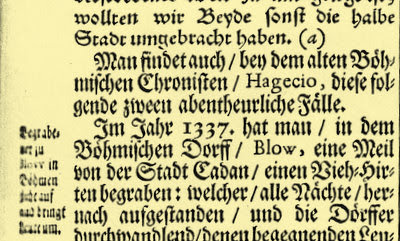
Von Schertz probably didn't know the word 'vampire', which first became well-known throughout Europe after the 1732 Medvedja vampire case, but he was aware of earlier tales of revenants. One tale was that of the shepherd from Blov in Bohemia (situated northwest of Prague at approximately latitude 56.324 N and longitude 13.295 E), which was also related by Johann Weichard Valvasor (1641-1693) in Die Ehre des Herzogthums Krain (1689). The story can be traced to the 16th century Böhmische Chronica written by Wenceslaus Hagecius (Wenzel Hajek von Libotschan/Václav Hájek z Libočan; died 1553) and further back to the Kronika Neplachova, i.e. Neplach's Chronicle, which is also known by the Latin title Summula Chronicae tam Romanae quam Bohemicae written by the Benedictine abbot Jan Neplach (1322-1371).
In the chronicle, the year 1336 A.D. is described this way:
"A. d. MCCCXXXVI Philippus, filius regis Maiorikarum, cum XII nobilibus regni ordinem fratrum Minorum in vigilia Nativitatis Christi ingreditur et in Boemia circa Cadanum ad milliare unum in villa dicta Blow quidam pastor nomine Myslata moritur. Hic omni nocte surgens circuibat omnes villas in circuitu hominus terrendo et iugulando et loquebatur. Et cum fuisset cum palo transfixus: dicebat, multum nocuerunt michi, nam dederunt michi baculum, ut me a canibus defendam ; et cum cremandus efoderetur, tumebat sicut bos et terribiliter rugiebat. Et cum poneretur in ignem, quidam arripiens fustem fixit in eum et continuo eupit cruor sicut de vase. Insuper cum fuisset effossus et in currum positus, collegit pedes ad se sicut vivus, et cum fuisset crematus totum malum conquievit, et antequam cremaretur, quemcumque ex nomine in nocte vocabat, infra octo dies moriebatur. Eodem eciam anno Johannes papa XXI moritur et Benedictus XII in papam eligitur.'
In my rudimentary translation this means:
''A.D. 1336 Philip, son of the king of Majorca, entered the [Franciscan] Order of Friars Minor along with 12 nobles of the kingdom on Christmas Eve Day. In Bohemia about one mile from Cadan in a village called Blow a certain shepherd called Myslata died. Every night he rose and went about every farm in the area and spoke to frighten and kill people. When he had been impaled with a stake, he said: They hurt me much, as they gave me a staff to defend me from the dogs; and when he was exhumed for cremation, he swelled up like an ox and roared terribly. When he was placed in the fire, someone grabbed a stick and put it into him, and immediately blood poured out from him as from a vessel. Furthermore, when he had been dug up and was being put on a cart, he drew his feet to himself as if alive, and before he was cremated, anyone whom he called by name at night, died within eight days. Also the same year the pope John XXI died and Benedict XII was elected as pope."
It is quite obvious that there is no mention of bloodsucking, and that blood ('cruor') is only mentioned in connection with the state of the dead body. His malice seems to be confined to haunting the neighbourhood and naming people who consequently die within eight days. The means that are used to destroy him are very similar to those used against vampires - stakes and fire - so, obviously, there are similarities, but would we call the shepherd a vampire or just a revenant?
Claude Lecouteux mentions the shepherd from Blov under the classification 'Rufer' (someone who yells or calls out) in the German translation of his book on vampires, as the deaths of his victims are caused by him saying aloud their names (and thereby probably calling them to him).
So it would be more appropriate to use the term Magia Posthuma in this case, as this term seems to cover both vampires and other revenants that haunt and molest the living, whose corpses exhibit no signs of ordinary corruption and must be destroyed by various means to stop the threat from the dead. I admit that I know of no use of the term prior to Von Schertz's book, but I find the term fitting for a subject that cannot be restricted to the Serbian vampire of the 18th century, but must take into account prior cases of 'living corpses' from other parts of Europe.
Finally, I like the term because it includes the word Magia and consequently can be linked to both the witch hunt and various 'systems of belief' that involved the concept of 'Magia', which incidentally is usually translated as 'Zauberei' in German. 'Magia Posthuma' thereby presents us with a link to the history and concepts of theology, demonology and witchcraft cases that can help us better understand the context of the famous cases of vampires and revenants of the 17th and 18th centuries. In fact, certain scholars claim that in some areas the witch hunt was succeeded by the cases of vampires and other forms of Magia Posthuma.
By the way, according to The Oxford Dictionary of Popes, pope John XII died on December 4th 1334 and was succeeded by Benedict XII on December 20th that year, so obviously Neplach's dates are not precise! As the above excerpt from Valvasor's book shows, he sets the incident in 1337, so here is a good example of how a story has evolved over the years.
The Latin text of Neplach's chronicle is actually available on the internet.
Many of these cases are documented - although often briefly - in contemporary sources, and the dead bodies not always appear as revenants, but are at times suspected of posthumous magic simply because they lack the expected signs of corruption. In other cases, they do actually disturb people, although not necessarily in the shape of the dead person, and usually they are not recorded to suck blood! In fact, one researcher rather considers these revenants as poltergeists than as vampires, whereas others relate them to other kinds of revenants known by other characteristics than blood sucking.
Von Schertz probably didn't know the word 'vampire', which first became well-known throughout Europe after the 1732 Medvedja vampire case, but he was aware of earlier tales of revenants. One tale was that of the shepherd from Blov in Bohemia (situated northwest of Prague at approximately latitude 56.324 N and longitude 13.295 E), which was also related by Johann Weichard Valvasor (1641-1693) in Die Ehre des Herzogthums Krain (1689). The story can be traced to the 16th century Böhmische Chronica written by Wenceslaus Hagecius (Wenzel Hajek von Libotschan/Václav Hájek z Libočan; died 1553) and further back to the Kronika Neplachova, i.e. Neplach's Chronicle, which is also known by the Latin title Summula Chronicae tam Romanae quam Bohemicae written by the Benedictine abbot Jan Neplach (1322-1371).
In the chronicle, the year 1336 A.D. is described this way:
"A. d. MCCCXXXVI Philippus, filius regis Maiorikarum, cum XII nobilibus regni ordinem fratrum Minorum in vigilia Nativitatis Christi ingreditur et in Boemia circa Cadanum ad milliare unum in villa dicta Blow quidam pastor nomine Myslata moritur. Hic omni nocte surgens circuibat omnes villas in circuitu hominus terrendo et iugulando et loquebatur. Et cum fuisset cum palo transfixus: dicebat, multum nocuerunt michi, nam dederunt michi baculum, ut me a canibus defendam ; et cum cremandus efoderetur, tumebat sicut bos et terribiliter rugiebat. Et cum poneretur in ignem, quidam arripiens fustem fixit in eum et continuo eupit cruor sicut de vase. Insuper cum fuisset effossus et in currum positus, collegit pedes ad se sicut vivus, et cum fuisset crematus totum malum conquievit, et antequam cremaretur, quemcumque ex nomine in nocte vocabat, infra octo dies moriebatur. Eodem eciam anno Johannes papa XXI moritur et Benedictus XII in papam eligitur.'
In my rudimentary translation this means:
''A.D. 1336 Philip, son of the king of Majorca, entered the [Franciscan] Order of Friars Minor along with 12 nobles of the kingdom on Christmas Eve Day. In Bohemia about one mile from Cadan in a village called Blow a certain shepherd called Myslata died. Every night he rose and went about every farm in the area and spoke to frighten and kill people. When he had been impaled with a stake, he said: They hurt me much, as they gave me a staff to defend me from the dogs; and when he was exhumed for cremation, he swelled up like an ox and roared terribly. When he was placed in the fire, someone grabbed a stick and put it into him, and immediately blood poured out from him as from a vessel. Furthermore, when he had been dug up and was being put on a cart, he drew his feet to himself as if alive, and before he was cremated, anyone whom he called by name at night, died within eight days. Also the same year the pope John XXI died and Benedict XII was elected as pope."
It is quite obvious that there is no mention of bloodsucking, and that blood ('cruor') is only mentioned in connection with the state of the dead body. His malice seems to be confined to haunting the neighbourhood and naming people who consequently die within eight days. The means that are used to destroy him are very similar to those used against vampires - stakes and fire - so, obviously, there are similarities, but would we call the shepherd a vampire or just a revenant?

Claude Lecouteux mentions the shepherd from Blov under the classification 'Rufer' (someone who yells or calls out) in the German translation of his book on vampires, as the deaths of his victims are caused by him saying aloud their names (and thereby probably calling them to him).
So it would be more appropriate to use the term Magia Posthuma in this case, as this term seems to cover both vampires and other revenants that haunt and molest the living, whose corpses exhibit no signs of ordinary corruption and must be destroyed by various means to stop the threat from the dead. I admit that I know of no use of the term prior to Von Schertz's book, but I find the term fitting for a subject that cannot be restricted to the Serbian vampire of the 18th century, but must take into account prior cases of 'living corpses' from other parts of Europe.
Finally, I like the term because it includes the word Magia and consequently can be linked to both the witch hunt and various 'systems of belief' that involved the concept of 'Magia', which incidentally is usually translated as 'Zauberei' in German. 'Magia Posthuma' thereby presents us with a link to the history and concepts of theology, demonology and witchcraft cases that can help us better understand the context of the famous cases of vampires and revenants of the 17th and 18th centuries. In fact, certain scholars claim that in some areas the witch hunt was succeeded by the cases of vampires and other forms of Magia Posthuma.
By the way, according to The Oxford Dictionary of Popes, pope John XII died on December 4th 1334 and was succeeded by Benedict XII on December 20th that year, so obviously Neplach's dates are not precise! As the above excerpt from Valvasor's book shows, he sets the incident in 1337, so here is a good example of how a story has evolved over the years.
The Latin text of Neplach's chronicle is actually available on the internet.
Subscribe to:
Posts (Atom)
