Showing posts with label Magia Posthuma. Show all posts

Sunday, 8 June 2014

Vampyrismus & Magia posthuma


By chance, years ago I watched part of a programme on History Channel about vampires in which anthropologist Giuseppe Maiello from the Charles University, Univerzita Karlova, in Prague was interviewed about vampires. I recall contacting Maiello who responded that he had himself not seen that interview. At the same time I learned about the book he had written on vampires, Vampyrismus v kulturních dĕjinách Evropy, which had been published in 2004, and got hold of it to see what a Czech researcher would include in a book on this subject.

Now Maiello has published a new edition of the book, this time titled Vampyrismus & Magia posthuma, and the new title indicates the major addition that has been made in this edition: A Czech translation of Karl Ferdinand von Schertz’s Magia Posthuma has been added to the sources at the end of the book!

The new edition also includes a foreword mentioning some of the work that has been published since the first edition, as well as summaries in English, French and Italian that can be helpful to those of us who are not proficient in the Czech language. Furthermore, a number of illustrations have been added, in particular of some key persons, including one of Schertz, which is unfortunately not of the best quality.


According to the English summary, 'Vampyrismus a Magia posthuma [Vampirism and Magia posthuma] is an updated version of Vampyrismus v kulturních dějinách Evropy [Vampirism in the cultural history of Europe], which had first appeared in bookstores back in 2005. The book describes the phenomenon of Vampirism from an etymological, cultural-historical, ethnographic and anthropological point of view.

Up until now, the sources of the book were found primarily in the libraries of the Czech Republic. For this reason the book includes both classic examples from the literature of Western countries, transmitted through the intermediation of Abbot Augustine Calmet, as well as examples taken from the ethnographic literature of Central and Eastern European countries and the Balkans; lesser known or completely unknown to wider audiences and to western European and northern American specialists.

The second part of the book deals with the main theories on the origins of vampirism through the comparison between different cultures, and across temporal space, from classical antiquity up to the late nineteenth century. These theories concentrate on three areas: universal theories of the origins and prehistory of vampirism; theories (less probable) that derive vampirism by social and cultural changes that took place in modern Europe; and theories related to the analysis of agrarian cults and their struggles for the fertility of the fields.

In addition to other texts already published or translated into other languages, this is the first time that there is published in a modern language the Karl Ferdinand Schertz's study
Magia posthuma, which had been released only once in a printed Latin edition in 1704 (but which had the date 1706 written on the title page).'

Maiello has also published a paper on Schertz in 2012 in Slavica litteraria, Racionalismus Karla Ferdinada Schertze a Magia posthuma (Karl Ferdinand Schertz's rationalism and Magia posthuma). Written in Czech, it does however include an English abstract:

'Karl Ferdinand Schertz is at home a no well known author. On the contrary, his name is known around the world thanks to his work Magia posthuma, which was quoted by Augustin Calmet. Because of his not well available biography and books, Schertz is unfortunately wrong understood and around him circulate various rumors or negative critics. Karl Ferdinand Schertz was on the contrary highly cultured author, who could enjoy a good reputation among the european intellectuals of his time.'

The paper briefly deals with Schertz's life and works, and discusses his approach to magia posthuma, which in Maiello's view make Schertz more of a rationalist than a man of the Baroque period. Maiello actually finds that the rationalistic approach of Schertz is comparable to that of Calmet. Cf. what I have myself written in Vampirismus und magia posthuma im Diskurs der Habsburgermonarchie edited by Augustynowiz and Reber (or as part of Kakanien Revisited).


Giuseppe Maiello talks about vampires on this Czech talk show

I thank Giuseppe Maiello for providing me with a copy of his book. He informs me that the publisheres are considering publishing an edition in English.

Sunday, 14 July 2013

'Vampire skeletons' in Poland


See Dziennik zachodni for more photos
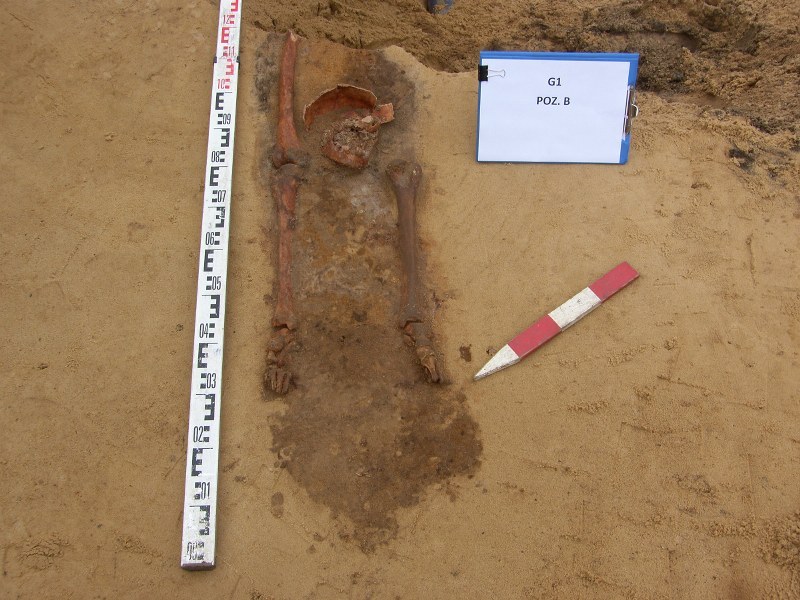
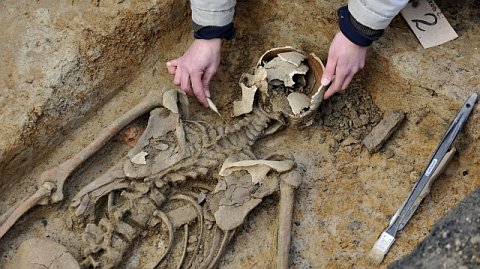
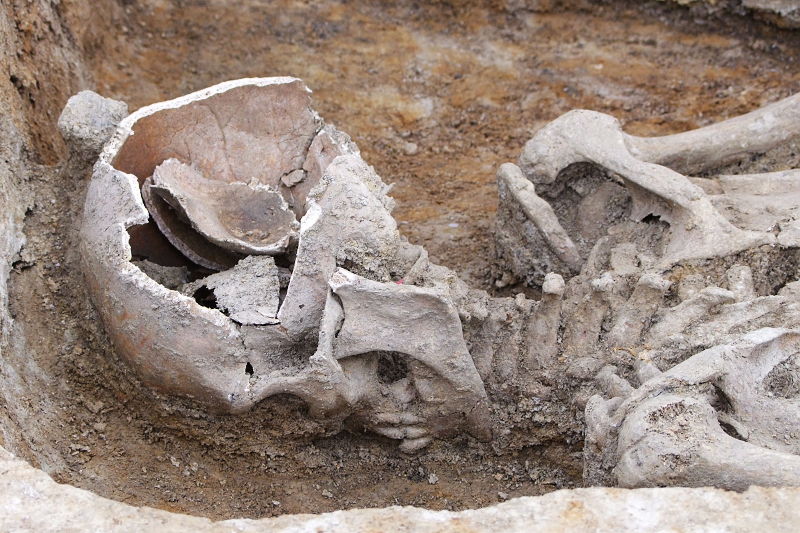
While constructing a ring road in Gliwice in South West Poland, formerly part of Silesia, four skeletons were found with their heads cut off and e.g. placed between the skeleton's legs. Archaeologist Dr. Jacek Pierzak says that it is hard to date the skeletons, but they are believed to come from the early modern period. Tests will date them and may provide a better understanding of whether they were e.g. victims of a cholera epidemic, executed criminals, or indeed people who the locals wished to prevent from becoming revenants.

The latter theory has made some Polish web sites write about incidents of vampirism in the areas that are now part of Poland, and, of course, Silesia was one of the areas where beliefs in magia posthuma was not uncommon in the early modern period. The press mentions a more recent example from the village Stare Mierzwice  Masovia, about 100 km to the East of Warsaw, where in 1914 a corpse was dug up, beheaded, and the head placed between the legs.

Thanks to Leon Aguilera Radford for notifying me of this news story.

Thursday, 29 December 2011

Witch-hunting

Readers residing in or visiting Switzerland, may wish to go to Chateau Chillon, famous for its literary connections, to attend the exhibition Witch-hunting in the Pays de Vaud, from the 15th to the 17th centuries.

'The Pays de Vaud was the site of major witch-hunts between the 15th and the 17th centuries. During this period, there were more than 2'000 death sentences!

On a larger scale, Switzerland within the current borders if the time holds not only the record for the longest-lasting repression of witchcraft but also for the largest number of people persecuted fro this crime, in relation to the population. In almost three centuries, 5,000 people were accused and 3,500 of them were put to death, mainly by fire, with 60 - 70% being women.

Chillon Castle was an important detention centre for individuals suspected of witchcraft, either when awaiting trail or carrying out their sentence. During the term of the Bernese bailiff, Nicolas de Watteville, from 1595 to 1601, some forty-odd people were executed at Chillon, La Tour-de-Peilz and Vevey. And 27 more in 1613! Their Excellencies of Bern noted «with regret and sadness» «the extent to which the negation of God and submission to the evil spirit was growing among our subjects in the Romand (French-speaking) country».


Given these facts, the renowned Vaudois fortress is an apt location for this exhibition. Based on documents primarily related to Chillon, then to the region (Riviera-Vaud-Western Switzerland), the exhibition highlights this little known facet of Vaudois history.

The purpose of the museography and the catalogue is not to make people shudder – although shudder one does when contemplating the terrible suffering the poor souls had to undergo. Through texts and images, the exhibition illustrates a portrait of simple madness, madness that at times leads to making pacts with the Devil and, on the other side of the coin, the madness of the inquisitors who could consider a hollow tooth housing for an impure spirit!'


Accompanying the exhibition, a series of films is screened by the Swiss cinemateque Sorciers and sorcières au cinéma, which includes several well-known films somehow related to the subject, even featuring Mario Bava's vampire film, La Maschera del Demonio.

Not included is Otakar Vávra's Czech Kladivo na carodejnice from 1970. Known in English as The Witches' Hammer and in German as Hexenjagd, it is the interesting and at the same time unpleasant story of the witch hunter Heinrich Franz Boblig's infamous persecution of supposed witches in Groß-Ullersdorf (Velké Losiny) in Northern Moravia in the 1680's. Worth watching in its own right, and no doubt the persecution resembles the paranoia people may have experienced on that side of the Iron Curtain, the film is also interesting because it is set in the vicinity of the areas where incidents of magia posthuma were encountered (and only a few years before von Schertz published his book on the subject). So you may imagine that some of the persons involved may at other times have heard of or dealt with corpses suspected of harming the living...

The film is available on DVD in Germany and in the USA, but it can currently be watched in toto on youtube with English subtitles.

Thursday, 1 December 2011

Vampertione infecta


I have always found it strange how various 'black metal' bands take up names and quotes from all sorts of literature on e.g. vampires and posthumous magic for their band names and song titles, cf. this post. According to the Wikipedia entry on Black Metal,

'The most common and founding lyrical theme is opposition to Christianity and other organized religions. As part of this, many artists write lyrics that could be seen to promote atheism, antitheism, paganism or Satanism. The hostility of many secular or pagan black metal artists is in some way linked to the Christianization of their countries. Other oft-explored themes are depression, nihilism, misanthropy, death and other dark topics. However, over time, many black metal artists have begun to focus more on topics like the seasons (particularly winter), nature, mythology, folklore, philosophy and fantasy.'

Certainly not to my own taste in music and aesthetics, it is curious to find that sometimes searches on the internet directly lead to web sites about black metal bands. One such search concerned the phrase 'vampertione infecta', which has been used as a song title by Italian metal band Riul Doamnei. The phrase is probably mainly known to people with a special interest in Moravian magia posthuma, as it supposedly appears in an 18th century parish register of deaths in Moravia or the North East of present day Czech Republic.

At least, so Christian d'Elvert claimed when writing about vampires and posthumous magic in 1859, see e.g. Die Wiedergänger von Bärn/Mähren 1662-1740 or this recent entry on Rob Brautigam's Shroudeater site, quoting an entry from the parish register of Bärn, present day Moravsky Beroun:

'Anno 1725 den 28. Februar ist Anna des seligen Andreas Berge, gewesene Ehewirtin verschieden, ihres Alters 48 Jahr, hat keine Ruhe in der Erden gehabt, Vampertione infecta, und ist letztlich verbrannt worden.'

In English: A.D. 1725 on February 28, Anna, the widow of the blessed Andreas Berge, deceased at the age of 48. She found no peace in the earth, Vampertione infecta, and was finally cremated.

Klaus Hamberger notes the word 'Vampertione' when commenting on the incident in his Mortuus non mordet: 'Das Fremdwort in der Eintragung zum 28. 2. 1725 verweist gleichwohl auf einen bemerkenswerten Bruch.' (p. 77) So I have always been somewhat intrigued by the term, and when I had the chance, I looked for it in the original (as shown below), and - to my eyes - there is no trace of the infection!


So, one might wonder how those two Latin words ended up among d'Elvert's otherwise reasonably reliable passages from the parish register. Just as one may wonder what 'Vampertione' was supposed to mean.

At face value this is clearly an example of the burning of a corpse suspected of posthumous magic that appears to have been relatively common in those parts during the 17th and 18th centuries. The entry in the parish register contains no description of how people determined that she should have found no rest in the grave. For that reason it seems farfetched to talk of a vampire per se. Still, as we know, the term 'vampire' was quickly linked to various kinds of revenants and (supposedly) uncorrupted corpses. For that reason, Gregor Wolny had no qualms using the term when mentioning the examples of posthumous magic in Bärn in his Die Markgraffschaft Mähren topographisch, statistisch und historisch geshildert from 1839, as shown in the excerpt at the bottom of this post.

Looking at the reproduction of the text above, even as shown here, I think you can see that there is a difference in the shade of the ink from the first to the last sentence, but the style of writing looks similar. Clearly, the last sentence was added later, as one would expect. Unfortunately, we know nothing of what happened in between, only that it apparently did not involve 'Vampertione infecta' ...


View Larger Map


Saturday, 29 January 2011

Reading von Schertz

Most of you probably have not had the chance to read a book by Carl Ferdinand von Schertz, but now it is possible on Google Books. OK, you may not be particularly interested in the subject of the book, but here is a chance to get a feel for the man and his interests besides the subject of the book that he is best known for, Magia Posthuma.

Mährisches Landes-Wappen published in Nuremberg in 1699, i.e. prior to Magia Posthuma, is a book on Moravian coats of arms with considerations on e.g. the etymology and spelling of the name of Moravia (which takes it name from the Morava River).

Heraldry may not be your subject, but you may wonder if that little portrait on the title page could bear any semblance to that of the author? Looking at other books from the same publisher or printer might answer that question.

Saturday, 8 May 2010

Another 'vampire' skeleton found

Javier Arries has kindly pointed me to news from Radio Prague concerning a recent archaeological discovery of a skeleton in Hrádek nad Nisou (known in German as Grottau) in the Czech Republic close to the borders to both Germany and Poland

Archeologists in Hrádek nad Nisou are excited about an archeological find uncovered during street repair work in the city centre. Workers digging under the surface of the cobbled street came upon a grave just 20 centimeter below the surface. The skeleton was that of a woman dating around 1310. She was found lying head down with a handful of coins clasped in her hand.

Her position and the location of the grave suggests that she was either considered a witch or a vampire or suffered from a severe physical anomaly and was buried far from the local cemetery in order to prevent her coming back to haunt or harm members of the local community after her death. The skeleton is reported to be surprisingly well preserved given how shallow the grave was and archeologists are hoping to glean much more from the remains. When the research is over the skeleton will be displayed at the local museum.


A couple of news stories in the native language with a few photos can be found here and here, including a close up of the skull. But you should go to this site to watch a TV news story on the vampire (upir), showing both the skeleton and views of the excavations!


Apparently, the five coins found in her hand date from the years 1310-30, and that is why the find is estimated to be from that period. If we should hazard to assume that the body was actually buried in this fashion to prevent it from returning to harm the living, the find is contemporary to the shepherd from Blov and the 'witch' from Levin, the most famous cases of magia posthuma before the 17th and 18th centuries. Both cases were located in the same part of Europe, which makes this find more interesting than the skeleton found in Venice a couple of years ago. Still, I think it pertinent to be sceptical when reading these sensational news stories of supposed 'vampires'.


Show large map

Tuesday, 6 October 2009

31 Days of Halloween

If you check out this blog, Reading with a Bite, you will find that I am today's guest blogger, contributing to 31 Days of Halloween. As many web sites and blogs are counting down to Halloween, you will probably find a lot of writings related to fictional vampires this October. If you are male and going to a Halloween party, you can even get some tips on how to dress the part :-)

If you happen to be someone visiting this blog for the first time in search of information on Magia Posthuma, I recommend that you read my paper on the subject of this blog and von Schertz's book! Otherwise, do look at some of the selected posts that I link to on the right hand side.

Tuesday, 15 September 2009

A weblog approach

Further papers from the conference in Vienna this summer are now available, including my own contribution, which is actually in English. Apart from an insight into this blog, it contains some information on the contents of the enigmatic Magia posthuma by Karl Ferdinand von Schertz...

Wednesday, 4 March 2009

Vampirism in Austria and Prussia

The digital anthology on vampirism on the Kakanien Revisited web site that I mentioned here contains a recent paper by Thomas Bohn on vampirism in Austria and Prussia (Vampirismus in Österreich und Preussen).

In the paper Bohn provides a brief, but clear and noteworthy history of the vampire and magia posthuma from the late 17th century and onwards that reveals an unusually good knowledge of the literature on vampires. Bohn obviously has studied not only the usual sources, but also some of those that are a bit harder to come by (like perhaps the one shown below) and background information on the period. He discusses the development of the vampire and its connection with geography and the construction of an East-West dichotomy, and in short concludes that 'Summa summarum symbolisierte der schillernde Ausdruck "Vampir" in den westlichen Gesellschaften bis zum Ersten Weltkrieg einen clash of civilizations.' Highly recommended reading.

Friday, 27 February 2009

In short

I have seen a preliminary list of abstracts for the conference in Vienna this July. It looks very interesting. I suppose that I may mention that a certain blogger has submitted an abstract concerning a blog on the history of Central and Eastern European vampire cases of the 18th Century.

Sunday, 22 February 2009

Tight-rope walking

The Austrian publisher Böhlau mentioned in my last post published a volume on vampire matters in 1997: 100 Jahre Dracula compiled by Rainer M. Köppl, who later on hosted the Vampire Princess documentary. Commemorating the centenary of Bram Stoker's Dracula, the book mostly contains material related to Dracula and other fictional vampires. There is, however, a short article on vampirism from a medical point of view by Andreas Leithner and Christian Reiter (Reiter also was in the above mentioned documentary) which lists some of the diseases that people have tried to relate to the vampire cases, and of our main interest: An article by Köppl on Gerard van Swieten (Wissenschaft und Totenzauber) and a reprint of the German translation of van Swieten's remarks on vampirism! Köppl's article is quite enjoyable in its description of van Swieten's tight-rope walking between religion and materialism when denouncing the magia posthuma.

Sunday, 11 January 2009

240 years ago

Although the title page actually says 1769, on December 31st it was 240 years since the Constitutio Criminalis Theresiana was published. This criminal law passed by Empress Maria Theresa was her attempt at unifying criminal law throughout the countries under Austrian rule, thereby putting an end to various local judicial practices. E.g. the Theresiana aimed at limiting the use of torture for judicial purposes, and consequently it contains various descriptions in text and figures on the minutiae of the methods of torture. The parts of the book describing these methods are available in a German book publish by Reprint-Verlag in Leipzig: Folterwerkzeuge und ihre Anwendung 1769. This is not pleasant reading, and the pain inflicted by the torture is clearly visible on the faces of the victims in the illustrations.


The Theresiana also deals with cases of witchcraft and in that sense sums up Maria Theresa's previous endeavours to fight acts of superstition like the burning of corpses suspected of magia posthuma, see e.g. this post, although the Theresiana apparently had to be more conservative than the actual practice. Witchcraft trials had actually been abolished in 1766.

Fortunately, less than twenty years later torture was abolished with the criminal law passed by Maria Theresa's son Joseph II in 1787.

Online the Theresiana is available as a PDF file.

Saturday, 29 November 2008

Hortus Medicus

I am not botanically inclined, but botanical gardens can be pleasant to visit. In Vienna I had even more reason to go to the Botanical Garden of the Vienna University, as it was Gerard van Swieten who as Direktor of the Medical Faculty suggested to Empress Maria Theresa to found a 'Hortus Medicus', a medical garden. This was in 1754, i.e. the year before both the Empress and van Swieten became involved in the matter of Magia Posthuma and vampirism.

To be honest, I wasn't impressed with the Botanische Garten, but that is probably because of my lack of personal interest in botanics, and because I had spent hours at the Heeresgeschichtliches Museum and at the Upper and Lower Belvedere before I went to visit it.

Actually, I had more pleasure from visiting the Botanischer Garten in Halle earlier this year. I don't know if it has any particular connection with some of the learned men related to the 18th century 'secret capital of vampire theory'. This garden predates the one in Vienna, as it was founded in 1698. It contains several greenhouses that are open to the public, whereas most of the greenhouses in Vienna are only open to researchers. It's a very pleasant and relatively quiet place, at least when I visited it this summer.

The first two photos above are from Vienna, whereas the photos just above and below are from Halle.

Sunday, 9 November 2008

On the trail

Although I have had time to start reading Hagen Schaub's book on the history of vampires, I doubt that I will find time to finish it and write about it for a number of days. Suffice it to say, that it definitely explores some of the avenues that are along the lines of this blog and my own interest in 'living corpses'.

It's curious that a book that needs be must debunk the notion of 'vampire fangs' itself is being sold by showing those teeth on the cover :-)

Saturday, 8 November 2008

Nostalgia

I have in my possession an old Danish comic book on ghosts, which is actually a translation of an original comic book from Classics International that published the well-known Illustrated Classics series. Published in 1961, which is a couple of years before I was born, I must have purchased it in some second hand book shop as a child (as a child I spent a lot of my pocket money on second hand books and comics) and for some reason I have kept it ever since.


The title translates as 'Superstition and Ghosts', and it was, of course, issue number 13 in a series on 'The world in text and pictures'. It contains a number of relatively archetypical examples of stories of ghosts and premonition, like e.g. the story of a man giving a girl a ride only to find that she was the ghost of a girl who was killed in a car accident and is buried in the cemetery where he saw her waiting for a bus.

Another example is poltergeist phenomena, which is also reported in some cases of magia posthuma. Like premonition, it is a subject that was of particular interest to those involved in parapsychology, a subject that was in vogue when the comic book was published, and a lot of the contents are concerned with 'telepathy', 'telechinesis' etc.

It's quite curious to be reminded of how popular 'paranormal research' was back then, as no one seems to care about it today. Well, I suppose it should be obvious that it was a dead end like the 'theories' of Von Däniken and others that were also widely studied when I was a child and a young man. I'm sure there are internet groups that cherish these theories and collect 'Forteana', but I'm not going to look for them. Even the subject of vampirism has its cultists, and I don't care to spend any time on them.

But it is very interesting to study how the conception of revenants and related 'supernatural' phenomena have changed over the years, e.g. from the quite corporeal revenants of earlier times to the rather incorporeal 'grey ladies' and onto the pseudo-scientific concepts of parapsychology. Unfortunately, very few books attempt to describe this evolution and explain it in terms of how our world view has changed over e.g. the past milennium.

The old comic book on ghosts isn't very well drawn, and maybe it's just because I read it as a child, but I think it does say something essential about the subject in a way that makes you say: 'What if?'

Click on the two pages from the comic book to see them in a larger format.

Tuesday, 4 November 2008

Bibliophilia

Those of us who are inclined towards bibliophilia will probably be fascinated by this list of rare and expensive books currently for sale on Abebooks. The prices are astronomical - $ 1.800.000 for a book! - so there's no Cosmographia for me.

Those who are inclined towards fictional vampires will be drawn in by this edition of Charlotte Brontë's Jane Eyre with its reference to 'the foul German spectre - the Vampyre', see e.g. James B. Twitchell's The Living Dead: A Study of the Vampire in Romantic Literature (Duke University Press, 1981), itself a nice book for bibliophiles because of the dust jacket with the two holes punched out to look like the mark of a vampire's bite on the neck of the woman in one Fuseli's Nightmare paintings.

One may wonder what the price would be of an original copy of von Schertz's Magia Posthuma. I know of at most three (3) copies of this book, so it would probably fetch a high price if set for sale on auction, but who knows.

Fortunately, an increasing number of those early books are now available digitally. That's not quite satisfactory for those who like to have a physical copy of the original book, but we are at least allowed the possibility of reading the text. Anyway, the owner of that edition of Jane Eyre which costs $ 122.107,03 probably wouldn't dare to sit comfortably on the settee reading it. He or she would probably rather buy a cheap paperback edition in order not to damage the expensive investment.

Sunday, 14 September 2008

A forgotten vampire case

I have been a bit quiet here lately, as I have been busy doing other things. But now I finally get around to mentioning that Nicolaus Equiamicus recently posted a forgotten vampire case from 1725, i.e. the same year as the Kisiljevo vampire case.

In early April of 1725 Johannes Ràcz de Mehàdia who was in charge of a district in Hungary, exhumed and examined the corpse of a dead person who while alive had been suspected of being a sorcerer. He found the corpse uncorrupted and with blood under its head. As the body had been buried for three months, he concluded that it must be that of a blood sucker (Bluthsauger). With the permission the Imperial Oberinspektor, Baron von Rebenstich, he dealt with the body in the accustomed manner, probably as is well known from the other vampire cases.

Quotes from the sources can be found via the above link.

Sunday, 17 August 2008

But my interests lie elsewhere...

Following up on my recent autobiographical note, I should perhaps say a bit more about my current interest in the subject.

I have frequently stressed my interest as 'historical'. I find that it is important to place vampires and magia posthuma in time and space instead of in some Neverland reminiscent of the Transylvania of our fictional or 'symbolic' geography. The people who were afraid of revenants were 'real' people, and it was 'real' people who were doctors, military personnel, priests and other persons in authority who had to find a way to deal with this 'superstition'. Also, it was well-educated and learned people who were involved in debating the incorruptibility of the corpses exhumed and the illness that the supposed victims were suffering from. In my opinion, it is more fascinating to try to understand these people, their concerns, notions, theories, beliefs and fears, and why they spent time on this strange subject, than to perpetuate the vampire mythology of Stoker or Summers, cf. some old posts here, here, and here.

So one of my interests is simply to place vampires and 'posthumous magic' in a historical context by asking relatively simple questions like: What did it look like in 'Medvegia', when people were afraid of vampires in the winter of 1731-32? How were the people dressed? Who were they? What medical background did a field surgeon like Flückinger have? Oh, and where is 'Medvegia' anyway? So I've tried to find out about the Habsburg Militärgrenze, looked for books on soldiers and military uniforms from the 18th century, and have been reading about the development of medicine in those years, but still some of the questions are pretty hard to answer when you're not familiar with the history of those regions, and the amount of information available here in Denmark on the region and period is far from impressive. You can for instance not find a copy of the only modern biography of Charles VI (Bernd Rill: Karl VI. Habsburg als barocke Großmacht) in any Danish library, so I had to get it on loan from Sweden...

On top of such practical obstacles, even historians can have a hard time understanding e.g. the history of the Habsburg Empire, cf. the preface to Charles Ingrao's The Habsburg Empire 1618-1815. Certainly, there are other aspects of the relevant period of European period that is far from described and understood, but then it is intriguing to see how e.g. the research into the witch hunt has developed over the past few years. What is particularly interesting is to see how muddled the picture really is, and how the stereotypical mythology of the progress of enlightened rationality and secularism isn't in harmony with the actual historical development. But then that is one of the aspects that might whet one's appetite for figuring out was going on and why :-)

This particularly goes for the great vampire debate of 1732. Very few studies place this debate in the context of the contemporary scientific and philosophical discourses, and consequently it is hard for most people to get an understanding of why learned people found it necessary to discuss revenants and incorruptibility. I am grateful for the hard work laid down by people like Klaus Hamberger to help understanding the various theories and discussions, because it's frequently hard to understand the context of a past debate.

In this respect, I see the vampire debate as an interesting case for illustrating and understanding the developments in science and academia in those years, as well as in other aspects of society, in an era when science and society developed pretty rapidly. From a more theoretical point of view on the development of the sciences, it is also very interesting to see how phenomena are discriminated and organized in new ways, new theoretical frameworks built, allowing for new institutions and methods. Here the various ways to deal with the 'miracula mortuorum', including incorruptibility and tales of revenants, are an interesting and pretty pertinent example.

No doubt, a lot of interest has been given to some of these subjects over the past decades, e.g. on burial practices, cf. not only the well-known work by Philippe Aries, but later work like that found in the anthologies Körper ohne Leben: Begegnung und Umgang mit Toten edited by Norbert Stefenelli, and The Place of the Dead: Death and Remembrance in Late Medieval and Early Modern Europe edited by Bruce Gordon and Peter Marshall.

Another aspect that has been stressed in the later years, is the relation between vampires and the magia posthuma on one hand and the witchcraft beliefs on the other. Gabor Klaniczay has contributed to this understanding leaving an easily detectable fingerprint on the current understanding of the history of the witch hunt, cf. e.g. volume 5 of The Athlone History of Witchcraft and Magic in Europe: The Eighteenth and Nineteenth Centuries, but I believe that a better understanding of the magia posthuma in e.g. Moravia and Silesia is required, see e.g. the work of Karen Lambrecht, to fully link the history of magia posthuma with that of Central European witchcraft.

This way, the history of vampires and magia posthuma is probably also an interesting case for illustrating and understanding the 'decline of magic' and the development of the modern secular society.

In fact, the 'complete' synthesis of the current knowledge of folklore, archaeology, evidence of revenant beliefs and apotropaics, etc. with the documents and books on vampires and magia posthuma of the 17th and 18th centuries, in my opinion still requires some work. However, with the opening up of borders within Europe, and the easier access to books and archival material, it should be possible to fill in the gaps. So I'm pretty optimistic, and maybe that elusive 'vampire book to end all vampire books' that I mentioned in my recent post, will get published in the near future :-)

Due should of course be given to the people who have put in important work in the later years and have inspired me in my own endeavours. Some have been mentioned in this post, some elsewhere in previous posts on this blog.

Saturday, 9 August 2008

An autobiographical note

A friend of mine tells me that blog visitors wish to know a bit about the blogger whose texts they are reading. I can understand that, but I was initially very concerned about the reaction my blog would get: Would I get lumped in with various self-styled 'vampires' and Goths? Would I be considered another weirdo? Well, fortunately I haven't encountered any real problems, so I have slowly allowed myself to disclose a bit more about myself here, including a photo (the current one taken while awaiting food and beer to be served at Gasthaus Alte Nikolaischule in Leipzig).

My initial interest in the subject of vampires, magia posthuma etc. probably followed a course not dissimilar to that of so many others. Reading Dracula comic books as a child, I finally read Stoker's Dracula (in a Danish translation) as a teenager. That's certainly an impressionable age where you are easily fascinated, so I started reading all the books on vampires and Dracula I could find. I knew about Vlad Tepes, so I had some ambition of studying both 'the historical Dracula' and vampires in general. This was in the late Seventies, so 'source material' would be e.g. Florescu and McNally, Gabriel Ronay (whose The Dracula Myth had been translated into Danish), Anthony Masters as well as all sorts of books. I also found Sturm und Völker's anthology. My interest certainly wasn't particularly focused, I was sort of a collector of anything that had to do with vampires and Dracula.

I soon realized that it would be useful to know other people with a similar interest. So I began working on a magazine (i.e. fanzine) and got into contact with a few people and got assistance from others. Consequently, we ended up organizing a 'vampire society' with its own magazine, newsletter and various meetings (the society dissolved many years ago, I should add). I also joined some of the international associations, like the British Dracula Society, the New York based Count Dracula Fan Club, and the Irish Bram Stoker Society, and even attended a walk around Stoker's and Dracula's London in the company of members of the Dracula Society in the mid Eighties.

In the meantime, my search for books on the subject continued, as I was still looking for that elusive vampire book to end all vampire books, but I was never really satisfied with what I found. At one point I started going to the reading room of the Royal Library where I found obscure articles and old books like Valvasor's, the 1734 edition of Ranft's Traktat, and even Tallar's book which I had never seen mentioned in any book on the subject. I also looked at an Icelandic translation of Stoker's Dracula with a foreword that I sent to someone who had it translated into English and published.

Anyway, at this time other activities required attention. Within a few years, I was studying physics and mathematics at the University of Copenhagen, became a father, and later on I got involved in political activities. So the years passed by focusing on other pursuits. Occasionally I would purchase a new book on the subject, but for every really good book (say Paul Barber's book), there were a lot of disappointing books like Peter Haining's Dracula Centenary book.

In 2006 I felt that I had both spare time and the desire to take up the subject of vampires again, aiming at writing a popular book on vampires in Danish, more or less based on the material I already had. So I decided to spend more or less a whole week of a summer vacation from early morning to late evening on getting started on this project. Well, it spilled over to the following weeks, and most of my vacation was spent on writing and looking for information, and it just continued in whatever spare time I could find in the following months.

I soon realized that there was a lot of information I had to find, and also that I needed to get hold of some books that I hadn't been aware of, to fill in the gaps and to know the status of research in this and related fields. I was also inspired to view the subject from new points of view, requiring me to find out more about the historical and scientific context of the vampire cases and debate.

The internet played a key role here. I discovered articles containing new information, and I was able to buy books that would otherwise have been almost impossible to get. Other books like e.g. Garmann's De miraculis mortuorum were available as downloads. Still there were those elusive pieces that I couldn't find or just didn't fit. In particular, there was that curious book, Magia Posthuma, which no one seemed to have read since Calmet in the 18th century, and I was really beginning to doubt whether it had ever existed.

After some deliberation, I decided to start this blog. Perhaps someone out there could help me in my search for that book, and maybe people in the areas that I was reading about could supply me with information, perhaps even photos, from the local areas of those sites where bodies were exhumed, decapitated and burned in the 17th and 18th centuries?

I wanted to dissociate myself from other vampire web sites and blogs, so I decided to use - or perhaps brand - the term magia posthuma as the subject name, and I chose to be pretty 'serious', perhaps at times even arrogant, in attitude.

I still enjoy a good vampire movie, possibly even a bad one, but the focus of my interest isn't on the fictional vampire. I appreciate that people get a kick out of reading vampire novels, and I can understand why people associate vampires with erotic, undead creatures. Actually, I am fascinated by the fact that the masticating corpses and revenants of the early modern period have inspired so many novels, movies, comic books etc. But my interests lie elsewhere as should be obvious from this blog.

Sunday, 4 May 2008

1755

The above shot is from the opening of Sofia Coppola's Marie Antoinette (2006), where Empress Maria Theresa (Marianne Faithfull) admonishes the future queen of France (Kirsten Dunst). Marie Antoinette was born on November 2 1755, i.e. almost a year after the empress got concerned with magia posthuma and sent a couple of court physicians to investigate a Moravian case that had astounded Vienna.

Certainly, the court in France was ahead of the Austrian court with respect to witchcraft and related matters that Maria Theresa had to concern herself with - aided by a certain Gerhard van Swieten. The movie, of course, has nothing to do with those matters, and takes off in 1770 when Marie is handed over to the French.

Those who enjoy that sort of thing should check out the November 5 1755 edition of the Wienerisches Diarium to read how the birth of the future Marie Antoinette was reported: "... Gegen halb 8. Uhr sodann wurden wir mit der höchst-erfreulichen Nachricht beglücket, daß Höchst-gedacht Ihre Majestät eine gesunde und Wolgestaltete Erz-herzogin, GOtt sey Dank! glücklich zur Welt geboren. ...'
Related Posts Plugin for WordPress, Blogger...