On several occasions, particularly on the periphery of the Habsburg Empire during the 17th and 18th centuries, dead people were suspected of being revenants or vampires, and consequently dug up and destroyed. Some contemporary authors named this phenomenon Magia Posthuma. This blog is dedicated to understanding what happened and why.
2014 marks the 250th anniversary of Horace Walpole's The Castle of Otranto, usually celebrated as the first Gothic novel. The British Library will be celebrating the anniversary with an exhibition that opens on October 3 this year: Terror and Wonder: The Gothic Imagination will be the most comprehensive exhibition on the subject in the UK so far:
'Beginning with Horace Walpole’s The Castle of Otranto, this wide-ranging exhibition explores our enduring fascination with the mysterious, the terrifying and the awe-inspiring. It also examines the long shadow the Gothic imagination has cast across film, art, music, fashion, culture and our daily lives.
Gothic literature began as a challenge to the rational certainties of the Enlightenment. By exploring the harsh romance of the medieval past with its castles and abbeys, its wild landscapes and fascination with the supernatural, Gothic writers placed imagination firmly at the heart of their work.
Through over 200 rare exhibits including manuscripts, paintings, film clips and posters, Terror and Wonder explores all aspects of the Gothic world. Iconic works, including Mary Shelley’s Frankenstein, Bram Stoker’s Dracula, the sinister fairy tales of Angela Carter and the modern horrors of Clive Barker highlight the ways in which contemporary fears have been addressed by successive generations of Gothic writers. Paintings, films and even a vampire-slaying kit add colour and drama to the story.
Terror and Wonder promises to be beautiful, dark, inspiring and haunting. Step into this world, if you dare.'
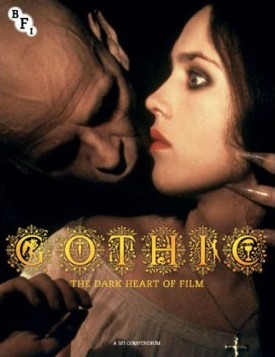
This exhibition follows hot on the heels of a Gothic film festival, Gothic: The Dark Heart of Film, arranged by the British Film Institute (BFI) in 2013. The BFI published a compendium, which is actually a delightful introduction to the world of Gothic film, its landscapes, architecture and inhabitants. In fact, this is probably one of the rare instances you will see me recommending a book on Gothic fiction on this blog, but the thematic approach to the subject as well as the host of experts who have contributed to it makes it a real treat, even for people with a more casual interest in the genre.
So the book includes essays on the relation between Gothic cinema and literature, architecture and art, with Martin Myrone, author of a nice book on Fuseli and contributor to the Tate exhibition on Gothic Nightmares back in 2006, noting that 'the relationship between the canon of Gothic literature of the 'classic' phase (c. 1760-1830) and the visual imagery of the same date is far from simple: the relationship of this early Gothic art and writing to modern cinema no more so.' Still, he later on concedes that 'nonetheless, there are parallels and resonances between Gothic literature of the 'classic' phase and precisely contemporary visual art, and between these and modern cinema,' accompanying his essay with a number of examples of these homologies, of which the most famous is, of course, Fuseli's Nightmare (see the Gothic Nightmares catalogue from Tate for numerous examples).
However many experts have contributed to the conpendium, they still are unable to solve the conundrum of pinning down what the Gothic 'genre' actually is. Myrone states that it is 'now often understood as, by definition, a trans-medial, genre-defying, migratory and polluting phenomenon, we should not expect homologies between Gothic productions in different media and eras need be predictable, explicit or orderly.' The paradox of how relatively easy it is to describe the Gothic 'landscape', while it seems almost impossible to define it, is what makes the compendium - cf. the title's nod to Joseph Conrad - a 'Grand Tour of the Gothic,' as Sir Christopher Frayling says in his foreword.
'In Styria ...' Irishman Sheridan Le Fanu set his Carmilla in Styria, part of current day Austria. A current exhibition at the GrazMuseum in Graz in Styria now explores the role of Styria in vampire literature, the development of the media vampire, and what it is all about.
Le Fanu appears to have read an 1836 travel book, Schloss Hainfeld, or a Winter in Lower Styria by Basil Hall, and probably found the description of a pre-industrial and romantic part of Europe an appropriate setting for his vampire novella. By the time Bram Stoker was working on Dracula, he also chose Styria as the home of the vampire count, before deciding to place Count Dracula's castle in Transylvania. The curators of the GrazMuseum believe that at the end of the nineteenth century the construction of a backwards, threatening, and superstitious East Europe had moved further to the Southeast, making Styria a region less likely for a vampire story. Stoker, however, as we know, still retained Styria as a location in his short story Dracula's Guest.
The exhibition, Carmilla, der Vampir und wir (Carmilla, the vampire and us), sees the fictional vampire of Le Fanu and Stoker not only as an extension of the Romantic vampire figure, but rather as a reaction to the industrialization that changed the face of many West European countries throughout the nineteenth century. This is, of course, evident in the conflict between East and West in Dracula, but as industries, media, and the globalization has developed and transforms even remote places, the vampire becomes (in the view of the curators) more a mirror image of the problems that humans face in an everchanging world more and more out of contact with its history and roots. At the same time the vampire of fiction, just like humans, faces his (or her) own existential crisis.
The exhibition at the GrazMuseum appears to explore such themes rather than the vampire's roots in folk beliefs. It consists of five rooms, glimpses of which can be seen in a clip from Austrian TV, from which a few shots are shown below. It is open until Halloween this year, and a publication related to the exhibition will be available later this year.
The German documentary series Terra X on channel ZDF launched a new documentary on Dracula and vampires this evening, Dracula: Die wahre Geschichte der Vampire, which is currently available on the ZDF web site along with various information on vampire books a.o. Forensic scientist and vampire expert Mark Benecke as well as Dr. Clare Downham participate in this program that is partially narrated by Count Dracula himself as portrayed by actor Christian Baumann. The Count visits the archives in Vienna to examine the original Visum et Repertum, and we see Flückinger examine 'Arnold Paole' - even the apocryphal journey of Gerard van Swieten to Moravia is dramatized. Still, this is generally one of the best documentaries on the subject so far, including visits to Romania, London, and Vienna, where Dracula studies some of the 18th century literature on vampires in the Prunksaal next to the bust of van Swieten.
The documentary will be released on DVD and Blu-ray in early 2014.
From Bram Stoker's Notes for Dracula: A Facsimile Edition by Robert Eighteen-Bisang and Elizabeth Miller p. 34-5: 'Directions in letter of Count to go to Munich stop at Quatre Saisons & wait instructions. Start on same day & arrive direct service. Visit to Pinacothek museum & to Dead House - telling how brought about.'
According to Bram Stoker's notes for Dracula, Jonathan Harker's travel route was: London - Paris - Munich - Salzburg - Vienna - Budapest - Klausenburg - Bistritz. In Munich he stayed at the Quatre Saisons hotel, now Hotel Vier Jahreszeiten in Maximilianstrasse, part of the Kempinski group. Opened in 1858 as a state of the art hotel, it is still considered one of the leading hotels of the world. Judging by the only Kempinski hotel I have myself stayed at, the luxurious Hotel Adlon in Berlin, the Vier Jahreszeiten is no doubt worth a stay - if you can afford it.
Hotel Vier Jahreszeiten
The relationship between the short story Dracula's Guest and Dracula, the novel, is disputed, but elements from the short story can be found in some of Stoker's notes for the novel. These include a visit to the Pinakothek, which at the time consisted of two collections, the Alte Pinakothek and the Neue Pinakothek. Today a Pinakothek der Moderne has been added. The collections exhibit many well-known and important pieces of art, e.g. Michael Pacher's 15th century set of four paintings from St. Augustine's life, including that of the Devil showing Augustine the Book of Vices. Currently the Alte Pinakothek is exhibiting an interesting collection of motifs from the Old Testament.
Alte Pinakothek
Stoker possibly intended Harker to visit the Opera for a performance of Wagner's Flying Dutchman, no doubt at the Nationaltheater München. There are, of course, also other things to enjoy while in Munich.
‘I am in doubt, and so have done the best thing I know of; I have written to my old friend and master, Professor Van Helsing, of Amsterdam, who knows as much about obscure diseases as any one in the world. I have asked him to come over, and as you told me that all things were to be at your charge, I have mentioned to him who you are and your relations to Miss Westenra. This, my dear fellow, is only in obedience to your wishes, for I am only too proud and happy to do anything I can for her. Van Helsing would, I know, do anything for me for a personal reason. So, no matter on what ground he comes, we must accept his wishes. He is a seemingly arbitrary man, but this is because he knows what he is talking about better than any one else. He is a philosopher and a metaphysician, and one of the most advanced scientists of his day; and he has, I believe, an absolutely open mind. This, with an iron nerve, a temper of the ice-brook, and indomitable resolution, self-command, and toleration exalted from virtues to blessings, and the kindliest and truest heart that beats – these form his equipment for the noble work that he is doing for mankind – work both in theory and practice, for his views are as wide as his all-embracing sympathy. I tell you these facts that you may know why I have such confidence in him,’ writes Dr. Seward in a letter to Arthur Holmwood dated Saturday, 2 September with regards to Miss Westenra’s health.
With all his peculiarities of action, manner and speech, the character of the Dutch Professor Abraham Van Helsing, ‘M.D., D.Ph., D.Lit., Etc.’, has been interpreted and portrayed in many ways since the first stage and film adaptations of Bram Stoker’s Dracula. In 1957, when British Hammer Films were to adapt the novel for their second excursion into Gothic horror, Dracula, they turned to the star of their The Curse of Frankenstein, Peter Cushing, for a suitable actor for another role as both scientist and outsider.
Usually acting on very limited budgets, Hammer had to limit the range of characters and action to a minimum, so Van Helsing himself took on the role of the prime vampire hunter after his collaborator, Jonathan Harker, had become the victim of Count Dracula. Cushing’s Van Helsing then is not the wise old man who conducts the younger men in their hunt for Dracula; he is himself the active vampire hunter taking the lead, and very physically running and jumping about in order to hunt down and eliminate Dracula and his vampire women. He also becomes the one who employs the latest technological advances like a phonograph, much to the amazement of the common man who is unable to understand why Van Helsing is ‘talking to himself’.
Cushing’s Van Helsing is, as Cushing’s roles almost always are: ever as astute as he is eloquent and immaculately attired, revealing exactly that attention to detail that Cushing appears to have applied when preparing himself for his roles. All this is exemplified in the curious, but at the same time fascinating scene in which Cushing records his observations and conclusions regarding vampires on the phonograph.
As for his study of vampires, Van Helsing tells us that ‘the study of these creatures has been my life’s work. I’ve carried out research for some of the greatest authorities of Europe, and we’ve only just scratched the surface.’
We in the audience probably feel uncertain as to whether Van Helsing is actually a progressive scientist, as the reference to ‘the greatest authorities of Europe’ would lead us to believe, or he is dabbling in things that truly transcend any reasonable boundaries of scientific method, as in the case of Cushing’s other grand role, Victor Frankenstein. Although we experience that the vampire in Hammer’s Dracula is a real phenomenon, the boundaries between science and metaphysics are blurred, and when we learn more of Van Helsing’s encounters with another vampiric aristocrat, Baron Meinster, in the follow up, The Brides of Dracula (1960), the religious symbolism is no less apparent. The vampires are ultimately killed with the sign of the cross (using the sails of a wind mill, perhaps echoing Universal’s Frankenstein films), and, when Van Helsing himself becomes the victim of a vampire, he must cleanse himself from the infection using holy water.
In Hammer’s series of Dracula films, Christopher Lee’s Count Dracula acts a sexual threat against the bourgeoisie, tempting both unmarried and married women to stray from the accepted paths. In Taste the Blood of Dracula (1970) he exposes the double standards of the family fathers who live a philistine double life seeking to taste forbidden fruit outside their lives as faithful husbands, fathers and citizens.
Peter Cushing only plays the role of Van Helsing in some of the films, allowing others to act as the one who restores order to family and society. Van Helsing, however, appears to live outside the mainstream of society, no doubt because of his knowledge concerning the very forces that threaten society, while his intelligent and direct manner also appears to offend polite society.
Cushing did, however, also the play the role of a religious figure at the core of a society, a fanatical zealot who is not only chastising women in general, but is always on the outlook for both witches and vampires, in Hammer’s third variation on Joseph Sheridan Le Fanu’s Carmilla, Twins of Evil (1971).
Hammer’s Count Dracula himself was introduced as an eloquent aristocrat, but was soon turned into a nonverbal force that appeared to have a rather limited freedom of movement, and as Hammer itself struggled to maintain it’s existence, they tried to bring both Dracula and Van Helsing into the 1970’s in Dracula A.D. 1972 and The Satanic Rites of Dracula. Consequently, Cushing plays Lorrimar Van Helsing, a descendant of the original Van Helsing, but generally remains as astute and dynamic as his forefather, but unfortunately both films are, although not without some merit, in retrospect signs of the death agony of Hammer’s Gothic formula when compared to it’s competition: blockbuster horror films like The Exorcist and The Omen.
As is The Legend of the 7 Golden Vampires, in which Peter Cushing added vampire hunting in China to the curriculum vitae of Van Helsing. It certainly has entertainment value, but overall the whole idea of a series of Dracula films based on Hammer's formula was probably becoming obsolete at this time.
Peter Cushing himself remained closely related to the genre, but also got the chance to play an important role in the first Star Wars film. Still, among his finest moments are his roles as Victor Frankenstein in Hammer’s series of rather thematically and artistically coherent Frankenstein films, and as Van Helsing in first and foremost Dracula, which was released on Blu-ray in a magnificent and highly recommended, restored edition earlier this year.
This post is part of the Peter Cushing Centennial Blogathon celebrating the centenary of Cushing’s birth. Peter Wilton Cushing was an English actor born on 26 May 1913, who appeared in numerous films, including films produced by Hammer Films. He died on 11 August 1994.
To many, Francis Ford Coppola’s film Bram Stoker’s Dracula has become quite the epitome of the story of the vampiric Count Dracula. The soundtrack music by Polish composer Wojciech Kilar is ubiquitous, and the film’s blend of history and fiction, of romance and horror, as well as its creative play with cinema itself, seem to suit a vision that many people have of Dracula and vampires, or at least one that appeals to them – that is, of course, prior to the boom of adolescent vampire fiction like Twilight. Perhaps, as it is more than twenty years since Coppola’s film received its premiere, many people have simply grown up with this film and consequently now identify Dracula with Coppola’s Count.
So it is little wonder that the first thing behind the dark curtain leading into the Dracula e il mito dei vampiriexhibition at the Triennale design museum in Milan was a screen showing excerpts from Coppola’s film. In fact, the fusion of historical fact and vampire fiction, of artistic creativity and design, and of Bram Stoker’s novel with its interpretation by artists and cinematographers, permeated the exhibition as a whole.
Not so much an extension or reworking of the Dracula Woiwode und Vampir exhibitions at Innsbruck and Bucharest, Dracula e il mito dei vampiri rather integrated items from that exhibition into something new, not only bringing the fictional vampire into focus, but also, as one would expect af a design museum, stressing Italian art and design.
Having watched Coppola’s vision of the Wallachian warlord turned vampire, the visitor was greeted by the famous portrait of Vlad Tepes from the Kunsthistorisches Museum in Vienna. Fortunately, one was not met by Vlad’s gaze, as he rather looks at something or someone to your left, so one can study his features without fear of having aroused his, er, attention. Similarly, the full-length portrait of Dracula Waida Princeps from Forchtenstein Castle appears to look to one side, but strangely, his eyes have an uncanny look as if a film is layered on top of them, or maybe someone attempted to blur them?
Only a very small selection of items from the earlier Dracula exhibitions were displayed here to provide some context for the life and cruelty of Vlad Tepes: A 17th century map of Transylvania from the Kunsthistorisches Museum, the coloured print of the city of Papa from 1617 showing impalements, a copy of Sebastian Münster’s 1598 Cosmographey with its depiction of impalements, and various clothes and weapons used by the Ottomans.
The vampire cases and the ensuing debate of the 18th century were illustrated via a handful of books, including Johann Christoph Harenberg’s 1733 Vernünftige und Christliche Gedancken über die Vampirs oder bluhtsaugende Todten, Nicolas Lenglet du Fresnoy’s 1751 Traité historique et dogmatique sur les apparitions, les visions & les revelations particulières, and the German translation of van Swieten’s commentaries published in 1768. However, there were no documents, no Calmet, Ranft or Tallar, no bust of van Swieten or portrait of Maria Theresa as in the exhibitions at Innsbruck and Bucharest.
Instead, the exhibition of vampire fiction was enhanced by some remarkable items courtesy of the Bram Stoker Estate and John Moore Collection: Bram Stoker’s so-called lost journal that was published for the first time last year, and Stoker’s autograph copy of the first edition of Dracula‘to my dear mother’, both definitely some of the chief attractions of the exhibition.
A couple of Goya’s Caprichos, a first edition copy of Polidori’s The Vampyre as well as posters for performances of Marschner’s opera Der Vampyr and a programme for a 1927 performance of Deane and Balderston’s stage adaptation all led the way into a room where quotes from Stoker’s novel were displayed in Italian on a wall. Here you could also enter the house of a vampire as envisioned by Milanese architect and designer Italo Rota. A rather creepy tableau of a ‘living room’ with earth strayed across the table and a selection of ritual tools, remedies, books and art, all of which, according to Rota, should reflect the mentality and everyday ‘life’ of a vampire. Suffice it to say, that I would not spend my time in that place…
Entering the world of vampire cinema, one could peep through holes like a voyeur to observe a variety of ‘vampire kisses’ from a number of vampire films, while more analytically, over the door to the next room, a brief genealogy and philosophy of cinematic vampirism was outlined. Nosferatu from 1922 accordingly reflected the psychoanalysis of Freud and Jung, whereas Dracula from 1931 showed the vampire in the modern major city, and might be interpreted in terms of Georg Simmel or Walter Benjamin.
Then, for some reason the vampires of Hammer and many other filmmakers from the 1950’s to 1980’s were not included in the genealogy, so we jumped right to the era of post-structuralism (Jacques Lacan) and postmodernism (Guy Debord and Gilles Deleuze) with Bram Stoker’s Dracula from 1992 and Interview with the Vampire from 1994, respectively. Finally, in a 'liquid' society where 'solid' concepts like work and marriage are, in the words of Zygmunt Bauman, 'like zombies, such concepts are today simultaneously dead and alive', Edward Cullen and the other vampires of Twilight could be perceived as 'post-vampires', indistinguishable from mortal humans.
Clips from a variety of vampire films, including Mario Bava’s Italian La maschera del demonio from 1960, were shown on three transparent screens in a separate room, their soundtrack having been replaced by popular pieces like Orff’s O Fortuna and Delibes’s Flower Duet, all played at high volume.
Among the clips were, of course, Coppola’s Dracula film, and not only its screenplay and parts of its storyboards were exhibited, Dracula e il mito dei vampiri also paid homage to the film's costume designer, Ishioka Eiko, by displaying the blood red armour she created for Dracula, and showing a documentary about her work on the film. The tribute to Eiko was followed up by a a tableau of impressive female stage costumes from various operas and ballets like Aida, Die Zauberflöte, and Turandot. Very fitting for an exhibition in the hometown of Italian fashion and the famous opera house, La Scala. A wall of photos from catwalks rounded this section off with fashion for men designed by Louis Vuitton, Gucci, Prada and others, all illustrating the crossover of the vampire from fiction to fashion, no doubt with a good deal of help from Goth subculture.
Finally, a room not intended for children, exhibited pages from Guido Crepax’ comic book adaptation of Dracula as well as a hitherto unknown sequence in which his heroine Valentina meets Count Dracula.
Personally, I must say that the exhibition whet my appetite for more, as it is fairly easy to imagine how an exhibition like Dracula e il mito dei vampiri could be expanded in order to go into more detail with Vlad Tepes, with the struggle between the Ottoman Empire and Christian Europe, with vampires and revenant beliefs, and with the rise of the fictional vampire, Count Dracula and the vampire of modern popular culture. I am, however, well aware of the painstaking work that is no doubt required to assemble the number of paintings, books, documents and artefacts that would fit in with the themes, and at the same time I am not sure how much the average visitor is in fact able to digest. With regards to Vlad Tepes and vampires, the exhibitions in Innsbruck and Bucharest are so far the most comprehensive exhibitions I am aware of, and it will probably be hard to surpass hem. But hopefully there is more to come in the future.
In connection with the exhibition, Skira has published a 131 page catalogue, which includes a number of articles and a selection of the items exhibited. Margot Rauch has contributed the historical part of the catalogue, Dracula: voivoda e vampire, which is in fact a translation of what she wrote for the Innsbruck and Bucharest exhibition catalogues, as well as an inventory of some of the books and artefacts exhibited. The article on the costumes of female vampires (and vamps) include a number of photos of stars like Dietrich, Garbo, Bernhardt, Swanson and Bara that were not on display, while Italo Rota’s vampiric living room is only documented on a youtube video that can be accessed with a QR code.
Whether Dracula e il mito dei vampiri will be exhibited elsewhere in the future – in the same or some other form – I do not know, but the photo to right was posted on facebook by the company that organized the exhibition,with the accompanying message:
‘Dracula ha fatoo le valigie ed è pronto a ripartire alle conquista di nuove città!’: Dracula has packed and is ready to conquer new cities!
The Bram Stoker Festival takes place in Dublin on 26 to 28 October. The program has just been revealed on the festival web site, and includes an exhibtion on Stoker's life as well as panels on Fatal attraction: What is it with vampires? and What lies beneath? Dracula and its legacy, featuring a.o. Stoker biographer Paul Murray.
'From 26th - 28th October, Dublin City will celebrate the life, work and legacy of Dublin horror novelist Bram Stoker and his gothic novel 'Dracula'.
The three-day festival will peel back the layers of the city to reveal Stoker's Dublin. Prepare for a weekend for all the family with walking tours through the lane-ways and hidden steps of the Victorian macabre aspect of the city; literary workshops exploring horror writing with award winning authors for both teens and adults; Stoker-themed theatre, lively discussions on all things vampire, and a highlight being an evening of spooky spectacle from renowned street theatre company Spraoi in the majestic surroundings of Dublin Castle.
Whether you're a city dweller, or a visitor to Dublin for the weekend, the inaugural Bram Stoker Festival is sure to chill your bones in time for Halloween!'
I recently received a copy of Neil R. Storey's book The Dracula Secrets: Jack the Ripper and the Darkest Sources of Bram Stoker (The History Press, 303 pages, hardcover, RRP £20), and although I have no far only dipped into it here and there, I can fairly easily say that this contains nothing of particular interest with regards to vampires, but it will no doubt be of interest to the Dracula, Bram Stoker or Jack the Ripper buff.
Storey, an award-winning historian, lecturer and author of many books, aims to link 'the Whitechapel vampire', i.e. Jack the Ripper, with Dracula, as one of Stoker's sources of inspiration. As I have so far not read the entire book, I am unable to say how successful he is in establishing this connection, but the book certainly contains a wealth of information on Stoker and some about the Ripper. It is very nicely illustrated, and among the appendices is the list of items from Stoker's library that was auctioned off at Sotheby's in 1913, including the notes for Dracula that a certain Mr. Drake purchased for the sum of £2 2s!
Another appendix is taken from the 1887 edition of Baedecker's Southern Germany and Austria, Including Hungary and Transylvania. Handbook for Travellers, detailing the railway trip from Klausenburg (Cluj) to Bistritz (Bistriţa).
From Reiseführer durch Rumänien published in Bucharest in 1932.
A friend of mine gave me a copy of Jack the Ripper: The Casebook by Richard Jones some time ago. This is an unusual book about the crimes of the Ripper, because it contains pockets with 18 items of removable facsimile documents and memorabilia. If you happen to be interested in doing some armchair sleuthing, you might want to consider getting hold of this book.
’… One of the most curious legacies ever bequeathed to anybody is perhaps that of £1000 left by the late Mrs Olivia Flint, of Pittsburg, to her doctor: Mrs Flint was very fond of novel reading, and, although very ill, began to read Bram Stoker’s thrilling romance, ”Dracula.” So interested did the dying woman become in it, that when she had read a chapter or two, she turned to her nurse, and, asking for pen and ink, wrote a few words to the effect that if Dr Allardyce could keep her alive long enough for her to finish the tale he was to receive a legacy of £1000. Mrs Flint lived for several hours after the last words had been read.’
This, an excerpt from the Marlborough Express Nov 2 1909, is one of the more curious examples of the early reception of Bram Stoker’s Dracula that have now been collected in a slim volume, Bram Stoker’s Dracula: The Critical Feast. An annotated reference of early reviews and reactions, 1897-1913, compiled and annotated, with an introduction, by John Edgar Browning (Apocryphile Press, 179 pages, $18.95).
Aiming at both dispelling the misconception that Dracula received a mixing critical reception and providing literary scholars and the public with the documentation, Browning compiles 91 examples of reviews and letters, along with book covers and ads, from the English languaged part of the world where most of the initial editions were published. Only two translations appeared in Stoker’s lifetime, and a ‘bibliographical afterword’ by J. Gordon Melton presents of a list of non-English editions of Dracula.
The tale of a ‘human vampire’, as many reviewers call Count Dracula, is generally favourably received, and apparently made the blood of many critics curl. ‘We had thought that vampires were extinct,’ notes the Saturday Review of Politics, Literature, Science and Art, ‘but Mr. Bram Stoker has set himself to prove to us the contrary. Or rather he has recreated them with considerable ingenuity and a distinct gift for story-writing of the blood-curdling order.’‘There are a hundred nightmares in “Dracula,” and each is more uncanny than the last,’ writes St. James’ Gazette, while a reviewer in The Daily Mail is reminded of the author of a number of gothic novels: ‘It is said of Mrs. Radcliffe that, when writing her now almost forgotten romances, she shut herself up in absolute seclusion, and fed upon raw beef, in order to give her work the desired atmosphere of gloom, tragedy and terror. If one had no assurance to the contrary, one might well suppose that a similar method and regimen had been adopted by Mr. Bram Stoker while writing his new novel Dracula.’
Some critics found that the transition of the vampire from the more gothic Transylvanian setting to contemporary London did not work so well.‘Vampires need a Transylvanian background to be convincing,’ wrote The Academy: A Weekly Review of Literature, Science, and Art, adding: ‘The witches in “Macbeth” would not be effective in Oxford-Street.’ Still, there was no doubt that Dracula’s castle is not a place to visit, in the words of The Glasgow Herald: ‘Henceforth we shall wreathe ourselves in garlic when opportunity offers, and firmly decline all invitations to visit out-of-the-way clients in castles in the South-East of Europe. Dracula is a first rate book of adventure.’
What will strike modern day readers as odd, is that some critics saw Dracula as a werewolf book. ‘Mr. Bram Stoker, in his remarkable novel “Dracula”, has gone to the old legends of the were-wolf for the inspiration of his story,’ writes The Speaker, calling the novel ‘the first introduction of the were-wolf to English soil.’ Similarly, The Daily Telegraph finds that Bram Stoker illustrates and modernises ‘a revival of a mediaeval superstition, the old legend of the “were-wolf”,’ and traces this ‘old legend’ and its literature more closely, as the critic asks: ‘What has Mr. Bram Stoker been reading?’
Indeed, what has Stoker been reading? Today, we tend to forget how small the existing ‘canon’ of vampire literature in the English language was when Stoker wrote the novel. In fact, the deluge of books on the subject only dates back to the 1960’s or 1970’s, and the 'classics' by Ernest Jones, Dudley Wright and Montague Summers were all published after Stoker’s death. So in the 1890’s, one might have found the translations of Dom Calmet, Herbert Mayo’s letters, and a bit here and there, including the Rev. Sabine Baring-Gould’s The Book of Werewolves, Being an Account of a Terrible Superstition from 1865, which is in fact mentioned by the reviewers of both The Daily Telegraph and The Stage, the latter apparently finding some pleasure in describing the horrors of the novel:
‘Those who know the Rev. S. Baring Gould’s little volume on the Were-Wolf, a theme also touched on here and there by Kipling, may possibly not be repelled by the grisly details of two beautiful and virtuous women having the veins in their throats sucked by the red lips, and lacerated by the gleaming white teeth of this centuries-old Transylvanian warrior and statesman, who often appears as a gaunt wolf and a huge bat.’
In his notes, Browning writes that the convention of seeing vampires transform into wolves‘was to fin de siècle readers relatively unfamiliar – practically an innovation at the hands of Stoker.’ His other vampiric innovations are humourously commented on by Longman’s Magazine, when reviewing an inexpensive reissue in 1901: ‘The rules of vampirizing, as indicated by Mr. Stoker, are too numerous and too elaborate. One does not see why the leading vampire, Count Dracula, could not bolt out of the box where was finally run to earth by a solicitor named Jonathan. If he could fly about as a bat, why did he crawl down walls head foremost? The rules of the game of Vampire ought to be printed in appendix: at present the pastime is as difficult as Bridge.’ The reviewer then lays down eight chief rules like e.g. this sixth rule: ‘No vampire can vamp a person protected by garlic.’
Fortunately, an interview with Stoker himself was published in The British Weekly, allowing him to comment on both his sources and the vampire belief itself. Asked, ‘Is there any historical basis for the legend?’ he answers:
‘It rested, I imagine, on some such case as this. A person may have fallen into a death-like trance and been buried before the time. Afterwards the body may have been dug up and found alive, and from this a horror seized upon the people, and in their ignorance they imagined that a vampire was about. The more hysterical, through excess of fear, might themselves fall into trances in the same way; and so the story grew that one vampire might enslave many others and make them like himself. Even in the single villages it was believed that there might be many such creatures. When once the panic seized the population, their only thought was to escape.’
He apparently thought that the vampire belief was particularly prevalent in certain parts of Styria (where he originally set Dracula), and added, that ‘the legend is common to many countries, to China, Iceland, Germany, Saxony, Turkey, the Cersonese, Russia, Poland, Italy, France, and England, besides all the Tartar communities.’ Two sources are mentioned in the interview: Baring-Gould’s book and Emily Gerard’s Essays on Roumanian Superstitions.
Interestingly, not many reviewers go into detail regarding the subject of vampires. The National Observer, and British Review of Politics, Economics, Literature, Science, and Art, briefly mentions that ‘More awful even than the ghoul of the Arabian Nights is the Slavonic superstition of the human vampire, which, dead to all intent and purposes during the day, is supposed to prowl around by night and gorge itself with the blood of living man,’ adding that ‘this fearful legend, which flourished in Eastern Europe a century ago, and still finds credence among the ignorant.’The Liverpool Mercury claims that it is ‘An old Eastern superstition, still having weight in Hungary.’
On the whole, the only reviewer to deal with ‘vampiredom’ in more detail is actually the one writing for the Australian Argus in 1897, who states that ‘Vampires – the “living dead,” whose corpses cannot decay, but who have the power of rising from their graves at night to batten upon the blood of human beings – are the Vroucolakas of the Greeks,' and then goes on to mention that 'They have been treated of by an old German writer, Michael Raufft (sic!), in his learned book “De Masticatione Mortuorum in Tumulis,” by the Frenchman Calmet, and by many another grave-faced sifter of mediæval superstitions,' before supplying more information about 'these unpleasant noctural prowlers.'
Upon Stoker’s death one hundred years ago on April 20 1912 , The Outlook found reason to note that ‘The lamented death of the author should direct fresh attention to the most imaginative creation of his pen. For weird force and picturesque horror Dracula deserves to rank with the classics of morbidity.’
For that reason, as well as for the novel's role in keeping ‘vampiredom’ alive and well in modern popular culture, the centenary of Stoker's death is good reason to read or re-acquaint oneself with the novel. For those interested in getting a better understanding of the literary reception of this, the single most important piece of vampire fiction, John Edgar Browning’s reference book is highly recommended.
Finally, a few words regarding the bibliography of translations: It is quite a daunting task to compile a complete and faultless bibliography of this task, and judging by the Scandinavian language editions mentioned, it is not a completely or a fully correct list. The Danish translations are all listed under the title ‘Drakula,’ but have actually all been titled Dracula, and I doubt that the list of adaptations is complete. The list of Swedish editions is, unfortunately, incomplete, and it is not correct that the first English translation of the preface to the Icelandic translation was published in 1993.
Sometime in the mid-Eighties, I was in contact with Richard Dalby, author of the first Stoker bibliography (published by the aptly named Dracula Press in 1983), and supplied him with information on the translation and copies of the preface. He subsequently had it translated and published by Guild Publishing in 1986 in a one-volume edition of both Dracula and The Lair of the White Worm, this also being the first time the latter novel was reprinted in its original length, as it had been absolutely butchered in all previous reprints.
'As we passed through the wood in the twilight the gentle wind took the puffs of steam from the engine and carried them in tall columns till they looked like ghosts among the trees.'
Tracing my interest in vampires and posthumous magic back to reading Bram Stoker's Dracula as a teenager, I find it interesting to occasionally follow the ongoing development in the literature on Stoker and his creation of the Count Vampyre.
The Lost Journal of Bram Stoker, edited by Elizabeth Miller and Dacre Stoker and published by The Robson Press, is a lovely and very welcome addition to both the Stoker biographies and the various editions of his own work. A caringly edited and annotated version of a journal that passed on from Stoker's widow, Florence, to their son, Noel, and now in the possession of Stoker's great-grandson, Noel Dobbs, the Journal is a kind of notebook containing verses, short pieces of prose, jokes, observations and ideas that the young, aspiring and developing writer Bram Stoker planned to use at some time. So now one can feel with the young man writing shortly before his twenty-fifth birthday of pain in 'Pain & Bravery':
'To have feeling but to lack its fit expression To be dumb amid the music-world of life To be still amid the roar & the progression Where the worker as he touches stamps possession - To be fettered by our hearts before the strife - To be crippled ere the race - to lose the Real Which we erst have sadly toiled for and in vain To seek among the passing forever our Ideal This is pain.'
The Journal is not reproduced in the original order. Instead, Miller and Stoker have organized the contents thematically, e.g. devoting one part to portions that may have inspired bits in Dracula, as they find that 'the Journal breathes new life into Dracula, offering fresh insights into Stoker's method of composition as well as motifs for his plot and characters.' This section contains references to Poe and Frankenstein, but I will let others decide to what extent it really does provide insights into Dracula, written several years after the Journal.
Stoker himself appears to have had a bit of taste for the gruesome, as in this sketch:
'Seaport. Two sailors love girl - one marries her, other swears revenge. Husband goes out to sea soon after marriage & on return after some days sees in grey light of morning his young wife crucified on the great cross which stands at end of pier.'
And we are affirmed that the sea played a special role for him, even curiously claiming that: 'Love can only be made in perfection beside the sea.'
Miller and Stoker note that 'the closest we get to vampires in the Journal are the references to Dion Boucicault,' who wrote the popular play The Vampire: A Phantom Related in Three Dramas from 1852. So the vampire historian will probably gain little from the Journal - apart from the pleasuring of dipping into the numerous bits and pieces.
Stoker researchers, of course, will find inspiration for future work, but first of all, it is simply a delightful collection of short pieces, proving that a private notebook never intended for publication actually can have some value to readers almost 150 years after it was written.
The various introductory essays and comments, along with a timeline of Stoker and his family, by Miller and Stoker aids in setting the Journal into the context of its author's life, work and times, as does about a dozen of photos of Stoker's family.
'Vampire, see Serbia', is what you find if you look up the word Vampyr in Dr. Christian Wilhelm Hufeland's encyclopedia on apparent death, Der Scheintod, oder Sammlung der wichtigsten Thatsachen und Bemerckungen darüber, from 1808.
The entry on Serbia, which incidentally follows an entry on the apparently dead eating themselves (das Selbstverzehren der Scheintodten: 'Man hat Beispiele von Todten, welche im Sarge sich selbst zu verzehren angefangen haben sollen...'), actually carries the title: 'Servien's Scheintodten-Ereignisse', the incidents involving apparently dead persons in Serbia. The entry concerns the incidents in Medvedja in the winter of 1731-2, although here erroneously dated 1733. Hufeland states that Emperor Charles VI asked Dr. Beyer to write an analysis of the matter, which however has not been published, but was probably suppressed by the Church ('Dieses ist aber, so sehr das Publicum auch darauf wartete, niemals öffentlich bekannt gemacht und warscheinlich durch den Kaiserlichen Beichtsvater, nach dessen Sinne es nicht ausgefallen seyn mochte, unterdrückt worden').
Hufeland finds that the vampires were in fact persons who became afflicted with some local disease and were presumed dead, and consequently prematurely buried. Well, all things considered, it is not exactly a satisfactory theory, but that is the reason why Serbia and vampires are included in Hufeland's book.
But Hufeland is not the only one to identify Serbia with vampirism, and vice versa. In a recent book, Vampire Nation: Violence as Cultural Imaginary (Duke University Press, 2011), Professor of Slavic and Comparative Literature at the University of Winsconsin, Tomislav Z. Longinovic, writes:
'Until the Bulldozer Revolution in October 2000, global media networks and the public relations industry profiled 'the serbs' as avatars of post-communist violence in the Balkans. Despite the burden of all too real war crimes committed during the 1990s in the name of collective survival of their own territorial identity, global media excessively emphasized 'the serbs' as the incarnation of an exemplary and exceptional form of evil not proper to Europe, a vision that gradually excluded this imaginary assemblage from the sphere of civilization. Despite the fact that 'the serbs' belong geographically to the very core of Europe, symbolically and territorially, their borderline position was constructed as a projection of the Eurocentric fantasy about a cruel Orient in Europe.' (p. 5-6)
'The perception of pathological fixation of Eastern Europe in general and of the Balkans in particular, on the "old centuries" voiced by Stoker at the end of the nineteenth century through the persona of Dracula* is symptomatic of a cultural vision based on an interesting intersection of local and global discourses of violence. The past and its bloody memories define a refusal to yield to modernity imputed to the countries of the Balkan region, whose resistance to civilization and its laws are naturalized as inherently evil to oppose the advances of the Enlightenment and its technologies of mediation. The narrative projected onto the vampire as a beast within, enslaved to the undying, bloody past, serves as a national fetish underlying the repressed origins of Europe proper.
A small nation such as 'the serbs' is by definition led by a mysterious, degenerate leader who is ready to sacrifice others and commit bloodshed only to prolong his political power. During the 1990s, this vision of the other Europe reinforced an imaginary relationship that extended the vampire metaphor from the realm of the Gothic period's horror genre to the mundane practice of global politics, strategically deploying violence to advance civilization and the rule of law in the Wild East of Europe. The signifier that will forever sink into historical oblivion - Yugoslavia, the proper name of the country that was erased to deny the striving of culturally heterogeneous populations to live in a common state - has been assaulted by differentialist logic of the "clash of civilization" to enforce local insecurity by bringing about a collective return to the ideology of the vampire nation.
Stoker's Dracula, which founded the literary discourse of the Gothic imaginary, appears as the incarnation of those old centuries that refuse to fade away in the face of modernizing Europe. This imaginary, sparked by a belated Romantic mourning for the glory of the past boundaries of Europe, uses violence with the automatism of the beast who has no other choice but to feed itself on the blood of others. This hungry being is always engendered in zones of intense cultural and linguistic hybridization and simultaneously is imbued with the pathos of a race submerged in the narratives of its own past and viewed as a herald of a cruel modernity at hand.
Many "national" histories written and taught in the Balkans and in the rest of "Oriental" Europe are saturated with a celebration of violence that is monumentalized as just revenge and sacrifice offered to the glory of cultural life and survival. Small nationalisms contain this imaginary economy; they appear colorful but ostensibly irrational, steeped in gore despite enlightened intentions and dominated by discourses of masculine injury that claim the victim's right to feed on the blood of others as the only way to sustain survival.' (p. 19-20)
'The discourse of stolen blood reveals how the imaginary lens crafted by Stoker persists in the West as a cultural filter that defines alterity: Eastern Europe is a location where sex and violence know no limits. The image produced in British popular culture at the end of the nineteenth century has traveled to the end of the twentieth century to establish political discourses that the U.S.-led West sustains when it deals with new yet old types of revenant nationalism: the specter of 'the serbs' as the global vampires who deserve a well-guided stake of democracy.
This Gothic vision defines the boundaries of proper identity and its civilizatoinal other within Europe, a location where bad but sharp teeth, carnage, and fornication abound. The other Europe is an extension of the notorious count's ruined castle, where excessive passions and "old centuries" conspire to halt the progress and enlightenment proper only to the superior technology of the West. One of the most symptomatic returns of this Gothic vision is the mediated emergence of 'the serbs' as a phantasm of a vampire community governed by an excess of malignant historical imagination that is alien to the values of Europe and the "civilized world."
Firmly rooted in political and cultural ideals inherited from the best European traditions of nationalism and liberalism, 'the serbs' share military rationality and territorial logic of the nation-state with Europe proper. In fact, the Yugoslav tragedies of the 1990s are a legacy of the violence that formed the foundation of modern Europe: the political and cultural ideals made flesh and blood in the uncanny law binding the nation-state. The temporal disjunction between the "other" Europe steeped in old centuries of its historical imagination and the hypermodern amnesia of the U.S.-led West is at the root of this interpellated subjectivity structuring the Gothic emergence of 'the serbs'.' (p. 10)
'The extraordinary success of Twilight among youth in the United States appears as a global symptom of chronic hunger for attention from others and a craving for freedom that, paradoxically, shrinks under an invisible yet omnipresent force based on consumption and concealed forms of violence inherent in the developed modes of the current economy. Images of vampires have persisted in popular culture as a remnant of that undying demand for the extraordinary established by the Romantics and reveal, with symptomatic ambiguity, ever more powerful yet abstinent revenants who can control their craving for the blood of the ones they love. The disgusting, corpse-like appearance of the vampire has been sublimated into beauty in Goth subcultures, lending esthetic currency to the love of death that is overcome by the ever increasing levels of consumption demanded from ordinary humans.
In fact, the global media gaze that has discovered the cradle of European violence among 'the serbs' continues to act as a stake to put other vampire nations out for good. The skill of the vampire slayer equals that of the exterminator, acting with rational violence against the irrational one of the nations deemed below civilization's dividing line. The imaginary of minor and peripheral cultures of southeastern Europe has been interpellated by the political discourse based on that gaze to produce a variety of strategies of resistance to both domestic and foreign attempts at appropriation. While 'the serbs' face up to the unflattering task of confronting the real crimes committed in their name, the sublimation of the vampire on the global entertainment scene points to the displacement of Balkan topoi to account for the return of imperial desire to its rightful source.' (p. 186-7)
'In the global landscape where the force of capital naturalizes its existence to appear as the omnipotent and invisible source of death-in-life, the vampire perhaps remains the only true face of a being lost in the speculations of Western metaphysics. Its imaginary journey from the undead creature of Balkan folklore to the antihero of Hollywood blockbusters tells the story of our post-human future, shared by the most peripheral of European cultures and the political and economic centers of the West, to account for the increasing acceptance of humanity's transformation since mass ideologies of emancipation failed in 1989. The status of the vampire in popular culture suggests that the naturalized state of predation inherent in the global order of consumption marks a transition of humanity to a new stage of development in which it gradually accepts and covertly celebrates the violence whose origins remain hidden by the ruins of Dracula's castle. The notion of the nation as an effect of bourgeois liberalism that originated in the philosophy of the Enlightenment has given birth to a vampire whose current transformations manifest a dawn of a different subjectivity, detaching itself from the nation to enter the global stage of free play, and offer a model identification that transcends humanism.
The vampire as a theoretical hybrid between political science and psychoanalysis offers a kind of lay philosophy that transcends both the model of the machine and that of the animal commonly utilized by theoreticians of the post-human. The power of this hybrid to incarnate the subjectivity to come builds on the conventions that, in previous centuries, posited the vampire as the opponent of the common human subject. The precognition inherent in the imaginary flights of popular culture speaks the truth about a political unconscious that has found its incarnation in both the phantasm of 'the serbs' as a vampire nation and the vampire as a new model for the global order of being - an order that is all too (post)human.' (p. 188-9)
I have only dipped into this complex, and I think it fair to say: far from easy to read book, so in the words of another blogger I will be cautious when commenting on Vampire Nation: 'I will let others more knowledgeable than I opine on how successfully Longinović applies critical theory to historical analysis. In any case his book makes a provocative addition to the literature on the Yugoslav wars.'
The popular and globalized vampire of Western fiction is, of course, probably as popular in Serbia as in so many other parts of the world, so there is even a Vampires Serbia magazine containing photos of the stars from Twilight and other vampire films and TV series. We love Twilight, we love True Blood, and we love The Vampire Diaries in Serbia as well.
*) Longinovic refers to Jonathan Harker's diary in Stoker's Dracula where Harker while in Dracula's castle writes: 'It is the nineteenth century up-to-date with a vengeance. And yet, unless my senses deceive me, the old centuries had, and have powers of their own which mere "modernity" cannot kill.'
This year marks the centenary of Bram Stoker's death on April 20, and Constable who published Dracula back in 1897 has decided to celebrate the centenary with a facsimile of the first edition. Few people can afford a first edition, but this one is more reasonably priced, and is even available as a paperback. Published on April 5, the hardcover edition has a RRP of £50, and the paperback is available at a RRP of just £7.99. Both are available for pre-order at reduced prices from various internet dealers.
'A facsimile editon from the original publisher to celebrate the Centenary of Bram Stoker's death. No book since Mrs Shelley's Frankenstein, or indeed any other at all has come near yours in originality, or terror - Poe is nowhere...'-Charlotte Stoker (Mother of Bram Stoker).
Originally published in 1897, Bram Stoker's Dracula has spawned countless new editions, inspired over fifty films, and hundreds of reimaginings. The iconic and terrifying character of Stoker's imagination has permeated our conciousness in such away that Dracula is the seminal vampire of popular culture.
Set across London and into the darkest corners of Eastern Europe, Dracula is told through the journal entries and letters of its protagonists as they strive to survive the presence of Count Dracula in their lives. Young lawyer Jonathan Harker travels to Transylvania to assist in a land transaction, but finds himself trapped in the Count's castle, tormented by strange and unearthly occurrences. After a miraculous escape, he returns to England, only to find that the Count has followed him to London and has begun tracking his fiancé, Mina...
Reprinted in its original form, this edition of Dracula is perfect for a first time reader, or as a classic to keep forever.'
Various conferences and symposia mark the centenary, including:



+GrazMuseum.jpg)