On several occasions, particularly on the periphery of the Habsburg Empire during the 17th and 18th centuries, dead people were suspected of being revenants or vampires, and consequently dug up and destroyed. Some contemporary authors named this phenomenon Magia Posthuma. This blog is dedicated to understanding what happened and why.
2014 marks the 250th anniversary of Horace Walpole's The Castle of Otranto, usually celebrated as the first Gothic novel. The British Library will be celebrating the anniversary with an exhibition that opens on October 3 this year: Terror and Wonder: The Gothic Imagination will be the most comprehensive exhibition on the subject in the UK so far:
'Beginning with Horace Walpole’s The Castle of Otranto, this wide-ranging exhibition explores our enduring fascination with the mysterious, the terrifying and the awe-inspiring. It also examines the long shadow the Gothic imagination has cast across film, art, music, fashion, culture and our daily lives.
Gothic literature began as a challenge to the rational certainties of the Enlightenment. By exploring the harsh romance of the medieval past with its castles and abbeys, its wild landscapes and fascination with the supernatural, Gothic writers placed imagination firmly at the heart of their work.
Through over 200 rare exhibits including manuscripts, paintings, film clips and posters, Terror and Wonder explores all aspects of the Gothic world. Iconic works, including Mary Shelley’s Frankenstein, Bram Stoker’s Dracula, the sinister fairy tales of Angela Carter and the modern horrors of Clive Barker highlight the ways in which contemporary fears have been addressed by successive generations of Gothic writers. Paintings, films and even a vampire-slaying kit add colour and drama to the story.
Terror and Wonder promises to be beautiful, dark, inspiring and haunting. Step into this world, if you dare.'
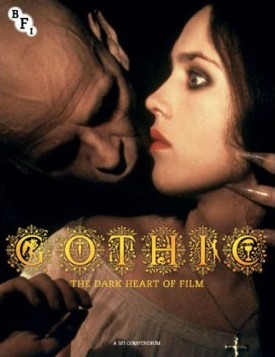
This exhibition follows hot on the heels of a Gothic film festival, Gothic: The Dark Heart of Film, arranged by the British Film Institute (BFI) in 2013. The BFI published a compendium, which is actually a delightful introduction to the world of Gothic film, its landscapes, architecture and inhabitants. In fact, this is probably one of the rare instances you will see me recommending a book on Gothic fiction on this blog, but the thematic approach to the subject as well as the host of experts who have contributed to it makes it a real treat, even for people with a more casual interest in the genre.
So the book includes essays on the relation between Gothic cinema and literature, architecture and art, with Martin Myrone, author of a nice book on Fuseli and contributor to the Tate exhibition on Gothic Nightmares back in 2006, noting that 'the relationship between the canon of Gothic literature of the 'classic' phase (c. 1760-1830) and the visual imagery of the same date is far from simple: the relationship of this early Gothic art and writing to modern cinema no more so.' Still, he later on concedes that 'nonetheless, there are parallels and resonances between Gothic literature of the 'classic' phase and precisely contemporary visual art, and between these and modern cinema,' accompanying his essay with a number of examples of these homologies, of which the most famous is, of course, Fuseli's Nightmare (see the Gothic Nightmares catalogue from Tate for numerous examples).
However many experts have contributed to the conpendium, they still are unable to solve the conundrum of pinning down what the Gothic 'genre' actually is. Myrone states that it is 'now often understood as, by definition, a trans-medial, genre-defying, migratory and polluting phenomenon, we should not expect homologies between Gothic productions in different media and eras need be predictable, explicit or orderly.' The paradox of how relatively easy it is to describe the Gothic 'landscape', while it seems almost impossible to define it, is what makes the compendium - cf. the title's nod to Joseph Conrad - a 'Grand Tour of the Gothic,' as Sir Christopher Frayling says in his foreword.
Whether I first learned of Vlad the Impaler from reading some newspaper article or from watching the Swedish TV documentary Vem var Dracula? (Who was Dracula?, internationally known as In Search of Dracula), I am not sure. In any case, from a very young age I was aware of the supposedly 'historical origins' of Count Dracula, the vampire. Of course, McNally and Florescu did not come up with this idea when they published their bestselling In Search of Dracula, as one e.g. finds a reference to 'Voivode Drakula or Dracula, who ruled in Walachia in 1455-1462' in Harry Ludlam's Stoker biography from 1962, but it was their book that internationally established 'historical Dracula', Vlad Tepes, as a 'historical fact'.
The Romanian stamp indicates the size of the book.
I suppose that back then, reading their book as a teenager, its scope seemed incredibly daunting, what with the appendices of German, Russian and Romanian Dracula stories. Later on, however, when trying to get a better grasp of the life of this Wallacian lord, I found this and some of the other books by the two historians all too brief.
Dieter Harmening's Der Anfang von Dracula. Zur Geschichte von Geschichte, published a decade later, on the other hand encourages the reader to follow in the footsteps of the historian reading source texts on the Impaler, as well as looking for the link between Vlad the Impaler and Count Dracula, the vampire.
This approach can now be carried out in full from your desk with the publication of the first of a three volume set Corpus Draculianum edited by Thomas M. Bohn, Adrian Gheorghe and Albert Weber, that collects all major sources for the life and deeds of Vlad the Impaler. The first volume is actually number 3, which collects sources from Ottoman world, written by both Muslim and Post-Byzantine Christian authors and as a whole complementing the more well-known European view of the Impaler with an Oriental Dracula figure.
The texts are mainly first and second hand sources, with only a few of the most important tertiary sources added. The primary sources were written by people who had been involved in Sultan Mehmed II's campaign against Vlad Tepes in 1462. Among them, Enveri has himself apparently seen many impaled corpses in Wallachia: 'Als jener abgezogen war, sahen wir dort viele Leichen/Auf den Pfähl [gezogen], manche alt, manche neu.' The focus of most texts is the campaign, and some of the authors seem to have little knowledge of what happend to the Impaler after his escape to Hungary. Tursun Beg, one of the more well-known Ottoman authors, even believed that Vlad Tepes died in captivity in Hungary, his soul ending up in Hell: 'Die Ungarn nahmen ihn fest und kerkerten ihn ein. Und hier schickte er seine Seele in die Hölle.'
The Ottoman Dracula figure retains its own character until the 17th century, when it gradually takes on the shape of the Vlad the Impaler from the European tradition, that is reflected in e.g. the stories recounted by McNally and Florescu in their In Search of Dracula.
Each text in the Corpus is presented in the original language along with a German translation. Extensive notes are supplied to make the text easier to understand and appreciate, just as information on the authors, their motivations, the sources themselves and secondary literature accompany each text. Furthermore, a chronology of events and an index of names and places are included along with a minute analysis of the interrelation between the texts.
Although, no doubt only a specialist can genuinely appreciate and critically evaluate a work of this kind, I am confident that this volume provides invaluable information for the specialist and historian interested in Vlad the Impaler or in the history of the region during this period. The layman interested in uncovering the bare bones behind the recreation of historical events that have become associated with a popular figure of modern cultural history, will no doubt find it intriguing to witness 'history in the making'.
The other two volumes will folow within the next ear or two, and I am also told that Bohn, Gheorge, and Weber hope to present the Corpus in English later on.
'Vlad III. Ţepeş „Dracula“ ist durch eine Reihe von Gräueltaten im historischen Gedächtnis verankert. Das aus einer zeitgenössischen Rufmordkampagne resultierende Image rekurrierte vor allem auf seine vermeintliche despotische Blutrünstigkeit. Im Pantheon des rumänischen Geschichtsdenkens erwarb er sich hingegen einen Heldenplatz, da er die Auseinandersetzung mit Mehmed II., dem Eroberer Konstantinopels, gesucht hatte. Osmanische Chroniken schildern Vlad aber als ungläubigen und tyrannischen Rebellen, der unschädlich gemacht werden musste, um eine Pax Ottomana im europäischen Südosten herbeiführen und legitimieren zu können. Zwischen den Zeilen kristallisiert sich aus den Quellen jedoch auch das Bild eines Kreuzritters oder Volkstribunen heraus. Dass Vlad letztlich von Ungarn, Sachsen und Bojaren verraten wurde, machte deren moralische Argumentationsstrategien obsolet und erleichterte es der späteren rumänischen Nationalhistoriographie, ihren Heroen zu idealisieren. Bis heute verfügt die Forschung über keine nach zeitgemäßen wissenschaftlichen Kriterien verfasste Biographie des Vlad Ţepeş oder eine eingehende Aufarbeitung der späteren Erinnerungskulturen und historiographischen Debatten über ihn.
Gerade die Vita des Vlad Ţepeş bietet sich an, um über verschiedenartige kulturelle Prägungen charismatischer Herrscherpersönlichkeiten in Südosteuropa während des Spätmittelalters und in der frühen Neuzeit nachzudenken. Die Tagung soll deshalb in einer Vergleichsperspektive die komplexen Lebensläufe auch anderer Herrscher sowie die damals und heute damit verknüpften Erinnerungskulturen in den Blick nehmen. Übergreifend sollen Einblicke in eine große Zone der geschichtlichen Verflechtungen zwischen Ostmitteleuropa und dem Osmanischen Reich ermöglicht werden.
Anlass der Tagung ist die dreibändige Dokumentation „Corpus Draculianum“, deren erster Teil in Kürze von Thomas Bohn, Adrian Gheorghe und Albert Weber bei Harassowitz in Wiesbaden veröffentlicht wird.
Konferenzsprachen sind deutsch und englisch. Die Manuskripte der Vorträge sollen den Organisatoren zu Beginn der Tagung vorliegen und werden später in einem Sammelband publiziert.' Corpus Dralianum 3. Die Überlieferung aus dem Osmanischen Reichcosts € 68, and can be purchased directly from the publishers, Harassowitz Verlag.
Ottoman booty from the 16th century collected at Castle Ambras, Innsbruck
'In Styria ...' Irishman Sheridan Le Fanu set his Carmilla in Styria, part of current day Austria. A current exhibition at the GrazMuseum in Graz in Styria now explores the role of Styria in vampire literature, the development of the media vampire, and what it is all about.
Le Fanu appears to have read an 1836 travel book, Schloss Hainfeld, or a Winter in Lower Styria by Basil Hall, and probably found the description of a pre-industrial and romantic part of Europe an appropriate setting for his vampire novella. By the time Bram Stoker was working on Dracula, he also chose Styria as the home of the vampire count, before deciding to place Count Dracula's castle in Transylvania. The curators of the GrazMuseum believe that at the end of the nineteenth century the construction of a backwards, threatening, and superstitious East Europe had moved further to the Southeast, making Styria a region less likely for a vampire story. Stoker, however, as we know, still retained Styria as a location in his short story Dracula's Guest.
The exhibition, Carmilla, der Vampir und wir (Carmilla, the vampire and us), sees the fictional vampire of Le Fanu and Stoker not only as an extension of the Romantic vampire figure, but rather as a reaction to the industrialization that changed the face of many West European countries throughout the nineteenth century. This is, of course, evident in the conflict between East and West in Dracula, but as industries, media, and the globalization has developed and transforms even remote places, the vampire becomes (in the view of the curators) more a mirror image of the problems that humans face in an everchanging world more and more out of contact with its history and roots. At the same time the vampire of fiction, just like humans, faces his (or her) own existential crisis.
The exhibition at the GrazMuseum appears to explore such themes rather than the vampire's roots in folk beliefs. It consists of five rooms, glimpses of which can be seen in a clip from Austrian TV, from which a few shots are shown below. It is open until Halloween this year, and a publication related to the exhibition will be available later this year.
According to Amazon, the last of the three volumes of Corpus Draculianum will be published in December, while the first two volumes will follow in 2014 and 2015. The Corpus compiles all sources to the current knowledge about Vlad Tepes, written in 16 different languages and supplemented by translations and commentaries, and is intended to not only make these sources available to both scholar and layman, but also to defictionalize the Wallachian Woiwode. For more information (in German) on the books, see this web site. The Corpus is prepared by Thomas M. Bohn, Adrian Gheorghe and Albert Weber. The books are published by Harassowitz Verlag in Wiesbaden, Germany.
From Bram Stoker's Notes for Dracula: A Facsimile Edition by Robert Eighteen-Bisang and Elizabeth Miller p. 34-5: 'Directions in letter of Count to go to Munich stop at Quatre Saisons & wait instructions. Start on same day & arrive direct service. Visit to Pinacothek museum & to Dead House - telling how brought about.'
According to Bram Stoker's notes for Dracula, Jonathan Harker's travel route was: London - Paris - Munich - Salzburg - Vienna - Budapest - Klausenburg - Bistritz. In Munich he stayed at the Quatre Saisons hotel, now Hotel Vier Jahreszeiten in Maximilianstrasse, part of the Kempinski group. Opened in 1858 as a state of the art hotel, it is still considered one of the leading hotels of the world. Judging by the only Kempinski hotel I have myself stayed at, the luxurious Hotel Adlon in Berlin, the Vier Jahreszeiten is no doubt worth a stay - if you can afford it.
Hotel Vier Jahreszeiten
The relationship between the short story Dracula's Guest and Dracula, the novel, is disputed, but elements from the short story can be found in some of Stoker's notes for the novel. These include a visit to the Pinakothek, which at the time consisted of two collections, the Alte Pinakothek and the Neue Pinakothek. Today a Pinakothek der Moderne has been added. The collections exhibit many well-known and important pieces of art, e.g. Michael Pacher's 15th century set of four paintings from St. Augustine's life, including that of the Devil showing Augustine the Book of Vices. Currently the Alte Pinakothek is exhibiting an interesting collection of motifs from the Old Testament.
Alte Pinakothek
Stoker possibly intended Harker to visit the Opera for a performance of Wagner's Flying Dutchman, no doubt at the Nationaltheater München. There are, of course, also other things to enjoy while in Munich.
‘I am in doubt, and so have done the best thing I know of; I have written to my old friend and master, Professor Van Helsing, of Amsterdam, who knows as much about obscure diseases as any one in the world. I have asked him to come over, and as you told me that all things were to be at your charge, I have mentioned to him who you are and your relations to Miss Westenra. This, my dear fellow, is only in obedience to your wishes, for I am only too proud and happy to do anything I can for her. Van Helsing would, I know, do anything for me for a personal reason. So, no matter on what ground he comes, we must accept his wishes. He is a seemingly arbitrary man, but this is because he knows what he is talking about better than any one else. He is a philosopher and a metaphysician, and one of the most advanced scientists of his day; and he has, I believe, an absolutely open mind. This, with an iron nerve, a temper of the ice-brook, and indomitable resolution, self-command, and toleration exalted from virtues to blessings, and the kindliest and truest heart that beats – these form his equipment for the noble work that he is doing for mankind – work both in theory and practice, for his views are as wide as his all-embracing sympathy. I tell you these facts that you may know why I have such confidence in him,’ writes Dr. Seward in a letter to Arthur Holmwood dated Saturday, 2 September with regards to Miss Westenra’s health.
With all his peculiarities of action, manner and speech, the character of the Dutch Professor Abraham Van Helsing, ‘M.D., D.Ph., D.Lit., Etc.’, has been interpreted and portrayed in many ways since the first stage and film adaptations of Bram Stoker’s Dracula. In 1957, when British Hammer Films were to adapt the novel for their second excursion into Gothic horror, Dracula, they turned to the star of their The Curse of Frankenstein, Peter Cushing, for a suitable actor for another role as both scientist and outsider.
Usually acting on very limited budgets, Hammer had to limit the range of characters and action to a minimum, so Van Helsing himself took on the role of the prime vampire hunter after his collaborator, Jonathan Harker, had become the victim of Count Dracula. Cushing’s Van Helsing then is not the wise old man who conducts the younger men in their hunt for Dracula; he is himself the active vampire hunter taking the lead, and very physically running and jumping about in order to hunt down and eliminate Dracula and his vampire women. He also becomes the one who employs the latest technological advances like a phonograph, much to the amazement of the common man who is unable to understand why Van Helsing is ‘talking to himself’.
Cushing’s Van Helsing is, as Cushing’s roles almost always are: ever as astute as he is eloquent and immaculately attired, revealing exactly that attention to detail that Cushing appears to have applied when preparing himself for his roles. All this is exemplified in the curious, but at the same time fascinating scene in which Cushing records his observations and conclusions regarding vampires on the phonograph.
As for his study of vampires, Van Helsing tells us that ‘the study of these creatures has been my life’s work. I’ve carried out research for some of the greatest authorities of Europe, and we’ve only just scratched the surface.’
We in the audience probably feel uncertain as to whether Van Helsing is actually a progressive scientist, as the reference to ‘the greatest authorities of Europe’ would lead us to believe, or he is dabbling in things that truly transcend any reasonable boundaries of scientific method, as in the case of Cushing’s other grand role, Victor Frankenstein. Although we experience that the vampire in Hammer’s Dracula is a real phenomenon, the boundaries between science and metaphysics are blurred, and when we learn more of Van Helsing’s encounters with another vampiric aristocrat, Baron Meinster, in the follow up, The Brides of Dracula (1960), the religious symbolism is no less apparent. The vampires are ultimately killed with the sign of the cross (using the sails of a wind mill, perhaps echoing Universal’s Frankenstein films), and, when Van Helsing himself becomes the victim of a vampire, he must cleanse himself from the infection using holy water.
In Hammer’s series of Dracula films, Christopher Lee’s Count Dracula acts a sexual threat against the bourgeoisie, tempting both unmarried and married women to stray from the accepted paths. In Taste the Blood of Dracula (1970) he exposes the double standards of the family fathers who live a philistine double life seeking to taste forbidden fruit outside their lives as faithful husbands, fathers and citizens.
Peter Cushing only plays the role of Van Helsing in some of the films, allowing others to act as the one who restores order to family and society. Van Helsing, however, appears to live outside the mainstream of society, no doubt because of his knowledge concerning the very forces that threaten society, while his intelligent and direct manner also appears to offend polite society.
Cushing did, however, also the play the role of a religious figure at the core of a society, a fanatical zealot who is not only chastising women in general, but is always on the outlook for both witches and vampires, in Hammer’s third variation on Joseph Sheridan Le Fanu’s Carmilla, Twins of Evil (1971).
Hammer’s Count Dracula himself was introduced as an eloquent aristocrat, but was soon turned into a nonverbal force that appeared to have a rather limited freedom of movement, and as Hammer itself struggled to maintain it’s existence, they tried to bring both Dracula and Van Helsing into the 1970’s in Dracula A.D. 1972 and The Satanic Rites of Dracula. Consequently, Cushing plays Lorrimar Van Helsing, a descendant of the original Van Helsing, but generally remains as astute and dynamic as his forefather, but unfortunately both films are, although not without some merit, in retrospect signs of the death agony of Hammer’s Gothic formula when compared to it’s competition: blockbuster horror films like The Exorcist and The Omen.
As is The Legend of the 7 Golden Vampires, in which Peter Cushing added vampire hunting in China to the curriculum vitae of Van Helsing. It certainly has entertainment value, but overall the whole idea of a series of Dracula films based on Hammer's formula was probably becoming obsolete at this time.
Peter Cushing himself remained closely related to the genre, but also got the chance to play an important role in the first Star Wars film. Still, among his finest moments are his roles as Victor Frankenstein in Hammer’s series of rather thematically and artistically coherent Frankenstein films, and as Van Helsing in first and foremost Dracula, which was released on Blu-ray in a magnificent and highly recommended, restored edition earlier this year.
This post is part of the Peter Cushing Centennial Blogathon celebrating the centenary of Cushing’s birth. Peter Wilton Cushing was an English actor born on 26 May 1913, who appeared in numerous films, including films produced by Hammer Films. He died on 11 August 1994.
Peter Mario Kreuter and Paul L. Yoder edited The Horrid Looking Glass: Reflections on Monstrosity (Inter-Disciplinary Press, £19.99) back in 2011. It compiles a number of papers on monsters and monstrosity. Among the papers are The Eternal Changeling: Dracula’s Transformations through the 1970s by Sorcha Ní Fhlainn, and The Nymph and the Witch: Female Magical Figures in the Works of Paracelsus by Kreuter.
'From the fictional world of vampires, zombies, and invaders from other worlds, to the very real world of revolutionary France and in between, the nature of the monster encompasses the very quality that makes them so believable – that which we perceive as ‘other’. While there is a commonality in this otherness, the monster lurking in the shadows, concealed in darkness or conjured with a few lines from a horror novel suggests the monster as one onto which we are free to project the most distorted and un-human features. In each chapter of this volume, you will discover that the way in which we project what is monstrous is not a singular other but is in fact a part of our own self-identity. The greatest horror of the monster is not that it stands apart, but that once we pull it from the shadow of our own projected imagination; we discover that that the monster we fear is also bound to our own mirror image. To look at the monster, to name that which must never be named, is to look upon a reflection and embrace a part of our nature we do not wish to see.
As the fourth gathering of scholars to bring light to this darkened world of Monsters and the Monstrous, the goal is not to turn away in fear, but to confront, explore, and ask questions of them. Within the pages of this volume are the results of the conversations that took place among them.'
To many, Francis Ford Coppola’s film Bram Stoker’s Dracula has become quite the epitome of the story of the vampiric Count Dracula. The soundtrack music by Polish composer Wojciech Kilar is ubiquitous, and the film’s blend of history and fiction, of romance and horror, as well as its creative play with cinema itself, seem to suit a vision that many people have of Dracula and vampires, or at least one that appeals to them – that is, of course, prior to the boom of adolescent vampire fiction like Twilight. Perhaps, as it is more than twenty years since Coppola’s film received its premiere, many people have simply grown up with this film and consequently now identify Dracula with Coppola’s Count.
So it is little wonder that the first thing behind the dark curtain leading into the Dracula e il mito dei vampiriexhibition at the Triennale design museum in Milan was a screen showing excerpts from Coppola’s film. In fact, the fusion of historical fact and vampire fiction, of artistic creativity and design, and of Bram Stoker’s novel with its interpretation by artists and cinematographers, permeated the exhibition as a whole.
Not so much an extension or reworking of the Dracula Woiwode und Vampir exhibitions at Innsbruck and Bucharest, Dracula e il mito dei vampiri rather integrated items from that exhibition into something new, not only bringing the fictional vampire into focus, but also, as one would expect af a design museum, stressing Italian art and design.
Having watched Coppola’s vision of the Wallachian warlord turned vampire, the visitor was greeted by the famous portrait of Vlad Tepes from the Kunsthistorisches Museum in Vienna. Fortunately, one was not met by Vlad’s gaze, as he rather looks at something or someone to your left, so one can study his features without fear of having aroused his, er, attention. Similarly, the full-length portrait of Dracula Waida Princeps from Forchtenstein Castle appears to look to one side, but strangely, his eyes have an uncanny look as if a film is layered on top of them, or maybe someone attempted to blur them?
Only a very small selection of items from the earlier Dracula exhibitions were displayed here to provide some context for the life and cruelty of Vlad Tepes: A 17th century map of Transylvania from the Kunsthistorisches Museum, the coloured print of the city of Papa from 1617 showing impalements, a copy of Sebastian Münster’s 1598 Cosmographey with its depiction of impalements, and various clothes and weapons used by the Ottomans.
The vampire cases and the ensuing debate of the 18th century were illustrated via a handful of books, including Johann Christoph Harenberg’s 1733 Vernünftige und Christliche Gedancken über die Vampirs oder bluhtsaugende Todten, Nicolas Lenglet du Fresnoy’s 1751 Traité historique et dogmatique sur les apparitions, les visions & les revelations particulières, and the German translation of van Swieten’s commentaries published in 1768. However, there were no documents, no Calmet, Ranft or Tallar, no bust of van Swieten or portrait of Maria Theresa as in the exhibitions at Innsbruck and Bucharest.
Instead, the exhibition of vampire fiction was enhanced by some remarkable items courtesy of the Bram Stoker Estate and John Moore Collection: Bram Stoker’s so-called lost journal that was published for the first time last year, and Stoker’s autograph copy of the first edition of Dracula‘to my dear mother’, both definitely some of the chief attractions of the exhibition.
A couple of Goya’s Caprichos, a first edition copy of Polidori’s The Vampyre as well as posters for performances of Marschner’s opera Der Vampyr and a programme for a 1927 performance of Deane and Balderston’s stage adaptation all led the way into a room where quotes from Stoker’s novel were displayed in Italian on a wall. Here you could also enter the house of a vampire as envisioned by Milanese architect and designer Italo Rota. A rather creepy tableau of a ‘living room’ with earth strayed across the table and a selection of ritual tools, remedies, books and art, all of which, according to Rota, should reflect the mentality and everyday ‘life’ of a vampire. Suffice it to say, that I would not spend my time in that place…
Entering the world of vampire cinema, one could peep through holes like a voyeur to observe a variety of ‘vampire kisses’ from a number of vampire films, while more analytically, over the door to the next room, a brief genealogy and philosophy of cinematic vampirism was outlined. Nosferatu from 1922 accordingly reflected the psychoanalysis of Freud and Jung, whereas Dracula from 1931 showed the vampire in the modern major city, and might be interpreted in terms of Georg Simmel or Walter Benjamin.
Then, for some reason the vampires of Hammer and many other filmmakers from the 1950’s to 1980’s were not included in the genealogy, so we jumped right to the era of post-structuralism (Jacques Lacan) and postmodernism (Guy Debord and Gilles Deleuze) with Bram Stoker’s Dracula from 1992 and Interview with the Vampire from 1994, respectively. Finally, in a 'liquid' society where 'solid' concepts like work and marriage are, in the words of Zygmunt Bauman, 'like zombies, such concepts are today simultaneously dead and alive', Edward Cullen and the other vampires of Twilight could be perceived as 'post-vampires', indistinguishable from mortal humans.
Clips from a variety of vampire films, including Mario Bava’s Italian La maschera del demonio from 1960, were shown on three transparent screens in a separate room, their soundtrack having been replaced by popular pieces like Orff’s O Fortuna and Delibes’s Flower Duet, all played at high volume.
Among the clips were, of course, Coppola’s Dracula film, and not only its screenplay and parts of its storyboards were exhibited, Dracula e il mito dei vampiri also paid homage to the film's costume designer, Ishioka Eiko, by displaying the blood red armour she created for Dracula, and showing a documentary about her work on the film. The tribute to Eiko was followed up by a a tableau of impressive female stage costumes from various operas and ballets like Aida, Die Zauberflöte, and Turandot. Very fitting for an exhibition in the hometown of Italian fashion and the famous opera house, La Scala. A wall of photos from catwalks rounded this section off with fashion for men designed by Louis Vuitton, Gucci, Prada and others, all illustrating the crossover of the vampire from fiction to fashion, no doubt with a good deal of help from Goth subculture.
Finally, a room not intended for children, exhibited pages from Guido Crepax’ comic book adaptation of Dracula as well as a hitherto unknown sequence in which his heroine Valentina meets Count Dracula.
Personally, I must say that the exhibition whet my appetite for more, as it is fairly easy to imagine how an exhibition like Dracula e il mito dei vampiri could be expanded in order to go into more detail with Vlad Tepes, with the struggle between the Ottoman Empire and Christian Europe, with vampires and revenant beliefs, and with the rise of the fictional vampire, Count Dracula and the vampire of modern popular culture. I am, however, well aware of the painstaking work that is no doubt required to assemble the number of paintings, books, documents and artefacts that would fit in with the themes, and at the same time I am not sure how much the average visitor is in fact able to digest. With regards to Vlad Tepes and vampires, the exhibitions in Innsbruck and Bucharest are so far the most comprehensive exhibitions I am aware of, and it will probably be hard to surpass hem. But hopefully there is more to come in the future.
In connection with the exhibition, Skira has published a 131 page catalogue, which includes a number of articles and a selection of the items exhibited. Margot Rauch has contributed the historical part of the catalogue, Dracula: voivoda e vampire, which is in fact a translation of what she wrote for the Innsbruck and Bucharest exhibition catalogues, as well as an inventory of some of the books and artefacts exhibited. The article on the costumes of female vampires (and vamps) include a number of photos of stars like Dietrich, Garbo, Bernhardt, Swanson and Bara that were not on display, while Italo Rota’s vampiric living room is only documented on a youtube video that can be accessed with a QR code.
Whether Dracula e il mito dei vampiri will be exhibited elsewhere in the future – in the same or some other form – I do not know, but the photo to right was posted on facebook by the company that organized the exhibition,with the accompanying message:
‘Dracula ha fatoo le valigie ed è pronto a ripartire alle conquista di nuove città!’: Dracula has packed and is ready to conquer new cities!
A copy of Johann Christoph Harenberg's Vernünftige und Christliche Gedanken über die Vampirs oder Bluhtsaugende Todten (1733) on display in Milan
This is a selection of videos from the current exhibition on Dracula and the vampire myth at the Triennale di Milano in Italy. The exhibition combines items from the exhibition that was originally on display at the Schloss Ambras in Austria, and that I myself saw when exhibited in Bucharest in Romania, with new items from e.g. vampire films like Francis Ford Coppola's Bram Stoker's Dracula.
Austrian and Romanian catalogues for the original Dracula exhibition
The Bram Stoker Festival takes place in Dublin on 26 to 28 October. The program has just been revealed on the festival web site, and includes an exhibtion on Stoker's life as well as panels on Fatal attraction: What is it with vampires? and What lies beneath? Dracula and its legacy, featuring a.o. Stoker biographer Paul Murray.
'From 26th - 28th October, Dublin City will celebrate the life, work and legacy of Dublin horror novelist Bram Stoker and his gothic novel 'Dracula'.
The three-day festival will peel back the layers of the city to reveal Stoker's Dublin. Prepare for a weekend for all the family with walking tours through the lane-ways and hidden steps of the Victorian macabre aspect of the city; literary workshops exploring horror writing with award winning authors for both teens and adults; Stoker-themed theatre, lively discussions on all things vampire, and a highlight being an evening of spooky spectacle from renowned street theatre company Spraoi in the majestic surroundings of Dublin Castle.
Whether you're a city dweller, or a visitor to Dublin for the weekend, the inaugural Bram Stoker Festival is sure to chill your bones in time for Halloween!'
The 'vampire skeleton' found in Sozopol in Bulgaria belonged to a man named Krivich, a name meaning the Crooked, according to novinite:
'He was a legendary pirate, manager of the Sozopol fortress or one of his heirs.
The Crooked, as his contemporaries called him, has been a crippled, but extremely intelligent man. He outshined everyone with his knowledge about the sea, the stars and herbs. Byzantine chronicles describe how he plundered a Venetian ship. It is possible that he was declared a master of the witchcraft because of these talents, which explains the metal stake through his heart.
Experts also believe that the man may have been an intellectual and perhaps a medic, as such individuals often raised suspicions in the Middle Ages. The grave was discovered near the apse of a church, which suggests that he was an aristocrat.'
'Sozopol is one of Bulgaria’s oldest towns, the current settlement dating back to the seventh century BCE when it was founded as a Greek colony named Antheia (the town’s name would later change to Apollonia and then Sozopolois), but it appears that the site was inhabited as far back as the second millennium BCE, which makes it a rich digging ground for archaeologists every summer.
It does not hurt that one of the town’s more famous sons, the head of the National History Museum in Sofia, Bozhidar Dimitrov, rarely misses an opportunity to promote Sozopol – as he did with the “vampire” find, which grabbed international media attention and resulted in a documentary by the National Geographic channel.
Dimitrov is not averse to making bombastic pronouncements on the value of new finds – in 2010, he proudly proclaimed the contents of a relic urn found on a small island off the coast of Sozopol to contain the bones of St John the Baptist, even before the remains could be dated.
Dimitrov, who is a former diver and whose historian credentials are based mainly on his research of the medieval Boyana church near Sofia, has in recent years seized every opportunity to big up his hometown, nor is he afraid of stepping on anyone’s toes – earlier this summer, he proudly proclaimed Vlad the Impaler, the Wallachian prince who served as the inspiration for Bram Stoker’s Count Dracula, as having been Bulgarian.
Following the “vampire” find earlier this summer, Sozopol plans to twin with Sighisoara, the Transylvanian town where Vlad spent his exile between his first two reigns.'
Earlier this Summer, The Sofia Globe noted that 'the Sozopol souvenir shops urgently are placing orders for Dracula souvenirs, as it turns out that the Sozopol “vampire” and the notorious Romanian count have been relatives. According to the news.bg website, several advertising agencies in Bourgas have received orders for vampire souvenirs.'
No doubt, pirates and vampires make for an excellent tourist attraction.
Celebrations of the memory of Bram Stoker as theatrical manager and author are still ongoing, and the Irish An Post marked the centenary of Stoker's death with two stamps depicting Stoker himself as well as his most famous fictional creation, Dracula. The stamps are available at face value, including the minisheet shown below on top of the sheet published in 1897 to celebrate the centenary of Dracula itself. Click on the photo for a more detailed look, or go to An Post's shop if you are interested in purchasing the stamps. The new stamps are designed by David Rooney.
Considering the use of the written word in various formats, including a number of letters, in the novel itself, and the enormous amount of letters Stoker must have written while working for Henry Irving, stamps are a fitting way of celebrating Stoker and his vampire.
Oh, and by the way, having spent some hot and sunny days in the Western part of the Mediterranean Sea here in July, it is interesting to note that it is at the same time of year that the Demeter experienced 'rough weather' while journeying to the Gibraltar Strait. I suppose that, although Stoker meticulously dated the events of the novel, one recalls the events and not the context. But then it is perhaps even more unpleasant that Count Dracula conjures up a storm in late July. Following the novel more or less 'in real time' via the Dracula blog allows one to be reminded of the timing of the events.
Despite the heat and sunshine, a modern day vampire film could easily be set in Barcelona. The narrow old streets, the shuttered houses, the broad avenues, the modernista houses, the modern architectonical creations, the numerous citizens and the masses of tourists flocking the streets and beaches well into the night, all of them are elements that would make an interesting backdrop to the fictional vampires preying a city in search of blood.
In real life, as a tourist one must beware of pickpockets and scam artists. A guy entering a metro train right behind me was pickpocketed, but fortunately recovered his wallet before the thief could get away with it. This, unfortunately, is the case with various larger cities, just as a waiter in a restaurant in the old part of the city apparently mixed up bills so I was asked to pay an amount that was almost one and a half of what we had actually ordered. Fortunately, most of the people we met on our stay were friendly and helpful.
This was certainly the case of the head waiter (owner?) of Crama Dracula, a small Romanian restaurant located in 18 Carrer de Provença opposite a huge panopticon style prison (closest metro station is Entença). We arrived there early, so we got a lot of attention and the food consisting of some traditional Romanian dishes with mineral water and 'Dracula' Cabernet Sauvignon arrived very quickly.
I suppose you need some sense of humour to own or work in a Dracula restaurant decorated with various Vlad Tepes and Dracula artefacts, so perhaps that is why I afterwards thought our waiter had a hint of John Cleese about him. Anyway, we were treated nicely, also tasting their 'Dracula crepes' for dessert as well as their Țuică.
And if you want to enjoy Romanian wine and food at home, there is a shop, Unirea, selling Romanian wine and ingredients almost next door to the restaurant. Their 'Dracula wine' is actually pretty cheap, just €4.
On a more horrific note, this year marks the centenary of the detention of the so-called 'vampire of Barcelona', Enriqueta Marti, a kidnapper and murderer of children. Born in 1868, Marti moved to Barcelona as a young woman and ended up as a prostitute, later on specializing in prostituting children. According to wikipedia, she led a double life:
'During the day she dressed in rags and begged at houses of charity, convents and parishes in the destitute parts of town where she selected children who looked the most abandoned. Taking the children by the hand, she made them pass as her children. Later, she prostituted or murdered them. She did not have any need to beg since her double work as a procurer and prostitute gave her sufficient money to live well. By night she dressed in luxurious clothes, hats and wigs, and attended the El Liceu, the Casino de la Arrabassada and other places where the wealthy of Barcelona gathered. It is probable that in these places she offered her services as procurer of children.'
Operating for many years, she not only had a brothel prostituting minors, but also served as a kind of witch-doctor. Again, according to wikipedia:
'The ingredients she used to make her remedies were made from the remains of the children that she was killing, who ranged from infants up to children of 9 years. From these children she used everything that she could; the fat, blood, hair,and bones (that normally she turned into powder). For this reason, she did not have problems disposing of the bodies of her victims. Enriqueta offered salves, ointments, filters, cataplasms and potions, especially to treat tuberculosis, which was highly feared at the time, and all kinds of diseases that did not have a cure in traditional medicine. Wealthy people were paying large sums of money for these remedies.'
On February 27 2012 she was finally arrested after a neighbour had noticed a girl she had never seen before playing in Marti's mezzanine flat in 29 Carrer de Ponent, now 29 Carrer de Joaquín Costa in the part of Barcelona called Raval. The girl turned out to be a girl kidnapped by Marti. Investigators from the police then searched a number of flats where Marti had stayed and made macabre discoveries of human remains.
All sorts of atrocities are attributed to Marti, but as she was never tried - the legal proceedings were interrupted by Marti getting lynched by fellow prisoners in 1913 - the case appears to be somewhat unclear. But if you read the wikipedia article - which appears to be an attempt at translating the Spanish one - you will find all manner of criminal and sadistic acts attributed to her.
Returning to the world of fiction, I noticed a well-assorted DVD store near the university: Castelló 70-nou in 79 Carre de Tallers, even stocking Dracula and Mummy lamps and clocks! I stuck to a cheap DVD as a kind of souvenir of El Mundo de las Perversas Vampiras (!), a Jess Franco film from 1971 (according to imdb: 1973) called Virgen entre los muertos vivientes in Spanish and known by a multitude of titles like Christina, princesse de l'érotisme.
Charitably said, the cover of the DVD is more fun than spending 75 minutes to get through the story of a young woman going to the estate of her family after her father's death, ultimately learning that the family members she meets are (living) dead with a taste for blood. Franco has his fans, and this film has once again convinced me that I will never become one of them...
Finally, it may be worth mentioning that Catalonia is, of course, the home of Cercle V, an organization interested in vampires, including the historical aspects. Among those involved in Cercle V is Jordi Ardanuy.



+GrazMuseum.jpg)


