On several occasions, particularly on the periphery of the Habsburg Empire during the 17th and 18th centuries, dead people were suspected of being revenants or vampires, and consequently dug up and destroyed. Some contemporary authors named this phenomenon Magia Posthuma. This blog is dedicated to understanding what happened and why.
According to Professor of anthropology, Yordan Yordanov, who has studied and reconstructed the head of the ‘vampire skeleton’ from Sozopol, the head is not only unusually asymmetrical, but it also shows traces of so-called incomplete or symbolic trepanation (or trephination).
Trepanations can be divided into three classes: 1) Those performed on living subjects as a therapeutic method. 2) Those performed on a corpse for "magic" properties. 3) Incomplete trepanations that are performed on living subjects without fully removing a piece of the skull, perhaps only scraping off portions of the skull. The last ones are those signified as symbolic trepanations and are supposed to be performed for cultical reasons.
Several examples of this kind of trepanation are known from Hungary (according to Berecki, Molnár, Marcsik, Pálfi: Rare Types of Trephinations from Hungary Shed New Light on Possible Cross-cultural Connections in the Carpathian Basin in International Journal of Osteantrohopology, it was fairly common there in the 9th to the 11th century, cf. also this blog).
The term symbolic trepanation was introduced by the Hungarian L. Bartucz in 1950, and Yordanov himself has studied the phenomenon on finds from the West coast of the Black Sea (Jordanov, Dimitrova, and Nikolov: Symbolic Trepanations of Skulls from the Middle Ages (IXth - Xth Century) in Bulgaria inActa Neurochirurgica Vol 92 (1988), issue 1-4, pp. 15-18).
Here are two documentaries inspired by the 'vampire skeleton' find in Sozopol in Bulgaria. The first one is an incredibly dramatic and sensational 'history' of vampires from Russian Mainstream TV Company, while the second is a more straightforward documentary about the Sozopol find made for National Geographic. Neither are currently available online in English.
After being displayed at the National History Museum in Sofia, the purported Bulgarian 'vampire skeleton' has been returned to Sozopol on the Black Sea coast, where it was originally found. A reconstruction of the head of the deceased man from the 14th century has been carried out by Professor Yordan Yordanov, and was presented to the public in late May. Apparently a man of about 45 years of age, he is described as 'handsome as a Roman'. He certainly does not look particularly scary...
Having arrived safely in Sozopol, both the skeleton and the reconstructed head are exhibited at the Archaeological Museum in Sozopol, where they are expected to become a tourist attriction. In the words of Bozhidar Dimitrov: 'They are pretty disappointed in Sozopol that [the skeleton] is not with them. He’s been lying about long enough, it is time he goes and makes some money at the seaside.'
The 'vampire skeleton' found in Sozopol in Bulgaria belonged to a man named Krivich, a name meaning the Crooked, according to novinite:
'He was a legendary pirate, manager of the Sozopol fortress or one of his heirs.
The Crooked, as his contemporaries called him, has been a crippled, but extremely intelligent man. He outshined everyone with his knowledge about the sea, the stars and herbs. Byzantine chronicles describe how he plundered a Venetian ship. It is possible that he was declared a master of the witchcraft because of these talents, which explains the metal stake through his heart.
Experts also believe that the man may have been an intellectual and perhaps a medic, as such individuals often raised suspicions in the Middle Ages. The grave was discovered near the apse of a church, which suggests that he was an aristocrat.'
'Sozopol is one of Bulgaria’s oldest towns, the current settlement dating back to the seventh century BCE when it was founded as a Greek colony named Antheia (the town’s name would later change to Apollonia and then Sozopolois), but it appears that the site was inhabited as far back as the second millennium BCE, which makes it a rich digging ground for archaeologists every summer.
It does not hurt that one of the town’s more famous sons, the head of the National History Museum in Sofia, Bozhidar Dimitrov, rarely misses an opportunity to promote Sozopol – as he did with the “vampire” find, which grabbed international media attention and resulted in a documentary by the National Geographic channel.
Dimitrov is not averse to making bombastic pronouncements on the value of new finds – in 2010, he proudly proclaimed the contents of a relic urn found on a small island off the coast of Sozopol to contain the bones of St John the Baptist, even before the remains could be dated.
Dimitrov, who is a former diver and whose historian credentials are based mainly on his research of the medieval Boyana church near Sofia, has in recent years seized every opportunity to big up his hometown, nor is he afraid of stepping on anyone’s toes – earlier this summer, he proudly proclaimed Vlad the Impaler, the Wallachian prince who served as the inspiration for Bram Stoker’s Count Dracula, as having been Bulgarian.
Following the “vampire” find earlier this summer, Sozopol plans to twin with Sighisoara, the Transylvanian town where Vlad spent his exile between his first two reigns.'
Earlier this Summer, The Sofia Globe noted that 'the Sozopol souvenir shops urgently are placing orders for Dracula souvenirs, as it turns out that the Sozopol “vampire” and the notorious Romanian count have been relatives. According to the news.bg website, several advertising agencies in Bourgas have received orders for vampire souvenirs.'
No doubt, pirates and vampires make for an excellent tourist attraction.
'First came the Thracians, about 2,700 years ago, followed by the Romans, the Byzantine Empire, the Ottoman Turks and then the Communists. These days — more than two decades after the fall of the Iron Curtain, and five years after joining the European Union — the Bulgarian capital is finally coming into its own. In place of the old Lenin monument, a statue of Sofia’s patron saint now stands tall — a dark princess that somehow embodies the city’s East-meets-West, old-meets-new allure. Under her gaze, a youthful, creative energy displays itself as Sofia angles for the title of European Capital of Culture 2019.'
If you are still intrigued by the Bulgarian 'vampire skeleton' discovered this Summer, New York Times has suggestions for a 36 hour stay in Sofia, including a visit to the National History Museum to take a look at the skeleton itself. Frankly, looking at the photos I would not mind going there for a couple of days, if only to take in the sights and taste the local food and drink.
When I initially read about the uncovering and quick exhibition of the ’vampire skeleton’ in Bulgaria, I was reminded of some of the bog body finds here in Denmark. Public interest in seeing the so-called ‘Grauballe Man’ was so extensive, that the authorities decided to put him on display quickly, and the 19th century ‘Haraldskær Woman’ was romantically identified with Queen Gunhild who according to the Jomsvikinga Saga was drowned in a bog by order of King Harald Bluetooth.
Today we are instead used to archaeologists spending a very long time preserving and studying their finds before they are described in papers and exhibited. And we are, I think, generally suspicious of interpretations that smack too much of romanticism or ideology. Archaeological finds have all too frequently been exploited for political purposes, or ideology and politics have served as a motivational factor intrinsic to the discipline, pre-determining interpretational possibilities and distinguishing between the relevant and the irrelevant.
The relationship between politics and archaeology is the focus of an anthology published by Routledge in 1998: Archaeology Under Fire: Nationalism, politics and heritage in the Eastern Mediterranean and Middle East edited by Lynn Meskell. Chapter 4 is of particular interest here as it concerns Bulgarian Archaeology: ideology, sociopolitics and the exotic. It is written by Douglass W. Bailey, an expert on the later prehistory of South Eastern Europe, author of Balkan Prehistory: Exclusion, Incorporation and Identity (2000) and Professor at San Francisco State University, cf. the video at the end of this post.
Based on his own work in Bulgaria as well as discussions with Bulgarian archaeologists, Bailey not only analyses Bulgarian archaeology and the Western attitude towards it, but suggests ways in which to develop it. Following Todorova’s well-known 1997 book Imagining the Balkans, Bailey notes that not only do Westerners consider Bulgaria and its archaeology exotic, ‘the history of modern Bulgaria is one of auto-exoticism’:
‘Bulgarian auto-exoticism has entailed efforts to create a modern nation-state by illuminating its distance (ethnic, historical, linguistic) from other states as well as to eliminate any internal alternative pockets of cultural or ethnic exoticism (thus the internal campaigns of forced resettlement and name-changing of 'non--Bulgarian' Bulgarians).’
Here I cannot help thinking of the Dracula tourism promoted by Romania which certainly exploits an exotic interest in the country to attract tourists, while at the same time it creates an identity, exemplified by the Crama Dracula restaurant that I recently visited in Barcelona. One should, however, also recall that Vlad Tepes was employed as a national hero by Nicolae Ceauşescu, a historic figure whose personality and deeds was not something distant, but part of a glorious past that was important to consider in modern day Romania. So, obviously the auto-exoticism that Bailey describes is much more than a scheme to attract tourists who cater for the exotic:
'From the West, the discipline [of Bulgarian archaeology] appears to exist solely to glorify the ethos of a magnificent past through a fascination with the art and culture of extinct peoples. From this perspective it is confirmed as a discipline born in the spirit (and the period) of modernism: it seeks to study the primitive in its past and it relegates matters of causal explanation to the epiphenomena of descriptive ideas of cultural progress.
Thus, Bulgarian archaeology itself considers its object of study (i.e. the past) as exotic. In this sense, the more mundane elements of the material record hold little interest: common practice on excavations is to discard coarse-ware pottery without concern or quantification. The emphasis of research remains firmly centred on the most sensational and emotive sectors of the archaeological record (i.e. burials, figurines, metal-work, fortresses and fine-ware pottery). Most surprisingly, perhaps, the tradition of Bulgarian archaeology-as-romanticism has remained in place through the post-1989 period of the region-wide opening of intellectual borders, research resources and collaborative strategies.’
But this archaeology-as-romanticism is not imposed by some extraneous political or ideological factor; it is intrinsic to the discipline, but also to the structure of the academic sciences and the political institutions of Bulgarian society. To Bailey Bulgarian archaeology essentially is itself an ideology.
‘Following M. Todorova, I suggest that Bulgarian archaeology itself is an active socio-politics and ideology: it is not a passive tool of socio-political, nationalist, totalitarian, or other state--level political structures. Bulgarian archaeology's long-established position as a socio-political ideology is one of the conditions which makes it appear exotic to Western eyes.’
This active ideology, however, does not confine itself to (re)creating national histories and ethnic identities, it has a powerful role in a society in which the past arbitrates the present:
‘As an historical subject and thus as active socio-political ideology, Bulgarian archaeology occupies an unrivalled position as justifier and legitimator. In this sense, the past is an arbiter of the present and those who can read the past are arbiters of justice and, as such, possess considerable power. The ideology of the past as arbitration is not limited to the recreation of national histories and prehistories: it drives a social logic through the reality of all elements of daily life. A particularly strong recent manifestation of this logic was the enthusiastic (and in most cases successful) drive by Bulgarian families, in the early 1990s, to reclaim property confiscated by the communists during their forty-five years in power. Property reclamation rested on the simple principle that proof of ownership in the past justified the right to regain ownership in the present. The past arbitrates the present.’
But, if Bulgarian archaeology is in fact an ideology, then its professional practitioners must themselves be considered ideologues:
‘The case that Bulgarian archaeologists are ideologues rests on several important facts. The first is a long-standing link between politicians and members of the scientific and cultural intelligentsia. The second link connects two separate roles which Bulgarian archaeologists play: on the one hand they are scientific field-workers; on the other they are custodians and, as mentioned above, arbiters of the nation's past. These links raise (and suggest answers to) important questions about the power of archaeological data and its interpretation. In turn they raise a debate surrounding the personnel of Bulgarian archaeology, most particularly the question of who is allowed (as opposed to who is qualified) to study the past. Furthermore, it is through an examination of the practitioners of archaeology that one comes to understand the unchanging condition of archaeological interpretation in Bulgaria. Such an understanding is especially enlightening in the absence of either processual or post-modern developments in Bulgarian archaeologies.’
Bailey traces the linkage between science and politics back in time to the creation of the Bulgarian Academy of Sciences (BAN) a century ago in July 1912 as a centralised organisation based on a law formalising the connection between BAN and the government. This centralisation was further reinforced during the Communist era, and today it is still a member institution of BAN that grants permission to carry out field work in Bulgaria. The close link between the government and academia and intelligentsia is reflected in the number of academics and intellectuals who have and still do occupy important political offices, like e.g. the Director of the Bulgarian National Museum of History, Bozhidar Dimitrov.
Bailey however rejects any naïve and condescending depreciation of Bulgarian archaeology as ‘a retarded stage of development in the evolution of archaeological theory,’ as it does not only assume a Western righteousness of method, but also a lack of appreciation and understanding of the background of the contemporary Bulgarian discipline. Whereas the quest of a processual approach to archaeology (aka new archaeology) is for an objectivity separate from politics, the Bulgarian approach to archaeology can by definition not be separated from politics. So explanations do not ideally follow strictly from the given data, but are pre-determined by a centralised ideology: ‘often archaeological research entails little more than recovering more and more data which can be assigned to pre-determined chronological and social stages.’
Bailey discusses ways to ‘de-exoticise’ Bulgarian archaeology, and suggests that Western archaeologists ‘treat colleagues as peers and offer them the respect of critical comment on their work, their methods and the social consequences of their doctrines. To do otherwise is to abrogate any responsibility for the impact which archaeology has on the reality of modern existence in Bulgaria or in any place that archaeology is practised. The time to accept that responsibility is now when, as a discipline, Bulgarian archaeology drifts without proper financial ballast, having been orphaned from a long-exploitative family.’
Now this is, of course, Bailey's analysis, but from what I can gather from reviews and the information I have seen concerning his work, I have found it relevant to write about it here. It supports the notion that Bulgarian archaeology has a tendency to favour more sensational finds, possibly from an intrinsic reasons, but at the same time aiming at attracting not only attention from a wider audience, but also more funding, either directly from the government or indirectly from tourists who are perhaps not interested in the Bulgarian history in general, but who are willing to spend money to see a 'vampire skeleton' or to go on pilgrimage to the site of the (supposed) human remains of John the Baptist.
As for the skeletons themselves, the news stories about the 'vampire skeletons' have not only been imprecise, but have presented us with very little concrete information. For that reason I have so far mainly quoted the news stories instead of trying to discuss something that I feel I have only a vague idea about. But it is obvious that a) Bulgaria has now firmly placed itself as an area of 'vampire interest', and b) the archaeological finds are now to the public part of 'vampire lore'. Whatever that precisely is, but I suppose that films, novels and roleplaying games will be inspired by the Sozopol skeletons. At least, it probably has a little more to do with revenants and vampires than the most recent vampire blockbuster, Abraham Lincoln: Vampire Hunter.
According to National Geographic, 'the skeleton's teeth [or rather some of them, ed.] had been pulled. Scholars believe the rod and tooth-pulling were techniques villagers used to prevent dead men from turning into vampires.'
After the find of the so-called 'vampire skeletons' in Sozopol in Bulgaria, someone posted the montage below of another Bulgarian archaeological find 'endorsed' by Bozhidar Dimitrov. According to 24 часа, Dimitrov appreciates the witty comment on his current involvement in the news stories on vampires.
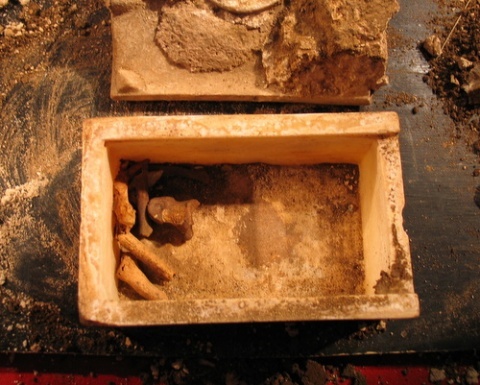
Ovcharov, who according to novinite is nicknamed 'the Bulgarian Indiana Jones', reburied the skeleton according to an 'ethnographic ritual in which the "vampire's" bones were cleansed with wine and water, and were placed together in a new grave close to the old one together with the lighting of candles in the Bulgarian Orthodox Christian tradition,' cf. the photo below.
As pointed out by 'bshistorian' in a couple of comments to an earlier post, there are several things that are hard to understand from just reading the news stories and looking at the photos and videos of the corpse. So to what extent the find is actually related to revenant or vampire beliefs seems hard to say.
Some of the archaeologists involved are certainly characters. What are we to think of archaeologists led by a 'Bulgarian Indiana Jones' who perform 'ethnographic rituals' on a medieval skeleton, and what about the director of the National Museum of History, Bozhidar Dimitrov? According to Wikipedia, he is also a prominent politican and former Minister without portfolio. As a historian he has written polemically on the ancestry of the Bulgarians and 'macedonism'. Incidentally, he was born in Sozopol where the 'vampire skeleton' now in display in Sofia was found.
Generally, the Bulgarians appear to have a fondness for sensationalistic claims with regards to some of their archaeological discoveries, as is evident from the news story below on the possible finds of the remains of John the Baptist in Bulgaria. Curiously, the discovery was made near Sozopol, and like the 'vampire skeletons' attracted a lot of attention. The remains have been transferred to the Orthodox Church where they lay in state in the St. George Church in Sozopol. Because the theory is not refuted, obviously there are many people who hold on to it for various reasons. Obviously, some Bulgarian archaeologists and politicians hope to attract tourists who are intrigued to see 'vampire skeletons'.
When the discovery of 'John the Baptist' was made, the same Finance Minister who has now stated that more funds will be set aside for archaeological excavations on the Black Sea coast, Simeon Djankov, plainly said: 'As soon as this amazing archaeological discovery was made, I made some research, and found that such finds generate great returns from tourism and pilgrimage. Bulgaria and this region will now enter the world tourism maps as a pilgrimage site. The fact that this is a sea resort provides for an unique combination between cultural and sea tourism.'
'Scientists Say Bulgarian St John Baptist Theory Possible
Scientists do not exclude the possibility that remains found in an ancient reliquary in a 5th century monastery on Sveti Ivan Island in Bulgaria may belong to St John the Baptist.
On Thursday, a team of Oxford University archaeologists announced they have provided scientific evidence to support the extraordinary claim.
The findings are to be presented in a documentary to be aired on The National Geographic channel in Britain on Sunday, The Telegraph informs.
The research team dated the right-handed knuckle bone to the first century AD, when John is believed to have lived until his beheading ordered by king Herod.
Scientists from the University of Copenhagen analysed the DNA of the bones, finding they came from a single individual, probably a man, from a family in the modern-day Middle East, where John would have lived.
The findings do not prove anything, but they also do not refute the theory initially presented by Bulgarian archaeologists that the remains in question may indeed belong to St John the Baptist.
The remains were uncovered on July 28, 2010, during excavations of the floor of the medieval monastery on Saint Ivan island, near Bulgaria's historical, coastal town of Sozopol. They were placed in a sealed reliquary buried next to a tiny urn inscribed with St. John's name and his birth date.
The Bulgarian government decided to benefit from the discovery to boost tourism, going as far as to say that Sozopol will help deal with the economic crisis by becoming the new Jerusalem on the Balkans, attracting believers from all over the world.'
Today novitel reports that another 'vampire skeleton' has been found, this time in central Bulgaria. I suppose it's safe to say that by now every self respecting Bulgarian archaeologist seems to be jumping the vampire band wagon. To what extent we can really talk about vampires or other kinds of revenants is pretty difficult to say, cf. also bshistorian's recent comments, but so far I have decided to just mention the news as they are reported from Bulgaria:
New centuries-old skeleton of a man who has been buried with a rite to prevent him from becoming a vampire has been found in central Bulgaria.
The skeleton is nailed to the ground with four metal brackets and burning coals were placed over the tomb, according to a report of the largest private TV channel bTV.
The skeleton is of a man about 30 years of age, and it is yet to be dated, but Bulgaria's top archeologist, Nikolay Ovcharov, is quoted saying it is several centuries-old.
Ovcharov explains that the man has not been a vampire, but was buried with a pagan rite to prevent him from turning into one after the death.
The skeleton was found during archeological digs in a monastery near the central city of Veliko Tarnovo, where 10 years ago Ovcharov's team came upon a very similar find.
No day without news of the vampire skeletons from Bulgaria, this time from the Focus Information Agency, stating that The Vampire is now in Sofia:
Sofia. “Under stepped-up security measures, and to the relief of the old ladies from the coastal town of Sozopol, the skeleton of the vampire has been transported from Sozopol to the National Museum of History in Sofia on Sunday,” museum’s director Bozhidar Dimitrov announced for FOCUS News Agency.
“Here the skeleton will be analysed and studied by the prominent anthropologist, Professor Yordan Yordanov. It has been ‘furnished’ with a glass box. Probably visitors will have the chance to see this strange proof to the beliefs and superstitions of our ancestors next weekend,” Dimitrov added.
“Those, who are afraid that the vampire will bring bad luck to Sofia and Sofia citizens, should feel calm as it has been neutralised by the iron stake yet in the Middle Ages. In this sense, it is less dangerous than a utilised shell,” Bozhidar Dimitrov remarked.
According to novinite.com, 'BBC and Russia's RTV have already expressed their interest in filming documentaries on Bulgaria's "vampire" skeletons, according to local media.'
The growing international interest in the archaeological find of 'vampire skeletons' in Sozopol in Bulgaria now make the Bulgarians point to other 'vampire' locations, hoping that they may attract some 'vampire tourism'. See the video in this news story, and those below. Director of National Museum of History, Bozhidar Dimitrov, even tries to appropriate Dracula by quoting Elizabeth Kostova, author of the Dracula novel The Historian, claiming that Dracula was originally Bulgarian.
Vampire tourism is a term that I have used several times over the years on this blog, so it is curious to find it in the news: 'Vampire' tourism in Bulgaria? reports that 'the considerable interest from abroad (in the Bulgarian 'vampire' skeletons discovered in Sozopol) can prove to be a perfect opportunity for popularizing Bulgaria's traditional folklore and its bizarre creatures and tales around the world.
Who knows, maybe a movie based on Bulgarian folklore can pour some fresh blood into the repetitive vampire film industry (pun not intended)?
Bulgarian tour operators have been quoted saying that the interest has been huge and Germans, Brits and Russians have already inquired about "vampire vacations" in Sozopol.
I do not want to discourage potential tourists, but travelling all the way to Bulgaria to see a skeleton pierced with an iron rod feels like a lame idea.
Firstly, Bulgaria has much more fascinating stuff to offer as a tourist destination, and secondly, vampires are truly great, but they belong to fiction. Looking at perfectly normal skeletons placed in a museum is not the point.'
Another news story, Vampire Hype to Boost Bulgaria's Tourism, provides some more insights to the archaeological find in Sozopol - and there is even a Venetian connection:
'People on three continents are excited about Bulgarian vampires in the wake of local archeologists claiming to have found a vampire skeleton in the Black Sea town of Sozopol.
The skeleton was the one of a buried man with an iron stick in his chest. He was buried over 700 years ago and was stabbed multiple times in the chest and the stomach, as his contemporaries feared that he would raise from the dead as a vampire, National History Museum Director, Bozhidar Dimitrov, told local media.
The Bulgarian Standard daily, which published a series of articles on the discovery, reports Thursday that media in the US, Europe and Asia have all broken the news in the press and in online editions.
The story found its place in two articles of the most-read tabloid in the world – The Daily Mail, in the Washington Post, BBC, and a number of Russian media.
Meanwhile, Bulgarian tour operators are quoted saying that the interest has been huge and Germans and Brits have already inquired about "vampire vacations" in Sozopol. There is an expected increase of visits from the US and Russia as well, while long lines are reported at the excavation site near the Saint Nicholas Wonderworker monastery.
Speaking for Standard, Bozhidar Dimitrov explained that the vampire's name was Krivich (The Crooked) and he was a legendary pirate, manager of the Sozopol fortress or one of his heirs.
The Crooked, as his contemporaries called him, has been a crippled, but extremely intelligent man. He outshined everyone with his knowledge about the sea, the stars and herbs. Byzantine chronicles describe how he plundered a Venetian ship. It is possible that he was declared a master of the witchcraft because of these talents, which explains the metal stake through his heart.
Experts also believe that the man may have been an intellectual and perhaps a medic, as such individuals often raised suspicions in the Middle Ages. The grave was discovered near the apse of a church, which suggests that he was an aristocrat.
According to archaeologists, this is the first time a "vampire" burial has been discovered in Sozopol.
Over 100 buried people whose corpses were stabbed to prevent them from becoming vampires have been discovered across Bulgaria over the years, according to Dimitrov.'
According to Focus, the skeletons will be on display at the National Museum of History in Sofia:
'The vampire burial unearthed in the seaside city of Sozopol will be displayed in the National Museum of History in Sofia due to the keen interest in Bulgaria and abroad, museum director Bozhidar Dimitrov told FOCUS News Agency.
The vampire will be displayed in about ten days when the special glass case in which it will be laid is ready.
On Tuesday AFP reported that archaeologists in Bulgaria unearthed two skeletons from the Middle Ages pierced through the chest with iron rods to keep them from turning into vampires.
According to pagan beliefs, people who were considered bad during their lifetimes might turn into vampires after death unless stabbed in the chest with an iron or wooden rod before being buried.
"These two skeletons stabbed with rods illustrate a practice which was common in some Bulgarian villages up until the first decade of the 20th century," national history museum chief Bozhidar Dimitrov said after the recent find in the Black Sea town of Sozopol.
People believed the rod would also pin the dead into their graves to prevent them from leaving at midnight and terrorizing the living, the historian explained.
The practice was common, Dimitrov added, saying some 100 similar burials had already been found in Bulgaria.
Archaeologist Petar Balabanov, who in 2004 unearthed six nailed-down skeletons at a site near the eastern town of Debelt, said the pagan rite was also practiced in neighboring Serbia and other Balkan countries.'
Dimitrov says, 'I do not know why an ordinary discovery like that became so popular. Perhaps because of the mysteriousness of the word "vampire." These people were believed to be evil while they were alive, and it was believed that they would become vampires once they are dead, continuing to torment people. (---) The curious thing is that there are no women among them. They were not afraid of witches.'
According to Wikipedia, 'Sozopol (Bulgarian: Созопол) is an ancient seaside town located 35 km south of Burgas on the southern Bulgarian Black Sea Coast. Today it is one of the major seaside resorts in the country, known for the Apollonia art and film festival (which takes place in early September) that is named after one of the town's ancient names.'
Writing recently of Jordi Ardanuy, it is worth mentioning the quarterly journal L'Upir which frequently publishes articles by Ardanuy. Although written in Catalan, those of us who cannot read the language may still get something from looking at it anyway.
The December 2011 issue was recently distributed and focuses on vampires in Bulgaria. It includes an article by Ardanuy that a.o. deals with a 'vampire case' from Tirnova in Bulgaria mentioned by Rob Brautigam on his Shroudeater site:
'The corpses (who are refered to as witches) were rising from their graves after sunset. Just like some of the vampires that we know from Romania, they would spoil the food, mess up people's belongings and - remaining invisible - throw dirt and stones at people. They knocked people down and sat on them. Some of the people were so scared that they decided to leave the town.
An exorcist called Nikola was called to the rescue and was offered the price of 800 Kurus to do his job. Apparently he used a stick with a picture (possibly a Saint ?) on it to locate the troublesome graves. He found two of them. Both graves contained the bodies of soldiers that had been Yeniceri (better known in our part of the world as Yanitsaries or Janitsaries). The graves were opened and the corpses looked inflated, with hair and nails that had grown. Nikola decided that a stake should be driven through the stomach, the heart should be cut out and boiled. And then - for good measure and just to make sure - the bodies would have to be cremated.'
I have in my possession a Danish booklet from 1855 by B. Kneazjeskij called Bolgarernes Skikke og Overtro (The customs and superstition of the Bulgarians), translated from the Russian by E. M. Thorson. It is just 39 pages on weddings, births, funerary customs, and superstition. The latter chapter is of particular interest here as it describes various beings: Talasam, Samovid, Karakóndzjal, Vampire, Varkolak, Magésnitsa, Murá, Úrisnitsa, Tsjûma and Sípanitsa!
Vampires are described this way (in my translation):
In the bodies of those persons who have led a life full of sin, as e.g. robbers and the like, an unclean spirit finds an abode after their death, viz. they are transformed into vampires. The same is the case with the one over whose corpse, while it is still in the house of mourning, a cat jumps. To prevent this misfortune, the relatives of the deceased must keep a watch by turns by the body, until it is taken out of the house. After the course of forty days a vampire begins to walk about in the houses and suck the blood of children and at times even from the grown ups through their ears. As soon as it rumours that a vampire haunts, the Bulgarians stay the night several families together in one and the same room. Throughout the whole night two of the men alternately stand guard with a lit candle or dip in each hand, and if one of those asleep start snoring somewhat heavily or to moan while asleep, the guard immediately awakens everybody, and they set off to look for the vampire. In case there is the least suspicion that a deceased has been transformed into a vampire, the authorities and his relatives go to the cemetery, exhume the body, pour sour wine over it and drive a stake through it in the belief that they will thereby drive away the evil spirit that has taken its abode in it.
A footnote (written by the translator, one presumes) is added to the last sentence: According to other authors, such a corpse is finally cremated.