On several occasions, particularly on the periphery of the Habsburg Empire during the 17th and 18th centuries, dead people were suspected of being revenants or vampires, and consequently dug up and destroyed. Some contemporary authors named this phenomenon Magia Posthuma. This blog is dedicated to understanding what happened and why.
'This book represents one Hungarian historian and traveler's sometimes elusive but ever conscientious filtering of numerous sources - sources including not only those books listed in the bibliography (some folkloric works available only in Hugarian) but also Hungarian-language and other archival materials and, indeed, stories heard during many journeys over many years in Transylvania and elsewhere.'
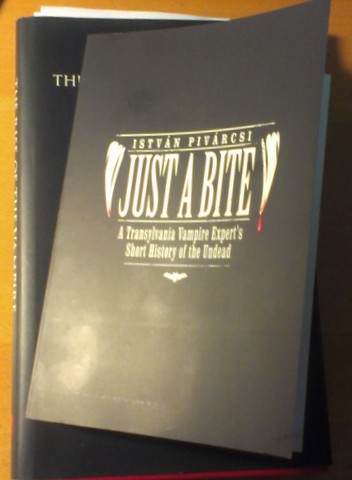
Hungarian historian István Pivárcsi has written a number of books on vampires and other subjects in Hungarian, while so far only the book quoted from above has been translated into English: Just A Bite: A Transylvania Vampire Expert's Short History of the Undead (paperback, 292 pages, $14.95). 'For more than twenty years he has led vampire tours in neighboring Transylvania,' the publishers write, making the reader expect that the book will contain a lot of information on vampires related specifically to Transylvania. Most of the book, however, covers ground familiar from numerous other books: Vlad Tepes, Elizabeth Bathory, Gilles de Rais, werewolves, zombies, the Golem, beliefs related to blood, vampire bats, porphyria, and the vampire of popular culture, and quite a lot of what is said about Romanian vampire beliefs is very brief.
Pivárcsi writes that, 'although research has found that vampire myths are rooted most firmly in Serbian, Croatian, Ukrainian, Romanian, and Ruthenian folklore,' Transylvania is of particular importance in 'vampirology', as he names the field: 'Largely because the vampire that was to become best known by name, Count Dracula, was linked in the popular imagination to that region,' even though he actually ruled south of Transylvania, but also because 'Romanian folklore in particular came to be permeated by vampires, thanks in no small part to a certain tenet of the Eastern Orthodox Church - name, that those people who died after being excommunicated returned as the walking dead - moroi in Romanian. Indeed, such souls were condemned to remain in this most unfortunate state of limbo until the Church saw fit to relieve them of the curse.' According to Pivárcsi, it was, however, the merging with the strigoi, 'a nocturnal death-bird with supernatural powers that flew about at night, hunting human flesh and blood,''that yielded the characteristic Romanian vampire figure whose modern permutations we have come to know. Linked as they were to the Christian religious tradition that pervaded nearly every aspect of society, vampires became seen as agents of Satan, as instruments of evil bent on violating and annihilating humanity - and it was thought that a whole army of them were out there in the night maneuvering for final victory. They fed on human blood, and their bite infected their victims with vampirism. Blood and darkness alone sustained them.'
Pivárcsi, unfortunately, does not evolve this theme much, but in a short chapter he relates some accounts related to the Transylvanian belief that 'were adapted by your humble guide from my archival research in Transylvania coupled with material in the works of the noted twentieth-century Hungarian folklorists Enikö Csögör and Tekla Dömötör.' There are in fact only five accounts, or 'possibly true tales', a couple of which are rather schematic, while the rest include other, and more interesting aspects of local folk beliefs that unfortunately are not dealt with in the book.
The book also includes a glossary, and a chronology in which it is claimed that Philip Rohr's De masticatione mortuorum'is the first work to be published in German language about vampires,' while under 1710 it says: 'Vampire hysteria sweeps across Eastern Prussia. Numerous cemeteries are dug up, and a mob sets the houses of suspected vampires on fire.' This sounds like a Hammer film! Equally apocryphal, yet still fascinating is the entry for 1725-1732: 'In the southern territories ruled by the Austrians, inhabited mainly by Serbians, several people are sentenced to death on charges of vampirism.'
The only part of the book that presents something truly Hungarian that is probably not available elsewhere, concerns the Hungarian silent Dracula film, Drakula halála, from 1921, so if you are looking for information on that one, Pivárcsi's book may be worth getting hold of. Otherwise, well, maybe this book is simply intended for younger readers looking for a popular introduction to the subject, and in that respect it is probably not worse than so many other books. But if you are looking for something on Hungarian or Transylvanian folk beliefs, I'd rather go for e.g. Tekla Dömötör's Hungarian Folk Beliefs.
The original title of the book is not mentioned, but I think this is a translation of Pivárcsi's Drakula gróf és társai originally published in 2003.
The publisher, New Europe Books, specializes in books from and about the former East Bloc, 'a literary landscape shrouded for all too many in mystery': 'We seek to introduce new and classic-yet-undiscovered authors and books whose stories will resonate with readers far afield. Our authors include not only those born and raised in this part of the world (whether or not they happen to write about their own societies) but also expatriate writers from elsewhere and those who may have lived abroad for a short or long time but whose ancestry is rooted firmly somewhere in Eastern Europe—in short, all those whose lives are bound up in some manner with the region, and who share startling new perspectives on the human condition that will appeal to readers from far reaches of the globe.'
Most of what was written on vampires in the eighteenth century consisted of commentaries on either a very small corpus of eyewitness accounts from officials of the Habsburg authorities or the Catholic Church or of various tales of vampires and revenants from around Europe. The most careful and comprehensive study based on first hand examinations of both those who complained of being attacked by a bloodsucker and of the bodies of the suspected vampires, was written in 1756 by a regimental surgeon, Georg Tallar.
Tallar was born in Mainz around 1700, and studied medicine there and in Straβburg. He then pursued a career as a surgeon and physician in the Habsburg army for more than thirty years, serving in Transylvania, Wallachia and the Banat. As Tallar mastered the local languages of those regions, he was not only able to discuss the subject of vampires first hand with the people who actually believed in them.
The new edition of Tallar's book and two pages from the manuscript shown in the Dracula. Woiwode und Vampir exhibition catalogue
Tallar witnessed five incidents in which people claimed to be attacked by vampires – or actually: Moroi – and in three cases he was himself involved in examining those who were ill as well as the corpses that were exhumed. He had actually even known some of those who, after their demise, were suspected of being bloodsuckers.
The Wallachians who were ill and claimed to have been attacked by a bloodsucker, told Tallar that they had been in bed for a couple of days, and that their heart hurt. When asked where the heart sits, they pointed, not to the heart, but to the stomach and the intestines. They said that, whenever they tried to fall asleep, the bloodsucker appeared in the shape of this or that deceased man or woman, standing in front of them or in a corner. Some said that they saw the bloodsucker when they were asleep, but many of the afflicted actually saw nothing. Still, they believed that it was necessary to open the graves to look for the Moroi. Although exhuming and destroying corpses was prohibited by law, they were willing to break the law to seek out and destroy the bloodsucker. In fact, people were so afraid of falling prey to the vampire, that they dared not walk about after dark.
Examining them, Tallar found that they complained from pains and aches in various part of the body, including strong headaches, and that their tongue would turn first pale and then become brownish red and dry as wood. They were very thirsty, and had a faint and erratic pulse.
In each case, only Wallachians were affected by the bloodsucker, whereas neither soldiers, German settlers, nor local Serbs became ill, so Tallar concluded that the Wallachians did not suffer from an epidemic, but rather an endemic disease. Considering the traits of the Wallachians, he concluded that the food eaten by them, especially during the fasts that they fanatically observed during Winter - consisting of e.g. cabbage, garlic, and sauerkraut - was the cause of the disease. In fact, administering a simple vomitive often cured the diseased!
Tallar also discusses various beliefs concerning the dead and their graves, refuting the beliefs and providing various natural causes for the phenomena. He e.g. refutes the belief that the bloodsuckers are more harmful on Saturdays, by exhuming and examining the corpses on various days of the week, showing that the state of the corpses were independent of the day of the week.
Overall, Tallar is an exemplar of the medical enlightened man, emphasizing – like Gerard van Swieten – the lack of education among the Wallachians, while at the same time mentioning that they are not so stupid not to accept his medical remedies against the disease, when they notice that people get cured.
From Medicinische Jahrbücher des kaiserl. königl.
österreichischen Staates Band 56 (Wien, 1846)
Tallar wrote his Visum-Repertum Anatomico-Chirurgicum after the vampire incident in Hermersdorf that prompted Empress Maria Theresa to stop the burning of corpses associated with magia posthuma, but his manuscript was left unpublished for almost thirty years, until the Viennese publisher Johann Georg Möβle came upon it and decided to publish it in 1784.
A reviewer in the Viennese Realzeitung für das Jahr 1784, expressed the wish that Tallar had used his proficiency in the Wallachian language to publish his observations on the matter in that tongue. Excerpts from the book turned up in Johann Dionis John’s Lexikon der K. K. Medizinalgeseze in 1790, and in an article in the Medicinische Jahrbücher des kaiserl. Königl. Österreichischen Staates in 1846.
Now, almost 250 years after its first publication, Tallar’s book has been reprinted by Nicolaus Equiamicus in a slim volume that replaces Möβle’s introduction by a new one by Equiamicus, and adds a few explanatory footnotes, while slightly updating the language of the original. Tallar’s original is readily available online (see my list of links), but Equiamicus is to be commended for providing us with a handy edition of this essential text on vampire beliefs. And it is available for just €7.90.
To many, Francis Ford Coppola’s film Bram Stoker’s Dracula has become quite the epitome of the story of the vampiric Count Dracula. The soundtrack music by Polish composer Wojciech Kilar is ubiquitous, and the film’s blend of history and fiction, of romance and horror, as well as its creative play with cinema itself, seem to suit a vision that many people have of Dracula and vampires, or at least one that appeals to them – that is, of course, prior to the boom of adolescent vampire fiction like Twilight. Perhaps, as it is more than twenty years since Coppola’s film received its premiere, many people have simply grown up with this film and consequently now identify Dracula with Coppola’s Count.
So it is little wonder that the first thing behind the dark curtain leading into the Dracula e il mito dei vampiriexhibition at the Triennale design museum in Milan was a screen showing excerpts from Coppola’s film. In fact, the fusion of historical fact and vampire fiction, of artistic creativity and design, and of Bram Stoker’s novel with its interpretation by artists and cinematographers, permeated the exhibition as a whole.
Not so much an extension or reworking of the Dracula Woiwode und Vampir exhibitions at Innsbruck and Bucharest, Dracula e il mito dei vampiri rather integrated items from that exhibition into something new, not only bringing the fictional vampire into focus, but also, as one would expect af a design museum, stressing Italian art and design.
Having watched Coppola’s vision of the Wallachian warlord turned vampire, the visitor was greeted by the famous portrait of Vlad Tepes from the Kunsthistorisches Museum in Vienna. Fortunately, one was not met by Vlad’s gaze, as he rather looks at something or someone to your left, so one can study his features without fear of having aroused his, er, attention. Similarly, the full-length portrait of Dracula Waida Princeps from Forchtenstein Castle appears to look to one side, but strangely, his eyes have an uncanny look as if a film is layered on top of them, or maybe someone attempted to blur them?
Only a very small selection of items from the earlier Dracula exhibitions were displayed here to provide some context for the life and cruelty of Vlad Tepes: A 17th century map of Transylvania from the Kunsthistorisches Museum, the coloured print of the city of Papa from 1617 showing impalements, a copy of Sebastian Münster’s 1598 Cosmographey with its depiction of impalements, and various clothes and weapons used by the Ottomans.
The vampire cases and the ensuing debate of the 18th century were illustrated via a handful of books, including Johann Christoph Harenberg’s 1733 Vernünftige und Christliche Gedancken über die Vampirs oder bluhtsaugende Todten, Nicolas Lenglet du Fresnoy’s 1751 Traité historique et dogmatique sur les apparitions, les visions & les revelations particulières, and the German translation of van Swieten’s commentaries published in 1768. However, there were no documents, no Calmet, Ranft or Tallar, no bust of van Swieten or portrait of Maria Theresa as in the exhibitions at Innsbruck and Bucharest.
Instead, the exhibition of vampire fiction was enhanced by some remarkable items courtesy of the Bram Stoker Estate and John Moore Collection: Bram Stoker’s so-called lost journal that was published for the first time last year, and Stoker’s autograph copy of the first edition of Dracula‘to my dear mother’, both definitely some of the chief attractions of the exhibition.
A couple of Goya’s Caprichos, a first edition copy of Polidori’s The Vampyre as well as posters for performances of Marschner’s opera Der Vampyr and a programme for a 1927 performance of Deane and Balderston’s stage adaptation all led the way into a room where quotes from Stoker’s novel were displayed in Italian on a wall. Here you could also enter the house of a vampire as envisioned by Milanese architect and designer Italo Rota. A rather creepy tableau of a ‘living room’ with earth strayed across the table and a selection of ritual tools, remedies, books and art, all of which, according to Rota, should reflect the mentality and everyday ‘life’ of a vampire. Suffice it to say, that I would not spend my time in that place…
Entering the world of vampire cinema, one could peep through holes like a voyeur to observe a variety of ‘vampire kisses’ from a number of vampire films, while more analytically, over the door to the next room, a brief genealogy and philosophy of cinematic vampirism was outlined. Nosferatu from 1922 accordingly reflected the psychoanalysis of Freud and Jung, whereas Dracula from 1931 showed the vampire in the modern major city, and might be interpreted in terms of Georg Simmel or Walter Benjamin.
Then, for some reason the vampires of Hammer and many other filmmakers from the 1950’s to 1980’s were not included in the genealogy, so we jumped right to the era of post-structuralism (Jacques Lacan) and postmodernism (Guy Debord and Gilles Deleuze) with Bram Stoker’s Dracula from 1992 and Interview with the Vampire from 1994, respectively. Finally, in a 'liquid' society where 'solid' concepts like work and marriage are, in the words of Zygmunt Bauman, 'like zombies, such concepts are today simultaneously dead and alive', Edward Cullen and the other vampires of Twilight could be perceived as 'post-vampires', indistinguishable from mortal humans.
Clips from a variety of vampire films, including Mario Bava’s Italian La maschera del demonio from 1960, were shown on three transparent screens in a separate room, their soundtrack having been replaced by popular pieces like Orff’s O Fortuna and Delibes’s Flower Duet, all played at high volume.
Among the clips were, of course, Coppola’s Dracula film, and not only its screenplay and parts of its storyboards were exhibited, Dracula e il mito dei vampiri also paid homage to the film's costume designer, Ishioka Eiko, by displaying the blood red armour she created for Dracula, and showing a documentary about her work on the film. The tribute to Eiko was followed up by a a tableau of impressive female stage costumes from various operas and ballets like Aida, Die Zauberflöte, and Turandot. Very fitting for an exhibition in the hometown of Italian fashion and the famous opera house, La Scala. A wall of photos from catwalks rounded this section off with fashion for men designed by Louis Vuitton, Gucci, Prada and others, all illustrating the crossover of the vampire from fiction to fashion, no doubt with a good deal of help from Goth subculture.
Finally, a room not intended for children, exhibited pages from Guido Crepax’ comic book adaptation of Dracula as well as a hitherto unknown sequence in which his heroine Valentina meets Count Dracula.
Personally, I must say that the exhibition whet my appetite for more, as it is fairly easy to imagine how an exhibition like Dracula e il mito dei vampiri could be expanded in order to go into more detail with Vlad Tepes, with the struggle between the Ottoman Empire and Christian Europe, with vampires and revenant beliefs, and with the rise of the fictional vampire, Count Dracula and the vampire of modern popular culture. I am, however, well aware of the painstaking work that is no doubt required to assemble the number of paintings, books, documents and artefacts that would fit in with the themes, and at the same time I am not sure how much the average visitor is in fact able to digest. With regards to Vlad Tepes and vampires, the exhibitions in Innsbruck and Bucharest are so far the most comprehensive exhibitions I am aware of, and it will probably be hard to surpass hem. But hopefully there is more to come in the future.
In connection with the exhibition, Skira has published a 131 page catalogue, which includes a number of articles and a selection of the items exhibited. Margot Rauch has contributed the historical part of the catalogue, Dracula: voivoda e vampire, which is in fact a translation of what she wrote for the Innsbruck and Bucharest exhibition catalogues, as well as an inventory of some of the books and artefacts exhibited. The article on the costumes of female vampires (and vamps) include a number of photos of stars like Dietrich, Garbo, Bernhardt, Swanson and Bara that were not on display, while Italo Rota’s vampiric living room is only documented on a youtube video that can be accessed with a QR code.
Whether Dracula e il mito dei vampiri will be exhibited elsewhere in the future – in the same or some other form – I do not know, but the photo to right was posted on facebook by the company that organized the exhibition,with the accompanying message:
‘Dracula ha fatoo le valigie ed è pronto a ripartire alle conquista di nuove città!’: Dracula has packed and is ready to conquer new cities!
I recently received a copy of Neil R. Storey's book The Dracula Secrets: Jack the Ripper and the Darkest Sources of Bram Stoker (The History Press, 303 pages, hardcover, RRP £20), and although I have no far only dipped into it here and there, I can fairly easily say that this contains nothing of particular interest with regards to vampires, but it will no doubt be of interest to the Dracula, Bram Stoker or Jack the Ripper buff.
Storey, an award-winning historian, lecturer and author of many books, aims to link 'the Whitechapel vampire', i.e. Jack the Ripper, with Dracula, as one of Stoker's sources of inspiration. As I have so far not read the entire book, I am unable to say how successful he is in establishing this connection, but the book certainly contains a wealth of information on Stoker and some about the Ripper. It is very nicely illustrated, and among the appendices is the list of items from Stoker's library that was auctioned off at Sotheby's in 1913, including the notes for Dracula that a certain Mr. Drake purchased for the sum of £2 2s!
Another appendix is taken from the 1887 edition of Baedecker's Southern Germany and Austria, Including Hungary and Transylvania. Handbook for Travellers, detailing the railway trip from Klausenburg (Cluj) to Bistritz (Bistriţa).
From Reiseführer durch Rumänien published in Bucharest in 1932.
A friend of mine gave me a copy of Jack the Ripper: The Casebook by Richard Jones some time ago. This is an unusual book about the crimes of the Ripper, because it contains pockets with 18 items of removable facsimile documents and memorabilia. If you happen to be interested in doing some armchair sleuthing, you might want to consider getting hold of this book.
Florian Kührer’s Vampire: Monster, Mythos, Medienstar (Butzon & Bercker) is a pleasant, interesting and in every respect very much up to date survey of vampires in folklore, history, the arts and popular culture in general. In Kührer’s own words, his book is ‘die Geschichte vom Aufstieg eines Dorfmonsters zum Popstar der Moderne’, the story of the rise of a village monster to pop star of the present.
Although relatively brief compared to the vastness of the subject, it is evident that Kührer has studied the topic thoroughly and has a good understanding of the various aspects of the subjects. Clearly, Kührer is familiar with the latest literature on the subject like the contributions to the 2009 vampirism conference in Vienna as well as well as the most prominent works of the current vampire trend of Twilight etc.
In the first part of the book Kührer presents a synthesis of the themes of the folkloric vampire: the various types of living corpses or revenants, their names and characteristics, mostly from parts of Europe, but also providing examples from other parts of the world as well as from different periods. Here Kührer also touches on the archaeological finds that are some times interpreted as evidence of vampire or revenant beliefs, and comments sensibly on the recent find of a ‘vampire skeleton’ in Venice:
’Ein klassischer Beispiel für ein Vampirgrab? Ja und nein. Wer immer dieser Frau den Stein in die Mundhöhle gesteckt hat, er dachte dabei kaum an einen Vampir, denn dieser Begriff war in diesem Raum im 16. Jahrhundert mit allerhöchster Wahrscheinlichkeit unbekannt. Wenn wir also am Begriff ”Vampir” hängen, handelt es sich gewiss um keinen “Vampirismus”.’ (p. 40)
Kührer also provides some interesting comments on the construction of a superstitious backwards, not only in the vampire reports of the 18th century, but also in recent news stories from e.g. Romania, where the distinction is not only between a civilised West and a superstitious, backwards East, but also between the enlightened Romanian cities and the superstitious villages. As in the case of the Marotinu de Sus incident:
‘Und wie schon drei Jahrhunderte zuvor stürzten sich die westlichen Medien gierig auf diese Geschichte. Alle großen europäischen Zeitungen berichteten über den Fall Toma, under Discovery Channel drehte gar eine Dokumentation, in der auch Dorfbewohner zu Wort kommen und ihre Versionen der Geschichte erzählen durften. Niemals wird in diesen Berichten vergessen, auf den Beitrittsantrag Rumäniens zur Europäischen Union hinzuweisen. Da waren sie wieder, die Bilder und Geschichten über eine rückständige und geheimnisvolle Gegend, die sich so sehr vom aufgeklärten Westen unterscheidet. Die Grenzen zwischen Zivilisation und Rückständigkeit folgen jedoch nicht ausschließlich dem Ost-West-Schema. Die Bruchlinien verlaufen mitten durch die Gesellschaft: Der westliche Lebensstil durchcringt sukzessive die urbanen Räume Osteuropas, und Vernunft und Aufgeklärtheit halten im Gefolge von Flatscreens und Multimediahandys Einzug. Auf dem Land hingegen scheint die Zeit stillzustehen, Mensch und Tier muss sich offenbar noch immer den Lebensraum mit Hexen, Gespenstern und Wiedergängern teilen. Denn aktuelle Vampirgeschichten aus dem Osten Europas – Mythen vom Rande der zivilisierten Welt – sind bestens dazy geeignet, dem Westen seinen zivilisatorischen Vorsprung zu bestätigen.’ (p. 57)
The second part of the book follows the vampire theme from Rohr’s Masticatione Mortuorum in the late 17th century over the vampire reports and debates of the the 18th century onto the transition of the vampire into a fictional creature of poetry, novels and movies. Kührer describes how the vampire provided the infotainment that suited the 18th century magazines and shortly characterizes the vampire ‘research’ of the period. Kührer, however, also attempts to view the vampire from the point of view of the villagers themselves, and tries to explain why the field surgeons and the learned people were unable to grasp the everyday vampire concept of the villagers:
‘Für die Dorfbewohner war der Vampir der monströse Alltag, der die Gemeinschaft bedrohte und eine tödliche Wirkung entfaltete, die für einen Betrachter von außen kaum zu verstehen war. Dewegen konnten die damaligen Erklärungsversuche den Vampir niemals völlig fassen. Denn die innere Logik der Ereignisse musste dem selektiven Blick des Militärarztes, des Verwaltungsbeamten und des aufgeklärten Philosophen verborgen bleiben. Vielleicht ist es diese Ohnmacht, die den Fremden aus dem Westen veranlasst, auf den Osten Europas oft herabzublicken und ihn sich als einen Ort der Rückständigkeit und des Aberglaubens vorzustellen.
Für die Leser der Zeitungsberichte muss der Eindruck entstanden sein, dass ohne das österreichische Militär ein völliges Chaos in den wiedereroberten Gebieten herrschen würde. Unter diesen Voraussetzungen ist es kein Wunder, dass der recht spezielle Begriff des Vampirs bald auf eine ganze Reihe von magischen Erscheinungen ausgeweitet wurde, die eine Sache gemeinsam haben: ihr Erscheinen in Grenz- und Übergangszonen, wo politische und kulturelle Einflussbereiche ineinander übergehen. Denn der Vampir ist der jeweils Andere, ein Fremder, für die Dorfbewohner ein Außenseiter des Kollektivs, der wie Arnand Paole erst später zur Gemeinschaft dazugestoßen ist oder sich anderwertig durch seinen abnormen Lebenswandel verdächtig machte. Und für den Westen ist er ein Monster aus einer fremden Welt, die gleichzeitig mit der Beschreibung ihrer Phänomene in der Phantasie des Westens neu erschaffen wird.’ (p. 84-5)
Kührer nicely describes how the vampire became part of gothic fiction, the creation of Stoker’s Dracula and the rise of the cinematic vampire. His exposition is clearly quite up to date, as he avoids the fallacies of most writers on the subject in e.g. describing the genesis of Dracula. I particularly enjoyed his account of the attempt at creating a Dracula theme park in Romania, ‘Projekt Draculapark’. Here as well, he interestingly traces the creation of Transylvania as the land of vampires.
The last part of the book traces a number of themes, including blood, gender, vampires as metaphor, anti-Semitism, mass murderers, and the construction of ‘real’ vampires. This part includes interesting, and again: up to date, passages on both Montague Summers and Elizabeth Bathory.
Kührer finishes with a summary that points out the distinction between the modern, popular concept of the vampire and the folkloric vampire, before pointing out why the vampire has developed into one of the most powerful and ever transforming myths of our time:
‘Der Vampir, dieses Geschöpf der Moderne, ist berühmt geworden, weil er dem Westen sein von der Aufklärung um die metaphysischen Dimensionen beraubtes Weltbild mit neuen übersinnlichen Facetten versehen konnte. Er ist mehr al seine einfache Legende oder ein Märchen. Die verschiedenen Entwicklungsstränge – vom serbischen Volksvampir bis zum Produktnamen für Haushaltgeräte – verbinden sich zu einem der mächtigsten Mythen der Moderne. Die Gestalt des Vampirs, zu Beginn noch Thema, hat sich zu einem Motiv entwickelt, zu einem auf wenige Elemente verkürzten Code, der auf der ganzen Welt verstanden wird.’ (p. 273)
It is fair to say that Kührer's book is not a detailed account of any particular aspect of the subject, but an overall history of the vampire, as well as an attempt as answering the obvious question: Why does the vampire remain so popular? It is well written and researched, and it is delightful to read a book that is in all aspects in accordance with a modern view of the subject, free of the myths and errors that you find in most other books. For that reason alone, this book is worth reading for the casual reader as well as for those of you who have a special interest in vampires.
'More decidedly evil, however, is the vampire, or nosferatu, in whom every Romanian peasant believes as firmly as he does in heaven or hell.'
Thus according to author Emily Gerard in an article on Transylvanian Superstitions in The Nineteenth Century in 1885. Her later book on her travels in Transylvania, The Land Beyond the Forest: Facts, Figures, and Fancies from Transylvania will be republished in two volumes by Cambridge Library Collection this November:
'Novelist Emily Gerard (1849–1905) went with her husband, an officer in the Austrian army, to Transylvania for two years in 1883. Then part of the Austro-Hungarian Empire, today a region of Western Romania, Transylvania was little known to readers back in England. Fascinated by the country, Gerard still found it an isolated and alienating place. In the years following, she wrote this full-length account (first published in 1888) as well as several articles on the region, which Bram Stoker used when researching the setting for Dracula. With humour and compassion she describes her encounters with the different nationalities that made up the Transylvanian people: Romanians, Saxons and gypsies. Full of startling anecdotes and written in a novelistic style, her work combines her personal recollections with a detailed account of the landscape, people, superstitions and customs.'
Anthony Hogg, by the way, has recently written a bit about the word nosferatu on his blog.
People become as stupid as a box of rocks from watching television in stead of listening to other people, a man in Transylvania informs us. You learn from talking to other people, but only watching television makes you die stupid. So young people are not interested in what the elder Transylvanians have to say about strigoi and varcolaci, what we might call vampires and werewolves.
The frustration must have been the same when folklorists interviewed people in many Western countries earlier in the 20th century: Mass media replacing local traditions and the art of learning from other people’s experiences by listening to their stories. Today we are required to be flexible and willing to leave behind the knowledge of yesterday to replace it with the knowledge of tomorrow, as some say.
All the more refreshing it is then to get a glimpse of a world of traditions and experiences that is in retreat, in this case the rural traditions concerning strigoi and other extraordinary phenomena, as documented in Justin Blair and Matthew Vincent’s labour of love, Across the Forest. This 79 minute documentary contains no background information or commentary, just the spoken word of a score Transylvanian men and women. Some of them are telling stories that are like fairy tales, while quite a number of them claim to communicate their first hand experiences with e.g. being visited by a strigoi and having to put a nail into the heart of a dead woman to stop the strigoi from harming animals.
The documentary style of the two filmmakers resembles that of folklorists interviewing people, so the movie is a compilation of fragments of traditions and experiences that have been part of the local communities, and they do not force any particular interpretation onto the spoken word. That makes it a bit confusing, but at the same time we are free to judge for ourselves and to relate their tales to what other information we have on such beliefs.
So although we have probably become more stupid from spending too much time in front of our television sets, we now have a chance of spending it more cleverly by watching this pretty unique documentary from across the forest. It is available on DVD for $9.99 plus shipping from the web site, which contains more information. I recommend supporting the project by purchasing the DVD.
Rob Brautigam has kindly informed me of a new documentary on Romanianstrigoi, varcolaci and forest spirits called Across the Forest. More information on the documentary, a trailer is available at this web site. Here you can also order the DVD for $9.99 plus shipping. I have myself just ordered it, so I am unable to comment on the contents, but you can read Brautigam's review, and listen to a radio interview with one of the film makers.
You will have to bear with me, as I have simply yet to find the time to write at more length on the conference in Vienna. In the meantime I may mention a magazine and a book that I found on my trip.
At the airport I stumbled on a special issue on vampires of the UK magazine SFX. It was pretty expensive as the Danish price is more than twice that of the original price (£7.99), but I thought I had better buy it now that I was on my way to spend a few days about vampires anyway :-)
The special issue comes with a poster, a set of Buffy coasters (!) and a book containing Le Fanu's Carmilla and Polidori's The Vampyre. The magazine itself contains mostly articles about vampire movies and TV series like True Blood and Twilight, but also Hammer's Dracula movies area featured, including a special on the making of The Legend of the Seven Golden Vampires. In a 'Top 50' of the greatest screen vampires of all time, Christopher Lee's count is only no 2, as one of the vampires (Spike) from the Buffy series is voted no 1 by readers of the magazine! There is even an interview with Elizabeth Miller on the genesis of Bram Stoker's Dracula, unfortunately marred by the interviewer's lack of knowledge of Austrian geography, as it is claimed that: 'Originally he was going to have the Count come from Astoria, not Transylvania.' In short, if you are into recent vampire fiction, you will probably find this magazine pretty entertaining.
Slightly more information on vampire beliefs can be found in a new coffee table book that I bought in Vienna: Transsylvanien im Reich von Dracula by Gerald Axelrod, appropriately printed in Leipzig. The major asset of this book is a large number of remarkably gloomy photos from various places in Romania, as the text itself probably will not surprise those familiar with the subject: A biography of Vlad Tepes, a relatively short chapter on Balkan vampire beliefs and a similarly short biography of Bram Stoker with emphasis on the origins of Dracula. At the end of the book a map of South Eastern Europe even has Medwegya marked in the mid 15th century. The short list of recommended reading mentions just two books on vampire beliefs, but certainly also two of the best books written on the subject: Peter Mario Kreuter's Der Vampirglaube in Südosteuropa, and Klaus Hamberger's Mortuus non mordet.
Yesterday I went to a local flea market and came back home with a book of manuscripts from Carl Th. Dreyer's Vampyr and three other of his movies, as well as a 1963 Atlas zur Weltgeschichte. All for the price of approximately 2 Euros.
Below I have scanned two maps from the latter book, and you can click on them to view them in more detail.
The first scan is of a map of Hungary after the wars with the Ottomans. At the bottom is the extent of occupied areas between 1717 and 1739, including the areas of Serbia of particular interest to this blog. The Southern border, cf. earlier posts like this, this, and this, is here shown a few kilometers south of the Zapadna Morava and Krusevac (Kruschewatz).
To the East in Siebenbürgen (Transylvania) you find several places known from Stoker's Dracula, like Bistritz, and to the West is Steiermark (Styria) the scene of Le Fanu's Carmilla. Here is also Krain, the subject of Johann Weichard von Valvasor's Die Ehre des Hertzogthums Crain.
To the North West is Vienna and the Southern part of Mähren (Moravia). And North of Serbia Banat Temesvar, also the scene of some instances of vampirism in the 18th century. So there is really a lot of interesting locations and information shown in this map.
The second one is a map of Vienna ca. 1800. Much easier to take in than a map of modern day Vienna.
I'm sorry, but I'm about to reiterate my usual tirade about why people prefer to contruct speculative fictions about vampires rather than telling the actual story. I honestly find it very hard to understand why people don't care to tell the true story when making a documentary about vampires, but rather prefer to invent their own fiction. Why don't they care about the facts? Why do they presume that we, the public, don't want to know the facts, but are willing to be deluded by their fictions? Do they prefer to tell us how superstitious people of the past were rather than try to explain why they did what they actually did?
How come that it is OK to blur the boundaries between fact and fiction when dealing with the (historical) subject of vampires, when no serious historian or documentarist would attempt to do so when dealing with e.g. various episodes in 20th Century history?
Consequently, I am pretty much surprised that scholars and academics are willing to lend their names and professional reputations to bogus historical docudrama like Die Vampir Prinzessin, which is the subject of this post.
The premises of this documentary are:
3 skeletons from the first half of the 18th Century are found by archaeologists in Cesky Krumlov in the Czech republic. They are buried North-South, and show signs which could be interpreted as if they had been treated for Magia Posthuma (decapitation, stone in a mouth, impaling)
In Cesky Krumlov, a princess called Eleonore Amalie von Schwarzenberg resided in the 18th Century. She suffered from a mysterious illness (actually, cancer), a seemingly mysterious autopsy was carried out on her corpse, and she was buried beneath the floor of a local church.
Bram Stoker quotes Bürger's famous poem, Lenore, in his tale Dracula's Guest, and an Austrian noble woman is referred to.
Based on speculations concerning these three facts, the documentary claims that the princess was suspected of becoming a vampire, and that Bram Stoker was inspired by her tale to create a noble man vampire, Dracula.
Well, today Stoker's working notes have been studied by various authors and scholars, and it is quite certain that Stoker was not inspired by this Bohemian princess but rather by a literary tradition instigated by John William Polidori's character Lord Ruthven. So this whole idea is certainly humbug.
What about the rest of this documentary?
Well, I assume that some of the facts concerning e.g. the three skeletons and princess Eleonore are in fact correct, but I don't find the conclusions very convincing.
Were the three corpses actually treated to prevent them from becoming vampires? The evidence presented is not so convincing that alternative explanations are ruled out.
Furthermore, it is claimed that a certain Dr. Frantz von Gerstorff inspected many cases of vampirism and that he also examined princess Eleonore. Oh, well, Frantz von Gerstorff was actually an Inspector at a mining facility in Transylvania who was involved in examining the case of a certain Dorothea Pihsin who was claimed to be a vampire in 1753. So he wasn't a doctor, and he probably had nothing to do with Eleonore Amalie who died in 1741. So this is even more humbug!
It is also claimed that Stoker probably based his character Abraham van Helsing on Gerard van Swieten, but to my knowledge there is no evidence that he had ever heard of van Swieten. So it's pure speculation.
As for 18th Century doctors, we are required to believe that some of them seriously believed in vampires, whereas the fact is that hardly any enlightened and well educated physician of that day believed in vampires. So when we furthermore are presented with the hypothesis that the autopsy conducted on Eleonora Amalie may have been carried out to prevent her from becoming a vampire, we are required to suspend our disbelief more than anyone can expect.
But then we are assumed to believe that her coffin was put into a specially walled up cavity beneath the church floor to prevent her from coming back, whereas this as far as I'm told isn't a particularly unique way of placing coffins in crypts and church floors.
Well, there's a lot more I could say about the speculations and nonsense that is presented in this documentary, but the above should suffice. What is perhaps even more strange is the appearance of various scholars from universities in e.g. Vienna, whose presence lends credibility to this ludicrous documentary.
So why do they do it? Why don't they tell the true story of the vampires of Serbia, the Magia Posthuma of Bohemia and Moravia, of van Swieten, Maria Theresa, Augustin Calmet etc.? In my opinion the true story will always be more fascinating and interesting than the speculative fantasies presented in documentaries like this one.
It actually really worries me that documentarists don't feel that they owe the public a true understanding of history? Do they really believe that it doesn't matter if we are told the true story or not?
The only redeeming thing about this documentary are the bonus features on the DVD which I have mentioned in an earlier post.
The photo shows Rainer Köppl from the University of Vienna, who hosts the documentary.
It is well-known that the vampire became a political metaphor almost immediately after the 1732 Medvedja case was published across Europe. Markman Ellis has described in The History of Gothic Fiction (Edinburgh University Press, 2000) how the vampire played a role in the British political debate as early as that very year, and to this day the vision of the bloodsucker or the living dead vampire still crops up in the media as a potent political metaphor. An example from academia is the published proceedings of a colloquium on “National stereotypes as Factors of Political Change in East Central Europe” that took place on 18-20 May 1994 in Amsterdam. The title of the book is Vampires Unstaked: National Images, Stereotypes and Myths in East Central Europe and it is edited by André Gerrits and Nanci Adler (Amsterdam: North-Holland, 1995). In the introduction the choice of title is explained this way:
“Robert Hayden employed the expression ‘vampires unstaked’ in his discussion on the ‘return’ of the Cetniks and the Ustasas in the Yugoslav war. The term so appropriately characterized the phenomena dealt with here that we did not hesitate to borrow it for the book’s title.”
The Cetniks (Četnici) and Ustasa (Ustaše) were nationalist organizations from respectively Serbia and Croatia, both of which fought the Communist partisans at the end of the Second World War.
In his paper, ‘The Use of National Stereotypes in the Wars in Yugoslavia’, Robert Hayden, associate professor in the Department of Antropology of the University of Pittsburgh, writes:
“The inflammatory nature of the Serb and Croat portrayals of each other as Ustasas and Cetniks received credibility by the adoption of Ustasa and Cetnik images, symbols and uniforms by some political figures in Croatia and Serbia. The fall of communist rule and the end of its suppression of these symbols and images pulled the stakes from the hearts of these fascist vampires.” (p. 213, my emphasis)
The vampire metaphor here both relates to the fascist nature of the Cetniks and Ustatas as well as to the revival of these terms. Hayden talks of “the transformation of Cetniks and Ustasas from horror story to horrible reality” (p. 215) and analyses the “symbolic geography” that plays a central part in this transformation.
We are all no doubt aware of the symbolic geography that e.g. divides Europe into a more privileged and advanced West and a poorer and possibly uncivilized East, and that creates divisions based on religion. Hayden quotes one Eugene Hammel on this subject:
“the emergence of the modern standard classification that identifies Croats with Catholicism and Serbs with Orthodoxy came only with the absolutism of the Habsburgs in the 18th Century. Ethnic classification in the Balkans is thus not strictly an endogenous process but either exogenously imposed or endogenously shaped in response to exogenous pressures.” (p. 208)
More interesting analysis of and background material for the “symbolic geography” of East Central Europe can also be found in three papers on Transylvania: ‘Transylvania: Myth and Reality. Changing Awareness of Transylvanian Identity’, ‘The Politicization of Myths: The Transylvanian Case’, and ‘Transylvania and the Great Powers: 1945-1946’.
So although Vampires Unstaked does not contain information on Magia Posthuma, it is an interesting collection of studies on how images, stereotypes and myths play an important role in shaping political events. No doubt many of us are aware of other political 'vampires' that unfortunately have become or may become unstaked in the near future.