Showing posts with label vampire books. Show all posts

Sunday, 7 February 2016

The vampire as European myth

Prof. Dr. Thomas Bohn of the Justig Liebig University in Giessen, Germany, who has previously published a few papers on vampires and co-edited the third volume of Corpus Draculianum, has written a book on vampires that is set to be published this April by Böhlau Verlag: Der Vampir: Ein europäischer Mythos (The Vampire: A European Myth).

According to the publishers, Bohn follows the metamorphoses of the vampire and succeeds in rehabilitation the vampire as a European myth:

'In nahezu allen Epochen und Kulturen hat es Geschichten von Wiedergängern gegeben, die nach dem Tode ihr Unwesen treiben, oder von unheimlichen Blutsaugern, die nachts aus ihren Gräbern steigen und sich ihre Opfer unter den Lebenden suchen. Wie alle Mythen verändern sich auch Vampirgeschichten stetig und passen sich dem Zeitgeist an. So gilt seit dem Erscheinen des Dracula-Romans beispielsweise Transsilvanien, das „Land jenseits des Waldes“, irrtümlich als die Heimat der Vampire.

Thomas Bohn hat sich mit den Fragen, wann und weshalb das östliche Europa zum Refugium der Blutsauger stilisiert wurde, auf die Suche nach den Ursprüngen des Vampirismus gemacht. Der Osteuropahistoriker folgt den Metamorphosen des Vampirs, indem er die Angst der kleinen Leute vor den Seuchenherden aufgeblähter Leichen von der Blutsaugermetapher der Gelehrten unterscheidet. Seine Reise in die Vergangenheit zeigt, dass das Bild des Blutsaugens im lateinischen Abendland lange vor der Entdeckung der Vampire im Donau-Balkan-Raum geprägt wurde. In diesem Sinne rehabilitiert dieses kenntnisreiche Buch den Vampir als einen europäischen Mythos.'

Saturday, 3 January 2015

A disinterested appraisal of Summers-ism

Back in 2011, I wrote two posts on ’a critical edition’ of Montague Summers’s The Vampire: His Kith and Kin edited by John Edgar Browning: A sustained study in projection and A Delayed Demonologist. These posts allowed me to once and for all collect some of the assessments that have been made of Summers’s work on ’the subject of witchcraft’, which includes the books on vampires and werewolves.

Recently, The Apocryphile Press has published The Vampire in Europe: A Critical Edition, once again edited by Browning, who in his preface remarks on the mission of these critical editions: ’Our approach, as literary critic Maurice Hindle noted after the fact, was instead a ”disinterested appraisal,” one aimed at re-visiting a familiar yet widely unexplored work with renewed perspective and interest in order that we may situate the book and its author in their historical context.’

I think that I have stated my mind on the matter in the aforementioned posts, but I am also happy to note that the new book does in fact include voices that comment on the style and contents of Summers’s work, because Browning has included excerpts from original reviews of The Vampire in Europe, both from 1929 when it was originally published and from 1960 onwards when it was reprinted.


Thus, according to a reviewer in The Yorkshire Post and Leeds Intelligencer on November 27, 1929, Summers’s ’new book, like its predecessor, ”The Vampire: His Kith and Kin,” reveals an astonishing learning hand-in-hand with an utter neglect of scientific method or knowledge,’ while August Derleth in 1962 similarly notes that ’The Vampire in Europe is a curious work, a volume of pseudo-scholarship written with a fascinating air of authority, offering between two covers a great deal of the lore Dr. Summers assembled from various sources.’

Reviewing the reprint in The Catholic Historical Review the following year, Ruth B. Dinbergs finds that: ’Much interesting material is included in this monograph, but it is presented in a dispersed and unsystematic way. The book seems written in haste. Legends and tales are related which show only the vaguest connection with vampirism as defined in this work. The book is divided into chapters according to countries, yet the author does not stay consistently within these confines. The numerous notes following each chapter testify to the broad erudition of the author, but it is frequently difficult to judge where notes begin and the text leaves off.’

A more in-depth review of Summers’s approach to the subject and his use and neglect of sources was undertaken by Gustave Leopold Van Roosbroeck of Columbia University in The Romanic Review in 1930. He mentions several sources that Summers has neglected, while at the same time he criticizes the sources that Summers does actually take into account, before stating that: ’This study seems to rest on a vague notion of the meaning of Vamprism. It is impossible to explain, for instance, the inclusion (with an illustration) of Huysmans’ Black Mass from À Rebours among vampire lore, when it is evidently a case of devil-worship; the illustrations from Goya’s Los Caæprichos deal with the Sabbath and witchcraft, and not with vampires; and it is strange to find a description of popular superstition from D’Annunzio’s Trionfo della Morte in this miscellaneous collection. With this lack of discrimination, the author could have included the entire history of witchcraft and half of folklore.’

Bringing it up to our day, Carol A. Senf in her afterword characterizes Summers's work along the same line as the just quoted reviewers:

’Summers moves casually from the ancient world to the medieval and from one part of the globe to another, cavalierly mising legends, literature, and folktales and treating even the most improbable cases with total seriousness. The experience is a bit like listening to a garrulous old uncle who interrupts himself and moves cavalierly from one story to the next, not stopping to take breaths between anecdotes.

His organization is equally eccentric. Even though his table of contents suggests that he is organizing his cases geographically, they are actually a hodge-podge of materials collected from literature, folklore, and personal anecdote.'

Adding that ’despite my criticism of his organization and his aesthetics, I was (and am) grateful for Summer’s research,’ she states exactly that ambivalence that many people have with regards to Summers: On the one hand, he is an unrealiable and inconsistent researcher, on the other he can be fascinating to read, and for a long time he was probably the main, if not sole, source for information on vampires and related subjects.

This ambivalence was nicely phrased by Marco Frenschkowski, as I mentioned in a post in 2013, that many of the scholars who denounce Summers’s books on witchcraft probably read his books discreetly.
Decadence and Catholicism (1997) by Ellis Hanson, p. 346
So Summers has his particular, quaint fascination and charm, and Gerard P. O’Sullivan coins a phrase for it in a prologue to The Vampire in Europe: A Critical Edition: Summers-ism.

Claiming that The Vampire in Europe is a casebook modelled on the work of Summers's friend and intellectual mentor, the Edwardian sexologist Havelock Ellis, he firmly states that the roots of Summers's views on vampires and related subjects are not in orthodox Catholicism, but in ’a strange syncretism’:

’Those who praise or blame Summers for his putative ultra-orthodoxy are missing an essential point: Summers believed in Summers-ism, and even long after his covert ordination to the Catholic priesthood. Dig deeply enough into the footnotes of Summers’s studies and you will find Tertullian and St. Thomas Aquinas rubbing elbows with the sexologist Havelock Ellis, the German physician and occultist Franz Hartmann, practitioners of Victorian parlor mysticism, and trance mediums and spiritualists of all kinds. If reading Summers appears to stretch a reader’s credulity, it is because the writer himself believed so many contradictory notions simultaneously. He accepted as established fact many things which any skeptic, rationalist or even conventional Catholic would dismiss out of hand.’

Personally, I feel unsure to what extent Summers actually believed in the existence of vampires, or if his claims to do so were rather a gimmick, a way of setting himself up to sell his pseudo-baroque collections of witchcraft, vampire and werewolf stories? In any case, it should be obvious that one cannot expect Summers to be systematic, consistent or reliable, but rather the opposite, and even self-contradictory. Summers-ism makes for fascinating reading and a vast resource to dip into, but not a voice of scholarship in any traditional sense.

Sunday, 17 August 2014

Revenant - from Italy

Since Emilio de' Rossignoli published his groundbreaking Io credo nei vampiri back in 1961, a number of books on revenants and vampires have been written in Italy, including Massimo Introvigne's La stirpe di Dracula (1997) and Tommaso Braccini's Prima di Dracula (2011). Recently, young Italian historian Simonluca Renda penned another book on the subject, Revenant: Il retorno dei vampiri, a slim volume (136 pages) published by Hermatena, that draws heavily on Introvigne and other writers.

Renda writes about 18th century vampires, the masticating dead, Greek vampires, the vampire tales recounted by William of Newburgh and Walter Map, related myths from antiquity, and - most notably, I suppose - archaeological finds that may (or may not) be related to beliefs in vampires and revenants. A brief appendix deals with the so-called Highgate Vampire, and a bibliography as well as a handful of maps are included.

As I do not really read Italian, I am, unfortunately, only able to get an idea of the contents based on names and references. Consequently, there may be finer points and details that are not apparent to me from scrutinizing the text based on my knowledge of the subject. No doubt this is a nice read for the Italian reader - considering, however, the brevity of the book, it looks to me as if, at best, it mainly summarizes information and views that are available elsewhere, in particular in the books that Renda himself refers to.

Revenant is available from the publisher at € 15.50 from the publisher.


Monday, 4 August 2014

A Horrible Incident, a Delightful Find


The 2013 Dracula exhibition in Milano, Dracula e il mito dei vampiri, recently moved East, opening in a new reincarnation at the National Museum of History in Taipei, Taiwan. As one can see in the videos above and below, the exhibition elaborates along the lines of the Milanese exhibition, while also including e.g. Asian vampire comics. Despite the macabre subject, the exhibition is promoted in a humorous and family friendly way, and I am sure that the very young visitors shown in the youtube videos were in for a treat.

What, however, is of particular interest here is a reproduction of what appears to be the cover of a pamphlet that the museum has posted on Facebook. The pamphlet is the very rare Entsetzliche Begebenheit, Welche sich in dem Dorff Kisolova / ohnweit Belgard in Ober-Ungarn / vor einigen Tagen zugetragen, a reprint of Provisor Frombald's report about the purported vampire Peter Plogojowitz in the Serbian village Kisiljevo, at the time referred to as Kisolova (note also the misspelling of Belgrade).

This pamphlet is so rare that Schroeder, Hamberger et al only knew the title, because Stefan Hock back in 1900 in his literatury study of the vampire, Die Vampyrsagen und ihre Verwertung in der deutschen Literatur, mentions it in a note, himself referring the reader to the Austria from 1843, i.e. Austria oder Österreischischer Universal-Kalender für das gemeine Jahr 1843, as his source. The Austria contains a transcript of the pamphlet, but here, finally, of all places, a reproduction of the cover turns up not only on Facebook, but also in the youtube video above!

Neither a place of printing nor a more exact date of publishing than the year appears on the cover.

For more on the pamphlet, see this post from 2013.


Sunday, 8 June 2014

Vampyrismus & Magia posthuma


By chance, years ago I watched part of a programme on History Channel about vampires in which anthropologist Giuseppe Maiello from the Charles University, Univerzita Karlova, in Prague was interviewed about vampires. I recall contacting Maiello who responded that he had himself not seen that interview. At the same time I learned about the book he had written on vampires, Vampyrismus v kulturních dĕjinách Evropy, which had been published in 2004, and got hold of it to see what a Czech researcher would include in a book on this subject.

Now Maiello has published a new edition of the book, this time titled Vampyrismus & Magia posthuma, and the new title indicates the major addition that has been made in this edition: A Czech translation of Karl Ferdinand von Schertz’s Magia Posthuma has been added to the sources at the end of the book!

The new edition also includes a foreword mentioning some of the work that has been published since the first edition, as well as summaries in English, French and Italian that can be helpful to those of us who are not proficient in the Czech language. Furthermore, a number of illustrations have been added, in particular of some key persons, including one of Schertz, which is unfortunately not of the best quality.


According to the English summary, 'Vampyrismus a Magia posthuma [Vampirism and Magia posthuma] is an updated version of Vampyrismus v kulturních dějinách Evropy [Vampirism in the cultural history of Europe], which had first appeared in bookstores back in 2005. The book describes the phenomenon of Vampirism from an etymological, cultural-historical, ethnographic and anthropological point of view.

Up until now, the sources of the book were found primarily in the libraries of the Czech Republic. For this reason the book includes both classic examples from the literature of Western countries, transmitted through the intermediation of Abbot Augustine Calmet, as well as examples taken from the ethnographic literature of Central and Eastern European countries and the Balkans; lesser known or completely unknown to wider audiences and to western European and northern American specialists.

The second part of the book deals with the main theories on the origins of vampirism through the comparison between different cultures, and across temporal space, from classical antiquity up to the late nineteenth century. These theories concentrate on three areas: universal theories of the origins and prehistory of vampirism; theories (less probable) that derive vampirism by social and cultural changes that took place in modern Europe; and theories related to the analysis of agrarian cults and their struggles for the fertility of the fields.

In addition to other texts already published or translated into other languages, this is the first time that there is published in a modern language the Karl Ferdinand Schertz's study
Magia posthuma, which had been released only once in a printed Latin edition in 1704 (but which had the date 1706 written on the title page).'

Maiello has also published a paper on Schertz in 2012 in Slavica litteraria, Racionalismus Karla Ferdinada Schertze a Magia posthuma (Karl Ferdinand Schertz's rationalism and Magia posthuma). Written in Czech, it does however include an English abstract:

'Karl Ferdinand Schertz is at home a no well known author. On the contrary, his name is known around the world thanks to his work Magia posthuma, which was quoted by Augustin Calmet. Because of his not well available biography and books, Schertz is unfortunately wrong understood and around him circulate various rumors or negative critics. Karl Ferdinand Schertz was on the contrary highly cultured author, who could enjoy a good reputation among the european intellectuals of his time.'

The paper briefly deals with Schertz's life and works, and discusses his approach to magia posthuma, which in Maiello's view make Schertz more of a rationalist than a man of the Baroque period. Maiello actually finds that the rationalistic approach of Schertz is comparable to that of Calmet. Cf. what I have myself written in Vampirismus und magia posthuma im Diskurs der Habsburgermonarchie edited by Augustynowiz and Reber (or as part of Kakanien Revisited).


Giuseppe Maiello talks about vampires on this Czech talk show

I thank Giuseppe Maiello for providing me with a copy of his book. He informs me that the publisheres are considering publishing an edition in English.

Wednesday, 23 April 2014

Sold ...

So what are the old books from the vampire debate of 1732 worth these days? It is probably fair to say that they - unlike copies of Calmet's work - are very scarce, so it would take some time to find just one for sale. On the internet you can see that a volume containing two of these books was sold in 2011 for almost four thousand Euro, more than ten times the estimate of 350 Euros. So not only are these books scarce, people (or, hopefully, libraries or other institutions) are willing to pay a lot for them!

Then in this instance, one of them, the anonymous Visum & Repertum published in Nürnberg in 1732 is no doubt one of the rarer books of this kind, so that may account for the result.

Fortunately, both books are available online, cf. my list on the right-hand side of the blog.

'Lot: 51
Fritsche, J. C.
[Fritsche, Joh. Chr.], Eines Weimarischen Medici Muthmaßliche Gedancken von denen Vampyren, oder sogenannten Blut-Saugern. Leipzig, M. Blochberger 1732. Pgt. d. Zt. mit hs. RTitel. 8vo. 80 S.

Angeb.: [Anon.], Visum & Repertum. Über die so genannten Vampirs, oder Blut-Aussauger, so zu Medvegia in Servien, an der Türckischen Granitz, den 7. Januarii 1732 geschehen. Nebst einem Anhang, von dem Kauen und Schmatzen der Todten in Gräbern. Nürnberg, J. A. Schmidt 1732. 45 S. - Sturm/Völker S. 596. - Nicht bei Graesse, Magica sowie Rosenthal, Ackermann etc. - Erste Ausgabe, sehr rar. - Das erste zeitgenössische Druckwerk, das den Bericht über die Vampire im serbischen Medvyga einem größeren Publikum zugänglich machte. Das in Nürnberg erschienene Werk enthält zunächst das sogenannte Flückinger-Gutachten , benannt nach dem 'Regiments-Feldscherer' Johann Flückinger, der zusammen mit den Offizieren und Militärärzten Sigel, Baumgarten, Büttener und von Lindenfels einen Bericht über die Vorkommnisse in Medvyga verfaßte. Es folgt ein Bericht über das Auftauchen des Vampirs Peter Plogojovitz im Dorf Kisolova, datiert vom 6. April 1725, sowie eine Art Nachwort des bis heute anonym gebliebenen Herausgebers über das 'Kauen und Schmatzen der Toten'. - Gebräunt und tlw. leicht stockfleckig. - Zwei ausgesprochen seltene Hauptschriften der Leipziger Vampirismusdebatte zu Beginn des 18. Jahrhunderts.

First edition, rare. - Last 6 pages with 'Gutachten der Königl. Preußischen Societät derer Wissenschafften, von denen Vampyren, oder Blut-Aussaugern', dated 11 March 1732. Contemp. vellum with lettering. 8vo. 80 pp. - Another manuscript by an anonymous author on the same topic bound in. First edition, very rare. - Browned and slightlöy foxed in places. - Two extremely rare works on the Leipzig Vampirism debate from the early 18th century.

Fritsche, J. C.
Von denen Vampyren. 1732
Result (incl. 20% surcharge): 3,960 EUR / 5,385 $
Estimate: 350 EUR / 476 $'

Monday, 14 October 2013

Calmet returns in German


From the ever productive Nicolaus Equiamicus comes a new German edition of the second volume of Augustin Calmet's Dissertation on apparitions and vampires. Soon to be published, this 160 page volume is available for pre-order from German amazon at € 14.95.

"Seit ungefähr sechzig Jahren hat sich in Ungarn, Polen, Schlesien und Mähren ein neues Schauspiel hervorgetan, indem dort Leute, die schon mehrere Jahre oder Monate zuvor verstorben sind, wieder zurückkommen, reden, gehen, die Dörfer beunruhigen, Menschen und Tiere misshandeln, ihren Verwandten das Blut aussaugen, ihnen Krankheiten und schließlich gar den Tod verursachen, und sich auch von solchen überlästigen und schädlichen Besuchen nicht zurückhalten lassen, bis man ihre Leiber wieder ausgräbt, spießt, ihnen das Haupt abschlägt, das Herz ausreißt, oder sie verbrennt..." (Augustin Calmet) Augustin Calmet (1672-1757), den gelehrten Geschichtsschreiber und Abt des Klosters Senones/Lothringen, würde heute kaum mehr eine Menschenseele kennen, hätte er nicht im Jahre 1746 dieses Buch über Vampire geschrieben. Er behandelt darin die Vampirthematik in 59 Kapiteln aus theologischer und historischer Sicht und geht dabei detailliert auf zahlreiche überlieferte und aktenkundig gewordene Vampirfälle ein. Das für Calmets Verhältnisse eher kleine Werk übertraf den Erfolg seiner anderen Bücher – unter anderem verfasste er einen dreiundzwanzigbändigen Bibelkommentar - bei weitem und erschien bereits im 18. Jahrhundert in vier französischen und drei deutschen Auflagen. Die vorliegende Neuausgabe soll dazu beitragen, dass dieser Klassiker der Vampirologie auch weiterhin nicht in Vergessenheit gerät.

Saturday, 12 October 2013

A Transylvania Vampire Expert

'This book represents one Hungarian historian and traveler's sometimes elusive but ever conscientious filtering of numerous sources - sources including not only those books listed in the bibliography (some folkloric works available only in Hugarian) but also Hungarian-language and other archival materials and, indeed, stories heard during many journeys over many years in Transylvania and elsewhere.'

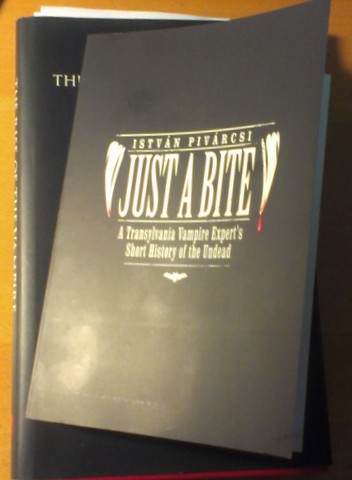
Hungarian historian István Pivárcsi has written a number of books on vampires and other subjects in Hungarian, while so far only the book quoted from above has been translated into English: Just A Bite: A Transylvania Vampire Expert's Short History of the Undead (paperback, 292 pages, $14.95). 'For more than twenty years he has led vampire tours in neighboring Transylvania,' the publishers write, making the reader expect that the book will contain a lot of information on vampires related specifically to Transylvania. Most of the book, however, covers ground familiar from numerous other books: Vlad Tepes, Elizabeth Bathory, Gilles de Rais, werewolves, zombies, the Golem, beliefs related to blood, vampire bats, porphyria, and the vampire of popular culture, and quite a lot of what is said about Romanian vampire beliefs is very brief.

Pivárcsi writes that, 'although research has found that vampire myths are rooted most firmly in Serbian, Croatian, Ukrainian, Romanian, and Ruthenian folklore,' Transylvania is of particular importance in 'vampirology', as he names the field:

'Largely because the vampire that was to become best known by name, Count Dracula, was linked in the popular imagination to that region,' even though he actually ruled south of Transylvania, but also because 'Romanian folklore in particular came to be permeated by vampires, thanks in no small part to a certain tenet of the Eastern Orthodox Church - name, that those people who died after being excommunicated returned as the walking dead - moroi in Romanian. Indeed, such souls were condemned to remain in this most unfortunate state of limbo until the Church saw fit to relieve them of the curse.' According to Pivárcsi, it was, however, the merging with the strigoi, 'a nocturnal death-bird with supernatural powers that flew about at night, hunting human flesh and blood,' 'that yielded the characteristic Romanian vampire figure whose modern permutations we have come to know. Linked as they were to the Christian religious tradition that pervaded nearly every aspect of society, vampires became seen as agents of Satan, as instruments of evil bent on violating and annihilating humanity - and it was thought that a whole army of them were out there in the night maneuvering for final victory. They fed on human blood, and their bite infected their victims with vampirism. Blood and darkness alone sustained them.'

Pivárcsi, unfortunately, does not evolve this theme much, but in a short chapter he relates some accounts related to the Transylvanian belief that 'were adapted by your humble guide from my archival research in Transylvania coupled with material in the works of the noted twentieth-century Hungarian folklorists Enikö Csögör and Tekla Dömötör.' There are in fact only five accounts, or 'possibly true tales', a couple of which are rather schematic, while the rest include other, and more interesting aspects of local folk beliefs that unfortunately are not dealt with in the book.

The book also includes a glossary, and a chronology in which it is claimed that Philip Rohr's De masticatione mortuorum 'is the first work to be published in German language about vampires,' while under 1710 it says: 'Vampire hysteria sweeps across Eastern Prussia. Numerous cemeteries are dug up, and a mob sets the houses of suspected vampires on fire.' This sounds like a Hammer film!  Equally apocryphal, yet still fascinating is the entry for 1725-1732: 'In the southern territories ruled by the Austrians, inhabited mainly by Serbians, several people are sentenced to death on charges of vampirism.'

The only part of the book that presents something truly Hungarian that is probably not available elsewhere, concerns the Hungarian silent Dracula film, Drakula halála, from 1921, so if you are looking for information on that one, Pivárcsi's book may be worth getting hold of. Otherwise, well, maybe this book is simply intended for younger readers looking for a popular introduction to the subject, and in that respect it is probably not worse than so many other books. But if you are looking for something on Hungarian or Transylvanian folk beliefs, I'd rather go for e.g. Tekla Dömötör's Hungarian Folk Beliefs.

The original title of the book is not mentioned, but I think this is a translation of Pivárcsi's Drakula gróf és társai originally published in 2003.

The publisher, New Europe Books, specializes in books from and about the former East Bloc, 'a literary landscape shrouded for all too many in mystery': 'We seek to introduce new and classic-yet-undiscovered authors and books whose stories will resonate with readers far afield. Our authors include not only those born and raised in this part of the world (whether or not they happen to write about their own societies) but also expatriate writers from elsewhere and those who may have lived abroad for a short or long time but whose ancestry is rooted firmly somewhere in Eastern Europe—in short, all those whose lives are bound up in some manner with the region, and who share startling new perspectives on the human condition that will appeal to readers from far reaches of the globe.'

Sunday, 15 September 2013

A surgeon's eyewitness accounts from Transylvania and Wallachia


Most of what was written on vampires in the eighteenth century consisted of commentaries on either a very small corpus of eyewitness accounts from officials of the Habsburg authorities or the Catholic Church or of various tales of vampires and revenants from around Europe. The most careful and comprehensive study based on first hand examinations of both those who complained of being attacked by a bloodsucker and of the bodies of the suspected vampires, was written in 1756 by a regimental surgeon, Georg Tallar.

Tallar was born in Mainz around 1700, and studied medicine there and in Straβburg. He then pursued a career as a surgeon and physician in the Habsburg army for more than thirty years, serving in Transylvania, Wallachia and the Banat. As Tallar mastered the local languages of those regions, he was not only able to discuss the subject of vampires first hand with the people who actually believed in them.

The new edition of Tallar's book and two pages from the manuscript shown in the Dracula. Woiwode und Vampir exhibition catalogue

Tallar witnessed five incidents in which people claimed to be attacked by vampires – or actually: Moroi – and in three cases he was himself involved in examining those who were ill as well as the corpses that were exhumed. He had actually even known some of those who, after their demise, were suspected of being bloodsuckers.

The Wallachians who were ill and claimed to have been attacked by a bloodsucker, told Tallar that they had been in bed for a couple of days, and that their heart hurt. When asked where the heart sits, they pointed, not to the heart, but to the stomach and the intestines. They said that, whenever they tried to fall asleep, the bloodsucker appeared in the shape of this or that deceased man or woman, standing in front of them or in a corner. Some said that they saw the bloodsucker when they were asleep, but many of the afflicted actually saw nothing. Still, they believed that it was necessary to open the graves to look for the Moroi. Although exhuming and destroying corpses was prohibited by law, they were willing to break the law to seek out and destroy the bloodsucker. In fact, people were so afraid of falling prey to the vampire, that they dared not walk about after dark.

Examining them, Tallar found that they complained from pains and aches in various part of the body, including strong headaches, and that their tongue would turn first pale and then become brownish red and dry as wood. They were very thirsty, and had a faint and erratic pulse.

In each case, only Wallachians were affected by the bloodsucker, whereas neither soldiers, German settlers, nor local Serbs became ill, so Tallar concluded that the Wallachians did not suffer from an epidemic, but rather an endemic disease. Considering the traits of the Wallachians, he concluded that the food eaten by them, especially during the fasts that they fanatically observed during Winter - consisting of e.g. cabbage, garlic, and sauerkraut - was the cause of the disease. In fact, administering a simple vomitive often cured the diseased!

Tallar also discusses various beliefs concerning the dead and their graves, refuting the beliefs and providing various natural causes for the phenomena. He e.g. refutes the belief that the bloodsuckers are more harmful on Saturdays, by exhuming and examining the corpses on various days of the week, showing that the state of the corpses were independent of the day of the week.

Overall, Tallar is an exemplar of the medical enlightened man, emphasizing – like Gerard van Swieten – the lack of education among the Wallachians, while at the same time mentioning that they are not so stupid not to accept his medical remedies against the disease, when they notice that people get cured.

From Medicinische Jahrbücher des kaiserl. königl.
österreichischen Staates
 Band 56 (Wien, 1846)
Tallar wrote his Visum-Repertum Anatomico-Chirurgicum after the vampire incident in Hermersdorf that prompted Empress Maria Theresa to stop the burning of corpses associated with magia posthuma, but his manuscript was left unpublished for almost thirty years, until the Viennese publisher Johann Georg Möβle came upon it and decided to publish it in 1784.

A reviewer in the Viennese Realzeitung für das Jahr 1784, expressed the wish that Tallar had used his proficiency in the Wallachian language to publish his observations on the matter in that tongue. Excerpts from the book turned up in Johann Dionis John’s Lexikon der K. K. Medizinalgeseze in 1790, and in an article in the Medicinische Jahrbücher des kaiserl. Königl. Österreichischen Staates in 1846.

Now, almost 250 years after its first publication, Tallar’s book has been reprinted by Nicolaus Equiamicus in a slim volume that replaces Möβle’s introduction by a new one by Equiamicus, and adds a few explanatory footnotes, while slightly updating the language of the original. Tallar’s original is readily available online (see my list of links), but Equiamicus is to be commended for providing us with a handy edition of this essential text on vampire beliefs. And it is available for just €7.90.

Sunday, 7 July 2013

A well-illustrated history of a modern myth

When in Paris a couple of months ago, I picked up a number of books at the Musée d'Orsay, including Jean Marigny's Vampires de la legende au mythe moderne published in 2011 by Éditions de La Martinière.

Large format, nicely bound with blood red edges, and fully illustrated in colour, it also includes three special booklets containing cover art, posters and stills from vampire novels and films. There are, in fact, a number of illustrations that you will probably not find elsewhere. The text, however, follows relatively traditional lines: 'Vampires' from various periods and regions across the globe, as well as listing Vlad Tepes, Elizabeth Bathory and Gilles de Rais as persons who inspired the vampire myth, and the main portion of the book traces the fictional vampire from John Polidori's Lord Ruthven to True Blood and manga.

Essentially, this is a colourful introduction to the subject, but those interested in vampires from a more historical or folkloric point of view, should rather seek out Marigny's Sang pour sang: Le réveil des vampires (translated into English as Vampires: The World of the Undead) or the volume Colloque de Cerisy: Les Vampires.


'Aujord'hui, le vampire est omniprésent sur nos écrans, dans nos libraires et dans le multiples manifestations. Cette vitalité exubérante est sans doute un signe de santé mais elle peut aussi mener rapidement à seuil de saturation. La mode actuelle des vampires a-t-elle des chances de durer? Nul ne peut le dire. On peut raisonnablement supposer que le vampire, devenu trop banal, connaîtra dans les années à venir une nouvelle période de récession - mais on sait aussi qu'il est immortel ...' (from Marigny's conclusion).

Wednesday, 27 February 2013

Austria or Serbia?

Roxanne Hellman and Derek Hall's Vampire Legends and Myths published in a series of books about the supernatural in 2012 by Rosen Publishing is a very attractive book about vampires aimed at adolescent readers. It is attractive because of a variety of colour illustrations from a broad range of places and sources, a selection that reflects an unusual variety of topics, which however are somewhat marred by a lack of precision. E.g. Kisiljevo or Kisilova is described as 'an Austrian village' and the text is accompanied by a nice photo of what looks precisely like that: a village in Austria instead of a village in Serbia. At the same time, Peter Plogojowitz is clearly characterized as 'a Serbian peasant'. It is, however, still a joy to flick through the pages of this book to study a great number of photos from Romania and other places around the world.

Kisilova: 'an Austrian village'
The Morava river, and Kosovo, 'in the vicinity of which Arnold Paole was seemingly troubled by a vampire'
Voltaire and Empress Maria Theresa
'Gerard van Swieten, whose investigations put an end to vampire hysteria in Austria' (sic)

Saturday, 16 February 2013

Waking the German Undead


The development of the literary vampire from John William Polidori’s The Vampyre over Varney the Vampire and Carmilla to Bram Stoker’s Dracula is well-known. This development highlights the vampire as an English language phenomenon, but this is, perhaps, due to lack of knowledge of the German language vampire fiction of the nineteenth century. According to Oliver Kotowski, this view probably stems from both Stefan Hock and Montague Summers, the latter claiming that ‘in Germany sensational fiction was long largely influenced by Polidori’, but it is a view that underestimates the number of vampire stories actually written during the nineteenth century.

Kotowski collects a dozen of these stories in his recent anthology Lasst die Toten ruhen: Deutsche Vampirgeschichten aus dem 19. Jahrhundert (Atlantis Verlag, 368 pages, paperback and hardcover at 14.90 € and 19.90 € respectively). Spanning the whole century, the stories are stylistically different, and Kotowski also includes two stories from parts of Eastern Europe that were available in German at the time.

Some texts are relatively well-known, e.g. Hoffmann’s Cyprians Erzählung, while others see their first modern reprint in this volume. Ernst Benjamin Salomo Raupach’s Lasst die Toten ruhen is among the latter, although it has been frequently reprinted in English as Wake Not The Dead where it is usually attributed to Johann Ludwig Tieck. An appendix reprints another story that is popular in English, The Mysterious Stranger, but as the original in German is so far unknown, Kotowski here has translated it from the English short story.

Each story is accompanied by biographical and bibliographical information as well as an afterword on the story and its use of the vampire motif. At the end of the book is a short summary of tendences in the German vampire literature of the nineteenth century and a bibliography.

Saturday, 1 September 2012

Trusting Peter Haining or not

How 'Arnold Paul' became a 'High Duke of Medreigia', I posted about some years ago. Peter Haining was the perpretator behind this curious misrepresentation of the famous 1732 Visum & Repertum. As I noted back then, in my youth I was initially impressed by Haining's prolific production of books, but later on I became increasingly sceptical of his research. Another instance is mentioned in a post under the title Another Haining Fraud on the Wormwoodiana blog, which concludes that 'it has become increasingly apparent that you can’t trust Peter Haining on anything.'


According to an obituary in The Guardian, the incredibly productive author, compiler and editor Peter Alexander Haining (1940-2007) 'was rooted in, and sustained by, a childhood passion for hidden nuggets of terror, witchcraft and crime.'  From 1963 to 1972 he was editor at New English Library, and readers of his books and anthologies - or indeed anyone interested in British paperbacks published in the Seventies - may enjoy watching this video about NEL and its books and authors that includes an interview with Haining himself.

Monday, 11 June 2012

The Darkest Sources of Bram Stoker

I recently received a copy of Neil R. Storey's book The Dracula Secrets: Jack the Ripper and the Darkest Sources of Bram Stoker (The History Press, 303 pages, hardcover, RRP £20), and although I have no far only dipped into it here and there, I can fairly easily say that this contains nothing of particular interest with regards to vampires, but it will no doubt be of interest to the Dracula, Bram Stoker or Jack the Ripper buff.

Storey, an award-winning historian, lecturer and author of many books, aims to link 'the Whitechapel vampire', i.e. Jack the Ripper, with Dracula, as one of Stoker's sources of inspiration. As I have so far not read the entire book, I am unable to say how successful he is in establishing this connection, but the book certainly contains a wealth of information on Stoker and some about the Ripper. It is very nicely illustrated, and among the appendices is the list of items from Stoker's library that was auctioned off at Sotheby's in 1913, including the notes for Dracula that a certain Mr. Drake purchased for the sum of £2 2s!

Another appendix is taken from the 1887 edition of Baedecker's Southern Germany and Austria, Including Hungary and Transylvania. Handbook for Travellers, detailing the railway trip from Klausenburg (Cluj) to Bistritz  (Bistriţa).


From Reiseführer durch Rumänien published in Bucharest in 1932.
A friend of mine gave me a copy of Jack the Ripper: The Casebook by Richard Jones some time ago. This is an unusual book about the crimes of the Ripper, because it contains pockets with 18 items of removable facsimile documents and memorabilia. If you happen to be interested in doing some armchair sleuthing, you might want to consider getting hold of this book.

Friday, 18 May 2012

The Philosophy of Spirits, Apparitions, Etc.


Cambridge University Press has reissued Henry Christmas's translation of Calmet, The Phantom World, as a set of two paperbacks. Available at at RRP of £39.00, it appears that there is no new material, like e.g. an introduction:

'The Benedictine monk and biblical scholar Antoine Augustin Calmet (1672–1757) published this work in 1746; it was translated into English in 1850 by Henry Christmas (1811–68). It examines a wide selection of supernatural tales and beliefs from across Europe. Taking the stance of a scientific enquirer, Calmet sought to understand the truth behind stories of good and bad angels, vampires, witchcraft, possession by demons, and the dead who come back to life. He compiled accounts of the supernatural from official reports, newspapers, eyewitness accounts and travel writing, and this two-volume anthology of his collected data analyses the material, noting problems and inconsistencies. Volume 1 investigates the appearance of good and bad angels, magic among the Greeks and Romans, sorcerers and witches, and possession by demons. Volume 2 investigates tales of vampires and ghosts across many different European countries.'

Henry Christmas (1811–1868), according to Wikipedia, 'at the end of his life going by the surname Noel-Fearn, was an English clergyman, a man of letters and editor of periodicals, known also as a numismatist.'

Also in the Cambridge Library Collection is a two volume edition of Emily Gerard's The land Beyond the Forest.

Tuesday, 28 February 2012

A bibliographical haunting

Readers sometimes point me to articles or web sites, but unfortunately it often takes me some time to write about it here. So, Roberto Labanti recently mentioned a bibliography of books and papers on vampirism that is now available online. The bibliography, Wissenschaftliche Vampir-Literatur: Eine bibliographische Heimsuchung by Gerd H. Hövelmann, was originally published in a journal called Anomalistik in 2007, so obviously it is not up to date, still it is relatively comprenhensive, so I am sure that most will find something useful.

I find the bibliograhpy of articles and papers the most interesting and useful, although some entries in my opinion are placed under a wrong category. Consequently, even if you are not particularly interested in one or more of the categories, I would suggest that you take a look anyway.

There are, as one might expect, a number of curiosities, like e.g. a paper on a Norwegian medical experiment, Does garlic protect against vampires? An experimental study with this abstract:

'Vampires are feared everywhere, but the Balkan region has been especially haunted. Garlic has been regarded as an effective prophylactic against vampires. We wanted to explore this alleged effect experimentally. Owing to the lack of vampires, we used leeches instead. In strictly standardized research surroundings, the leeches were to attach themselves to either a hand smeared with garlic or to a clean hand. The garlic-smeared hand was preferred in two out of three cases (95% confidence interval 50.4% to 80.4%). When they preferred the garlic the leeches used only 14.9 seconds to attach themselves, compared with 44.9 seconds when going to the non-garlic hand (p < 0.05). The traditional belief that garlic has prophylactic properties is probably wrong. The reverse may in fact be true. This study indicates that garlic possibly attracts vampires. Therefore to avoid a Balkan-like development in Norway, restrictions on the use of garlic should be considered.'

As for Anomalistik, according to the web site, 'the Gesellschaft für Anomalistik (Society for Anomalistics) is recognised as a charitable organisation for the advancement of science by the German state. Its roughly 130 members, with professional backgrounds in the natural and social sciences as well as in the humanities, advocate a critical but open-minded approach to controversial scientific claims and exceptional human experiences.

Based on multidisciplinary empirical, conceptual and historical research, the Society seeks to promote and cultivate an informed and respectful dialogue between proponents and opponents of controversial scientific claims and seemingly incompatible epistemic positions. The Society's only corporate view is a careful scepticism – meaning 'investigation' rather than 'dogmatic denial' in the original Greek – regarding unconventional claims and scientific orthodoxy alike.'

Sunday, 12 February 2012

C'era una Volta

Those of us who got interested in books on vampires in the Seventies or Eighties will probably have memories of the name Ornella Volta, as she was the author of an influential book titled Le Vampire: La mort, le sang, la peur, published as volume 8 in the French Bibliotheque internationale d'erotologie by Jean-Jacques Pauvert in 1962, highlighting various erotic aspects more or less related to the vampire theme, and not least including a lot of interesting illustrations. With Valerio Riva she was also the editor of an Italian anthology of both non fictional and fictional vampire texts, published in French as Histoires de Vampires in 1961, and popularly attributed to Roger Vadim, who at the time had just directed his vampire opus Et mourir de plaisir (hard to find on DVD, but currently available on youtube) inspired by Joseph Sheridan Le Fanu's Carmilla.

While collecting a bit of information on various editions of her vampire book some time ago, I noticed on the internet that she moved on to become an expert on the French composer and pianist Érik Satie, and that she is today running the Satie museum at 6 Rue Cortot in Mortmartre, Paris.

I had almost forgotten about this, until I recently decided to supplement what I had of Satie's compositions for solo piano with a 5 cd collection of his complete solo piano music performed by Jean-Yves Thibaudet and noticed that the liner notes were written by - Ornella Volta!

Thibaudet, by the way, has also recorded the complete works for solo piano of another French composer, Maurice Ravel, including Gaspard de la nuit. The second movement of this composition should be familiar to vampire film enthusiasts, as it was featured in Tony Scott's The Hunger starring Bowie, Deneuve and Sarandon.

Saturday, 7 January 2012

Los vampiros

'Is this worth purchasing?' is a question I have asked myself many times over the years, when a new book title on vampires and related subjects turned up. Fortunately, with the internet one can sometimes find a reasonable amount of reviews and other information, but in many cases you are left to make a decision on the basis of almost no information at all. For that reason, over the years I have tried to write a bit about various books that might have some value for people with an interest in the subject of vampirism and posthumous magic along the lines of this blog.

Jordi Ardanuy is a physicist and vampire expert who has written extensively in Catalan and Spanish. Much of what he has written on the subject is available on the internet, cf. e.g. the web site of Cercle V, but I have been intrigued to see his book Los vampiros ¡vaya timo! published by Laetoli in 2009 in a series on superstition, pseudoscience and antisicence called ¡Vaya timo! aimed at teenagers and other younger readers. Other books in the series deal with e.g. witchcraft, tarot and psychoanalysis.


Ardanuy's book is short, containing only about 130 pages, and is no doubt easily read if you know Spanish. The first chapter deals with Lilith, lamiae, ghosts, incubi and efialtes, and the second contains annotated translations from Henry More and Valvasor on the shoemaker from Silesia, Johannes Cuntius, and Giure Grando. Chapters 3, 4 and 5 deal with the famous Serbian vampire cases, the 18th century debate on vampires, Van Swieten's commentaries, also drawing lines ahead to e.g. the vampire beliefs and traits in 19th century New England. Finally, chapters 6 and 7 are concerned with the fictional vampire and the modern conception of vampires.

So, overall it looks like it contains standard information the subject that can be found elsewhere. The main exception is probably a few pages dealing with the critical reaction of the Spanish benedictine monk Benito Jéronimo Feijoo to Dom Calmet's work on revenants and vampires. Although not frequently mentioned in books on vampires, Feijoo's critique of Calmet is touched upon in e.g. Fernando Vidal's paper Ghosts, the economy of religion, and the laws of princes. Dom Calmet's Treatise on the apparitions of spirits in Gespenster und Politik, edited by Claire Gantet and Fabrice d'Almeida (Wilhelm Fink, 2007).

Ardanuy's list of recommended further reading is brief, mentioning works by Paul Barber, Jan Bondeson (a Spanish translation of his book on premature burial, Buried Alive), Robert Eighteen-Bisang and Elizabeth Miller, and Jean Marigny, including only one Spanish book: Vampiros y hombres lobo by Erberto Petoia.

Tuesday, 13 December 2011

Vampirism and magia posthuma

So the papers from the conference on vampirism and magia posthuma arranged by Christoph Augustynowicz and Ursula Reber at the University of Vienna in the Summer of 2009 have finally been published. I received the book yesterday, Vampirismus und magia posthuma im Diskurs der Habsburgermonarchie published by Lit Verlag. As little information on the book is mentioned on various web sites, I will list the contents:

  • Vorwort by Augustynowicz and Reber
  • Hans Richard Brittnacher: Blut. Grundsätzliche Bemerkungen zur Erfolgsgeschichte des Vampirs
  • Hagen Schaub: Beweist ein archäologischer Fund den Wiedergängerglauben? Kamen Südosteurops Vampire über österreichische Berichte bis nach Nordhessen?
  • Marco Frenchowski: Die Unverweslichkeit der Heiligen und Vampire: Eine Studie über Kulturelle Ambivalenz
  • Vlado Vlacic: Militärberichte und Vampirmythos
  • Bernhard Unterholzner: Vampire im Habsburgerreich, Schlagzeilen in Preußen. Wie Mythen zu politischen Druckmitteln werden
  • Oliver Hepp: Vom Aberglauben hin zur "magischen Würckung" der Einbildung. Michael Ranffts Tractat von dem Kauen und Schmatzen der Todten in Gräbern
  • Christian Reiter: Der Vampyr-Aberglaube und die Militärärzte
  • Thomas M. Bohn: Das Gespenst von Lublau. Michael Kaspereks/Kaspareks Verwandlung vom Wiedergänger zum Blutsauger
  • Clemens Ruthner: Ärzte am offenen (Text-)Grab. Zur Literarisierung von Flückingers Vampirismus-Protokoll (1732) bei Mayo (1846) und Kock (1998)
  • Christoph Augustynowicz: Von Branntweinmaßen, Klöstern und Waisenhäusern oder Galizien langes 19. Jahrhundert und Vampir-Motive
  • Christa A. Tuczay: Alb- Buhlteufel - Vampirin und die Geschlechter- und Traumtheorien des 19. Jahrhunderts
  • Peter Mario Kreuter: Er steht sogar im MERIAN. Zum vampiresken Verwaltungsschriftgut des 18. Jahrhunderts aus dem Hofkammerarchiv
  • Ursula Reber: Vampirmaschinen | Engelscharen. Diskursive Reihen und Knoten
  • Niels K. Petersen: Magia Posthuma. A Weblog Approach to the History of Central and Eastern European Vampire Cases of the 18th Century
  • Anhang: Farbabbildungen
  • Biographien

I am looking forward to reading it, and I expect to write a bit about this and some other books that have been published this year. I am sorry to say that - as usual - the most important books published this year  are not written in English. At least as far as I am aware of.

Vampirismus und magia posthuma im Diskurs der Habsburgermonarchie is available at just € 19.90 from the publisher and various online booksellers like e.g. German Amazon. Do note that it is also listed under the alternative title Vampirglaube und magia posthuma im Diskurs der Habsburgermonarchie.

Tuesday, 6 December 2011

The World of the Undead according to Marigny

An interview (in French) with Jean Marigny has just been published here. Marigny has penned a few books on the subject of vampires, including the popular Sang pour Sang which has been published in English as Vampires: The World of the Undead:

'En 1992, j’ai dirigé un colloque sur les vampires à Cerisy-la-Salle dans la Manche. Le centre étant très connu, les éditions Gallimard m’ont contacté pour me proposer de faire un livre sur les vampires dans la superbe collection « Découvertes ». Le but de l’opération était de publier ce livre en janvier 1993, au moment de la sortie du Dracula de Coppola. J’ai travaillé d’arrache-pied pour tenir le délai, et lorsque le livre est sorti, il a eu un énorme succès, à ma grande surprise, ce qui m’a valu d’être invité sur les principales chaînes de radio et de télé. Cela m’a permis aussi d’acquérir, dans ce domaine, une certaine notoriété.'

Marigny's most recent book on vampires is the fully illustrated Vampire: De la légende au Mythe moderne which was published by Éditions de la Martinière in November.
Related Posts Plugin for WordPress, Blogger...