On several occasions, particularly on the periphery of the Habsburg Empire during the 17th and 18th centuries, dead people were suspected of being revenants or vampires, and consequently dug up and destroyed. Some contemporary authors named this phenomenon Magia Posthuma. This blog is dedicated to understanding what happened and why.
'This book represents one Hungarian historian and traveler's sometimes elusive but ever conscientious filtering of numerous sources - sources including not only those books listed in the bibliography (some folkloric works available only in Hugarian) but also Hungarian-language and other archival materials and, indeed, stories heard during many journeys over many years in Transylvania and elsewhere.'
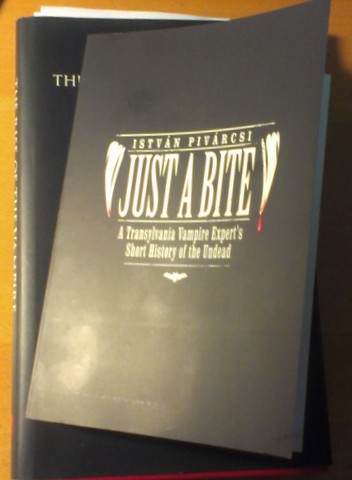
Hungarian historian István Pivárcsi has written a number of books on vampires and other subjects in Hungarian, while so far only the book quoted from above has been translated into English: Just A Bite: A Transylvania Vampire Expert's Short History of the Undead (paperback, 292 pages, $14.95). 'For more than twenty years he has led vampire tours in neighboring Transylvania,' the publishers write, making the reader expect that the book will contain a lot of information on vampires related specifically to Transylvania. Most of the book, however, covers ground familiar from numerous other books: Vlad Tepes, Elizabeth Bathory, Gilles de Rais, werewolves, zombies, the Golem, beliefs related to blood, vampire bats, porphyria, and the vampire of popular culture, and quite a lot of what is said about Romanian vampire beliefs is very brief.
Pivárcsi writes that, 'although research has found that vampire myths are rooted most firmly in Serbian, Croatian, Ukrainian, Romanian, and Ruthenian folklore,' Transylvania is of particular importance in 'vampirology', as he names the field: 'Largely because the vampire that was to become best known by name, Count Dracula, was linked in the popular imagination to that region,' even though he actually ruled south of Transylvania, but also because 'Romanian folklore in particular came to be permeated by vampires, thanks in no small part to a certain tenet of the Eastern Orthodox Church - name, that those people who died after being excommunicated returned as the walking dead - moroi in Romanian. Indeed, such souls were condemned to remain in this most unfortunate state of limbo until the Church saw fit to relieve them of the curse.' According to Pivárcsi, it was, however, the merging with the strigoi, 'a nocturnal death-bird with supernatural powers that flew about at night, hunting human flesh and blood,''that yielded the characteristic Romanian vampire figure whose modern permutations we have come to know. Linked as they were to the Christian religious tradition that pervaded nearly every aspect of society, vampires became seen as agents of Satan, as instruments of evil bent on violating and annihilating humanity - and it was thought that a whole army of them were out there in the night maneuvering for final victory. They fed on human blood, and their bite infected their victims with vampirism. Blood and darkness alone sustained them.'
Pivárcsi, unfortunately, does not evolve this theme much, but in a short chapter he relates some accounts related to the Transylvanian belief that 'were adapted by your humble guide from my archival research in Transylvania coupled with material in the works of the noted twentieth-century Hungarian folklorists Enikö Csögör and Tekla Dömötör.' There are in fact only five accounts, or 'possibly true tales', a couple of which are rather schematic, while the rest include other, and more interesting aspects of local folk beliefs that unfortunately are not dealt with in the book.
The book also includes a glossary, and a chronology in which it is claimed that Philip Rohr's De masticatione mortuorum'is the first work to be published in German language about vampires,' while under 1710 it says: 'Vampire hysteria sweeps across Eastern Prussia. Numerous cemeteries are dug up, and a mob sets the houses of suspected vampires on fire.' This sounds like a Hammer film! Equally apocryphal, yet still fascinating is the entry for 1725-1732: 'In the southern territories ruled by the Austrians, inhabited mainly by Serbians, several people are sentenced to death on charges of vampirism.'
The only part of the book that presents something truly Hungarian that is probably not available elsewhere, concerns the Hungarian silent Dracula film, Drakula halála, from 1921, so if you are looking for information on that one, Pivárcsi's book may be worth getting hold of. Otherwise, well, maybe this book is simply intended for younger readers looking for a popular introduction to the subject, and in that respect it is probably not worse than so many other books. But if you are looking for something on Hungarian or Transylvanian folk beliefs, I'd rather go for e.g. Tekla Dömötör's Hungarian Folk Beliefs.
The original title of the book is not mentioned, but I think this is a translation of Pivárcsi's Drakula gróf és társai originally published in 2003.
The publisher, New Europe Books, specializes in books from and about the former East Bloc, 'a literary landscape shrouded for all too many in mystery': 'We seek to introduce new and classic-yet-undiscovered authors and books whose stories will resonate with readers far afield. Our authors include not only those born and raised in this part of the world (whether or not they happen to write about their own societies) but also expatriate writers from elsewhere and those who may have lived abroad for a short or long time but whose ancestry is rooted firmly somewhere in Eastern Europe—in short, all those whose lives are bound up in some manner with the region, and who share startling new perspectives on the human condition that will appeal to readers from far reaches of the globe.'
To many, Francis Ford Coppola’s film Bram Stoker’s Dracula has become quite the epitome of the story of the vampiric Count Dracula. The soundtrack music by Polish composer Wojciech Kilar is ubiquitous, and the film’s blend of history and fiction, of romance and horror, as well as its creative play with cinema itself, seem to suit a vision that many people have of Dracula and vampires, or at least one that appeals to them – that is, of course, prior to the boom of adolescent vampire fiction like Twilight. Perhaps, as it is more than twenty years since Coppola’s film received its premiere, many people have simply grown up with this film and consequently now identify Dracula with Coppola’s Count.
So it is little wonder that the first thing behind the dark curtain leading into the Dracula e il mito dei vampiriexhibition at the Triennale design museum in Milan was a screen showing excerpts from Coppola’s film. In fact, the fusion of historical fact and vampire fiction, of artistic creativity and design, and of Bram Stoker’s novel with its interpretation by artists and cinematographers, permeated the exhibition as a whole.
Not so much an extension or reworking of the Dracula Woiwode und Vampir exhibitions at Innsbruck and Bucharest, Dracula e il mito dei vampiri rather integrated items from that exhibition into something new, not only bringing the fictional vampire into focus, but also, as one would expect af a design museum, stressing Italian art and design.
Having watched Coppola’s vision of the Wallachian warlord turned vampire, the visitor was greeted by the famous portrait of Vlad Tepes from the Kunsthistorisches Museum in Vienna. Fortunately, one was not met by Vlad’s gaze, as he rather looks at something or someone to your left, so one can study his features without fear of having aroused his, er, attention. Similarly, the full-length portrait of Dracula Waida Princeps from Forchtenstein Castle appears to look to one side, but strangely, his eyes have an uncanny look as if a film is layered on top of them, or maybe someone attempted to blur them?
Only a very small selection of items from the earlier Dracula exhibitions were displayed here to provide some context for the life and cruelty of Vlad Tepes: A 17th century map of Transylvania from the Kunsthistorisches Museum, the coloured print of the city of Papa from 1617 showing impalements, a copy of Sebastian Münster’s 1598 Cosmographey with its depiction of impalements, and various clothes and weapons used by the Ottomans.
The vampire cases and the ensuing debate of the 18th century were illustrated via a handful of books, including Johann Christoph Harenberg’s 1733 Vernünftige und Christliche Gedancken über die Vampirs oder bluhtsaugende Todten, Nicolas Lenglet du Fresnoy’s 1751 Traité historique et dogmatique sur les apparitions, les visions & les revelations particulières, and the German translation of van Swieten’s commentaries published in 1768. However, there were no documents, no Calmet, Ranft or Tallar, no bust of van Swieten or portrait of Maria Theresa as in the exhibitions at Innsbruck and Bucharest.
Instead, the exhibition of vampire fiction was enhanced by some remarkable items courtesy of the Bram Stoker Estate and John Moore Collection: Bram Stoker’s so-called lost journal that was published for the first time last year, and Stoker’s autograph copy of the first edition of Dracula‘to my dear mother’, both definitely some of the chief attractions of the exhibition.
A couple of Goya’s Caprichos, a first edition copy of Polidori’s The Vampyre as well as posters for performances of Marschner’s opera Der Vampyr and a programme for a 1927 performance of Deane and Balderston’s stage adaptation all led the way into a room where quotes from Stoker’s novel were displayed in Italian on a wall. Here you could also enter the house of a vampire as envisioned by Milanese architect and designer Italo Rota. A rather creepy tableau of a ‘living room’ with earth strayed across the table and a selection of ritual tools, remedies, books and art, all of which, according to Rota, should reflect the mentality and everyday ‘life’ of a vampire. Suffice it to say, that I would not spend my time in that place…
Entering the world of vampire cinema, one could peep through holes like a voyeur to observe a variety of ‘vampire kisses’ from a number of vampire films, while more analytically, over the door to the next room, a brief genealogy and philosophy of cinematic vampirism was outlined. Nosferatu from 1922 accordingly reflected the psychoanalysis of Freud and Jung, whereas Dracula from 1931 showed the vampire in the modern major city, and might be interpreted in terms of Georg Simmel or Walter Benjamin.
Then, for some reason the vampires of Hammer and many other filmmakers from the 1950’s to 1980’s were not included in the genealogy, so we jumped right to the era of post-structuralism (Jacques Lacan) and postmodernism (Guy Debord and Gilles Deleuze) with Bram Stoker’s Dracula from 1992 and Interview with the Vampire from 1994, respectively. Finally, in a 'liquid' society where 'solid' concepts like work and marriage are, in the words of Zygmunt Bauman, 'like zombies, such concepts are today simultaneously dead and alive', Edward Cullen and the other vampires of Twilight could be perceived as 'post-vampires', indistinguishable from mortal humans.
Clips from a variety of vampire films, including Mario Bava’s Italian La maschera del demonio from 1960, were shown on three transparent screens in a separate room, their soundtrack having been replaced by popular pieces like Orff’s O Fortuna and Delibes’s Flower Duet, all played at high volume.
Among the clips were, of course, Coppola’s Dracula film, and not only its screenplay and parts of its storyboards were exhibited, Dracula e il mito dei vampiri also paid homage to the film's costume designer, Ishioka Eiko, by displaying the blood red armour she created for Dracula, and showing a documentary about her work on the film. The tribute to Eiko was followed up by a a tableau of impressive female stage costumes from various operas and ballets like Aida, Die Zauberflöte, and Turandot. Very fitting for an exhibition in the hometown of Italian fashion and the famous opera house, La Scala. A wall of photos from catwalks rounded this section off with fashion for men designed by Louis Vuitton, Gucci, Prada and others, all illustrating the crossover of the vampire from fiction to fashion, no doubt with a good deal of help from Goth subculture.
Finally, a room not intended for children, exhibited pages from Guido Crepax’ comic book adaptation of Dracula as well as a hitherto unknown sequence in which his heroine Valentina meets Count Dracula.
Personally, I must say that the exhibition whet my appetite for more, as it is fairly easy to imagine how an exhibition like Dracula e il mito dei vampiri could be expanded in order to go into more detail with Vlad Tepes, with the struggle between the Ottoman Empire and Christian Europe, with vampires and revenant beliefs, and with the rise of the fictional vampire, Count Dracula and the vampire of modern popular culture. I am, however, well aware of the painstaking work that is no doubt required to assemble the number of paintings, books, documents and artefacts that would fit in with the themes, and at the same time I am not sure how much the average visitor is in fact able to digest. With regards to Vlad Tepes and vampires, the exhibitions in Innsbruck and Bucharest are so far the most comprehensive exhibitions I am aware of, and it will probably be hard to surpass hem. But hopefully there is more to come in the future.
In connection with the exhibition, Skira has published a 131 page catalogue, which includes a number of articles and a selection of the items exhibited. Margot Rauch has contributed the historical part of the catalogue, Dracula: voivoda e vampire, which is in fact a translation of what she wrote for the Innsbruck and Bucharest exhibition catalogues, as well as an inventory of some of the books and artefacts exhibited. The article on the costumes of female vampires (and vamps) include a number of photos of stars like Dietrich, Garbo, Bernhardt, Swanson and Bara that were not on display, while Italo Rota’s vampiric living room is only documented on a youtube video that can be accessed with a QR code.
Whether Dracula e il mito dei vampiri will be exhibited elsewhere in the future – in the same or some other form – I do not know, but the photo to right was posted on facebook by the company that organized the exhibition,with the accompanying message:
‘Dracula ha fatoo le valigie ed è pronto a ripartire alle conquista di nuove città!’: Dracula has packed and is ready to conquer new cities!
'There are several tricky problems inherent in discussing the earliest substantial manifestations of a much-loved screen genre,'David Pirie wrote in The Vampire Cinema (Hamlyn, 1977), which I purchased all those years ago as a teenager who had just become passionately interested in everything to do with vampires (when I had finally saved the DKK 64,90 necessary to buy the book, the bookshop had only one copy left). Pirie does not mention Le Manoir du Diable AKA The Haunted Castle or The Devil's Castle directed by Georges Méliès as the 'first' vampire film, but many books do, like John L. Flynn's Cinematic Vampires: The Living Dead on Film and Television, from The Devil's Castle (1896) to Bram Stoker's Dracula (1992) (McFarland, 1992): 'The imaginative climax occurs when the bat is vaporized in a puff of smoke, and from that puff of smoke, the vampire film was born.'
Thanks to youtube, the film itself is currently available for your own, personal judgment. Although the short film is imaginative and extremely well-made, I find that the vampire is, so to speak, in the eye of the beholder. Clearly, it contains elements that would reappear in vampire films, but I personally would not call it a vampire film.
If you are intrigued by this early film and you are not familiar with other films by Méliès, I encourage you to take a look at some of the other ones available on youtube, particularly his most famous one, Le Voyage dans la lune.
Writing about vampires in Venice a couple of months ago, I could only feature part of the Doctor Who documentary Death in Venice. In the meantime I have found the complete one elsewhere, and although it is mainly a making of featurette, it does include a bit of information on the bubonic plague in Venice - and a short reference to the archaeological find that made the headlines as a 'vampire' a couple of years ago.
Perhaps slightly off topic, but I think this recent BBC documentary on horror cinema is excellent and worth watching, not least because it provides some rare insights into a number of classic vampire and Dracula movies. Hopefully it will be available on DVD some time in the future, but as someone has put it up on youtube, here is a chance to view (most of) all three episodes.
Although historically it has nothing to do with vampires, it is hard for someone interested in that subject not to be intrigued by the history and legends surrounding Elisabeth/Erzsebet Báthory. Through modern books on vampires she has become inseparably connected to the subject of vampires, and by itself it is interesting to try and understand how much of the myth is actually based on historical reality and how the legends about blood baths and other cruel acts arose and developed into the ‘Blutgräfin’, blood countess, of contemporary fiction.
Michael Farin compiled a comprehensive anthology of texts and documentation in his 1990 Heroine des Grauens: Elisabeth Báthory, which is available in a slightly updated edition from 2003. In English, the most recent biography is Infamous Lady: The True Story of Countess Erzsebet Bathory by Kimberly L. Craft, which was published last year and probably incorporates and comments on material from Farin’s book as well as Tony Thorne’s Countess Dracula: The Life and Times of Elisabeth Báthory, the Blood Countess (1997).
The earliest source for Bathory’s blood bathing and obsession with beauty is the 1729 book on Hungary, Ungaria suis cum regibus compendio data, by László Turóczi which is, I think, not available on the internet. The notion was then retold by various other writers, including Sabine Baring-Gould in his 1865 The Book of Werewolves which Bram Stoker read, a fact that has made a lot of later writers on Dracula and vampires claim that Stoker was inspired by Bathory when writing Dracula.
Although the actual acts of the trials against Bathory were made available to the public in the 19th century, the idea of the blood bathing countess has persisted, and Bathory appears to be increasingly popular in fiction. Prudence Fostermixed von Schertz’s Magia posthuma with Bathory in the 1989 novel Blood Legacy, and Georges Pichard made a comic book edition of Sacher-Masoch’s short story on Bathory in 1985, La comtesse rouge (some images from an English translation can be found here). Most recently she played a central part in the 'official sequel' to Dracula.
In the cinema, a couple of dramas have been made over the last couple of years, The Countess and the Czech Bathory which should finally be available on German DVD this summer, plus various vampire movies like Eternal (2004). But the most famous are probably still Les lèvres du rouge (1971), Countess Dracula (1971), and Contes immoraux (1974), although only the latter two attempt some kind of 'historical' portrayal.
Contes immoraux was released on DVD here in Denmark recently, so I had a chance to view it for the first time in many years. More like a series of tableaux, there is little storyline in the film’s four parts, of which the third concerns Bathory. In fact, the raison d’être of the movie seems to be to show a lot of young women with little or no clothes on. Most of the Bathory sequence shows a number of these young women bathing for a long, long time to clean themselves before providing the sanguineous liquids for the bath of Bathory (played by Pablo Picasso’s daughter, Paloma, apparently her sole attempt at acting). There is given no explanation for the blood bath, so the viewer is assumed to know the legend, perhaps from Sacher-Masoch or from a popular book by Valentine Penrose, Erzsébet Báthory – La Comtesse sanglante, published in France in 1962.
In all fairness to the director, Walerian Borowczyk, I should add that I found his (in)famous and very explicit La Bête (1975), which was also released on DVD here, far more entertaining and innovative than his imho slightly boring 'immoral tales'.
For this post I have taken some photos of novels that I collected many years ago that exploit the legend. Click on the photos to read the spine tingling attempts at whetting your appetite for new tales of the 'blood countess'. I also found an old Danish magazine of 'chocking and hair-raising' historical sensationalism which includes the story of 'Prinsessen bag Drakula-myten: Hun tog bad i jomfrublod': The princess behind the Dracula myth: She bathed in virgin blood.
Something seems to attract people to the story, as Michael Farin also admits in his 2003 postscript on Bathoriana: 'Ja, es sei zugegeben, ausch solchen Gelüsten diente die vorliegende Sammlung. Sie fand LeserInnen, deren Augen zu schwimmen begannen. Das gehört bei einem solchen Thema nun einmal dazu, und auch einem "Kulturarchäologen" ist dies nich gleichgültig.'
And so the cultural archaeologist may find some entertainment and inspiration for the holidays below...
Apropos of horror fiction, some may have noticed that some time ago I added a banner concerning the Boris Karloff Blogathon, a collective effort to commemorate the 122th birthday of the well-known actor.
I have previously written about Karloff's contributions to vampire cinema, but I intend to return to this subject as part of the 'blogathon' that involves more than 50 blogs. If you have a weakness for this actor and his roles in horror cinema, do have a look at the other blogs participating. The 'blogathon' will haunt the blogosphere in late November.
I recently saw a book from 1999 by French sociologist Sabine Jarrot, Le vampire dans la littérature du XIXe au XXe siècle, which explores the differences between the portrayal of the vampire in the 19th and 20th centuries. She concludes that the vampire has become humanizes and asks what that tells us about our modern society and ourselves. Apart from a chapter on the genesis of the vampire that contains some information on the historical vampire, this book of course mainly is about fictional vampires.
This humanization of the vampire - which is also evident for certain other 'monsters' - is apparent from so much of the vampire fiction currently available, so much so that the so-called Vampire-con has taken the identification with the vampire as its catchphrase: 'Find your inner vampire'.
This 'con' has been mentioned in several places, so I thought I should mention it as well, at least it goes to show the popularity of vampire fiction these days. Set in mid August in Hollywood it is basically a film festival with panel discussions and a party. A number of well-known authors participate: Leslie S. Klinger, J. Gordon Melton, David J. Skal, and even Don F. Glut, and the vampire movies include older 'classics' and a sneak preview of an upcoming movie.
Well, you can look for yourself at the official site where you can also find information on the sponsors like a company that sells vampire wine, vodka and fangs! Even us Europeans can easily purchase a bottle of the wine from an online shop, if anyone should wish to impress (?) their friends by serving a 2005 vintage Vampire (actually, Californian Merlot or Cabernet Sauvignon).
On another blog I noticed a vampire movie set in Romania that may prove interesting. The movie has its own page on facebook where you can see one of the actors talking briefly about strigoi, moroi and the movie.
You will have to bear with me, as I have simply yet to find the time to write at more length on the conference in Vienna. In the meantime I may mention a magazine and a book that I found on my trip.
At the airport I stumbled on a special issue on vampires of the UK magazine SFX. It was pretty expensive as the Danish price is more than twice that of the original price (£7.99), but I thought I had better buy it now that I was on my way to spend a few days about vampires anyway :-)
The special issue comes with a poster, a set of Buffy coasters (!) and a book containing Le Fanu's Carmilla and Polidori's The Vampyre. The magazine itself contains mostly articles about vampire movies and TV series like True Blood and Twilight, but also Hammer's Dracula movies area featured, including a special on the making of The Legend of the Seven Golden Vampires. In a 'Top 50' of the greatest screen vampires of all time, Christopher Lee's count is only no 2, as one of the vampires (Spike) from the Buffy series is voted no 1 by readers of the magazine! There is even an interview with Elizabeth Miller on the genesis of Bram Stoker's Dracula, unfortunately marred by the interviewer's lack of knowledge of Austrian geography, as it is claimed that: 'Originally he was going to have the Count come from Astoria, not Transylvania.' In short, if you are into recent vampire fiction, you will probably find this magazine pretty entertaining.
Slightly more information on vampire beliefs can be found in a new coffee table book that I bought in Vienna: Transsylvanien im Reich von Dracula by Gerald Axelrod, appropriately printed in Leipzig. The major asset of this book is a large number of remarkably gloomy photos from various places in Romania, as the text itself probably will not surprise those familiar with the subject: A biography of Vlad Tepes, a relatively short chapter on Balkan vampire beliefs and a similarly short biography of Bram Stoker with emphasis on the origins of Dracula. At the end of the book a map of South Eastern Europe even has Medwegya marked in the mid 15th century. The short list of recommended reading mentions just two books on vampire beliefs, but certainly also two of the best books written on the subject: Peter Mario Kreuter's Der Vampirglaube in Südosteuropa, and Klaus Hamberger's Mortuus non mordet.
I am currently three episodes into watching the first season of True Blood which I received on DVD from USA the other day. I am not quite sure what to make of it, but somehow I tend to get involved in what's happening in these series - I recently watched the first season of another HBO series, The Wire, and initially thought it was unbearable to watch, but quickly got hooked! Certainly, True Blood is a humorous take on the vampire genre, as well as an unusual series with its explicit focus on sex, at least I am not used to seeing condoms in a TV series!
As an aside, I can also recommend the Mad Men series. Not that it has anything to do with vampires, but because it has something to do with history. Set in New York in 1960 it shows how many things that were just part of the everyday world back then have changed over the past five decades: They constantly smoke and drink at work, and don't mind driving a car after drinking an incredible amount of alcohol. Sexual harassment of female employees is almost obligatory, and women in general are either secretaries or house wives. Racial segregation, of course, is the norm. If we find it hard to understand the world of our ancestors a few centuries back, it is worth being reminded how things that were part of the social order just fifty years ago have become unacceptable today.
(John Polidori's) '"The Vampyre" transformed the revenant of folklore from a lumbering peasant who returned from the grave to attack family and friends into a nobleman who frequented fashionable clubs and wandered the globe in search of suitable, nubile victims.' (Notes, p. 310).
While browsing Stoker's Notes, it occurred to me that you could say that my own primary interest in this subject is mainly intellectual, whereas the fascination that many people have for the subject is of a more emotional character. In a way, the above description - by the editors of the Notes - of the transformation of the vampire from revenant into fashionable and erotic aristocrat probably illustrates this very well. The fascination with the fictional vampire is more driven by frisson, the almost pleasurable sensation of fright, or perhaps romance - some would simply say: sex.
Some tales of revenants certainly do involve sexual encounters, like in the Kukljin vampire case where a dead haiduk returns to sleep with his wife ('und was noch abscheulicher, so ist ein gestern beerdigter Heyducke folgende Nacht zu seinem Weibe gekommen und solcher ordentlich beygewohnet, welche solches gleich Tages darauff dem Hadnack selbiges Orts angedeutet, mit Vermelden, daß er seine Sache so wohl, als bey Lebzeiten verrichtet, ausser daß der Saamen gantz kalt gewesen.'). The emphasis, however, is not on erotics. We aren't told that the wife hoped that her dead husband would visit her again and again, as would be the case in modern vampire fiction, where e.g. the female victim - if that is the correct word? - looks forward to be visited by the count in Hammer's 1958 Dracula.
So, even though the sexual aspect is apparent from some revenant tales as well as from demonological works, this is not the aspect that is of primary interest or concern. Not so with the vampire of fiction.
Another illustration of this is shown in the above illustration. Taken from a Danish translation of a children's book, In the Footsteps of Dracula by Jim Pipe, this page juxtaposes the revenant of a peasant and the vampire count: 'Stoker's count, however, is very different from traditional vampires. He is an elegant and civilized nobleman with a pale, handsome face. Apart from his moustache he is clean-shaven. The original Transilvanian vampires on the contrary were rough creatures with boastful voices and red faces covered with stuble.' (Click on the image to view it in more detail).
Obviously, this blog is more concerned with those inelegant peasants that don't lend themselves so well to novels and motion pictures. It is, however, fascinating that those peasants somehow inspired the aristocratic vampire that is so popular nowadays.
Now that I have mentioned the Italian director Mario Bava (1914-1980) in a recent post, I might add a few words about his film adaptation of Aleksey Tolstoy's (Алексей Константинович Толстой, a cousin of Leo Tolstoy, 1817-1875) story La famille du Vourdalak(Family of the Vourdalak). Bava's adaptation is the middle story in an anthology film of three stories (or three faces of fear, as the title goes): I tre volti delta paura (1963). Like in Tolstoy's story, a nobleman called d'Urfé (in Tolstoy's story he is a marquis, in the film a count called Vladimir d'Urfé) who in 1759 ends up in a Serbian village at a time when Gorcha, the father of a family, has been away to fight a Turkish criminal, Alibek. Gorcha (played by Boris Karloff) has warned his family that if he does not return within five days (in Tolstoy's story: ten days), he will have become a wurdalak (or vourdalak), i.e. a vampire.
Tolstoy draws heavily on his knowledge of the vampire cases of the 18th century in his story, and Bava adds extra touches from later authors. As film critic Tim Lucas points out in his commentary on a recent DVD release, the adaptation actually incorporates elements from a short story by Guy de Maupassant, and from Bram Stoker's Dracula. Consequently, although this film is often regarded as one of the films closest to the actual vampire cases, it is in fact inspired more by literary conventions and inventions than by historical fact. Furthermore, Bava himself adds his own sense of colour, style and athmosphere to create a unique vampire film.
As for the ending, Bava opted for d'Urfé joining his beloved Sdenka, even though she had become a wurdalak, and consequently becoming a member of the family of the wurdalak. In the American version called Black Sabbath, a different ending was decided on, that was more in the vein of Tolstoy's, where d'Urfé survives to tell the story in Vienna in 1815.
Boris Karloff also starred in another film that will be of interest to anyone interested in the Magia Posthuma, Isle of the Dead produced by Val Lewton in 1945. The theme of this film is pretty unusual, as it is inspired by the Greek belief in vrykolakas. I may return to it in a future post.
This blog is definitely not about vampire cinema, but I find it relevant to deal with those instances where fictional vampires - from literature or cinema - have a particular relevance for the study or understanding of the subject of Magia Posthuma. That is why I will at times write about films likeLeptirića or I tre volti della paura.
Laurence A. Rickels, professor of German literature at the University of California, has lectured on vampires for a number of years. The lectures were taped and made into a book, The Vampire Lectures (University of Minnesota Press, 1999). The book contains 26 lectures, mainly on vampire fiction and film. It may appeal to people with an inclination towards Freud who want an introduction to the fictional vampire, but to those of us who are interested in the more historical aspects of Magia Posthuma, there is no reason to spend time on these lectures. Curiously, a German translation will be published later this year: Vampirismus Vorlesungen (Brinkmann U. Bose).
By far the most popular search topic that leads people to this blog is 'Leptirića', which is a testament to the 'cult' surrounding this rare Yugoslavian TV film mentioned in one of my first posts. Now someone has placed another small extract from it on youtube showing the miller being attacked by the vampire.
The Fantastic Vampire: Studies in the Children of the Night (Greenwood Press, 1997) is a pretty expensive book that I have had the opportunity to borrow. It has nothing of particular value for the historical study of Magia Posthuma, as it is mainly about Bram Stoker and various themes related to the vampire in film, fiction and popular culture. However, I found Elizabeth Miller's discussion of Stoker's 1901 abridged edition of Dracula interesting, and there are a few other papers on Stoker that might be worth reading. The editor, James Craig Holte, writes about Christopher Lee and the Hammer Dracula films, and Raymond T. McNally reviews a few classic examples of 'Irish gothic'. The table of contents and an excerpt are available at amazon.
Most vampire motion pictures are expansions and variations on a popular theme that has evolved considerably since the word “vampire” originally entered the language of people around the world. On its own this is a fascinating and often quite entertaining subject, but vampire cinema generally sheds very little light on the vampire’s historical and folkloric context. Occasionally a film does however contain aspects that are of considerable interest to the historian of magia poshuma.
The 1973 Yugoslavian TV production Leptirića (Butterfly) is an example. It is set in a Balkan village in the past. A year is not specified, but as it is based on a tale called Posle devedeset godina (Ninety years later) by a Serbian author who was considered the “Serbian Gogol”, Milovan Glišić (1847-1908), more information on the context of the story is probably available in the tale. According to some web sites it concerns a Serbian vampire called Sava Savanović (Сава Сaвановић) who is associated with a water-mill (Sava’s mill, Savina vodenica).
A miller is attacked by a hideous creature, and as the word “vampire” is clearly audible later on in the film, this must be a vampire. The vampire is shrouded in a dark cape which only allows us to see the vampire’s lower face that is covered with hair. The vampire’s mouth is filled with long sharp fangs that enable the vampire to suck blood from the miller’s throat.
We then follow two sets of people: On the one hand, a young, fair haired shepherdess and a young man who (as I do not understand Serbo-Croatian, I unfortunately can not understand what they are saying, but I believe this is what happens) want to get married, but the girl’s father will not allow it. On the other, a group of men, including the local Orthodox priest, who are advised by a crone to take a horse to find the vampire’s tomb. Where the horse stops, they start to dig a hole and uncover a wooden coffin. For some reason they do not open the coffin, but simply put a long stake directly into the coffin.
The girl and the young man are married, but on their wedding night the newly wed husband discovers a hole in her stomach. She then grows hair in her face and her teeth become long fangs, so obviously she is a vampire. She attacks him, and he runs off with her on his shoulders. They come to the site of the vampire’s grave, and the young man removes the stake from the coffin. A female vampire then gets out of the coffin, but is staked by the young man.
The film is interesting, because it enables us to see a vampire tale in a geographical and ethnic context that is related to that of the 18th Century vampire cases. The original tale by Glišić is probably inspired by 19th Century vampire fiction, so it is a bit hard to say how much of the tale is actually based on Balkan folklore. But I still find it profitable for an understanding of the context of the magia posthuma to watch a picture made by natives of the areas where the word “vampire” originated.
Unfortunately, Leptirića is hard to find, and seems to be mainly known in Balkan and the surrounding countries. However, its cult like reputation seems to be growing on the internet. A clip is currently available on youtube, which can give you an idea of the flavour of this tale.