Showing posts with label cinema. Show all posts

Sunday, 22 June 2014

The Gothic Imagination


2014 marks the 250th anniversary of Horace Walpole's The Castle of Otranto, usually celebrated as the first Gothic novel. The British Library will be celebrating the anniversary with an exhibition that opens on October 3 this year: Terror and Wonder: The Gothic Imagination will be the most comprehensive exhibition on the subject in the UK so far:

'Beginning with Horace Walpole’s The Castle of Otranto, this wide-ranging exhibition explores our enduring fascination with the mysterious, the terrifying and the awe-inspiring. It also examines the long shadow the Gothic imagination has cast across film, art, music, fashion, culture and our daily lives.

Gothic literature began as a challenge to the rational certainties of the Enlightenment. By exploring the harsh romance of the medieval past with its castles and abbeys, its wild landscapes and fascination with the supernatural, Gothic writers placed imagination firmly at the heart of their work.

Through over 200 rare exhibits including manuscripts, paintings, film clips and posters, Terror and Wonder explores all aspects of the Gothic world. Iconic works, including Mary Shelley’s
Frankenstein, Bram Stoker’s Dracula, the sinister fairy tales of Angela Carter and the modern horrors of Clive Barker highlight the ways in which contemporary fears have been addressed by successive generations of Gothic writers. Paintings, films and even a vampire-slaying kit add colour and drama to the story.

Terror and Wonder promises to be beautiful, dark, inspiring and haunting. Step into this world, if you dare.'


The British Library web site already contains a theme on the subject, including, of course, a page on Dracula and vampire literature (incidentally, they also have a page on Emily Gerard's The Land beyond the Forest). They have also made a youtube video on the Gothic in which Professor John Bowen discusses Gothic motifs while wandering around Horace Walpole's Strawberry Hill House.
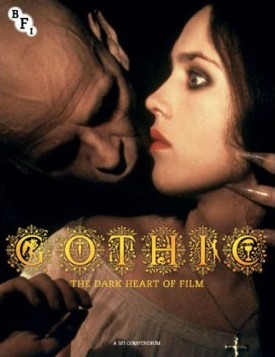
This exhibition follows hot on the heels of a Gothic film festival, Gothic: The Dark Heart of Film, arranged by the British Film Institute (BFI) in 2013. The BFI published a compendium, which is actually a delightful introduction to the world of Gothic film, its landscapes, architecture and inhabitants. In fact, this is probably one of the rare instances you will see me recommending a book on Gothic fiction on this blog, but the thematic approach to the subject as well as the host of experts who have contributed to it makes it a real treat, even for people with a more casual interest in the genre.

So the book includes essays on the relation between Gothic cinema and literature, architecture and art, with Martin Myrone, author of a nice book on Fuseli and contributor to the Tate exhibition on Gothic Nightmares back in 2006, noting that 'the relationship between the canon of Gothic literature of the 'classic' phase (c. 1760-1830) and the visual imagery of the same date is far from simple: the relationship of this early Gothic art and writing to modern cinema no more so.' Still, he later on concedes that 'nonetheless, there are parallels and resonances between Gothic literature of the 'classic' phase and precisely contemporary visual art, and between these and modern cinema,' accompanying his essay with a number of examples of these homologies, of which the most famous is, of course, Fuseli's Nightmare (see the Gothic Nightmares catalogue from Tate for numerous examples).

However many experts have contributed to the conpendium, they still are unable to solve the conundrum of pinning down what the Gothic 'genre' actually is. Myrone states that it is 'now often understood as, by definition, a trans-medial, genre-defying, migratory and polluting phenomenon, we should not expect homologies between Gothic productions in different media and eras need be predictable, explicit or orderly.' The paradox of how relatively easy it is to describe the Gothic 'landscape', while it seems almost impossible to define it, is what makes the compendium - cf. the title's nod to Joseph Conrad - a 'Grand Tour of the Gothic,' as Sir Christopher Frayling says in his foreword.

Sunday, 16 September 2012

The men by sword and the women buried alive


In Lech Majewski's brilliant and unique cinematic recreation and interpretation of Brueghel's famous painting The Way to Calvary (known in German as Die Kreuztragung Christi), exhibited at the Kunsthistoriches Museum in Vienna, The Mill & the Cross via Michael Francis Gibson's book Le Moulin et la Croix, a woman is executed by being buried alive.

The imagery is not explicitly based on the painting, although perhaps all the characters can be found there, so obviously this is something that could have in the context of the painting's universe. The cruelty of the Spanish rulers is patently part of the theme of the film. Dated in 1564, the painting - in Gibson's words - is set in a time which 'has come to evoke the Spanish presence signified in this painting by the double file of horsemen dressed in red.'

'Despite the efforts of Charles V, the Reformation, successfully stamped out by the Inquisition on the far side of the Pyrenees, kept gaining ground in the Netherlands. The Flemish towns had always been vigilant guardians of their prerogatives and they steadfastly resisted the King's will. By 1520, underground printing presses in Antwerp were disseminating Flemish versions of the writings of Martin Luther to the far corners of Flanders. Just before setting sail for Spain, the gloomy Philip [Phlip II, son of Charles] had entrusted the regency to his half-sister, Margaret of Parma, and being rather more devious, and not as blindly devout as is generally assumed, he gave her some final instructions at the foot of the gangway in Vlessingen. They were to be of momentous consequence: the edicts of their father in matters of heresy had all too long been neglected, he noted. From now on they were to be rigorously implemented.

But what did these
plakkaten or "placards" of Charles V command?

Proclaiming heretics
seditieuse personen ende perturbateurs van onsen staet ende der gemeynde ruste, "seditious persons disruptive of our State and of the common peace," they commanded that they "be put to death," te weten de mans metten sweerde ende de vrouwen gedolven: "to wit, the men by the sword and the women buried alive." These harsh decrees were ruthlessly applied - and many were put to death in the sight of their families, some by fire while others, having first been tortured, were carried to the tip of the Antwerp pier where the executioners sewed them into a leather sheath and tossed them into the sea.'

The burying alive, particularly of women, as a method of punishment and execution is known from other parts of the world as well, and it has been discussed, e.g. by Dieter Feucht, to which extent this and related practices is related to revenant beliefs. In his recent, tiny volume Vampire, Wiedergänger und Untote: Auf der Spur der lebenden Toten, Wolfgang Schwerdt notes that, taking these and other practices of execution into account, one cannot easily conclude from the state of archaeological finds to a general belief in revenants.

Burial alive, dismemberment, or - essentially the theme of the painting - crucifixion, the practices of mankind surpass the imagination of various authors and film makers of 'horror' and vampire fiction.

The Mill & the Cross is available on DVD in Germany, France and USA.

Wednesday, 11 January 2012

Non-linearity and reanimation

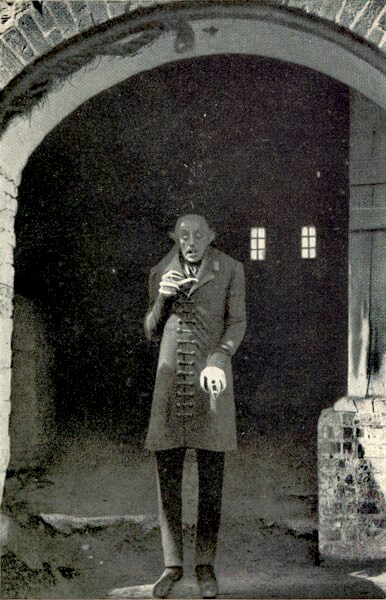
In 1922, the year Murnau's Nosferatu was released, critic and writer Béla Balázs wrote in the Viennese newspaper The Day:

'But crucially, film is a fundamentally new kind of art of an emerging new culture ... A means of mental expression that will influence humankind so widely and so deeply due to the unlimited accessibility of its technology must be of similar significance as Gutenberg's technological invention was for its time. Victor Hugo once wrote that the printed book assumed the role of the medieval cathedrals. The book became the carrier of the people's spirit and shredded it into millions of little opinions. The book broke the stone: the one church into a thousand books. Visible spirit became readable spirit, visual culture became conceptual. We probably need to say no more about how this changed the face of human society.

But today, another machine is at work to give human society a new spiritual shape. The many millions of people who sit every night and watch images, wordless images, which represent human feelings and thoughts - these many millions of people are learning a new language: the long forgotten, now newly emerging (and indeed international) language of facial expressiveness ... Perhaps we are standing on the threshold of a new visual culture?'

Bettina Bildhauer quotes Balázs in her 2011 book Filming the Middle Ages and comments: 'In a nutshell, we have the main themes here that recur in films and media theories to the present day. Balázs orders history into three periods, divided by the invention of the printing press and of film: the Middle Ages, characterized by the cathedral; the modern period, characterized by the book; and a new period characterized by film. For him, as for many medieval films, film and cathedral have more in common with each other than with the book: they are both visual and collective media, communicating through images to a united people, as opposed to the book, which communicates through words to individuals, having torn apart their communal spirit.' (p. 215)

She, however, points to another aspect of cinema and cathedrals that Balázs 'does not state explicitly, but on which his comparison is based: they both upset the fundamental idea that history is a linear progression, that time's arrow moves unstoppably, steadily and irreversibly forward in a line. By returning to the past, film resists a linear forward trajectory: the future, according to Balász's prediction, will circle back to the past.' (p. 215)

She traces these notions to the humanists of the mid-fourteenth century: 'The idea that time in the Middle Ages was not yet perceived in terms of linear progression originates from the very fact that the humanists declared themselves different from all that came before, thereby evidencing and fostering a sense of historical progress and change. The Romantics in the late eighteenth century were the first to argue for a New Middle Ages, revalued more positively as a model to cure the ills of modern society.' (p. 221)

Obviously, medieval film in Bildhauer's sense is not about historical accuracy, but rather 'a state of mind': 'a group of films usually set in the Middle Ages, creating non-linear time structures, playing visuality off against writing, and critiquing the modern individual human subject.' (p. 213)

The non-linear temporal aspect according to Bildhauer is evident in the reanimation of the dead in these films, which serves as the subject of the second chapter of her book, specifically considering the films Golem, Hard to Be a God, Waxworks, The Seventh Seal and Siegfried:

'In historiography, haunting has become a dominant, even clichéd metaphor for the relationship between present and past. In medieval film reanimation, rather than haunting, is used to depict the presence of the dead and its affective consequences. The dead return not so much as immaterial ghosts but as animated, solid or at least visible bodies. In the magical realist mode of many medieval films, the reality of the dead and of death is visualized on the diegesis through magically reanimated corpses or statues or through personifications of Death. (---) Alongside reanimation, a second frequently used visualization of the presence of the dead is that they physically approach the living, often in the direction of the camera and sometimes even stepping outside the diegesis. In the commonsensical concept of time as progressing in a linear and irreversible fashion, people and events seem less significant and have less power to affect us emotionally if they lived or took place a long time ago. The past, understood as severed and safely removed from the present, can gradually be forgotten and 'put in perspective'; and the dead, who are consigned to the past and referred to in the past tense, recede into the distance. The dead in medieval film reverse the usual movement of retreating into the past.' (p. 52)

Filming the Middle Ages is published by Reaktion Books.

Sunday, 4 May 2008

1755

The above shot is from the opening of Sofia Coppola's Marie Antoinette (2006), where Empress Maria Theresa (Marianne Faithfull) admonishes the future queen of France (Kirsten Dunst). Marie Antoinette was born on November 2 1755, i.e. almost a year after the empress got concerned with magia posthuma and sent a couple of court physicians to investigate a Moravian case that had astounded Vienna.

Certainly, the court in France was ahead of the Austrian court with respect to witchcraft and related matters that Maria Theresa had to concern herself with - aided by a certain Gerhard van Swieten. The movie, of course, has nothing to do with those matters, and takes off in 1770 when Marie is handed over to the French.

Those who enjoy that sort of thing should check out the November 5 1755 edition of the Wienerisches Diarium to read how the birth of the future Marie Antoinette was reported: "... Gegen halb 8. Uhr sodann wurden wir mit der höchst-erfreulichen Nachricht beglücket, daß Höchst-gedacht Ihre Majestät eine gesunde und Wolgestaltete Erz-herzogin, GOtt sey Dank! glücklich zur Welt geboren. ...'
Related Posts Plugin for WordPress, Blogger...