One of the most important sources for the history of vampirism is the report
Visum et Repertum written and attested by military surgeons in
Serbia on January 26 1732. It was sent to the authorities in Belgrade and Vienna, and copied by envoys of foreign governments. Foremost it was distributed in various versions to newspapers and scientific periodicals throughout Europe causing a public as well as scientific sensation in many European countries throughout the year 1732. In fact, had it not been for this report, the word
‘vampire’ and the stories of these supposedly blood drinking corpses would probably not have become known, and consequently the popular vampire of authors like
John William Polidori and
Bram Stoker, as well as the vampire of 20th and 21st century popular media would not have come into existence.

A copy of the original manuscript is stored in the archives in Vienna, but the text is mostly known in somewhat different versions through various printed sources. Curiously it has rarely been translated into English, and this is certainly also the case of the report from the first investigation of the vampire case in late 1731, and other documents commenting on the report.
I have referred to this report and vampire case many times, but I think it's time to write a bit more about this document, the vampire case, and the historical background.
Having defeated the Ottomans, the
Habsburg Austrians entered a treaty with the
Ottoman Empire at
Passarowitz (Požarevac south east of Belgrade in Serbia) in 1718 whereby parts of present day Romania, a part of Bosnia and the Northern part of Serbia came under Austrian rule. These areas that had recently become occupied were put under military jurisdiction. Due to the war the area was very depolated. The population did, however, const of different ethnical groups, including the
Ratzians, Serbs of the Orthodox Greek faith.
The occupied areas in Serbia acted as an enlargement of the so-called
Militärgrenze, the military border (
confinium militare), which was a buffer zone between the Habsburg and Ottoman empires. The zone was not only a buffer zone against military attacks but also against
epidemic diseases which had ravaged parts of Europe for centuries. In 1679 the plague had cost Vienna about one third or fourth of its population, and as late as 1713 there had been a minor epidemic in Vienna. Epidemics were known to occur in the Ottoman Empire from time to time, and consequently it was necessary to stay aware of cases of epidemic deaths. So Austrian officials like military surgeons had good reason to be very cautious towards signs of inexplicable deaths.
One case was reported to the commander of the Imperial army in Jagodina, colonel-lieutenant
Schnezzer, by inhabitants of the Serb village
Medvegya (Medveđa or
Medvedja) in the fall of 1731. Along with the local militia, the so-called
haiduks, they complained of several mysterious deaths. Schnezzer consequently sent a
Contagions-Medicus, a doctor called
Glaser, to Medvedja to investigate what had happened.
Glaser arrived in Medvedja on December 12th 1731. Although he found symptoms from malnutrition caused by the fasting of the orthodox villagers, he found no evidence of any epidemic disease. The villagers, however, claimed that symptoms like fever were the cause of the deaths of 13 villagers who had died within the past six weeks.
They believed that the deaths were caused by
bloodsuckers or
vampires which had been common among the Ottoman Turks. Glaser could not persuade the villagers from believing this. In fact, they claimed that they would have to move somewhere else, if the authorities would not execute the vampires. Consequently, Glaser had ten graves opened to carry out an autopsy of the corpses. Some of the bodies had decomposed, but others had become bloated and bloody with fresh blood flowing from nose and mouth. For this reason, Glaser found it impossible to persuade the villagers from believing that the corpses had become vampires. In his report to the authorities he asked for permission for the corpses to be executed, so the people could be calmed.
Glaser’s report was sent to the commander in Belgrade who apparently decided to send a commission to investigate the matter anew. This commission was led by the regimental surgeon
Johann Flückinger and arrived in Medvedja on January 7th 1732. They interviewed the villagers who said that a haiduk called
Arnont Paole had died in 1727 from a fall from a hay wagon.
While alive, Paole had often told that he had been harassed by a vampire when he was in another part of Serbia. To rid himself of the vampire, he had eaten soil from its grave and rubbed himself with its blood. But after some 20 or 30 days after his death some of the villagers had complained of being haunted by Paole who had become a vampire.
Four villagers were claimed to having been killed by him. To rid themselves of the vampire, the villagers opened his grave forty days after his interment and found his body uncorrupted. Fresh blood was flowing from his ears, eyes, mouth and nose, and his clothing and the whole coffin was bloody. According to the villagers, these were signs that he was a vampire, and they consequently drove a stake through his heart which made his corpse groan and bleed copiously. Finally, the body was burned and the ashes buried in his grave.
As the villagers believed that everyone killed by a vampire could become vampires themselves, they also dug op the corpses of the four people who had allegedly been killed by Paole, and treated them in the same fashion as they had Paole. Still, as Paole had also sucked the blood of cattle, the people who had eaten the flesh of those animals also risked becoming vampires.
During three months in late 1731 and early 1732 17 villagers, young as well as old, had died. Some of them had become ill suddenly and had died after two or three days of illness. The daughter in law of a haiduk,
Stanoika, had lain down to sleep healthy, but woke up with a terrible scream a midnight, frightened and shaking, complaining that she was being suffocated by
Milloe, a man who had died nine weeks before. She then got a strong pain in her chest and got worse and worse until she died after three days.
The villagers told this on January 7th 1732 to the commission consisting of Austrian military officials, including two subordinate medical officers. After interrogating the villagers, the commission went to the cemetery, exhumed and examined the 17 corpses. The minority of the 17 corpses had corrupted, whereas most of them were found in a to all appearances incorruptible state with fresh blood within the body. This was e.g. the case of the sixty year old woman called
Miliza who was believed to be the cause of the deaths, because she had eaten the flesh of sheeps which had been killed by a vampire. She had died after three months of illness and had been buried three months previously. Although she had all her life been skinny, much to the amazement of the villagers her exhumed body was fattish. In the cavity of her chest fluid blood was found, and the intestines were uncorrupted.
The above mentioned
Stanoika was, 18 days after her burial, found with a ruddy and lifelike face. Under her right ear was found a blue bruise of a finger. A quantiy of fresh blood flowed from her nose when she was taken out of her grave, and fluid blood was found in her chest and heart. All the intestines, the subcutis and her nails were fresh.
After the examination of the bodies, the corrupted bodies were replaced into their graves, while the rest of the bodies were decapitated and burned by local gypsies. Finally, the ashes were thrown into the river
Morava.

On January 26th 1732 the medical officers of the commission described their findings and acts in the report
Visum et repertum (Seen and found) and sent it to the authorities in Belgrade who forwarded it to the war council at the court in Vienna along with a request for remuneration of Flückinger and his two colleagues. The council dealt with the matter on February 11th, but more correspondence was necessary before Flückinger and his fellow officers received their remuneration in November 1732.
In the meantime, however, the report had been reprinted in various newspapers and journals, causing a large scale debate in certain parts of Europe. This sensation was helped on its way by some of the people who were somehow connected with what had happened.
As early as the very day that the
Visum et Repertum was signed, i.e. on January 26 1732, a standard bearer serving in Serbia,
von Kottwitz, wrote a letter from Belgrade to professor Michael Ernst Ettmüller in Leipzig asking for an explanation of the phenomena observed.
Glaser himself tried to attract some attention to his experiences by first sending a copy of his report to the
Collegium Sanitatis in Vienna, and later on to his father,
Johann Friedrich Glaser. Glaser Sr. wrote about it to one of the editors of the scientific journal
Commercii Litterarii ad rei medicae et scientiae naturalis incremementum institute published in
Nürnberg. His letter was published in Latin in the journal on March 22nd 1732, and caused a debate on vampires in that journal which lasted for the rest of the year.
Meanwhile,
Carl Alexander Prince of Württemberg, who had been in charge of Serbia and Belgrade, was travelling to the court of king
Friedrich Wilhelm I of Prussia in Berlin. Apparently, they discussed the
Visum et repertum, because the king asked
The Royal Prussian Society of Sciences to state a verdict on the contents of the report. The society convened on March 7th and finished a statement on the vampires or blood suckers on March 11th, in which they stated that all the phenomena that had been observed on the examined corpses could be explained by well-known natural processes.
Particularly in
Leipzig, but also in other places, however, the matter of vampires and how one were to explain the apparent incorruptibility of the corpses, the illness of the victims, and the claims concerning being haunted by vampires, were debated in numerous books and journals.
Later on, the vampire case from Medvedja was retold numerous times. The names of persons and places were changed along the way, so sometimes Arnont Paole became e.g. Arnod Paole or Arnold Paul. In the middle of the 19th century,
Herbert Mayo decided to try and use
'the romancing vein ... to try and restore the original colours of the picture', i.e. he dramatised the story, when he recounted it in his letters 'on the truths contained in modern susperstitions' that were first published in
Blackwood's Edinburgh Magazine. It is this version that is more or less used by
Dudley Wright and
Montague Summers, and it is amazing to find that the
'original colours of the picture' include a story of doomed love between Arnod Paole and his neighbour, Nina. Curiously, we are even told that
'it was on a grey morning in early August that the commission visited the cemetery of Meduegna,' although we know it actually happened in January. The tradition of mixing up fact and fiction when it comes to vampires apparently is far from new.

When it comes to the name of
Arnont Paole, Arnond Paole, Arnod Paole or however it is written, one theory is that the name was actually
Pavle, and that
'Arnont' was actually a title or description, namely that of
'arnaut', a Turkish word for the people of Albania.
Medvedja in my opinion is the village
Medvedja close to the
Zapadna Morava branch of the Morava river, not to be confused with the much larger city of Medvedja that was outside the part of Serbia occupied by the Austrians in 1732.
 The accompanying excerpts of the
 Visum et Repertum
are from a contemporary copy that was sent from Vienna to the Danish government.


 Left Copenhagen on September 23 at 11:15 AM and arrived at Henry Conanda (Otopeni) Airport, Romania, around 2:40 PM.
 I visited the exhibition twice, but I can only show you a photo of the exterior, as photography was stricly prohibited inside. So if you want to know what the exhibition looks like, you have to go to the web site I linked to recently. I think that the exhibition was smaller than the original one at Schloss Ambras, but it was of course exciting to find on the same location famous paintings of Vlad Tepes and one of Elizabeth Bathory, as well as books and manuscripts on the subject of vampires, including Flückinger's Visum et Repertum.
 I suppose that this may well have been the first and last time that I get to see some of these items, as they are usually to be found at a number of different locations in Europe. Looking at the opening page of the Visum et Repertum, it was obvious that the spelling is Arnout Pavle and not all the other ways it has been spelled in books since that time.
 Apparently funded by Fundatia Snagov, a lot of time and effort must have gone into compiling all this material. And what a coincidence that I should find it at the very hotel I was staying at! A pleasant one as well, the Golden Tulip situated on Calea victoriei, not far from the national art museum. If you are going to Bucharest, I would recommend hotels on or near this street, as you are in a convenient part of town close to the city centre.
 Curiously, many of the hotels and restaurants seem to think that beer from my own country is 'probably the best beer in town', so I had to go to a supermarket to taste one of their local beers. In the photo below you can also see an issue of a Romanian historical magazine, Historia with a theme on Vlad Tepes that I noticed in one of the numerous small shops selling books and magazines around town.
 I was actually surprised to find how omnipresent Vlad Tepes/Dracula is in Bucharest. Even Bram Stoker seems to be a household name! Most of the souvenirs are pretty kitschy, but I had a pretty pleasant time at the Count Dracula Club, a theme restaurant where you can get vampiric cocktails and menus based on Dracula. So I had a 'vampire coffin' cocktail, paprika chicken and tasted their Tuica. All pretty nice and it ended with the count himself turning up, quoting Stoker and biting 'Mina' on the neck. Good fun, and not expensive.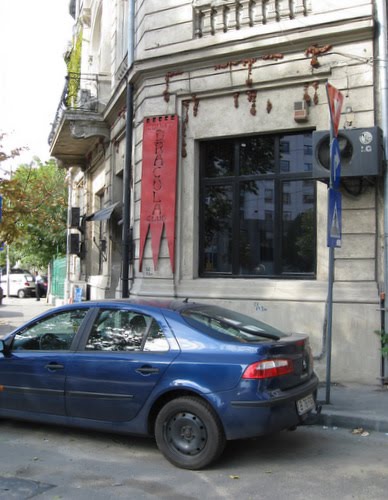
 Apart from the exhibition, the other highlight of my trip was a visit to the church on an island in the lake Snagov, Lacul Snagov, where the remains of Vlad Tepes were buried according to legend.
 I hired a 'limousine' to there, which also allowed me to get some more information on the town and on Romania in general from the driver. Just €65 to go there and back, which is pretty reasonable for a 3 hour ride.
 In any case, it was like entering another world when we drove off the high way and entered the forest. The road was awful, but the driver knew his way around, so everything went fine. We encountered a few horse carts and people collecting logs, everything more or less like pictures I had seen of rural Romania.
 A bridge is being constructed to the island where the Snagov monastery is located, but I think it will take some time before it is finished. In the meantime you still have to go by boat to the island, and this means sailing in an old fashioned rowing boat across the lake as shown in the photo below, and no one seems to be thinking about life vests! Anyway, everything went fine, and I and my driver got to the island. I was actually the only tourist around, and I may even have been the only one that day!
 The monastery or church is pretty small like so many of the Romanian Orthodox churches. It costs 15 lei to enter and 5 lei to be rowed back and forth, which is around €2.50. Photography, unfortunately, is very expensive, €20 I think. The main attraction is the 'grave' of Vlad Tepes, which is easy to find.
 So I and my driver went around the small island, while he retold some of the stories about Vlad Tepes. Not quite historically correct, but who cares as all the circumstances surrounding this visit to a place I have read about since I was a teenager made it a highlight of a trip.

 A copy of the original manuscript is stored in the archives in Vienna, but the text is mostly known in somewhat different versions through various printed sources. Curiously it has rarely been translated into English, and this is certainly also the case of the report from the first investigation of the vampire case in late 1731, and other documents commenting on the report.
 On January 26th 1732 the medical officers of the commission described their findings and acts in the report Visum et repertum (Seen and found) and sent it to the authorities in Belgrade who forwarded it to the war council at the court in Vienna along with a request for remuneration of Flückinger and his two colleagues. The council dealt with the matter on February 11th, but more correspondence was necessary before Flückinger and his fellow officers received their remuneration in November 1732.
 When it comes to the name of Arnont Paole, Arnond Paole, Arnod Paole or however it is written, one theory is that the name was actually Pavle, and that 'Arnont' was actually a title or description, namely that of 'arnaut', a Turkish word for the people of Albania.


