Showing posts sorted by relevance for query medvedja. Sort by date Show all posts

Sunday, 21 September 2008

Medvedja and Medvedja

Although Google has provided us with good tools for geographical searches, my maps of Serbia and other parts of Europe are still an indispensable tool for searching for places mentioned in texts on magia posthuma and vampires.

In connection with my posts on Medvedja and Kukljin, I think it's worth mentioning that some people have looked for 'Medvegya' in another place in North Eastern Serbia. Namely the Medvedja located on the Resava river, North of Jagodina (shown on the right side of the map below).

However, in the Visum et Repertum the ashes of the bodies are thrown into the Morava river, and it is also said that Medvedja is on the border of Turkish area. The Zapadna Morava more or less marked the southern border between the part of Serbia occupied by Austrian forces, and the Ottomans. Furthermore, the proximity of Kukljin to that Medvedja in my opinion is further evidence that this must be the correct 'Medvegya'.

And this is not the only evidence, because if you go back and look at contemporary lists of haiduk villages in the occupied parts of Serbia, you can find both 'Medved' and 'Kuklin' mentioned in the 'Jagodinaer Distrikt' along with other village names from the same area. So I am quite convinced that my identification of Medvedja is correct.

Sunday, 26 February 2012

An Uncertain Place: Highgate, Kisiljevo and Medvedja


Vampire history very infrequently turns up in fiction, and as I only sporadically inform myself about fictional vampires, and by the way have never been a fan of crime fiction, the vampiric connection in Un lieu incertain (An Uncertain Place) by Fred Vargas somehow slipped under my radar. Fortunately, a reader recently mentioned it, so I have picked up and read the 2008 novel in the Danish translation, Et uvist sted.

Definitely a page-turner, although I personally find that the gallery of more or less eccentric characters smacks a bit too much of a crime fiction cliché, this novel in the series about Commissaire Adamsberg takes him and his colleagues to Highgate Cemetery in London and to a small village on the Danube in Serbia, Kisiljevo, on the trail of a murderer who literally destroys his victims. The plot not only involves the infamous 'Highgate Vampire', but also the famous 18th century vampires Petar Blagojevic/Peter Plogojowitz from Kisiljevo and Arnold Paole from Medvedja, as well as their ancestors. What kind of sense this combination makes, if any, you should read the novel to learn, because I am not going to spoil the fun by giving it all away here.

Fred Vargas herself is actually a French historian and archaeologist called Frédérique Audoin-Rouzeau, who became a successful author of crime fiction in the mid 1990's. Some of the Adamsberg novels have been made into a TV series, Collection Fred Vargas, including Un lieu incertain as shown in the youtube video below. This episode, unfortunately, is not yet available on DVD.


'An example of modern legend-building,' according to English Wikipedia, the Highgate Vampire case, to the extent one can actually call it that, has taken on a life of its own, in particular on the internet. Because of the legend-building, perhaps even cult surround the subject, it is probably difficult to be certain what actually happened in 1969 and 1970 when a 'vampire hunt' purportedly took place in the famous cemetery.

Fred Vargas couples this incident with another legendary occurrence in the old part of the cemetery, the one initiated by poet and painter Dante Gabriel Rosetti when in 1869 he had the corpse of his late love, Elizabeth (Lizzie) Siddal (also visit this site devoted to her), dug up from its grave in Highgate Cemetery to obtatin the one and only copy of a book of poetry that he had left buried in her hair. Rossetti's operation is told in Felix Barker and John Gay's Highgate Cemetery: Victorian Valhalla (1984):

'Much secret preparation took place in which [Dante Gabriel Rossetti] enlisted the help of a young man called Howell who, as well as being Ruskin's secretary, had a talent for conspiracy. Through Howell, Rossetti obtained the Home Secretary's permission for an exhumation, and on a night early in October 1869 'the ghastly business', as Rossetti called it, was carried out. The deed was done by the light of lanterns and the warmth of a small bonfire watched by Howell, a solicitor and a Camberwell doctor. The receipted bill of two guineas for the workmen is still in existence. Rossetti could not bring himself to be present. Full of self-doubts he waited alone at Howell's house in Fulham.

When the coffin was opened, it was said that Lizzie's pale beauty remained unimpaired, and someone - it was probably Howell - carried back the message that her lovely hair had retained its colour and had grown in death. The vital manuscript, discovered to be intact, was eased gently from her face. After being disinfected and dried by the doctor, it was conveyed to Rossetti.'


The preservation of Lizzie, and particular the claim that her hair had grown in death, is of course reminiscent of the phenomena related to vampirism, the 'vampire state' reported about in the early 18th century from both Kisiljevo and Medvedja.

Imperial Provisor Frombald's 1725 report from Kisiljevo, which today is only known in a copy in the Viennese archives, is well-known from a contemporary newspaper, the Wienerisches Diarium, reprinted and translated in a number of journals and books, and the inspiration for the young Michael Ranft's first edition of his De masticatione mortuorum in tumulis from 1725, commenting on the similarly titled book by Philip Rohr published in 1679. Frombald's report is the oldest known use of the word vampire as spelled that way (the copy actually has: 'vanpiri').

The occurrences in Kisolova, i.e. Kisiljevo, concerning the vampire Peter Plogojowitz (probably Petar Blagojevic) are recounted in English on Wikipedia. In An Uncertain Place, the villagers in Kisiljevo are today familiar with the vampire story, and one can still locate the grave of Plogojowitz, but this is mere fiction, because Serbian media have been unable to locate any local information on this contender to the title of the world's first vampire.

In that respect Plogojowitz plays a central role in defining 'vampirism', so it is important to point out that the people who said there were haunted by Plogojowitz did not complain of bloodsucking but of being suffocated by him as he lay on top of them. Furthermore, his wife said Plogojowitz had come to her to retrieve his shoes (Oppanki = opanci, according to Wikipedia: Opanak are 'traditional peasant shoes' worn in Southeastern Europe). As Peter Kremer has pointed out, this is the well-known motif of a deceased returning as a revenant to retrieve something that he requires to rest in peace after death, in this case his shoes.


View Larger Map


Source for this map: Wikipedia

The exhumation and examination of Plogojowitz' corpse, including his penile erection, forebodes the large scale examinations carried out seven years later in Medvedja in the Southern part of Serbia under Habsburg military control. Commissaire Adamsberg doesn't visit this village, but Arnold Paole, probably Arnaut Pavle, contender for the title as the world's most famous and influential vampire, also plays a role in An Uncertain Place. Oddly, Vargas places Medvedja in the Branicevo District, not very far from Kisiljevo, but I am not aware of any Medvedja in that area.

For more information on this, the most famous incident in vampire history, see my post on the Visum et Repertum, as well as other posts on this blog.

This vampire case also turns up in a work of popular fiction, as German author Markus Heitz includes it in his 2006 novel Kinder des Judas.


View Larger Map

Saturday, 20 September 2008

Visum et repertum

One of the most important sources for the history of vampirism is the report Visum et Repertum written and attested by military surgeons in Serbia on January 26 1732. It was sent to the authorities in Belgrade and Vienna, and copied by envoys of foreign governments. Foremost it was distributed in various versions to newspapers and scientific periodicals throughout Europe causing a public as well as scientific sensation in many European countries throughout the year 1732. In fact, had it not been for this report, the word ‘vampire’ and the stories of these supposedly blood drinking corpses would probably not have become known, and consequently the popular vampire of authors like John William Polidori and Bram Stoker, as well as the vampire of 20th and 21st century popular media would not have come into existence.

A copy of the original manuscript is stored in the archives in Vienna, but the text is mostly known in somewhat different versions through various printed sources. Curiously it has rarely been translated into English, and this is certainly also the case of the report from the first investigation of the vampire case in late 1731, and other documents commenting on the report.

I have referred to this report and vampire case many times, but I think it's time to write a bit more about this document, the vampire case, and the historical background.

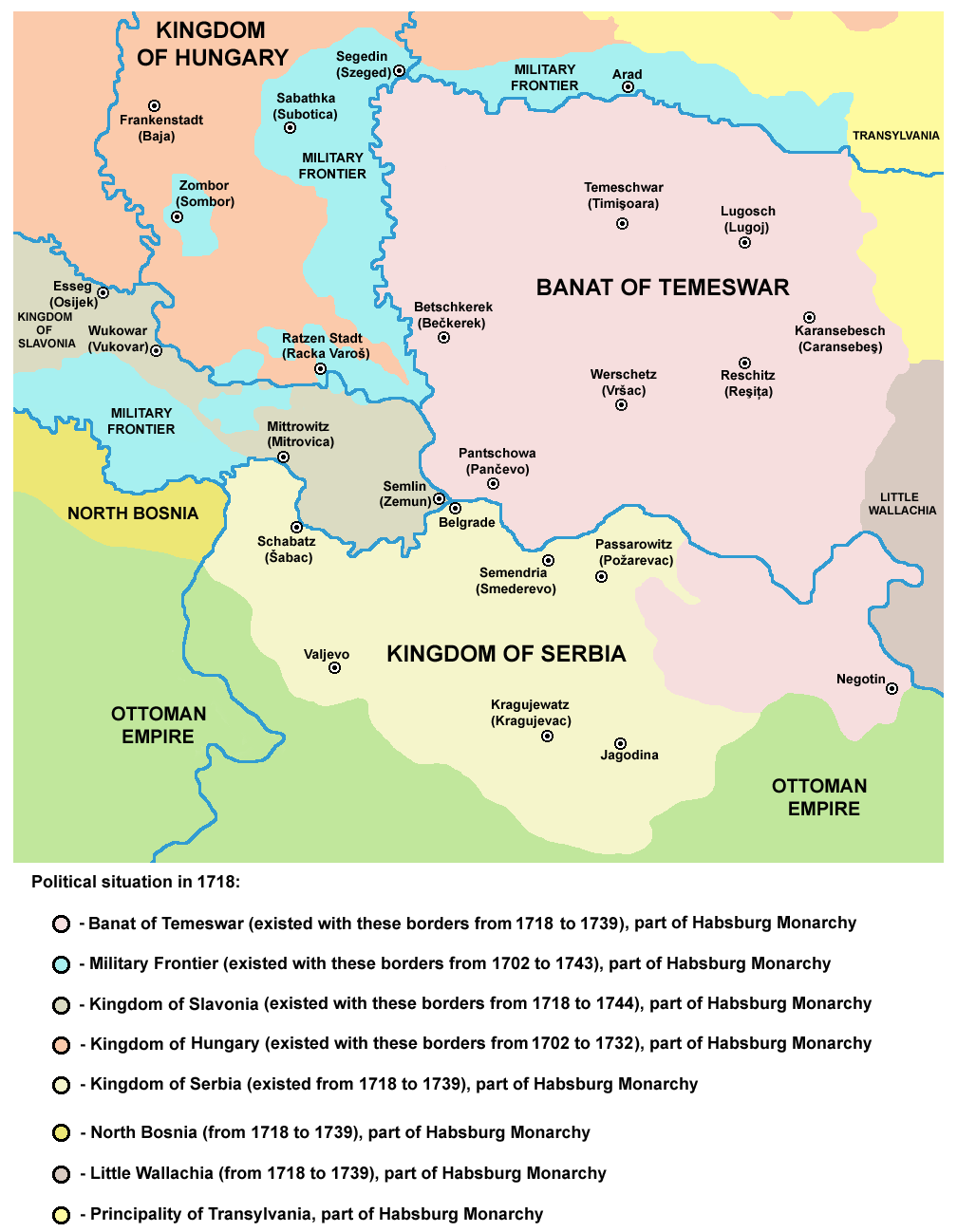
Having defeated the Ottomans, the Habsburg Austrians entered a treaty with the Ottoman Empire at Passarowitz (Požarevac south east of Belgrade in Serbia) in 1718 whereby parts of present day Romania, a part of Bosnia and the Northern part of Serbia came under Austrian rule. These areas that had recently become occupied were put under military jurisdiction. Due to the war the area was very depolated. The population did, however, const of different ethnical groups, including the Ratzians, Serbs of the Orthodox Greek faith.

The occupied areas in Serbia acted as an enlargement of the so-called Militärgrenze, the military border (confinium militare), which was a buffer zone between the Habsburg and Ottoman empires. The zone was not only a buffer zone against military attacks but also against epidemic diseases which had ravaged parts of Europe for centuries. In 1679 the plague had cost Vienna about one third or fourth of its population, and as late as 1713 there had been a minor epidemic in Vienna. Epidemics were known to occur in the Ottoman Empire from time to time, and consequently it was necessary to stay aware of cases of epidemic deaths. So Austrian officials like military surgeons had good reason to be very cautious towards signs of inexplicable deaths.

One case was reported to the commander of the Imperial army in Jagodina, colonel-lieutenant Schnezzer, by inhabitants of the Serb village Medvegya (Medveđa or Medvedja) in the fall of 1731. Along with the local militia, the so-called haiduks, they complained of several mysterious deaths. Schnezzer consequently sent a Contagions-Medicus, a doctor called Glaser, to Medvedja to investigate what had happened.

Glaser arrived in Medvedja on December 12th 1731. Although he found symptoms from malnutrition caused by the fasting of the orthodox villagers, he found no evidence of any epidemic disease. The villagers, however, claimed that symptoms like fever were the cause of the deaths of 13 villagers who had died within the past six weeks.

They believed that the deaths were caused by bloodsuckers or vampires which had been common among the Ottoman Turks. Glaser could not persuade the villagers from believing this. In fact, they claimed that they would have to move somewhere else, if the authorities would not execute the vampires. Consequently, Glaser had ten graves opened to carry out an autopsy of the corpses. Some of the bodies had decomposed, but others had become bloated and bloody with fresh blood flowing from nose and mouth. For this reason, Glaser found it impossible to persuade the villagers from believing that the corpses had become vampires. In his report to the authorities he asked for permission for the corpses to be executed, so the people could be calmed.

Glaser’s report was sent to the commander in Belgrade who apparently decided to send a commission to investigate the matter anew. This commission was led by the regimental surgeon Johann Flückinger and arrived in Medvedja on January 7th 1732. They interviewed the villagers who said that a haiduk called Arnont Paole had died in 1727 from a fall from a hay wagon.

While alive, Paole had often told that he had been harassed by a vampire when he was in another part of Serbia. To rid himself of the vampire, he had eaten soil from its grave and rubbed himself with its blood. But after some 20 or 30 days after his death some of the villagers had complained of being haunted by Paole who had become a vampire.

Four villagers were claimed to having been killed by him. To rid themselves of the vampire, the villagers opened his grave forty days after his interment and found his body uncorrupted. Fresh blood was flowing from his ears, eyes, mouth and nose, and his clothing and the whole coffin was bloody. According to the villagers, these were signs that he was a vampire, and they consequently drove a stake through his heart which made his corpse groan and bleed copiously. Finally, the body was burned and the ashes buried in his grave.

As the villagers believed that everyone killed by a vampire could become vampires themselves, they also dug op the corpses of the four people who had allegedly been killed by Paole, and treated them in the same fashion as they had Paole. Still, as Paole had also sucked the blood of cattle, the people who had eaten the flesh of those animals also risked becoming vampires.

During three months in late 1731 and early 1732 17 villagers, young as well as old, had died. Some of them had become ill suddenly and had died after two or three days of illness. The daughter in law of a haiduk, Stanoika, had lain down to sleep healthy, but woke up with a terrible scream a midnight, frightened and shaking, complaining that she was being suffocated by Milloe, a man who had died nine weeks before. She then got a strong pain in her chest and got worse and worse until she died after three days.

The villagers told this on January 7th 1732 to the commission consisting of Austrian military officials, including two subordinate medical officers. After interrogating the villagers, the commission went to the cemetery, exhumed and examined the 17 corpses. The minority of the 17 corpses had corrupted, whereas most of them were found in a to all appearances incorruptible state with fresh blood within the body. This was e.g. the case of the sixty year old woman called Miliza who was believed to be the cause of the deaths, because she had eaten the flesh of sheeps which had been killed by a vampire. She had died after three months of illness and had been buried three months previously. Although she had all her life been skinny, much to the amazement of the villagers her exhumed body was fattish. In the cavity of her chest fluid blood was found, and the intestines were uncorrupted.

The above mentioned Stanoika was, 18 days after her burial, found with a ruddy and lifelike face. Under her right ear was found a blue bruise of a finger. A quantiy of fresh blood flowed from her nose when she was taken out of her grave, and fluid blood was found in her chest and heart. All the intestines, the subcutis and her nails were fresh.

After the examination of the bodies, the corrupted bodies were replaced into their graves, while the rest of the bodies were decapitated and burned by local gypsies. Finally, the ashes were thrown into the river Morava.

On January 26th 1732 the medical officers of the commission described their findings and acts in the report Visum et repertum (Seen and found) and sent it to the authorities in Belgrade who forwarded it to the war council at the court in Vienna along with a request for remuneration of Flückinger and his two colleagues. The council dealt with the matter on February 11th, but more correspondence was necessary before Flückinger and his fellow officers received their remuneration in November 1732.

In the meantime, however, the report had been reprinted in various newspapers and journals, causing a large scale debate in certain parts of Europe. This sensation was helped on its way by some of the people who were somehow connected with what had happened.

As early as the very day that the Visum et Repertum was signed, i.e. on January 26 1732, a standard bearer serving in Serbia, von Kottwitz, wrote a letter from Belgrade to professor Michael Ernst Ettmüller in Leipzig asking for an explanation of the phenomena observed.

Glaser himself tried to attract some attention to his experiences by first sending a copy of his report to the Collegium Sanitatis in Vienna, and later on to his father, Johann Friedrich Glaser. Glaser Sr. wrote about it to one of the editors of the scientific journal Commercii Litterarii ad rei medicae et scientiae naturalis incremementum institute published in Nürnberg. His letter was published in Latin in the journal on March 22nd 1732, and caused a debate on vampires in that journal which lasted for the rest of the year.

Meanwhile, Carl Alexander Prince of Württemberg, who had been in charge of Serbia and Belgrade, was travelling to the court of king Friedrich Wilhelm I of Prussia in Berlin. Apparently, they discussed the Visum et repertum, because the king asked The Royal Prussian Society of Sciences to state a verdict on the contents of the report. The society convened on March 7th and finished a statement on the vampires or blood suckers on March 11th, in which they stated that all the phenomena that had been observed on the examined corpses could be explained by well-known natural processes.

Particularly in Leipzig, but also in other places, however, the matter of vampires and how one were to explain the apparent incorruptibility of the corpses, the illness of the victims, and the claims concerning being haunted by vampires, were debated in numerous books and journals.

Later on, the vampire case from Medvedja was retold numerous times. The names of persons and places were changed along the way, so sometimes Arnont Paole became e.g. Arnod Paole or Arnold Paul. In the middle of the 19th century, Herbert Mayo decided to try and use 'the romancing vein ... to try and restore the original colours of the picture', i.e. he dramatised the story, when he recounted it in his letters 'on the truths contained in modern susperstitions' that were first published in Blackwood's Edinburgh Magazine. It is this version that is more or less used by Dudley Wright and Montague Summers, and it is amazing to find that the 'original colours of the picture' include a story of doomed love between Arnod Paole and his neighbour, Nina. Curiously, we are even told that 'it was on a grey morning in early August that the commission visited the cemetery of Meduegna,' although we know it actually happened in January. The tradition of mixing up fact and fiction when it comes to vampires apparently is far from new.

When it comes to the name of Arnont Paole, Arnond Paole, Arnod Paole or however it is written, one theory is that the name was actually Pavle, and that 'Arnont' was actually a title or description, namely that of 'arnaut', a Turkish word for the people of Albania.

Medvedja in my opinion is the village Medvedja close to the Zapadna Morava branch of the Morava river, not to be confused with the much larger city of Medvedja that was outside the part of Serbia occupied by the Austrians in 1732.


The accompanying excerpts of the Visum et Repertum are from a contemporary copy that was sent from Vienna to the Danish government.

Thursday, 17 March 2011

What if ...

What if Flückinger had not been sent to Medvedja in 1732? Or if the Visum et Repertum had attracted no attention but had just been another report stored at the Hofkammerarhiv in Vienna?

As we know, Michael Ranft was so intrigued by reading of the supposed vampire Peter Plogojowitz that he presented his own De masticatione mortuorum later in 1725, but otherwise few people seemed to take note of it.

It did, however, attract a bit of attention at the Academia Naturæ Curios. in Breslau (Wrocław in Poland), the publisher of the so-called Breslauische Sammlungen, a major scientific journal of the early 18th century. Founded by Johann Kanold, it was originally published in Breslau, but later on in Leipzig and Budziszyn (Bautzen).

In 1727 the volume containing information on the Summer quarter of 1725 was published, and among other both enlightening and entertaining articles, e.g. ‘von einem See-Manne’, of a merman, it contains an Article 19: ‘Abentheuerliche Begebenheit mit einem Vermeyntlich wieder gekommenen Todten’. The dead man who was presumed to return was Peter Plogojowitz as referred to in a ‘gazette’ containing the report from Kisiljevo in Northern Serbia: ‘Copia eines Schreibens aus dem Gradisker District in Hungarn M. Aug. 1725’.

The document is followed by an analysis to prove that the incident stems from superstition, oversight and rashness (‘Diß ist abermals eine Begebenheit vom Aberglauben, Inadvertenz, und rachgieriger Ubereilung’), which argues in a forensic fashion that was to be used in several texts on the subject after the incidents at Medvedja in 1732. A short review of Ranft’s original dissertation is also provided, and a reference is given to a previous issue on examples of masticating dead from Poland and Prussia (‘Von dem Polnischen Upiertz oder sich selbst fressenden Todten und der daraus entstandenen Furcht for Pest- und Vieh-Sterben’).

I think it is fair to say that if Glaser and Flückinger had not reported from Medvedja in 1732, this would have been about as much attention the Serbian vampire had received.

Monday, 21 April 2014

In search of Georg Tallar and other borderland vampire investigators

'While the belief in returning dead and the ritual/social practices related to it had already had a many-centuries-old, established tradition, it was the special relations of the borderland region [in the Southern parts of the Habsburg empire] which made them visible and problematized them for different officials of the state administration. At the same time, these same relations posed considerable difficulties for these functionaries to fulfil their respective tasks by essentially leaving them alone, baffled in the face of strange phenomena, which they nevertheless had to interpret and react to. Focusing foremost on medical experts in some form of state-service, the present essay seeks to map the power-relations of different parts of this distressing but exciting world, to which western culture’s perpetual fascination with vampirism owes its existence.'

As has so often been pointed out on this blog, despite western culture’s fascination with the subject very little has been written in English on the key events of 'vampire history', and for that reason it is very welcome to be able to point to the ’essay’ in question, which is in fact a M.A. thesis by one Adam Mezes. Supervised by Laszlo Kontler and Gabor Klaniczay, Mezes submitted his thesis, Insecure Boundaries: Medical experts and the returning dead on the Southern Habsburg borderland, at the Central European University History Department last year.

Situated in Budapest, Hungary, the History Department of the CEU according to its web site is 'the only transnational, English-language graduate school in Europe that is accredited both on the continent (in Hungary) and in the United States', it 'provides an excellent academic gateway to the history of Central, Southeastern, and Eastern Europe,' and 'offers one of the few programs in the world that effectively enables students to study comparatively the Habsburg, Romanov, and Ottoman Empires and their successor states, engaging with a variety of social, political, and cultural issues.' Its staff is multinational and multilingual, and among them we find Professor Laszlo Kontler who has a background in the European intellectual history of the early modern period and the Enlightenment. Kontler is the author of A History of Hungary: Millennium in Central Europe and the forthcoming Translations, Histories, Enlightenments: William Robertson in Germany, 1760-1795. Professor Klaniczay is affiliated with the Medieval Department of the CEU and author of, among many other papers and books, an influential article from 1987 on the Decline of Witches and Rise of Vampires in 18th Century Habsburg Monarchy that has featured prominently in the succeeding literature on 18th century witchcraft affairs.

In his thesis, Mezes focuses on the context of the vampire investigations of the 18th century, in particular those in Serbia (Kisiljevo and Medvedja) and those investigated by Georg Tallar in Banat and Oltenia. Briefly mentioning a few books on the subject, Mezes states that: 'It is visible from this brief literature overview that considerably more attention has been paid to the findings of the medical reports than to the authors themselves. The factors which influenced the way they constructed their own role and formulated their reports have not been researched in depth. Taking the studies mentioned last as a departing point, the present essay makes an attempt at applying a magnifying glass on this frontier-region and investigate the specific spheres of power and authority which shaped the formulation of the reports on vampirism. The exact mapping of these relations is a valid task, because much confusion exists even in the above mentioned literature dealing specificially with the topic of politics and vampires. It seems that basic, factual matters have to be cleared, otherwise the scholarly gaze on vampirism and state will remain hazy.'

Mezes is particularly interested in vampirism as 'a problem of ordering for Habsburg statecraft', because it was in the 18th century that various ways of governance and policing were explored and implemented in order to centralize and uniform the control of the authorities. In the borderland areas to the South, a direct control based on central institutions was employed, which had the effect that what was going on locally among the common people became more visible to the central authorities.

So Mezes describes the organization and development of the Militärgrenze, the military frontier in the Southeastern parts of Habsburg territory, including the military and governmental structure of Serbia in the short period that it was under Habsburg occupation. He also goes into detail with regards to the frontier's function as a plague cordon, the setting up of special quarantine stations where people were to be confined until one could be sure that they were not potential carriers of the plague miasma, and the order to report suspicious infection cases directly to the Aulic War Council.

Source: Wikimedia

Mezes correctly identifies Kisilova from Frombald's report with present day Kisiljevo, and points out the differences between Kisiljevo and Medvedja in the military and governmental structure of Serbia at the time. Kisiljevo being a cameral village, and not a Hayduk village like Medvedja, the investigations of purported cases of vampirism were handled differently in these two villages. Mezes also discusses the curious circumstances related to the copy of Frombald's manuscript and other information on the case in the Viennese archives.

All this is a nice and clear exposition and synthesis of information most of which can be found in various books on the subject and on the Militärgrenze, but that is certainly not the case when it comes to the part of the thesis on Georg Tallar. Here Mezes carries out a detailed analysis and comparison of both the printed book and the original manuscript to learn more about this 'enigmatic figure', Tallar, his investigation of vampire cases and the reason why a publisher decided to print the book some thirty years after the report was written.

Tallar was part of a commission consisting of himself, a theologian, and a physician, the latter according to Mezes possibly the Protomedicus Paul Adam Kömovesch (actually: Kômûves) who is recorded to having singlehandedly investigated one case of vampirism. Mezes suggests that, perhaps, the three did not actually work together, which could perhaps explain why it was Tallar and not the Protomedicus who wrote the report. On the other hand, Mezes notes that in the manuscript there are sections of a more religious character, which are so different from the otherwise sceptical voice of Tallar, that he thinks they may originate from the hand of the (unknown) theologian: 'Every now and then, there appears a voice in the text – albeit faintly and awkwardly – which addresses issues of demonic activity and morals and their consequences.'

These parts of the manuscript were omitted when the Viennese publisher Johann Georg Möβle prepared the text for printing. In his foreword Möβle claims that he stumbled upon the manuscript by accident, but Mezes finds this improbable.

Although dated 1756, Tallar may have written it in 1753: 'hypothetically, it might be conjectured, that Tallar handed in his report to the Banat Provincial Administration in 1753, right after he finished his investigation, just as his fellow-commissioner, Kömovesch did. Then, when the Hermsdorf-scandal popped out, the central administration wanted to collect materials about vampirism and asked the Banat Administration to send all documents they have on the issue. This scenario would explain why the report is dated 1756: it was written on it when the Aulic Treasury (Hofkammer) received the document three years after the report was actually finished.'

So what prompted Möβle to publish the report some thirty years later in 1784? Mezes convincingly conjectures that news of another vampire investigation got to Vienna that year, and that the authorities once again searched their archives for material on vampires, found Tallar's manuscript, and asked Möβle to publish it. Mezes lists a number of works published by Möβle that supports his theory that Möβle not only catered for 'the public's hunger for curiosities,' but was in fact also publishing books that would serve as instructive 'governmental messages.'

As for the vampire case that prompted the publication, Mezes writes: 'In our opinion (though again, further investigation is needed), the publication of the report has something to do with another vampire scandal, one which secondary literature does not yet know of (in fact neither do we). What points nevertheless in this direction is a royal statute of Joseph II., dates 1784.11.02., in which the king warns the Orthodox Church to take active part in the fight against vampire-beliefs.'

Mezes refers to an entry in Franz Xavier Linzbauer's voluminous Codex Sanitario-medicinalis Hungariae (a book that contains other source material on vampire investigations) concerning the practice among some people of the Orthodox faith of leaving corpses unburied ('in aperta tumba') for fear of bloodsuckers ('Wampier'), a practice that may cause epidemics illnesses to spread, so the authorites found it necessary to reiterate its stance.*

Franciscus Xav. Linzbauer: Codex Sanitario-Medicinalis Hungariae Tomus III. Sectio I, p. 122 (Buda, 1853)
Apart from the theological omissions mentioned above, Mezes finds that Möβle was fairly loyal to the text of the manuscript, although he made some changes like removing Tallar's references to the local authorities that appointed him to the commission: 'By doing so, Möβle severed important roots which linked the report to its original circumstances, and at the same time managed to elevate the report to a more general level of the enlightenment fighting the forces of darkness, be they superstitions or illnesses.'

Obviously, this is highly interesting work, particularly on Tallar's investigations and the interest in vampires of the late 18th century Enlightenment. Certainly a well-written and well-researched thesis, it earned Mezes a Hanak Prize at the History Department of the CEU, and as it is written in English, it also offers those who are unable to read the German language literature on the subject a glimpse of what they are missing out on.

Thanks to Jonathan Ferguson for notifying me of this work.

*) The contemporary review of the printed edition of Tallar's report that I quoted in an earlier post, was published 'Wien am 17ten Hornung, 1784', i.e. in Vienna on February 17 1784, and if that is correct, Möβle published Tallar's report several months before the royal statute.

Sunday, 16 March 2008

Els vampirs de Medveda

Jordi Ardanuy has published a paper on the Medvedja vampire case. Unfortunately, it is only available in Catalan. It contains translations of the source material, as well as background information. Some may notice that this blogger's entry on Medvedja is referred to in the references and notes.

Thursday, 21 July 2011

Serbian vampires close-up!

This Serbian documentary provides an exceptional look at some of the places related to vampire history and legends in Serbia, including Kisiljevo and Medvedja. As I do not understand the language, I cannot tell you much about what they are actually saying, but names of places and persons, like e.g. Petar Blagojevic (i.e. 'Peter Plogojowitz'), are easy to recognize. Part two also includes some (split screen) clips from the old Leptirica film.

It is pretty ridiculous to see a guy trying to locate the grave of Blagojevic using a pendulum, and I had to smile when I saw Flückinger portrayed as an old man writing the Visum & Repertum. But I find it very nice to see Serbians reclaiming the vampire. After all this is where it started. Without the vampires - or at least the villagers worried about vampires - of Kisiljevo and Medvedja we would hardly be talking about vampires today.


Friday, 21 January 2011

Medvedja anno 1738

Changes in my personal life may allow me to spend a bit more time on this blog. Well, I better not make any promises, but there is a chance that I can devote more time to the subject of 'magia posthuma'. So, let me kick off this new year with a part of a map from 1738 of Serbia that shows the site of the most famous vampire case, Medvedja, near the Zapadna Morava river in central Serbia. Unfortunately, this scan of the map is not in high resolution, but in the figure below you can see the village at the top. The map below it shows the surrounding area of the Jagodiner District.


The same map also shows the Ramm District, the site of the first attested vampire case in Kisiljevo in 1725. Maybe I will return to that in a future post.

Monday, 9 July 2007

An der Türckischen Granitz III

So how close was Medvedja actually to the "Granitz"? My own best source for material on the geography of Serbia as occupied by the Habsburgs is the old Serbien unter der kaiserlichen Regierung 1717-1739 by Langer published in Mittheilungen der K. K. Kriegs-Archivs Neue Folge III. Band in 1889. For some reason most of the books I have been able to get hold of concerning the "Militärgrenze" contain little material on the Serbian area, so for many purposes I have had to content myself with the information in Langer's paper. Fortunately, it is very interesting, and the appendices are very useful for establishing the whereabouts of the places mentioned in some of the old vampire related documents, including "Kisilova" and "Medved".

However, a map of the area can be found on German Wikipedia in an entry concerning the treaty of Passarowitz (Požarevac). Below I have linked to the map, which is from a 1900 German historical atlas, and you will notice that in this map the Turkish border is drawn somewhat south of the Zapadna Morava river, where Medvedja is situated.


As a curiosity here is an extract from a ca. 1720 map of Serbia and the surrounding areas attributed to J. B. Homann which is currently for sale on ebay at the price of € 320.


Previous posts on the subject: Granitz I & Granitz II.

Sunday, 21 September 2008

Kottwitz and Kucklina


Travelling East from Medvedja, passing through Velika Drenova which is known for its production of vine, you will enter a village called Kukljin (view satellite photo).

Kukljin is probably the Kucklina that features in the history of vampires, Kucklina being the village referred to by von Kottwitz in his letter on vampires (see my post on the Medvedja vampire case).

Von Kottwitz sent his letter to a doctor of medicine in Leipzig, Michael Ernst Ettmüller (1673-1732), on the same day that Flückinger and co. signed their Visum et Repertum. He enclosed a copy of the report and referred to another instance that occurred in Kucklina, i.e. Kukljin.

Two brothers were haunted by a vampire at night, so one had to keep watch over the other. The vampire, however, opened the door 'like a dog', but they succeeded in escaping. Soon both fell asleep, and the vampire returned and sucked one of them leaving a red spot under his right ear. Within three days he was dead.

On the following night, a haiduk who had just been buried returned to his wife and slept with her. Next day she told the hadnack that he had done so just as he had while alive, only that his semen had been cold. She had then become pregnant and had born a child of the size of a normal boy, but with no limbs, just a piece of flesh, that wrinkled up like a sausage after three days.

Von Kottwitz wrote to Ettmüller to hear his opinion on how to explain these tales. Could the phenomena be of a sympathetic or diabolical nature, or were they the effect of astral spirits?

As far as we know, Ettmüller didn't answer, but von Kottwitz's letter was published in various books, and other people, in Leipzig in particular, attempted to answer the question.

Below is the original text of the letter sent from Belgrade to Leipzig.

Hoch-Edler,
Hochgeehrter Herr Doctor,

Ich nehme mir die Freyheit, Denenselben einen Casum zu communicieren, welcher sich zwar schon vorlängsten, iedoch ietzo besonders in unserm Königreich Servien ereignet, welchen Ew. Hoch-Edeln aus beylegter Relation der an dasigem Orte von einem löbl. Ober-commando angestellten Commission des mehresten ersehen werden. Es werden solche Aeser in der Türckischen Sprache Vampyren oder Menschen-Saugern genennet, welche capable seyn, in kurtzer Zeit ein gantzes Dorff an Menschen und Vieh zu ruinieren, deßwegen fast täglich häuffige Klagen bey hiesiger Regierung einlauffen. Es hat sich noch ausser dem darinnen benennten Dorffe Medwedia, auff einem andern, Kucklina genannt, zugetragen, welches auch dasige Einwohner endlich bekräfftigen, daß zwey Brüder von so einem Vampyr zur Nacht-Zeit geplaget worden, weßwegen einer um den andern gewachet, da es denn wie ein Hund die Thüre geöffnet, auff Anschreyen aber gleich wieder davon gelauffen, biß endlich alle beyde einmahl eingeschlaffen, da es denn dem einen in einem Augenblick einen rothen Fleck unter dem rechten Ohr gesauget, worauff er in drey Tagen davon gestorben; und was noch abscheulicher, so ist ein gestern beerdigter Heyducke folgende Nacht zu seinem Weibe gekommen und solcher ordentlich beygewohnet, welche solches gleich Tages darauff dem Hadnack selbiges Orts angedeutet, mit Vermelden, daß er seine Sache so wohl, als bey Lebzeiten verrichtet, ausser daß der Saamen gantz kalt gewesen. Sie ist davon schwanger worden und hat nach gewöhnlichen Termino derer 40. Wochen ein Kind gebohren, welches die völlige Proportion eines Knabens, iedoch kein eintziges Glied gehabt, sondern wie ein pures Stücke Fleisch gewesen, auch nach dreyen Tagen wie eine Wurst zusammen geruntzelt. Weil man nun hier ein ungemeines Wunder daraus machet, als unterstehe mich Dero Particular-Meinung mir gehorsamst auszubitten, ob solches etwas sympathetisches, teuffliches oder astralischer Geister Würkung sey, der ich mit vieler Hochachtung verharre

Ew. Hoch-Edlen,
Meines Hochgeehrtesten Herrn Doctoris
gehorsamster Diener
Sieg. Alex. Fr. von Kottwitz,
Fähnrich des löbl. Printz Alexandrischen Regiments

Belgrad, den 26. Jan. 1732.

Thursday, 10 May 2007

An der Türkischen Granitz

I recently quoted Glaser’s letter to one of the editors of Commercii litterarii about a case of Magia Posthuma in a Serbian village. Obviously, this was the famous Medvegia vampire case of the winter 1731-32.

Many years ago I first read the official report about the Medvegia vampire case, Flückinger’s Visum et Repertum, in Dieter Sturm and Klaus Völker’s classic German anthology Von denen Vampiren oder Menschensaugern: Dichtungen und Dokumente (1st edition: Carl Hanser Verlag, 1968). The reprint of the report is based on a contemporary version from Nuremberg and carries the introductory text:

“Über die so genannten Vampirs, oder Blut-Aussauger, so zu Medvegia in Servien, an der Türkischen Granitz, den 7. Januarii 1732 geschehen.”

In fact, the same text can be found on p. 211ff in Michael Ranft’s famous Tractat von dem Kauen und Schmatzen der Todten in Gräbern, Worin die wahre Beschaffenheit derer Hungarischen Vampyrs und Blut-Sauger gezeigt, Auch alle von dieser Materie bißher zum Vorschein gekommene Schrifften recensiret werden (Leipzig, 1734).

However, I never really understood that bit about “an der Türkischen Granitz”, but then I must admit that for many years I was uncertain about the location of the village Medvegia.

But when I noticed that Klaus Hamberger cites it as “an der türckischen Gräniz” in his anthology Mortuus non mordet: Kommentierte Dokumentation zum Vampirismus 1689-1791 (Turia & Kant, 1992; p. 49), it occurred to me that “Granitz” must either be a variant or possibly a misspelling of German “Grenze”, i.e. border. So Medvegia should have been located near the Turkish border.

In fact Medvegia (or actually, Medvedja or more correctly: Medveđa) is close to the river Zapadna Morava, into which the ashes of the supposed vampires were thrown, and this river was to my knowledge the border between the Northern part of Serbia occupied by the Habsburgs and the Southern part still under Ottoman rule during the years 1718 and 1739.

So “Granitz” has nothing to do with granite or whatever I might have wondered about years back, but just places this famous location of Magia Posthuma at the extreme periphery of the Austrian Habsburg Empire during the few decades when Northern Serbia was under their rule.

I will return to Medvedja and other places associated with Magia Posthuma in later posts.

Sunday, 8 July 2007

An der Türckischen Granitz II

Curiously, I stumbled upon this blog called Languagehat that quotes one of my posts for a discussion of the etymology of the German word "Grenze". It is in fact pretty interesting, so go and read it. Languagehat is interested in the location of Medvedja (Medveđa), and it should be pretty easy to find on a reasonably good map of Serbia, as it is located along the Zapadna Morava between Kraljevo and Kruševac, very close to Velika Drenova and Trstenik. Below is a map from Wikipedia of the area. There are two other places called Medvedja which are sometimes confused with the one relevant to the history of vampires!

Monday, 18 August 2008

Perhaps a little too High?

I recently mentioned Peter Haining's Dracula Centenary Book as a disappointment, and I suppose I was disappointed because I have enjoyed many of Haining's anthologies, including e.g. his Dracula Scrapbook, but this one really has the feel of an attempt at an early cash in on the centenary of Stoker's Dracula. Well, as I usually say, this blog definitely isn't about Dracula, but many books about Dracula contain chapters on vampires and magia posthuma, and vice versa, so that's why I mention this particular book.

Old friends will perhaps recall that I wrote about it in an article published in a little magazine back in the Eighties, and here I will more or less reiterate that comment :-) That's because the book contains a so-called Checklist of Vampirism, which is a chronological list of vampire cases, and accompanying this text you will find two of the entries in the checklist.

At first glance, here's a case from Hungary anno 1690, and another one from Moravia in 1731. But to those familiar with the famous Medvedja vampire case of 1731-2, it should be quite obvious that both instances of vampirism are actually based on that case which occurred in Serbia - not in Moravia, and not in Hungary! Furthermore, the 'Arnold Paul' mentioned was not a 'High Duke of Medreiga'. 'Medreiga' is simply another way of writing Medvedja, as is 'Mettwett', and there probably never was any 'High Duke' of that village, but Paul (or perhaps rather Pavle) was a hajduk, certainly a title of less rank and nobility!

Haining lists a number of, ahem, highly reliable sources like Basil Copper, Anthony Masters, Montague Summers, and Dudley Wright, but I'm not quite sure how he transformed a hajduk into a High Duke, and Serbia into Moravia, but obviously that's what can happen when you try to establish that 1987, not 1997, was the 'Dracula centenary'!

Click on the illustrations to better read the text from Haining's book.

Wednesday, 15 February 2012

Serbian vampires and a journey along the Danube


While the Serbian documentary on vampires I posted about last year has been removed from youtube, here is a video from Radio Television Vojvodine about, as far as can I gather, a specific vampire incident in Radojevo. However, readers more familiar with the language are welcome to supply more exact information.

As for Serbia, here are a couple of extracts from Servia and the Servians by the Reverend William Denton, published in 1862. The book contain Denton's observations from a journey along the Danube. In Northern Serbia, Denton one evening 'strolled to the village of Dobra about a mile and a half to the west of the place where our boat had been moored for the night':

'The way to the village led past two small cemeteries, one apparently deserted, and both of them at least half a mile from any houses. The little village cemeteries of Servia are less squalid and forlorn looking than similar ones in France and Germany, but they lack the neat appearance and the shade and repose of an English churchyard. The entrance lies through what is known in England by the name of a lych gate. Such gates, however, as with us are only seen at the entrance of a churchyard, are in Servia common not only to cemeteries, but also to private houses> the piece of shingle roofing being absolutely necessary for the protection of the wood work of the gate from the effect of the sun. In the centre of the first cemetery which I entered stands a square piece of cob-wall with a shingle roof, but whether tool-house or chapel it was impossible to determine. One or two dry twigs stuck at the head of some of the grass evidenced an attempt at planting a tree, which seemed to have failed from want of water. The tombstones were of very singular forms, but scarcely any could be met with older than the time of the War of Independence. Over the little mounds of earth and in and out of the graves sported large green lizards, besides troops of small brown ones. In no place are so many lizards found as in these cemeteries; the dry hillocks of earth which rise over the graves, and the uninterrupted quiet which reigns around makes the abodes of the dead a favourite retreat for these beautiful beings. Eastern fables represent the spirit of man under the shape of a lizard: and the reason for so doing seemed clear enough, as I looked on the number of these reptiles sporting around the graves or lying basking in the rays of the sun on the top of a tombstone.' (p. 110-1)


Denton also visits the village Medvedja in Eastern Serbia, that some people have erroneusly identified with the Medvedja of Flückinger's Visum et Repertum:

'A drive of about an hour and a half brought us to the village of Medvedje, where we found the parish priest the service in the church having been over more than two hours before seated under the far projecting roof of a little tavern, and engaged in explaining to his flock the provisions of a bill, as we should call it, then before the Skoupschina, or Servian Parliament, for an alteration in the law of assessment to the public service. The main feature of the new bill was, that it proposed to lighten the amount of taxes to be paid by the classes which had been hitherto the sole contributors to the revenue of the country; but by enlarging the area of taxation to maintain, or perhaps to increase, the whole sum received by the Treasury. In order that the wishes and sentiments of the people should be made known, the Government had directed the various parish priests throughout the country to assemble their parishioners, and invite a discussion on the proposed alteration. When we drove up to the inn-door, the pastor or pope of Medvedje was engaged in reading the proposed enactments clause by clause. An animated and very creditably conducted debate on the part of the people then ensued, and the opinions of the village parliament appeared to be much divided as to the prospective advantages of the new bill. On the whole, however, it seemed to me that the proposed scheme of the Ministry of Prince Michel was regarded with disfavour by the majority of the community. At least, the villagers of Medvedje, which probably comprised a larger proportion than some other districts of hitherto non-paying members, were not disposed to acquiesce in the alteration of the law, which would deprive them for the future of exemption from taxation. Of course, it is impossible to please those who feel the constant pressure of a direct tax, but it must be owned that the temper and ability with which the bill was discussed by the Medvedjean Parliament was very creditable to them, and might advantageously be imitated in larger popular assemblies.

Though the village of Medvedje does not, so far as I know, appear in any map - at any rate it is not marked in Kiepert's map, which I carried with me - it lies about equal distances from Swilainatz and the monastery of Manassia, on the cross road which leads to towns and villages in four different directions. The village itself seems to have grown out of the necessities of such a position, and consists largely of small taverns and eating houses, mingled with the homes of labourers and small cottage proprietors. For their needs a church was just about to be erected. The ground had been cleared, and the stone for building had been collected and brought to the spot, by the various inhabitants, and a small assessment on real property would soon supply the means for paying the workmen. Judging from what I saw in the course of my rambles, there must be a considerable amount of church building going on in Servia. My travelling led me through thinly peopled and rural districts more than through towns and amongst a concentrated population; yet merely taking account of those which were building by the road-side, there seemed to be every disposition on the part of the people to supply themselves with churches adequate to the population. Indeed, a monk with whom I had an interesting conversation on the state of the Church in Servia, whilst lamenting that so many persons neglected the service of the Church, yet added, what might well be the confession of other priests than those of this country, "The people are ready enough to build churches and are willing to die for their religion at any time, but it is not so easy to get them to come to church." There is great truth, no doubt, in these words; but the difficulty, as I assured the monk, was not altogether and solely a Servian one. In the present case it may perhaps be a satisfaction to sermon-writers to know that the disinclination does not arise either from the length or the quality of the sermons as people are but little troubled with preaching in the orthodox Church - at any rate in this part of it.' (p. 188-90)

Wednesday, 1 August 2007

The Historical Context of Vampire Beliefs

I have written a few posts (The rationality of the strange past, Strange cover and Strange Histories) about Darren Oldridge's book Strange Histories, and I have mentioned that Oldridge refers to the Medvedja vampire case from 1732. He elaborates a bit on this subject in his contribution to an anthology called Vampires: Myths and Metaphors of Enduring Evil edited by Peter Day and published by Rodopi, Amsterdam, in 2006. The text is pretty short, just 11 pages, and is entitled "Dead Man Walking": The Historical Context of Vampire Beliefs.

Here Oldridge again discusses the historical construction of belief, as he asks the question: "If perfectly rational, well-educated people could accept the existence of roaming corpses three hundred years ago, why is the same idea inconceivable today?" To answer this question, he borrows the concept of a system of belief from the antropologist Clifford Geertz: "the framework of beliefs, expressive symbols, and values in terms of which individuals define their world, express their feelings, and make their judgments." As a system of belief constitutes the framework within which the facts of the world are perceived, and as it also changes over time, our concept of rationality and "common sense" will change depending on our "historically defined standards of judgments." Oldridge gives a number of examples and also shows how certain phenomena can be either interpreted within a framework where the existence of revenants is accepted or within the framework of scientific medicine, where they are not.

As for our own 21st century system of belief, Oldridge puts it like this: "We live in a culture that does not permit corpses to stir; and this basic assumption has condemned vampires to the realm of fiction."

I'm pretty surprised to find that Oldridge states that in the Medvedja vampire case, "the doctors concluded that several of the bodies [of suspected vampires] posed a threat to the living," as I don't remember a statement of this kind in the Visum & Repertum report. The military doctors (if we can call them doctors?) were certainly surprised by the apparently uncorrupted state of the bodies, but in my opinion they did not agree with the local people on the reality of the revenants.

Considering the sleep paralysis which is the term frequently used to describe the state of supposed victims of e.g. vampires, Oldridge writes that 'sufferers also report visual hallucinations, often in the form of a threatening figure standing at their bedside,' a phenomenon that would seem to be better described by a 'system of belief' within which such figures exist, than by the 'system of belief' of modern medicine. Oldridge doesn't discuss this interesting aspect, but as he says:

"The point of these observations is not to 'explain away' vampire beliefs in terms of modern science. On the contrary, it is to suggest that prior assumptions often determine our understanding of what we see. (...) In a world that believes in demons, 'the hag' presents clear evidence of their power; in a society that does not, it needs to be explained in terms of other acceptable ideas, such as the psychology of sleep disorders. The social construction of belief is most obvious when we step outside our own culture."

The book contains a couple of other contributions that may be of interest to readers of this blog, in particular Peter Mario Kreuter's The Name of the Vampire: Some Reflections on Current Linguistic Theories on the Etymology of the Word Vampire. There is also a nice and short overview of the genesis of Bram Stoker's Dracula by Elizabeth Miller.


I couldn't resist showing the above scene from Mario Bava's Italian horror film Operazione paura from 1966 (in English known under various titles like Curse of the Living Dead and Kill Baby Kill). Curiosly, in this film the local people do not want the bodies of the dead disinterred, in fact, they don't even want to discuss the subject for fear of the revenant of a little girl that haunts the place. As you can see, the authorities and men of modernity, including the doctor at the left who has been called upon to examine the bodies, discuss the system of belief of the local people. As outsiders they meet the local people in a way similar to how we read the 'strange histories' of the past, but as it goes, the good doctor can not escape the terrifying 'system of belief' that determines how the local people live and act.

Thursday, 9 October 2008

Medvedja sources

He's been at it again, fellow blogger Nicolaus Equiamicus, this time compiling a number of sources on the Medvedja vampire case on his blog!

Sunday, 15 January 2012

Bear's blood


The Medvedja krv redwine is from Rubin, producer of wines from the Zapadna Morava region in Serbia.

Sunday, 12 July 2009

Some notes on the Conference on Vampirism and Magia Posthuma

So, finally, here are the notes on the conference on vampirism and magia posthuma in the discourse of the Habsburg monarchy in the 18th and 19th centuries I have promised you. As it is always difficult to provide a detailed account of the presentations at a conference, so I will simply highlight the themes and theories presented.

First of all, I would once again like to thank the organizers, Ursula Reber and Christoph Augustynowicz, for making the conference possible and for inviting me! It was an extraordinary experience to spend three days in the company of people who share this peculiar interest and who can speak with familiarity of Frombald, Glaser and Flückinger.

Held at the Institute for East European History which is located in the buildings of the former Alte Allgemeine Krankhaus (AKH) that now house the Viennese Unicampus, we were close to the Josephinum and Van Swieten Gasse. In fact, right outside the windows of the auditorium we could see the Narrenturm. All in all I think that around fifty people participated with a nucleus of some 25 participants, many of whom presented papers during the conference in sunny and hot Vienna.

The conference started on the evening of Thursday 2 July, when Christoph Augustynowicz, Ursula Reber and the head of the institute bid us welcome. I then spoke for about an hour about this blog: Why I started the blog, my approach to vampires, my search for the book Magia Posthuma, the blog itself, its visitors and the feedback I have received. I finished my talk with some information about von Schertz’s Magia Posthuma. The evening ended with a reception and a copious supply of food, beer and wine.

Next day Peter Mario Kreuter, author of Der Vampirglaube in Südosteuropa and currently at the Südost-Institute in Regensburg, compared the state of the interest in vampires to that of the unscientific attitude towards witch research until 1970s. He recommended that researchers should examine the original documents at the Hofkammerarchiv in Vienna. As for the use of the word vampire in the documents, he interpreted the differences in the use of the word from Frombald’s 1725 document (unfortunately only known in a copy) to Flückinger’s 1732 Visum et Repertum, and posed the theory that the term 'Vampyr' must have become well-known in the years following 1725, but that the cases of vampirism in the intermediate years apparently have not been documented.

The 18th century documents on vampires were also the focus of Christian Reiter, professor extraordinarius in forensic medicine, as he delivered an analysis of the Visum et Repertum from the point of view of forensic medicine. He convincingly argued that the epidemic in Medvedja in 1731-32 was caused by anthrax. Furthermore he concluded that Flückinger and co. had falsified their report concerning the corpses not in a ‘vampire state’ with the intent of obtaining remuneration for their examination of the corpses. Clearly a number of the participants wanted to exonerate Flückinger of this charge, but was unable to oppose the theory, so no doubt Reiter’s paper will be closely studied when published.


Another kind of documentation that is often taken as evidence of vampire beliefs are archaeological finds of human remains that appears to have been treated to prevent the deceased to harm the living. Author of Blutspuren: Die Geschichte der Vampire, Hagen Schaub, presented his thoughts on these finds, including the recent excavation in Venice. Overall his analysis left little or no positive evidence that any of these archaeological finds convincingly can be taken as proof of beliefs in vampires or similar revenants. Some of the interpretations of the archaeological evidence are just far too fantastic, and alternative explanations can not be ruled out. The verdict did not seem to surprise to anyone, but it was nice to hear a clear presentation of the various founds and the theories that are frequently claimed to support them as evidence of vampire beliefs.

The interpretation of human corpses were also the topic of Marco Frenschowski, protestant theologian and associate professor with an impressive knowledge of vampires and related subjects, as he spoke on various notions concerning incorruptibility, in particular from the point of view of various Christian churches, and their relation to ‘living corpses’.

As for other aspects of vampire beliefs, Christa Tuczay, lecturer and associate professor at the Institute for German Studies in Vienna as well as author of several books including this one, discussed various examples of nightmare entities, e.g. in the works of Philostratus, Füssli and Sacher-Masoch, and how they were perceived throughout particularly the 19th century. In the following discussion, Christian Reiter mentioned that the experiences related by victims of the “alptraum” could be explained as an asthmatic attack. Hans Richard Brittnacher should have talked on blood magic, but was unfortunately unable to attend.

The development of vampire or vampire related cases and tales, as well as of the term vampire, was the topic of several papers.

Clemens Ruthner, lecturer at Trinity College in Dublin, discussed Herbert Mayo’s fictionalization of Flückinger’s Visum et Repertum with an emphasis on the literary aspects of the version.

Thomas M. Bohn, professor in History of Eastern and Middle Europe at the University of Regensburg, in detail traced the interesting development of the original 1718 posthumous execution of Michael Kasparek in Lubló in present day Slovakia into various tales and interpretations, including that of a vampire ('ein Vorläufer der Serbischen Vampyrs, und von allen das abenteuerlichste dieser Spuckgespenster' according to in Georg Conrad Horst in his Zauber-Bibliothek). Apparently the story of Michael Kasparek has even inspired a Czecko-Slovak movie, Kisertet Lublon (1976).

Christoph Augustynowicz, professor extraordinarius at the University of Vienna, discussed the portrayal of vampires by Sacher-Masoch, Karl Emil Franzos and Bertha Pappenheim in the 19th century, and the views of Jews in Galicia in these texts.

Karin Barton, associate professor at Laurier University in Canada, is particularly interested in insects and their role in cultural history and literature, currently with emphasis on the flea. She presented a paper on The Habsburg Flea: Notes on the Cultural and Literary History of an Insect Vampire with numerous examples of how the flea has been presented in various media, including some that related it to vampires. Remarkably, she presented a source from 1866 that mentions the word 'nosferatu', a term otherwise usually perceived as constructed by Emily Gerard in her Transsylvanian Superstitions from 1885!


Ursula Reber spoke on Klaus Hamberger’s original thesis on vampires, and on Michel Serres’ La Légende des Anges. Apparently Hamberger, author of the seminal collection of source material Mortuus non mordet: Vampirismus 1689-1791 (1992), in his voluminous thesis wrote in a now obsolete discourse that makes it rather difficult to read today. The organizers had actually tried to contact Hamberger to invite him to the conference, but without being able to localize him. He probably is no longer interested in the subject, but there was a general consensus that a reprint of Mortuus non mordet is long overdue. (I was by the way relieved to find during the conference that I am not the only one who has had difficulty in reading volume 2 of Hamberger’s work on vampires: Über Vampirismus: Krankengeschichte und Deutungsmuster 1801-1899).

Sigrid Janisch, Ph.D. student in Vienna, talked about various definitions of vampires from 18th and 19th century encyclopedias, the subject of her Ph.D. work, and Bernhard Unterholzner, Master student in Munich, traced the vampire debates from 1732 and onwards.

Another aspect of the topic brought vampire beliefs into our present day as we were presented with two different kinds of field work on Balkan. Assistant professor for languages and cultures of the Balkan region, Thede Kahl, talked about his field work in Albania and Northern Greece, where he got about 200 tales about vampires, revenants and other entities. He discussed the various types and divided the tales into five narrative categories depending on how the narrator referred to a belief in vampires. The interesting findings will be published later this year.

Whereas the work of Kahl is that of an outsider investigating vampires in areas of Balkan, Vlado Vlacic, a student from Munich, has carried out his field work in the parts of Bosnia where he himself grew up. So Vlacic actually has first hand experience of vampire beliefs from his native community. He struggled somewhat with presenting the beliefs and their framework to us outsiders, as he apparently found it hard to put into words and terms the ‘silent’ knowledge he has grown up with. I think that many of us who were present hope that he overcomes his frustrations and keeps working on how to communicate to us the concrete vampire beliefs of Bosnia.

Obviously the conference touched upon various aspects of the subject, all of which contribute to a better understanding of vampire beliefs, their history and reception, as well as the development of the concept of a vampire into a metaphor and a fictional character that can be used for almost any purpose. For a detailed insight into the topics presented you must wait until the papers are published on the Kakanien Revisited web site. The plan is, however, that they will ultimately be published as a regular book.

Considering e.g. Stephanie Meyer’s current bestselling books, it is amazing that a topic that is so ‘hot’ in the popular media, attracts only a relatively limited number of scholars. Peter Mario Kreuter told us about an attempt at making a TV documentary series that presented the actual historical facts on vampires and other matters. Unfortunately, no one was willing to support the project, as you apparently have to compromise historical facts to highlight fictional vampires if you want to get in the media!

Originally Kreuter himself had to win money in a quiz show to be able to finance the publication of his book on vampires. Publishers apparently are not queuing up to publish this kind of book, but fortunately he is currently working on an updated edition of his book which will be published in English!

If we accept the parallel to witch research, we may hope that the research into vampires and other revenants will follow a route similar to that of witch research within the next couple of decades. The papers from this conference should contribute to that, and I hope that this blog in some way can also contribute to this end. Before the end of the conference there was some slight discussion of a future conference, and hopefully it will be possible to arrange one in a not too distant future!

I thank participants for good company and support, as well as for interesting presentations discussions. The conference also allowed me to visit a Heuriger with traditional food and wine on the outskirts of Vienna. And most curiously, I found out that Peter Mario Kreuter speaks Danish, so to my surprise I found myself talking in my native tongue a few times with this German authority on vampires!

Saturday, 31 January 2009

Ranft - then and now

As mentioned in an earlier post, I have a couple of times been contacted by descendants of some of the people who have played a role in the history of magia posthuma and vampires. Most notably, I was recently contacted by Richard Ranft who informed me that Michael Ranft was his 5th great-grandfather. Richard Ranft lives in England and informs me that 'one of Michael Ranft's great-great grandsons, Michael Walter George Ranft (1854-1893) was born in Leipzig but later on emigrated from Geneva to London, which is why I am English.'

He has also directed me to a genealogical web site, RootsWeb, where you can follow the Ranft family from the 1500's. If you take a look at the entry on Michael Ranft, you will probably be amazed to learn that not only was he a very productive author, he was also the father of no less than twelve (12) children! Apparently, his first wife, Johanne Sophie Vogt, died at the age of 26, so Ranft married Konstantia Maria Birkholz. (Actually, according to a contemporary biography, Johanne Sophie gave birth to five children, but one of them was still born. Two of Ranft's other children died very young, and another died in his youth).

Born on December 9th 1700 in Güldengossa, Michael Ranft was the son of the local pastor also named Michael Ranft (1670-1743). Obviously an intelligent child, Michael Ranft went to school at Chemnitz from 1712-19 before going to Leipzig where he became a Baccalareus in 1723 and a Magister in 1724. In 1725 he was inspired by the Kisiljevo (Peter Plogojowitz) vampire case to write his dissertation on the mastication of the dead.

Joining his father who had in the meantime become a pastor in Droysig for a short while in 1726, Ranft became a deacon in Nebra the following year. Here he was an industrious writer of biographies and genealogical works. During this period he wrote an expanded edition of his work on the mastication of the dead, which no one seemed to take serious until the advent of the 1732 Medvedja vampire case. The ensuing vampire debate prompted Ranft to write a third edition in 1734, translating the former editions to German, and commenting on the vast vampire literature of 1732-3.

In 1739 Ranft returned to Droysig to aid his ageing father, whom he followed in office upon the father's death in 1743. In 1749 he became pastor in Groß Stechau where he died in 1774.

Obviously, Ranft was an extremely productive author, and one biographer mentions 38 books in his Ranft bibliography. A couple of his books are available online like this one, but most of them will today mostly be of interest to specialists. Somehow, he got obsessed with the matter of the masticating dead, revenants and vampires, writing three editions of his dissertation on the subject, and even later on referred to it in his writings. Certainly, it is this obsession that has made his name known today, although for many years his books on the subject were only read by those who could find a copy at a library. Recent editions in German and French, and now an online edition, have, however, made his thoughts on the subject more accessible to a modern audience.
Related Posts Plugin for WordPress, Blogger...