Showing posts with label Hermersdorf. Show all posts

Monday, 21 April 2014

In search of Georg Tallar and other borderland vampire investigators

'While the belief in returning dead and the ritual/social practices related to it had already had a many-centuries-old, established tradition, it was the special relations of the borderland region [in the Southern parts of the Habsburg empire] which made them visible and problematized them for different officials of the state administration. At the same time, these same relations posed considerable difficulties for these functionaries to fulfil their respective tasks by essentially leaving them alone, baffled in the face of strange phenomena, which they nevertheless had to interpret and react to. Focusing foremost on medical experts in some form of state-service, the present essay seeks to map the power-relations of different parts of this distressing but exciting world, to which western culture’s perpetual fascination with vampirism owes its existence.'

As has so often been pointed out on this blog, despite western culture’s fascination with the subject very little has been written in English on the key events of 'vampire history', and for that reason it is very welcome to be able to point to the ’essay’ in question, which is in fact a M.A. thesis by one Adam Mezes. Supervised by Laszlo Kontler and Gabor Klaniczay, Mezes submitted his thesis, Insecure Boundaries: Medical experts and the returning dead on the Southern Habsburg borderland, at the Central European University History Department last year.

Situated in Budapest, Hungary, the History Department of the CEU according to its web site is 'the only transnational, English-language graduate school in Europe that is accredited both on the continent (in Hungary) and in the United States', it 'provides an excellent academic gateway to the history of Central, Southeastern, and Eastern Europe,' and 'offers one of the few programs in the world that effectively enables students to study comparatively the Habsburg, Romanov, and Ottoman Empires and their successor states, engaging with a variety of social, political, and cultural issues.' Its staff is multinational and multilingual, and among them we find Professor Laszlo Kontler who has a background in the European intellectual history of the early modern period and the Enlightenment. Kontler is the author of A History of Hungary: Millennium in Central Europe and the forthcoming Translations, Histories, Enlightenments: William Robertson in Germany, 1760-1795. Professor Klaniczay is affiliated with the Medieval Department of the CEU and author of, among many other papers and books, an influential article from 1987 on the Decline of Witches and Rise of Vampires in 18th Century Habsburg Monarchy that has featured prominently in the succeeding literature on 18th century witchcraft affairs.

In his thesis, Mezes focuses on the context of the vampire investigations of the 18th century, in particular those in Serbia (Kisiljevo and Medvedja) and those investigated by Georg Tallar in Banat and Oltenia. Briefly mentioning a few books on the subject, Mezes states that: 'It is visible from this brief literature overview that considerably more attention has been paid to the findings of the medical reports than to the authors themselves. The factors which influenced the way they constructed their own role and formulated their reports have not been researched in depth. Taking the studies mentioned last as a departing point, the present essay makes an attempt at applying a magnifying glass on this frontier-region and investigate the specific spheres of power and authority which shaped the formulation of the reports on vampirism. The exact mapping of these relations is a valid task, because much confusion exists even in the above mentioned literature dealing specificially with the topic of politics and vampires. It seems that basic, factual matters have to be cleared, otherwise the scholarly gaze on vampirism and state will remain hazy.'

Mezes is particularly interested in vampirism as 'a problem of ordering for Habsburg statecraft', because it was in the 18th century that various ways of governance and policing were explored and implemented in order to centralize and uniform the control of the authorities. In the borderland areas to the South, a direct control based on central institutions was employed, which had the effect that what was going on locally among the common people became more visible to the central authorities.

So Mezes describes the organization and development of the Militärgrenze, the military frontier in the Southeastern parts of Habsburg territory, including the military and governmental structure of Serbia in the short period that it was under Habsburg occupation. He also goes into detail with regards to the frontier's function as a plague cordon, the setting up of special quarantine stations where people were to be confined until one could be sure that they were not potential carriers of the plague miasma, and the order to report suspicious infection cases directly to the Aulic War Council.
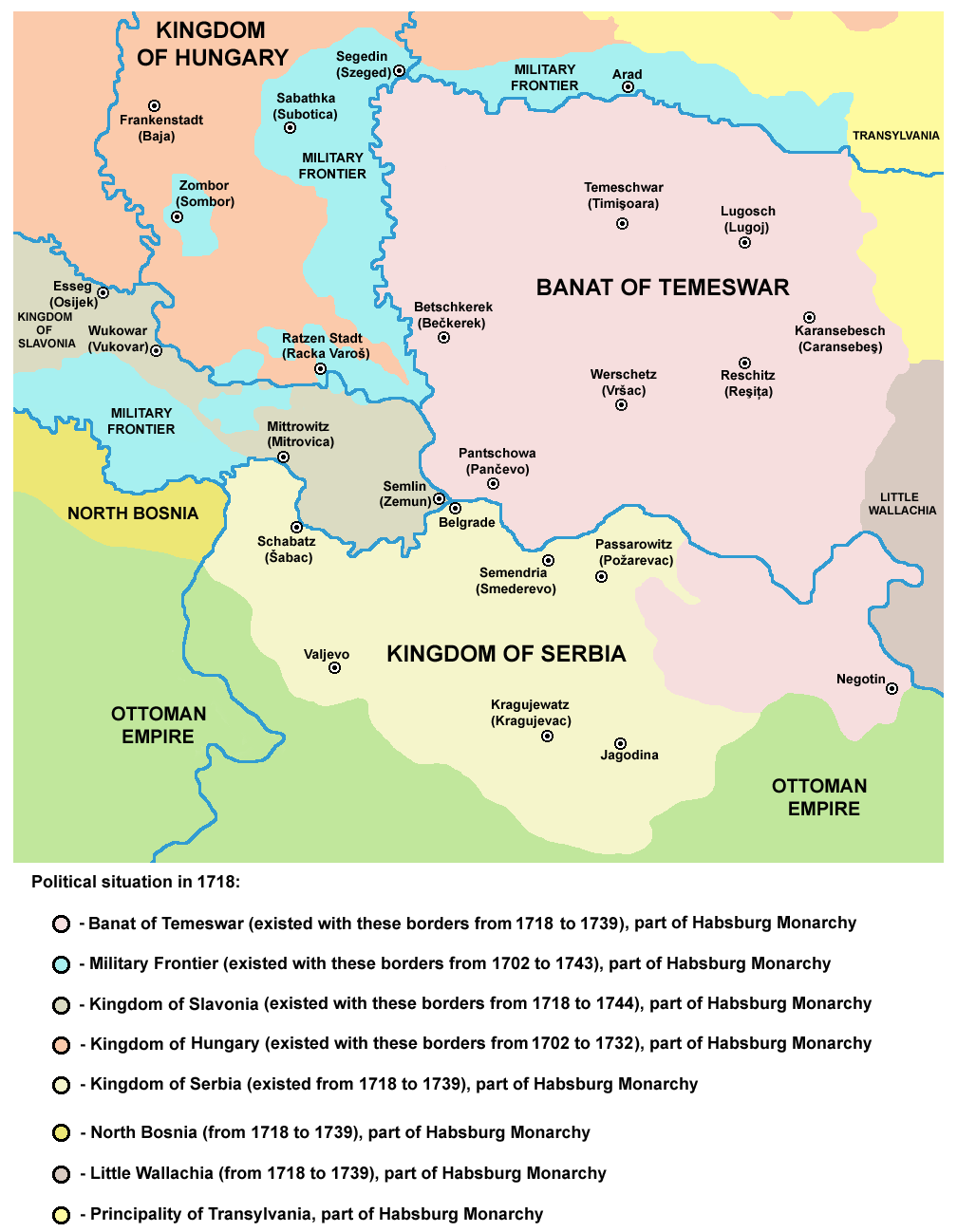
Source: Wikimedia

Mezes correctly identifies Kisilova from Frombald's report with present day Kisiljevo, and points out the differences between Kisiljevo and Medvedja in the military and governmental structure of Serbia at the time. Kisiljevo being a cameral village, and not a Hayduk village like Medvedja, the investigations of purported cases of vampirism were handled differently in these two villages. Mezes also discusses the curious circumstances related to the copy of Frombald's manuscript and other information on the case in the Viennese archives.

All this is a nice and clear exposition and synthesis of information most of which can be found in various books on the subject and on the Militärgrenze, but that is certainly not the case when it comes to the part of the thesis on Georg Tallar. Here Mezes carries out a detailed analysis and comparison of both the printed book and the original manuscript to learn more about this 'enigmatic figure', Tallar, his investigation of vampire cases and the reason why a publisher decided to print the book some thirty years after the report was written.

Tallar was part of a commission consisting of himself, a theologian, and a physician, the latter according to Mezes possibly the Protomedicus Paul Adam Kömovesch (actually: Kômûves) who is recorded to having singlehandedly investigated one case of vampirism. Mezes suggests that, perhaps, the three did not actually work together, which could perhaps explain why it was Tallar and not the Protomedicus who wrote the report. On the other hand, Mezes notes that in the manuscript there are sections of a more religious character, which are so different from the otherwise sceptical voice of Tallar, that he thinks they may originate from the hand of the (unknown) theologian: 'Every now and then, there appears a voice in the text – albeit faintly and awkwardly – which addresses issues of demonic activity and morals and their consequences.'

These parts of the manuscript were omitted when the Viennese publisher Johann Georg Möβle prepared the text for printing. In his foreword Möβle claims that he stumbled upon the manuscript by accident, but Mezes finds this improbable.

Although dated 1756, Tallar may have written it in 1753: 'hypothetically, it might be conjectured, that Tallar handed in his report to the Banat Provincial Administration in 1753, right after he finished his investigation, just as his fellow-commissioner, Kömovesch did. Then, when the Hermsdorf-scandal popped out, the central administration wanted to collect materials about vampirism and asked the Banat Administration to send all documents they have on the issue. This scenario would explain why the report is dated 1756: it was written on it when the Aulic Treasury (Hofkammer) received the document three years after the report was actually finished.'

So what prompted Möβle to publish the report some thirty years later in 1784? Mezes convincingly conjectures that news of another vampire investigation got to Vienna that year, and that the authorities once again searched their archives for material on vampires, found Tallar's manuscript, and asked Möβle to publish it. Mezes lists a number of works published by Möβle that supports his theory that Möβle not only catered for 'the public's hunger for curiosities,' but was in fact also publishing books that would serve as instructive 'governmental messages.'

As for the vampire case that prompted the publication, Mezes writes: 'In our opinion (though again, further investigation is needed), the publication of the report has something to do with another vampire scandal, one which secondary literature does not yet know of (in fact neither do we). What points nevertheless in this direction is a royal statute of Joseph II., dates 1784.11.02., in which the king warns the Orthodox Church to take active part in the fight against vampire-beliefs.'

Mezes refers to an entry in Franz Xavier Linzbauer's voluminous Codex Sanitario-medicinalis Hungariae (a book that contains other source material on vampire investigations) concerning the practice among some people of the Orthodox faith of leaving corpses unburied ('in aperta tumba') for fear of bloodsuckers ('Wampier'), a practice that may cause epidemics illnesses to spread, so the authorites found it necessary to reiterate its stance.*

Franciscus Xav. Linzbauer: Codex Sanitario-Medicinalis Hungariae Tomus III. Sectio I, p. 122 (Buda, 1853)
Apart from the theological omissions mentioned above, Mezes finds that Möβle was fairly loyal to the text of the manuscript, although he made some changes like removing Tallar's references to the local authorities that appointed him to the commission: 'By doing so, Möβle severed important roots which linked the report to its original circumstances, and at the same time managed to elevate the report to a more general level of the enlightenment fighting the forces of darkness, be they superstitions or illnesses.'

Obviously, this is highly interesting work, particularly on Tallar's investigations and the interest in vampires of the late 18th century Enlightenment. Certainly a well-written and well-researched thesis, it earned Mezes a Hanak Prize at the History Department of the CEU, and as it is written in English, it also offers those who are unable to read the German language literature on the subject a glimpse of what they are missing out on.

Thanks to Jonathan Ferguson for notifying me of this work.

*) The contemporary review of the printed edition of Tallar's report that I quoted in an earlier post, was published 'Wien am 17ten Hornung, 1784', i.e. in Vienna on February 17 1784, and if that is correct, Möβle published Tallar's report several months before the royal statute.

Sunday, 13 October 2013

Dracula: Die wahre Geschichte der Vampire

Count Dracula visits the Prunksaal in Vienna
The German documentary series Terra X on channel ZDF launched a new documentary on Dracula and vampires this evening, Dracula: Die wahre Geschichte der Vampire, which is currently available on the ZDF web site along with various information on vampire books a.o. Forensic scientist and vampire expert Mark Benecke as well as Dr. Clare Downham participate in this program that is partially narrated by Count Dracula himself as portrayed by actor Christian Baumann. The Count visits the archives in Vienna to examine the original Visum et Repertum, and we see Flückinger examine 'Arnold Paole' - even the apocryphal journey of Gerard van Swieten to Moravia is dramatized. Still, this is generally one of the best documentaries on the subject so far, including visits to Romania, London, and Vienna, where Dracula studies some of the 18th century literature on vampires in the Prunksaal next to the bust of van Swieten.

The documentary will be released on DVD and Blu-ray in early 2014.


Sunday, 25 December 2011

A Christmas Card

With the above look at part of a postcard from Freihermersdorf, I wish readers of this blog a merry christmas.

This was the site of the exhumation and cremation of several bodies suspected of posthumous magic in the winter of 1754-55. When news of the events arrived in Vienna, the court of Maria Theresa sent two prominents physicians, Wabst and Gasser, to investigate. Their report on this and similar incidents in the vicinity of Olomouc (Olmütz) led to Gerard van Swieten's famous commentaries on vampirism and the Empress' proscription of the superstitious handling of corpses.

Some years ago I spent a lot of time perusing texts and maps to locate Herm(er)sdorf. At the time not an easy task, because texts tend to only mention an approximate position, and there are more than one place that has been called something like Hermersdorf. Unfortunately, this uncertainty is also found in as recent a work as Anja Lauper's Die phantastische Seuche. Lauper follows Heiko Haumann'a opinion that Hermersdorf must be Temenice, today a part of Šumperk (in German Mährisch Schönberg) in Northern Moravia.

Haumann actually just states his opinion in a note ('Bei Hermesdorf handelt es sich vermutlich um ein Dorf bei Mährisch-Schönberg, das Heute Temenice heißt und mit Sumperk zusammengewachsen ist), adding that the research was done by Thomas Bürgisser. (Zeitschrift für Siebenbürgische Landeskunde 28 (2005) 1, p. 8)

Bernard Unterholzner, on the other hand, in his paper on the incident in Vampirismus und magia posthuma im Diskurs der Habsburgermonarchie, clearly identifies Hermersdorf as Svobodné Hermanice: 'Bei dem Ort in Oberschlesien, nahe der mährischen Grenze, handelte es sich um das heutige Svobodné Hermanice, das rund zehn Kilometer westlich von Opava liegt.' (p. 91)

Suffice it to say, it can be proved beyond doubt that Hermersdorf was Svobodné Hermanice, later on known as Freihermersdorf. In fact, if you look at other villages and towns associated with incidents of posthumous magic in the areas near Olomouc/Olmütz and Bruntál/Freudenthal, many of them are situated within a relatively small part of present day Poland and Czech Republic. E.g. just some ten kilometers to the North East you find Velké Heraltice (Groß Herrlitz), and some fifty kilometers to the South West Moravsky Beroun (Bärn) that I recently mentioned in a post on the term vampertione infecta. Both sites of the exhumation and destruction of bodies suspected of harming the living.

Sunday, 20 September 2009

Reading for autumn evenings

A little bat has been prowling outside my window lately, perhaps trying to inspire me to put other matters aside and blog more on posthumous magic.

I should at least mention - as hinted at in my previous post - a few more papers that are available online, and I would like to write a bit more about them, but that will have to wait until some other day. The first of the two online papers that I have not mentioned before is Bernhard Unterholzner's Vampire im Habsburgerreich, Schlagzeilen in Preussen: Zum Nutzen des Vampirs für politische Schmähungen which focuses on the 1755 vampire case in Hermersdorf which led to Maria Theresa prohibiting destroying corpses suspected of Magia Posthuma, and how it was treated in contemporary media. The second is Christian Reiter's analysis of the Visum et Repertum, Der Vampyr-Aberglaube und die Militärärzte, that I wrote a bit about in my original post on the conference.

If you do read German, the papers are well worth seeking out. If you only read English, the abstracts are available in that language as well.

Sunday, 21 September 2008

Hermsdorf

Nicolaus Equiamicus keeps coming up with new source material. This time it's a 1755 newspaper article from the Berlinische Priviligirte Zeitung on the vampire case from Hermsdorf in Silesia.

Friday, 4 May 2007

Gerard van Swieten commemorated

Earlier this year the Münze Österreichs, the Austrian Mint, issued a 50 Euro gold coin commemorating Gerard van Swieten (1700-1772). The coin is the first in a series called Großen Mediziner Österreichs, i.e. Great Austrian Physicians, and it seems only fitting that the first coin is dedicated to the memory of van Swieten who played a major role in developing medicine and medical education in 18th Century Austria.


However, as those of us who are interested in the history of magia posthuma of the 18th Century know, van Swieten played an important role in trying to stop the belief in magia posthuma. In a recent book on vampire slayers, Slayers and their Vampires: A Cultural History of Killing the Dead by Bruce McClelland (University of Michigan Press, 2006), he is even called "the Lowlands slayer", and it is claimed that "in 1755, Maria Theresa dispatched Van Swieten to Hermersdorf, Moravia, to investigate the postmortem treatment of a certain 'Rosina Polackin'".

However, I can find no evidence of Van Swieten playing this active role in the investigation himself.

In his written remarks on the affair and on vampirism in general, Van Swieten only mentions that the Empress sent two other physicians to investigate this case of magia posthuma: the Professor of Anatomy, Johannes Gasser, and the court physician, Christian Wabst. As has been noted by vampire historians, this was the first time physicians of this calibre were sent to investigate a vampire case, which in itself is a testament to the progress of medicine during the few decades that had passed since the famous Serbian vampire cases. It was the report of Gasser and Wabst to Empress Maria Theresa that prompted Van Swieten to write about vampires and to recommend to the Empress that she should pass a law against digging up corpses and burning them because of beliefs in magia posthuma.

The role of Van Swieten and Maria Theresa in the history of the magia posthuma has only recently been recognized in vampire books in English, no doubt aided by Gábor Klaniczay's paper on The Decline of Witches and the Rise of Vampires under the Eighteenth-Century Habsburg Monarchy which has become a standard text in the historical study of witchcraft.

Related Posts Plugin for WordPress, Blogger...