Showing posts with label Serbia. Show all posts

Sunday, 25 October 2015

After 135 years: Sava Savanovic in English

Although so many pieces of vampire fiction have been compiled and published over the past decades, Serb author Milovan Glišić’s Posle devedest godina (After 90 years), originally published in 1880, has remained elusive to readers outside of the Balkans. Until now that James Lyon, author of The Kiss of the Butterfly, has translated it into English.

Obviously, the story is from an era when authors took a particular interest in translating local folklore and etnography into fiction, and reading it reminds me vaguely of the local Danish variant of The Wise Men of Gotham, those humorous stories of foolish and incredulous people inhabiting some backwards countryside. Essentially, After 90 Years is a love story with one village stealing a bride from another village (you know, not dissimilar to Seven Brides for Seven Brothers, but on a lesser scale), that mixes in a vampire story and a lot of etnographic detail.

The vampire, the well-known Sava Savanovic that made the headlines a few years ago, haunts a watermill in Zarozje, so it has become impossible to hire a miller, for no one survives a single night in the mill: 'At dusk he was hale and whole, and at daybreak dead, with a red bruise around his neck as though strangled with a cord.' Savanovic himself appears 'with a face as red as blood', carrying 'across his shoulders a linen shroud that dropped down his back all the way to his heels,' for as Lyon says in a footnote: 'In South Slav folklore, a vampire’s power resides in its burial shroud, which it typically wears draped around its neck and shoulders. If the vampire loses this shroud, then it loses any special powers.'

It is certainly nice to finally read the story, which as a vampire story benefits from the author's wish to rely on the actual folklore instead of employing literary conventions of the type familiar from other nineteenth century vampire stories like e.g. Aleksey Tolstoy's The Family of the Vourdalak.

Andrew M. Boylan, known for his quest to watch and review any film related to vampires, supplies a foreword that explores the relationship between the story and the film adaptation, Leptirica, and Lyon himself writes about the translation, Zarozje and vampires.

Available as both a paperback and an e-book at a reasonable price, After 90 Years is worth seeking out.

Speaking of James Lyon, I would also recommend a book that has nothing to do with vampires - although he does actually mention Vlad Tepes in it: Serbia and the Balkan Front, 1914: The Outbreak of the Great War, the history of the complex political and military events on the Balkan Front before and after the outbreak of the first World War.

Monday, 21 April 2014

In search of Georg Tallar and other borderland vampire investigators

'While the belief in returning dead and the ritual/social practices related to it had already had a many-centuries-old, established tradition, it was the special relations of the borderland region [in the Southern parts of the Habsburg empire] which made them visible and problematized them for different officials of the state administration. At the same time, these same relations posed considerable difficulties for these functionaries to fulfil their respective tasks by essentially leaving them alone, baffled in the face of strange phenomena, which they nevertheless had to interpret and react to. Focusing foremost on medical experts in some form of state-service, the present essay seeks to map the power-relations of different parts of this distressing but exciting world, to which western culture’s perpetual fascination with vampirism owes its existence.'

As has so often been pointed out on this blog, despite western culture’s fascination with the subject very little has been written in English on the key events of 'vampire history', and for that reason it is very welcome to be able to point to the ’essay’ in question, which is in fact a M.A. thesis by one Adam Mezes. Supervised by Laszlo Kontler and Gabor Klaniczay, Mezes submitted his thesis, Insecure Boundaries: Medical experts and the returning dead on the Southern Habsburg borderland, at the Central European University History Department last year.

Situated in Budapest, Hungary, the History Department of the CEU according to its web site is 'the only transnational, English-language graduate school in Europe that is accredited both on the continent (in Hungary) and in the United States', it 'provides an excellent academic gateway to the history of Central, Southeastern, and Eastern Europe,' and 'offers one of the few programs in the world that effectively enables students to study comparatively the Habsburg, Romanov, and Ottoman Empires and their successor states, engaging with a variety of social, political, and cultural issues.' Its staff is multinational and multilingual, and among them we find Professor Laszlo Kontler who has a background in the European intellectual history of the early modern period and the Enlightenment. Kontler is the author of A History of Hungary: Millennium in Central Europe and the forthcoming Translations, Histories, Enlightenments: William Robertson in Germany, 1760-1795. Professor Klaniczay is affiliated with the Medieval Department of the CEU and author of, among many other papers and books, an influential article from 1987 on the Decline of Witches and Rise of Vampires in 18th Century Habsburg Monarchy that has featured prominently in the succeeding literature on 18th century witchcraft affairs.

In his thesis, Mezes focuses on the context of the vampire investigations of the 18th century, in particular those in Serbia (Kisiljevo and Medvedja) and those investigated by Georg Tallar in Banat and Oltenia. Briefly mentioning a few books on the subject, Mezes states that: 'It is visible from this brief literature overview that considerably more attention has been paid to the findings of the medical reports than to the authors themselves. The factors which influenced the way they constructed their own role and formulated their reports have not been researched in depth. Taking the studies mentioned last as a departing point, the present essay makes an attempt at applying a magnifying glass on this frontier-region and investigate the specific spheres of power and authority which shaped the formulation of the reports on vampirism. The exact mapping of these relations is a valid task, because much confusion exists even in the above mentioned literature dealing specificially with the topic of politics and vampires. It seems that basic, factual matters have to be cleared, otherwise the scholarly gaze on vampirism and state will remain hazy.'

Mezes is particularly interested in vampirism as 'a problem of ordering for Habsburg statecraft', because it was in the 18th century that various ways of governance and policing were explored and implemented in order to centralize and uniform the control of the authorities. In the borderland areas to the South, a direct control based on central institutions was employed, which had the effect that what was going on locally among the common people became more visible to the central authorities.

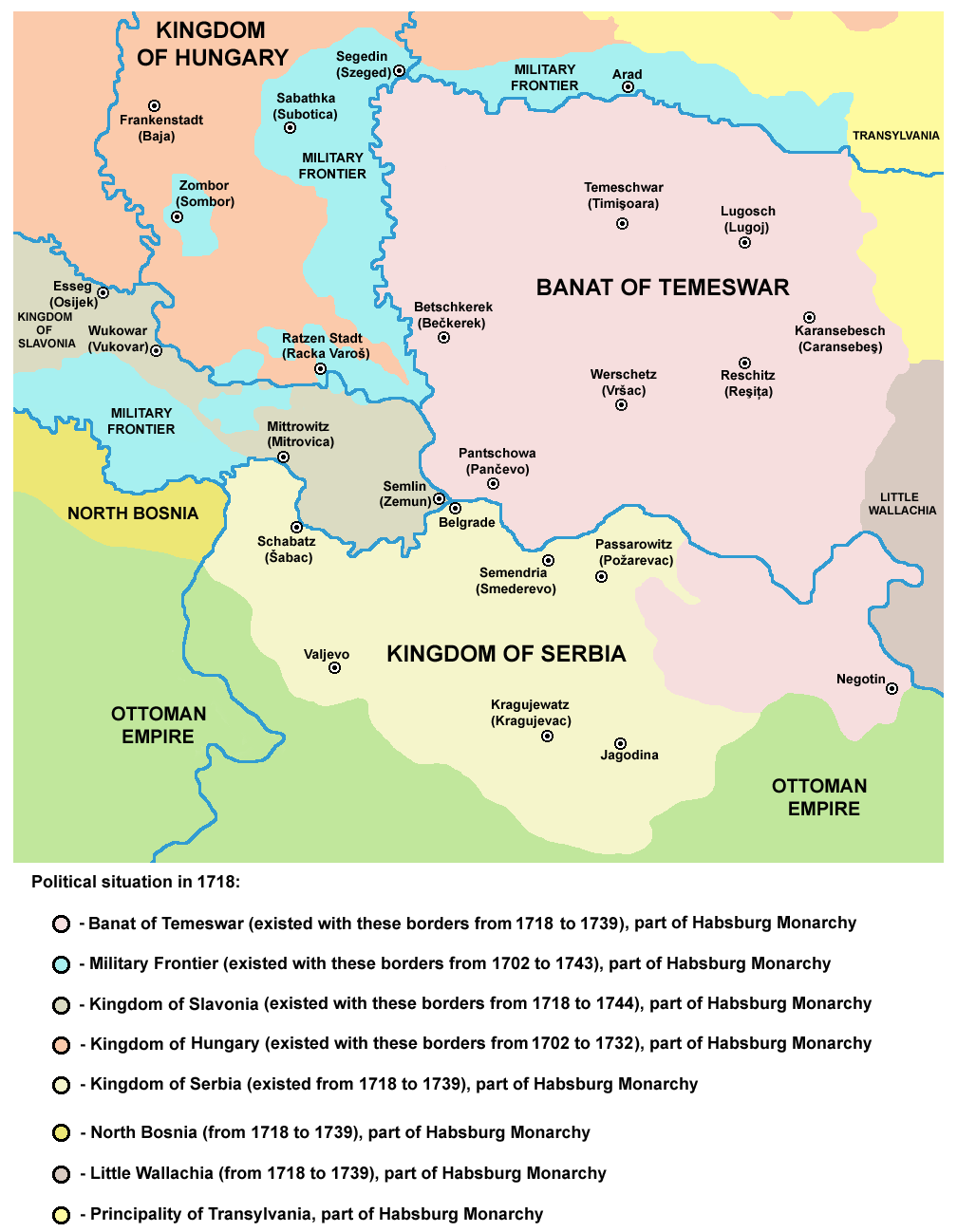
So Mezes describes the organization and development of the Militärgrenze, the military frontier in the Southeastern parts of Habsburg territory, including the military and governmental structure of Serbia in the short period that it was under Habsburg occupation. He also goes into detail with regards to the frontier's function as a plague cordon, the setting up of special quarantine stations where people were to be confined until one could be sure that they were not potential carriers of the plague miasma, and the order to report suspicious infection cases directly to the Aulic War Council.

Source: Wikimedia

Mezes correctly identifies Kisilova from Frombald's report with present day Kisiljevo, and points out the differences between Kisiljevo and Medvedja in the military and governmental structure of Serbia at the time. Kisiljevo being a cameral village, and not a Hayduk village like Medvedja, the investigations of purported cases of vampirism were handled differently in these two villages. Mezes also discusses the curious circumstances related to the copy of Frombald's manuscript and other information on the case in the Viennese archives.

All this is a nice and clear exposition and synthesis of information most of which can be found in various books on the subject and on the Militärgrenze, but that is certainly not the case when it comes to the part of the thesis on Georg Tallar. Here Mezes carries out a detailed analysis and comparison of both the printed book and the original manuscript to learn more about this 'enigmatic figure', Tallar, his investigation of vampire cases and the reason why a publisher decided to print the book some thirty years after the report was written.

Tallar was part of a commission consisting of himself, a theologian, and a physician, the latter according to Mezes possibly the Protomedicus Paul Adam Kömovesch (actually: Kômûves) who is recorded to having singlehandedly investigated one case of vampirism. Mezes suggests that, perhaps, the three did not actually work together, which could perhaps explain why it was Tallar and not the Protomedicus who wrote the report. On the other hand, Mezes notes that in the manuscript there are sections of a more religious character, which are so different from the otherwise sceptical voice of Tallar, that he thinks they may originate from the hand of the (unknown) theologian: 'Every now and then, there appears a voice in the text – albeit faintly and awkwardly – which addresses issues of demonic activity and morals and their consequences.'

These parts of the manuscript were omitted when the Viennese publisher Johann Georg Möβle prepared the text for printing. In his foreword Möβle claims that he stumbled upon the manuscript by accident, but Mezes finds this improbable.

Although dated 1756, Tallar may have written it in 1753: 'hypothetically, it might be conjectured, that Tallar handed in his report to the Banat Provincial Administration in 1753, right after he finished his investigation, just as his fellow-commissioner, Kömovesch did. Then, when the Hermsdorf-scandal popped out, the central administration wanted to collect materials about vampirism and asked the Banat Administration to send all documents they have on the issue. This scenario would explain why the report is dated 1756: it was written on it when the Aulic Treasury (Hofkammer) received the document three years after the report was actually finished.'

So what prompted Möβle to publish the report some thirty years later in 1784? Mezes convincingly conjectures that news of another vampire investigation got to Vienna that year, and that the authorities once again searched their archives for material on vampires, found Tallar's manuscript, and asked Möβle to publish it. Mezes lists a number of works published by Möβle that supports his theory that Möβle not only catered for 'the public's hunger for curiosities,' but was in fact also publishing books that would serve as instructive 'governmental messages.'

As for the vampire case that prompted the publication, Mezes writes: 'In our opinion (though again, further investigation is needed), the publication of the report has something to do with another vampire scandal, one which secondary literature does not yet know of (in fact neither do we). What points nevertheless in this direction is a royal statute of Joseph II., dates 1784.11.02., in which the king warns the Orthodox Church to take active part in the fight against vampire-beliefs.'

Mezes refers to an entry in Franz Xavier Linzbauer's voluminous Codex Sanitario-medicinalis Hungariae (a book that contains other source material on vampire investigations) concerning the practice among some people of the Orthodox faith of leaving corpses unburied ('in aperta tumba') for fear of bloodsuckers ('Wampier'), a practice that may cause epidemics illnesses to spread, so the authorites found it necessary to reiterate its stance.*

Franciscus Xav. Linzbauer: Codex Sanitario-Medicinalis Hungariae Tomus III. Sectio I, p. 122 (Buda, 1853)
Apart from the theological omissions mentioned above, Mezes finds that Möβle was fairly loyal to the text of the manuscript, although he made some changes like removing Tallar's references to the local authorities that appointed him to the commission: 'By doing so, Möβle severed important roots which linked the report to its original circumstances, and at the same time managed to elevate the report to a more general level of the enlightenment fighting the forces of darkness, be they superstitions or illnesses.'

Obviously, this is highly interesting work, particularly on Tallar's investigations and the interest in vampires of the late 18th century Enlightenment. Certainly a well-written and well-researched thesis, it earned Mezes a Hanak Prize at the History Department of the CEU, and as it is written in English, it also offers those who are unable to read the German language literature on the subject a glimpse of what they are missing out on.

Thanks to Jonathan Ferguson for notifying me of this work.

*) The contemporary review of the printed edition of Tallar's report that I quoted in an earlier post, was published 'Wien am 17ten Hornung, 1784', i.e. in Vienna on February 17 1784, and if that is correct, Möβle published Tallar's report several months before the royal statute.

Monday, 17 March 2014

Peter Plogojowitz unearthed

The extraordinary Terra X documentary Dracula: Die wahre Geschichte der Vampire, that aired on German ZDF in October last year, is now available on Blu-ray in both 3D and 2D. Although primarily a gimmick, the 3D works reasonably well, e.g. in the Prunksaal of the Austrian National Library. As a bonus, the disc includes a National Geographic documentary on the archaeological find of Irish 'vampire skeletons'.

Both documentaries are readily available on youtube, where another interesting Terra X documentary can currently be found: Draculas Schatten: Fahndung im Reich der Finsternis from 1995, which includes a retellinig of the Peter Plogojowitz/Petar Blagojewic incident and an interview with Dr. Christian Reiter who talks about anthrax as the possible cause of the deaths in Kisiljevo.


Saturday, 2 November 2013

A visit to Kisiljevo

Author James Lyon recently visited Kisiljevo in Serbia with ABC News in search of Peter Plogojowitz.


Wednesday, 24 April 2013

Kiss of the Butterfly in Print


'An exciting read ... A well-crafted mix of fact and fiction ... fascinating ... I can highly recommend Kiss of the Butterfly,' were parts of my review of James Lyon's novel. Now Kiss of the Butterfly is no longer only available as an e-book, but is now available as an illustrated paperback from e.g. Amazon.


Sunday, 21 April 2013

Harenberg: Vampire icon


It is highly unlikely that Johann Christoph Harenberg imagined that, 280 years after he originally wrote it, the title page of one his books would be sold as a poster in Italy. That, however, is what happened at the Dracula e il mito dei vampiri exhibition in Milan, and the book was, of course, Harenberg's Vernünftige und Christliche Gedancken über die Vampirs oder Bluhtsaugende Todten, published in Wolffenbüttel in 1733.

Source: Europeana
Harenberg was born on April 28 1696 in the village Langenholzen close to Alfeld in present day Lower Saxony. His parents were farmers and traders of cloth. Having given birth to four daughters, his mother prayed to God that, if God would grant her a son, she would devote him to the service of God. Besides, the young Johann Christoph was a delicate child, so he was allowed to devote his energy on learning to read, write and calculate in German as well as in Latin. At eight years of age he was sent to school in Alfeld, and at thirteen he went to Hildesheim to continue his education in various subjects and languages.

As he was walking from Alfeld to Langenholzen one Saturday in the Spring of 1708, he saw a well-dressed, old man nearby whom he recognized as a man he knew. Harenberg approached him, but he suddenly noticed that the man was transparent, and the closer he got to the man, the more transparent he became. Terrified, Harenberg retreated to his village, where he next day learned that the old man had died from consumption at about the time that he had seen the vision. This was only Harenberg's first of three encounters with apparitions in connection with the death of locals.

In 1715, at the age of nineteen he went to the University in Helmstedt to study the sciences as well as further languages. In 1719 he visited the universities in Jena and Halle, and the following year he was asked by the abbess and duchess of Gandersheim, Elisabeth Ernestine Antonie von Sachsen-Meiningen, to become headmaster of school belonging to the diocese. Besides teaching, he researched not only the Holy Writ, but also the history of the diocese. Several of his theological articles were published in the so-called Bremische Sammlungen published by Theodor Hase.

Merian's view of Gandersheim from Wikimedia
1734 was marked by ups and downs for Harenberg. He finished his voluminous history of the Gandersheim diocese, but fell into disgrace with the abbess and, although he accepted to become a parson at Bornhausen, he was finally appointed chief caretaker of the schools in the duchy of Wolfenbüttel. While there, he was in 1738 appointed a member of the Royal Prussian Academy of Sciences in Berlin. Incidentally, in 1732 this academy had been asked to write a memorandum on the Serbian vampires.

In 1745 Harenberg became Honorary Professor at the newly established Carolina collegium in Braunschweig and dean of the St. Lorenz convent in Schöningen. He died in Braunschweig on November 12 1774.

Göttingische Anzeigen von gelehrten Sachen November 26 1774, p. 1224
(He must have been 78 years of age, not 74).
Harenberg's multiple writings were mostly concerned with historical and theological topics, and particularly include a two volume book on the history of the Jesuit Order published in 1760. He was, however, also interested in other matters, like the fossil encrinus that was relatively common in Lower Saxony and also became the subject of one his shorter writings. In fact, at his death he left behind a large collection of these fossils, cf. Journal für die Liebhaber des Steinreichs und Konchyliologie Vol. II, pp. 524-7 (Weimar, 1775).

It was while he was Headmaster in Gandersheim that he wrote his book on vampires on the request of a high-ranking individual, no doubt the abbess herself. It must have been aimed at a wider audience, as it was not written in Latin like most of his other writings at the time, but in German. Postponing the publication in the hope that more examples would be published, he finished it on September 24 1732, and was consequently able to comment on a number of books on the subject that were published in the first half of that year. He also drew on his own experiences, including the above mentioned vision from his youth.

In Harenberg's view, the Serbs who claimed to be victims of vampires, probably suffered from angina (pectoris) that was caused by a) eating contaminated animal flesh, b) visiting other ill persons, and c) coming into contact with contaminated corpses. The illness then caused the blood to thicken, and as the blood began to stand still in the small vessels in the head, depression set in and the imagination malfunctioned. As the beliefs in harmful revenants were so impressed upon their imagination, the ill and their relations explained the illness, the chest pains and suffocation in terms of such vampires.

Ranft on Harenberg
Harenberg not only commented on a variety of theories that had been proposed since the publication of the Visum et Repertum, but also on subjects like werewolves. His etymology of the word 'vampire' was ridiculed by Michael Ranft in the third edition of his dissertation on the mastication of the dead. Ranft in fact ridiculed Harenberg and his efforts in general, leading to some controversy, when a review of both Harenberg's and Ranft's books were published in the supplements to the Leipzig Nova acta eruditorum, an anonymous review that was actually written by Harenberg himself. Obviously, Ranft felt obliged to vindicate himself, as years later, in 1742, he published a comment on the whole episode.

An in-depth study of Harenberg's book can be found in Anja Lauper's paper published in Begemann, Herrmann and Neumeyer's Dracula unbound: Kulturwissenschaftliche Lektüren des Vampirs (2008) and her subsequent book Die "phantastische Seuche": Episoden des Vampirismus im 18. Jahrhundert (2011).

Although it is, of course, his book and its subject that could be considered a 'vampire icon', one might still imagine a film inspired by Harenberg: His visions of the recently deceased and his considerations on the vampires could be intertwined and combined with machinations at the various courts and universities, perhaps even including some creative use of the controversy with Ranft, so that Hollywood could come up with stories of his own feverish experiences with bloodsuckers...

Geschichte Jetztlebender Gelehrten Vol. V (Zelle, 1732), pp. 94-144

Wednesday, 27 February 2013

Austria or Serbia?

Roxanne Hellman and Derek Hall's Vampire Legends and Myths published in a series of books about the supernatural in 2012 by Rosen Publishing is a very attractive book about vampires aimed at adolescent readers. It is attractive because of a variety of colour illustrations from a broad range of places and sources, a selection that reflects an unusual variety of topics, which however are somewhat marred by a lack of precision. E.g. Kisiljevo or Kisilova is described as 'an Austrian village' and the text is accompanied by a nice photo of what looks precisely like that: a village in Austria instead of a village in Serbia. At the same time, Peter Plogojowitz is clearly characterized as 'a Serbian peasant'. It is, however, still a joy to flick through the pages of this book to study a great number of photos from Romania and other places around the world.

Kisilova: 'an Austrian village'
The Morava river, and Kosovo, 'in the vicinity of which Arnold Paole was seemingly troubled by a vampire'
Voltaire and Empress Maria Theresa
'Gerard van Swieten, whose investigations put an end to vampire hysteria in Austria' (sic)

Wednesday, 23 January 2013

In Search of Peter Plogojowitz’s Grave


James Lyon, author of the excellent novel Kiss of the Butterfly, has kindly sent me this report from his recent visits to Kisiljevo. Click on the photos to see them in greater detail.

On 9 December 2012, and again on 17 January 2013, I visited the village of Kisiljevo, Serbia, the site of the first known recorded use of the word “vampire” in history, the famous case of Peter Plogojowitz from 1725. Given that Niels has already written a number of excellent posts on the topic, I write on the assumption that the reader is familiar with the case.

The purpose of the visit was two-fold: to discuss local legends of the Peter Plogojowitz case with residents, and to see if it was possible to identify the site of Peter Plogojowitz’s grave. Due to heavy snowfall on 9 December that restricted access to the graveyard, that visit was limited to interviews only. On 17 January, I returned to the graveyard after the snows had melted.

The village president, Mirko Bogičić, and author James Lyon
Although I spoke with a number of very friendly Kisiljevo residents, most were hesitant to discuss Peter Plogojowitz, and all referred me to the village (mesna zajednica) president, Mirko Bogičić, a man in his mid-50s who is also the custodian of records for the nearby municipality of Veliko Gradište, which is located further east along the Danube. Mr. Bogičić turned out to be a very warm and intelligent gentleman, who was well-versed in local history and folklore, and who is in the final phase of publishing a book on the history of Kisiljevo. He lives in a household with four generations under the same roof, a common practice in the region.

Kisiljevo used to be a river port on an arm of the Danube, but is today located on the banks of a 14-kilometer long artificial lake (Srebreno Jezero) that was dammed off in 1971 to prevent flooding along the southern banks of the river. Today the lake is a popular summer tourist resort in Serbia. Kisiljevo itself, however, has not profited from this tourism, the town’s population continues to decline, and a number of homes are abandoned and falling apart, due to lack of upkeep. Although the 2002 census listed the town as having 704 residents, that number appears optimistically high.

An abandoned home in the town centre, 
with death notices on the telephone pole 
in the foreground
Mr. Bogičić took great pride in his hometown and noted that it was first mentioned in the 14th century during the time of Serbian Prince Lazar (who lost his head at the Battle of Kosovo Polje in 1389), and again in the Ottoman census of the Branicevo district (Braničevski Defter 1467). At that time, Kisiljevo was a large and economically powerful town, with more than double the number of households of nearby Požarevac (Passarowitz). He also recounted the local legend of the origins of the town’s name, which dated to the time of the Great Plague.

In Kisiljevo, there is no surname of Plogojowitz, and no such surname exists among the South Slavs. The locals all refer to him as Petar Blagojević, and until recently there was still a Blagojević family in the village, so one must assume that Imperial Provisor Frombald used a Germanized spelling of the name in his report. The following material is transcribed from a recording I made on 9 December.

Mr. Bogičić said that “Petar Blagojević isn’t the only vampire. Here among us in Serbia, vampires are frequently spoken of. The Vlahs say ‘Drakulj’… Vojvoda Tsepes was a legendary figure, the way Kraljević Marko is with us, as a man who was dangerous in battle against the Turks. But he didn’t have vampire characteristics, such as were seen in Petar Blagojević.”

Bogičić mentioned that two women visited him from Berlin [?! sic] with photocopies of Frombald’s original report, which he could not read, as they were in a language which he assumed was German. He noted that under the Treaty of Passarowitz (Požarevac) the north of Serbia belonged to Austria and the seat of regional administration was in Veliko Gradište. But when it came to details about the Petar Blagojević case, neither he nor the other local residents appeared to have passed on much in the way of folklore about the events of 1725. Rather, it appeared as though much of the information regarding the Blagojević case was of relatively recent origin.

The Other Kisiljevo Vampire: Ruža Žapunjica

Bogičić, however, did raise an interesting point of local folklore regarding an entirely different vampire. “People also speak about an old woman who became a vampire, at least 100 years after Petar Blagojević. The old people say that an old woman, whose name was Ruža [Rose], turned into a vampire. She had the nickname of Žapunjica… The old folks called her Ruža Žapunjica, no one knows what the nickname means. She became a vampire. My great-grandmother remembered those times. She [Ruža] would make incidents in the middle of the day. She would bang around houses, climb up into the attic and begin to make noise in the middle of the day. She would throw things around in the attic of the house, and people could hear sounds, but when they went up to the attic, they couldn’t see anyone. But this was quite some time after Petar Blagojević, because my great-grandmother as a child had seen this and heard it from her parents. Those houses no longer exist; they were torn down.”


Bogičić continued: “One person – and this is very important -- saw her after she died in the early evening on the steps in front of one of the houses, even though she had long since died. That old man who saw her, died a few years ago at the age of 93. He said that he had seen Ruža Žapunjica, even though she had died over 100 years earlier, and he repeated this on television, that he had seen her figure and silhouette on the steps. This was in the 1930s, when he was a young man in his 20s, before the war. So Petar wasn’t the only one.”

The village church
“People usually don’t like to talk about that. As children we grew up on the stories of the older people about those unbelievable, unusual nighttime events, but the only incident that was actually written down was the one of Petar Blagojević. You know we have this church in our village that was built in 1825. Those people in the village who are close to the Church, who are Orthodox Christians, don’t like it when people speak about Petar. They don’t want it glorified and say that we’re speaking against Christianity. But this is something that has nothing to do with Christianity, or belief in God, or attending church, or our Orthodox customs now.” Bogičić mentioned some famous Serbian historical figures who were born in Kisiljevo, noting regretfully: “But these things are much less known, because it is truly the vampire that jumps out from Kisiljevo. Not a single church council has ever questioned or denied the vampirism that was then around”.

Death Rituals

Bogičić shared with me a number of local customs surrounding death. When a person dies, they keep a lit candle next to the body from the moment of death until the body is placed in the casket. The body is kept in the home, and someone is next to it 24 hours a day. In olden times, gold coins were placed over the eyes of the deceased, but today they use regular coins. This is so the deceased will have money for the next life. Prior to placing the body in the coffin, they conduct several ceremonies against evil spirits. These include burning incense and then igniting a small amount of gunpowder in the bottom of the coffin. The graveyard is always in a better location than the village, because they don’t want anything to disturb the dead. The Danube used to flood Kisiljevo before they built the dams, and the village graveyard is up on a high bluff overlooking the Danube.


Searching for Petar’s Grave

On 17 January 2013 I visited the Kisiljevo graveyard with Mr. Bogičić. The graveyard is located on a bluff high above the banks of Srebreno Jezero and offers a panormaic view over the lake and the island between the lake and the Danube.

Bogičić explained that that graveyard was divided into three parts. The first part consisted of the oldest graves, which predated the late 18th century. This section was entirely overgrown and the grave markers were not easily recognizable as such. The stones consist of roughly-hewn thin stone slabs made of greenish rock from a quarry further west along the Danube near Ram. None of these slabs appeared to have any trace of engravings on them, and Bogičić said that prior to the late 18th century the gravestones were not engraven with names. This is the portion of the graveyard where Petar Blagojević would have been buried. As a result, it is not possible to ascertain which grave is his. I should add, that it is impossible to ascertain which grave belongs to which family, and as a result, no one has cared for the graves.

From the oldest part of the graveyard
The second part consists of graves from the latter half of the 18th century onward, when grave markers were carved into recognizable shapes, such as crosses, or tombstones with rounded edges and engravings. This portion of the graveyard is in better shape, as people are still able to identify a gravestone with a particular family, and members of that family will continue to care for it.


The third portion of the graveyard dates largely from the early 20th century and consists of modern – sometimes elaborate – gravestones and family burial plots, usually outlined by small concrete walls about ten centimeters high. In many cases, families have taken the old pre-20th century gravestones and fixed them in concrete in the modern family burial plot.

Modern gravestones with old gravestones embedded in concrete in front of the family burial plot
In the modern part of the graveyard, I came across two plots for the Blagojević family. Bogičić told me that there are no longer any Blagojevićs in Kisiljevo.

The Blagojevic family plot
As a parting gift, Mr. Bogičić kindly presented me with a bottle of his own home-made grape brandy, which he jokingly referred to as “vampire rakija”.

Conclusion

My overall impression is that local lore related to the Peter Plogojowitz incident of 1725 has been suppressed over time by the Serbian Orthodox Church; many people feel uncomfortable discussing the matter. It seemed that although everyone knew something had happened in the distant past regarding a vampire named Petar Blagojević, no one really knew the details outside of what has been uncovered by more modern scholarship. Unlike the village of Zarožje, where local inhabitants were well versed in the legend of Sava Savanović, Kisiljevo residents seemed more aware of Ruža Žapunjica and less of Petar Blagojević. Interestingly, the characteristics associated with some of Ruža's behavior – while similar to a poltergeist – are not at all unusual for vampires in South Slavic folklore. The state of the grave markers in the old part of the graveyard is such that it seems unlikely anyone will ever be able to identify with absolute certainty the actual grave site of Petar Blagojević.

James Lyon is currently working on a sequel to The Kiss of the Butterfly.

Text and photos © James Lyon.

Sunday, 2 December 2012

Vampire Alert 2

James Lyon, author of Kiss of the Butterfly, has kindly reported more information on the subject of my previous post, cf. his comments to that post, while the story of the purported 'vampire alert' has spread to various media, including a tabloid in my own country, B.T.

The gist of the matter still seems elusive, but here is a video from the vicinity of Zarozje.


According to the Associated Press:

'Richard Sugg, a lecturer in Renaissance Studies at the UK's University of Durham and an expert on the vampire legends, said the fear could be very real. Stress can bring on nightmares, which makes people's feelings of dread even worse.

"The tourists think it is fun — and the Serbian locals think it's terrifying," he said.'


Sugg is the author of Mummies, Cannibals and Vampires: the History of Corpse Medicine from the Renaissance to the Victorians and is currently writing Faces of the Vampire: from Holy Terror to Sexual Taboo.

Sunday, 25 November 2012

Vampire Alert

According to Austrian Times on 24 November,

'Council Issues Vampire Alert

Sales of garlic are booming in western Serbia after the local council issued a public health warning that a vampire was on the loose.

The warning came after an old ruined mill said to once have been the home of the country's most famous monster in the form of vampire Sava Savanovic collapsed.

Sava Savanovic was said to have lived in the old watermill on the Rogacica river, at Zarozje village in the municipality of Bajina Basta where he drank the blood of anybody that came to mill their grain.

Source: Srbija danas

The watermill was bought by the local Jagodic family, and they were too scared to use it as a mill – but discovered it was a goldmine when they started advertising for tourists to come and visit it – always during the day.

But the family were worried about carrying out building work on the mill because they were scared they might disturb the vampire or unleash his wrath if his home was messed around with – and now the property has collapsed through lack of repair.

But for locals it has sparked rumours that the vampire is now free once again.

Local mayor Miodrag Vujetic admitted: "People are worried, everybody knows the legend of this vampire and the thought that he is now homeless and looking for somewhere else and possibly other victims is terrifying people. We are all frightened."

He added that it was all very well for people who didn't live in the area to laugh at their fears but he said nobody in the region was in any doubt that vampires do exist.

He confirmed that the local council had advised all villagers to put garlic on their doors and windows to protect them from the vampire as it was well known they can't stand the smell.

He added: "We have also reminded them to put a Holy cross in every room in the house."

Villagers who cashed in catering to tourists fascinated by the legend of Sava Savanovic say they now wish they had left the place well alone.'


Local stories on the subject can be found on Srbija danac, 24sata, and Pravda.

A member of the Jagodic family, Slobodan Jagodic, is seen in an older video on the subject below, and at the bottom is a youtube video of the Yugoslav vampire film Leptirica which is based on a story about Sava Savanovic by Serbian author Milovan Glisic.


With thanks to Mort Amsel for informing me of the news story.

Sunday, 2 September 2012

Kiss of the Butterfly


‘Something has torn apart the once-proud Yugoslavia with ease and is feasting on it’s life essence.’

In 1991 when the Yugoslav Wars were beginning to take place, Steven Roberts, a student and teaching assistant of Professor Marko Slatina in San Diego, California, is travelling to Serbia on a mysterious ethnography grant. Steven’s scholarship involves studying a large amount of books and archival material on history, folklore and ethnography. Some of it concerns Societas Draconis, the Order of the Dragon, but most of it turns out be about vampires. Studying at the National Library in Belgrade, he e.g. reads of a vampire case on the Dalmatian island of Pasman in 1403 and of vampire investigations in Dubrovnik in the 18th century.

‘The research was tedious, and his eyes grew tired easily because of the poor lighting. Sometimes he felt he could read no more. Gradually, he uncovered small pieces of what increasingly seemed to be a much larger puzzle. Some came from historical documents, while others came from collections of folk tales recorded by ethnographers… Ducic, Novak, Zovko, Klaic, Liepopili, Karadzic … the names blurred together. Everywhere he turned he found Serbian newspaper accounts of people who were arrested and tried for opening up graves and driving stakes through the hearts of suspected vampires. He had particular problems with one 15th century document written in the Glagolithic alphabet, a precursor to Cyrillic that resembled mangled bicycles, trapezoids and triangles. It took him the better part of three days to read a two page document.’

Steven is astounded by the numerous references to vampires, and their similarities. He notes that ‘these vampires were unlike anything he had ever heard of and bore scant resemblance to film versions of Dracula,’ but the amount of material prompts him to write Professor Slatina that: ‘I suspect there might have once been some phenomenon that led to the establishments of these myths. In fact, there are days when I wonder if vampires might actually have once existed.’

Other threats are, however, more imminent than vampires. In the winter of 1991-92, the secret police in Belgrade is naturally interested in an American staying in Belgrade, and when Steven finds some interesting articles by Tihomir Djordevic on vampires, strange things happen. Apart from the well-known article from 1953, Vampir i druga bica u nasem narodnom verovanju i predanju (Vampires and other beings in our folk beliefs and traditions), ‘a veritable catalogue of vampirism, scientifically organized and categorized with instructions’, Steven discovers a rare article titled The Twelve Mighty Vampires in Legend and Fact. He asks the librarian if she can help photocopy it, but the next day the librarian is ill and replaced by another librarian who refuses to let him see the article. As Steven later learns, only 100 copies were printed, and it had been placed on a restricted list prior to publication by the Yugoslavian secret police, UDBA.

Steven, however, asks a bookseller in Sremski Karlovci, south of Novi Sad, to help him get hold of a copy, while travelling with friends to Petrovaradin and Novi Sad. At the Matica Srpska library he finds more information on vampires, in particular in the work of Stefan Novakovic, ‘the scholar who had found the original Flückinger documents about the Austrian Army vampire-hunting missions in Serbia.’ Novakovic had, apparently, found more information concerning the activities of Flückinger and other Austrians. Steven also finds information relating to the subject in the archives at the Fortress in Petrovaradin which leads him and his friends on a guided tour of the underground of that Fortress.

I am not going to disclose more of the exciting plot, but obviously Steven encounters an unexpected world in Serbia. Here evil is not an abstract term: ‘In America, if I were to talk about evil as being real they would laugh me out of the university. Yet everybody I speak with here talks of evil as if it exists and is a palpable presence.’

Source: Wikimedia
And the past and the present are intertwined. The novel sets out with Vlad III, Prince of Wallachia, following the Driva River upstream between Serbia and Bosnia in February 1476, heading to Srebrenica in connection with the Battle of Sabac. In 1991 Srebrenica is again to play a role in history. Vampire folklore, the Order of the Dragon, events in 18th Century Serbia and the conflict on the Balkans in the early 1990’s all become the backdrop of a conflict that transcends centuries.

A conflict that is related to the topic of Steven’s research, vampires that are in many ways very different from those Steven had heard of in California. They are shape-shifters, but typically turn into butterflies or moths, as in the Serbian folklore, the human spirit leaves the body in the form of a butterfly.

Kiss of the Butterfly is certainly an exciting read. The backdrop of Serbia on the brink of war, the minutiae of history, geography and customs, combined with a well-crafted mix of fact in fiction in the findings of Steven’s vampire research makes it a fascinating read as well. I recommend that readers have their smartphone or computer at hand when reading it, because it will prove handy to look up places and things on maps and in dictionaries while following Steven’s exploits. Eventually, you may find inspiration for future reading and travelling.

In short, I can highly recommend James Lyon’s Kiss of the Butterfly.

Kiss of the Butterfly is available as an e-book from Amazon.

Professor Marko Slatina: 'I am interested in real vampires, Balkan vampires, and they existed long before Dracula. The answers to the questions I have posed bear no resemblance to popular imagination. To find your answers you must undertake solid, academic research. You must comb through Balkan folklore, history and ethnography. You must find what the people who actually experienced vampires have to say. Find out how peasants, priests and soldiers fought against these dreaded creatures and what they had to do to vanquish them.'

James M. B. Lyon has over 30 years experience with the Balkans and the lands of former Yugoslavia: Bosnia and Herzegovina, Croatia, Kosovo, Macedonia, Montenegro, Serbia and Slovenia. Although he calls San Diego home, he has lived and studied in Boston, Florida, Germany, the Soviet Union, and England. He has a Ph.D. in Balkan History from UCLA and has lived in the Balkans for more than 18 years, during which time he has been involved in international peacekeeping efforts and Non-Governmental Organizations, and worked as a business consultant. A well-known political analyst, at present, he divides his time between Belgrade, Sarajevo and the Dalmatian coast.

Wednesday, 14 March 2012

Fear and Servant

During the winter of 1736-37, the Devil travelled to Belgrade, Serbia, with his Serbian servant, Novak, to investigate rumours about vampires. At the same time, an Austrian commission was on their way to Belgrade to find out if vampires really exist.

However, the vampires they encounter - if they can in fact be considered vampires - are not exactly what one might expect, neither from the actual vampire cases of the period or from modern Western vampire fiction.

In fact, the whole story is as far from an attempt at recreating the period as it is a piece of ordinary vampire fiction. Rather, Mirjana Novakovic' Fear and Servant is a literary fantasy mixing history with literature, no doubt inspired by Mikhail Bulgakov's The Master & Margarita and Milovan Glisic's novel about the vampire Sava Savanovic, Posle devedeset godina from 1880. In the mix are numerous references to e.g. Melville, Shakespeare, Baum, and even the Rolling Stones (whose Sympathy for the Devil itself is perhaps inspired by Bulgakov's novel about the Devil visiting the Soviet Union).

The story is narrated by the Devil using the nom de plume Otto von Hausburg, and Princess Maria Augusta of Thurn and Taxis, the wife of Carl Alexander, Duke of Württemberg, who played his role in distributing the information about the investigation of purported vampirism in Medvedja in Serbia (cf. Hamberger, Mortuus non mordet, p. 111).

A reader in Nis in Serbia recently kindly mentioned that the novel, originally published in 2000, had been translated into English and published by Geopoetika in 2009 in a series of Serbian Prose in Translation. Obviously, Fear and Servant is not your typical vampire novel, nor is it a novel that provides much information of use for vampire research, but it is a very enjoyable and well-written novel, and as a literary experience certainly far more rewarding spending time on than Fred Vargas's Un lieu incertain.

The novel has been reprinted several times in Serbia, was awarded the Isidora Sekulic Award and a play based on it was performed in 2003 at the Kalemegdan Fortress in Belgrade where parts of the action takes place. As mentioned in an earlier post, the novel was translated into French in 2006.


Thursday, 8 March 2012

Wild Serbia - Wild Balkan

Vampire nation or not, there are other aspects of Serbia and the Balkan nations worth getting acquainted with. Yesterday German TV channel NDR aired a 2008 documentary on the incredibly diverse wildlife of Serbia, Wild Serbia - Gorges and Jackals:

'Serbia, which lies at the heart of the Balkans, is called “little Europe,” a name that does full justice to the land and its extremely varied landscapes and nature. Serbia’s breathtakingly grandiose landscapes and unique animal world are at the forefront of this journey to the most beautiful and wildest areas of the Balkan peninsula. This is presumably the sole HD documentary about nature in Serbia, Europe’s hot spot for diversity of species. Highlights are the rare shots of wild jackals and black storks.'

Fortunately, someone has uploaded the documentary to youtube. Those who are unable to understand the German narration, can take a look at the English language trailer.


Another German production available on youtube and worth watching, documents Balkan nature and wildlife as if it could have been the inspiration for J. R. R. Tolkien's Middle Earth.


Sunday, 4 March 2012

'Vampire, see Serbia'

'Vampire, see Serbia', is what you find if you look up the word Vampyr in Dr. Christian Wilhelm Hufeland's encyclopedia on apparent death, Der Scheintod, oder Sammlung der wichtigsten Thatsachen und Bemerckungen darüber, from 1808.

The entry on Serbia, which incidentally follows an entry on the apparently dead eating themselves (das Selbstverzehren der Scheintodten: 'Man hat Beispiele von Todten, welche im Sarge sich selbst zu verzehren angefangen haben sollen...'), actually carries the title: 'Servien's Scheintodten-Ereignisse', the incidents involving apparently dead persons in Serbia. The entry concerns the incidents in Medvedja in the winter of 1731-2, although here erroneously dated 1733. Hufeland states that Emperor Charles VI asked Dr. Beyer to write an analysis of the matter, which however has not been published, but was probably suppressed by the Church ('Dieses ist aber, so sehr das Publicum auch darauf wartete, niemals öffentlich bekannt gemacht und warscheinlich durch den Kaiserlichen Beichtsvater, nach dessen Sinne es nicht ausgefallen seyn mochte, unterdrückt worden').

Hufeland finds that the vampires were in fact persons who became afflicted with some local disease and were presumed dead, and consequently  prematurely buried. Well, all things considered, it is not exactly a satisfactory theory, but that is the reason why Serbia and vampires are included in Hufeland's book.

But Hufeland is not the only one to identify Serbia with vampirism, and vice versa. In a recent book, Vampire Nation: Violence as Cultural Imaginary (Duke University Press, 2011), Professor of Slavic and Comparative Literature at the University of Winsconsin, Tomislav Z. Longinovic, writes:

'Until the Bulldozer Revolution in October 2000, global media networks and the public relations industry profiled 'the serbs' as avatars of post-communist violence in the Balkans. Despite the burden of all too real war crimes committed during the 1990s in the name of collective survival of their own territorial identity, global media excessively emphasized 'the serbs' as the incarnation of an exemplary and exceptional form of evil not proper to Europe, a vision that gradually excluded this imaginary assemblage from the sphere of civilization. Despite the fact that 'the serbs' belong geographically to the very core of Europe, symbolically and territorially, their borderline position was constructed as a projection of the Eurocentric fantasy about a cruel Orient in Europe.' (p. 5-6)

'The perception of pathological fixation of Eastern Europe in general and of the Balkans in particular, on the "old centuries" voiced by Stoker at the end of the nineteenth century through the persona of Dracula* is symptomatic of a cultural vision based on an interesting intersection of local and global discourses of violence. The past and its bloody memories define a refusal to yield to modernity imputed to the countries of the Balkan region, whose resistance to civilization and its laws are naturalized as inherently evil to oppose the advances of the Enlightenment and its technologies of mediation. The narrative projected onto the vampire as a beast within, enslaved to the undying, bloody past, serves as a national fetish underlying the repressed origins of Europe proper.

A small nation such as 'the serbs' is by definition led by a mysterious, degenerate leader who is ready to sacrifice others and commit bloodshed only to prolong his political power. During the 1990s, this vision of the other Europe reinforced an imaginary relationship that extended the vampire metaphor from the realm of the Gothic period's horror genre to the mundane practice of global politics, strategically deploying violence to advance civilization and the rule of law in the Wild East of Europe. The signifier that will forever sink into historical oblivion - Yugoslavia, the proper name of the country that was erased to deny the striving of culturally heterogeneous populations to live in a common state - has been assaulted by differentialist logic of the "clash of civilization" to enforce local insecurity by bringing about a collective return to the ideology of the vampire nation.

Stoker's Dracula, which founded the literary discourse of the Gothic imaginary, appears as the incarnation of those old centuries that refuse to fade away in the face of modernizing Europe. This imaginary, sparked by a belated Romantic mourning for the glory of the past boundaries of Europe, uses violence with the automatism of the beast who has no other choice but to feed itself on the blood of others. This hungry being is always engendered in zones of intense cultural and linguistic hybridization and simultaneously is imbued with the pathos of a race submerged in the narratives of its own past and viewed as a herald of a cruel modernity at hand.

Many "national" histories written and taught in the Balkans and in the rest of "Oriental" Europe are saturated with a celebration of violence that is monumentalized as just revenge and sacrifice offered to the glory of cultural life and survival. Small nationalisms contain this imaginary economy; they appear colorful but ostensibly irrational, steeped in gore despite enlightened intentions and dominated by discourses of masculine injury that claim the victim's right to feed on the blood of others as the only way to sustain survival.' (p. 19-20)


'The discourse of stolen blood reveals how the imaginary lens crafted by Stoker persists in the West as a cultural filter that defines alterity: Eastern Europe is a location where sex and violence know no limits. The image produced in British popular culture at the end of the nineteenth century has traveled to the end of the twentieth century to establish political discourses that the U.S.-led West sustains when it deals with new yet old types of revenant nationalism: the specter of 'the serbs' as the global vampires who deserve a well-guided stake of democracy.

This Gothic vision defines the boundaries of proper identity and its civilizatoinal other within Europe, a location where bad but sharp teeth, carnage, and fornication abound. The other Europe is an extension of the notorious count's ruined castle, where excessive passions and "old centuries" conspire to halt the progress and enlightenment proper only to the superior technology of the West. One of the most symptomatic returns of this Gothic vision is the mediated emergence of 'the serbs' as a phantasm of a vampire community governed by an excess of malignant historical imagination that is alien to the values of Europe and the "civilized world."

Firmly rooted in political and cultural ideals inherited from the best European traditions of nationalism and liberalism, 'the serbs' share military rationality and territorial logic of the nation-state with Europe proper. In fact, the Yugoslav tragedies of the 1990s are a legacy of the violence that formed the foundation of modern Europe: the political and cultural ideals made flesh and blood in the uncanny law binding the nation-state. The temporal disjunction between the "other" Europe steeped in old centuries of its historical imagination and the hypermodern amnesia of the U.S.-led West is at the root of this interpellated subjectivity structuring the Gothic emergence of 'the serbs'.' (p. 10)

Europe according to USA, from Mapping Stereortypes

'The extraordinary success of Twilight among youth in the United States appears as a global symptom of chronic hunger for attention from others and a craving for freedom that, paradoxically, shrinks under an invisible yet omnipresent force based on consumption and concealed forms of violence inherent in the developed modes of the current economy. Images of vampires have persisted in popular culture as a remnant of that undying demand for the extraordinary established by the Romantics and reveal, with symptomatic ambiguity, ever more powerful yet abstinent revenants who can control their craving for the blood of the ones they love. The disgusting, corpse-like appearance of the vampire has been sublimated into beauty in Goth subcultures, lending esthetic currency to the love of death that is overcome by the ever increasing levels of consumption demanded from ordinary humans.

In fact, the global media gaze that has discovered the cradle of European violence among 'the serbs' continues to act as a stake to put other vampire nations out for good. The skill of the vampire slayer equals that of the exterminator, acting with rational violence against the irrational one of the nations deemed below civilization's dividing line. The imaginary of minor and peripheral cultures of southeastern Europe has been interpellated by the political discourse based on that gaze to produce a variety of strategies of resistance to both domestic and foreign attempts at appropriation. While 'the serbs' face up to the unflattering task of confronting the real crimes committed in their name, the sublimation of the vampire on the global entertainment scene points to the displacement of Balkan topoi to account for the return of imperial desire to its rightful source.' (p. 186-7)

'In the global landscape where the force of capital naturalizes its existence to appear as the omnipotent and invisible source of death-in-life, the vampire perhaps remains the only true face of a being lost in the speculations of Western metaphysics. Its imaginary journey from the undead creature of Balkan folklore to the antihero of Hollywood blockbusters tells the story of our post-human future, shared by the most peripheral of European cultures and the political and economic centers of the West, to account for the increasing acceptance of humanity's transformation since mass ideologies of emancipation failed in 1989. The status of the vampire in popular culture suggests that the naturalized state of predation inherent in the global order of consumption marks a transition of humanity to a new stage of development in which it gradually accepts and covertly celebrates the violence whose origins remain hidden by the ruins of Dracula's castle. The notion of the nation as an effect of bourgeois liberalism that originated in the philosophy of the Enlightenment has given birth to a vampire whose current transformations manifest a dawn of a different subjectivity, detaching itself from the nation to enter the global stage of free play, and offer a model identification that transcends humanism.

The vampire as a theoretical hybrid between political science and psychoanalysis offers a kind of lay philosophy that transcends both the model of the machine and that of the animal commonly utilized by theoreticians of the post-human. The power of this hybrid to incarnate the subjectivity to come builds on the conventions that, in previous centuries, posited the vampire as the opponent of the common human subject. The precognition inherent in the imaginary flights of popular culture speaks the truth about a political unconscious that has found its incarnation in both the phantasm of 'the serbs' as a vampire nation and the vampire as a new model for the global order of being - an order that is all too (post)human.' (p. 188-9)

I have only dipped into this complex, and I think it fair to say: far from easy to read book, so in the words of another blogger I will be cautious when commenting on Vampire Nation: 'I will let others more knowledgeable than I opine on how successfully Longinović applies critical theory to historical analysis. In any case his book makes a provocative addition to the literature on the Yugoslav wars.'

The popular and globalized vampire of Western fiction is, of course, probably as popular in Serbia as in so many other parts of the world, so there is even a Vampires Serbia magazine containing photos of the stars from Twilight and other vampire films and TV series. We love Twilight, we love True Blood, and we love The Vampire Diaries in Serbia as well.

*) Longinovic refers to Jonathan Harker's diary in Stoker's Dracula where Harker while in Dracula's castle writes: 'It is the nineteenth century up-to-date with a vengeance. And yet, unless my senses deceive me, the old centuries had, and have powers of their own which mere "modernity" cannot kill.'
Related Posts Plugin for WordPress, Blogger...