Showing posts with label Banat. Show all posts

Monday, 21 April 2014

In search of Georg Tallar and other borderland vampire investigators

'While the belief in returning dead and the ritual/social practices related to it had already had a many-centuries-old, established tradition, it was the special relations of the borderland region [in the Southern parts of the Habsburg empire] which made them visible and problematized them for different officials of the state administration. At the same time, these same relations posed considerable difficulties for these functionaries to fulfil their respective tasks by essentially leaving them alone, baffled in the face of strange phenomena, which they nevertheless had to interpret and react to. Focusing foremost on medical experts in some form of state-service, the present essay seeks to map the power-relations of different parts of this distressing but exciting world, to which western culture’s perpetual fascination with vampirism owes its existence.'

As has so often been pointed out on this blog, despite western culture’s fascination with the subject very little has been written in English on the key events of 'vampire history', and for that reason it is very welcome to be able to point to the ’essay’ in question, which is in fact a M.A. thesis by one Adam Mezes. Supervised by Laszlo Kontler and Gabor Klaniczay, Mezes submitted his thesis, Insecure Boundaries: Medical experts and the returning dead on the Southern Habsburg borderland, at the Central European University History Department last year.

Situated in Budapest, Hungary, the History Department of the CEU according to its web site is 'the only transnational, English-language graduate school in Europe that is accredited both on the continent (in Hungary) and in the United States', it 'provides an excellent academic gateway to the history of Central, Southeastern, and Eastern Europe,' and 'offers one of the few programs in the world that effectively enables students to study comparatively the Habsburg, Romanov, and Ottoman Empires and their successor states, engaging with a variety of social, political, and cultural issues.' Its staff is multinational and multilingual, and among them we find Professor Laszlo Kontler who has a background in the European intellectual history of the early modern period and the Enlightenment. Kontler is the author of A History of Hungary: Millennium in Central Europe and the forthcoming Translations, Histories, Enlightenments: William Robertson in Germany, 1760-1795. Professor Klaniczay is affiliated with the Medieval Department of the CEU and author of, among many other papers and books, an influential article from 1987 on the Decline of Witches and Rise of Vampires in 18th Century Habsburg Monarchy that has featured prominently in the succeeding literature on 18th century witchcraft affairs.

In his thesis, Mezes focuses on the context of the vampire investigations of the 18th century, in particular those in Serbia (Kisiljevo and Medvedja) and those investigated by Georg Tallar in Banat and Oltenia. Briefly mentioning a few books on the subject, Mezes states that: 'It is visible from this brief literature overview that considerably more attention has been paid to the findings of the medical reports than to the authors themselves. The factors which influenced the way they constructed their own role and formulated their reports have not been researched in depth. Taking the studies mentioned last as a departing point, the present essay makes an attempt at applying a magnifying glass on this frontier-region and investigate the specific spheres of power and authority which shaped the formulation of the reports on vampirism. The exact mapping of these relations is a valid task, because much confusion exists even in the above mentioned literature dealing specificially with the topic of politics and vampires. It seems that basic, factual matters have to be cleared, otherwise the scholarly gaze on vampirism and state will remain hazy.'

Mezes is particularly interested in vampirism as 'a problem of ordering for Habsburg statecraft', because it was in the 18th century that various ways of governance and policing were explored and implemented in order to centralize and uniform the control of the authorities. In the borderland areas to the South, a direct control based on central institutions was employed, which had the effect that what was going on locally among the common people became more visible to the central authorities.

So Mezes describes the organization and development of the Militärgrenze, the military frontier in the Southeastern parts of Habsburg territory, including the military and governmental structure of Serbia in the short period that it was under Habsburg occupation. He also goes into detail with regards to the frontier's function as a plague cordon, the setting up of special quarantine stations where people were to be confined until one could be sure that they were not potential carriers of the plague miasma, and the order to report suspicious infection cases directly to the Aulic War Council.
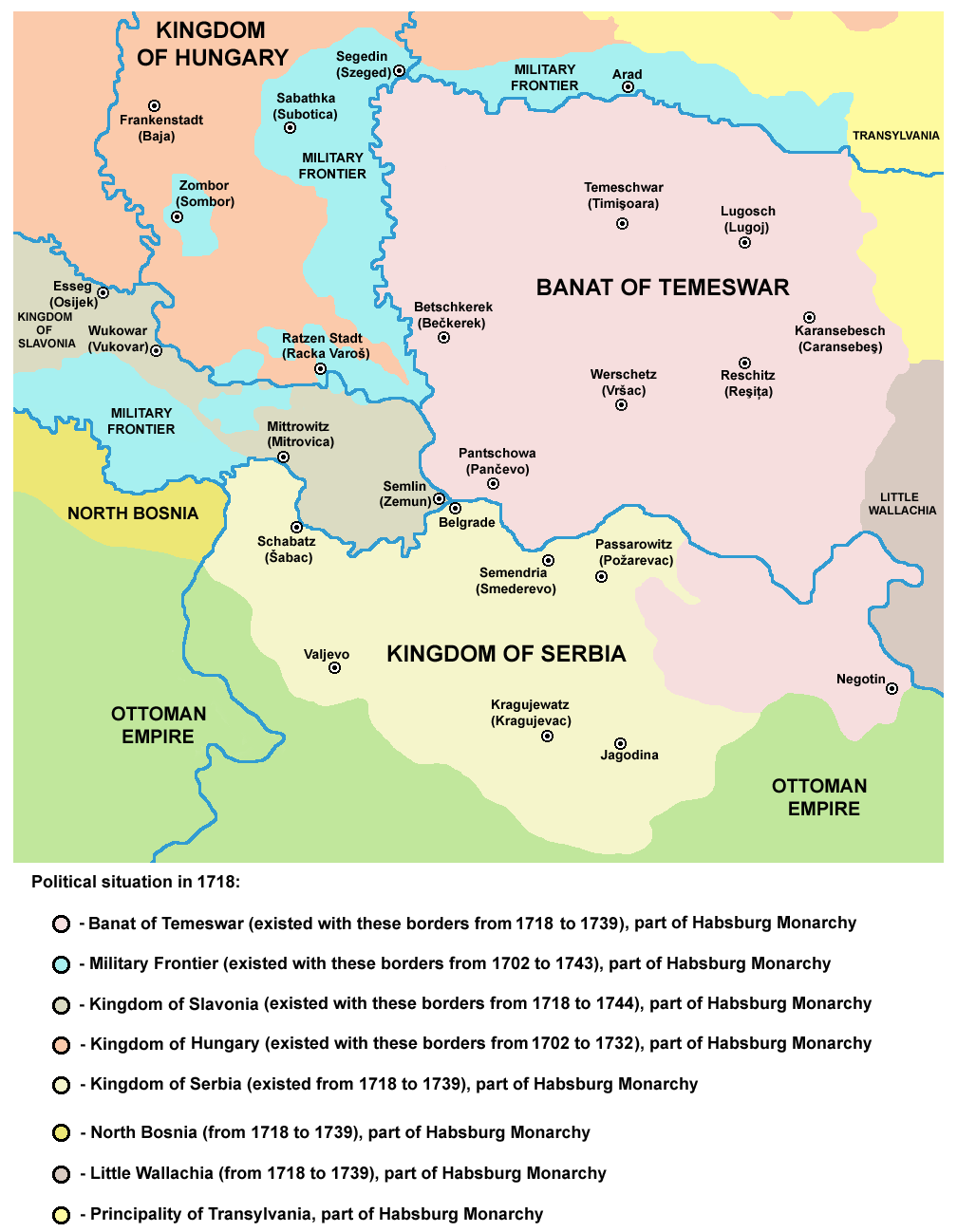
Source: Wikimedia

Mezes correctly identifies Kisilova from Frombald's report with present day Kisiljevo, and points out the differences between Kisiljevo and Medvedja in the military and governmental structure of Serbia at the time. Kisiljevo being a cameral village, and not a Hayduk village like Medvedja, the investigations of purported cases of vampirism were handled differently in these two villages. Mezes also discusses the curious circumstances related to the copy of Frombald's manuscript and other information on the case in the Viennese archives.

All this is a nice and clear exposition and synthesis of information most of which can be found in various books on the subject and on the Militärgrenze, but that is certainly not the case when it comes to the part of the thesis on Georg Tallar. Here Mezes carries out a detailed analysis and comparison of both the printed book and the original manuscript to learn more about this 'enigmatic figure', Tallar, his investigation of vampire cases and the reason why a publisher decided to print the book some thirty years after the report was written.

Tallar was part of a commission consisting of himself, a theologian, and a physician, the latter according to Mezes possibly the Protomedicus Paul Adam Kömovesch (actually: Kômûves) who is recorded to having singlehandedly investigated one case of vampirism. Mezes suggests that, perhaps, the three did not actually work together, which could perhaps explain why it was Tallar and not the Protomedicus who wrote the report. On the other hand, Mezes notes that in the manuscript there are sections of a more religious character, which are so different from the otherwise sceptical voice of Tallar, that he thinks they may originate from the hand of the (unknown) theologian: 'Every now and then, there appears a voice in the text – albeit faintly and awkwardly – which addresses issues of demonic activity and morals and their consequences.'

These parts of the manuscript were omitted when the Viennese publisher Johann Georg Möβle prepared the text for printing. In his foreword Möβle claims that he stumbled upon the manuscript by accident, but Mezes finds this improbable.

Although dated 1756, Tallar may have written it in 1753: 'hypothetically, it might be conjectured, that Tallar handed in his report to the Banat Provincial Administration in 1753, right after he finished his investigation, just as his fellow-commissioner, Kömovesch did. Then, when the Hermsdorf-scandal popped out, the central administration wanted to collect materials about vampirism and asked the Banat Administration to send all documents they have on the issue. This scenario would explain why the report is dated 1756: it was written on it when the Aulic Treasury (Hofkammer) received the document three years after the report was actually finished.'

So what prompted Möβle to publish the report some thirty years later in 1784? Mezes convincingly conjectures that news of another vampire investigation got to Vienna that year, and that the authorities once again searched their archives for material on vampires, found Tallar's manuscript, and asked Möβle to publish it. Mezes lists a number of works published by Möβle that supports his theory that Möβle not only catered for 'the public's hunger for curiosities,' but was in fact also publishing books that would serve as instructive 'governmental messages.'

As for the vampire case that prompted the publication, Mezes writes: 'In our opinion (though again, further investigation is needed), the publication of the report has something to do with another vampire scandal, one which secondary literature does not yet know of (in fact neither do we). What points nevertheless in this direction is a royal statute of Joseph II., dates 1784.11.02., in which the king warns the Orthodox Church to take active part in the fight against vampire-beliefs.'

Mezes refers to an entry in Franz Xavier Linzbauer's voluminous Codex Sanitario-medicinalis Hungariae (a book that contains other source material on vampire investigations) concerning the practice among some people of the Orthodox faith of leaving corpses unburied ('in aperta tumba') for fear of bloodsuckers ('Wampier'), a practice that may cause epidemics illnesses to spread, so the authorites found it necessary to reiterate its stance.*

Franciscus Xav. Linzbauer: Codex Sanitario-Medicinalis Hungariae Tomus III. Sectio I, p. 122 (Buda, 1853)
Apart from the theological omissions mentioned above, Mezes finds that Möβle was fairly loyal to the text of the manuscript, although he made some changes like removing Tallar's references to the local authorities that appointed him to the commission: 'By doing so, Möβle severed important roots which linked the report to its original circumstances, and at the same time managed to elevate the report to a more general level of the enlightenment fighting the forces of darkness, be they superstitions or illnesses.'

Obviously, this is highly interesting work, particularly on Tallar's investigations and the interest in vampires of the late 18th century Enlightenment. Certainly a well-written and well-researched thesis, it earned Mezes a Hanak Prize at the History Department of the CEU, and as it is written in English, it also offers those who are unable to read the German language literature on the subject a glimpse of what they are missing out on.

Thanks to Jonathan Ferguson for notifying me of this work.

*) The contemporary review of the printed edition of Tallar's report that I quoted in an earlier post, was published 'Wien am 17ten Hornung, 1784', i.e. in Vienna on February 17 1784, and if that is correct, Möβle published Tallar's report several months before the royal statute.

Sunday, 15 September 2013

A surgeon's eyewitness accounts from Transylvania and Wallachia


Most of what was written on vampires in the eighteenth century consisted of commentaries on either a very small corpus of eyewitness accounts from officials of the Habsburg authorities or the Catholic Church or of various tales of vampires and revenants from around Europe. The most careful and comprehensive study based on first hand examinations of both those who complained of being attacked by a bloodsucker and of the bodies of the suspected vampires, was written in 1756 by a regimental surgeon, Georg Tallar.

Tallar was born in Mainz around 1700, and studied medicine there and in Straβburg. He then pursued a career as a surgeon and physician in the Habsburg army for more than thirty years, serving in Transylvania, Wallachia and the Banat. As Tallar mastered the local languages of those regions, he was not only able to discuss the subject of vampires first hand with the people who actually believed in them.

The new edition of Tallar's book and two pages from the manuscript shown in the Dracula. Woiwode und Vampir exhibition catalogue

Tallar witnessed five incidents in which people claimed to be attacked by vampires – or actually: Moroi – and in three cases he was himself involved in examining those who were ill as well as the corpses that were exhumed. He had actually even known some of those who, after their demise, were suspected of being bloodsuckers.

The Wallachians who were ill and claimed to have been attacked by a bloodsucker, told Tallar that they had been in bed for a couple of days, and that their heart hurt. When asked where the heart sits, they pointed, not to the heart, but to the stomach and the intestines. They said that, whenever they tried to fall asleep, the bloodsucker appeared in the shape of this or that deceased man or woman, standing in front of them or in a corner. Some said that they saw the bloodsucker when they were asleep, but many of the afflicted actually saw nothing. Still, they believed that it was necessary to open the graves to look for the Moroi. Although exhuming and destroying corpses was prohibited by law, they were willing to break the law to seek out and destroy the bloodsucker. In fact, people were so afraid of falling prey to the vampire, that they dared not walk about after dark.

Examining them, Tallar found that they complained from pains and aches in various part of the body, including strong headaches, and that their tongue would turn first pale and then become brownish red and dry as wood. They were very thirsty, and had a faint and erratic pulse.

In each case, only Wallachians were affected by the bloodsucker, whereas neither soldiers, German settlers, nor local Serbs became ill, so Tallar concluded that the Wallachians did not suffer from an epidemic, but rather an endemic disease. Considering the traits of the Wallachians, he concluded that the food eaten by them, especially during the fasts that they fanatically observed during Winter - consisting of e.g. cabbage, garlic, and sauerkraut - was the cause of the disease. In fact, administering a simple vomitive often cured the diseased!

Tallar also discusses various beliefs concerning the dead and their graves, refuting the beliefs and providing various natural causes for the phenomena. He e.g. refutes the belief that the bloodsuckers are more harmful on Saturdays, by exhuming and examining the corpses on various days of the week, showing that the state of the corpses were independent of the day of the week.

Overall, Tallar is an exemplar of the medical enlightened man, emphasizing – like Gerard van Swieten – the lack of education among the Wallachians, while at the same time mentioning that they are not so stupid not to accept his medical remedies against the disease, when they notice that people get cured.

From Medicinische Jahrbücher des kaiserl. königl.
österreichischen Staates
 Band 56 (Wien, 1846)
Tallar wrote his Visum-Repertum Anatomico-Chirurgicum after the vampire incident in Hermersdorf that prompted Empress Maria Theresa to stop the burning of corpses associated with magia posthuma, but his manuscript was left unpublished for almost thirty years, until the Viennese publisher Johann Georg Möβle came upon it and decided to publish it in 1784.

A reviewer in the Viennese Realzeitung für das Jahr 1784, expressed the wish that Tallar had used his proficiency in the Wallachian language to publish his observations on the matter in that tongue. Excerpts from the book turned up in Johann Dionis John’s Lexikon der K. K. Medizinalgeseze in 1790, and in an article in the Medicinische Jahrbücher des kaiserl. Königl. Österreichischen Staates in 1846.

Now, almost 250 years after its first publication, Tallar’s book has been reprinted by Nicolaus Equiamicus in a slim volume that replaces Möβle’s introduction by a new one by Equiamicus, and adds a few explanatory footnotes, while slightly updating the language of the original. Tallar’s original is readily available online (see my list of links), but Equiamicus is to be commended for providing us with a handy edition of this essential text on vampire beliefs. And it is available for just €7.90.

Sunday, 28 June 2009

Flea market finds

Yesterday I went to a local flea market and came back home with a book of manuscripts from Carl Th. Dreyer's Vampyr and three other of his movies, as well as a 1963 Atlas zur Weltgeschichte. All for the price of approximately 2 Euros.

Below I have scanned two maps from the latter book, and you can click on them to view them in more detail.

The first scan is of a map of Hungary after the wars with the Ottomans. At the bottom is the extent of occupied areas between 1717 and 1739, including the areas of Serbia of particular interest to this blog. The Southern border, cf. earlier posts like this, this, and this, is here shown a few kilometers south of the Zapadna Morava and Krusevac (Kruschewatz).

To the East in Siebenbürgen (Transylvania) you find several places known from Stoker's Dracula, like Bistritz, and to the West is Steiermark (Styria) the scene of Le Fanu's Carmilla. Here is also Krain, the subject of Johann Weichard von Valvasor's Die Ehre des Hertzogthums Crain.

To the North West is Vienna and the Southern part of Mähren (Moravia). And North of Serbia Banat Temesvar, also the scene of some instances of vampirism in the 18th century. So there is really a lot of interesting locations and information shown in this map.

The second one is a map of Vienna ca. 1800. Much easier to take in than a map of modern day Vienna.

Friday, 5 June 2009

Maps

I have been looking at a number of maps from the 18th century recently, and I noticed a nice online map of Northern Serbia around the time of the conquest of Belgrade in 1717. You will need a plugin for your browser to study the map.

The location of Medvedja, unfortunately, is just outside the map, but you can clearly see Gradiska and Ram in the vicinity of Kisiljevo by the Danube East of Belgrade. Then there is Ban(n)at, also the site of vampire cases as recorded by e.g. Ignaz von Born and Georg Tallar.

In the North Eastern corner you will find Lugos (Lugoj), the birthplace of Béla Ferenc Dezső Blaskó AKA Bela Lugosi.

Monday, 16 July 2007

Von Born's Curious account

I mentioned Ignaz von Born and his letters on Banat in a recent post. Although his Briefe über mineralogische Gegenstände auf seiner Reise durch das Temeswarer Bannat, Siebenbürgen, Ober- und Niederhungarn, an den Herausgeber derselben, J. J. Ferber, geschrieben, does not contain much material on vampires, it is an interesting read because of its general description of the customs of the people in the area, where a few known cases of Magia Posthuma took place.

The online edition of the Allgemeine deutsche Bibliothek contains a review by P. D. Giseke of the Briefe from 1777, in which Giseke notes that:

"So klein auch die Zahl der Seiten ist (und auf Einer Reise drey und zwanzig solche Briefe zu schreiben, ist in der That genug:) so voll Merkwürdigkeiten sind sie." (As small as the number of pages is (and to write twenty three letters like these on one journey should suffice), as full of curiosities they are).

Giseke mainly discusses the mineralogical content of the book, but briefly comments on the wildness of the customs of the people living in Banat:

"Sollten die Stubenphilosophen es wohl glauben, daß in Europa Leute gefunden würden, die so malabarisch dächten, daß sie Sonnenfinsternisse für Streite des hollischen Drachen mit der Sonne halten? - Hr. v. B. hat sie im Temeswarer Bannat gefunden." (Should the parlour philosophers really believe that in Europe people could be found, whose thinking is so wild, that they believe that the solar eclipse is caused by a hellish dragon fighting the sun? Mr. von Born has found them in the Banat of Temeswar).

Ignaz von Born
A very nice paper has been written on Born and his Briefe by Alex Drace-Francis: A Provincial Imperialist and a Curious Account of Wallachia in European History Quarterly vol. 36 (2006), p. 61-89. Drace-Francis is particularly interested in how 'East European' areas, in particular those of present day Romania, were represented by Born and other writes. From the above quote, it is quite obvious that some of them were considered as wild, superstititious, and uneducated. He traces von Born's journey, and the various editions of his Briefe and finds that:

"The Habsburgs' conquest, colonization, exploitation and representation of their south-eastern frontier is, I argue, best understood not as part of a process of defining Eastern Europe, nor as a 'semi-' or 'para' imperial enterprise, but one that bears legitimate comparison with colonial experiences elsewhere."

It is, I hope, obvious that this is interesting for us who wish to understand the context of the Magia Posthuma. The cases of vampirism reported to the Vienna court of Charles VI and Maria Theresa usually took place on the borders of the empire, in the military buffer zones occupied by Austrian military forces or in mining towns, so in most cases we have encounters between representatives of the empire and the locals and their beliefs. The curiosity about these parts of Europe was increasing in these years, travelogues were avidly read. This included an anonymous and abridged version of Born's Briefe published in London in 1779 under the title A very entertaining, comical and curious account of the manners and customs of the inhabitants of Wallachia, with a particular description of that country.

The word 'entertaining' is telling, because entertainment and amusement were very important to the people of that day. Even many of the more learned periodicals of the 17th and 18th centuries aimed to entertain, and it is to some extent in that context that we should see the printing of news on vampires and other curiosities in a number of these journals. In fact, a reviewer of von Born's Briefe even reminds his readers of the old Horatian dictum "Omne tulit punctum, qui miscuit utile dulci." (He gets every vote, who mixes the useful with the pleasant).

Anyway, Drace-Francis finds that Born's representation of the people of Banat should be seen in the light of a tension between province and empire. He finds that there are some similarities between Born's work and that of contemporary German scholars who define Jews and Gypsies in what we term as a racist way, but he ensures us that "it would be reductive to identify him with any movement towards theories of immutable ethnic distinction."

Although Austria considered taking over more areas of present day Romania, it seems that Maria Theresa decided not to. Drace-Francis quotes her for this view:

"Unhealthy provinces, without culture, depopulated or inhabited by perfidious and ill-intentioned Greeks, would be more likely to exhaust than to augment the forces of the monarchy."

One would, in fact, also think that she had plenty to do with reforming the empire than to expand it with further "malabarisch" people and their outlandish beliefs in e.g. vampires and revenants.

Sunday, 8 July 2007

Mozart related trivia

Oh well, June passed by quickly and there were so many other things on my mind, that I didn't get around to writing much in this blog. Perhaps there will be time for a few more entries this month? Certainly, I keep searching for new material and studying various sources for information on the Magia Posthuma, so the lack of new posts only reflects that I have had to concentrate on other matters than writing Magia Posthuma posts.

Anyway, here is a bit of trivia that can relate Wolfgang Amadeus Mozart (1756-1791) to persons who are somehow relevant to the history of Magia Posthuma.

Viewers of Amadeus may have noticed a sensible character at the court of Emperor Joseph II called Baron van Swieten who is played by Jonathan Moore in the film version. This van Swieten was the son of Gerard van Swieten whose name should be well known to readers of this blog because he played a key role in establishing the Austrian law against Magia Posthuma put forth by Maria Theresa. Joseph II himself was, of course, the son of Maria Theresa.

Amadeus: Baron van Swieten and SalieriThe baron van Swieten was a patron of many composers in Vienna of that day, including Haydn and Mozart. His full name was Gottfried van Swieten, and he lived from 1733 to 1803. His name and legacy is commemorated today by e.g. The Van Swieten Society. The photo above is from Amadeus with van Swieten in the background and F. Murray Abraham as Salieri in the foreground.
Ignaz von Born Another link between Magia Posthuma and Mozart is Ignaz von Born (1742-1791) who was an Austrian mineralogist. He traveled through Banat, parts of present day south western Romania, researching mining and mineralogy, and wrote letters about his findings in 1770. The letters were published in 1774 as Briefe über Mineralogische Gegenstände. Some of the letters describe the habits and culture of the people living in the area. Here von Born includes a short description of burial practices carried out to prevent the dead from returning as vampires:

"Man scharrt ihn [den Todten] ein, setzt ihm ein Kreutz und einen großen Stein zum Kopfe, damit er kein Blutsäuger (Vampyr) werde, gießet Wein und räuchert um das Grab, um die Unholden und Zauberer zu vertreiben, und dann geht man nach Hause." (They scratch the corpse and put a cross on him and a big stone on his head to prevent him from becoming a bloodsucker (vampire), pour wine and burn incense around the grave to drive away witches and sorcerers, and then they go home.)

Like Mozart, von Born was a freemason and is usually considered to be the inspiration for the character Sarastro in Mozart's famous opera The Magic Flute.

On his travels Mozart also visited places that play a role in the history of the Magia Posthuma, e.g. Olomouc (Olmütz), where 11 year old Mozart got infected with smallpox in 1767, just 12 years after Viennese court physicians investigated a case of Magia Posthuma in the vicinity. It was also at Olomouc that Karl Ferdinand von Schertz published his Magia Posthuma.

So Mozart obviously lived an age when vampires were not quite a terror from the past. In fact, it seems that an author of popular fiction even has imagined Mozart as a vampire. In I, Vampire by Michael Romkey, not only Mozart turns out to be a vampire, the same goes for Cesare Borgia and Hitler!
Related Posts Plugin for WordPress, Blogger...