I mentioned
Ignaz von Born and his letters on Banat in a recent
post. Although his
Briefe über mineralogische Gegenstände auf seiner Reise durch das Temeswarer Bannat, Siebenbürgen, Ober- und Niederhungarn, an den Herausgeber derselben, J. J. Ferber, geschrieben, does not contain much material on vampires, it is an interesting read because of its general description of the customs of the people in the area, where a few known cases of Magia Posthuma took place.
The online edition of the
Allgemeine deutsche Bibliothek contains a
review by P. D. Giseke of the
Briefe from 1777, in which Giseke notes that:
"So klein auch die Zahl der Seiten ist (und auf Einer Reise drey und zwanzig solche
Briefe zu schreiben, ist in der That genug:) so voll Merkwürdigkeiten sind sie." (As small as the number of pages is (and to write twenty three letters
like these on one journey should suffice), as full of curiosities they are).
Giseke mainly discusses the mineralogical content of the book, but briefly comments on the wildness of the customs of the people living in Banat:
"Sollten die Stubenphilosophen es wohl glauben, daß in Europa Leute gefunden würden, die so malabarisch dächten, daß sie Sonnenfinsternisse für Streite des hollischen Drachen mit der Sonne halten? - Hr. v. B. hat sie im Temeswarer Bannat gefunden." (Should the parlour philosophers really believe that in Europe people could be found, whose thinking is so wild, that they believe that the solar eclipse is caused by a hellish dragon fighting the sun? Mr. von Born has found them in the Banat of Temeswar).
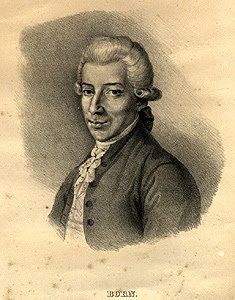
A very nice paper has been written on Born and his
Briefe by
Alex Drace-Francis:
A Provincial Imperialist and a Curious Account of Wallachia in
European History Quarterly vol. 36 (2006), p. 61-89. Drace-Francis is particularly interested in how 'East European' areas, in particular those of present day Romania, were represented by Born and other writes. From the above quote, it is quite obvious that some of them were considered as wild, superstititious, and uneducated. He traces von Born's journey, and the various editions of his
Briefe and finds that:
"The Habsburgs' conquest, colonization, exploitation and representation of their south-eastern frontier is, I argue, best understood not as part of a process of defining Eastern Europe, nor as a 'semi-' or 'para' imperial enterprise, but one that bears legitimate comparison with colonial experiences elsewhere."It is, I hope, obvious that this is interesting for us who wish to understand the context of the Magia Posthuma. The cases of vampirism reported to the Vienna court of Charles VI and Maria Theresa usually took place on the borders of the empire, in the military buffer zones occupied by Austrian military forces or in mining towns, so in most cases we have encounters between representatives of the empire and the locals and their beliefs. The curiosity about these parts of Europe was increasing in these years, travelogues were avidly read. This included an anonymous and abridged version of Born's
Briefe published in London in 1779 under the title
A very entertaining, comical and curious account of the manners and customs of the inhabitants of Wallachia, with a particular description of that country.
The word
'entertaining' is telling, because entertainment and amusement were very important to the people of that day. Even many of the more learned periodicals of the 17th and 18th centuries aimed to entertain, and it is to some extent in that context that we should see the printing of news on vampires and other curiosities in a number of these journals. In fact, a reviewer of von Born's
Briefe even reminds his readers of the old Horatian dictum
"Omne tulit punctum, qui miscuit utile dulci." (He gets every vote, who mixes the useful with the pleasant).
Anyway, Drace-Francis finds that Born's representation of the people of Banat should be seen in the light of a tension between province and empire. He finds that there are some similarities between Born's work and that of contemporary German scholars who define Jews and Gypsies in what we term as a racist way, but he ensures us that
"it would be reductive to identify him with any movement towards theories of immutable ethnic distinction."Although Austria considered taking over more areas of present day Romania, it seems that
Maria Theresa decided not to. Drace-Francis quotes her for this view:
"Unhealthy provinces, without culture, depopulated or inhabited by perfidious and ill-intentioned Greeks, would be more likely to exhaust than to augment the forces of the monarchy."
One would, in fact, also think that she had plenty to do with reforming the empire than to expand it with further
"malabarisch" people and their outlandish beliefs in e.g. vampires and revenants.
 I have been looking at a number of maps from the 18th century recently, and I noticed a nice online map of Northern Serbia around the time of the conquest of Belgrade in 1717. You will need a plugin for your browser to study the map.


