Showing posts with label Tallar. Show all posts

Monday, 21 April 2014

In search of Georg Tallar and other borderland vampire investigators

'While the belief in returning dead and the ritual/social practices related to it had already had a many-centuries-old, established tradition, it was the special relations of the borderland region [in the Southern parts of the Habsburg empire] which made them visible and problematized them for different officials of the state administration. At the same time, these same relations posed considerable difficulties for these functionaries to fulfil their respective tasks by essentially leaving them alone, baffled in the face of strange phenomena, which they nevertheless had to interpret and react to. Focusing foremost on medical experts in some form of state-service, the present essay seeks to map the power-relations of different parts of this distressing but exciting world, to which western culture’s perpetual fascination with vampirism owes its existence.'

As has so often been pointed out on this blog, despite western culture’s fascination with the subject very little has been written in English on the key events of 'vampire history', and for that reason it is very welcome to be able to point to the ’essay’ in question, which is in fact a M.A. thesis by one Adam Mezes. Supervised by Laszlo Kontler and Gabor Klaniczay, Mezes submitted his thesis, Insecure Boundaries: Medical experts and the returning dead on the Southern Habsburg borderland, at the Central European University History Department last year.

Situated in Budapest, Hungary, the History Department of the CEU according to its web site is 'the only transnational, English-language graduate school in Europe that is accredited both on the continent (in Hungary) and in the United States', it 'provides an excellent academic gateway to the history of Central, Southeastern, and Eastern Europe,' and 'offers one of the few programs in the world that effectively enables students to study comparatively the Habsburg, Romanov, and Ottoman Empires and their successor states, engaging with a variety of social, political, and cultural issues.' Its staff is multinational and multilingual, and among them we find Professor Laszlo Kontler who has a background in the European intellectual history of the early modern period and the Enlightenment. Kontler is the author of A History of Hungary: Millennium in Central Europe and the forthcoming Translations, Histories, Enlightenments: William Robertson in Germany, 1760-1795. Professor Klaniczay is affiliated with the Medieval Department of the CEU and author of, among many other papers and books, an influential article from 1987 on the Decline of Witches and Rise of Vampires in 18th Century Habsburg Monarchy that has featured prominently in the succeeding literature on 18th century witchcraft affairs.

In his thesis, Mezes focuses on the context of the vampire investigations of the 18th century, in particular those in Serbia (Kisiljevo and Medvedja) and those investigated by Georg Tallar in Banat and Oltenia. Briefly mentioning a few books on the subject, Mezes states that: 'It is visible from this brief literature overview that considerably more attention has been paid to the findings of the medical reports than to the authors themselves. The factors which influenced the way they constructed their own role and formulated their reports have not been researched in depth. Taking the studies mentioned last as a departing point, the present essay makes an attempt at applying a magnifying glass on this frontier-region and investigate the specific spheres of power and authority which shaped the formulation of the reports on vampirism. The exact mapping of these relations is a valid task, because much confusion exists even in the above mentioned literature dealing specificially with the topic of politics and vampires. It seems that basic, factual matters have to be cleared, otherwise the scholarly gaze on vampirism and state will remain hazy.'

Mezes is particularly interested in vampirism as 'a problem of ordering for Habsburg statecraft', because it was in the 18th century that various ways of governance and policing were explored and implemented in order to centralize and uniform the control of the authorities. In the borderland areas to the South, a direct control based on central institutions was employed, which had the effect that what was going on locally among the common people became more visible to the central authorities.

So Mezes describes the organization and development of the Militärgrenze, the military frontier in the Southeastern parts of Habsburg territory, including the military and governmental structure of Serbia in the short period that it was under Habsburg occupation. He also goes into detail with regards to the frontier's function as a plague cordon, the setting up of special quarantine stations where people were to be confined until one could be sure that they were not potential carriers of the plague miasma, and the order to report suspicious infection cases directly to the Aulic War Council.
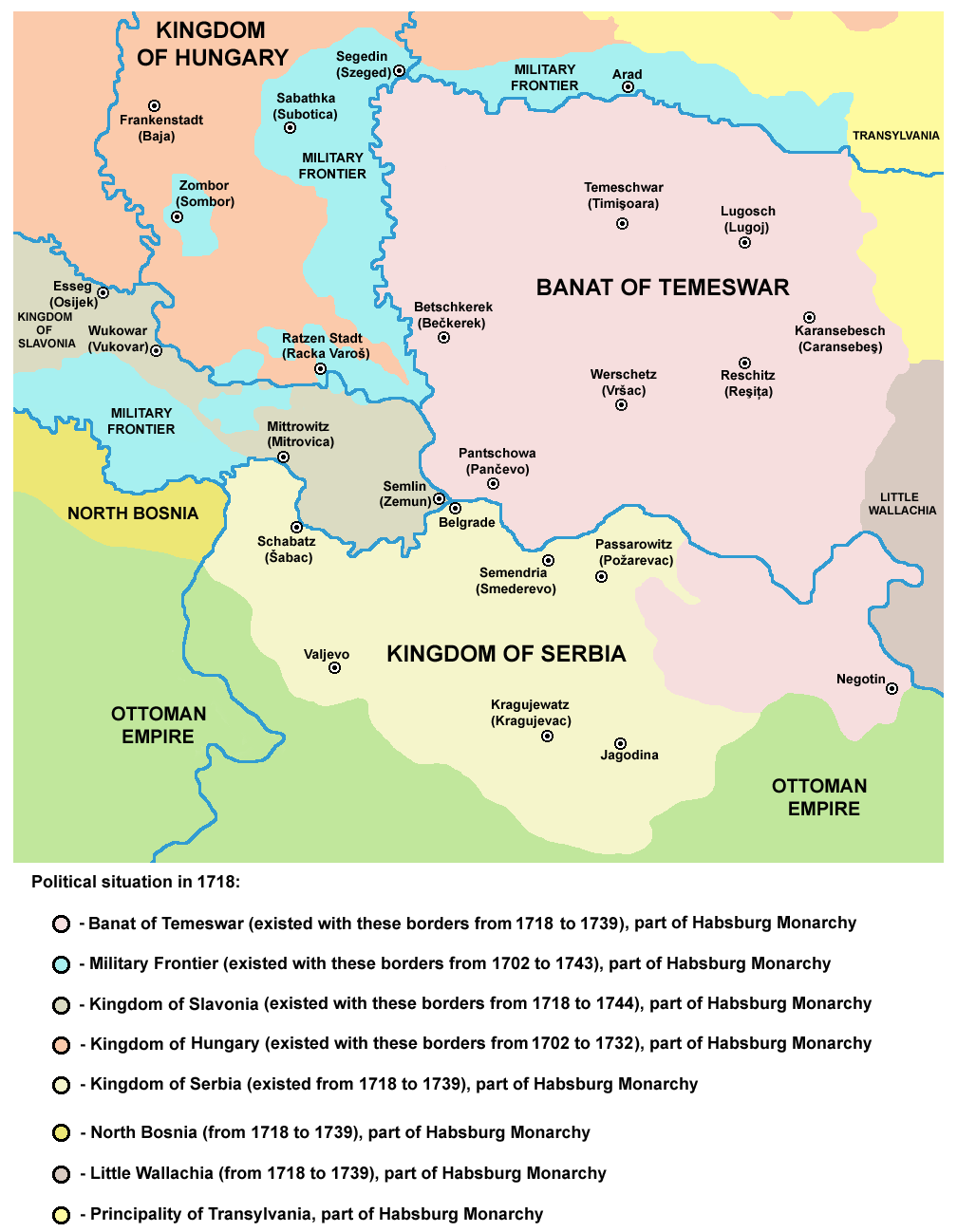
Source: Wikimedia

Mezes correctly identifies Kisilova from Frombald's report with present day Kisiljevo, and points out the differences between Kisiljevo and Medvedja in the military and governmental structure of Serbia at the time. Kisiljevo being a cameral village, and not a Hayduk village like Medvedja, the investigations of purported cases of vampirism were handled differently in these two villages. Mezes also discusses the curious circumstances related to the copy of Frombald's manuscript and other information on the case in the Viennese archives.

All this is a nice and clear exposition and synthesis of information most of which can be found in various books on the subject and on the Militärgrenze, but that is certainly not the case when it comes to the part of the thesis on Georg Tallar. Here Mezes carries out a detailed analysis and comparison of both the printed book and the original manuscript to learn more about this 'enigmatic figure', Tallar, his investigation of vampire cases and the reason why a publisher decided to print the book some thirty years after the report was written.

Tallar was part of a commission consisting of himself, a theologian, and a physician, the latter according to Mezes possibly the Protomedicus Paul Adam Kömovesch (actually: Kômûves) who is recorded to having singlehandedly investigated one case of vampirism. Mezes suggests that, perhaps, the three did not actually work together, which could perhaps explain why it was Tallar and not the Protomedicus who wrote the report. On the other hand, Mezes notes that in the manuscript there are sections of a more religious character, which are so different from the otherwise sceptical voice of Tallar, that he thinks they may originate from the hand of the (unknown) theologian: 'Every now and then, there appears a voice in the text – albeit faintly and awkwardly – which addresses issues of demonic activity and morals and their consequences.'

These parts of the manuscript were omitted when the Viennese publisher Johann Georg Möβle prepared the text for printing. In his foreword Möβle claims that he stumbled upon the manuscript by accident, but Mezes finds this improbable.

Although dated 1756, Tallar may have written it in 1753: 'hypothetically, it might be conjectured, that Tallar handed in his report to the Banat Provincial Administration in 1753, right after he finished his investigation, just as his fellow-commissioner, Kömovesch did. Then, when the Hermsdorf-scandal popped out, the central administration wanted to collect materials about vampirism and asked the Banat Administration to send all documents they have on the issue. This scenario would explain why the report is dated 1756: it was written on it when the Aulic Treasury (Hofkammer) received the document three years after the report was actually finished.'

So what prompted Möβle to publish the report some thirty years later in 1784? Mezes convincingly conjectures that news of another vampire investigation got to Vienna that year, and that the authorities once again searched their archives for material on vampires, found Tallar's manuscript, and asked Möβle to publish it. Mezes lists a number of works published by Möβle that supports his theory that Möβle not only catered for 'the public's hunger for curiosities,' but was in fact also publishing books that would serve as instructive 'governmental messages.'

As for the vampire case that prompted the publication, Mezes writes: 'In our opinion (though again, further investigation is needed), the publication of the report has something to do with another vampire scandal, one which secondary literature does not yet know of (in fact neither do we). What points nevertheless in this direction is a royal statute of Joseph II., dates 1784.11.02., in which the king warns the Orthodox Church to take active part in the fight against vampire-beliefs.'

Mezes refers to an entry in Franz Xavier Linzbauer's voluminous Codex Sanitario-medicinalis Hungariae (a book that contains other source material on vampire investigations) concerning the practice among some people of the Orthodox faith of leaving corpses unburied ('in aperta tumba') for fear of bloodsuckers ('Wampier'), a practice that may cause epidemics illnesses to spread, so the authorites found it necessary to reiterate its stance.*

Franciscus Xav. Linzbauer: Codex Sanitario-Medicinalis Hungariae Tomus III. Sectio I, p. 122 (Buda, 1853)
Apart from the theological omissions mentioned above, Mezes finds that Möβle was fairly loyal to the text of the manuscript, although he made some changes like removing Tallar's references to the local authorities that appointed him to the commission: 'By doing so, Möβle severed important roots which linked the report to its original circumstances, and at the same time managed to elevate the report to a more general level of the enlightenment fighting the forces of darkness, be they superstitions or illnesses.'

Obviously, this is highly interesting work, particularly on Tallar's investigations and the interest in vampires of the late 18th century Enlightenment. Certainly a well-written and well-researched thesis, it earned Mezes a Hanak Prize at the History Department of the CEU, and as it is written in English, it also offers those who are unable to read the German language literature on the subject a glimpse of what they are missing out on.

Thanks to Jonathan Ferguson for notifying me of this work.

*) The contemporary review of the printed edition of Tallar's report that I quoted in an earlier post, was published 'Wien am 17ten Hornung, 1784', i.e. in Vienna on February 17 1784, and if that is correct, Möβle published Tallar's report several months before the royal statute.

Sunday, 15 September 2013

A surgeon's eyewitness accounts from Transylvania and Wallachia


Most of what was written on vampires in the eighteenth century consisted of commentaries on either a very small corpus of eyewitness accounts from officials of the Habsburg authorities or the Catholic Church or of various tales of vampires and revenants from around Europe. The most careful and comprehensive study based on first hand examinations of both those who complained of being attacked by a bloodsucker and of the bodies of the suspected vampires, was written in 1756 by a regimental surgeon, Georg Tallar.

Tallar was born in Mainz around 1700, and studied medicine there and in Straβburg. He then pursued a career as a surgeon and physician in the Habsburg army for more than thirty years, serving in Transylvania, Wallachia and the Banat. As Tallar mastered the local languages of those regions, he was not only able to discuss the subject of vampires first hand with the people who actually believed in them.

The new edition of Tallar's book and two pages from the manuscript shown in the Dracula. Woiwode und Vampir exhibition catalogue

Tallar witnessed five incidents in which people claimed to be attacked by vampires – or actually: Moroi – and in three cases he was himself involved in examining those who were ill as well as the corpses that were exhumed. He had actually even known some of those who, after their demise, were suspected of being bloodsuckers.

The Wallachians who were ill and claimed to have been attacked by a bloodsucker, told Tallar that they had been in bed for a couple of days, and that their heart hurt. When asked where the heart sits, they pointed, not to the heart, but to the stomach and the intestines. They said that, whenever they tried to fall asleep, the bloodsucker appeared in the shape of this or that deceased man or woman, standing in front of them or in a corner. Some said that they saw the bloodsucker when they were asleep, but many of the afflicted actually saw nothing. Still, they believed that it was necessary to open the graves to look for the Moroi. Although exhuming and destroying corpses was prohibited by law, they were willing to break the law to seek out and destroy the bloodsucker. In fact, people were so afraid of falling prey to the vampire, that they dared not walk about after dark.

Examining them, Tallar found that they complained from pains and aches in various part of the body, including strong headaches, and that their tongue would turn first pale and then become brownish red and dry as wood. They were very thirsty, and had a faint and erratic pulse.

In each case, only Wallachians were affected by the bloodsucker, whereas neither soldiers, German settlers, nor local Serbs became ill, so Tallar concluded that the Wallachians did not suffer from an epidemic, but rather an endemic disease. Considering the traits of the Wallachians, he concluded that the food eaten by them, especially during the fasts that they fanatically observed during Winter - consisting of e.g. cabbage, garlic, and sauerkraut - was the cause of the disease. In fact, administering a simple vomitive often cured the diseased!

Tallar also discusses various beliefs concerning the dead and their graves, refuting the beliefs and providing various natural causes for the phenomena. He e.g. refutes the belief that the bloodsuckers are more harmful on Saturdays, by exhuming and examining the corpses on various days of the week, showing that the state of the corpses were independent of the day of the week.

Overall, Tallar is an exemplar of the medical enlightened man, emphasizing – like Gerard van Swieten – the lack of education among the Wallachians, while at the same time mentioning that they are not so stupid not to accept his medical remedies against the disease, when they notice that people get cured.

From Medicinische Jahrbücher des kaiserl. königl.
österreichischen Staates
 Band 56 (Wien, 1846)
Tallar wrote his Visum-Repertum Anatomico-Chirurgicum after the vampire incident in Hermersdorf that prompted Empress Maria Theresa to stop the burning of corpses associated with magia posthuma, but his manuscript was left unpublished for almost thirty years, until the Viennese publisher Johann Georg Möβle came upon it and decided to publish it in 1784.

A reviewer in the Viennese Realzeitung für das Jahr 1784, expressed the wish that Tallar had used his proficiency in the Wallachian language to publish his observations on the matter in that tongue. Excerpts from the book turned up in Johann Dionis John’s Lexikon der K. K. Medizinalgeseze in 1790, and in an article in the Medicinische Jahrbücher des kaiserl. Königl. Österreichischen Staates in 1846.

Now, almost 250 years after its first publication, Tallar’s book has been reprinted by Nicolaus Equiamicus in a slim volume that replaces Möβle’s introduction by a new one by Equiamicus, and adds a few explanatory footnotes, while slightly updating the language of the original. Tallar’s original is readily available online (see my list of links), but Equiamicus is to be commended for providing us with a handy edition of this essential text on vampire beliefs. And it is available for just €7.90.

Friday, 5 June 2009

Maps

I have been looking at a number of maps from the 18th century recently, and I noticed a nice online map of Northern Serbia around the time of the conquest of Belgrade in 1717. You will need a plugin for your browser to study the map.

The location of Medvedja, unfortunately, is just outside the map, but you can clearly see Gradiska and Ram in the vicinity of Kisiljevo by the Danube East of Belgrade. Then there is Ban(n)at, also the site of vampire cases as recorded by e.g. Ignaz von Born and Georg Tallar.

In the North Eastern corner you will find Lugos (Lugoj), the birthplace of Béla Ferenc Dezső Blaskó AKA Bela Lugosi.

Tuesday, 21 October 2008

Heart-Eaters

Last year I mentioned a book by Christa A. Tuczay about demonic crimes in the Donau Monarchy: Die Herzesser: Dämonische Verbrechen in der Donaumonarchie (Seifert Verlag, 2007). I bought a copy of it when I was in Vienna, and from the parts that I have read I can say that it is a nice and informative book about subjects like cannibals, werewolves, murderers and vampires from the countries that have been part of the Donau monarchy!

There are about a dozen pages about vampires that provide an overview of some of the 18th century vampire cases, including Georg Tallar's examinations of victims of vampires. Gilles de Rais, Elisabeth Báthory, Vlad Tepes and a few other well-known characters are also briefly described, slightly ironically, as Tuczay says in her afterword: 'obwohl sie sicherlich meist nicht zum Lachen reizen, sich aber mit einer Prise Humor leichter ertragen lassen.'

The 'heart eaters' mentioned in the title refer to various tales of literal and symbolic eaters and stealers of hearts, including Le Livre du cuer d'amours espris by René d'Anjou, which exists in an illuminated manuscript in Vienna (see the above illustration which is shown in black and white in the book). In this poem the poet is in love and dreams that Amor takes out his heart and gives it to Desire, cf. the illustration. In other tales, the heart of a lover is served as food by the cuckolded husband to his wife.

The foreword is by Mark Benecke, and there are useful notes specifying sources and further reading. All in all 160 illustrated pages at €19.90, and once again: it is in German...

Addendum: I notice that Tuczay is also one of the editors of a new anthology entitled Faszination des Okkulten: Diskurse zum Übersinnlichen published by Francke Verlag that also published the Poetische Wiedergänger anthology on vampires.

Sunday, 6 January 2008

What the postman brought

It's always nice to find a package in your mailbox, and the first one this year contained Michael Kroner's 2005 book Dracula: Wahrheit, Mythos und Vampirgeschäft from Johannis Reeg Verlag, a publisher specialising in Romanian or rather Siebenbürgen history.

Kroner is a historian who was actually born in Romania and he has for many years researched and written books and papers on the history of Siebenbürgen and Romania. So this little book contains an introduction to the 15th century Wallachian ruler Vlad Tepes who in popular culture has become connected with vampires through Bram Stoker's Dracula as well as the works of the historians Radu Florescu and Richard McNally, in particular their 1972 bestseller In Search of Dracula. Although Bram Stoker didn't really know much about Vlad Tepes, as has been pointed out by e.g. Elisabeth Miller in her delightful Dracula: Sense & Nonsense (2000), it has almost become a popular 'truth' that the fictional vampiric count 'is' Vlad Tepes. Miller even claims that 'few would pay [Vlad Tepes] the slightest attention today, were it not for the dubious Count Dracula link' (p. 150 in the 2006 edition), but he is still an interesting historical character who plays a special role in Romanian history.

Kroner also devotes a few pages to vampires in general. He even shows the frontispiece of Georg Tallar's book, which I scanned in my recent christmas post. I can't remember seeing it in any other book, so this is probably the first reproduction in print. Otherwise, it seems to be a fairly traditional, but reasonable account of vampire cases and debates from the 18th century and onwards. Kroner continues with the various fictional Draculas, and for some reason even goes along the traditional lines of discussing 'living vampires' like Peter Kürten and Elisabeth Báthory...

There are some interesting illustrations, including a 1617 depiction of how people were impaled. I think it's the first time I have seen an illustration like this one (shown below), and I can't help thinking that it must have required a lot of effort to impale just one person. So how much time would it have taken Vlad Tepes and his men to impale those vast amounts of enemies he is claimed to have done?


Of course, this blog isn't devoted to the history of Vlad Tepes, to Dracula or to execution methods in general. Magia posthuma, however, does involve post mortem executions of corpses of witches and other dead people assumed to harass the living, and in general I find it interesting to get some understanding of how these things were really done. Particularly, because history seems to have been forgotten and replaced by a 'pseudohistory', somewhat like Disney's animated versions of classic fairy tales have replaced the original tales. It's in this 'pseudohistory' that vampires have become pale immortals leaving their coffins at night to sink their sharp fangs into the living who in turn die and become immortal.

Gothic fiction is itself usually a sort of 'pseudohistory', but it does at times attempt to approximate some of the horrors of the past. In the case of executions, there is a rare attempt at showing a quartering of a man in the German Gothic horror movie Die Schlangengrube und das Pendel (1967). The trailer is available on youtube and includes a portion of the quartering scene as well as numerous other horrors.

However, the images can not rival the descriptions of a French execution in 1757 quoted in the opening pages of Michel Foucault's classic (and certainly not to be missed by anyone interested in the development of modern society!) study of the birth of the prison, Surveiller et punir (Discipline and punish), here in the words of an eye witness:

'The horses tugged hard, each pulling straight on a limb, each horse held by an executioner. After a quarter of an hour, the same ceremony was repeated and finally, after several attempts, the direction of the horses had to be changed, thus: those at the arms were made to pull towards the head, those at the thighs towards the arms, which broke the arms at the joints. This was repeated several times without success. He raised his head and looked at himself. Two more horses had to be added to those harnessed to the thighs, which made six horses in all. Without success.

Finally, the executioner, Samson, said to Monsieur Le Breton that there was no way or hope of succeeding, and told him to ask their Lordships if they wished him to have the prisoner cut into pieces. Monsieur Le Breton, who had come down from the town, ordered that renewed efforts be made, and this was done; but the horses gave up and one of those harnessed to the thighs fell to the ground. The confessors returned and spoke to him again. He said to them (I heard him). "Kiss me, gentlemen." The parish priest of St Paul's did not dare to, so Monsieur de Marsilly slipped under the rope holding the left arm and kissed him on the forehead. The executioners gathered round and Damiens told them not to swear, to carry out their task and that he did not think ill of them; he begged them to pray to God for him, and asked the parish priest of St Paul's to pray for him at the first mass.

'After two or three more attempts, the executioner Samson and he who had used the pincers each drew out a knife from his pocket and cut the body at the thighs instead of severing the legs at the joints; the four horses gave a tug and carried off the two thighs after them, namely, that of the right side first, the other following; then the same was done to the arms, the shoulders, the arm-pits and the four limbs; the flesh had to be cut almost to the bone, the horses pulling hard carried off the right arm first and the other afterwards.

'When the four limbs had been pulled away, the confessors came to speak to him; but his executioner told them that he was dead, though the truth was that I saw the man move, his lower jaw moving from side to side as if he were talking. One of the executioners even said shortly afterwards that when they had lifted the trunk to throw it on the stake, he was still alive. The four limbs were untied from the ropes and thrown on the stake set up in the enclosure in line with the scaffold, then the trunk and the rest were covered with logs and faggots, and fire was put to the straw mixed wit this wood.

'... In accordance with the decree, the whole was reduced to ashes. The last piece to be found in the embers was still burning at half-past ten in the evening. The pieces of flesh and the trunk had taken about four hours to burn. The officers of whom I was one, as also was my son, and a detachment of archers remained in the square until nearly eleven o'clock.
(Penguin edition, p. 4-5)

Although dealing with a pretty morbid subject, I think it will be a while before this blog returns to this particularly cruel subject...

Monday, 24 December 2007

Merry christmas!

After weeks of silence I have considered how to wish visitors of this blog a merry christmas. Unfortunately, I have not had time to write a longer essay, so I will present you with the gift of a scan of the front page of one the seminal works on vampirism, VISUM REPERTUM ANATOMICO-CHIRURGICUM oder Gründlicher Bericht von den sogenannten Blutsäugern, VAMPIER, oder in der wallachischen Sprache Morie by the well-educated physician Georg Tallar published in Vienna and Leipzig in 1784.


I found this book at The Royal Library in Copenhagen in the mid Eighties, when the book was virtually unknown. At least, it was not mentioned in any bibliography that I knew of, including Dieter Sturm and Klaus Völker's Von denen Vampiren oder Menschensaugern. Later on I noticed that Aribert Schroeder knew of it, when he wrote Vampirismus: Seine Entwicklung vom Thema zum Motiv in 1973, but Schroeder's book was and is for some reason unfortunately very scarce.

Then, in 1988, Tallar turned up a few times in Paul Barber's Vampires, Burial, and Death, and later on he has been quoted by a few other authors, so his investigations are getting their proper place in the history of magia posthuma. Investigations that include interviewing and examining people who claim to be the victims of vampires (or moroi) and the examination of corpses suspected of being vampires.

Saturday, 21 July 2007

Keyworth and the Uniqueness of the Vampire

Now I have obtained and read a paper by G. David Keyworth, who was mentioned in one of my recent posts. It seems that Keyworth wrote a thesis on 'the socio-religious beliefs and nature of the contemporary vampire subculture' before completing a PhD thesis on 'the unnatural history of troublesome corpses and vampires in Europefrom the medieval period to the twentieth century'. The paper I refer to, Was the Vampire of the Eighteenth Century a Unique Type of Undead-corpse? published in Folklore 117 (December 2006), p. 241-260, is obviously based on his work for the latter thesis.

Augustin Calmet in his Dissertation on revenants and vampires claimed that “in no history do we read anything similar, so common, or so decided, as what is related to us of the vampires of Poland, Hungary, and Moravia.” ("Mais en nulle Histoire on ne lit rien d'aussi commun ni aussi marqué que ce qu'on nous raconte des Vampires de Pologne, de Hongrie & de Moravie." II, vii). In his paper Keyworth aims to “test the validity of Calmet’s notion that eighteenth-century vampires were a unique type of revenant.” Consequently, Keyworth compares and contrasts the vampires of the 18th century with tales and cases of revenants and other 'troublesome corpses' from the 12th century and onwards.

Some of his examples will be well known, e.g. those from William of Newburgh and Henry More, whereas others are more obscure. The older sources are mainly from England, Iceland and parts of northern Europe, and Keyworth seems to be fascinated by the old Norse draugrs. He refers to various writings on the Greek vrykolakas (e.g. Allatius and Tournefourt) before coming to the oupire and vampire of the 18th century, which are described via quotes from Harleian Miscellany, Mercure Argent, the Lettres Juives, and the reports from Kisiljevo and Medvedja.

Further on he refers to writers on theosophy and spiritualism, who had notions of 'astral' and 'posthumous' vampirism. He also mentions von Görres' mystical views in Die Christliche Mystik (1836-42), and finally compares the New England 19th century 'vampires cases' with those of the 18th century.

All in all this makes for an interesting peek into the historical development of notions about revenants.

As for Keyworth's question: 'Were the Vampires of the Eighteenth Century Unique?', he concludes that:

“The Slavic vampire of the eighteenth century remains a unique type of revenant, given its supposed thirst for human blood.” (p. 256)

I feel that the paper is much too biased towards England and northern Europe, whereas in my opinion it is particularly interesting to know if the same trend can be found if you incorporate material from various continental European countries. Quite a few books have been written about the revenants and apparitions of the medieval period, so material should be readily available.

Furthermore, I am a bit wary of the use of e.g. the Harleian Miscellany as evidence, because this text is mainly based on other sources. In general I prefer to try to go to the most original sources, in particular those written by people who were present when examining cases of purported vampirism. Keyworth mentions two examples (and his source is obviously Paul Barber's Vampires, Burial, and Death), but there are others. In particular the military physician Georg Tallar's examination of 'vampire victims' is important.

These sources are also important when considering the 'blood sucking' of 18th century vampires. Were they really supposed to suck blood and how? In many cases the victims complained of other symptoms than losing blood, e.g. suffocation.

Keyworth does however note that the notion of blood sucking could be inferred from the post mortem effects on the human body:

“Slavic culture, however, as we have seen emphasised the apparent accumulation of blood within the organs and bodily cavities of such corpses, this being taken as supposed evidence that the deceased had been sucking the blood of the living.” (p. 257)

But is this enough evidence to claim the uniqueness of the 18th century vampires?

In my opinion there are still unanswered questions. Keyworth touches upon important aspects of the history of vampires and revenants, but I do not feel convinced by his conclusion, or perhaps I just view things from a different perspective? However, now I have even more reason to look forward to reading Keyworth's book!
Related Posts Plugin for WordPress, Blogger...