Showing posts with label Romania. Show all posts

Sunday, 13 October 2013

Dracula: Die wahre Geschichte der Vampire

Count Dracula visits the Prunksaal in Vienna
The German documentary series Terra X on channel ZDF launched a new documentary on Dracula and vampires this evening, Dracula: Die wahre Geschichte der Vampire, which is currently available on the ZDF web site along with various information on vampire books a.o. Forensic scientist and vampire expert Mark Benecke as well as Dr. Clare Downham participate in this program that is partially narrated by Count Dracula himself as portrayed by actor Christian Baumann. The Count visits the archives in Vienna to examine the original Visum et Repertum, and we see Flückinger examine 'Arnold Paole' - even the apocryphal journey of Gerard van Swieten to Moravia is dramatized. Still, this is generally one of the best documentaries on the subject so far, including visits to Romania, London, and Vienna, where Dracula studies some of the 18th century literature on vampires in the Prunksaal next to the bust of van Swieten.

The documentary will be released on DVD and Blu-ray in early 2014.


Corpus Draculianum


According to Amazon, the last of the three volumes of Corpus Draculianum will be published in December, while the first two volumes will follow in 2014 and 2015. The Corpus compiles all sources to the current knowledge about Vlad Tepes, written in 16 different languages and supplemented by translations and commentaries, and is intended to not only make these sources available to both scholar and layman, but also to defictionalize the Wallachian Woiwode. For more information (in German) on the books, see this web site. The Corpus is prepared by Thomas M. Bohn, Adrian Gheorghe and Albert Weber. The books are published by Harassowitz Verlag in Wiesbaden, Germany.

Saturday, 12 October 2013

A Transylvania Vampire Expert

'This book represents one Hungarian historian and traveler's sometimes elusive but ever conscientious filtering of numerous sources - sources including not only those books listed in the bibliography (some folkloric works available only in Hugarian) but also Hungarian-language and other archival materials and, indeed, stories heard during many journeys over many years in Transylvania and elsewhere.'

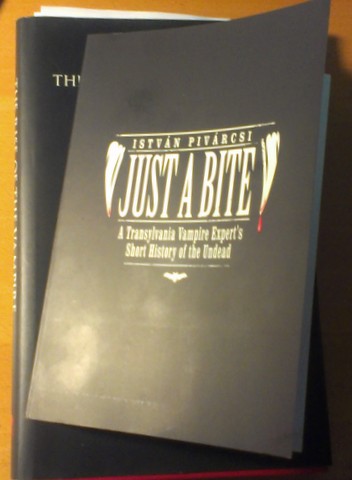
Hungarian historian István Pivárcsi has written a number of books on vampires and other subjects in Hungarian, while so far only the book quoted from above has been translated into English: Just A Bite: A Transylvania Vampire Expert's Short History of the Undead (paperback, 292 pages, $14.95). 'For more than twenty years he has led vampire tours in neighboring Transylvania,' the publishers write, making the reader expect that the book will contain a lot of information on vampires related specifically to Transylvania. Most of the book, however, covers ground familiar from numerous other books: Vlad Tepes, Elizabeth Bathory, Gilles de Rais, werewolves, zombies, the Golem, beliefs related to blood, vampire bats, porphyria, and the vampire of popular culture, and quite a lot of what is said about Romanian vampire beliefs is very brief.

Pivárcsi writes that, 'although research has found that vampire myths are rooted most firmly in Serbian, Croatian, Ukrainian, Romanian, and Ruthenian folklore,' Transylvania is of particular importance in 'vampirology', as he names the field:

'Largely because the vampire that was to become best known by name, Count Dracula, was linked in the popular imagination to that region,' even though he actually ruled south of Transylvania, but also because 'Romanian folklore in particular came to be permeated by vampires, thanks in no small part to a certain tenet of the Eastern Orthodox Church - name, that those people who died after being excommunicated returned as the walking dead - moroi in Romanian. Indeed, such souls were condemned to remain in this most unfortunate state of limbo until the Church saw fit to relieve them of the curse.' According to Pivárcsi, it was, however, the merging with the strigoi, 'a nocturnal death-bird with supernatural powers that flew about at night, hunting human flesh and blood,' 'that yielded the characteristic Romanian vampire figure whose modern permutations we have come to know. Linked as they were to the Christian religious tradition that pervaded nearly every aspect of society, vampires became seen as agents of Satan, as instruments of evil bent on violating and annihilating humanity - and it was thought that a whole army of them were out there in the night maneuvering for final victory. They fed on human blood, and their bite infected their victims with vampirism. Blood and darkness alone sustained them.'

Pivárcsi, unfortunately, does not evolve this theme much, but in a short chapter he relates some accounts related to the Transylvanian belief that 'were adapted by your humble guide from my archival research in Transylvania coupled with material in the works of the noted twentieth-century Hungarian folklorists Enikö Csögör and Tekla Dömötör.' There are in fact only five accounts, or 'possibly true tales', a couple of which are rather schematic, while the rest include other, and more interesting aspects of local folk beliefs that unfortunately are not dealt with in the book.

The book also includes a glossary, and a chronology in which it is claimed that Philip Rohr's De masticatione mortuorum 'is the first work to be published in German language about vampires,' while under 1710 it says: 'Vampire hysteria sweeps across Eastern Prussia. Numerous cemeteries are dug up, and a mob sets the houses of suspected vampires on fire.' This sounds like a Hammer film!  Equally apocryphal, yet still fascinating is the entry for 1725-1732: 'In the southern territories ruled by the Austrians, inhabited mainly by Serbians, several people are sentenced to death on charges of vampirism.'

The only part of the book that presents something truly Hungarian that is probably not available elsewhere, concerns the Hungarian silent Dracula film, Drakula halála, from 1921, so if you are looking for information on that one, Pivárcsi's book may be worth getting hold of. Otherwise, well, maybe this book is simply intended for younger readers looking for a popular introduction to the subject, and in that respect it is probably not worse than so many other books. But if you are looking for something on Hungarian or Transylvanian folk beliefs, I'd rather go for e.g. Tekla Dömötör's Hungarian Folk Beliefs.

The original title of the book is not mentioned, but I think this is a translation of Pivárcsi's Drakula gróf és társai originally published in 2003.

The publisher, New Europe Books, specializes in books from and about the former East Bloc, 'a literary landscape shrouded for all too many in mystery': 'We seek to introduce new and classic-yet-undiscovered authors and books whose stories will resonate with readers far afield. Our authors include not only those born and raised in this part of the world (whether or not they happen to write about their own societies) but also expatriate writers from elsewhere and those who may have lived abroad for a short or long time but whose ancestry is rooted firmly somewhere in Eastern Europe—in short, all those whose lives are bound up in some manner with the region, and who share startling new perspectives on the human condition that will appeal to readers from far reaches of the globe.'

Saturday, 30 March 2013

Voyage to Transylvania


Allessandra Bisceglia's Dracula: Viaggio in Transilvania (Giunti, 2008) is a colourful companion to the Italian TV series Voyager presented by Roberto Giacobbo. The book is no doubt meant for a relatively young audience who are presented with the history of Vlad Tepes, vampires, the fictional Dracula and his cinematic incarnations. A number of photos from Romania from the making of the Voyager documentary on the subject are included.

The few pages concerning vampires are cursory and go into very little detail, although it may be worth noting that the author favours the possible translation of the word nosferatu - which in my opinion Emily Gerard hardly heard, but simply read while researching her book on Transylvania - as "non-spirato": 'il non-morto'...


Sunday, 30 September 2012

'Ever heard of the Jewett City vampires?'

'Scraping away soil with flat-edged shovels, and then brushes and bamboo picks, the archaeologist [Nick Bellantoni] and his team worked through several feet of earth before reaching the top of the crypt. When Bellantoni lifted the first of the large, flat rocks that formed the roof, he uncovered the remains of a red-painted coffin and a pair of skeletal feet. They lay, he remembers, “in perfect anatomical position.” But when he raised the next stone, Bellantoni saw that the rest of the individual “had been com­pletely...rearranged.” The skeleton had been beheaded; skull and thighbones rested atop the ribs and vertebrae. “It looked like a skull-and-crossbones motif, a Jolly Roger. I’d never seen anything like it,” Bellantoni recalls.

Subsequent analysis showed that the beheading, along with other injuries, including rib fractures, occurred roughly five years after death. Somebody had also smashed the coffin.

The other skeletons in the gravel hillside were packaged for reburial, but not “J.B.,” as the 50ish male skeleton from the 1830s came to be called, because of the initials spelled out in brass tacks on his coffin lid. He was shipped to the National Museum of Health and Medicine, in Washington, D.C., for further study. Meanwhile, Bellantoni started networking. He invited archaeologists and historians to tour the excavation, soliciting theories. Simple vandalism seemed unlikely, as did robbery, because of the lack of valuables at the site.

Finally, one colleague asked: “Ever heard of the Jewett City vampires?”'


The October 2012 issue of the Smithsonian magazine contains a lengthy article on The Vampire Panic in New England, i.e. the numerous instances of corpses being treated in various ways to avoid vampirism, of which the case concerning Mercy Lena Brown is probably the most publicized.

Michael E. Bell, author of the well-known Food for the Dead: On the Trail of New England's Vampires, is, of course, one of the sources for the article. According to the version of the article available on Smithsonian's web site, 'a consulting folklorist at the Rhode Island Historical Preservation & Heritage Commission for most of his career, Bell has been investigating local vampires for 30 years now—long enough to watch lettering on fragile slate gravestones fade before his eyes and prosperous subdivisions arise beside once-lonely graveyards.


He has documented about 80 exhumations, reaching as far back as the late 1700s and as far west as Minnesota. But most are concentrated in backwoods New England, in the 1800s—startlingly later than the obvious local analogue, the Salem, Massachusetts, witch hunts of the 1690s.

Hundreds more cases await discovery, he believes. “You read an article that describes an exhumation, and they’ll describe a similar thing that happened at a nearby town,” says Bell, whose book,
Food for the Dead: On the Trail of New England’s Vampires, is seen as the last word on the subject, though he has lately found so many new cases that there’s a second book on the way. “The ones that get recorded, and I actually find them, are just the tip of the iceberg.”'

According to Howard Peirce, who kindly notified me of the article, the internet article does not correspond to the one in the printed magazine, so it may well be worth the while to seek out a copy.

The Smithsonian has previously dealt with vampire related subjects. I have a copy of the February 1975 issue which contains an article on Vlad the Impaler and the Ceasescu era's interest in Dracula: 'Since he succeeded Gheorghe Gheorghiu-Dej upon the latter's death in 1965, Ceausescu has steadily solidified his powere base. And it is Ceasescu's appreciation of the potency of nationalism that has rekindled Romanian interest in the history surrounding the real Dracula - and has promoted the development of a tourist program which promises to bring Western visitors to Draculaland.'

Sunday, 26 August 2012

Dr. Kreuter: Vampire Hunter

This WDR German documentary follows Peter Mario Kreuter on a visit to Romania in 2003 in search of first and second hand witnesses of vampire and werewolf beliefs. The journalist ultimately asks Kreuter himself if he - like some of the people he meets - actually believes in such things...


A more recent interview with Kreuter in which he e.g. discards with the fictional notions of bloodsucking, canines, and good vampires...

Sunday, 5 August 2012

Archaeology as romanticism and ideology


When I initially read about the uncovering and quick exhibition of the ’vampire skeleton’ in Bulgaria, I was reminded of some of the bog body finds here in Denmark. Public interest in seeing the so-called ‘Grauballe Man’ was so extensive, that the authorities decided to put him on display quickly, and the 19th century ‘Haraldskær Woman’ was romantically identified with Queen Gunhild who according to the Jomsvikinga Saga was drowned in a bog by order of King Harald Bluetooth.

Today we are instead used to archaeologists spending a very long time preserving and studying their finds before they are described in papers and exhibited. And we are, I think, generally suspicious of interpretations that smack too much of romanticism or ideology. Archaeological finds have all too frequently been exploited for political purposes, or ideology and politics have served as a motivational factor intrinsic to the discipline, pre-determining interpretational possibilities and distinguishing between the relevant and the irrelevant.

The relationship between politics and archaeology is the focus of an anthology published by Routledge in 1998: Archaeology Under Fire: Nationalism, politics and heritage in the Eastern Mediterranean and Middle East edited by Lynn Meskell. Chapter 4 is of particular interest here as it concerns Bulgarian Archaeology: ideology, sociopolitics and the exotic. It is written by Douglass W. Bailey, an expert on the later prehistory of South Eastern Europe, author of Balkan Prehistory: Exclusion, Incorporation and Identity (2000) and Professor at San Francisco State University, cf. the video at the end of this post.

Based on his own work in Bulgaria as well as discussions with Bulgarian archaeologists, Bailey not only analyses Bulgarian archaeology and the Western attitude towards it, but suggests ways in which to develop it. Following Todorova’s well-known 1997 book Imagining the Balkans, Bailey notes that not only do Westerners consider Bulgaria and its archaeology exotic, ‘the history of modern Bulgaria is one of auto-exoticism’:

‘Bulgarian auto-exoticism has entailed efforts to create a modern nation-state by illuminating its distance (ethnic, historical, linguistic) from other states as well as to eliminate any internal alternative pockets of cultural or ethnic exoticism (thus the internal campaigns of forced resettlement and name-changing of 'non--Bulgarian' Bulgarians).’

Here I cannot help thinking of the Dracula tourism promoted by Romania which certainly exploits an exotic interest in the country to attract tourists, while at the same time it creates an identity, exemplified by the Crama Dracula restaurant that I recently visited in Barcelona. One should, however, also recall that Vlad Tepes was employed as a national hero by Nicolae Ceauşescu, a historic figure whose personality and deeds was not something distant, but part of a glorious past that was important to consider in modern day Romania. So, obviously the auto-exoticism that Bailey describes is much more than a scheme to attract tourists who cater for the exotic:

'From the West, the discipline [of Bulgarian archaeology] appears to exist solely to glorify the ethos of a magnificent past through a fascination with the art and culture of extinct peoples. From this perspective it is confirmed as a discipline born in the spirit (and the period) of modernism: it seeks to study the primitive in its past and it relegates matters of causal explanation to the epiphenomena of descriptive ideas of cultural progress.

Thus, Bulgarian archaeology itself considers its object of study (i.e. the past) as exotic. In this sense, the more mundane elements of the material record hold little interest: common practice on excavations is to discard coarse-ware pottery without concern or quantification. The emphasis of research remains firmly centred on the most sensational and emotive sectors of the archaeological record (i.e. burials, figurines, metal-work, fortresses and fine-ware pottery). Most surprisingly, perhaps, the tradition of Bulgarian archaeology-as-romanticism has remained in place through the post-1989 period of the region-wide opening of intellectual borders, research resources and collaborative strategies.’

But this archaeology-as-romanticism is not imposed by some extraneous political or ideological factor; it is intrinsic to the discipline, but also to the structure of the academic sciences and the political institutions of Bulgarian society. To Bailey Bulgarian archaeology essentially is itself an ideology.

‘Following M. Todorova, I suggest that Bulgarian archaeology itself is an active socio-politics and ideology: it is not a passive tool of socio-political, nationalist, totalitarian, or other state--level political structures. Bulgarian archaeology's long-established position as a socio-political ideology is one of the conditions which makes it appear exotic to Western eyes.’

This active ideology, however, does not confine itself to (re)creating national histories and ethnic identities, it has a powerful role in a society in which the past arbitrates the present:

‘As an historical subject and thus as active socio-political ideology, Bulgarian archaeology occupies an unrivalled position as justifier and legitimator. In this sense, the past is an arbiter of the present and those who can read the past are arbiters of justice and, as such, possess considerable power. The ideology of the past as arbitration is not limited to the recreation of national histories and prehistories: it drives a social logic through the reality of all elements of daily life. A particularly strong recent manifestation of this logic was the enthusiastic (and in most cases successful) drive by Bulgarian families, in the early 1990s, to reclaim property confiscated by the communists during their forty-five years in power. Property reclamation rested on the simple principle that proof of ownership in the past justified the right to regain ownership in the present. The past arbitrates the present.’


But, if Bulgarian archaeology is in fact an ideology, then its professional practitioners must themselves be considered ideologues:

‘The case that Bulgarian archaeologists are ideologues rests on several important facts. The first is a long-standing link between politicians and members of the scientific and cultural intelligentsia. The second link connects two separate roles which Bulgarian archaeologists play: on the one hand they are scientific field-workers; on the other they are custodians and, as mentioned above, arbiters of the nation's past. These links raise (and suggest answers to) important questions about the power of archaeological data and its interpretation. In turn they raise a debate surrounding the personnel of Bulgarian archaeology, most particularly the question of who is allowed (as opposed to who is qualified) to study the past. Furthermore, it is through an examination of the practitioners of archaeology that one comes to understand the unchanging condition of archaeological interpretation in Bulgaria. Such an understanding is especially enlightening in the absence of either processual or post-modern developments in Bulgarian archaeologies.’

Bailey traces the linkage between science and politics back in time to the creation of the Bulgarian Academy of Sciences (BAN) a century ago in July 1912 as a centralised organisation based on a law formalising the connection between BAN and the government. This centralisation was further reinforced during the Communist era, and today it is still a member institution of BAN that grants permission to carry out field work in Bulgaria. The close link between the government and academia and intelligentsia is reflected in the number of academics and intellectuals who have and still do occupy important political offices, like e.g. the Director of the Bulgarian National Museum of History, Bozhidar Dimitrov.


Bailey however rejects any naïve and condescending depreciation of Bulgarian archaeology as ‘a retarded stage of development in the evolution of archaeological theory,’ as it does not only assume a Western righteousness of method, but also a lack of appreciation and understanding of the background of the contemporary Bulgarian discipline. Whereas the quest of a processual approach to archaeology (aka new archaeology) is for an objectivity separate from politics, the Bulgarian approach to archaeology can by definition not be separated from politics. So explanations do not ideally follow strictly from the given data, but are pre-determined by a centralised ideology: ‘often archaeological research entails little more than recovering more and more data which can be assigned to pre-determined chronological and social stages.’

Bailey discusses ways to ‘de-exoticise’ Bulgarian archaeology, and suggests that Western archaeologists ‘treat colleagues as peers and offer them the respect of critical comment on their work, their methods and the social consequences of their doctrines. To do otherwise is to abrogate any responsibility for the impact which archaeology has on the reality of modern existence in Bulgaria or in any place that archaeology is practised. The time to accept that responsibility is now when, as a discipline, Bulgarian archaeology drifts without proper financial ballast, having been orphaned from a long-exploitative family.’

Now this is, of course, Bailey's analysis, but from what I can gather from reviews and the information I have seen concerning his work, I have found it relevant to write about it here. It supports the notion that Bulgarian archaeology has a tendency to favour more sensational finds, possibly from an intrinsic reasons, but at the same time aiming at attracting not only attention from a wider audience, but also more funding, either directly from the government or indirectly from tourists who are perhaps not interested in the Bulgarian history in general, but who are willing to spend money to see a 'vampire skeleton' or to go on pilgrimage to the site of the (supposed) human remains of John the Baptist.

As for the skeletons themselves, the news stories about the 'vampire skeletons' have not only been imprecise, but have presented us with very little concrete information. For that reason I have so far mainly quoted the news stories instead of trying to discuss something that I feel I have only a vague idea about. But it is obvious that a) Bulgaria has now firmly placed itself as an area of 'vampire interest', and b) the archaeological finds are now to the public part of 'vampire lore'. Whatever that precisely is, but I suppose that films, novels and roleplaying games will be inspired by the Sozopol skeletons. At least, it probably has a little more to do with revenants and vampires than the most recent vampire blockbuster, Abraham Lincoln: Vampire Hunter.

Friday, 27 July 2012

Vampires in Barcelona? Perhaps...


Despite the heat and sunshine, a modern day vampire film could easily be set in Barcelona. The narrow old streets, the shuttered houses, the broad avenues, the modernista houses, the modern architectonical creations, the numerous citizens and the masses of tourists flocking the streets and beaches well into the night, all of them are elements that would make an interesting backdrop to the fictional vampires preying a city in search of blood.

In real life, as a tourist one must beware of pickpockets and scam artists. A guy entering a metro train right behind me was pickpocketed, but fortunately recovered his wallet before the thief could get away with it. This, unfortunately, is the case with various larger cities, just as a waiter in a restaurant in the old part of the city apparently mixed up bills so I was asked to pay an amount that was almost one and a half of what we had actually ordered. Fortunately, most of the people we met on our stay were friendly and helpful.


This was certainly the case of the head waiter (owner?) of Crama Dracula, a small Romanian restaurant located in 18 Carrer de Provença opposite a huge panopticon style prison (closest metro station is Entença). We arrived there early, so we got a lot of attention and the food consisting of some traditional Romanian dishes with mineral water and 'Dracula' Cabernet Sauvignon arrived very quickly.

I suppose you need some sense of humour to own or work in a Dracula restaurant decorated with various Vlad Tepes and Dracula artefacts, so perhaps that is why I afterwards thought our waiter had a hint of John Cleese about him. Anyway, we were treated nicely, also tasting their 'Dracula crepes' for dessert as well as their Țuică.

And if you want to enjoy Romanian wine and food at home, there is a shop, Unirea, selling Romanian wine and ingredients almost next door to the restaurant. Their 'Dracula wine' is actually pretty cheap, just €4.


On a more horrific note, this year marks the centenary of the detention of the so-called 'vampire of Barcelona', Enriqueta Marti, a kidnapper and murderer of children. Born in 1868, Marti moved to Barcelona as a young woman and ended up as a prostitute, later on specializing in prostituting children. According to wikipedia, she led a double life:

'During the day she dressed in rags and begged at houses of charity, convents and parishes in the destitute parts of town where she selected children who looked the most abandoned. Taking the children by the hand, she made them pass as her children. Later, she prostituted or murdered them. She did not have any need to beg since her double work as a procurer and prostitute gave her sufficient money to live well. By night she dressed in luxurious clothes, hats and wigs, and attended the El Liceu, the Casino de la Arrabassada and other places where the wealthy of Barcelona gathered. It is probable that in these places she offered her services as procurer of children.'

Operating for many years, she not only had a brothel prostituting minors, but also served as a kind of witch-doctor. Again, according to wikipedia:

'The ingredients she used to make her remedies were made from the remains of the children that she was killing, who ranged from infants up to children of 9 years. From these children she used everything that she could; the fat, blood, hair,and bones (that normally she turned into powder). For this reason, she did not have problems disposing of the bodies of her victims. Enriqueta offered salves, ointments, filters, cataplasms and potions, especially to treat tuberculosis, which was highly feared at the time, and all kinds of diseases that did not have a cure in traditional medicine. Wealthy people were paying large sums of money for these remedies.'

On February 27 2012 she was finally arrested after a neighbour had noticed a girl she had never seen before playing in Marti's mezzanine flat in 29 Carrer de Ponent, now 29 Carrer de Joaquín Costa in the part of Barcelona called Raval. The girl turned out to be a girl kidnapped by Marti. Investigators from the police then searched a number of flats where Marti had stayed and made macabre discoveries of human remains.


All sorts of atrocities are attributed to Marti, but as she was never tried - the legal proceedings were interrupted by Marti getting lynched by fellow prisoners in 1913 - the case appears to be somewhat unclear. But if you read the wikipedia article - which appears to be an attempt at translating the Spanish one - you will find all manner of criminal and sadistic acts attributed to her.


Returning to the world of fiction, I noticed a well-assorted DVD store near the university: Castelló 70-nou in 79 Carre de Tallers, even stocking Dracula and Mummy lamps and clocks! I stuck to a cheap DVD as a kind of souvenir of El Mundo de las Perversas Vampiras (!), a Jess Franco film from 1971 (according to imdb: 1973) called Virgen entre los muertos vivientes in Spanish and known by a multitude of titles like Christina, princesse de l'érotisme.

Charitably said, the cover of the DVD is more fun than spending 75 minutes to get through the story of a young woman going to the estate of her family after her father's death, ultimately learning that the family members she meets are (living) dead with a taste for blood. Franco has his fans, and this film has once again convinced me that I will never become one of them...

Finally, it may be worth mentioning that Catalonia is, of course, the home of Cercle V, an organization interested in vampires, including the historical aspects. Among those involved in Cercle V is Jordi Ardanuy.

Monday, 11 June 2012

The Darkest Sources of Bram Stoker

I recently received a copy of Neil R. Storey's book The Dracula Secrets: Jack the Ripper and the Darkest Sources of Bram Stoker (The History Press, 303 pages, hardcover, RRP £20), and although I have no far only dipped into it here and there, I can fairly easily say that this contains nothing of particular interest with regards to vampires, but it will no doubt be of interest to the Dracula, Bram Stoker or Jack the Ripper buff.

Storey, an award-winning historian, lecturer and author of many books, aims to link 'the Whitechapel vampire', i.e. Jack the Ripper, with Dracula, as one of Stoker's sources of inspiration. As I have so far not read the entire book, I am unable to say how successful he is in establishing this connection, but the book certainly contains a wealth of information on Stoker and some about the Ripper. It is very nicely illustrated, and among the appendices is the list of items from Stoker's library that was auctioned off at Sotheby's in 1913, including the notes for Dracula that a certain Mr. Drake purchased for the sum of £2 2s!

Another appendix is taken from the 1887 edition of Baedecker's Southern Germany and Austria, Including Hungary and Transylvania. Handbook for Travellers, detailing the railway trip from Klausenburg (Cluj) to Bistritz  (Bistriţa).


From Reiseführer durch Rumänien published in Bucharest in 1932.
A friend of mine gave me a copy of Jack the Ripper: The Casebook by Richard Jones some time ago. This is an unusual book about the crimes of the Ripper, because it contains pockets with 18 items of removable facsimile documents and memorabilia. If you happen to be interested in doing some armchair sleuthing, you might want to consider getting hold of this book.

Saturday, 19 May 2012

In Pursuit of Dracula


À la poursuite de Dracula (In pursuit of Dracula) is a book under preparation by photographer Gwenn Dubourthoumieu and SF/fantasy novelist Simon Sanahujas. Dubourthoumieu writes:

'The book is about our journey in Romania, UK and Paris, looking after Dracula and the modern vampyres. It is not our first collaboration. We regularly send ourselves on quests for both the fictional and historic traces of popular characters from literature. One fruit of this joint-labor is the book Conan the Texan, published in 2008, after the character Conan the Barbarian created by the Texan novelist Robert E. Howard. In 2009, we repeated this experience with Tarzan, for whom we searched throughout Gabon. Our adventures, this time, could be followed on our blog, hosted by the French newspaper Libération, and gave rise to the publication of another book, in 2010.

However, in order to collect the necessary funds to publish the book and organize a related photo exhibition, we have launched a call for contributions through the crowdfounding platform "kisskissbankbank". Our aim is to collect 3300€ in 90 days.'

So if you are intrigued to know more about this project, and perhaps contribute to its completion, please go to Kiss Kiss Bank Bank for more details. If you contribute at least €40, you will receive a signed copy of the book when it is published.


Friday, 27 January 2012

'Vampire Skeletons'


As reviewed on Taliesin meets the Vampires, and including a dramatization of Flückinger's examination of supposed vampires in Medvedja in 1732.

Sunday, 8 May 2011

In the Footsteps of Dracula

'Transylvania! To really be there at the top of the Borgo Pass, the site where Bram Stoker placed Count Dracula's "vast ruined castle," was the realization of a lifelong dream (maybe not everyone's dream, but it was mine). I was chilled to the bone by the piercing winds that overwhelmed the pale sunshine of May, but as I walked along the winding road that leads from Piatra Fantanele - the Romanian name for the Borgo Pass - to the borders of Moldava and the Ukraine, I knew in my heart that my journey had come to a successful end.'

Steven P. Unger's In the Footsteps of Dracula: A Personal Journey and Travel Guide (Audience Artist Group, 2010), available in a revised 2nd edition, is a highly personal, but also practical guide to 'Dracula tourism', i.e. traveling to Romania, Great Britain and Ireland in search of Bram Stoker's vampiric count and the 15th century prince who is usually regarded as his historical counterpart or inspiration. Abundant in black and white photos, anecdotes and tips on how to travel around Romania, I think the book is highly recommendable to anyone interested in travelling in Dracula's footsteps. It certainly is much more detailed than the guide that was included in Florescu and McNally's Essential Dracula some decades ago, possible the first guide of its kind.

The author fails to mention Bram Stoker's house in Chelsea, so obviously his guide can not be considered exhaustive, but perhaps he will keep expanding and revising the guide over the years to come? Still, it is reasonably priced at $20 or £10, and I am sure that many readers will be delighted by the author's enthusiastic approach to the subject.

Tuesday, 12 April 2011

Dracula Lives!

This evening German TV channel ZDF aired a new documentary, Dracula lebt (Dracula lives), which is fortunately available online here. In German, of course, but worth watching even if you do not understand that language for its scenes from Romania, Vienna, Whitby etc. Elizabeth Miller, Dacre Stoker, Hagen Schaub, Mark Benecke are among the participating experts. A number of photos from the documentary can be found on Der Spiegel's web site.

Friday, 31 December 2010

Happy New Year!

With only a few hours left of 2010, it is quite obvious that I have not been very active on this blog during the past year. I must confess that other activities have taken up most of my attention, and there is no reason to expect that this will change in 2011. This blog suffers from it, not only because of lack of time on my part, but also because my everyday activities leave me little time and energy for reading and absorbing myself in the subject of this blog. That is also why I have been so slow at reviewing some of the recent books, not least those by Florian Kührer and Nicolaus Equiamicus.

Looking back on 2010, however, there is no doubt that the most important new book is Vampire: Von damals bis(s) heute by Euqiamicus because of its accessible and comprehensive history of vampire cases from the famous ones of the early 18th century and into the 21st century. I will shortly be writing more on the book, but this is really the one single recent book to get hold of, if you are interested in vampire history.

Other noteworthy books from 2010 are Kührer's that I did get to write about, and Erik Butler's Metamorphoses of the Vampire in Literature and Film.

For me personally, the 'vampire' highlight of 2010 was travelling to Bucharest to see the exhibition on Dracula and vampires at the National Museum of Art of Romania.

Apropos of Romania, I also got to watch the movie Strigoi at a one off screening here in Denmark. It is very unusual and quite entertaining, so worth seeking out. It will be available on DVD here shortly.

No plans are yet set for 2011, but no doubt something will come up.

I wish everyone a happy new year!

Sunday, 17 October 2010

'Vlad the Prick'

I noticed a critical commentary on the Dracula Voivod or Vampire exhibition in Bucharest:

'In the last fifty years the local culture has merged the Dracula myth with that of 15th Century Wallachian prince Vlad ‘Tepes’ Dracul– which is translated as Vlad the Impaler or, more amusingly for the English, Vlad the Prick. But there is little linking the two figures other than a shared surname. (...)

But the real victim here is Romania, which is at the mercy of two independent myths – mostly constructed by foreigners. (...)

Then the exhibition jumps into the 18th Century and enters Moravia, where it elaborates accounts of vampires. Peasants blame mysterious deaths in villages on the dead who walk at night, so they dig up graveyards and disinter bodies. When they find a corpse that has not fully decayed, the villagers chop off its head and burn the body. Villagers recount how people become hungry for human blood if they eat the flesh of an animal which a vampire has consumed or if they are buried in the same cemetery as a vampire. These accounts fuel vampire and zombie myths – but how does this relate to Vlad Tepes?

This exhibition at the National Museum of Arts makes the same mistake – it combines historical artefacts from Romania’s 15th and 16th century with the vampire legend - an 18th century construct from central Europe. Even the title confuses the casual visitor – ‘Dracula: Voievod (prince) and Vampire’, above an image of Vlad Tepes.'


I think that the exhibition could perhaps have stressed more clearly the theme of the struggle between the Habsburgs and the Ottoman Empire in South Eastern Europe as the common backdrop of both Vlad Tepes and the vampire cases of the 1730's. The exhibition follows this struggle from the days of Vlad Tepes and until the 18th century, and I think this is an interesting historical way of linking the otherwise disparate subjects of a Valachian Voivod and the 'undead' corpses that caught the attention of many people in the 18th century.

Bram Stoker wanted to place his novel in the region, but moved it from Austria to Transilvania, and most probably by chance made a link that is now part of Romanian tourism. Romania today seems to have integrated so many elements of popular Western culture that you can easily find translations of various vampire novels in their bookstores, including a Romanian translation of Dacre Stoker and Ian Holt's 'sequel' to Stoker's Dracula: Dracula, mortul viu!

Tuesday, 28 September 2010

Dracula is dead and well and living in Romania...

Left Copenhagen on September 23 at 11:15 AM and arrived at Henry Conanda (Otopeni) Airport, Romania, around 2:40 PM.

Like Jonathan Harker I went beyond the forests but I was travelling above them, as he or any of his modern colleagues would have done today, watching the Carpathians and the Transylvanian Alps from way up. My short visit to Bucharest, lasting just a little more than fifty hours, had one aim: to see the exhibition on Dracula and vampires at the Muzeul national de arta al Romaniei.

I visited the exhibition twice, but I can only show you a photo of the exterior, as photography was stricly prohibited inside. So if you want to know what the exhibition looks like, you have to go to the web site I linked to recently. I think that the exhibition was smaller than the original one at Schloss Ambras, but it was of course exciting to find on the same location famous paintings of Vlad Tepes and one of Elizabeth Bathory, as well as books and manuscripts on the subject of vampires, including Flückinger's Visum et Repertum.

I suppose that this may well have been the first and last time that I get to see some of these items, as they are usually to be found at a number of different locations in Europe. Looking at the opening page of the Visum et Repertum, it was obvious that the spelling is Arnout Pavle and not all the other ways it has been spelled in books since that time.

I am unable to say what other people thought about these items - although I noticed a number of enthusiastic writings in the guest book - but to me it was sensational to finally see the genuine article on display to the public: the occurrences in Serbia and the following debate. Of course, the exhibition only gave a superficial impression of these things, as it follows the story from Vlad Tepes over the wars between Christian Europe and the Ottomans, the vampire cases and debate of the 18th century, ending up with Bram Stoker and the cinematic vampire. Personally, I would have liked to see some these things elaborated on in more detail, but I am more than happy to have had the opportunity to see these paintings, manuscripts, books and other items. Well worth travelling 2600 km to attend, I would say.

But this was not the only exhibition on Vlad Tepes, because at the very hotel that I stayed at I found an exhibition of stamps, letters, postcards and other items tracing the history of Vlad Tepes.

Apparently funded by Fundatia Snagov, a lot of time and effort must have gone into compiling all this material. And what a coincidence that I should find it at the very hotel I was staying at! A pleasant one as well, the Golden Tulip situated on Calea victoriei, not far from the national art museum. If you are going to Bucharest, I would recommend hotels on or near this street, as you are in a convenient part of town close to the city centre.

Curiously, many of the hotels and restaurants seem to think that beer from my own country is 'probably the best beer in town', so I had to go to a supermarket to taste one of their local beers. In the photo below you can also see an issue of a Romanian historical magazine, Historia with a theme on Vlad Tepes that I noticed in one of the numerous small shops selling books and magazines around town.

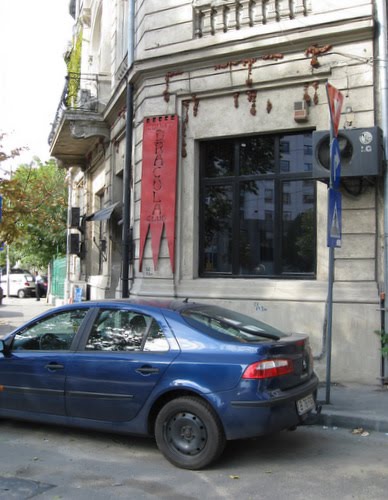
I was actually surprised to find how omnipresent Vlad Tepes/Dracula is in Bucharest. Even Bram Stoker seems to be a household name! Most of the souvenirs are pretty kitschy, but I had a pretty pleasant time at the Count Dracula Club, a theme restaurant where you can get vampiric cocktails and menus based on Dracula. So I had a 'vampire coffin' cocktail, paprika chicken and tasted their Tuica. All pretty nice and it ended with the count himself turning up, quoting Stoker and biting 'Mina' on the neck. Good fun, and not expensive.


Apart from the exhibition, the other highlight of my trip was a visit to the church on an island in the lake Snagov, Lacul Snagov, where the remains of Vlad Tepes were buried according to legend.

I hired a 'limousine' to there, which also allowed me to get some more information on the town and on Romania in general from the driver. Just €65 to go there and back, which is pretty reasonable for a 3 hour ride.

In any case, it was like entering another world when we drove off the high way and entered the forest. The road was awful, but the driver knew his way around, so everything went fine. We encountered a few horse carts and people collecting logs, everything more or less like pictures I had seen of rural Romania.


A bridge is being constructed to the island where the Snagov monastery is located, but I think it will take some time before it is finished. In the meantime you still have to go by boat to the island, and this means sailing in an old fashioned rowing boat across the lake as shown in the photo below, and no one seems to be thinking about life vests! Anyway, everything went fine, and I and my driver got to the island. I was actually the only tourist around, and I may even have been the only one that day!


The monastery or church is pretty small like so many of the Romanian Orthodox churches. It costs 15 lei to enter and 5 lei to be rowed back and forth, which is around €2.50. Photography, unfortunately, is very expensive, €20 I think. The main attraction is the 'grave' of Vlad Tepes, which is easy to find.

So I and my driver went around the small island, while he retold some of the stories about Vlad Tepes. Not quite historically correct, but who cares as all the circumstances surrounding this visit to a place I have read about since I was a teenager made it a highlight of a trip.

I hope to return some time in a not too distant future to 'go to the mountains', as I was recommended at the hotel, and see some of the other places I have read about, as well as the Carpathians and the Romanian countryside. But I should not wait too long, because in ten years or so Snagov and other locations may have turned into tourist traps as we know them from other countries: crowded and expensive.

The only disappointment I had was a 'standard tour' of the Parliament. The building or palace itself and the boulevard leading to it looks like the remnants of a megalomaniac vision, but I had expected more from the tour of the interiors. Anyway, this has nothing to do with vampires per se, and it did not spoil the highlights of the Dracula exhibition and Snagov!


Related Posts Plugin for WordPress, Blogger...