'This book represents one Hungarian historian and traveler's sometimes elusive but ever conscientious filtering of numerous sources - sources including not only those books listed in the bibliography (some folkloric works available only in Hugarian) but also Hungarian-language and other archival materials and, indeed, stories heard during many journeys over many years in Transylvania and elsewhere.'
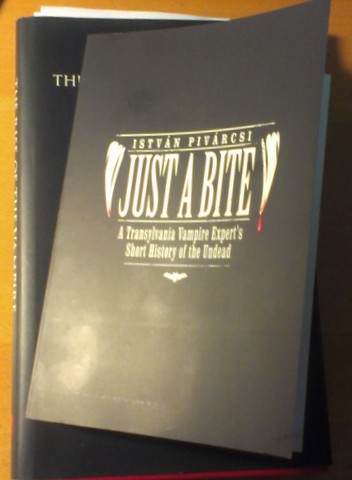
Hungarian historian István Pivárcsi has written a number of books on vampires and other subjects in Hungarian, while so far only the book quoted from above has been translated into English: Just A Bite: A Transylvania Vampire Expert's Short History of the Undead (paperback, 292 pages, $14.95). 'For more than twenty years he has led vampire tours in neighboring Transylvania,' the publishers write, making the reader expect that the book will contain a lot of information on vampires related specifically to Transylvania. Most of the book, however, covers ground familiar from numerous other books: Vlad Tepes, Elizabeth Bathory, Gilles de Rais, werewolves, zombies, the Golem, beliefs related to blood, vampire bats, porphyria, and the vampire of popular culture, and quite a lot of what is said about Romanian vampire beliefs is very brief.
Pivárcsi writes that, 'although research has found that vampire myths are rooted most firmly in Serbian, Croatian, Ukrainian, Romanian, and Ruthenian folklore,' Transylvania is of particular importance in 'vampirology', as he names the field:
'Largely because the vampire that was to become best known by name, Count Dracula, was linked in the popular imagination to that region,' even though he actually ruled south of Transylvania, but also because 'Romanian folklore in particular came to be permeated by vampires, thanks in no small part to a certain tenet of the Eastern Orthodox Church - name, that those people who died after being excommunicated returned as the walking dead - moroi in Romanian. Indeed, such souls were condemned to remain in this most unfortunate state of limbo until the Church saw fit to relieve them of the curse.' According to Pivárcsi, it was, however, the merging with the strigoi, 'a nocturnal death-bird with supernatural powers that flew about at night, hunting human flesh and blood,' 'that yielded the characteristic Romanian vampire figure whose modern permutations we have come to know. Linked as they were to the Christian religious tradition that pervaded nearly every aspect of society, vampires became seen as agents of Satan, as instruments of evil bent on violating and annihilating humanity - and it was thought that a whole army of them were out there in the night maneuvering for final victory. They fed on human blood, and their bite infected their victims with vampirism. Blood and darkness alone sustained them.'
Pivárcsi, unfortunately, does not evolve this theme much, but in a short chapter he relates some accounts related to the Transylvanian belief that 'were adapted by your humble guide from my archival research in Transylvania coupled with material in the works of the noted twentieth-century Hungarian folklorists Enikö Csögör and Tekla Dömötör.' There are in fact only five accounts, or 'possibly true tales', a couple of which are rather schematic, while the rest include other, and more interesting aspects of local folk beliefs that unfortunately are not dealt with in the book.
The book also includes a glossary, and a chronology in which it is claimed that Philip Rohr's De masticatione mortuorum 'is the first work to be published in German language about vampires,' while under 1710 it says: 'Vampire hysteria sweeps across Eastern Prussia. Numerous cemeteries are dug up, and a mob sets the houses of suspected vampires on fire.' This sounds like a Hammer film! Equally apocryphal, yet still fascinating is the entry for 1725-1732: 'In the southern territories ruled by the Austrians, inhabited mainly by Serbians, several people are sentenced to death on charges of vampirism.'
The only part of the book that presents something truly Hungarian that is probably not available elsewhere, concerns the Hungarian silent Dracula film, Drakula halála, from 1921, so if you are looking for information on that one, Pivárcsi's book may be worth getting hold of. Otherwise, well, maybe this book is simply intended for younger readers looking for a popular introduction to the subject, and in that respect it is probably not worse than so many other books. But if you are looking for something on Hungarian or Transylvanian folk beliefs, I'd rather go for e.g. Tekla Dömötör's Hungarian Folk Beliefs.
The original title of the book is not mentioned, but I think this is a translation of Pivárcsi's Drakula gróf és társai originally published in 2003.
The publisher, New Europe Books, specializes in books from and about the former East Bloc, 'a literary landscape shrouded for all too many in mystery': 'We seek to introduce new and classic-yet-undiscovered authors and books whose stories will resonate with readers far afield. Our authors include not only those born and raised in this part of the world (whether or not they happen to write about their own societies) but also expatriate writers from elsewhere and those who may have lived abroad for a short or long time but whose ancestry is rooted firmly somewhere in Eastern Europe—in short, all those whose lives are bound up in some manner with the region, and who share startling new perspectives on the human condition that will appeal to readers from far reaches of the globe.'
On several occasions, particularly on the periphery of the Habsburg Empire during the 17th and 18th centuries, dead people were suspected of being revenants or vampires, and consequently dug up and destroyed. Some contemporary authors named this phenomenon Magia Posthuma. This blog is dedicated to understanding what happened and why.
Showing posts with label Hungary. Show all posts
Saturday, 12 October 2013
Sunday, 16 June 2013
Symbolic trepanation
![]() |
| Source: Bolgari |
Trepanations can be divided into three classes: 1) Those performed on living subjects as a therapeutic method. 2) Those performed on a corpse for "magic" properties. 3) Incomplete trepanations that are performed on living subjects without fully removing a piece of the skull, perhaps only scraping off portions of the skull. The last ones are those signified as symbolic trepanations and are supposed to be performed for cultical reasons.
Several examples of this kind of trepanation are known from Hungary (according to Berecki, Molnár, Marcsik, Pálfi: Rare Types of Trephinations from Hungary Shed New Light on Possible Cross-cultural Connections in the Carpathian Basin in International Journal of Osteantrohopology, it was fairly common there in the 9th to the 11th century, cf. also this blog).
The term symbolic trepanation was introduced by the Hungarian L. Bartucz in 1950, and Yordanov himself has studied the phenomenon on finds from the West coast of the Black Sea (Jordanov, Dimitrova, and Nikolov: Symbolic Trepanations of Skulls from the Middle Ages (IXth - Xth Century) in Bulgaria in Acta Neurochirurgica Vol 92 (1988), issue 1-4, pp. 15-18).
Sunday, 27 November 2011
Body, Soul, Spirits & Supernatural Communication
I have seen this announcement a couple of times recently:
BODY: SOUL: SPIRITS & SUPERNATURAL COMMUNICATION
International Conference
Hungarian Academy of Sciences, Pécs, Hungary
18th-20th May 2012, Friday to Sunday
Department of Ethnology and Cultural Anthropology of Pécs University
The Folklore Department of the Hungarian Ethnographic Society, &
ISFNR Belief Narrative Research Network
CALL FOR PAPERS
June 1st 2011
This conference will be the ninth in a row of events launched by the Hungarian organisers in 1993 under the heading “concepts of religious ethnology in an interdisciplinary approach”. To date this has resulted in eight publications. The primary objective we declared at the outset of the project is still valid today: to approach various concepts of religious ethnology and to survey the latest findings from the angle of folklore studies, anthropology, religious studies, cultural history, psychiatry, literary studies etc.; as well as to create an interdisciplinary discourse to find the solution to our various scientific problems. Participants at the conference will include academics from all parts of Europe to give us an even closer view of current European research areas.
Each of the topics mentioned in the title deserves investigation in its own right; however, at this conference our main aim is to capture the set of connections which exist around these three topics. Thus we need to explore the ties between different notions of the soul, communicational techniques and functions and the spiritual world which is supposed to decode such communication. We would also welcome papers which investigate the role of notions of the soul and the spirit world in the everyday life, religion and mentality of various communities. On the other hand, we would like to explore the narrative traditions surrounding each of our themes: narrative metaphors for notions of the soul and for supernatural communication, their representations in folklore, literature, the arts and academic literature, as well as the ways in which beliefs and narratives are related.
As regards notions of the soul, folklore research has presented a rather simplistic account in the past, insofar as they reduced the topic, at least with regard to Christian Europe, to something like “the Christian duality of body and soul versus the remnants of the mythological legacy of the different peoples”. The latter mainly refers to representations of the free soul/shadow soul, alter ego or second body as well as their traces in literature and folklore. E.g. in a Hungarian respect this mainly meant exploring the “shamanistic” legacy of the nation’s archaic pre-Christian religion, while in Greek literature and philosophy they were discovering remains of Thracian or Iranian shamanism, etc. Besides this simple pattern, research sometimes came face to face with the more nuanced notions of the soul held by certain non-Christian and even non-European peoples, e.g. the rich ancient Greek literary, philosophical and linguistic heritage or Germanic mediaeval data (or, in the Hungarian context, the varied material of the Ob-Ugrian linguistic relatives), which were mainly examined by linguists, literary scholars, researchers of religion, theologians and philosophers (e.g. Erwin Rohde, Jan Bremmer, Hans-Peter Hasenfratz, Régis Boyer, Claude Lecouteux, etc.). It barely occurred to anthropologists studying similar subjects abroad to look around their own neighbourhood.
Research conducted by linguists and historians of religion about notions of the soul, the free soul or the alter ego which breaks away from the body, have attained considerable results in Europe, but rarely if ever have scholars looked into the role of these notions in the everyday religiosity of a community, and in the communication with the supernatural. As regards the exploration of Christian visions, both religious studies and anthropology have made serious advances in the last few decades, particularly as regards investigations into the religious and social role of visions in the Middle Ages and the modern period (pl. Ernst Benz, Peter Dinzelbacher, Jean-Claude Schmitt, Claude Lecouteux, most recently William Christian, Galia Valtchinova and many others). At the same time, many other forms of communication have remained unexplored, nor do we see clearly regarding the boundaries and interconnections of various systems of communication (e.g. shamanism, spirit possession, Christian visions, mediumism, etc.) with each other and with different notions of the soul.
Therefore we believe that the time has come to gain a somewhat more nuanced picture of the notions of the soul held by the peoples of Europe, in the above indicated context of connections. It would be desirable to form clear ideas about the extent to which the notions of the soul used by various religions and denominations were known, the local interpretations that existed, the special “popular” notions and representations of the soul which might differ from or only partially converge with the former; as well as alternative traditions that have been preserved alongside Christianity and survived in folklore collections, literary and linguistic relics or have merged with Christianity. (Naturally, Christian notions are also far from being homogeneous and have been changing along the constantly shifting ideas and boundaries of monism/dualism/trialism and also in relation to the various eschatological and resurrection dogmas which are in themselves also in constant change. At the same time they have helped sustain popular and non-Christian traditions.) We are not necessarily implying here the existence of a unified and clearly outlined notion of the soul or several, clearly delineated souls with different functions – it is more to do with the (frequently merging) representations of different ideas and notions as they appear in mentality, way of thinking, folklore or literature.
It is this rich and varied array of phenomena that needs to be mapped out for each nation and culture, including their terminology, cultural and social context, linguistic metaphors, visual representations and meaning, with regard to a people or a geographic unit or local society, preferably in the context of the above described connections, meaning the role they play in sacred communication.
A few possible points to anchor this vast and varied material may be the following.
1. Concepts of the soul
Life soul, selbst, psyché. life force (vitalstoff) as a body-soul immanently present in the body, the ‘inside’ (thymos) which is clearly connected to some part of the body (head, brain, heart, liver, kidneys etc.), it resides there and is associated with bodily functions (breathing, breath, blood circulation, sperm). The soul related to some natural element or phenomenon such as the wind blowing (duše), fog, water. Functions related to various notions/terms for the soul (life force, mental concepts, breathing, movement) etc.
The free soul, external soul, mirror or shadow soul, double ( alter ego, double, harm, fylgja etc.) as the seat of life force, as the depository of communication with the supernatural. It is outside the body either constantly or temporarily, it breaks away from the soul in dreams, in a trance etc. Living and dead, bodily and spiritual variants. Their connection with the soul which lives on after death and with mortal spirits. Its formations (human, animal, mirror image, light, foggy figure). It is only observable in certain situations, at certain times, before death; appears only in dreams or visions. An invisible protector, companion (guardian angel), a fate soul which determines destiny or prophecies the future. It is an emotional and intellectual tie with the alter ego of oneself or others (mara/Mahr/mora phenomena). Accompanying, guarding, helping and initiating spirits interpreted as formal variants of the free soul.
Narrative traditions related to notions of the soul, motifs in stories and legends for the free soul, shadow soul, external soul, as well as departure from the body, the soul departing in sleep, narrative metaphors for transformation, metamorphosis, for turning into a soul (flight, invisibility, becoming small, entering through the keyhole, travelling in a small object, walking on the water, turning into an animal etc.).
Special creatures who have a free soul or an alter ego since birth – two-souled creatures, double beings, shapeshifters: werewolves and mara/mora/Mahr/Alp/lidérc beings, vampires, witches and magicians.
2. Body and soul – death, life after death, spirits of the dead
Death of an individual: death of the body and/or soul, the bodily and spiritual existence of the dead. Dead body (drying out, turning to dust, whether the soil will or will not admit it). Bodies living on, living dead bodies. Half-living or revived bodies, possessed dead bodies. What (sort of soul) dies along with the body, what survives the body. Souls living on in dead bodies and in bones.
Deathbed – with ancestors and relatives appearing, coming to take the soul. Companions of the soul (angels, saints, demons). The soul at the moment of death, which soul dies. Whether and how it leaves the body, where it goes, what shape it takes (breath, blood, fog, tiny man, tiny angel, naked baby, bee, bird etc.). Linguistic metaphors for the departure of the body. The place where the departing soul resides, its different stages, periods, dates of departure. Gradual death, bodily functions which persist temporarily after death, gradual departure. Transitory places, transitory existence: dead persons with no status who have not found a final place of rest, souls roaming in a liminal existence.
Souls and spirits in the other world, up, down, in heaven, in the underworld, in the woods, on the mountain, on an island, under water. The spirit of the dead in the other world – bodily and spiritual attributes and manifestations. Personal judgement and resurrection, resurrected body and/or soul – the fate of the body and/or soul in the meantime; souls in purgatory. Transition between different other worlds. Last judgement, the final destiny of the soul after resurrection.
Souls remaining in the soil, in the body, in the cemetery (in or around the grave), in the house, with the family; the dead of the family in the house, around the hearth, the soul of the ancestor in the wall, around the hearth, under the doorstep – in an animal form (house snake, talašom etc., ‘building sacrifices’). The spirit of the dead person in the likeness, statue, magical object (talisman, stoicheion). Dead people turned into guardian spirits of the family or the individual, ‘evil dead’ assaulting the family or the community.
Mythical beings fused or merged with the dead: fairies; ill-intentioned dead turned into demons; ‘two-souled creatures’ – people who have alter egos or living and dead variants (witches, magicians, vampires), demons. Spiritual beings which are half human or a transition between human and spirit – ‘light shadowed ones’, ‘wind-men’ (storm magicians, stuha, zduhać, płanetnyk, chmurnik); fairies.
Spirits of the dead or possessing dead who return to the human community, to earth, who appear to humans (in a dream, trance, in an earthly setting as ghosts, in ’a bodily form’, individually or in a group), helping or assaulting humans, snatching them to death, hoping that they would influence their otherworldly destiny or demanding offerings. Occasions, time and purpose for returning/appearance; times and places of the dead on earth.
3. Supernatural communication – in the context of the body-soul and spirits
General, spontaneous, lay forms and professionals who use certain bodily/spiritual capacities, birth traits (they have a special soul, alter ego or peculiar guardian spirits etc, and communicate with a unique spirit world or other worlds).
Communication with the dead, with spirits of the dead, with demons of storm clouds, ‘walking with the fairies’ etc. Forms and functions of such communication (assaults by the dead, snatching the living for ‘initiation’, possession by the dead, poltergeist phenomena). Communication with dead people or spirits who appear in dreams. Communication through alter egos/doubles of the living. Lay and professional communication with the dead, with spirits through a double who had broken away from the person: horizontal, earthly travels of the double. Double beings, creatures with two souls and shapeshifters communicating between the worlds of nature and culture (werewolf), and between the human world and the night world of the dead and demons through their demonic alter egos: mora, Mahr, witch, strigoi, vampire etc. Helping spirits as the unique manifestations of the alter ego.
Techniques of the communication. Communication in a trance – inducing a trance, relevant techniques (spontaneous transe, self-suggestion, meditation, objects inducing a trance such as a mirror, water etc). The state of the body and the soul in a transe. Seers and fortune tellers reporting in a transe about their journey int he other world.
Ritual communication, symbolic and trance-inducing rites (fasting, St. Lucy’s stool, magic circle, magic wand, walking around the grave of the dead and the ‘places of the fairies’, beating them with the wand). Ritual invocation of the dead and of fairies, rites for acquiring spirit helpers or invoking the dead.
Spontaneous and professional, ritually induced activity of mediums. The clairvoyant as a medium possessed by the dead. The role of music, dance and turning round in inducing trance; ritual possession by the dead or by fairies (healing societies: rusalia, rusalje, căluşari, etc.).
‘Journeys’ of the free soul – with companions, helping souls or spirits or without; the free soul rises out of the body, elevates itself, looks back and sees the body or the earth; falling in a tunnel, crossing the water in a vehicle, rising with the vapours into a storm cloud; flying in dream to a ’fairy heaven’; turning into an animal and thus joining the demonic werewolf troupe; travelling to a witches’ Sabbath on the back of animals, or of objects or metamorphosed into an animal; flying to the fairy other world with a troupe of fairies, making music and dancing etc.
Battles of the soul in dream or trance, against hostile harming spirits, storm souls in storm clouds, against assaulting werewolf demons, between good and bad – healing and harmful – spirits (in a possession trance); night battles (in a dream or trance) against the assaults of the dead or demons.
Narrative tradition, linguistic metaphors and textual representations of trance experiences and soul journeys, of communication through alter egos, of being snatched by the dead and of journeys to the other world, accounts of such experience, motifs in tales, legends and literature; folklore and literary motifs of journeys to the other world; narrative traditions of fairy other worlds and witches’ Sabbaths.
*
Papers are welcome without restrictions on methodology or on the time and place of their subject matter as long as they use a theoretical approach in folklore studies, anthropology, cultural history, sociology etc. We also welcome comparative historical or textual philological analyses or presentations of research findings based on archive work or field work either in our outside of Europe, as well as analyses of religious phenomena from the perspective of religious anthropology, history of religion, theology etc. Mere descriptions of material are acceptable only if they considerably enhance our knowledge about a particular field.
The conference will be bilingual (Hungarian and English), and might take place in parallel sections, preferably in alternate time periods. (In such a case foreign participants will be offered optional cultural events or excursions for the duration of Hungarian papers.)
We request applicants to submit applications with an abstract of 10-15 sentences before August 20th 2011 on the form attached. The full text of the papers should be submitted no later than April 30th 2012 in order to leave sufficient time for circulating and printing.
Although publication of the proceedings of our last conference (Magical and Sacred Medical World) in English are still not forthcoming, we are not giving up hope and will do everything for the material of this conference to appear in both languages. While the Hungarian publication seems almost guaranteed, we are making efforts to secure an English version, too.
Costs for participants are presently being calculated, and organisers will do their best to keep costs manageable. (Should we fail to secure sponsorship, costs for three days and three or four nights, including food and accommodation but excluding travel costs, are expected to be around EUR 200.)
The maximum number of papers to be accepted for presentation is 50. Should there be more applicants than this, we will be forced to select among presenters. However, we shall not limit the number of non-presenting participants. We also reserve the right to reject papers for thematic discrepancy or other reasons.
Please, submit applications to the address below (by e-mail or post).
Professor Emeritus Éva Pócs
PTE Néprajz-Kulturális Antropológia Tanszék
7624 Pécs, Rókus u. 2.
e-mail: pocse@chello.hu
Application form for the conference Body, Soul and Supernatural Communication (Pécs, 18th-20th May 2012)
Name:
Occupation, position, title, employer:
Postal address:
Telephone:
E-mail:
Title of paper:
Language of paper:
Abstract (10-15 sentences):
---
Éva Pócs is known for her work - in some cases in cooperation with Gabor Klaniczay - on Hungarian witchcraft cases and folklore.
BODY: SOUL: SPIRITS & SUPERNATURAL COMMUNICATION
International Conference
Hungarian Academy of Sciences, Pécs, Hungary
18th-20th May 2012, Friday to Sunday
Department of Ethnology and Cultural Anthropology of Pécs University
The Folklore Department of the Hungarian Ethnographic Society, &
ISFNR Belief Narrative Research Network
CALL FOR PAPERS
June 1st 2011
This conference will be the ninth in a row of events launched by the Hungarian organisers in 1993 under the heading “concepts of religious ethnology in an interdisciplinary approach”. To date this has resulted in eight publications. The primary objective we declared at the outset of the project is still valid today: to approach various concepts of religious ethnology and to survey the latest findings from the angle of folklore studies, anthropology, religious studies, cultural history, psychiatry, literary studies etc.; as well as to create an interdisciplinary discourse to find the solution to our various scientific problems. Participants at the conference will include academics from all parts of Europe to give us an even closer view of current European research areas.
Each of the topics mentioned in the title deserves investigation in its own right; however, at this conference our main aim is to capture the set of connections which exist around these three topics. Thus we need to explore the ties between different notions of the soul, communicational techniques and functions and the spiritual world which is supposed to decode such communication. We would also welcome papers which investigate the role of notions of the soul and the spirit world in the everyday life, religion and mentality of various communities. On the other hand, we would like to explore the narrative traditions surrounding each of our themes: narrative metaphors for notions of the soul and for supernatural communication, their representations in folklore, literature, the arts and academic literature, as well as the ways in which beliefs and narratives are related.
As regards notions of the soul, folklore research has presented a rather simplistic account in the past, insofar as they reduced the topic, at least with regard to Christian Europe, to something like “the Christian duality of body and soul versus the remnants of the mythological legacy of the different peoples”. The latter mainly refers to representations of the free soul/shadow soul, alter ego or second body as well as their traces in literature and folklore. E.g. in a Hungarian respect this mainly meant exploring the “shamanistic” legacy of the nation’s archaic pre-Christian religion, while in Greek literature and philosophy they were discovering remains of Thracian or Iranian shamanism, etc. Besides this simple pattern, research sometimes came face to face with the more nuanced notions of the soul held by certain non-Christian and even non-European peoples, e.g. the rich ancient Greek literary, philosophical and linguistic heritage or Germanic mediaeval data (or, in the Hungarian context, the varied material of the Ob-Ugrian linguistic relatives), which were mainly examined by linguists, literary scholars, researchers of religion, theologians and philosophers (e.g. Erwin Rohde, Jan Bremmer, Hans-Peter Hasenfratz, Régis Boyer, Claude Lecouteux, etc.). It barely occurred to anthropologists studying similar subjects abroad to look around their own neighbourhood.
Research conducted by linguists and historians of religion about notions of the soul, the free soul or the alter ego which breaks away from the body, have attained considerable results in Europe, but rarely if ever have scholars looked into the role of these notions in the everyday religiosity of a community, and in the communication with the supernatural. As regards the exploration of Christian visions, both religious studies and anthropology have made serious advances in the last few decades, particularly as regards investigations into the religious and social role of visions in the Middle Ages and the modern period (pl. Ernst Benz, Peter Dinzelbacher, Jean-Claude Schmitt, Claude Lecouteux, most recently William Christian, Galia Valtchinova and many others). At the same time, many other forms of communication have remained unexplored, nor do we see clearly regarding the boundaries and interconnections of various systems of communication (e.g. shamanism, spirit possession, Christian visions, mediumism, etc.) with each other and with different notions of the soul.
Therefore we believe that the time has come to gain a somewhat more nuanced picture of the notions of the soul held by the peoples of Europe, in the above indicated context of connections. It would be desirable to form clear ideas about the extent to which the notions of the soul used by various religions and denominations were known, the local interpretations that existed, the special “popular” notions and representations of the soul which might differ from or only partially converge with the former; as well as alternative traditions that have been preserved alongside Christianity and survived in folklore collections, literary and linguistic relics or have merged with Christianity. (Naturally, Christian notions are also far from being homogeneous and have been changing along the constantly shifting ideas and boundaries of monism/dualism/trialism and also in relation to the various eschatological and resurrection dogmas which are in themselves also in constant change. At the same time they have helped sustain popular and non-Christian traditions.) We are not necessarily implying here the existence of a unified and clearly outlined notion of the soul or several, clearly delineated souls with different functions – it is more to do with the (frequently merging) representations of different ideas and notions as they appear in mentality, way of thinking, folklore or literature.
It is this rich and varied array of phenomena that needs to be mapped out for each nation and culture, including their terminology, cultural and social context, linguistic metaphors, visual representations and meaning, with regard to a people or a geographic unit or local society, preferably in the context of the above described connections, meaning the role they play in sacred communication.
A few possible points to anchor this vast and varied material may be the following.
1. Concepts of the soul
Life soul, selbst, psyché. life force (vitalstoff) as a body-soul immanently present in the body, the ‘inside’ (thymos) which is clearly connected to some part of the body (head, brain, heart, liver, kidneys etc.), it resides there and is associated with bodily functions (breathing, breath, blood circulation, sperm). The soul related to some natural element or phenomenon such as the wind blowing (duše), fog, water. Functions related to various notions/terms for the soul (life force, mental concepts, breathing, movement) etc.
The free soul, external soul, mirror or shadow soul, double ( alter ego, double, harm, fylgja etc.) as the seat of life force, as the depository of communication with the supernatural. It is outside the body either constantly or temporarily, it breaks away from the soul in dreams, in a trance etc. Living and dead, bodily and spiritual variants. Their connection with the soul which lives on after death and with mortal spirits. Its formations (human, animal, mirror image, light, foggy figure). It is only observable in certain situations, at certain times, before death; appears only in dreams or visions. An invisible protector, companion (guardian angel), a fate soul which determines destiny or prophecies the future. It is an emotional and intellectual tie with the alter ego of oneself or others (mara/Mahr/mora phenomena). Accompanying, guarding, helping and initiating spirits interpreted as formal variants of the free soul.
Narrative traditions related to notions of the soul, motifs in stories and legends for the free soul, shadow soul, external soul, as well as departure from the body, the soul departing in sleep, narrative metaphors for transformation, metamorphosis, for turning into a soul (flight, invisibility, becoming small, entering through the keyhole, travelling in a small object, walking on the water, turning into an animal etc.).
Special creatures who have a free soul or an alter ego since birth – two-souled creatures, double beings, shapeshifters: werewolves and mara/mora/Mahr/Alp/lidérc beings, vampires, witches and magicians.
2. Body and soul – death, life after death, spirits of the dead
Death of an individual: death of the body and/or soul, the bodily and spiritual existence of the dead. Dead body (drying out, turning to dust, whether the soil will or will not admit it). Bodies living on, living dead bodies. Half-living or revived bodies, possessed dead bodies. What (sort of soul) dies along with the body, what survives the body. Souls living on in dead bodies and in bones.
Deathbed – with ancestors and relatives appearing, coming to take the soul. Companions of the soul (angels, saints, demons). The soul at the moment of death, which soul dies. Whether and how it leaves the body, where it goes, what shape it takes (breath, blood, fog, tiny man, tiny angel, naked baby, bee, bird etc.). Linguistic metaphors for the departure of the body. The place where the departing soul resides, its different stages, periods, dates of departure. Gradual death, bodily functions which persist temporarily after death, gradual departure. Transitory places, transitory existence: dead persons with no status who have not found a final place of rest, souls roaming in a liminal existence.
Souls and spirits in the other world, up, down, in heaven, in the underworld, in the woods, on the mountain, on an island, under water. The spirit of the dead in the other world – bodily and spiritual attributes and manifestations. Personal judgement and resurrection, resurrected body and/or soul – the fate of the body and/or soul in the meantime; souls in purgatory. Transition between different other worlds. Last judgement, the final destiny of the soul after resurrection.
Souls remaining in the soil, in the body, in the cemetery (in or around the grave), in the house, with the family; the dead of the family in the house, around the hearth, the soul of the ancestor in the wall, around the hearth, under the doorstep – in an animal form (house snake, talašom etc., ‘building sacrifices’). The spirit of the dead person in the likeness, statue, magical object (talisman, stoicheion). Dead people turned into guardian spirits of the family or the individual, ‘evil dead’ assaulting the family or the community.
Mythical beings fused or merged with the dead: fairies; ill-intentioned dead turned into demons; ‘two-souled creatures’ – people who have alter egos or living and dead variants (witches, magicians, vampires), demons. Spiritual beings which are half human or a transition between human and spirit – ‘light shadowed ones’, ‘wind-men’ (storm magicians, stuha, zduhać, płanetnyk, chmurnik); fairies.
Spirits of the dead or possessing dead who return to the human community, to earth, who appear to humans (in a dream, trance, in an earthly setting as ghosts, in ’a bodily form’, individually or in a group), helping or assaulting humans, snatching them to death, hoping that they would influence their otherworldly destiny or demanding offerings. Occasions, time and purpose for returning/appearance; times and places of the dead on earth.
3. Supernatural communication – in the context of the body-soul and spirits
General, spontaneous, lay forms and professionals who use certain bodily/spiritual capacities, birth traits (they have a special soul, alter ego or peculiar guardian spirits etc, and communicate with a unique spirit world or other worlds).
Communication with the dead, with spirits of the dead, with demons of storm clouds, ‘walking with the fairies’ etc. Forms and functions of such communication (assaults by the dead, snatching the living for ‘initiation’, possession by the dead, poltergeist phenomena). Communication with dead people or spirits who appear in dreams. Communication through alter egos/doubles of the living. Lay and professional communication with the dead, with spirits through a double who had broken away from the person: horizontal, earthly travels of the double. Double beings, creatures with two souls and shapeshifters communicating between the worlds of nature and culture (werewolf), and between the human world and the night world of the dead and demons through their demonic alter egos: mora, Mahr, witch, strigoi, vampire etc. Helping spirits as the unique manifestations of the alter ego.
Techniques of the communication. Communication in a trance – inducing a trance, relevant techniques (spontaneous transe, self-suggestion, meditation, objects inducing a trance such as a mirror, water etc). The state of the body and the soul in a transe. Seers and fortune tellers reporting in a transe about their journey int he other world.
Ritual communication, symbolic and trance-inducing rites (fasting, St. Lucy’s stool, magic circle, magic wand, walking around the grave of the dead and the ‘places of the fairies’, beating them with the wand). Ritual invocation of the dead and of fairies, rites for acquiring spirit helpers or invoking the dead.
Spontaneous and professional, ritually induced activity of mediums. The clairvoyant as a medium possessed by the dead. The role of music, dance and turning round in inducing trance; ritual possession by the dead or by fairies (healing societies: rusalia, rusalje, căluşari, etc.).
‘Journeys’ of the free soul – with companions, helping souls or spirits or without; the free soul rises out of the body, elevates itself, looks back and sees the body or the earth; falling in a tunnel, crossing the water in a vehicle, rising with the vapours into a storm cloud; flying in dream to a ’fairy heaven’; turning into an animal and thus joining the demonic werewolf troupe; travelling to a witches’ Sabbath on the back of animals, or of objects or metamorphosed into an animal; flying to the fairy other world with a troupe of fairies, making music and dancing etc.
Battles of the soul in dream or trance, against hostile harming spirits, storm souls in storm clouds, against assaulting werewolf demons, between good and bad – healing and harmful – spirits (in a possession trance); night battles (in a dream or trance) against the assaults of the dead or demons.
Narrative tradition, linguistic metaphors and textual representations of trance experiences and soul journeys, of communication through alter egos, of being snatched by the dead and of journeys to the other world, accounts of such experience, motifs in tales, legends and literature; folklore and literary motifs of journeys to the other world; narrative traditions of fairy other worlds and witches’ Sabbaths.
*
Papers are welcome without restrictions on methodology or on the time and place of their subject matter as long as they use a theoretical approach in folklore studies, anthropology, cultural history, sociology etc. We also welcome comparative historical or textual philological analyses or presentations of research findings based on archive work or field work either in our outside of Europe, as well as analyses of religious phenomena from the perspective of religious anthropology, history of religion, theology etc. Mere descriptions of material are acceptable only if they considerably enhance our knowledge about a particular field.
The conference will be bilingual (Hungarian and English), and might take place in parallel sections, preferably in alternate time periods. (In such a case foreign participants will be offered optional cultural events or excursions for the duration of Hungarian papers.)
We request applicants to submit applications with an abstract of 10-15 sentences before August 20th 2011 on the form attached. The full text of the papers should be submitted no later than April 30th 2012 in order to leave sufficient time for circulating and printing.
Although publication of the proceedings of our last conference (Magical and Sacred Medical World) in English are still not forthcoming, we are not giving up hope and will do everything for the material of this conference to appear in both languages. While the Hungarian publication seems almost guaranteed, we are making efforts to secure an English version, too.
Costs for participants are presently being calculated, and organisers will do their best to keep costs manageable. (Should we fail to secure sponsorship, costs for three days and three or four nights, including food and accommodation but excluding travel costs, are expected to be around EUR 200.)
The maximum number of papers to be accepted for presentation is 50. Should there be more applicants than this, we will be forced to select among presenters. However, we shall not limit the number of non-presenting participants. We also reserve the right to reject papers for thematic discrepancy or other reasons.
Please, submit applications to the address below (by e-mail or post).
Professor Emeritus Éva Pócs
PTE Néprajz-Kulturális Antropológia Tanszék
7624 Pécs, Rókus u. 2.
e-mail: pocse@chello.hu
Application form for the conference Body, Soul and Supernatural Communication (Pécs, 18th-20th May 2012)
Name:
Occupation, position, title, employer:
Postal address:
Telephone:
E-mail:
Title of paper:
Language of paper:
Abstract (10-15 sentences):
---
Éva Pócs is known for her work - in some cases in cooperation with Gabor Klaniczay - on Hungarian witchcraft cases and folklore.
Friday, 31 July 2009
Hungarian roots
An interest in vampires can be hard to suppress, at least for some of us. In the foreword to a masters thesis on the Hungarian roots of Nosferatu, Csaba Ljendel traces his interest back to 1996 when as a freshman studying medicine in Vienna he got interested in illnesses that might be connected with the subject of vampires. After some time he stopped studying medicine and got a job in the Austrian police, which allowed him to later on go back to the university to study Hungarology - and vampires! This year he then submitted his thesis (Magisterarbeit), which can be found on the internet via the above link.
Sunday, 28 June 2009
Flea market finds
Yesterday I went to a local flea market and came back home with a book of manuscripts from Carl Th. Dreyer's Vampyr and three other of his movies, as well as a 1963 Atlas zur Weltgeschichte. All for the price of approximately 2 Euros.
Below I have scanned two maps from the latter book, and you can click on them to view them in more detail.
The first scan is of a map of Hungary after the wars with the Ottomans. At the bottom is the extent of occupied areas between 1717 and 1739, including the areas of Serbia of particular interest to this blog. The Southern border, cf. earlier posts like this, this, and this, is here shown a few kilometers south of the Zapadna Morava and Krusevac (Kruschewatz).
To the East in Siebenbürgen (Transylvania) you find several places known from Stoker's Dracula, like Bistritz, and to the West is Steiermark (Styria) the scene of Le Fanu's Carmilla. Here is also Krain, the subject of Johann Weichard von Valvasor's Die Ehre des Hertzogthums Crain.
To the North West is Vienna and the Southern part of Mähren (Moravia). And North of Serbia Banat Temesvar, also the scene of some instances of vampirism in the 18th century. So there is really a lot of interesting locations and information shown in this map.
The second one is a map of Vienna ca. 1800. Much easier to take in than a map of modern day Vienna.
Below I have scanned two maps from the latter book, and you can click on them to view them in more detail.
The first scan is of a map of Hungary after the wars with the Ottomans. At the bottom is the extent of occupied areas between 1717 and 1739, including the areas of Serbia of particular interest to this blog. The Southern border, cf. earlier posts like this, this, and this, is here shown a few kilometers south of the Zapadna Morava and Krusevac (Kruschewatz).
To the East in Siebenbürgen (Transylvania) you find several places known from Stoker's Dracula, like Bistritz, and to the West is Steiermark (Styria) the scene of Le Fanu's Carmilla. Here is also Krain, the subject of Johann Weichard von Valvasor's Die Ehre des Hertzogthums Crain.
To the North West is Vienna and the Southern part of Mähren (Moravia). And North of Serbia Banat Temesvar, also the scene of some instances of vampirism in the 18th century. So there is really a lot of interesting locations and information shown in this map.
The second one is a map of Vienna ca. 1800. Much easier to take in than a map of modern day Vienna.
Sunday, 14 September 2008
A forgotten vampire case
I have been a bit quiet here lately, as I have been busy doing other things. But now I finally get around to mentioning that Nicolaus Equiamicus recently posted a forgotten vampire case from 1725, i.e. the same year as the Kisiljevo vampire case.
In early April of 1725 Johannes Ràcz de Mehàdia who was in charge of a district in Hungary, exhumed and examined the corpse of a dead person who while alive had been suspected of being a sorcerer. He found the corpse uncorrupted and with blood under its head. As the body had been buried for three months, he concluded that it must be that of a blood sucker (Bluthsauger). With the permission the Imperial Oberinspektor, Baron von Rebenstich, he dealt with the body in the accustomed manner, probably as is well known from the other vampire cases.
Quotes from the sources can be found via the above link.
In early April of 1725 Johannes Ràcz de Mehàdia who was in charge of a district in Hungary, exhumed and examined the corpse of a dead person who while alive had been suspected of being a sorcerer. He found the corpse uncorrupted and with blood under its head. As the body had been buried for three months, he concluded that it must be that of a blood sucker (Bluthsauger). With the permission the Imperial Oberinspektor, Baron von Rebenstich, he dealt with the body in the accustomed manner, probably as is well known from the other vampire cases.
Quotes from the sources can be found via the above link.
Friday, 21 March 2008
Another docudrama
Speaking of documentaries about vampires and Magia Posthuma, below you will find a clip from the History Channel documentary Vampire Secrets that dramatizes chapter 8 of Calmet's volume on revenants and vampires, Morts de Hongrie qui sucent le sang des vivants (Dead persons in Hungary who suck the blood of the living).
The original source in the translation of Henry Christmas:
About fifteen years ago, a soldier who was billeted at the house of a Haidamaque peasant, on the frontiers of Hungary, as he was one day sitting at table near his host, the master of the house saw a person he did not know come in and sit down to table also with them. The master of the house was strangely frightened at this, as were the rest of the company. The soldier knew not what to think of it, being ignorant of the matter in question. But the master of the house being dead the very next day, the soldier inquired what it meant. They told him that it was the body of the father of his host, who had been dead and buried for ten years, which had thus come to sit down next to him, and had announced and caused his death.
The soldier informed the regiment of it in the first place, and the regiment gave notice of it to the general officers, who commissioned the Count de Cabreras, captain of the regiment of Alandetti infantry, to make information concerning this circumstance. Having gone to the place, with some other officers, a surgeon and an auditor, they heard the depositions of alle the people belonging to the house, who attested unanimously that the ghost was the father of the master of the house, and that all the soldier had said and reported was the exact truth, which was confirmed by all the inabitants of the village.
In consequence of this, the corpse of this spectre was exhumed, and found to be like that of a man who has just expired, and his blood like that of a living man. The Count de Cabreras had his head cut off, and caused him to be laid again in his tomb. He also took information concerning other similar ghosts, amongst others, of a man dead more than thirty years, who had come back three times to his house at mealtime. The first time he had sucked the blood from the neck of his own brother, the second time from one of his sons, and the third from one of the servants in the house; and all three died of it instantly and on the spot. Upon this deposition the commissary had this man taken out of his grave, and finding that, like the first, his blood was in a fluid state, like that of a living person, he ordered them to run a large nail into his temple, and then to lay him again in the grave.
He caused a third to be burnt, who had been buried more than sixteen years, and had sucked the blood and caused the death of two of his sons. The commissary having made his report to the general officers, was deputed to the court of the emperor, who commanded that some officers, both of war and justice, some physicians and surgeons, and some learned men, should be sent to examine the causes of these extraordinary events. The person who related these particulars to us had heard them from the Count de Cabreras, at Fribourg in Brigau, in 1730.
Notice that in the documentary it is claimed that the event occurred at a place in Hungary called Haidamaque, whereas Calmet says that the soldier stayed with a Haydamaque peasant on the frontiers of Hungary (chez un paysan Haidamaque, frontière de Hongrie). Haydamaque denoting haidamakas, 18th Century Ukrainian paramilitary bands similar to the haiduks known from the Serbian vampire cases.
There is also a small error in the Christmas translation: Fribourg in Brigau is actually Fribourg en Brisgau, Freiburg im Breisgau situated in South Western Germany.
It is in fact quite curious to read Montague Summers's version in The Vampire in Europe (p. 147-9): Count de Cabreras becomes Count de Cadreras, and the events are said to occur in Haidam (!) around 1720. He even finishes his account by claiming:
The papers dealing with the case are still extant and the whole story was related in 1730 by the Count de Cadreras himself to a responsible official of the University of Fribourg who took down the details from the Count's own lips. It is hard to see how more reliable evidence is to be obtained of any happening or event.
Vampire Secrets is available on DVD.
The original source in the translation of Henry Christmas:
About fifteen years ago, a soldier who was billeted at the house of a Haidamaque peasant, on the frontiers of Hungary, as he was one day sitting at table near his host, the master of the house saw a person he did not know come in and sit down to table also with them. The master of the house was strangely frightened at this, as were the rest of the company. The soldier knew not what to think of it, being ignorant of the matter in question. But the master of the house being dead the very next day, the soldier inquired what it meant. They told him that it was the body of the father of his host, who had been dead and buried for ten years, which had thus come to sit down next to him, and had announced and caused his death.
The soldier informed the regiment of it in the first place, and the regiment gave notice of it to the general officers, who commissioned the Count de Cabreras, captain of the regiment of Alandetti infantry, to make information concerning this circumstance. Having gone to the place, with some other officers, a surgeon and an auditor, they heard the depositions of alle the people belonging to the house, who attested unanimously that the ghost was the father of the master of the house, and that all the soldier had said and reported was the exact truth, which was confirmed by all the inabitants of the village.
In consequence of this, the corpse of this spectre was exhumed, and found to be like that of a man who has just expired, and his blood like that of a living man. The Count de Cabreras had his head cut off, and caused him to be laid again in his tomb. He also took information concerning other similar ghosts, amongst others, of a man dead more than thirty years, who had come back three times to his house at mealtime. The first time he had sucked the blood from the neck of his own brother, the second time from one of his sons, and the third from one of the servants in the house; and all three died of it instantly and on the spot. Upon this deposition the commissary had this man taken out of his grave, and finding that, like the first, his blood was in a fluid state, like that of a living person, he ordered them to run a large nail into his temple, and then to lay him again in the grave.
He caused a third to be burnt, who had been buried more than sixteen years, and had sucked the blood and caused the death of two of his sons. The commissary having made his report to the general officers, was deputed to the court of the emperor, who commanded that some officers, both of war and justice, some physicians and surgeons, and some learned men, should be sent to examine the causes of these extraordinary events. The person who related these particulars to us had heard them from the Count de Cabreras, at Fribourg in Brigau, in 1730.
Notice that in the documentary it is claimed that the event occurred at a place in Hungary called Haidamaque, whereas Calmet says that the soldier stayed with a Haydamaque peasant on the frontiers of Hungary (chez un paysan Haidamaque, frontière de Hongrie). Haydamaque denoting haidamakas, 18th Century Ukrainian paramilitary bands similar to the haiduks known from the Serbian vampire cases.
There is also a small error in the Christmas translation: Fribourg in Brigau is actually Fribourg en Brisgau, Freiburg im Breisgau situated in South Western Germany.
It is in fact quite curious to read Montague Summers's version in The Vampire in Europe (p. 147-9): Count de Cabreras becomes Count de Cadreras, and the events are said to occur in Haidam (!) around 1720. He even finishes his account by claiming:
The papers dealing with the case are still extant and the whole story was related in 1730 by the Count de Cadreras himself to a responsible official of the University of Fribourg who took down the details from the Count's own lips. It is hard to see how more reliable evidence is to be obtained of any happening or event.
Vampire Secrets is available on DVD.
Sunday, 11 November 2007
Vampirism from a colonial pespective
According to the web site of the Ludwig-Maximilians Universität in Munich, Prof. Dr. Thomas Bohn is currently teaching a seminar on the cultural history of the vampire. The seminar started on October 17th and continues to February 5th 2008. The description of the seminar e.g. says that vampires
"were stylized as an expression of a barbarous world from which civilised Europe could be demarcated. At the same time the phrase 'vampirism' worked as an imperial category. It was primarily aimed at the border areas of the empires that stood up against each other in Central Europe. While the witch hunts of the 16th and 17th centuries proceeded from the West to the East of the continent, the posthumous staking and burning of vampires on the contrary spread from the East to the West. From a colonial perspective vampirism could be interpreted as an invasion of primitive forces and connected with slavophobic thoughts. On this background the home of the vampire displaced itself from Serbia and Hungary over Moravia and Silesia to Poland and Lithuania."
I find it a bit difficult to understand the localities mentioned in this displacement, because quite a number of Moravian and Silesian cases of Magia Posthuma antedate the Serbian vampire cases of the 18th Century. However, here is the original description of the seminar:
"Prof. Dr. Thomas Bohn
Kulturgeschichte der Vampire 3-stündig, Di 15-18 Uhr, Amalienstr. 52, R. 507 5.OG
Der Glaube an den „lebenden Leichnam“ ist ein universales Phänomen. Während in der mitteleuropäischen Variante sogenannte Nachzehrer ihre Angehörigen durch Sympathie ins Grab locken, werden in der südosteuropäischen Version Verwandte vermeintlicher Blutsauger der ewigen Verdammnis ausgesetzt. Die Vampire verdanken ihre Popularität der Aufklärung. Sie wurden zum Ausdruck einer barbarischen Welt stilisiert, von der sich das zivilisierte Europa abgrenzen konnte. Gleichzeitig fungierte das Schlagwort „Vampirismus“ als imperiale Kategorie. Es wurde bevorzugt auf die Grenzgebiete der Vielvölkerreiche bezogen, die sich in der Mitte Europas gegenüberstanden. Hatte sich die Hexenverfolgung im 16. und 17. Jahrhundert allmählich vom Westen in den Osten des Kontinents ausgedehnt, so schien sich im Gegenzug die posthume Pfählung und Verbrennung von Vampiren im 18. und 19. Jahrhundert von Osten nach Westen zu verbreiten. Aus kolonialer Perspektive ließ sich der Vampirismus daher als Invasion primitiver Kräfte deuten und mit slavophoben Sentenzen verbinden. Vor diesem Hintergrund verschob sich die Heimat der Vampire in westlichen Diskursen allmählich von Serbien und Ungarn über Mähren und Schlesien nach Polen und Litauen.
Literatur: Hamberger, Klaus (Hrsg.): Mortuus non mordet. Dokumente zum Vampirismus, 1689-1791. Wien 1992; Sturm, Dieter/Klaus Völker (Hrsg.): Von denen Vampiren und Menschensaugern. Dichtungen und Dokumente. 4. Aufl. Frankfurt am Main 2003; Thomas Schürmann: Nachzehrerglauben in Mitteleuropa. Marburg 1990; Peter Mario Kreuter: Der Vampirglaube in Südosteuropa. Studien zur Genese, Bedeutung und Funktion. Rumänien und der Balkanraum. Berlin 2001.
Bohn recently talked about "Der Dracula-Mythos" - Osteuropäischer Volksglaube und westeuropäische Klischees ("The Dracula Myth" - East European Folklore and West European Clichés) as an introduction to the movie Bram Stoker's Dracula that was shown as part of a series of symposia, workshops and conferences on Romania called donumenta in Regensburg
Bohn has also taught on the subject of Dracula - Mythos oder Wirklichkeit? (Dracula - Myth or Reality?) at the Friedrich Schiller Universität in Jena, and in 2008 he will be in charge of a seminar on Vlad Tepes „Dracula“ - Tyrann oder Volkstribun? (Vlad Tepes "Dracula" - Tyrant or tribune of the people?)
"were stylized as an expression of a barbarous world from which civilised Europe could be demarcated. At the same time the phrase 'vampirism' worked as an imperial category. It was primarily aimed at the border areas of the empires that stood up against each other in Central Europe. While the witch hunts of the 16th and 17th centuries proceeded from the West to the East of the continent, the posthumous staking and burning of vampires on the contrary spread from the East to the West. From a colonial perspective vampirism could be interpreted as an invasion of primitive forces and connected with slavophobic thoughts. On this background the home of the vampire displaced itself from Serbia and Hungary over Moravia and Silesia to Poland and Lithuania."
I find it a bit difficult to understand the localities mentioned in this displacement, because quite a number of Moravian and Silesian cases of Magia Posthuma antedate the Serbian vampire cases of the 18th Century. However, here is the original description of the seminar:
"Prof. Dr. Thomas Bohn
Kulturgeschichte der Vampire 3-stündig, Di 15-18 Uhr, Amalienstr. 52, R. 507 5.OG
Der Glaube an den „lebenden Leichnam“ ist ein universales Phänomen. Während in der mitteleuropäischen Variante sogenannte Nachzehrer ihre Angehörigen durch Sympathie ins Grab locken, werden in der südosteuropäischen Version Verwandte vermeintlicher Blutsauger der ewigen Verdammnis ausgesetzt. Die Vampire verdanken ihre Popularität der Aufklärung. Sie wurden zum Ausdruck einer barbarischen Welt stilisiert, von der sich das zivilisierte Europa abgrenzen konnte. Gleichzeitig fungierte das Schlagwort „Vampirismus“ als imperiale Kategorie. Es wurde bevorzugt auf die Grenzgebiete der Vielvölkerreiche bezogen, die sich in der Mitte Europas gegenüberstanden. Hatte sich die Hexenverfolgung im 16. und 17. Jahrhundert allmählich vom Westen in den Osten des Kontinents ausgedehnt, so schien sich im Gegenzug die posthume Pfählung und Verbrennung von Vampiren im 18. und 19. Jahrhundert von Osten nach Westen zu verbreiten. Aus kolonialer Perspektive ließ sich der Vampirismus daher als Invasion primitiver Kräfte deuten und mit slavophoben Sentenzen verbinden. Vor diesem Hintergrund verschob sich die Heimat der Vampire in westlichen Diskursen allmählich von Serbien und Ungarn über Mähren und Schlesien nach Polen und Litauen.
Literatur: Hamberger, Klaus (Hrsg.): Mortuus non mordet. Dokumente zum Vampirismus, 1689-1791. Wien 1992; Sturm, Dieter/Klaus Völker (Hrsg.): Von denen Vampiren und Menschensaugern. Dichtungen und Dokumente. 4. Aufl. Frankfurt am Main 2003; Thomas Schürmann: Nachzehrerglauben in Mitteleuropa. Marburg 1990; Peter Mario Kreuter: Der Vampirglaube in Südosteuropa. Studien zur Genese, Bedeutung und Funktion. Rumänien und der Balkanraum. Berlin 2001.
Bohn recently talked about "Der Dracula-Mythos" - Osteuropäischer Volksglaube und westeuropäische Klischees ("The Dracula Myth" - East European Folklore and West European Clichés) as an introduction to the movie Bram Stoker's Dracula that was shown as part of a series of symposia, workshops and conferences on Romania called donumenta in Regensburg
Bohn has also taught on the subject of Dracula - Mythos oder Wirklichkeit? (Dracula - Myth or Reality?) at the Friedrich Schiller Universität in Jena, and in 2008 he will be in charge of a seminar on Vlad Tepes „Dracula“ - Tyrann oder Volkstribun? (Vlad Tepes "Dracula" - Tyrant or tribune of the people?)
Saturday, 25 August 2007
Internet resources II: Zedler's Universal-Lexicon
To finally continue pointing out interesting internet resources on Magia Posthuma and related subjects (here is my first post on the subject), I would like to mention the online edition of Johann Heinrich Zedler's famous Grosses vollständiges Universal-Lexicon which was published in 64 volumes in Leipzig between 1732 and 1750. The encyclopedia gives an interesting insight into many things that have a bearing on our subject of Magia Posthuma, vampires and other revenants. In fact, there is no entry on Magia posthuma, but there are several other kinds of Magia listed and explained: Magia Adamica, Magia artificialis, Magia dæmonica, Magia diabolica, Magia directa etc. Evidently this makes it possible to get some understanding of what was understand by Magia.

We can also read about the geography of Hungary (Ungarn), where the (changing) borders are listed along with the a list of areas that were originally ('in the days of old') part of Hungary: 'Siebenbürgen, Wallachey, Bulgarien, Thracien und Romanien, Servien, Bosnien, Dalmatien, Croatien und Sclavonien' (Transylvania, Wallachia, Bulgaria, Thracia, Romania, Serbia, Bosnia, Dalmatia, Croatia and Slavonia). In this 'old' sense of the name Hungary, the Serbian vampire cases can be attributed to Hungary, whereas it has often been pointed out that some of the vampires referred to as 'Hungarian' were not located in contemporary or modern Hungary.
And, of course, there are the long entries on vampires (Vampyren) and the mastication of the dead (Schmatzen der Toden), which according to the Zedler are closely related, although of Greek origin. Vampires are defined as ‘Todte menschliche Cörper, welche aus den Gräbern hervor spazieren, den Lebendigen das Blut aussaugen, und sie dadurch umbringen sollen.’ (Dead human bodies, which walk out of the graves and suck the blood of the living, thereby killing them). Both vampire cases from Serbia (Kisiljevo 1725 and Medvedja 1731-2) are described in detail, and various aspects of Greek Orthodox faith, Valvasor's mention of vampires/revenants etc. are related and discussed. There is even a rather detailed list of many of the 18th century works on vampires, so it is really a rather nice review that sums up a lot of what one might say about vampires in Leipzig some 10-15 years after the great vampire debate of 1732.
Furthermore, one can read a detailed bibliography of Michael Ranft (here called Ranfft), and there is the short entry on von Schertz which was shown in a previous post. In short, this is a wonderful source of information for anyone interested in the knowledge of 18th century.
Connoisseuers of the gothic will probably find it intriguing that the editor of the two first volumes of the Universal-Lexicon was Jacob August Franckenstein (1689-1733), and may consequently be interested in reading the entry about the ancient family Franckenstein or Frankenstein in volume 9.
On a more modern note, Jutta Nowosadtko who was mentioned in my previous post, has been involved in a project researching and writing about the Zedler lexicon, Zedleriana.
We can also read about the geography of Hungary (Ungarn), where the (changing) borders are listed along with the a list of areas that were originally ('in the days of old') part of Hungary: 'Siebenbürgen, Wallachey, Bulgarien, Thracien und Romanien, Servien, Bosnien, Dalmatien, Croatien und Sclavonien' (Transylvania, Wallachia, Bulgaria, Thracia, Romania, Serbia, Bosnia, Dalmatia, Croatia and Slavonia). In this 'old' sense of the name Hungary, the Serbian vampire cases can be attributed to Hungary, whereas it has often been pointed out that some of the vampires referred to as 'Hungarian' were not located in contemporary or modern Hungary.
And, of course, there are the long entries on vampires (Vampyren) and the mastication of the dead (Schmatzen der Toden), which according to the Zedler are closely related, although of Greek origin. Vampires are defined as ‘Todte menschliche Cörper, welche aus den Gräbern hervor spazieren, den Lebendigen das Blut aussaugen, und sie dadurch umbringen sollen.’ (Dead human bodies, which walk out of the graves and suck the blood of the living, thereby killing them). Both vampire cases from Serbia (Kisiljevo 1725 and Medvedja 1731-2) are described in detail, and various aspects of Greek Orthodox faith, Valvasor's mention of vampires/revenants etc. are related and discussed. There is even a rather detailed list of many of the 18th century works on vampires, so it is really a rather nice review that sums up a lot of what one might say about vampires in Leipzig some 10-15 years after the great vampire debate of 1732.
Furthermore, one can read a detailed bibliography of Michael Ranft (here called Ranfft), and there is the short entry on von Schertz which was shown in a previous post. In short, this is a wonderful source of information for anyone interested in the knowledge of 18th century.
Connoisseuers of the gothic will probably find it intriguing that the editor of the two first volumes of the Universal-Lexicon was Jacob August Franckenstein (1689-1733), and may consequently be interested in reading the entry about the ancient family Franckenstein or Frankenstein in volume 9.
On a more modern note, Jutta Nowosadtko who was mentioned in my previous post, has been involved in a project researching and writing about the Zedler lexicon, Zedleriana.
Subscribe to:
Posts (Atom)


