Showing posts with label Austria. Show all posts

Sunday, 2 February 2014

In Styria ...

'In Styria ...' Irishman Sheridan Le Fanu set his Carmilla in Styria, part of current day Austria. A current exhibition at the GrazMuseum in Graz in Styria now explores the role of Styria in vampire literature, the development of the media vampire, and what it is all about.

Le Fanu appears to have read an 1836 travel book, Schloss Hainfeld, or a Winter in Lower Styria by Basil Hall, and probably found the description of a pre-industrial and romantic part of Europe an appropriate setting for his vampire novella. By the time Bram Stoker was working on Dracula, he also chose Styria as the home of the vampire count, before deciding to place Count Dracula's castle in Transylvania. The curators of the GrazMuseum believe that at the end of the nineteenth century the construction of a backwards, threatening, and superstitious East Europe had moved further to the Southeast, making Styria a region less likely for a vampire story. Stoker, however, as we know, still retained Styria as a location in his short story Dracula's Guest.

The exhibition, Carmilla, der Vampir und wir (Carmilla, the vampire and us), sees the fictional vampire of Le Fanu and Stoker not only as an extension of the Romantic vampire figure, but rather as a reaction to the industrialization that changed the face of many West European countries throughout the nineteenth century. This is, of course, evident in the conflict between East and West in Dracula, but as industries, media, and the globalization has developed and transforms even remote places, the vampire becomes (in the view of the curators) more a mirror image of the problems that humans face in an everchanging world more and more out of contact with its history and roots. At the same time the vampire of fiction, just like humans, faces his (or her) own existential crisis.

The exhibition at the GrazMuseum appears to explore such themes rather than the vampire's roots in folk beliefs. It consists of five rooms, glimpses of which can be seen in a clip from Austrian TV, from which a few shots are shown below. It is open until Halloween this year, and a publication related to the exhibition will be available later this year.


Friday, 18 October 2013

Are there vampires in the library?

Having recently seen Count Dracula visit the Prunksaal of the Austrian National Library, it should be easy to answer the question: Gibt es Vampire in der Bibliothek? (i.e. Are there vampires in the library?) Of course, Gerard van Swieten vil disagree, but visitors, and this tour is particularly aimed at children, will find garlic and books to help them ward off vampires and other creatures of popular superstition...

More information on the library's web site.

Wednesday, 7 August 2013

Rarities at Schloss Ambras: Vlad Tepes


The 1655 engraving of the Danish physician and antiquarian Ole Worm's collection of various animals, plants, minerals and other objects, the Museum Wormianum, is one of the most famous examples of the Schatz-, Kunst-, Raritäten-, and Wunderkammern from the sixteenth and seventeenth century. After the death of Worm, King Frederik III obtained the collection and integrated it with his own art collection. The original collection no longer exists, but I suppose it is hard not to wonder what it would have been like to visit Worm's museum, and, if my memory serves me right, an attempt was actually made to temporarily reconstruct the Museum for an exhibition at Rundetårn in Copenhagen some 25 years ago.

The only collection of this kind that survives to this day, is the one started by Ferdinand II of Tyrol at Castle Ambras just outside Innsbruck in 1580, and it is fortunately readily accessible to the public. It is, however, not easy for the modern visitor to find out what the unifying principle behind the collection was, as it consists of natural objects, art and handicraft from around the globe, some fantastic, some very exotic, some grotesque, and some more ordinary, like the portraits of the Renaissance authors Petrarca, Dante, and Boccaccio, as well as that of the Wallachian ruler Vlad Tepes.

Castle Ambras at Innsbruck, Austria
I first read of 'the fascinating and rather frightening gallery of rogues and monsters at Castle Ambras' many years ago in the then instant classic In Search of Dracula, in which historians Raymond T. McNally and Radu Florescu wrote, that 'a visit to Castle Ambras, particularly to the "Frankenstein Gallery", as the modern-day guides insist on calling it, is a startling experience, even for the most stout-hearted.'

According to the two historians, 'Ferdinand II, Archduke of the Tyrol, who owned Castle Ambras during the 16th century, had a perverse hobby of documenting the villains and deformed personalities of history. He sent emissaries all over Europe to collect portraits of such persons, and reserved a special room in the castle for displaying them. It made no difference whether the subjects were well-known or comparatively obscure. What did matter was that they be actual human beings, not imagined ones.'

The catalogue for sale at the castle, Meisterwerke der Sammlungen Schloss Ambras, is, however, more prosaic in describing the Archduke's collection mania. Apart from collecting armoury and weapons and building a library, the Archduke was in full harmony with the ideology of that day and age, collecting examples of antiquitas, antiquity, mirabilia, wonders, abnormalities, and artefacts, scientifica, scientific instruments of all sorts, as well as exotica, objects of non-European origin. The collection was intended to comprise a compendium of works of nature and art that reflected the macrocosm of God.


The notion that such a collection should reflect God's macrocosm did, however, not mean that it should be a microcosm of God's creation or Nature or an inventory as e.g. the daunting Naturhistorisches Museum in Vienna, but in fact only 'a microcosm or Compendium of all rare strange things,' as a French physician had inscribed over his own cabinet. 'Early modern collections excluded 99.9 percent of the known universe, both natural and artificial - namely, all that was ordinary, regular, or common,' writes Lorraine Daston and Katharine Park in Wonders and the Order of Nature (2001).

In fact, the Wunderkammer and its curiosities should not only stimulate an emotional response, it was 'provocatively subverting or straddling the boundaries of familiar categories. Was a winged cat bird or animal? Was coral vegetable or mineral? Was a gilded cocnut shell nature or art? Distraction as well as disorientation amplified the onlooker's wonder. Not only did individual objects subvert commonplaces or shatter categories; from every nook and cranny uncountable rarities clamored simultaneously for attention. The cabinets paid visual tribute to the variety and plenitude of nature, albeit very partially sampled. Stuffed with singularities, they astonished by copiousness as well as by oddity. Collectors did not savor paradoxes and surprises, they piled them high in overflowing cupboards and hung them from the walls and ceilings. The wonder they aimed at by the profusion of these heterogeneous particulars was neither contemplative nor inquiring, but rather dumbstruck.' (Daston and Park, p. 272-3)

Obviously there is much more to Archduke Ferdinand's collection than the mere interest in horrors that McNally and Florescu would have us believe back in 1972.

The famous portrait of Vlad Tepes, 60 cm by 50 cm, was painted during the second half of the sixteenth century, and it is usually assumed to have been copied from another painting that may be lost. It is known to have been located in Archduke Ferdinand's library by 1596. In fact, according to the inventory of 'allerlai gmäl und taflen' from that year, the painting is simply described as 'Dux Balachie' (as mentioned in the catalogue from the Dracula. Woiwode und Vampir exhibition at Castle Ambras in 2008). The lower part of the painting is painted white, perhaps in an order to remove a name or title.

Incidentally, the Dracula. Woiwode und Vampir catalogue mentions that the letters 'S T', probably the initials of the otherwise anonymous artist, can be found on the middle button, cf. the photo below. 


When McNally and Florescu visited the castle forty years ago, the portrait of Vlad Tepes was situated to the right of 'the portrait of Gregor Baxi, a Hungarian courtier who in the course of a duel had one eye pierced by a pale. The other eye degenerated into a bloodied and deformed shape. Baxi managed to survive this condition for one year, long enough for the portrait to be completed with the actual pale protruding from both sides of the head - which made medieval history. It is strangely appropriate that this impaled victim should be located close to Dracula, whose eyes are depicted slightly turned to the left and seem to gaze in satisfaction at this macabre scene.'

During my visit, the truly unusual portrait of Gregor Baxi was exhibited as part of a fascinating exhibition about the history of knights, along with a reconstruction of an impaled skull similar to the painting of Baxi made as part of a research project that concluded that the pale penetrated Baxi's head so low that the brain would have been left intact.

As can be seen from the photo of this blogger in front of the portrait of Vlad Tepes, it was placed next to the painting of a disabled man suffering from a genetic disease of the connective tissue, possibly Thomas Schweicker, who used his feet for producing art and calligraphy:

'The naked man is illustrated together with a collectible from a chamber of art and curiosities in the background. This means he is already presented in the environment where his picture is displayed. A red sheet of paper was attached to the painting, so that only the left shoulder was visible. If the observer wanted to see more, he had to lift the paper.' (from the text next to the painting)

Below the disabled man is a painting of a dwarf, perhaps one of the dwarfs present at the court of the Archduke, including 'the Italian Magnifico, who had the looks of an eighty-year old at the age of eighteen. Magnifico presumably suffered from progeria, a disease where the body ages prematurely.'

To the left of this set of paintings is a painting of a giant and a dwarf, and to the right Pedro Gonzalez, 'The Wolfman of Munich' according to McNally and Florescu, along with his two children. I intend to return to these portraits in another post.

Outside the castle is a large garden consisting of, I suppose, both a more baroque and a more romantic and naturalistic garden, both worth a walk up and down the heights. Next to the castle one finds a very cold cave, the Bacchus Grotto, where noble visitors were requested to ceremoniously pass a test in which they were put in fetters until they had drunk a cup of wine. Afterwards they were freed and signed a ledger. These Trinkbücher still exist and are exhibited at the castle.

The castle seen from the Bacchus Grotto
No ceremony is required to enter the castle these days, apart from paying a few Euros. It is truly a great place to visit, and so is Innsbruck and the surrounding Alps. Of particular interest in my opinion is the Tiroler Volkskunstmuseum, and if you fancy Renaissance and early Baroque music, you might consider the Innsbruck Festival of Early Music. Believe it or not, during my visit, one of the local cinemas, Cinematograph, was actually showing Werner Herzog's Nosferatu!


Innsbruck seen from Hafelekarspitze (2.334 m above sea level)

Wednesday, 27 February 2013

Austria or Serbia?

Roxanne Hellman and Derek Hall's Vampire Legends and Myths published in a series of books about the supernatural in 2012 by Rosen Publishing is a very attractive book about vampires aimed at adolescent readers. It is attractive because of a variety of colour illustrations from a broad range of places and sources, a selection that reflects an unusual variety of topics, which however are somewhat marred by a lack of precision. E.g. Kisiljevo or Kisilova is described as 'an Austrian village' and the text is accompanied by a nice photo of what looks precisely like that: a village in Austria instead of a village in Serbia. At the same time, Peter Plogojowitz is clearly characterized as 'a Serbian peasant'. It is, however, still a joy to flick through the pages of this book to study a great number of photos from Romania and other places around the world.

Kisilova: 'an Austrian village'
The Morava river, and Kosovo, 'in the vicinity of which Arnold Paole was seemingly troubled by a vampire'
Voltaire and Empress Maria Theresa
'Gerard van Swieten, whose investigations put an end to vampire hysteria in Austria' (sic)

Sunday, 18 December 2011

Elisabeth Bathory and Vlad Tepes in Austria

If you have read their books on Elisabeth Bathory and Vlad Tepes, or if you are just curious to know more about those two historical persons, you might plan to visit Austria next Summer for a tour of Ritterburg Lockenhaus or Burg Forchtenstein hosted by Gerald Axelrod and Liane Angelico. See their website for more information.

You can also watch a couple of videos on their Dracula and Bathory tours.

Saturday, 13 August 2011

Austrian devils and witches

Here is a couple of interesting books that I saw while I was in Vienna.

Teuflisches Österreich: Geschichten aus einem höllischen Land by Dr. Reinhard Pohanka (Pichler Verlag, € 24.95), published in the same series as Unheimliches Wien, claims that Austria is a Devil's country with a devilish topography, and includes a number of examples with many all colour illustrations: 'Österreich ist ein Land des Teufels. Er begleitet den heiligen Nikolaus als Krampus, tritt uns im Volksbrauch der Perchtenumzüge und im Fasching entgegen und treibt sein Unwesen in einer ganzen Reihe von Sprichwörtern. Österreich hat auch eine „teuflische“ Topografie, sie reicht vom Höllental bei der Rax über den Teufelsturm im Gesäuse bis zum Stephansdom mit seinem Meister Puchsbaum, der vom Teufel in den Tod gestürzt wurde. Zahlreiche Teufelsbrücken, Teufelsmühlen und Teufelssteine gibt es in Österreich und zu allen weiß der Volksmund Sagen zu erzählen. Als Herr der Hexen verführte der Höllenfürst unschuldige Männer und Frauen, Zauberer und Alchemisten gehörten zu seinen Anhängern. Auch die Kirche kämpft weiter gegen ihn und fast jeder von uns hat an einem Beschwörungsritual gegen den Teufel schon teilgenommen: Nämlich als wir getauft wurden. Kurz gesagt, der Teufel lebt in Österreich, wir begegnen ihm täglich – er ist Teil unseres kollektiven Gedächtnisses.'

Als die Scheiterhaufen brannten: Hexenverfolgung in Österreich by Isabella Ackerl (Amalthea, € 22.95) is a history of witch persecutions in Austria which also debunks the popular myths on the subject in general: 'Die Hexenverfolgung in Österreich ist ein emotional aufgeladenes Thema, das von unzähligen Legenden umrankt ist. So ist in der Literatur die Rede von sechs bis neun Millionen Menschen, die diesem Wahn geopfert wurden - eine Zahl, die einer Entvölkerung Europas gleichgekommen wäre. Dieser Mythos entstand vor allem durch die feministische Forschung, die sich mit großer Solidarität diesem Thema widmete und die Zahlen subjektiv deutete. Außerdem wurde argumentiert, dass sich die Verfolgungen fast ausschließlich gegen die sogenannten "weisen" Frauen und gegen die Hebammen richteten.

Die Autorin geht mit ihrer fundierten Kenntnis wissenschaftlich an dieses Thema heran und widmet sich den zahlreichen, sich aufdrängenden Fragen so objektiv wie möglich:
Wie viele Prozesse gegen Hexen wurden tatsächlich geführt? Wer waren die Ankläger und Richter? Welches soziale und wirtschaftliche Umfeld begünstigte diese grausamen Verfolgungen? U.v.m.'

Of bats, rats, mummified corpses and Schlagobers


The olde blogger spent some days in Vienna this Summer. Actually, we hoped to escape the rain here in Denmark, but on the airplane I read in the Österreich that the Austrians themselves were fleeing the rain to go to Spain and Italy. Anyway, we arrived at our hotel just around the corner from the Stephansdom and Graben, and the Viennese weather was actually quite OK during most of our stay.

This time I got to visit the crypt under the Michaelerkirche, which was a creepy, but in some ways also enlightening experience. Photography was not allowed, so I must refer you to e.g. this web site for a view of the coffins and mumified corpses that are stored there. Much has happened to the human remains over the years, and we were told that the floor we were walking on top of was actually a layer of about 1,5 m of a mix of soil and human bones! Recently they have had problems with a bug (that has somehow come to Austria from New Zealand) which is devouring the old wooden coffins, so they have to cool part of the crypt to make it less attractive to the insects.

Less creepy is the Kaisergruft, where you can see the development of 'sarcophagus fashion' from Baroque, macabre ornaments to more almost plain sarcophagi, most notably in the difference from Maria Theresia to her son Joseph II.
Of particular interest to the subject of posthumous magic, one finds Karl Joseph von Lothringen in the Neue Gruft. He was bishop at Olomouc from 1694 to 1711, and Karl Ferdinand von Schertz dedicated his book Magia Posthuma to him.

I had also hoped to see the burial site of Gerard van Swieten in the Augustinerkirche, but unfortunately could not get access to that part of the church when I was there. I did, however, see the so-called Kaiserstöckl where he lived from 1751 until his death in 1772. This house, which Maria Theresia built for van Swieten, is located at one of Schönbrunn's gates, in Hietzing, a yellow building which is apparently a post office these days.

Apropos of medicine, there is a nice little guide book for those interested in the subject (and this was where I read about Kaiserstöckl): Wien für Mediziner: 15 Spaziergänge durch das alte medizinisches Wien by Wolfgang Regal and Michael Nanut, and it is also available in English as Vienna: A Doctor's Guide).


The zoological gardens at Schönbrunn, Tiergarten, was a particular surprise. I have never seen so large bats before, nor have I ever stood in the midst of a lot of small bats flying all around me. This was in the rain forest house, but there were also bats in a part of the zoo simulating life at night. There is even a detailed exhibition on bats, including the vampire bat, at the Naturhistorisches Museum, and we saw a couple of bats flying around in the Stadtpark one evening. Unfortunately, there was also a great number of rats walking around in the park, although mostly under the trees and bushes.

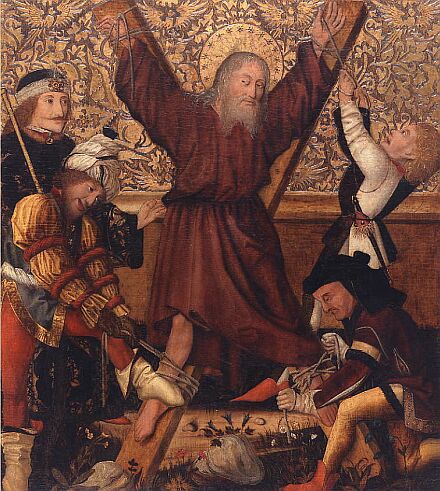
Apart from various zoological creatures, Frankenstein and Boris Karloff turned up in an installation at the Botanical Gardens, and Vlad Tepes lent a helping hand to the crucifixion of St. Andrew in the medieval section of the Unteres Belvedere. And, of course, Fuseli's Nightmare could famously be seen in Sigmund Freud's waiting room in Berggasse. Ernest Jones, who gave Freud the Nightmare black and white reproduction, was the author of On the Nightmare which includes a chapter on vampires. Considering how influential and recognized Freud was in my own country as well as in so many other places, I was surprised to learn that Freudianism had little impact in Austria until decades after WWII.


Otherwise it was a holiday not too dissimilar to that of other tourists. I saw the Hundertwasserhaus and a few other sights, and I certainly feel that I had enough Schlagobers for some time.


In central Vienna - as in many other large cities - a number of people try to amuse and entertain tourists and shoppers, including the guy in the photo above who appears to defy gravity. This to me shows that, perhaps, almost anything is possible in this city? Vienna is a pleasant place to stay, people are polite, and I haven't encountered any scams like the ones that you find in e.g. Rome and Paris.


Friday, 4 May 2007

Gerard van Swieten commemorated

Earlier this year the Münze Österreichs, the Austrian Mint, issued a 50 Euro gold coin commemorating Gerard van Swieten (1700-1772). The coin is the first in a series called Großen Mediziner Österreichs, i.e. Great Austrian Physicians, and it seems only fitting that the first coin is dedicated to the memory of van Swieten who played a major role in developing medicine and medical education in 18th Century Austria.


However, as those of us who are interested in the history of magia posthuma of the 18th Century know, van Swieten played an important role in trying to stop the belief in magia posthuma. In a recent book on vampire slayers, Slayers and their Vampires: A Cultural History of Killing the Dead by Bruce McClelland (University of Michigan Press, 2006), he is even called "the Lowlands slayer", and it is claimed that "in 1755, Maria Theresa dispatched Van Swieten to Hermersdorf, Moravia, to investigate the postmortem treatment of a certain 'Rosina Polackin'".

However, I can find no evidence of Van Swieten playing this active role in the investigation himself.

In his written remarks on the affair and on vampirism in general, Van Swieten only mentions that the Empress sent two other physicians to investigate this case of magia posthuma: the Professor of Anatomy, Johannes Gasser, and the court physician, Christian Wabst. As has been noted by vampire historians, this was the first time physicians of this calibre were sent to investigate a vampire case, which in itself is a testament to the progress of medicine during the few decades that had passed since the famous Serbian vampire cases. It was the report of Gasser and Wabst to Empress Maria Theresa that prompted Van Swieten to write about vampires and to recommend to the Empress that she should pass a law against digging up corpses and burning them because of beliefs in magia posthuma.

The role of Van Swieten and Maria Theresa in the history of the magia posthuma has only recently been recognized in vampire books in English, no doubt aided by Gábor Klaniczay's paper on The Decline of Witches and the Rise of Vampires under the Eighteenth-Century Habsburg Monarchy which has become a standard text in the historical study of witchcraft.

Related Posts Plugin for WordPress, Blogger...