Showing posts with label Jure Grando. Show all posts
Showing posts with label Jure Grando. Show all posts
Monday, 18 November 2013
Jure Grando, the 'first' vampire
I have previously written about current interest in the so-called first vampire, Jure (or: Giure) Grando, first mentioned by Johann Weichard von Valvasor in 1689. In the meantime, a local gymnasium has made an amateur video about Grando that is possibly worth watching, even if you can only understand a word here and there.

Saturday, 7 January 2012
Los vampiros

Jordi Ardanuy is a physicist and vampire expert who has written extensively in Catalan and Spanish. Much of what he has written on the subject is available on the internet, cf. e.g. the web site of Cercle V, but I have been intrigued to see his book Los vampiros ¡vaya timo! published by Laetoli in 2009 in a series on superstition, pseudoscience and antisicence called ¡Vaya timo! aimed at teenagers and other younger readers. Other books in the series deal with e.g. witchcraft, tarot and psychoanalysis.

Ardanuy's book is short, containing only about 130 pages, and is no doubt easily read if you know Spanish. The first chapter deals with Lilith, lamiae, ghosts, incubi and efialtes, and the second contains annotated translations from Henry More and Valvasor on the shoemaker from Silesia, Johannes Cuntius, and Giure Grando. Chapters 3, 4 and 5 deal with the famous Serbian vampire cases, the 18th century debate on vampires, Van Swieten's commentaries, also drawing lines ahead to e.g. the vampire beliefs and traits in 19th century New England. Finally, chapters 6 and 7 are concerned with the fictional vampire and the modern conception of vampires.

Ardanuy's list of recommended further reading is brief, mentioning works by Paul Barber, Jan Bondeson (a Spanish translation of his book on premature burial, Buried Alive), Robert Eighteen-Bisang and Elizabeth Miller, and Jean Marigny, including only one Spanish book: Vampiros y hombres lobo by Erberto Petoia.

Thursday, 21 July 2011
The 'first' vampire
Anthony Hogg, in a comment to a recent post, asks: Who was the first vampire? Giure Grando, Peter Plogojowitz, or perhaps the vampires mentioned in Mercure Galant as quoted by Calmet.
As I wrote in an earlier post, there is a museum dedicated to Giure (or: Jure) Grando, commemorating him as the first vampire. As it says here: 'Jure Grando (1656) was the first classical Vampire to be mentioned in documented records.' Still, I would myself refer to Peter Plogojewitz (or however you prefer to spell his name) as the 'first' vampire, because that term is used in Provisor Frombald's report from Kisiljevo.
As for bloodsucking, well, most of these revenants tend to either strangle or by other means affect the living, and blood itself generally first turns up on the corpses that are exhumed, and it is then interpreted as blood drawn from the unfortunate victims of the revenant. But some kind of bloodsucking is actually mentioned in connection with the Mercure Galant article on the Polish Upiertz that Hogg also refers to in his comment. Still, the term 'vampire' is apparently not used, although Calmet claims that the articles 'parlent des oupires, vampires ou revenants'. There appears to be an excerpt from the 1693 issue in question on the web site of this author of a book on vampires, i.e. here, and it actually says that this Demon draws blood from the body of a living person or of cattle.
A Google search, of course, provides a number of other answers like Cain, Lilith, Vlad Tepes, George Bush...
As I wrote in an earlier post, there is a museum dedicated to Giure (or: Jure) Grando, commemorating him as the first vampire. As it says here: 'Jure Grando (1656) was the first classical Vampire to be mentioned in documented records.' Still, I would myself refer to Peter Plogojewitz (or however you prefer to spell his name) as the 'first' vampire, because that term is used in Provisor Frombald's report from Kisiljevo.
As for bloodsucking, well, most of these revenants tend to either strangle or by other means affect the living, and blood itself generally first turns up on the corpses that are exhumed, and it is then interpreted as blood drawn from the unfortunate victims of the revenant. But some kind of bloodsucking is actually mentioned in connection with the Mercure Galant article on the Polish Upiertz that Hogg also refers to in his comment. Still, the term 'vampire' is apparently not used, although Calmet claims that the articles 'parlent des oupires, vampires ou revenants'. There appears to be an excerpt from the 1693 issue in question on the web site of this author of a book on vampires, i.e. here, and it actually says that this Demon draws blood from the body of a living person or of cattle.

A Google search, of course, provides a number of other answers like Cain, Lilith, Vlad Tepes, George Bush...
Sunday, 30 January 2011
Vampire tourism
View Larger Map
If you are considering where to go on holiday this summer, why not go to Kringa in Croatia?
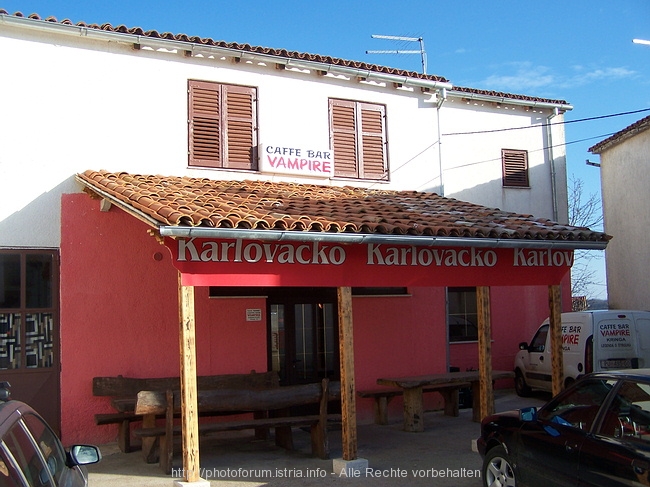
In recent years this village has embraced the legacy of its local 'vampire', Jure Grando (often spelled: Giure Grando), made famous by Johann Weichard von Valvasor. You can visit a museum dedicated to him, Muzej Jure Grando, have a 'vampire menu' at the Tavern Danijeli before going to the Vampire Café for 'vampire cocktails'. And you can even stay at the Villa Jure Grando, which claims to be 'well stocked with garlic and holy water'!

Jure Grando supposedly haunted the village from his death in 1656 and until his corpse was decapitated in 1672. Valvasor writes:
'Im 1672ten Jahr hat man gleichfalls / zu Krhing in Isterreich / dem begrabenen Leichnam deß Giure Grando einen Pfahl durch den Leib zu treiben / sich bemühet; weil aber der Pfahl in den Leib nicht hineindringen wollen / ihm den Kopff abgeschnitten. Solches verwegenen Stückleins haben sich Ihrer Etliche unterfangen: nemlich der Micolo Nyena, der Stipan Milasich, der Miho Raderich, Mattio Chericatin, Nicolo Macina, Jure Macina, Juira Sorsich, Martino Udereicich, und Micula Crairær. Dem ersten aber ist da Hertz entfallen / also / daß er / den todten Körper anzugreiffen / allzu verzagt worden. Worauf sich der Andre drüber hergemacht / und den Kopff herabgescnitten ; und der Dritte das Krucifix dabey gehalten. Wie dann diese alle drey noch am Leben seynd. Wovon wir unten / in dem Buch / darinn von den Crainerischen Städten / gehandelt wird / einen umständlichern Bericht / bey Beschreibung deß Marckts Kreinck / thun wollen: weil sich unterschiedliche sehr merckwürdige Sachen dabey ereignet haben / die wir allhie auslassen / und an diesem Ort nur den Handel bloß berühren.'
Subscribe to:
Posts (Atom)
