A more recent interview with Kreuter in which he e.g. discards with the fictional notions of bloodsucking, canines, and good vampires...
Sunday, 26 August 2012
Dr. Kreuter: Vampire Hunter
This WDR German documentary follows Peter Mario Kreuter on a visit to Romania in 2003 in search of first and second hand witnesses of vampire and werewolf beliefs. The journalist ultimately asks Kreuter himself if he - like some of the people he meets - actually believes in such things...
A more recent interview with Kreuter in which he e.g. discards with the fictional notions of bloodsucking, canines, and good vampires...
A more recent interview with Kreuter in which he e.g. discards with the fictional notions of bloodsucking, canines, and good vampires...

Sunday, 5 August 2012
Archaeology as romanticism and ideology

When I initially read about the uncovering and quick exhibition of the ’vampire skeleton’ in Bulgaria, I was reminded of some of the bog body finds here in Denmark. Public interest in seeing the so-called ‘Grauballe Man’ was so extensive, that the authorities decided to put him on display quickly, and the 19th century ‘Haraldskær Woman’ was romantically identified with Queen Gunhild who according to the Jomsvikinga Saga was drowned in a bog by order of King Harald Bluetooth.
Today we are instead used to archaeologists spending a very long time preserving and studying their finds before they are described in papers and exhibited. And we are, I think, generally suspicious of interpretations that smack too much of romanticism or ideology. Archaeological finds have all too frequently been exploited for political purposes, or ideology and politics have served as a motivational factor intrinsic to the discipline, pre-determining interpretational possibilities and distinguishing between the relevant and the irrelevant.

Based on his own work in Bulgaria as well as discussions with Bulgarian archaeologists, Bailey not only analyses Bulgarian archaeology and the Western attitude towards it, but suggests ways in which to develop it. Following Todorova’s well-known 1997 book Imagining the Balkans, Bailey notes that not only do Westerners consider Bulgaria and its archaeology exotic, ‘the history of modern Bulgaria is one of auto-exoticism’:
‘Bulgarian auto-exoticism has entailed efforts to create a modern nation-state by illuminating its distance (ethnic, historical, linguistic) from other states as well as to eliminate any internal alternative pockets of cultural or ethnic exoticism (thus the internal campaigns of forced resettlement and name-changing of 'non--Bulgarian' Bulgarians).’

'From the West, the discipline [of Bulgarian archaeology] appears to exist solely to glorify the ethos of a magnificent past through a fascination with the art and culture of extinct peoples. From this perspective it is confirmed as a discipline born in the spirit (and the period) of modernism: it seeks to study the primitive in its past and it relegates matters of causal explanation to the epiphenomena of descriptive ideas of cultural progress.
Thus, Bulgarian archaeology itself considers its object of study (i.e. the past) as exotic. In this sense, the more mundane elements of the material record hold little interest: common practice on excavations is to discard coarse-ware pottery without concern or quantification. The emphasis of research remains firmly centred on the most sensational and emotive sectors of the archaeological record (i.e. burials, figurines, metal-work, fortresses and fine-ware pottery). Most surprisingly, perhaps, the tradition of Bulgarian archaeology-as-romanticism has remained in place through the post-1989 period of the region-wide opening of intellectual borders, research resources and collaborative strategies.’

‘Following M. Todorova, I suggest that Bulgarian archaeology itself is an active socio-politics and ideology: it is not a passive tool of socio-political, nationalist, totalitarian, or other state--level political structures. Bulgarian archaeology's long-established position as a socio-political ideology is one of the conditions which makes it appear exotic to Western eyes.’
This active ideology, however, does not confine itself to (re)creating national histories and ethnic identities, it has a powerful role in a society in which the past arbitrates the present:
‘As an historical subject and thus as active socio-political ideology, Bulgarian archaeology occupies an unrivalled position as justifier and legitimator. In this sense, the past is an arbiter of the present and those who can read the past are arbiters of justice and, as such, possess considerable power. The ideology of the past as arbitration is not limited to the recreation of national histories and prehistories: it drives a social logic through the reality of all elements of daily life. A particularly strong recent manifestation of this logic was the enthusiastic (and in most cases successful) drive by Bulgarian families, in the early 1990s, to reclaim property confiscated by the communists during their forty-five years in power. Property reclamation rested on the simple principle that proof of ownership in the past justified the right to regain ownership in the present. The past arbitrates the present.’

But, if Bulgarian archaeology is in fact an ideology, then its professional practitioners must themselves be considered ideologues:
‘The case that Bulgarian archaeologists are ideologues rests on several important facts. The first is a long-standing link between politicians and members of the scientific and cultural intelligentsia. The second link connects two separate roles which Bulgarian archaeologists play: on the one hand they are scientific field-workers; on the other they are custodians and, as mentioned above, arbiters of the nation's past. These links raise (and suggest answers to) important questions about the power of archaeological data and its interpretation. In turn they raise a debate surrounding the personnel of Bulgarian archaeology, most particularly the question of who is allowed (as opposed to who is qualified) to study the past. Furthermore, it is through an examination of the practitioners of archaeology that one comes to understand the unchanging condition of archaeological interpretation in Bulgaria. Such an understanding is especially enlightening in the absence of either processual or post-modern developments in Bulgarian archaeologies.’
Bailey traces the linkage between science and politics back in time to the creation of the Bulgarian Academy of Sciences (BAN) a century ago in July 1912 as a centralised organisation based on a law formalising the connection between BAN and the government. This centralisation was further reinforced during the Communist era, and today it is still a member institution of BAN that grants permission to carry out field work in Bulgaria. The close link between the government and academia and intelligentsia is reflected in the number of academics and intellectuals who have and still do occupy important political offices, like e.g. the Director of the Bulgarian National Museum of History, Bozhidar Dimitrov.

Bailey however rejects any naïve and condescending depreciation of Bulgarian archaeology as ‘a retarded stage of development in the evolution of archaeological theory,’ as it does not only assume a Western righteousness of method, but also a lack of appreciation and understanding of the background of the contemporary Bulgarian discipline. Whereas the quest of a processual approach to archaeology (aka new archaeology) is for an objectivity separate from politics, the Bulgarian approach to archaeology can by definition not be separated from politics. So explanations do not ideally follow strictly from the given data, but are pre-determined by a centralised ideology: ‘often archaeological research entails little more than recovering more and more data which can be assigned to pre-determined chronological and social stages.’
Bailey discusses ways to ‘de-exoticise’ Bulgarian archaeology, and suggests that Western archaeologists ‘treat colleagues as peers and offer them the respect of critical comment on their work, their methods and the social consequences of their doctrines. To do otherwise is to abrogate any responsibility for the impact which archaeology has on the reality of modern existence in Bulgaria or in any place that archaeology is practised. The time to accept that responsibility is now when, as a discipline, Bulgarian archaeology drifts without proper financial ballast, having been orphaned from a long-exploitative family.’
Now this is, of course, Bailey's analysis, but from what I can gather from reviews and the information I have seen concerning his work, I have found it relevant to write about it here. It supports the notion that Bulgarian archaeology has a tendency to favour more sensational finds, possibly from an intrinsic reasons, but at the same time aiming at attracting not only attention from a wider audience, but also more funding, either directly from the government or indirectly from tourists who are perhaps not interested in the Bulgarian history in general, but who are willing to spend money to see a 'vampire skeleton' or to go on pilgrimage to the site of the (supposed) human remains of John the Baptist.
As for the skeletons themselves, the news stories about the 'vampire skeletons' have not only been imprecise, but have presented us with very little concrete information. For that reason I have so far mainly quoted the news stories instead of trying to discuss something that I feel I have only a vague idea about. But it is obvious that a) Bulgaria has now firmly placed itself as an area of 'vampire interest', and b) the archaeological finds are now to the public part of 'vampire lore'. Whatever that precisely is, but I suppose that films, novels and roleplaying games will be inspired by the Sozopol skeletons. At least, it probably has a little more to do with revenants and vampires than the most recent vampire blockbuster, Abraham Lincoln: Vampire Hunter.
Wednesday, 1 August 2012
An Exile in Paradise

The entry on Edward Lear (1812-88) in my Bloomsbury Guide to English Literature - incidentally right below an entry on J. S. Le Fanu mentioning In a Glass Darkly, the collection including Carmilla - states:
'Lear was by profession a landscape painter, but his elaborate landscape paintings have much less distinction and interest than his drawings and sketches.'
Fortunately, there is more of interest in Lear's work as a landscape painter than the Guide will have us believe. He published his Journals of a Landscape Painter in Albania, &c in 1851, and a couple of years ago a television series followed in Lear's footsteps on his journey through Greece and Albania: An Exile in Paradise: The Adventures of Edward Lear is currently aired here in Denmark, so I just caught the episode in which Robert Horne - described as 'an adventurer, traveller and writer with a keen interest in art and science fiction' - guides the viewer through Albania, looking for the places where Lear stayed and tracing the history from Lear's time until today. Lear appears to have been something of an adventurer himself.
Detailed information on the production is available from Lear Productions, with the promo below. A DVD, unfortunately, is currently unavailable.
Monday, 30 July 2012
Still celebrating Stoker and his vampire count
Celebrations of the memory of Bram Stoker as theatrical manager and author are still ongoing, and the Irish An Post marked the centenary of Stoker's death with two stamps depicting Stoker himself as well as his most famous fictional creation, Dracula. The stamps are available at face value, including the minisheet shown below on top of the sheet published in 1897 to celebrate the centenary of Dracula itself. Click on the photo for a more detailed look, or go to An Post's shop if you are interested in purchasing the stamps. The new stamps are designed by David Rooney.
Considering the use of the written word in various formats, including a number of letters, in the novel itself, and the enormous amount of letters Stoker must have written while working for Henry Irving, stamps are a fitting way of celebrating Stoker and his vampire.

Oh, and by the way, having spent some hot and sunny days in the Western part of the Mediterranean Sea here in July, it is interesting to note that it is at the same time of year that the Demeter experienced 'rough weather' while journeying to the Gibraltar Strait. I suppose that, although Stoker meticulously dated the events of the novel, one recalls the events and not the context. But then it is perhaps even more unpleasant that Count Dracula conjures up a storm in late July. Following the novel more or less 'in real time' via the Dracula blog allows one to be reminded of the timing of the events.
Considering the use of the written word in various formats, including a number of letters, in the novel itself, and the enormous amount of letters Stoker must have written while working for Henry Irving, stamps are a fitting way of celebrating Stoker and his vampire.

Oh, and by the way, having spent some hot and sunny days in the Western part of the Mediterranean Sea here in July, it is interesting to note that it is at the same time of year that the Demeter experienced 'rough weather' while journeying to the Gibraltar Strait. I suppose that, although Stoker meticulously dated the events of the novel, one recalls the events and not the context. But then it is perhaps even more unpleasant that Count Dracula conjures up a storm in late July. Following the novel more or less 'in real time' via the Dracula blog allows one to be reminded of the timing of the events.
Saturday, 28 July 2012
'Vampire skeleton' still popular

As I pointed out when the 'vampire skeleton' from Sozopol in Bulgaria made the news, the number of visits to this blog exploded when people (particularly in USA) went in search of 'vampire skeletons'. Now a recent short news story on the subject on the National Geographic web site has attracted a lost of interest on Facebook, becoming the most shared news story in four months, according to novinite.com. As of writing, it has been shared 4.441 times and 10.692 people have 'liked' the story.
According to National Geographic, 'the skeleton's teeth [or rather some of them, ed.] had been pulled. Scholars believe the rod and tooth-pulling were techniques villagers used to prevent dead men from turning into vampires.'
Friday, 27 July 2012
Vampires in Barcelona? Perhaps...

Despite the heat and sunshine, a modern day vampire film could easily be set in Barcelona. The narrow old streets, the shuttered houses, the broad avenues, the modernista houses, the modern architectonical creations, the numerous citizens and the masses of tourists flocking the streets and beaches well into the night, all of them are elements that would make an interesting backdrop to the fictional vampires preying a city in search of blood.
In real life, as a tourist one must beware of pickpockets and scam artists. A guy entering a metro train right behind me was pickpocketed, but fortunately recovered his wallet before the thief could get away with it. This, unfortunately, is the case with various larger cities, just as a waiter in a restaurant in the old part of the city apparently mixed up bills so I was asked to pay an amount that was almost one and a half of what we had actually ordered. Fortunately, most of the people we met on our stay were friendly and helpful.


I suppose you need some sense of humour to own or work in a Dracula restaurant decorated with various Vlad Tepes and Dracula artefacts, so perhaps that is why I afterwards thought our waiter had a hint of John Cleese about him. Anyway, we were treated nicely, also tasting their 'Dracula crepes' for dessert as well as their Țuică.
And if you want to enjoy Romanian wine and food at home, there is a shop, Unirea, selling Romanian wine and ingredients almost next door to the restaurant. Their 'Dracula wine' is actually pretty cheap, just €4.


On a more horrific note, this year marks the centenary of the detention of the so-called 'vampire of Barcelona', Enriqueta Marti, a kidnapper and murderer of children. Born in 1868, Marti moved to Barcelona as a young woman and ended up as a prostitute, later on specializing in prostituting children. According to wikipedia, she led a double life:
'During the day she dressed in rags and begged at houses of charity, convents and parishes in the destitute parts of town where she selected children who looked the most abandoned. Taking the children by the hand, she made them pass as her children. Later, she prostituted or murdered them. She did not have any need to beg since her double work as a procurer and prostitute gave her sufficient money to live well. By night she dressed in luxurious clothes, hats and wigs, and attended the El Liceu, the Casino de la Arrabassada and other places where the wealthy of Barcelona gathered. It is probable that in these places she offered her services as procurer of children.'
 Operating for many years, she not only had a brothel prostituting minors, but also served as a kind of witch-doctor. Again, according to wikipedia:
'The ingredients she used to make her remedies were made from the remains of the children that she was killing, who ranged from infants up to children of 9 years. From these children she used everything that she could; the fat, blood, hair,and bones (that normally she turned into powder). For this reason, she did not have problems disposing of the bodies of her victims. Enriqueta offered salves, ointments, filters, cataplasms and potions, especially to treat tuberculosis, which was highly feared at the time, and all kinds of diseases that did not have a cure in traditional medicine. Wealthy people were paying large sums of money for these remedies.'
On February 27 2012 she was finally arrested after a neighbour had noticed a girl she had never seen before playing in Marti's mezzanine flat in 29 Carrer de Ponent, now 29 Carrer de Joaquín Costa in the part of Barcelona called Raval. The girl turned out to be a girl kidnapped by Marti. Investigators from the police then searched a number of flats where Marti had stayed and made macabre discoveries of human remains.


All sorts of atrocities are attributed to Marti, but as she was never tried - the legal proceedings were interrupted by Marti getting lynched by fellow prisoners in 1913 - the case appears to be somewhat unclear. But if you read the wikipedia article - which appears to be an attempt at translating the Spanish one - you will find all manner of criminal and sadistic acts attributed to her.


Charitably said, the cover of the DVD is more fun than spending 75 minutes to get through the story of a young woman going to the estate of her family after her father's death, ultimately learning that the family members she meets are (living) dead with a taste for blood. Franco has his fans, and this film has once again convinced me that I will never become one of them...
Finally, it may be worth mentioning that Catalonia is, of course, the home of Cercle V, an organization interested in vampires, including the historical aspects. Among those involved in Cercle V is Jordi Ardanuy.
Thursday, 26 July 2012
Varberg vampires

I was considering going to the museum in Varberg on the Western coast of Sweden, as they are currently hosting an exhibition about vampires. The home of the famous bog body known as the Bocksten man, this might be worth spending a day off on. Then I read what author of a Swedish vampire book, Katarina Harrison Lindbergh, wrote on her blog and decided that it probably was not worth the time and money. The museum claims that the exhibition was inspired by her book, Vampyrernas historia, but she was clearly disappointed and is actually grateful that she had nothing to do with it. I suppose that it is, as I had myself expected, mostly staged to attract the attention of kids and youngsters interested in Twilight and The Vampire Diaries.
The best exhibition on the subject that I know of, was Dracula: Woiwode und Vampir exhibited at Castle Ambras and the National Museum of Art of Romania.

Sunday, 15 July 2012
Apropos of Bulgarian archaeology
After the find of the so-called 'vampire skeletons' in Sozopol in Bulgaria, someone posted the montage below of another Bulgarian archaeological find 'endorsed' by Bozhidar Dimitrov. According to 24 часа, Dimitrov appreciates the witty comment on his current involvement in the news stories on vampires.
And by the way, in 2011 a bay in Antarctica was named after Dimitrov.

And by the way, in 2011 a bay in Antarctica was named after Dimitrov.

Monday, 9 July 2012
The new vampires

However popular zombies - or rather the zombies of cinema and comic books - have become over the past years, what with e.g. The Walking Dead, I sincerely doubt that their appeal will ever replace that of vampires. As zombies usually behave like brainless automata, who would ever want to become a zombie, whereas it appears that many people find the undead life of the (fictional) vampire intriguing and enticing.
Photo taken from Season Four of True Blood.
Sunday, 8 July 2012
'Vampire skeletons', a Bulgarian Indiana Jones and the remains of John the Baptist
More than a month has now gone by since the hype about the Bulgarian 'vampire skeletons' spread across the globe. Since then, the Bulgarian Finance Minister, Simeon Djankov, has stated that the Bulgarian government is planning to slate additional funding for archeological excavations on the southern Black Sea coast, and one of the skeletons from Sozopol is now in Sofia, and as far as I have understood on display at the National Museum of History.
Vampire skeleton on display in Bulgaria by Zoomin_Canada
Another 'vampire skeleton', found in Veliko Tarnovo, was ritually reburied by the archaeologists who found it led by Professors Nikolay Ovcharov and Hitko Vachev. This skeleton of a medieval man had been buried with his hands and feet tied, and with pieces of ember inside his grave.
Ovcharov, who according to novinite is nicknamed 'the Bulgarian Indiana Jones', reburied the skeleton according to an 'ethnographic ritual in which the "vampire's" bones were cleansed with wine and water, and were placed together in a new grave close to the old one together with the lighting of candles in the Bulgarian Orthodox Christian tradition,' cf. the photo below.

As pointed out by 'bshistorian' in a couple of comments to an earlier post, there are several things that are hard to understand from just reading the news stories and looking at the photos and videos of the corpse. So to what extent the find is actually related to revenant or vampire beliefs seems hard to say.
Bulgaria Looks to Suck the Vampire Legend Out of... by NewsLook
Some of the archaeologists involved are certainly characters. What are we to think of archaeologists led by a 'Bulgarian Indiana Jones' who perform 'ethnographic rituals' on a medieval skeleton, and what about the director of the National Museum of History, Bozhidar Dimitrov? According to Wikipedia, he is also a prominent politican and former Minister without portfolio. As a historian he has written polemically on the ancestry of the Bulgarians and 'macedonism'. Incidentally, he was born in Sozopol where the 'vampire skeleton' now in display in Sofia was found.
Generally, the Bulgarians appear to have a fondness for sensationalistic claims with regards to some of their archaeological discoveries, as is evident from the news story below on the possible finds of the remains of John the Baptist in Bulgaria. Curiously, the discovery was made near Sozopol, and like the 'vampire skeletons' attracted a lot of attention. The remains have been transferred to the Orthodox Church where they lay in state in the St. George Church in Sozopol. Because the theory is not refuted, obviously there are many people who hold on to it for various reasons. Obviously, some Bulgarian archaeologists and politicians hope to attract tourists who are intrigued to see 'vampire skeletons'.
When the discovery of 'John the Baptist' was made, the same Finance Minister who has now stated that more funds will be set aside for archaeological excavations on the Black Sea coast, Simeon Djankov, plainly said: 'As soon as this amazing archaeological discovery was made, I made some research, and found that such finds generate great returns from tourism and pilgrimage. Bulgaria and this region will now enter the world tourism maps as a pilgrimage site. The fact that this is a sea resort provides for an unique combination between cultural and sea tourism.'
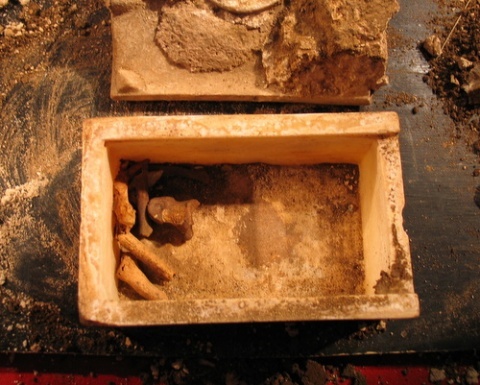
Scientists do not exclude the possibility that remains found in an ancient reliquary in a 5th century monastery on Sveti Ivan Island in Bulgaria may belong to St John the Baptist.
On Thursday, a team of Oxford University archaeologists announced they have provided scientific evidence to support the extraordinary claim.
The findings are to be presented in a documentary to be aired on The National Geographic channel in Britain on Sunday, The Telegraph informs.
The research team dated the right-handed knuckle bone to the first century AD, when John is believed to have lived until his beheading ordered by king Herod.
Scientists from the University of Copenhagen analysed the DNA of the bones, finding they came from a single individual, probably a man, from a family in the modern-day Middle East, where John would have lived.
The findings do not prove anything, but they also do not refute the theory initially presented by Bulgarian archaeologists that the remains in question may indeed belong to St John the Baptist.
The remains were uncovered on July 28, 2010, during excavations of the floor of the medieval monastery on Saint Ivan island, near Bulgaria's historical, coastal town of Sozopol. They were placed in a sealed reliquary buried next to a tiny urn inscribed with St. John's name and his birth date.
The Bulgarian government decided to benefit from the discovery to boost tourism, going as far as to say that Sozopol will help deal with the economic crisis by becoming the new Jerusalem on the Balkans, attracting believers from all over the world.'
Subscribe to:
Posts (Atom)
