Showing posts with label Horace Walpole. Show all posts

Sunday, 22 June 2014

The Gothic Imagination


2014 marks the 250th anniversary of Horace Walpole's The Castle of Otranto, usually celebrated as the first Gothic novel. The British Library will be celebrating the anniversary with an exhibition that opens on October 3 this year: Terror and Wonder: The Gothic Imagination will be the most comprehensive exhibition on the subject in the UK so far:

'Beginning with Horace Walpole’s The Castle of Otranto, this wide-ranging exhibition explores our enduring fascination with the mysterious, the terrifying and the awe-inspiring. It also examines the long shadow the Gothic imagination has cast across film, art, music, fashion, culture and our daily lives.

Gothic literature began as a challenge to the rational certainties of the Enlightenment. By exploring the harsh romance of the medieval past with its castles and abbeys, its wild landscapes and fascination with the supernatural, Gothic writers placed imagination firmly at the heart of their work.

Through over 200 rare exhibits including manuscripts, paintings, film clips and posters, Terror and Wonder explores all aspects of the Gothic world. Iconic works, including Mary Shelley’s
Frankenstein, Bram Stoker’s Dracula, the sinister fairy tales of Angela Carter and the modern horrors of Clive Barker highlight the ways in which contemporary fears have been addressed by successive generations of Gothic writers. Paintings, films and even a vampire-slaying kit add colour and drama to the story.

Terror and Wonder promises to be beautiful, dark, inspiring and haunting. Step into this world, if you dare.'


The British Library web site already contains a theme on the subject, including, of course, a page on Dracula and vampire literature (incidentally, they also have a page on Emily Gerard's The Land beyond the Forest). They have also made a youtube video on the Gothic in which Professor John Bowen discusses Gothic motifs while wandering around Horace Walpole's Strawberry Hill House.
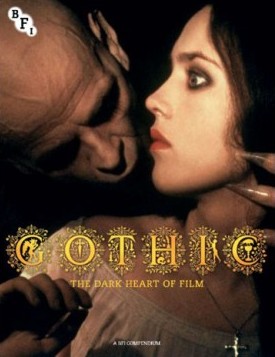
This exhibition follows hot on the heels of a Gothic film festival, Gothic: The Dark Heart of Film, arranged by the British Film Institute (BFI) in 2013. The BFI published a compendium, which is actually a delightful introduction to the world of Gothic film, its landscapes, architecture and inhabitants. In fact, this is probably one of the rare instances you will see me recommending a book on Gothic fiction on this blog, but the thematic approach to the subject as well as the host of experts who have contributed to it makes it a real treat, even for people with a more casual interest in the genre.

So the book includes essays on the relation between Gothic cinema and literature, architecture and art, with Martin Myrone, author of a nice book on Fuseli and contributor to the Tate exhibition on Gothic Nightmares back in 2006, noting that 'the relationship between the canon of Gothic literature of the 'classic' phase (c. 1760-1830) and the visual imagery of the same date is far from simple: the relationship of this early Gothic art and writing to modern cinema no more so.' Still, he later on concedes that 'nonetheless, there are parallels and resonances between Gothic literature of the 'classic' phase and precisely contemporary visual art, and between these and modern cinema,' accompanying his essay with a number of examples of these homologies, of which the most famous is, of course, Fuseli's Nightmare (see the Gothic Nightmares catalogue from Tate for numerous examples).

However many experts have contributed to the conpendium, they still are unable to solve the conundrum of pinning down what the Gothic 'genre' actually is. Myrone states that it is 'now often understood as, by definition, a trans-medial, genre-defying, migratory and polluting phenomenon, we should not expect homologies between Gothic productions in different media and eras need be predictable, explicit or orderly.' The paradox of how relatively easy it is to describe the Gothic 'landscape', while it seems almost impossible to define it, is what makes the compendium - cf. the title's nod to Joseph Conrad - a 'Grand Tour of the Gothic,' as Sir Christopher Frayling says in his foreword.

Wednesday, 26 December 2012

On the pleasure derived from objects of terror...

Viktoriapark in Berlin with neogothic memorial on Kreuzberg in the background
The medieval period and its remains were romanticised by the authors of the Gothic novel with Horace Walpole, author of The Castle of Otranto (1764), being so obsessed with Gothic architecture that he constructed his own 'castle', Strawberry Hill. The enthusiasm for medieval architecture, ruins and other remnants of the past was  taken up by German painters in the early nineteenth century as documented in a current exhibition at the Alte Nationalgalerie in Berlin: Romantik & Mittelalter: Architektur und Natur in der Malerei nach Schinkel (Romanticism and the Middle Ages: Architecture and Nature in Paintings after Schinkel, Schinkel being the Prussian architect and painter Karl Friedrich Schinkel). This interest in buildings from the past clearly mixed realism with fantasy as both exponents of romanticism and nationalism. So some of the themes of these paintings look familiar to readers of  gothic fiction or even viewers of the more 'gothic' parts of horror and fantasy cinema. And entering the permanent parts of the Alte Nationalgalerie, one can trace the evolution of some of the themes to the paintings of Caspar David Friedrich.

Schinkel: Gotische Klosterruine und Baumgruppen (1809)
But what starts out as fascinating soon becomes too much, even for a visitor like me who is far from unaccustomed to gothic horror and medieval romance. The German poet Heinrich Heine is quoted for writing about how the German public became tired of knights and other medieval trappings: 'die ewige Rittertümelei missbehagte am Ende den bürgerlich Gebildeten im deutschen Publikum, [...] dieser beständige Singsang von Harnischen, Turniergenossen, Burgfrauen, ehrsamen Zanftmeistern, Zwergen, Knappen, Schlosskapellen, Minne und Glaube, und wie der mittelalterliche Trödel sonst heißt, wurde uns endlich lästig.'

There are, however, still today people who nourish an enthusiasm for a romanticised medievalism. At the main railway station in Berlin I recently noticed a number of issues of a German magazine called Miroque Lebendige Geschichte, a popular magazine that deals with e.g. everyday life in the middle ages and carries ads for medieval style paraphernalia like clothes and tournament tents! I purchased Edition nr. 5 - III/2012 subtitled Kabinett des Grauens vom Mittelalter zur Moderne, i.e. a cabinet of horrors from the middle ages to our modern day.

A free CD is included containing 13 pieces of 'Horror-Musik' for Halloween, and on page 2 there is an ad for a Jack the Ripper bag in leather, so readers are probably of the kind who also would enjoy a spine-tingling Gothic novel. The Cabinet of Horrors itself features witches, demons, dragons, zombies, werewolves, and even zombies. The six page article on the living dead, i.e. vampires, is written by Dr. Utz Anhalt and is simply a mix of fact and fiction about vampires. A very short interview with Mark Benecke concerns scientific explanations of cases of the masticating dead and vampires. The magazine also deals with horror films set in the past (or perhaps rather a fictional version of the past), 'dark' novels, and Jack the Ripper. Obviously, all this is more about making the reader shudder with a mix of horror and delight than about history.

The Schauerroman, the German equivalent or perhaps original form of the Gothic novel, is the subject of a recent anthology published first in German as Populäre Erscheinungen: Der deutsche Schauerroman um 1800 and subsequently in English as Popular Revenants: The German Gothic and Its International Reception, 1800-2000, edited by Andrew Cusack and Barry Murnane. Apparently, British literary critics in the 1790's attributed the roots of the Gothic novel to German Ritter-, Räuber- und Schauerromantik: 'Indeed, the labels "German" and "gothic" were competing terms for a species of popular fictions in the 1790s as evidenced by the frequent use of such designations as "A German Tale." For readers these labels indicated the thrillingly foreign; for organs of the conservative government such as the Anti-Jacobin they represented an indecent and politically suspect class of fictions that were dangerously popular.' (Cusack's introduction, p. 2) Although the Schauerroman had its heyday in the early 19th century, some of the essays in the book explore their profound influence and development on both literature and film.

Similarly, an exhibition at the Städel Museum in Frankfurt, Germany, currently explores the darker aspects of romantic art from Goya to Max Ernst and their influences on opera, cinema and other art forms: Schwarze Romantik, Dark romanticism, a term inspired by Mario Praz's seminal study The Romantic Agony. It is the first German exhibition focusing on this aspect of Romanticism and its legacy, comprises more than 200 paintings, sculptures, graphic works, photographs and films, also including works by Johann Heinrich Fuseli, William Blake and Caspar David Friedrich. According to the museum's web site, the exhibition

'is conceived to stimulate interest in the sombre aspects of Romanticism and to expand understanding of this movement. Many of the artistic developments and positions presented here emerge from a shattered trust in enlightened and progressive thought, which took hold soon after the French Revolution – initially celebrated as the dawn of a new age – at the end of the 18th century. Bloodstained terror and war brought suffering and eventually caused the social order in large parts of Europe to break down. The disillusionment was as great as the original enthusiasm when the dark aspects of the Enlightenment were revealed in all their harshness. Young literary figures and artists turned to the reverse side of Reason. The horrific, the miraculous and the grotesque challenged the supremacy of the beautiful and the immaculate. The appeal of legends and fairy tales and the fascination with the Middle Ages competed with the ideal of Antiquity. The local countryside became increasingly attractive and was a favoured subject for artists. The bright light of day encountered the fog and mysterious darkness of the night.'


The exhibition travels to the Musée d'Orsay in Paris in March. A voluminous catalogue is available in both German and English from Hatje Cantz Verlag.

Related Posts Plugin for WordPress, Blogger...