Sunday, 20 October 2013

The Dark Side of the Enlightenment


'The reading of any work of literature becomes richer and more intelligible when conducted against the background of the intellectual climate in which it was created, but for the period of the Enlightenment the historical "background" is often indispensable. First in preparing to write the book and then again while actually writing it, I spent several years pursuing such apparently disparate topics as alchemy, epistolary culture, Renaissance Egyptology, Jansenism, Pietism, the spread of Freemasonry in France, and the rise and decline of the literary salon. I say "apparently" disparate because one at length discovers in the period of the Enlightenment, as of course in other historical periods, some convincing overarching unities.'

Medievalist John V. Fleming explores The Dark Side of the Enlightenment in his recently published book at at the educated general reader. He 'chose the title The Dark Side of the Enlightenment, which is meant to be goo-humored as well as lighthearted, for probably obvious reasons. It seems rather catcy. It plays against the flattering idea of intellectual and spiritual illumination that gave birth to the word "Enlightenment," as well as its principal European equivalents, the French Lumières and the German Aufklärung. Since the period of the Enlightenment witnessed, among other things, a remarkable efflorescence of occultism and mysticism, and since such topics occupy much of my attention, the title seemed to me not merely appropriate but inevitable.'

The subtitle alludes to wizards, alchemists, and spiritual seekers in the Age of Reason, including convulsionists, the Rosy Cross, the Freemasons, and Cagliostro. The latter 'performed feats of clairvoyance ranging from the humdrum (locating mislaid peices of property) to the sensational. The empress Maria Theresa, the mother of the French queen, died on November 19, 1780. It is about eight hundred miles from Vienna to Paris. Ordinary carriage travel might be as slow as thirty miles a day, and even the fastest express relay couriers would require upward of a week. Cagliostro, newly arrived in Strassburg, had quite publicly (and daringly) predicted her death to Cardinal Rohan, with whom he had already ingratiated himself. "He even foretold the hour at which she would expire," writes Madame d'Oberkirch. "Monsier de Rohan told it me in the evening, and it was five days after that the news arrived."'

Fleming also provides a substrate of what alchemy was about, a subject nowadays hard to penetrate, but at the time still part of the intellectual context: 'Literary and iconographic evidence alike attest to the very widespread cultural diffusion of alchemical ideas and images throughout the Enlightenment period. It is true that among many thinkers, alchemy had a musty and medieval whiff about it. Yet insofar as there was a "popular" idea of a scientist, it found its expression in the image of a learned man laboring amid his exotic implements with their exotic names. In the year 1700 almost anybody interested in "the advancement of science" was likely to have an interest in alchemy; and even as experimental science developed during the eighteenth century, the alchemical dream remained vivid for many scientists.'

The Dark Side of the Enlightenment is published by W. W. Norton & Company. The cover is taken from a painting by Pietro Longhi.

Saturday, 19 October 2013

An anti-modernist

At the conference on vampirism and magia posthuma in Vienna in 2009 I had the opportunity to talk to Professor Marco Frenschkowski about Montague Summers, so it was interesting to read what he had to say about the subject in a delightful and inexpensive introduction to the cultural history of witches published last year, Die Hexen: Eine kulturgeschichtliche Analyse (Marix Verlag). In fact, what he writes is very much like the opinion he told me back then: that he thought many scholars denounced Summers, but still read his books, albeit discreetly.

Frenchowski’s book is dedicated to Henry Charles Lea, whose collection of sources, Materials toward a History of Witchcraft, was published posthumously in 1939, a work that Frenschkowski praises for its scope and Lea’s understanding of ecclesiastical history. Montague Summers on the other hand is Lea’s diametrical antipole, although in Frenchowski's opinion not a mere crank. Nor did Summers represent a remnant of conservative Catholic conviction, as his homosexuality was an unconcealed part of his life as well as his work. What Summers, however, is to Frenschkowski, is an anti-modernist, whose 'quaint, sultry and baroque language, his evocation of a magical alternative reality to the Modern, in which witches are absolutely real, can hardly be considered a case of misguided scholarship, but rather as a piece of art, as decadently poethical evocations of a (fictious, and faux authentic) Pre-Modern.' (my translation)

Frenschkowski also admits that the reader may doubt whether Summers actually did believe fully in the reality of the vampires, werewolves, witches, and demons that he claimed, but finds he use of sources solid and learned, while his style and subject matters have made his books desired collector's items.

Die Hexen: Eine kulturgeschichtliche Analyse is one of three books by Frenschkowski published in the series Marix Wissen.

On vampires of mythology and folklore Frenschkowski has written an article in the anthology Draculas Wiederkehr edited by Thomas Le Blanc, Clemens Ruthner, and Bettina Twrsnick that was published in 2003.


Friday, 18 October 2013

Are there vampires in the library?

Having recently seen Count Dracula visit the Prunksaal of the Austrian National Library, it should be easy to answer the question: Gibt es Vampire in der Bibliothek? (i.e. Are there vampires in the library?) Of course, Gerard van Swieten vil disagree, but visitors, and this tour is particularly aimed at children, will find garlic and books to help them ward off vampires and other creatures of popular superstition...

More information on the library's web site.

Monday, 14 October 2013

Calmet returns in German


From the ever productive Nicolaus Equiamicus comes a new German edition of the second volume of Augustin Calmet's Dissertation on apparitions and vampires. Soon to be published, this 160 page volume is available for pre-order from German amazon at € 14.95.

"Seit ungefähr sechzig Jahren hat sich in Ungarn, Polen, Schlesien und Mähren ein neues Schauspiel hervorgetan, indem dort Leute, die schon mehrere Jahre oder Monate zuvor verstorben sind, wieder zurückkommen, reden, gehen, die Dörfer beunruhigen, Menschen und Tiere misshandeln, ihren Verwandten das Blut aussaugen, ihnen Krankheiten und schließlich gar den Tod verursachen, und sich auch von solchen überlästigen und schädlichen Besuchen nicht zurückhalten lassen, bis man ihre Leiber wieder ausgräbt, spießt, ihnen das Haupt abschlägt, das Herz ausreißt, oder sie verbrennt..." (Augustin Calmet) Augustin Calmet (1672-1757), den gelehrten Geschichtsschreiber und Abt des Klosters Senones/Lothringen, würde heute kaum mehr eine Menschenseele kennen, hätte er nicht im Jahre 1746 dieses Buch über Vampire geschrieben. Er behandelt darin die Vampirthematik in 59 Kapiteln aus theologischer und historischer Sicht und geht dabei detailliert auf zahlreiche überlieferte und aktenkundig gewordene Vampirfälle ein. Das für Calmets Verhältnisse eher kleine Werk übertraf den Erfolg seiner anderen Bücher – unter anderem verfasste er einen dreiundzwanzigbändigen Bibelkommentar - bei weitem und erschien bereits im 18. Jahrhundert in vier französischen und drei deutschen Auflagen. Die vorliegende Neuausgabe soll dazu beitragen, dass dieser Klassiker der Vampirologie auch weiterhin nicht in Vergessenheit gerät.

Sunday, 13 October 2013

Dracula: Die wahre Geschichte der Vampire

Count Dracula visits the Prunksaal in Vienna
The German documentary series Terra X on channel ZDF launched a new documentary on Dracula and vampires this evening, Dracula: Die wahre Geschichte der Vampire, which is currently available on the ZDF web site along with various information on vampire books a.o. Forensic scientist and vampire expert Mark Benecke as well as Dr. Clare Downham participate in this program that is partially narrated by Count Dracula himself as portrayed by actor Christian Baumann. The Count visits the archives in Vienna to examine the original Visum et Repertum, and we see Flückinger examine 'Arnold Paole' - even the apocryphal journey of Gerard van Swieten to Moravia is dramatized. Still, this is generally one of the best documentaries on the subject so far, including visits to RomaniaLondon, and Vienna, where Dracula studies some of the 18th century literature on vampires in the Prunksaal next to the bust of van Swieten.

The documentary will be released on DVD and Blu-ray in early 2014.


Corpus Draculianum


According to Amazon, the last of the three volumes of Corpus Draculianum will be published in December, while the first two volumes will follow in 2014 and 2015. The Corpus compiles all sources to the current knowledge about Vlad Tepes, written in 16 different languages and supplemented by translations and commentaries, and is intended to not only make these sources available to both scholar and layman, but also to defictionalize the Wallachian Woiwode. For more information (in German) on the books, see this web site. The Corpus is prepared by Thomas M. Bohn, Adrian Gheorghe and Albert Weber. The books are published by Harassowitz Verlag in Wiesbaden, Germany.

Saturday, 12 October 2013

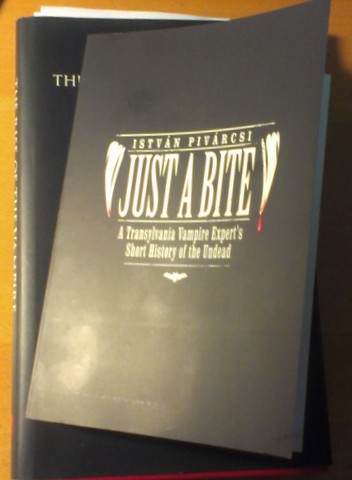
A Transylvania Vampire Expert

'This book represents one Hungarian historian and traveler's sometimes elusive but ever conscientious filtering of numerous sources - sources including not only those books listed in the bibliography (some folkloric works available only in Hugarian) but also Hungarian-language and other archival materials and, indeed, stories heard during many journeys over many years in Transylvania and elsewhere.'

Hungarian historian István Pivárcsi has written a number of books on vampires and other subjects in Hungarian, while so far only the book quoted from above has been translated into English: Just A Bite: A Transylvania Vampire Expert's Short History of the Undead (paperback, 292 pages, $14.95). 'For more than twenty years he has led vampire tours in neighboring Transylvania,' the publishers write, making the reader expect that the book will contain a lot of information on vampires related specifically to Transylvania. Most of the book, however, covers ground familiar from numerous other books: Vlad Tepes, Elizabeth Bathory, Gilles de Rais, werewolves, zombies, the Golem, beliefs related to blood, vampire bats, porphyria, and the vampire of popular culture, and quite a lot of what is said about Romanian vampire beliefs is very brief.

Pivárcsi writes that, 'although research has found that vampire myths are rooted most firmly in Serbian, Croatian, Ukrainian, Romanian, and Ruthenian folklore,' Transylvania is of particular importance in 'vampirology', as he names the field:

'Largely because the vampire that was to become best known by name, Count Dracula, was linked in the popular imagination to that region,' even though he actually ruled south of Transylvania, but also because 'Romanian folklore in particular came to be permeated by vampires, thanks in no small part to a certain tenet of the Eastern Orthodox Church - name, that those people who died after being excommunicated returned as the walking dead - moroi in Romanian. Indeed, such souls were condemned to remain in this most unfortunate state of limbo until the Church saw fit to relieve them of the curse.' According to Pivárcsi, it was, however, the merging with the strigoi, 'a nocturnal death-bird with supernatural powers that flew about at night, hunting human flesh and blood,' 'that yielded the characteristic Romanian vampire figure whose modern permutations we have come to know. Linked as they were to the Christian religious tradition that pervaded nearly every aspect of society, vampires became seen as agents of Satan, as instruments of evil bent on violating and annihilating humanity - and it was thought that a whole army of them were out there in the night maneuvering for final victory. They fed on human blood, and their bite infected their victims with vampirism. Blood and darkness alone sustained them.'

Pivárcsi, unfortunately, does not evolve this theme much, but in a short chapter he relates some accounts related to the Transylvanian belief that 'were adapted by your humble guide from my archival research in Transylvania coupled with material in the works of the noted twentieth-century Hungarian folklorists Enikö Csögör and Tekla Dömötör.' There are in fact only five accounts, or 'possibly true tales', a couple of which are rather schematic, while the rest include other, and more interesting aspects of local folk beliefs that unfortunately are not dealt with in the book.

The book also includes a glossary, and a chronology in which it is claimed that Philip Rohr's De masticatione mortuorum 'is the first work to be published in German language about vampires,' while under 1710 it says: 'Vampire hysteria sweeps across Eastern Prussia. Numerous cemeteries are dug up, and a mob sets the houses of suspected vampires on fire.' This sounds like a Hammer film!  Equally apocryphal, yet still fascinating is the entry for 1725-1732: 'In the southern territories ruled by the Austrians, inhabited mainly by Serbians, several people are sentenced to death on charges of vampirism.'

The only part of the book that presents something truly Hungarian that is probably not available elsewhere, concerns the Hungarian silent Dracula film, Drakula halála, from 1921, so if you are looking for information on that one, Pivárcsi's book may be worth getting hold of. Otherwise, well, maybe this book is simply intended for younger readers looking for a popular introduction to the subject, and in that respect it is probably not worse than so many other books. But if you are looking for something on Hungarian or Transylvanian folk beliefs, I'd rather go for e.g. Tekla Dömötör's Hungarian Folk Beliefs.

The original title of the book is not mentioned, but I think this is a translation of Pivárcsi's Drakula gróf és társai originally published in 2003.

The publisher, New Europe Books, specializes in books from and about the former East Bloc, 'a literary landscape shrouded for all too many in mystery': 'We seek to introduce new and classic-yet-undiscovered authors and books whose stories will resonate with readers far afield. Our authors include not only those born and raised in this part of the world (whether or not they happen to write about their own societies) but also expatriate writers from elsewhere and those who may have lived abroad for a short or long time but whose ancestry is rooted firmly somewhere in Eastern Europe—in short, all those whose lives are bound up in some manner with the region, and who share startling new perspectives on the human condition that will appeal to readers from far reaches of the globe.'

Friday, 11 October 2013

The Corpse of Evidence

Call for papers for an edited volume temporarily entitled:

The Corpse of Evidence. Cadavers and Proofs in Early modern European Forensic Medicine.

We invite scholars to submit abstracts for a proposed volume on the history of early modern European forensic medicine. At the center of the volume is the cadaver, observed, dissected and manipulated to provide answers to the questions of doctors, lawyers, theologians. How did the practices of interrogation of the dead body evolve in the different European countries and how did the concept of proof change?

Proposals are encouraged which, while based on specific case studies, can provide ample stimulus for reflection and allow for comparisons between countries with different cultural, and particularly scientific, traditions.

We welcome submissions on the following subjects:
  • Medical-legal Literature
  • Dissection practices and narratives
  • Resistance to dissection
  • Postmortem phenomena
  • The corpse in the history of mentalités
  • Comparative analyses between the various European legal systems
  • Comparisons of doctors, lawyers and theologians
  • Pathological anatomy and teratology
  • Processes of beatification and sanctification in the Catholic Church
Those interested should submit a 300 word abstract describing the essay they propose to write. Authors should include a short cv, affiliation and contact information with their abstracts, which should be sent electronically to Dr. Francesco Paolo de Ceglia: francescopaolo.deceglia@uniba.it

The deadline for submission is November 1, 2013.

Thanks to Dr. de Ceglia of the Centro Interuniversitario di Ricerca "Seminario di Storia della Scienza" at the Università degli Studi di Bari Aldo Moro for notifying me. De Ceglia has published a paper on Giuseppe Davanzati's view on vampires: The Archbishop's Vampires.

Sunday, 15 September 2013

A surgeon's eyewitness accounts from Transylvania and Wallachia


Most of what was written on vampires in the eighteenth century consisted of commentaries on either a very small corpus of eyewitness accounts from officials of the Habsburg authorities or the Catholic Church or of various tales of vampires and revenants from around Europe. The most careful and comprehensive study based on first hand examinations of both those who complained of being attacked by a bloodsucker and of the bodies of the suspected vampires, was written in 1756 by a regimental surgeon, Georg Tallar.

Tallar was born in Mainz around 1700, and studied medicine there and in Straβburg. He then pursued a career as a surgeon and physician in the Habsburg army for more than thirty years, serving in Transylvania, Wallachia and the Banat. As Tallar mastered the local languages of those regions, he was not only able to discuss the subject of vampires first hand with the people who actually believed in them.

The new edition of Tallar's book and two pages from the manuscript shown in the Dracula. Woiwode und Vampir exhibition catalogue

Tallar witnessed five incidents in which people claimed to be attacked by vampires – or actually: Moroi – and in three cases he was himself involved in examining those who were ill as well as the corpses that were exhumed. He had actually even known some of those who, after their demise, were suspected of being bloodsuckers.

The Wallachians who were ill and claimed to have been attacked by a bloodsucker, told Tallar that they had been in bed for a couple of days, and that their heart hurt. When asked where the heart sits, they pointed, not to the heart, but to the stomach and the intestines. They said that, whenever they tried to fall asleep, the bloodsucker appeared in the shape of this or that deceased man or woman, standing in front of them or in a corner. Some said that they saw the bloodsucker when they were asleep, but many of the afflicted actually saw nothing. Still, they believed that it was necessary to open the graves to look for the Moroi. Although exhuming and destroying corpses was prohibited by law, they were willing to break the law to seek out and destroy the bloodsucker. In fact, people were so afraid of falling prey to the vampire, that they dared not walk about after dark.

Examining them, Tallar found that they complained from pains and aches in various part of the body, including strong headaches, and that their tongue would turn first pale and then become brownish red and dry as wood. They were very thirsty, and had a faint and erratic pulse.

In each case, only Wallachians were affected by the bloodsucker, whereas neither soldiers, German settlers, nor local Serbs became ill, so Tallar concluded that the Wallachians did not suffer from an epidemic, but rather an endemic disease. Considering the traits of the Wallachians, he concluded that the food eaten by them, especially during the fasts that they fanatically observed during Winter - consisting of e.g. cabbage, garlic, and sauerkraut - was the cause of the disease. In fact, administering a simple vomitive often cured the diseased!

Tallar also discusses various beliefs concerning the dead and their graves, refuting the beliefs and providing various natural causes for the phenomena. He e.g. refutes the belief that the bloodsuckers are more harmful on Saturdays, by exhuming and examining the corpses on various days of the week, showing that the state of the corpses were independent of the day of the week.

Overall, Tallar is an exemplar of the medical enlightened man, emphasizing – like Gerard van Swieten – the lack of education among the Wallachians, while at the same time mentioning that they are not so stupid not to accept his medical remedies against the disease, when they notice that people get cured.

From Medicinische Jahrbücher des kaiserl. königl.
österreichischen Staates
 Band 56 (Wien, 1846)
Tallar wrote his Visum-Repertum Anatomico-Chirurgicum after the vampire incident in Hermersdorf that prompted Empress Maria Theresa to stop the burning of corpses associated with magia posthuma, but his manuscript was left unpublished for almost thirty years, until the Viennese publisher Johann Georg Möβle came upon it and decided to publish it in 1784.

A reviewer in the Viennese Realzeitung für das Jahr 1784, expressed the wish that Tallar had used his proficiency in the Wallachian language to publish his observations on the matter in that tongue. Excerpts from the book turned up in Johann Dionis John’s Lexikon der K. K. Medizinalgeseze in 1790, and in an article in the Medicinische Jahrbücher des kaiserl. Königl. Österreichischen Staates in 1846.

Now, almost 250 years after its first publication, Tallar’s book has been reprinted by Nicolaus Equiamicus in a slim volume that replaces Möβle’s introduction by a new one by Equiamicus, and adds a few explanatory footnotes, while slightly updating the language of the original. Tallar’s original is readily available online (see my list of links), but Equiamicus is to be commended for providing us with a handy edition of this essential text on vampire beliefs. And it is available for just €7.90.

Saturday, 7 September 2013

Sleep paralysis and 'a sensationalist cock-and-bull story'


'From 12th-century 'revenants' to today's teen thriller Twilight, belief in vampires has been an enduring theme in cultural history,' and in the September issue of the BBC History magazine, Richard Sugg writes about a few incidents of vampire history. Sugg is a lecturer in the English department at Durham University, has written Mummies, Cannibals and Vampires: The History of Corpse Medicine from the Renaissance to the Victorians and the forthcoming The Smoke of the Soul: Medicine, Physiology and Religion in Early Modern England, and is currently preparing Faces of the Vampire: From Holy Terror to Vampotainment. Elsewhere, it has been pointed out that one of the 'vampire cases' that Sugg reports, probably is simply 'a sensationalist cock-and-bull story'. Sugg, apparently, supports the theory that vampire beliefs are based on experiences of sleep paralysis:

'In her recent book on sleep paralysis, Shelley Adler related how the religious beliefs of Hmong people from south-east Asia led to several nightmare-related deaths during and after the 1970s. Therese attack, which occurred in the USA among Hmong refugees, were thought to be due to angry ancestral spirits and subsequently inspired the horror film A Nightmare on Elm Street.

So vampires (or nightmares incorporating them) really can kill you - if you believe in them. Anyone who has suffered from sleep paralysis nightmares will understand this level of terror. And if you suffered such an attack in a little Serbian or Greek village a century or more ago, what explanation could there be - except something supernatural and demonic?'


Related Posts Plugin for WordPress, Blogger...