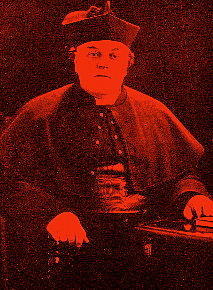
In the early 20th century the British Egyptologist
Margaret Murray claimed that the witch trials were actually aimed at a pagan, pre-Christian religion. Evaluating Murray's work in 1994, Jacqueline Simpson wrote (as quoted on the
English Wikipedia entry on Murray):
'So what was the appeal of her work? Part of the answer lies in what was at the time perceived as her sensible, demystifying, liberating approach to a longstanding but sterile argument between the religious minded and the secularists as to what witches had been. At one extreme stood the eccentric and bigoted Catholic writer Montague Summers, maintaining that they really had worshipped Satan, and that by his help they really had been able to fly, change shape, do magic and so forth… In the other camp, and far more numerous at least among academics, were sceptics who said that all so-called witches were totally innocent victims of hysterical panics whipped up by the Churches for devious political or financial reasons; their confessions must be disregarded because they were made under threat of torture. When The Witch-Cult in Western Europe
appeared in 1921, it broke the deadlock.' (Margaret Murray: Who believed her, and why? in
Folklore, 105 (1994): 89-96)
In a recent introduction to the subject published in Germany,
Hexen und Magie (Campus Verlag, 2007), Dr. phil. habil.
Johannes Dillinger talks of
'Verspätete Dämonologen', delayed demonologists, and mentions
'Summers who in the first third of the 20th century besides anthologies of horror stories published several monographs about magic as well as English translations of some demonological treatises with chatty introductions. Whether Summers, as he claimed, was really a priest has yet to be proved. His spleen or perhaps rather his sales trick consisted in posing as an ultra conservative Catholic. Summers wrote as if he literally accepted witchcraft as a reality. His works are at best of interest as a curiosity of historiography.' (p. 114)
*
That Summers was controversial I have previously
shown examples of, and more can be found in his books. In the introduction to
A Popular History of Witchcraft he e.g. states that
‘the present study aims at presenting a clear view of the Practice and Profession of Witchcraft, as it was carried on in former centuries and now prevails amongst us. I am convinced that it is most necessary to realize that this is no mere historical question, but a definite factor in politics of to-day, as well as in social life and the progress of humanity.
The Black International of Satan – that is the canker which is corrupting and destroying the world.’ (p. xvi)
Such extreme statements are perhaps easier to find in his books on witches and witchcraft, so perhaps his books on vampires are a different kettle of fish? If, however, you read an interesting letter that is reproduced on pp. 391-3 of the new, critical edition of
The Vampire: His Kith and Kin, you can see that Summers himself in September 1934 wrote:
'Scholars have been generous enough to recognize me as the greatest living English authority upon historical witchcraft. My HISTORY OF WITCHCRAFT is accepted as the standard book upon the subject. I have written six books upon witchcraft, and I have further translated and edited nine treatises, some of great length, covering the whole area of historical and mediaeval witchcraft.'
So what were these
'six books upon the subject of witchcraft'? Checking with the bibliography by
Timothy d’Arch Smith, I suppose the books are:
The History of Witchcraft and Demonology (1926),
The Geography of Witchcraft (1927),
The Discovery of Witches: A Study of Master Matthew Hopkins (1928),
The Vampire: His Kith and Kin (1928),
The Vampire in Europe (1929), and
The Werewolf (1933). So to Summers himself, his two books on vampires must be treated as part of his oeuvre upon witchcraft, and not as something distinct from those books. Actually, vampires are briefly mentioned in
The Geography of Witchcraft (p. 503-4), and in the introduction to
The Werewolf, he calls it
‘a successor to my study, The Vampire’ (p. ix)
Apparently these subjects are not separate, but according to Summers really just different themes within the overall subject of witchcraft. Subjects whose reality he claimed to believe in, while at the same time stressing their universality:
'A subject as old as the world and as wide as the world' according to his
The History of Witchcraft and Demonology (p. ix), and a subject that had not lost its relevance in the early twentieth century:
‘My aim throughout my new work has been to show how the profession and practice of witchcraft are the same always and in all places, be it in some remote English village, in a quiet cathedral city, in the sweltering hinterland of Jamica, or in savage Africa.’ ‘Up and down England there is hardly a village without a witch. In our great cities, our larger towns, our seats of learning, Satanists abound and are organized (as of old) into covens of wickedness. Black Masses are celebrated in Mayfair and Chelsea; in Wapping and Shoreditch; in Brighton; in Birmingham; in Liverpool; in Edinburgh.’ (
A Popular Introduction to Witchcraft, p. xiii and 258)
The Werewolf echoes his words on witchcraft:
'As old as time and as wide as the world, the belief in the werewolf by its very antiquity and its universality affords accumulated evidence that there is at least some extremely significant and vital element of truth in this dateless tradition, however disguised and distorted it may have become in later days by the fantasies and poetry of epic sagas, roundel, and romance.' (
The Werewolf, p. 1)
And of course, vampires according to Summers are as universal as werewolves and witches:
'The tradition is world wide and of dateless antiquity.' (
The Vampire: His Kith and Kin p. ix), although it may not be quite as prevalent in Summers’s own time as the Black Mass:
'Cases of vampirism may be said to be in our time a rare occult phenomenon. Yet whether we are justified in supposing that they are less frequent to-day than in past centuries I am far from certain. One thing is plain: - not that they do not occur but that they are carefully hushed up and stifled.' (
The Vampire in Europe, p. xx-xxi).
Summers, however, does note in places that the vampire – at least in its more strict sense – can be located to certain parts of Europe at a certain period, but overall his universal vampire concept is one of the most influential aspects of his books.
Examples from
anthropology and
archaeology are provided as proof and foundation for the antiquity and universality of the phenomena. So when specialists decide to use the word
‘vampire’ in translations of e.g. cuneiform texts from
Sumer and
Babylonia, Summers can appropriate these
‘vampires’ to conform to his ancient vampire concept.
Although prevalent in many popular vampire books, universality is not at the heart of many modern studies that rather stress the vampire's historicity by discussing whether the vampire is unique, and if the vampire was really of Slavic origin. In a recent - and excellent - book on magic and witchcraft published in Denmark, it is stated that the Romans
'did not have a specific term for the category revenant. Indeed, the concept 'revenant' in the meaning 'walking corpse' appears to have been unknown to them. The examples that are usually shown hereof, in my opinion do not concern walking corpses, but apparently dead people. It should be added that further categories like bloodsucking vampires, zombies and poltergeists in antiquity were unknown phenomena, notions and phantasies. They have all been invented more recently, i.e. within the last couple of centuries.' (Allan A. Lund:
Magi og hekseri: Fra den romerske oldtid til og med middelalderen (Gyldendal, 2010), p. 106)
And writing of Summers and other 'vampirologists' in 2010,
Erik Butler in
Metamorphoses of the Vampire in Literature and Film says:
‘Because they have bought into the fiction of vampire antiquity, many popular and scholarly discussions of the vampire fall victim to a lure posed by vampire stories, and they accept the monster as a near-eternal being whose existence reaches back to the ancient world.’ (p. 3)
As Summers was a professed Catholic, it is interesting to compare his work to those of prominent Roman Catholics who wrote on the subject of e.g. vampires, most notably
Dom Calmet and
Giuseppe Davanzati. Both Calmet and Davanzati responded to the scepticism of 18th century Enlightenment. Calmet tried to uphold Catholic dogma while at the same time approaching the subject from a sceptical and historical point of view, whereas Davanzati basically dismissed the vampire belief as ignorance and superstition. No wonder then that Summers could not abide by Davanzati, saying without further explanation:
Nor can we accept “Che l’apparizione de’ Vampiri non sia altro che paro effetto di fantasia.” The truth lies something deeper than that as Leone Allacci so well knew.' (
The Vampire: His Kith and Kin, p. 25) Obviously, it was hard for Summers to accept that a prominent Catholic dismissed the vampire as an effect of the imagination.
Compared to Calmet and Davanzati, Summers's project might be termed anti-Enlightenment, as he attempts to establish his own mythological pseudo-Orthodox Catholicism, apparently wishing to revert to some (probably unhistorical) Christian fervor in opposition to witches, Satanists, vampires and werewolves.
Similarly, he probably would not have sympathised with
Gerard van Swieten and Empress
Maria Theresa, who were both Catholics opposing superstition. In the bibliography of
The Vampire: His Kith and Kin, Summers refers to the 1768
Abhandlung des Daseyns der Gespenster Nebst einem Anhange vom Vampyrismus (the first entry in the bibliography), but I doubt that he read it, because he does not refer to the incident that Gerard van Swieten dealt with in the Anhang.
Re-reading parts of Summers’s
The Vampire: His Kith and Kin, I honestly can not help wondering whether he really believed what he wrote. Was he confident in his belief that evil forces, Satanists, vampires and shapeshifters were lurking in the shadows of contemporary Britain? Or was it to some extent merely a fictional ploy to make the reader’s blood curl, perhaps inspired by the penny dreadfuls and Gothic horrors he enjoyed?
His 'occult' books are in their construction and style not dissimilar to Baroque books: anthologising various curious stories to make some points, e.g. of a philosophical nature, but essentially entertaining the reader with strange and marvellous stories. I suppose one could remove most of a book like
The Vampire: His Kith and Kin and still provide enough material to say what Summers essentially has to say about the vampire, its origins, generation, traits and practices. A summary could be stated in perhaps a few pages. That, of course, would remove a lot of the entertainment value, as well as the supposed documentation.
Fortunately, there is more to be found in the follow up,
The Vampire in Europe, and no doubt, much of the value of Summers’s books on the subject stems from his interest in collecting stories and documents. His analysis and his beliefs, on the other hand, are at best mostly ephemeral.
I myself am no Summers buff. I admired his books when I was much younger, which was also at a time when I had little access to much of the material on vampires that is now available. It was also at a time when witchcraft literature was still bogged down by
Gerard Gardner,
Erica Jong and others whose approach to the subject - like that of Montague Summers - mixed historical fact with fiction. Summers’s books contain a lot of material, which can be used for inspiration and entertainment, but I would recommend people to check the sources before trusting old Montague’s research and analysis.
Gerard O'Sullivan writes about Summers in a paper published in 2009 in
The Antigonish Review (No. 159, p. 111-131):
'The mere mention of Montague Summers's name calls to mind Erving Goffman's trenchant "managed stigma" (Goffman [Stigma. Notes on the management of spoiled Identity]
1963). Summers was, and at the very same time, both victim and beneficiary of a spoiled public persona - one which he stage-managed with great skill and, evidently, no little glee. Rumors of bad behavior, occult dabbling, and a purported friendship with none other than Aleister Crowley (they were not friends, but acquaintances, and dined together only twice) swirled around Summers through most of his life.
Summers did little if anything to dispel the rumors. He was alsways, as Fr. Sewell noted, mal vu
in the eyes of London's Catholic clerisy, who had no doubt that Summers was in holy orders, but could not be certain as to their origin, liceity, or canonical regularity. And Summers's very public literary battles with academic critics and scholars whom he perceived as encroaching upon his fields of specialization - the Restoration stage, gothic literature, and the supernatural - left him a figure alternately loathed and praised in the British press.' (p. 113)
Recently, Summers has even been called a ‘freak’ by
Florian Kührer in his recent book on vampires,
Vampire: Monster - Mythos - Medienstar (2010):
‘A “freak” of a special kind, Montague Summers (1880-1948) – in popular lexica described as a “literary historian, demonologist and occult author” – must be numbered among the leading creators of the modern vampire mythos. His admirers, who have immortalized him biographically, but also Summers himself have ensured that the story of his life moves between legend, rumour and serious information.’ (p. 244) **
More specifically, Kührer has this to say about Summers's work on vampires:
‘In his zeal of (false) piety lay also the weakness of Summer’s oeuvre: He read his folkloric sources only from the perspective of a demon hunter and classified almost every phenomenon, that only slightly fitted the profile, as a vampire. Consequently, Summers left us with not only an entertaining panoptikon of monsters, but also succeeded in contributing significanttly to an inflation of the vampire mythos. A great number of “vampirologists” to this day crib from the occult “reverend” and duplicate unreflectingly his phantasms. The World Wide (Vampire) Web has once more duly reinforced the tendency.’ (p. 246) ***
So we are back at Summers’s invention of an ancient and universal vampire.
Hagen Schaub in
Vampire: Dem Mythos auf der Spur (here quoted from the 2011 edition) talks of the misunderstanding of mixing up living corpses with gods and demons, for which Summers is the main perpetrator,
‘who as the first collected an infinite number of international bloodsuckers, which even today infest many vampire books. Furthermore, one must be cautious because not everything is well researched, and many of Summers’s entities have little in common with a vampire. And when you know that the man was convinced of the existence of vampires, his work relativises itself, and one must ask the question if his oft-quoted works really ought to be the basis of current books and not least internet sites about vampires.’ (p. 32-3) ****
David Keyworth in
Troublesome Corpses (2007) simply notes that
‘Montague Summers’ oft-quoted The Vampire in Europe
(1929), for example, although scholarly and interesting to read, is often inaccurate in many regards.’ (p. 6) In fact, nearly 35 years ago
Christopher Frayling in 1978 noted in
The Vampyre: Lord Ruthven to Count Dracula noted that both Summers’s books and
Dudley Wright’s single book on vampires
‘are unreliable, and have for too long been treated as gospel. Tony Faivre’s Les Vampires
(1962) and Sturm and Volker’s Von denen Vampiren oder Menschensaugern
(1973) are both much more scholarly, and can be trusted more than the (many) Summers derivatives.’ (p. 331)
All these critical comments are in a way a testament to the influence of Montague Summers on the field, but at the same time they show how ridiculous it would be to uphold him and his work as an authority on vampires in the 21st century. His research is flawed and erroneus. His project is idiosyncratic and dated. His concept of the vampire as
'world-wide and of dateless antiquity' was extremely influential in the past, but today it must be considered a dead end.
Klaus Hamberger, of course, mentions Summers's two books on vampires in his bibliography of secondary literature in
Mortuus non mordet from 1992, one of the most important books on vampire history published in the 20th century. But it is quite obvious, that Summers play little or no role in the book, and that there are so many other sources that are far more important than Montague Summers will ever be.
In many ways, I think the writer(s) of
German Wikipedia nailed it, when writing of Summers:
‘Characteristic of Summers’s books is his style that is reminiscent of baroque literature. Scholars found Summers’s occult themes unfit as academic research, because his books about the occult did not meet the demands of academic precision. The works of Montague Summers is a testament to a unique passion for collecting, whose ambition for completion is paired with a lack of critical discrimination. In his efforts to track down as many proofs as possible of the acts of bloodsuckers, he placed any ghost that fulfilled just one of the fundamental criteria of the phenomenon “Vampire”, under this denomination, so that in his works on the subject one also find monsters that in no way belong to the category of “living corpses”. In his remarkable industry he searched in all kinds of works of folklore and ethnology for vampires and werewolves, not only from a scientific interest, but also to prove the existence of Evil and its innumerable variants. Montague Summers was convinced of the existence of witches, vampires and werewolves, and maintained the point of view that these were known and feared by all people at all times. This explains why Summers considered eyewitness accounts of vampires and werewolves, as they were published in the occult literature and the sensationalist press of his time, to be genuine.
Despite his erudition it was impossible for Summers to put the incredible amount of collected material into order. With long quotes in various foreign languages, in particular Latin, he wished to give an air of scholarship. Thanks to Summers’s research, both copies of the otherwise lost leaflet about the Werewolf from Bedburg, the in 1589 executed Peter Stübbe, were rediscovered.’ *****
Original quotes in German
*) '
Die Hexenlehre hat auch noch im 20. Jahrhundert Befürworter gefunden: dummdreiste Reaktionäre und Autoren, die den auflagensteigernden Effekt extremer Meinungen erkannt haben (Laven 1907/08; Petersdorff 1995). Summers legte im ersten Drittel des 20. Jahrhunderts neben Anthologien von Horrorstories mehrere Monografien über Magie sowie mit geschwätzigen Einleitungen ausgestattete englische Übersetzungen einiger dämonologischer Traktate vor. Ob Summers, wie er behauptete, tatsächlich Priester war, mag dahingestellt bleiben. Sein Spleen oder wohl eher noch sein Verkaufstrick bestand darin, sich als ultrakonservativer Katholik zu gebärden. Summers schrieb, als akzeptiere er Hexerei im dämonologischen Vollsinn als Wirklichkeit. Sein Œvure ist allenfalls als Kuriosum der Wissenschaftsgeschichte von Interesse.'
**)
Ein “Freak” der besonderen Art war Montague Summers (1880-1948) – in populären Nachschlagewerken als “Litteraturwisscenschaftler, Dämonologe und okkultistischer Schriftsteller” beschrieben, der zu den maßgeblichen Schöpfern des modernen Vampir-Mythos gezählt warden kann. Seine Verehrer, die ihn biographisch verewigt haben, aber auch Summers selbst, sorgten dafür, dass sich die Geschichten über sein Leben zwischen Legenden, Gerüchten und seriösen Informationen bewegen.’
***)
‘In seinem (schein)heiligen Eifer liegen aber auch die Nachteile von Summers Oeuvre: Er las seine volkskundlichen Quellen nur aus der Perspektive des Dämonenjägers und klassifizierty nahezu jades Phänomen, das auch nur im Ansatz auf das Profil paste, als Vampir. Summers hinterließ uns somit nicht nur einunterhaltsames Panoptikum von Monstern, sondern leistete auch einen großen Beitrag zur Aufblähung des Vampir-Mythos. Ein Gutteil der “Vampirologen” schreibt bis heute vom okkulten “Reverend” ab und vervielfältigt unreflektiert seine Phantasmen. Das World Wide (Vampire) Web hat diese Tendenz noch einmail gehörig verstärkt.’
****)
‘Für diese Vermischung ist vor allem der selbst ernannte Reverend und Okkultist Montague Summers (1880-1948) verantwortlich, der als Erster eine unendlich große Zahl von internationalen Blutsaugern zusammengetragen hat, die auch heute noch in vielen Vampirbüchern ihr Unwesen treiben. Mitunter ist hier aber Vorsicht geboten, denn nicht alles ist wirklich gut recherchiert, und manche von Summers angeführte Figur hat mit einem Vampir wenig gemeinsam. Und wenn man weiß, dass der mann von der Existenz von Vampiren überzeugt war, relativiert sich seine Arbeit ohnehin und es stellt sich die Frage, ob seine noch immer viel zitierten Werke wirklich Basis aktueller Bücher und vor allem von Internetauftritten über Vampire sein sollten.’
*****)
'Summers an Barockliteratur erinnernder Schreibstil prägt seine Publikationen. Der Fachwelt galten Summers Okkult-Themen als akademischer Forschung unangemessen, darüber hinaus entsprachen seine Bücher über Okkultismus nicht den Anforderungen akademischer Genauigkeit. Das Œuvre von Montague Summers stellt sich als Zeugnis einer einzigartigen Sammelleidenschaft dar, die sich bei allem Streben nach Vollständigkeit mit einem vollständigen Mangel an Kritikfähigkeit paart. In seinem Bemühen, möglichst viele Belege für das Treiben von Blutsaugern aufzustöbern, packte er jedes Spukwesen, das auch nur eins der Grundkriterien für das Phänomen „Vampir“ erfüllte, unter diesen Begriff, so dass sich in seinen diesbezüglichen Werken auch Schreckensgestalten finden, die keineswegs unter die Rubrik „lebender Leichnam“ fallen. In erheblicher Fleißarbeit durchforstete Summers alle nur denkbaren volks- und völkerkundlichen Werke nach Vampiren und Werwölfen, nicht nur aus wissenschaftlichem Interesse, sondern um den Beweis für die Existenz des Bösen und seiner unzähligen Varianten zu erbringen. Montague Summers war von der Existenz von Hexen, Vampiren und Werwölfen überzeugt und verfocht die Ansicht, dass diese bei allen Völkern und zu allen Zeiten bekannt und gefürchtet gewesen seien. So erklärt sich, weshalb Summers angebliche Augenzeugenberichte von Werwolf- und Vampirerscheinungen, wie sie in der okkultischen Literatur seiner Zeit und in der Sensationspresse publiziert worden waren, für bare Münze nahm.
Trotz Gelehrsamkeit war es Summers unmöglich, die Unmassen an gesammeltem Material zu ordnen. Lange Zitate aus diversen Fremdsprachen, vornehmlich aus dem Lateinischen, wollen Wissenschaftlichkeit vermitteln. Dem Forscherfleiß von Summers ist zu verdanken, dass die beiden einzigen Exemplare der ansonsten verlorenen Flugschrift über den „Werwolf von Bedburg“, dem 1589 hingerichteten Peter Stübbe, wiederentdeckt wurden.'