Friday, 21 May 2010

A visit to Leiden

While staying in Amasterdam for a couple of days, I spent some hours in Leiden, the birthplace of Gerard van Swieten. Just half an hour by train from Amsterdam (and ten minutes from Schiphol airport), it was quite easy to go there for some sightseeing. There is a route that takes you on a walk lasting about two hours around town, the 'Leidse loper'.

I was there on Ascension Day, and people were at church, so it was probably a very quiet Leiden I visited. Unfortunately it was grey and pretty cold, but it was a very welcome change from the busy capital. One of the places you pass by on the walk is the old prison with a square where people were executed, as seen in the photo above. One of the houses in the background is the old Latin School where Rembrandt was a pupil. Unfortunately, I am not that well versed in van Swieten's biographical history, so I am not quite sure whether he was a pupil there as well.

One is left in no doubt of Leiden's role in the advancements of science, especially if you visit the old botanical gardens from around 1590, and the Boerhaave museum. The museum traces the scientific revolution in various sciences, including physics and medicine, and anyone who has studied e.g. mechanics will enjoy studying the experimental setups on display. And everyone will be horrified to see the surgical instruments on display. On exhibit is a reconstruction of the Leiden Anatomy Theater, originally constructed in 1593 and displaying various human and animal skeletons:

'In 1593 the University of Leiden was one of the first to build an anatomy theatre in Europe. It was constructed in a former church, which had fallen to the city of Leiden after the Reformation.

In the winter the professor of anatomy conducted public dissections of corpses. During the summer months there was no teaching and the theatre was turned into a kind of museum containing human and animal skeletons. There were also curiosities such as Egyptian mummies and Roman antiquities. It was a place where visitors could stand in amazement and ponder the transience of life.

In the 19th century the anatomy theatre closed down, leaving no trace. What you see here is an actual-size reconstruction of how it must have looked in about 1610, based on manuscripts and prints. The skeletons are also modern, but a few of the curiosities have survived.'


I noticed no mention of van Swieten anywhere, but popular vampires had, of course, set their mark, in this case on a bag on display in a shop window as seen below.

The Blood Countess needs your support :-)

If anyone is interested in supporting an opera about Erzsebet Bathory, here is your chance:

Sunday, 9 May 2010

Yet another Czech 'vampire' found


Show large map

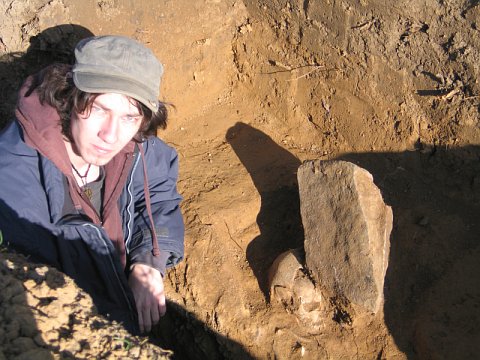
Javier Arries points out to me that there are in fact no less than two recent archaeological finds that may document beliefs in revenants. Apart from the find in Hradék nad Nisou, a more recent one was done in Modrá, known in German as Neudorf, located in Moravia in the South Eastern part of the Czech Republic. You can find more information on the history of Modrá here.

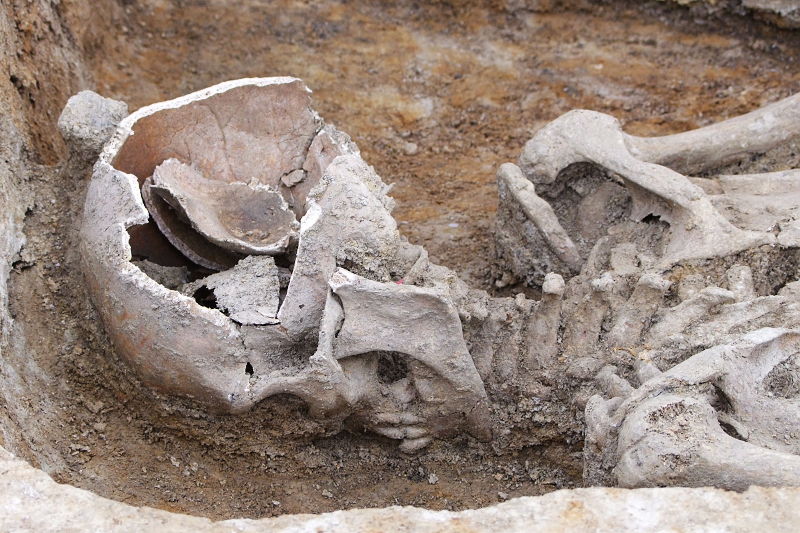
The news about this find is, unfortunately, not available in English, but here is the Czech news story dated May 4 2010: 'V Modré objevili archeologové hrob tzv. vampýra', an interview with the archaeologist Miroslav Vaškových, so here the word vampire, and not upir, is actually used. From what I can gather, the indications of revenant belief includes that the corpse was prevented by stones from exiting the tomb, and that the skull should have been crushed on purpose.

Saturday, 8 May 2010

Another 'vampire' skeleton found

Javier Arries has kindly pointed me to news from Radio Prague concerning a recent archaeological discovery of a skeleton in Hrádek nad Nisou (known in German as Grottau) in the Czech Republic close to the borders to both Germany and Poland

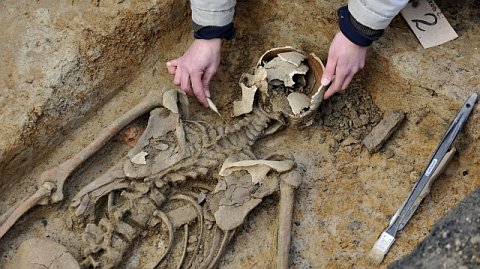
Archeologists in Hrádek nad Nisou are excited about an archeological find uncovered during street repair work in the city centre. Workers digging under the surface of the cobbled street came upon a grave just 20 centimeter below the surface. The skeleton was that of a woman dating around 1310. She was found lying head down with a handful of coins clasped in her hand.

Her position and the location of the grave suggests that she was either considered a witch or a vampire or suffered from a severe physical anomaly and was buried far from the local cemetery in order to prevent her coming back to haunt or harm members of the local community after her death. The skeleton is reported to be surprisingly well preserved given how shallow the grave was and archeologists are hoping to glean much more from the remains. When the research is over the skeleton will be displayed at the local museum.


A couple of news stories in the native language with a few photos can be found here and here, including a close up of the skull. But you should go to this site to watch a TV news story on the vampire (upir), showing both the skeleton and views of the excavations!


Apparently, the five coins found in her hand date from the years 1310-30, and that is why the find is estimated to be from that period. If we should hazard to assume that the body was actually buried in this fashion to prevent it from returning to harm the living, the find is contemporary to the shepherd from Blov and the 'witch' from Levin, the most famous cases of magia posthuma before the 17th and 18th centuries. Both cases were located in the same part of Europe, which makes this find more interesting than the skeleton found in Venice a couple of years ago. Still, I think it pertinent to be sceptical when reading these sensational news stories of supposed 'vampires'.


Show large map

Friday, 2 April 2010

Die Blutgräfin


Show large map

Although historically it has nothing to do with vampires, it is hard for someone interested in that subject not to be intrigued by the history and legends surrounding Elisabeth/Erzsebet Báthory. Through modern books on vampires she has become inseparably connected to the subject of vampires, and by itself it is interesting to try and understand how much of the myth is actually based on historical reality and how the legends about blood baths and other cruel acts arose and developed into the ‘Blutgräfin’, blood countess, of contemporary fiction.

Michael Farin compiled a comprehensive anthology of texts and documentation in his 1990 Heroine des Grauens: Elisabeth Báthory, which is available in a slightly updated edition from 2003. In English, the most recent biography is Infamous Lady: The True Story of Countess Erzsebet Bathory by Kimberly L. Craft, which was published last year and probably incorporates and comments on material from Farin’s book as well as Tony Thorne’s Countess Dracula: The Life and Times of Elisabeth Báthory, the Blood Countess (1997).


The earliest source for Bathory’s blood bathing and obsession with beauty is the 1729 book on Hungary, Ungaria suis cum regibus compendio data, by László Turóczi which is, I think, not available on the internet. The notion was then retold by various other writers, including Sabine Baring-Gould in his 1865 The Book of Werewolves which Bram Stoker read, a fact that has made a lot of later writers on Dracula and vampires claim that Stoker was inspired by Bathory when writing Dracula.

Although the actual acts of the trials against Bathory were made available to the public in the 19th century, the idea of the blood bathing countess has persisted, and Bathory appears to be increasingly popular in fiction. Prudence Foster mixed von Schertz’s Magia posthuma with Bathory in the 1989 novel Blood Legacy, and Georges Pichard made a comic book edition of Sacher-Masoch’s short story on Bathory in 1985, La comtesse rouge (some images from an English translation can be found here). Most recently she played a central part in the 'official sequel' to Dracula.

In the cinema, a couple of dramas have been made over the last couple of years, The Countess and the Czech Bathory which should finally be available on German DVD this summer, plus various vampire movies like Eternal (2004). But the most famous are probably still Les lèvres du rouge (1971), Countess Dracula (1971), and Contes immoraux (1974), although only the latter two attempt some kind of 'historical' portrayal.

Contes immoraux was released on DVD here in Denmark recently, so I had a chance to view it for the first time in many years. More like a series of tableaux, there is little storyline in the film’s four parts, of which the third concerns Bathory. In fact, the raison d’être of the movie seems to be to show a lot of young women with little or no clothes on. Most of the Bathory sequence shows a number of these young women bathing for a long, long time to clean themselves before providing the sanguineous liquids for the bath of Bathory (played by Pablo Picasso’s daughter, Paloma, apparently her sole attempt at acting). There is given no explanation for the blood bath, so the viewer is assumed to know the legend, perhaps from Sacher-Masoch or from a popular book by Valentine Penrose, Erzsébet Báthory – La Comtesse sanglante, published in France in 1962.

In all fairness to the director, Walerian Borowczyk, I should add that I found his (in)famous and very explicit La Bête (1975), which was also released on DVD here, far more entertaining and innovative than his imho slightly boring 'immoral tales'.

For this post I have taken some photos of novels that I collected many years ago that exploit the legend. Click on the photos to read the spine tingling attempts at whetting your appetite for new tales of the 'blood countess'. I also found an old Danish magazine of 'chocking and hair-raising' historical sensationalism which includes the story of 'Prinsessen bag Drakula-myten: Hun tog bad i jomfrublod': The princess behind the Dracula myth: She bathed in virgin blood.

Something seems to attract people to the story, as Michael Farin also admits in his 2003 postscript on Bathoriana: 'Ja, es sei zugegeben, ausch solchen Gelüsten diente die vorliegende Sammlung. Sie fand LeserInnen, deren Augen zu schwimmen begannen. Das gehört bei einem solchen Thema nun einmal dazu, und auch einem "Kulturarchäologen" ist dies nich gleichgültig.'

And so the cultural archaeologist may find some entertainment and inspiration for the holidays below...

Wednesday, 31 March 2010

A book full of surprises

Purchasing second hand books over the internet can provide both positive and negative surprises, as I have mentioned before.

I recently bought a copy of the 1961 French anthology Roger Vadim présente: Histoires de Vampires based on the original Italian Vampiri tra noi compiled by Ornella Volta and Valerio Riva from 1960. The French edition comprises 593 pages, whereas the 1963 English edition omits a lot of the contents ending up at only 286 pages. Anyway, the copy I bought turned out to contain numerous surprises as a previous owner had put a number of cuts from papers and magazines in it, mostly just pictures that the owner must have found appropriate to this book. Certainly, a charming idea which adds a personal dimension to a book that includes not one single illustration. And I will, of course, leave them as the previous owner arranged them.


What makes this book particularly interesting is the part on vampirologie which contains excerpts from Calmet, Voltaire's famous text on vampires ('Quoi ! c'est dans notre dix-hitième siècle qu'il y a eu des vampires !'), an excerpt from Caraccioli's biography of pope Benedict XIV as wells as texts by that pope, and van Swieten's remarks on vampires (unfortunately, not in the original French text by in a translation from the Italian translation). The rest of the book anthologizes a number of now well-known vampire short stories by Polidori, Gautier, Doyle etc.

Caraccioli's book on Benedict XIV, La Vie du Pape Benoît XIV Prosper Lambertini, by the way can be found on google books: 'Dans plusieurs villages de Pologne & de Hongrie, imbus de ces fables, on exhumoit fréquemment des cadavres, qu'on soupconnoit Vampires; & c'étoit affez qu'ils parussent avoir le visage enflammé, pour qu'on les mutilât & qu'on outrageât leur mémoire.' The same goes for another book by Caraccioli excerpted in the anthology: Lettres a une illustre morte, décédéé en Pologne depuis peu de tems, which contains a few letters concerning vampires.

Tuesday, 30 March 2010

Gender and crime


Criminal women is the theme of a book published last year: Murderesses in German Writing, 1720-1860: Heroines of Horror by Susanne Kord from the Department of German at University College London. The book contains a chapter on vampires, including a history of how 'Serbian vampires come to life in Germany (Leipzig and Vienna, 1732-1755)', but probably mostly concentrating on Elizabeth Bathory and 'female vampires in literature from Goethe to the Grimms (1797-1823)'. Published by Cambridge University Press, it is available for around £50.

The cover reproduces Philip Burne-Jones's famous painting The Vampire.

Sunday, 28 March 2010

Dracula bibliography

This is mostly about the fictional Dracula, but I am sure some will find this Canadian three part bibliography useful. It is particularly strong on literature in English and French on Stoker and his novel and its adaptations. Part three is concerned with the cinematic Dracula.

Sunday, 7 March 2010

Revenants and vampire forensics


National Geographics has recently aired a documentary on 'vampire forensics' inspired by the find of a skeleton near Venice that some archaeologists have claimed to have been that of a 'vampire corpse' - see e.g. this previous post. The theory is highly improbable, but the documentary may still be very interesting to watch. I suppose that it is closely linked to the new book from National Geographics on the same subject, which is advertised in the video below.

Tuesday, 2 March 2010

Flückinger and Mayo

Untotes Wachsen im Textgrab: Zur narrativen Ausarbeitung von Flückingers Vampirismus-Protokoll (1732) bei Herbert Mayo (1846) by Clemens Ruthner is the latest addition to the anthology of papers from the conference on vampirism in Vienna last summer:

'The written records and the tradition of the vampire phenomenon are rich. I will focus on the literary and cultural constitution of the (popular) vampire myth on the basis of the existing textual corpus. Starting point are the earliest authentic reports on vampires from Serbia around 1732 which provide an interesting case study. It will be shown how from then on up to the 19th century a vampire plot has been developed and transformed in oral and written tradition through compilation, citation and similar intertextual processes - a kind of ping-pong play as it were between historical documents and literary texts.'
Related Posts Plugin for WordPress, Blogger...