Friday, 31 December 2010

Happy New Year!

With only a few hours left of 2010, it is quite obvious that I have not been very active on this blog during the past year. I must confess that other activities have taken up most of my attention, and there is no reason to expect that this will change in 2011. This blog suffers from it, not only because of lack of time on my part, but also because my everyday activities leave me little time and energy for reading and absorbing myself in the subject of this blog. That is also why I have been so slow at reviewing some of the recent books, not least those by Florian Kührer and Nicolaus Equiamicus.

Looking back on 2010, however, there is no doubt that the most important new book is Vampire: Von damals bis(s) heute by Euqiamicus because of its accessible and comprehensive history of vampire cases from the famous ones of the early 18th century and into the 21st century. I will shortly be writing more on the book, but this is really the one single recent book to get hold of, if you are interested in vampire history.

Other noteworthy books from 2010 are Kührer's that I did get to write about, and Erik Butler's Metamorphoses of the Vampire in Literature and Film.

For me personally, the 'vampire' highlight of 2010 was travelling to Bucharest to see the exhibition on Dracula and vampires at the National Museum of Art of Romania.

Apropos of Romania, I also got to watch the movie Strigoi at a one off screening here in Denmark. It is very unusual and quite entertaining, so worth seeking out. It will be available on DVD here shortly.

No plans are yet set for 2011, but no doubt something will come up.

I wish everyone a happy new year!

Sunday, 12 December 2010

Vampires: Myths of the Past and the Future

With thanks to Jordi Ardanuy, I am able to mention this forthcoming conference at the University of London:

Vampires: Myths of the Past and the Future
An interdisciplinary conference organised by Simon Bacon, The London Consortium in collaboration with the Centre for the Study of Cultural Memory, Institute of Germanic & Romance Studies, University of London


Deadline for submissions: 30 April 2011
Conference dates: 2nd – 4th November 2011
Venue: Institute of Germanic & Romance Studies, School of Advanced Study, University of London

Myths of vampires and the undead are as old as civilisation itself, wherever humans gather these ‘dark reflections’ are sure to follow. Whether as hungry spirits, avenging furies or as the disgruntled dearly departed, they have been used to signify the monstrous other and the consequences of social transgression. Embodying the result of a life lived beyond patriarchal protective proscription that quickly changes from dream to nightmare and from fairy tale to ghost story.

However their manifold and multifarious manifestation also provides a point of opposition and resistance, one that subverts majority narrative and gives agency to the disenfranchised and oppressed within society. This is seen most clearly in the late twentieth century where, in a plethora of filmic and literary texts, amidst a growing ‘sympathy for the devil’ the vampire is constructed as a site of personal and social transition. Here alternative narratives (e.g. feminist, ethnic, post-colonial discourses etc) find expression and ways in which to configure their own identity within, or in opposition to, the dominant cultural parameters revealing hybridity as the catalyst for future myth making.

In the course of the past century the vampire has undergone many transformations which now see them as a separate evolutionary species, both genetically and cybernetically, signifying all that late capitalist society admires and desires thus completing its change from an abhorational figure to an aspirational one; the vampire is no longer the myth of a murky superstitious past but that of a bright new future and one that will last forever.

This interdisciplinary conference will look at the various ways the vampire has been used in the past and present to construct narratives of possible futures, both positive and negative, that facilitate both individual and collective, either in the face of hegemonic discourse or in the continuance of its ideological meta-narratives.

Keynote speakers include:

Stacey Abbott
Catherine Spooner
Milly Williamson

We invite papers from a wide variety of disciplines and approaches such as: anthropology, art history, cultural studies, film studies, history, literary studies, philosophy, psychology, theology, etc.

Possible themes include but are not limited to:

• Myths, fairy tales and urban legends
• Cross cultural colonisation; vampiric appropriation and reappropriation
• Cinema, Manga/ Anime and gaming
• Fandom, lifestyle, ‘real’ vampires and identity configuration
• Minority discourse and the transcultural vampire
• Genetics, cybernetics and the post human
• Blood memory, vampiric memory and the immortal archive
• Dracula vs. Nosferatu; Urban vs. Rural
• Globalisation, corporations and ‘Dark’ societies
• Immortality, transcendence and cyberspace
• Old World/ New World and vampiric migration
• From stakes to crosses to sunlight
• Blood Relations and the vampiric family
• Abjection, psychoanalysis and transitional objects

Papers will also be considered on any related themes. Abstracts of 300 words should be submitted to Simon Bacon at vampiremyths1@googlemail.com no later than April 30th 2011.

Sunday, 14 November 2010

The source of Oder

Here is a short review of one Karl Ferdinand von Schertz' books from the Leipzig journal Acta eruditorum from September 1715. Apparently, von Schertz traces the sources of the river Oder, Odra, to the mountain Sauberg, Svini hora, currently in the Czech Republic: 'In ejus montis apice & fere meditullio inter obumbrantes sagos prosilit Odera, ex humo uvida, non lapide, proveniens, primo exiguus, post ad rivi magnitudiunem perveniens, & sic porro magis ac magis excrescens.'

Saturday, 13 November 2010

A History of Horror

Perhaps slightly off topic, but I think this recent BBC documentary on horror cinema is excellent and worth watching, not least because it provides some rare insights into a number of classic vampire and Dracula movies. Hopefully it will be available on DVD some time in the future, but as someone has put it up on youtube, here is a chance to view (most of) all three episodes.


Sunday, 7 November 2010

Books and reviews

My apologies to all for first posting a review of Florian Kührer's book at this point. I have a couple of other books that I will post reviews of shortly. First of which is Vampire: Von damals bis(s) heute by Nicolaus Equiamicus (Ubooks).

Apropos of books, the forthcoming book on Calmet that I mentioned here, has been postponed until February 2011.

Vampire: Monster, Mythos, Medienstar

Florian Kührer’s Vampire: Monster, Mythos, Medienstar (Butzon & Bercker) is a pleasant, interesting and in every respect very much up to date survey of vampires in folklore, history, the arts and popular culture in general. In Kührer’s own words, his book is ‘die Geschichte vom Aufstieg eines Dorfmonsters zum Popstar der Moderne’, the story of the rise of a village monster to pop star of the present.

Although relatively brief compared to the vastness of the subject, it is evident that Kührer has studied the topic thoroughly and has a good understanding of the various aspects of the subjects. Clearly, Kührer is familiar with the latest literature on the subject like the contributions to the 2009 vampirism conference in Vienna as well as well as the most prominent works of the current vampire trend of Twilight etc.

In the first part of the book Kührer presents a synthesis of the themes of the folkloric vampire: the various types of living corpses or revenants, their names and characteristics, mostly from parts of Europe, but also providing examples from other parts of the world as well as from different periods. Here Kührer also touches on the archaeological finds that are some times interpreted as evidence of vampire or revenant beliefs, and comments sensibly on the recent find of a ‘vampire skeleton’ in Venice:

’Ein klassischer Beispiel für ein Vampirgrab? Ja und nein. Wer immer dieser Frau den Stein in die Mundhöhle gesteckt hat, er dachte dabei kaum an einen Vampir, denn dieser Begriff war in diesem Raum im 16. Jahrhundert mit allerhöchster Wahrscheinlichkeit unbekannt. Wenn wir also am Begriff ”Vampir” hängen, handelt es sich gewiss um keinen “Vampirismus”.’ (p. 40)

Kührer also provides some interesting comments on the construction of a superstitious backwards, not only in the vampire reports of the 18th century, but also in recent news stories from e.g. Romania, where the distinction is not only between a civilised West and a superstitious, backwards East, but also between the enlightened Romanian cities and the superstitious villages. As in the case of the Marotinu de Sus incident:

‘Und wie schon drei Jahrhunderte zuvor stürzten sich die westlichen Medien gierig auf diese Geschichte. Alle großen europäischen Zeitungen berichteten über den Fall Toma, under Discovery Channel drehte gar eine Dokumentation, in der auch Dorfbewohner zu Wort kommen und ihre Versionen der Geschichte erzählen durften. Niemals wird in diesen Berichten vergessen, auf den Beitrittsantrag Rumäniens zur Europäischen Union hinzuweisen. Da waren sie wieder, die Bilder und Geschichten über eine rückständige und geheimnisvolle Gegend, die sich so sehr vom aufgeklärten Westen unterscheidet. Die Grenzen zwischen Zivilisation und Rückständigkeit folgen jedoch nicht ausschließlich dem Ost-West-Schema. Die Bruchlinien verlaufen mitten durch die Gesellschaft: Der westliche Lebensstil durchcringt sukzessive die urbanen Räume Osteuropas, und Vernunft und Aufgeklärtheit halten im Gefolge von Flatscreens und Multimediahandys Einzug. Auf dem Land hingegen scheint die Zeit stillzustehen, Mensch und Tier muss sich offenbar noch immer den Lebensraum mit Hexen, Gespenstern und Wiedergängern teilen. Denn aktuelle Vampirgeschichten aus dem Osten Europas – Mythen vom Rande der zivilisierten Welt – sind bestens dazy geeignet, dem Westen seinen zivilisatorischen Vorsprung zu bestätigen.’ (p. 57)

The second part of the book follows the vampire theme from Rohr’s Masticatione Mortuorum in the late 17th century over the vampire reports and debates of the the 18th century onto the transition of the vampire into a fictional creature of poetry, novels and movies. Kührer describes how the vampire provided the infotainment that suited the 18th century magazines and shortly characterizes the vampire ‘research’ of the period. Kührer, however, also attempts to view the vampire from the point of view of the villagers themselves, and tries to explain why the field surgeons and the learned people were unable to grasp the everyday vampire concept of the villagers:

‘Für die Dorfbewohner war der Vampir der monströse Alltag, der die Gemeinschaft bedrohte und eine tödliche Wirkung entfaltete, die für einen Betrachter von außen kaum zu verstehen war. Dewegen konnten die damaligen Erklärungsversuche den Vampir niemals völlig fassen. Denn die innere Logik der Ereignisse musste dem selektiven Blick des Militärarztes, des Verwaltungsbeamten und des aufgeklärten Philosophen verborgen bleiben. Vielleicht ist es diese Ohnmacht, die den Fremden aus dem Westen veranlasst, auf den Osten Europas oft herabzublicken und ihn sich als einen Ort der Rückständigkeit und des Aberglaubens vorzustellen.

Für die Leser der Zeitungsberichte muss der Eindruck entstanden sein, dass ohne das österreichische Militär ein völliges Chaos in den wiedereroberten Gebieten herrschen würde. Unter diesen Voraussetzungen ist es kein Wunder, dass der recht spezielle Begriff des Vampirs bald auf eine ganze Reihe von magischen Erscheinungen ausgeweitet wurde, die eine Sache gemeinsam haben: ihr Erscheinen in Grenz- und Übergangszonen, wo politische und kulturelle Einflussbereiche ineinander übergehen. Denn der Vampir ist der jeweils Andere, ein Fremder, für die Dorfbewohner ein Außenseiter des Kollektivs, der wie Arnand Paole erst später zur Gemeinschaft dazugestoßen ist oder sich anderwertig durch seinen abnormen Lebenswandel verdächtig machte. Und für den Westen ist er ein Monster aus einer fremden Welt, die gleichzeitig mit der Beschreibung ihrer Phänomene in der Phantasie des Westens neu erschaffen wird.’
(p. 84-5)

Kührer nicely describes how the vampire became part of gothic fiction, the creation of Stoker’s Dracula and the rise of the cinematic vampire. His exposition is clearly quite up to date, as he avoids the fallacies of most writers on the subject in e.g. describing the genesis of Dracula. I particularly enjoyed his account of the attempt at creating a Dracula theme park in Romania, ‘Projekt Draculapark’. Here as well, he interestingly traces the creation of Transylvania as the land of vampires.

The last part of the book traces a number of themes, including blood, gender, vampires as metaphor, anti-Semitism, mass murderers, and the construction of ‘real’ vampires. This part includes interesting, and again: up to date, passages on both Montague Summers and Elizabeth Bathory.

Kührer finishes with a summary that points out the distinction between the modern, popular concept of the vampire and the folkloric vampire, before pointing out why the vampire has developed into one of the most powerful and ever transforming myths of our time:

‘Der Vampir, dieses Geschöpf der Moderne, ist berühmt geworden, weil er dem Westen sein von der Aufklärung um die metaphysischen Dimensionen beraubtes Weltbild mit neuen übersinnlichen Facetten versehen konnte. Er ist mehr al seine einfache Legende oder ein Märchen. Die verschiedenen Entwicklungsstränge – vom serbischen Volksvampir bis zum Produktnamen für Haushaltgeräte – verbinden sich zu einem der mächtigsten Mythen der Moderne. Die Gestalt des Vampirs, zu Beginn noch Thema, hat sich zu einem Motiv entwickelt, zu einem auf wenige Elemente verkürzten Code, der auf der ganzen Welt verstanden wird.’ (p. 273)

It is fair to say that Kührer's book is not a detailed account of any particular aspect of the subject, but an overall history of the vampire, as well as an attempt as answering the obvious question: Why does the vampire remain so popular? It is well written and researched, and it is delightful to read a book that is in all aspects in accordance with a modern view of the subject, free of the myths and errors that you find in most other books. For that reason alone, this book is worth reading for the casual reader as well as for those of you who have a special interest in vampires.

Highly recommended.

Sunday, 31 October 2010

Another Halloween

I find that I rarely get around to writing blog posts because other activities tend to take up a lot of my time. But I just received an e-mail from someone who had found this blog because of a search inspired by Halloween, so I thought I would just post of a photo of the pumpkin head I made from this year's harvest in my own garden.

I have a few blog posts that I have left unfinished, e.g. one regarding the new digital books, like Calmet's Phantom World which is easily available for Kindle on a smartphone as seen in the photo above.

In the photo below are three pretty rare vampire books that took me some time to get hold of: Otto Steiner's Vampirleichen: Vampirprozesse in Preussen (1959), Aribert Schroeder's Vampirismus (1973), and Tony Faivre's Les Vampires (1962). Who knows, with the advent of e-books, they will perhaps be accessible for next to nothing on a phone, Kindle or iPad?

Sunday, 17 October 2010

'Vlad the Prick'

I noticed a critical commentary on the Dracula Voivod or Vampire exhibition in Bucharest:

'In the last fifty years the local culture has merged the Dracula myth with that of 15th Century Wallachian prince Vlad ‘Tepes’ Dracul– which is translated as Vlad the Impaler or, more amusingly for the English, Vlad the Prick. But there is little linking the two figures other than a shared surname. (...)

But the real victim here is Romania, which is at the mercy of two independent myths – mostly constructed by foreigners. (...)

Then the exhibition jumps into the 18th Century and enters Moravia, where it elaborates accounts of vampires. Peasants blame mysterious deaths in villages on the dead who walk at night, so they dig up graveyards and disinter bodies. When they find a corpse that has not fully decayed, the villagers chop off its head and burn the body. Villagers recount how people become hungry for human blood if they eat the flesh of an animal which a vampire has consumed or if they are buried in the same cemetery as a vampire. These accounts fuel vampire and zombie myths – but how does this relate to Vlad Tepes?

This exhibition at the National Museum of Arts makes the same mistake – it combines historical artefacts from Romania’s 15th and 16th century with the vampire legend - an 18th century construct from central Europe. Even the title confuses the casual visitor – ‘Dracula: Voievod (prince) and Vampire’, above an image of Vlad Tepes.'


I think that the exhibition could perhaps have stressed more clearly the theme of the struggle between the Habsburgs and the Ottoman Empire in South Eastern Europe as the common backdrop of both Vlad Tepes and the vampire cases of the 1730's. The exhibition follows this struggle from the days of Vlad Tepes and until the 18th century, and I think this is an interesting historical way of linking the otherwise disparate subjects of a Valachian Voivod and the 'undead' corpses that caught the attention of many people in the 18th century.

Bram Stoker wanted to place his novel in the region, but moved it from Austria to Transilvania, and most probably by chance made a link that is now part of Romanian tourism. Romania today seems to have integrated so many elements of popular Western culture that you can easily find translations of various vampire novels in their bookstores, including a Romanian translation of Dacre Stoker and Ian Holt's 'sequel' to Stoker's Dracula: Dracula, mortul viu!

Tuesday, 28 September 2010

Dracula is dead and well and living in Romania...

Left Copenhagen on September 23 at 11:15 AM and arrived at Henry Conanda (Otopeni) Airport, Romania, around 2:40 PM.

Like Jonathan Harker I went beyond the forests but I was travelling above them, as he or any of his modern colleagues would have done today, watching the Carpathians and the Transylvanian Alps from way up. My short visit to Bucharest, lasting just a little more than fifty hours, had one aim: to see the exhibition on Dracula and vampires at the Muzeul national de arta al Romaniei.

I visited the exhibition twice, but I can only show you a photo of the exterior, as photography was stricly prohibited inside. So if you want to know what the exhibition looks like, you have to go to the web site I linked to recently. I think that the exhibition was smaller than the original one at Schloss Ambras, but it was of course exciting to find on the same location famous paintings of Vlad Tepes and one of Elizabeth Bathory, as well as books and manuscripts on the subject of vampires, including Flückinger's Visum et Repertum.

I suppose that this may well have been the first and last time that I get to see some of these items, as they are usually to be found at a number of different locations in Europe. Looking at the opening page of the Visum et Repertum, it was obvious that the spelling is Arnout Pavle and not all the other ways it has been spelled in books since that time.

I am unable to say what other people thought about these items - although I noticed a number of enthusiastic writings in the guest book - but to me it was sensational to finally see the genuine article on display to the public: the occurrences in Serbia and the following debate. Of course, the exhibition only gave a superficial impression of these things, as it follows the story from Vlad Tepes over the wars between Christian Europe and the Ottomans, the vampire cases and debate of the 18th century, ending up with Bram Stoker and the cinematic vampire. Personally, I would have liked to see some these things elaborated on in more detail, but I am more than happy to have had the opportunity to see these paintings, manuscripts, books and other items. Well worth travelling 2600 km to attend, I would say.

But this was not the only exhibition on Vlad Tepes, because at the very hotel that I stayed at I found an exhibition of stamps, letters, postcards and other items tracing the history of Vlad Tepes.

Apparently funded by Fundatia Snagov, a lot of time and effort must have gone into compiling all this material. And what a coincidence that I should find it at the very hotel I was staying at! A pleasant one as well, the Golden Tulip situated on Calea victoriei, not far from the national art museum. If you are going to Bucharest, I would recommend hotels on or near this street, as you are in a convenient part of town close to the city centre.

Curiously, many of the hotels and restaurants seem to think that beer from my own country is 'probably the best beer in town', so I had to go to a supermarket to taste one of their local beers. In the photo below you can also see an issue of a Romanian historical magazine, Historia with a theme on Vlad Tepes that I noticed in one of the numerous small shops selling books and magazines around town.

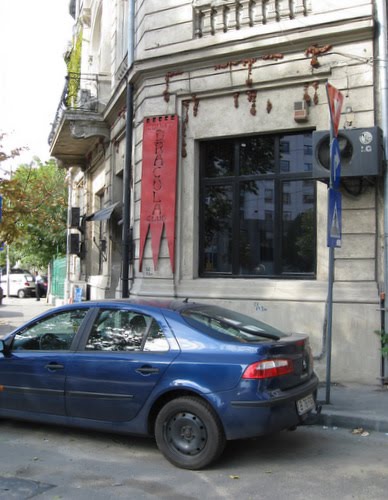
I was actually surprised to find how omnipresent Vlad Tepes/Dracula is in Bucharest. Even Bram Stoker seems to be a household name! Most of the souvenirs are pretty kitschy, but I had a pretty pleasant time at the Count Dracula Club, a theme restaurant where you can get vampiric cocktails and menus based on Dracula. So I had a 'vampire coffin' cocktail, paprika chicken and tasted their Tuica. All pretty nice and it ended with the count himself turning up, quoting Stoker and biting 'Mina' on the neck. Good fun, and not expensive.


Apart from the exhibition, the other highlight of my trip was a visit to the church on an island in the lake Snagov, Lacul Snagov, where the remains of Vlad Tepes were buried according to legend.

I hired a 'limousine' to there, which also allowed me to get some more information on the town and on Romania in general from the driver. Just €65 to go there and back, which is pretty reasonable for a 3 hour ride.

In any case, it was like entering another world when we drove off the high way and entered the forest. The road was awful, but the driver knew his way around, so everything went fine. We encountered a few horse carts and people collecting logs, everything more or less like pictures I had seen of rural Romania.


A bridge is being constructed to the island where the Snagov monastery is located, but I think it will take some time before it is finished. In the meantime you still have to go by boat to the island, and this means sailing in an old fashioned rowing boat across the lake as shown in the photo below, and no one seems to be thinking about life vests! Anyway, everything went fine, and I and my driver got to the island. I was actually the only tourist around, and I may even have been the only one that day!


The monastery or church is pretty small like so many of the Romanian Orthodox churches. It costs 15 lei to enter and 5 lei to be rowed back and forth, which is around €2.50. Photography, unfortunately, is very expensive, €20 I think. The main attraction is the 'grave' of Vlad Tepes, which is easy to find.

So I and my driver went around the small island, while he retold some of the stories about Vlad Tepes. Not quite historically correct, but who cares as all the circumstances surrounding this visit to a place I have read about since I was a teenager made it a highlight of a trip.

I hope to return some time in a not too distant future to 'go to the mountains', as I was recommended at the hotel, and see some of the other places I have read about, as well as the Carpathians and the Romanian countryside. But I should not wait too long, because in ten years or so Snagov and other locations may have turned into tourist traps as we know them from other countries: crowded and expensive.

The only disappointment I had was a 'standard tour' of the Parliament. The building or palace itself and the boulevard leading to it looks like the remnants of a megalomaniac vision, but I had expected more from the tour of the interiors. Anyway, this has nothing to do with vampires per se, and it did not spoil the highlights of the Dracula exhibition and Snagov!


Sunday, 19 September 2010

Books...

Another book on vampires arrived the other day, and I know I still need to post a review of the recent book by Florian Kührer. I hope to post more on both books soon (and I have been told even one more book on vampires should arrive shortly)...
Related Posts Plugin for WordPress, Blogger...