Saturday, 25 August 2007
Prof. Nowosadtko on vampires
It is possible to hear Prof. Jutta Nowosadtko of the Helmut Schmidt Universität in Hamburg talking (in German!) about the origin of vampires and the development of the vampire theme here: Vampire! Ein südosteuropäischer Beitrag zur internationalen Kulturgeschichte (Vampires! A South East European contribution to the international cultural history). Of her writings on vampires, Der „Vampyrus Serviensis“ und sein Habitat: Impressionen von der österreichischen Militärgrenze, is available online in a collection of papers on Militär und Gesellschaft in der Frühen Neuzeit.

Sunday, 19 August 2007
"Heart-Eaters"
I just happened to notice that Christa Tuczay, who has previously written about medieval magic, vampires and related subjects, is publishing a book this month that might interest some.
The subject is "Demonic Crimes in the Donau Monarchy", but as the publisher actually has a web page in English describing the book, I will refer you to that for a description of this - at least at first sight - rather outlandish subject. One example of a "demonic criminal" seems to be the infamous "blood countess", Elisabeth Bathory, who is frequently dealt with in books on vampires and Dracula, although she has nothing particularly to do with revenants.
According to the web site of the Vienna University, Tuczay is lecturing on 'Der Dichter als Aufklärer. Kritische Stimmen zum Aberglauben' this fall, and has previously lectured on 'Unheimliche Begegnungen: Geister, Vampire und Dämonen in der mhd. Literatur'.

The subject is "Demonic Crimes in the Donau Monarchy", but as the publisher actually has a web page in English describing the book, I will refer you to that for a description of this - at least at first sight - rather outlandish subject. One example of a "demonic criminal" seems to be the infamous "blood countess", Elisabeth Bathory, who is frequently dealt with in books on vampires and Dracula, although she has nothing particularly to do with revenants.
According to the web site of the Vienna University, Tuczay is lecturing on 'Der Dichter als Aufklärer. Kritische Stimmen zum Aberglauben' this fall, and has previously lectured on 'Unheimliche Begegnungen: Geister, Vampire und Dämonen in der mhd. Literatur'.
August

August has been busy in other areas than blogging, so there has been a pause in my postings recently. As a 'filler', here is a photo from the cemetery that is just next to my home. Spending so much time reading about corpses that cannot find rest in their graves, it is somewhat reassurring to see how cosy cats and other animals can make themselves around the graves. Incidentally, the head-stone in the photo is placed in memory of a stone cutter.
Magia posthuma and the shepherd from Blov
Frequently Karl Ferdinand von Schertz's 1706 book Magia Posthuma is referred to as the first book on vampires, or as the first 'widely read' book on vampires. It often seems unclear what is the background for these statement, but as far as we can judge from Calmet's description of von Schertz's book, Magia Posthuma was mainly concerned with the revenants of Moravia and neighbouring areas. In fact, von Schertz apparently wrote the book to give a juridical evaluation of the legal proceedings of the authorities in contemporary cases where bodies were exhumed, examined and in some cases destroyed because they were suspected of Magia Posthuma.
Many of these cases are documented - although often briefly - in contemporary sources, and the dead bodies not always appear as revenants, but are at times suspected of posthumous magic simply because they lack the expected signs of corruption. In other cases, they do actually disturb people, although not necessarily in the shape of the dead person, and usually they are not recorded to suck blood! In fact, one researcher rather considers these revenants as poltergeists than as vampires, whereas others relate them to other kinds of revenants known by other characteristics than blood sucking.
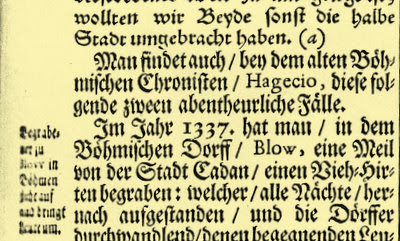
Von Schertz probably didn't know the word 'vampire', which first became well-known throughout Europe after the 1732 Medvedja vampire case, but he was aware of earlier tales of revenants. One tale was that of the shepherd from Blov in Bohemia (situated northwest of Prague at approximately latitude 56.324 N and longitude 13.295 E), which was also related by Johann Weichard Valvasor (1641-1693) in Die Ehre des Herzogthums Krain (1689). The story can be traced to the 16th century Böhmische Chronica written by Wenceslaus Hagecius (Wenzel Hajek von Libotschan/Václav Hájek z Libočan; died 1553) and further back to the Kronika Neplachova, i.e. Neplach's Chronicle, which is also known by the Latin title Summula Chronicae tam Romanae quam Bohemicae written by the Benedictine abbot Jan Neplach (1322-1371).
In the chronicle, the year 1336 A.D. is described this way:
"A. d. MCCCXXXVI Philippus, filius regis Maiorikarum, cum XII nobilibus regni ordinem fratrum Minorum in vigilia Nativitatis Christi ingreditur et in Boemia circa Cadanum ad milliare unum in villa dicta Blow quidam pastor nomine Myslata moritur. Hic omni nocte surgens circuibat omnes villas in circuitu hominus terrendo et iugulando et loquebatur. Et cum fuisset cum palo transfixus: dicebat, multum nocuerunt michi, nam dederunt michi baculum, ut me a canibus defendam ; et cum cremandus efoderetur, tumebat sicut bos et terribiliter rugiebat. Et cum poneretur in ignem, quidam arripiens fustem fixit in eum et continuo eupit cruor sicut de vase. Insuper cum fuisset effossus et in currum positus, collegit pedes ad se sicut vivus, et cum fuisset crematus totum malum conquievit, et antequam cremaretur, quemcumque ex nomine in nocte vocabat, infra octo dies moriebatur. Eodem eciam anno Johannes papa XXI moritur et Benedictus XII in papam eligitur.'
In my rudimentary translation this means:
''A.D. 1336 Philip, son of the king of Majorca, entered the [Franciscan] Order of Friars Minor along with 12 nobles of the kingdom on Christmas Eve Day. In Bohemia about one mile from Cadan in a village called Blow a certain shepherd called Myslata died. Every night he rose and went about every farm in the area and spoke to frighten and kill people. When he had been impaled with a stake, he said: They hurt me much, as they gave me a staff to defend me from the dogs; and when he was exhumed for cremation, he swelled up like an ox and roared terribly. When he was placed in the fire, someone grabbed a stick and put it into him, and immediately blood poured out from him as from a vessel. Furthermore, when he had been dug up and was being put on a cart, he drew his feet to himself as if alive, and before he was cremated, anyone whom he called by name at night, died within eight days. Also the same year the pope John XXI died and Benedict XII was elected as pope."
It is quite obvious that there is no mention of bloodsucking, and that blood ('cruor') is only mentioned in connection with the state of the dead body. His malice seems to be confined to haunting the neighbourhood and naming people who consequently die within eight days. The means that are used to destroy him are very similar to those used against vampires - stakes and fire - so, obviously, there are similarities, but would we call the shepherd a vampire or just a revenant?
Claude Lecouteux mentions the shepherd from Blov under the classification 'Rufer' (someone who yells or calls out) in the German translation of his book on vampires, as the deaths of his victims are caused by him saying aloud their names (and thereby probably calling them to him).
So it would be more appropriate to use the term Magia Posthuma in this case, as this term seems to cover both vampires and other revenants that haunt and molest the living, whose corpses exhibit no signs of ordinary corruption and must be destroyed by various means to stop the threat from the dead. I admit that I know of no use of the term prior to Von Schertz's book, but I find the term fitting for a subject that cannot be restricted to the Serbian vampire of the 18th century, but must take into account prior cases of 'living corpses' from other parts of Europe.
Finally, I like the term because it includes the word Magia and consequently can be linked to both the witch hunt and various 'systems of belief' that involved the concept of 'Magia', which incidentally is usually translated as 'Zauberei' in German. 'Magia Posthuma' thereby presents us with a link to the history and concepts of theology, demonology and witchcraft cases that can help us better understand the context of the famous cases of vampires and revenants of the 17th and 18th centuries. In fact, certain scholars claim that in some areas the witch hunt was succeeded by the cases of vampires and other forms of Magia Posthuma.
By the way, according to The Oxford Dictionary of Popes, pope John XII died on December 4th 1334 and was succeeded by Benedict XII on December 20th that year, so obviously Neplach's dates are not precise! As the above excerpt from Valvasor's book shows, he sets the incident in 1337, so here is a good example of how a story has evolved over the years.
The Latin text of Neplach's chronicle is actually available on the internet.
Many of these cases are documented - although often briefly - in contemporary sources, and the dead bodies not always appear as revenants, but are at times suspected of posthumous magic simply because they lack the expected signs of corruption. In other cases, they do actually disturb people, although not necessarily in the shape of the dead person, and usually they are not recorded to suck blood! In fact, one researcher rather considers these revenants as poltergeists than as vampires, whereas others relate them to other kinds of revenants known by other characteristics than blood sucking.
Von Schertz probably didn't know the word 'vampire', which first became well-known throughout Europe after the 1732 Medvedja vampire case, but he was aware of earlier tales of revenants. One tale was that of the shepherd from Blov in Bohemia (situated northwest of Prague at approximately latitude 56.324 N and longitude 13.295 E), which was also related by Johann Weichard Valvasor (1641-1693) in Die Ehre des Herzogthums Krain (1689). The story can be traced to the 16th century Böhmische Chronica written by Wenceslaus Hagecius (Wenzel Hajek von Libotschan/Václav Hájek z Libočan; died 1553) and further back to the Kronika Neplachova, i.e. Neplach's Chronicle, which is also known by the Latin title Summula Chronicae tam Romanae quam Bohemicae written by the Benedictine abbot Jan Neplach (1322-1371).
In the chronicle, the year 1336 A.D. is described this way:
"A. d. MCCCXXXVI Philippus, filius regis Maiorikarum, cum XII nobilibus regni ordinem fratrum Minorum in vigilia Nativitatis Christi ingreditur et in Boemia circa Cadanum ad milliare unum in villa dicta Blow quidam pastor nomine Myslata moritur. Hic omni nocte surgens circuibat omnes villas in circuitu hominus terrendo et iugulando et loquebatur. Et cum fuisset cum palo transfixus: dicebat, multum nocuerunt michi, nam dederunt michi baculum, ut me a canibus defendam ; et cum cremandus efoderetur, tumebat sicut bos et terribiliter rugiebat. Et cum poneretur in ignem, quidam arripiens fustem fixit in eum et continuo eupit cruor sicut de vase. Insuper cum fuisset effossus et in currum positus, collegit pedes ad se sicut vivus, et cum fuisset crematus totum malum conquievit, et antequam cremaretur, quemcumque ex nomine in nocte vocabat, infra octo dies moriebatur. Eodem eciam anno Johannes papa XXI moritur et Benedictus XII in papam eligitur.'
In my rudimentary translation this means:
''A.D. 1336 Philip, son of the king of Majorca, entered the [Franciscan] Order of Friars Minor along with 12 nobles of the kingdom on Christmas Eve Day. In Bohemia about one mile from Cadan in a village called Blow a certain shepherd called Myslata died. Every night he rose and went about every farm in the area and spoke to frighten and kill people. When he had been impaled with a stake, he said: They hurt me much, as they gave me a staff to defend me from the dogs; and when he was exhumed for cremation, he swelled up like an ox and roared terribly. When he was placed in the fire, someone grabbed a stick and put it into him, and immediately blood poured out from him as from a vessel. Furthermore, when he had been dug up and was being put on a cart, he drew his feet to himself as if alive, and before he was cremated, anyone whom he called by name at night, died within eight days. Also the same year the pope John XXI died and Benedict XII was elected as pope."
It is quite obvious that there is no mention of bloodsucking, and that blood ('cruor') is only mentioned in connection with the state of the dead body. His malice seems to be confined to haunting the neighbourhood and naming people who consequently die within eight days. The means that are used to destroy him are very similar to those used against vampires - stakes and fire - so, obviously, there are similarities, but would we call the shepherd a vampire or just a revenant?

Claude Lecouteux mentions the shepherd from Blov under the classification 'Rufer' (someone who yells or calls out) in the German translation of his book on vampires, as the deaths of his victims are caused by him saying aloud their names (and thereby probably calling them to him).
So it would be more appropriate to use the term Magia Posthuma in this case, as this term seems to cover both vampires and other revenants that haunt and molest the living, whose corpses exhibit no signs of ordinary corruption and must be destroyed by various means to stop the threat from the dead. I admit that I know of no use of the term prior to Von Schertz's book, but I find the term fitting for a subject that cannot be restricted to the Serbian vampire of the 18th century, but must take into account prior cases of 'living corpses' from other parts of Europe.
Finally, I like the term because it includes the word Magia and consequently can be linked to both the witch hunt and various 'systems of belief' that involved the concept of 'Magia', which incidentally is usually translated as 'Zauberei' in German. 'Magia Posthuma' thereby presents us with a link to the history and concepts of theology, demonology and witchcraft cases that can help us better understand the context of the famous cases of vampires and revenants of the 17th and 18th centuries. In fact, certain scholars claim that in some areas the witch hunt was succeeded by the cases of vampires and other forms of Magia Posthuma.
By the way, according to The Oxford Dictionary of Popes, pope John XII died on December 4th 1334 and was succeeded by Benedict XII on December 20th that year, so obviously Neplach's dates are not precise! As the above excerpt from Valvasor's book shows, he sets the incident in 1337, so here is a good example of how a story has evolved over the years.
The Latin text of Neplach's chronicle is actually available on the internet.
Wednesday, 8 August 2007
'A veritable bombshell'
 In his autobiography The Galanty Show, published posthumously in 1980, Montague Summers (1880-1948) wrote a short chapter about the reception of his books on witchcraft, vampires and werewolves. The first book, The History of Witchcraft and Demonology, was published in October 1926, and Summers claims that no less than 'a veritable bombshell exploded amid the anti-christian and nihilst rabblement':
'The edition sold out in two or three days. Within less than a week copies were at a premium. Men awoke to the danger still energizing and active in their midst. The evil which many had hardly suspected, deeming it either a mere historical question, long dead and gone, of no interest save to the antiquarian, or else altogether fabled, was shown to be very much alive, potent in politics, potent in society, corrupting the arts, a festering, leprous disease and decay.
 France knew the foul thing, Satanism, and so did Italy, and other countries beside, but it was, perhaps, the first time there had been in English a History of Witchcraft since the days of the learned Glanvil, the philosophic More, and of Dr Richard Boulton's Compleat History of Magick, which appeared in 1715. True, Dr F. G. Lee had raised a solemn voice during the decade 1875-1885; but the hour proved unpropitious, and his warnings were largely unheeded.
Not so in 1926. Facts were facts. The sensation was immense.
Men realized that spiritism, so vaunted, so advertised, so mysteriously attractive, so praised and tenselled by such highly placed writers as Sir Oliver Lodge and Sir Arthur Conan Doyle was nothing else than demoniality in masquerade.' (p. 156-7)
A companion volume, The Geography of Witchcraft, was published in May 1927, before he published books on 'allied themes', including his two influential volumes on vampires: The Vampire, His Kith and Kin (1928) and The Vampire in Europe (1929). Summers only has this to say in The Galanty Show:

'An angry reviewer writing in Time and Tide for January 1929 declared that in The Vampire, His Kith and Kin I had quoted Bram Stoker's romance Dracula as an authority, and that further my 'favourite evidence ... comes from Montague Summers on Withcraft (previously published), and Montague Summers on Werewolves (in preparation).' I was constrained to point out in that paper on January 18th 1929 that in the whole course of my book, 340 pages, I had only one bare reference of a couple of lines to my History of Witchcraft. In the Introduction to my The Vampire I stated (p. 13) that I was devoting a separate study to the werewolf. There is no further reference. Surely, I asked, it is a little exaggerated to describe this mention, once in the Introduction and once on page 195, of two books as 'favourite evidence'? In fact this sort of thing might not untruly be characterized as unscrupulous, the more so as I nowhere quoted Dracula as an authority, but, on the contrary, when dealing with this sensational romance in a survey of 'The Vampire in Literature' I went to some pains to point out that Bram Stoker far too recklessly availed himself of those more extravagant legends of vampirism which frankly have no place outside the stories told round a winter's heart.' (p. 158-9)
Summers later on points out that
'There is room, there always will be, for studies of witchcraft, of hauntings, of the occult. We only ask that these books should be written seriously, and with knowledge. The ignorant may posture and pose as authorities upon art, upon poetry, upon literature generally, and there is no vital mischief done. True, they lower the standards of culture and of taste. This many will consider harm enough. But there the dilettante is not playing with the eternal issues of life and death. The amateurs, and alas! there are all too many of them, who invade the occult are awaking forces of which they have no conception.' (p. 163-4)
Well, Summers certainly had a system of belief, within which the existence of e.g. witchcraft could not be denied based on arguments not unlike those of Dr. Johnson in my previous post. As he writes in The Galanty Show:
'Faith, the Bible, actual experience, all taught that witchcraft had existed and existed still. There could be and there is no sort of doubt concerning this.'
Few modern readers, if any, will agree with Summers on this point, and there is no doubt that many 'dilettantes' have attempted to write about witchcraft and the vampire from a more 'sceptical' or 'entertaining' point of view. However, this blogger too prefers that writings on the subject of e.g. Magia Posthuma are 'written seriously, and with knowledge', even if that knowledge is not - in fact: preferably not! - informed by Summers' (system of) belief which prompts him to end his chapter on Witchcraft by stating:
'The world invisible is infinite. How many there are whose sight is blindly bounded by their own horizons, the wall they have builded of the bricks of gross materialism and denial. If they but guessed what lay beyond that barrier and bourne!'
Certainly, this blogger will be content in getting the historical facts correct and trying to understanding what happened and why, in stead of trying to grasp any 'world invisible', let alone interpret the historical Magia Posthuma within a belief like that of Montague Summers!
The illustrations are fragments of a well-known cartoon of Montague Summers drawn by 'Matt' (Matthew Sandsford) and published in the Evening Standard ca. 1925.
Tuesday, 7 August 2007
Superstition in (temporary?) decline
 In recent years, a few scholars have investigated why the persecution of witches stopped and how the belief in witchcraft and magic evolved and declined. The popular, but naive, concept of how science and rationality enlightened the darkness and replaced superstition has given way to a more complex and in many ways much more fascinating history of e.g. the secularisation of West European societies. In my opinion this is valuable background information for understanding the context of the vampires and Magia Posthuma of the 17th and 18th centuries, so, consequently, I do try to look a bit at those studies.
One example is Owen Davies's Witchcraft, Magic and Culture 1736-1951 (Manchester Univ. Press, 1999) which traces the history of witchcraft and magic in England and Wales from 1736, when a Witchcraft statute was passed, to 1951 when the Fraudulent Mediums Act erased the concept of witchcraft from the statute books. As it says on the back of the book, 'The reader will discover the extent to which witchcraft, magic and fortunetelling influenced the thoughts and actions of the people of England and Wales in a period when the forces of 'progress' are often thought to have vanquished such beliefs.'
Certainly, the existence of witchcraft was not doubted by many educated people. Davies quotes an episode, when the famous Dr. Johnson answered an advocate called Mr. Crosbie, who had claimed 'it not credible, that witches should have effected what they are said in stories to have done':
'Sir, you have all mankind, rude and civilised, agreeing in the belief of the agency of preternatural powers. You must take evidence: you must consider, that wise and great men have condemned witches to die.' - Crosbie: 'But an act of parliament put an end to witchcraft.' - Johnson: 'No, sir! witchcraft had ceased; and therefore an act of parliament was passed to prevent persecution for what was not witchcraft. Why it ceased, we cannot tell, as we cannot tell the reason of many things.'
Davies does, however, try to answer the question 'why', and e.g. writes:
'One would have thought that the decline in witchcraft-accusations was indicative of the declining belief in witchcraft, but this was clearly not the case. People who believed in witches did not know themselves why there were no longer any left. What this suggests is that it was the decline of witchcraft-accusations which resulted in the declining belief in witchcraft, rather than the other way round. This precludes the notion of a reasoned popular denial of witchcraft, a conscious rejection of a long-held framework of supernatural causation, explanation and cultural referents. It cannot be denied that many working-class people, educated, informed and experienced, did consciously reject the existence of witchcraft and magic: we know as much from their autobiographies. For the mass of people, though, witchcraft simply became an irrelevance which no longer played a part in their daily lives and in their interaction with other people. Once out of sight, the witch was very much out of mind.' (p. 292)
This understanding of the decline of witchcraft and magic leads Davies to speculate on our own time and our future:
'In the 1980s and 1990s we have heard how an American president patronised an astrologer, how British jurists consulted a ouija-board to ascertain a defendant's guilt, how a multinational mineral extraction company employed a spoon-bender to find hidden mineral reserves, and of leading quantum theorists and astrophysicists expressing a devout belief in Christianity. We must seriously consider if we really are any more rational than the witch-believers of the past. Instead of thinking of the modern period as an age in which the mass of the population has advanced from a state of supernatural credulity to one of scientific rationality, we must look at it as a period in which expressions of 'irrational' belief have continued by a process of translation.' (p. 295)
And he adds:
'Furthermore, it is not impossible that at some point in the future, profound economic and environmental upheavals will once more create the social and cultural conditions in which once widespread beliefs and practices concerning witchcraft and magic may return. The mumping witch may come knocking once more.' (p. 295)
I suppose that, perhaps, the author would say the same for that special kind of 'magic', the Magia Posthuma?
Friday, 3 August 2007
The Wurdalak
Now that I have mentioned the Italian director Mario Bava (1914-1980) in a recent post, I might add a few words about his film adaptation of Aleksey Tolstoy's (Алексей Константинович Толстой, a cousin of Leo Tolstoy, 1817-1875) story La famille du Vourdalak (Family of the Vourdalak). Bava's adaptation is the middle story in an anthology film of three stories (or three faces of fear, as the title goes): I tre volti delta paura (1963). Like in Tolstoy's story, a nobleman called d'Urfé (in Tolstoy's story he is a marquis, in the film a count called Vladimir d'Urfé) who in 1759 ends up in a Serbian village at a time when Gorcha, the father of a family, has been away to fight a Turkish criminal, Alibek. Gorcha (played by Boris Karloff) has warned his family that if he does not return within five days (in Tolstoy's story: ten days), he will have become a wurdalak (or vourdalak), i.e. a vampire.
Tolstoy draws heavily on his knowledge of the vampire cases of the 18th century in his story, and Bava adds extra touches from later authors. As film critic Tim Lucas points out in his commentary on a recent DVD release, the adaptation actually incorporates elements from a short story by Guy de Maupassant, and from Bram Stoker's Dracula. Consequently, although this film is often regarded as one of the films closest to the actual vampire cases, it is in fact inspired more by literary conventions and inventions than by historical fact. Furthermore, Bava himself adds his own sense of colour, style and athmosphere to create a unique vampire film.

As for the ending, Bava opted for d'Urfé joining his beloved Sdenka, even though she had become a wurdalak, and consequently becoming a member of the family of the wurdalak. In the American version called Black Sabbath, a different ending was decided on, that was more in the vein of Tolstoy's, where d'Urfé survives to tell the story in Vienna in 1815.
Boris Karloff also starred in another film that will be of interest to anyone interested in the Magia Posthuma, Isle of the Dead produced by Val Lewton in 1945. The theme of this film is pretty unusual, as it is inspired by the Greek belief in vrykolakas. I may return to it in a future post.
This blog is definitely not about vampire cinema, but I find it relevant to deal with those instances where fictional vampires - from literature or cinema - have a particular relevance for the study or understanding of the subject of Magia Posthuma. That is why I will at times write about films like Leptirića or I tre volti della paura.
Tolstoy draws heavily on his knowledge of the vampire cases of the 18th century in his story, and Bava adds extra touches from later authors. As film critic Tim Lucas points out in his commentary on a recent DVD release, the adaptation actually incorporates elements from a short story by Guy de Maupassant, and from Bram Stoker's Dracula. Consequently, although this film is often regarded as one of the films closest to the actual vampire cases, it is in fact inspired more by literary conventions and inventions than by historical fact. Furthermore, Bava himself adds his own sense of colour, style and athmosphere to create a unique vampire film.

As for the ending, Bava opted for d'Urfé joining his beloved Sdenka, even though she had become a wurdalak, and consequently becoming a member of the family of the wurdalak. In the American version called Black Sabbath, a different ending was decided on, that was more in the vein of Tolstoy's, where d'Urfé survives to tell the story in Vienna in 1815.
Boris Karloff also starred in another film that will be of interest to anyone interested in the Magia Posthuma, Isle of the Dead produced by Val Lewton in 1945. The theme of this film is pretty unusual, as it is inspired by the Greek belief in vrykolakas. I may return to it in a future post.
This blog is definitely not about vampire cinema, but I find it relevant to deal with those instances where fictional vampires - from literature or cinema - have a particular relevance for the study or understanding of the subject of Magia Posthuma. That is why I will at times write about films like Leptirića or I tre volti della paura.
Wednesday, 1 August 2007
The Vampire Subculture
Although I usually steer pretty clear of the subject of 'vampire subcultures', I would like to point out that David Keyworth's paper The Socio-Religious Beliefs and Nature of the Contemporary Vampire Subculture (Journal of Contemporary Religion Vol. 17, No. 3 (2002), pp. 355-370) is an interesting and certainly unsettling introduction to the subculture of people who in some way identify with vampires, even to the extent of drinking human blood. Keyworth's paper covers various aspects, including the wealth of internet resources and the popular role-playing game Vampire: The Masquerade. He even mentions that there are Christian groups who are so opposed to the vampire subculture that they consider themselves 'vampire-hunters'!
Personally I feel no inclination or fascination for this subculture, but Keyworth's paper comes in handy for better assessing the background of those web sites that you stumble upon, when searching the net for information on Magia Posthuma and related subjects.
Personally I feel no inclination or fascination for this subculture, but Keyworth's paper comes in handy for better assessing the background of those web sites that you stumble upon, when searching the net for information on Magia Posthuma and related subjects.
The Historical Context of Vampire Beliefs
 I have written a few posts (The rationality of the strange past, Strange cover and Strange Histories) about Darren Oldridge's book Strange Histories, and I have mentioned that Oldridge refers to the Medvedja vampire case from 1732. He elaborates a bit on this subject in his contribution to an anthology called Vampires: Myths and Metaphors of Enduring Evil edited by Peter Day and published by Rodopi, Amsterdam, in 2006. The text is pretty short, just 11 pages, and is entitled "Dead Man Walking": The Historical Context of Vampire Beliefs.
Here Oldridge again discusses the historical construction of belief, as he asks the question: "If perfectly rational, well-educated people could accept the existence of roaming corpses three hundred years ago, why is the same idea inconceivable today?" To answer this question, he borrows the concept of a system of belief from the antropologist Clifford Geertz: "the framework of beliefs, expressive symbols, and values in terms of which individuals define their world, express their feelings, and make their judgments." As a system of belief constitutes the framework within which the facts of the world are perceived, and as it also changes over time, our concept of rationality and "common sense" will change depending on our "historically defined standards of judgments." Oldridge gives a number of examples and also shows how certain phenomena can be either interpreted within a framework where the existence of revenants is accepted or within the framework of scientific medicine, where they are not.
As for our own 21st century system of belief, Oldridge puts it like this: "We live in a culture that does not permit corpses to stir; and this basic assumption has condemned vampires to the realm of fiction."
I'm pretty surprised to find that Oldridge states that in the Medvedja vampire case, "the doctors concluded that several of the bodies [of suspected vampires] posed a threat to the living," as I don't remember a statement of this kind in the Visum & Repertum report. The military doctors (if we can call them doctors?) were certainly surprised by the apparently uncorrupted state of the bodies, but in my opinion they did not agree with the local people on the reality of the revenants.
Considering the sleep paralysis which is the term frequently used to describe the state of supposed victims of e.g. vampires, Oldridge writes that 'sufferers also report visual hallucinations, often in the form of a threatening figure standing at their bedside,' a phenomenon that would seem to be better described by a 'system of belief' within which such figures exist, than by the 'system of belief' of modern medicine. Oldridge doesn't discuss this interesting aspect, but as he says:
"The point of these observations is not to 'explain away' vampire beliefs in terms of modern science. On the contrary, it is to suggest that prior assumptions often determine our understanding of what we see. (...) In a world that believes in demons, 'the hag' presents clear evidence of their power; in a society that does not, it needs to be explained in terms of other acceptable ideas, such as the psychology of sleep disorders. The social construction of belief is most obvious when we step outside our own culture."
The book contains a couple of other contributions that may be of interest to readers of this blog, in particular Peter Mario Kreuter's The Name of the Vampire: Some Reflections on Current Linguistic Theories on the Etymology of the Word Vampire. There is also a nice and short overview of the genesis of Bram Stoker's Dracula by Elizabeth Miller.

I couldn't resist showing the above scene from Mario Bava's Italian horror film Operazione paura from 1966 (in English known under various titles like Curse of the Living Dead and Kill Baby Kill). Curiosly, in this film the local people do not want the bodies of the dead disinterred, in fact, they don't even want to discuss the subject for fear of the revenant of a little girl that haunts the place. As you can see, the authorities and men of modernity, including the doctor at the left who has been called upon to examine the bodies, discuss the system of belief of the local people. As outsiders they meet the local people in a way similar to how we read the 'strange histories' of the past, but as it goes, the good doctor can not escape the terrifying 'system of belief' that determines how the local people live and act.
Tuesday, 31 July 2007
Das grosse Handbuch der Dämonen
 During a visit in Hamburg I tried to look for books of value for my interest in the Magia Posthuma. In fact, I only found two books, and I wasn't quite sure about one of them, Das grosse Handbuch der Dämonen compiled by Helmut Werner (tosa/Verlag Ueberreuter, Vienna). A few vampires encyclopedias have been published, but I must confess that I rarely use them, because they mainly focus on the fictional vampire. So I feared the worst when I unwrapped this hardcover book, but was delighted to find entries on early authors on vampires and vampire related topics like Phillip Rohr, Michael Ranft and Johann Christoph Harenberg.
In his foreword the author describes the book's themes:
"In über 1.200 Stichworten bietet dieses Nachslagewerk für den Laien und den Fachmann eine übersicthliche und umfassende Übersicht nach dem neuesten Forschungsbestand zu folgenden Themen: Monster (Luft, Land, Wasser), monströse Dämonen und Geister, Mischwesen, Fabeltiere, rätselhafte Tiere, Missgeburten (Mensch und Tier), rätselhafte Menschen und menschliche Ungeheuer wie die Blutgräfin Bathory, Kürten etc., Vampire, vampirartige Dämonen, Werwölfe, Biografien bedeutender Gelehrter, die sich mit dieser Thematik beschäftigten, und die zentralen Begriffe dieser Themen."
As for these creatures being demons or not, the first page of the Handbuch actually contains this entry:
"ADÄMONISTEN
Bez. für Anhänger einer Vampirtheorie, welche davon ausgeht, dass der Teufel, böse Dämonen, unkörperliche Substanzen wie Astralkörper (→Unverweslichkeit) und →Incubus nicht zur Erklärung des →Vampirismus herangezogen werden dürfen. Im Gegensatz zu ihren Gegnern, den Dämoniaken, glauben sie zwar an die Existenz des Teufels, sie lehnen aber seine Leiblichkeit ab. Der Teufel untersteht Gott und seine Fähigkeit, mit Erlaubnis Gottes in die Schöpfung einzugreifen, ist nur begrenzt."
So, obviously, it is debatable whether this is really an encyclopedia of demons or not, and it is probably a matter of taste whether you like the mix of themes. Personally, I would have preferred it done differently, e.g. making it easier to find the sources behind each entry, but I still find the encyclopedia both useful and enjoyable. Certainly, this book made the trip from Germany to Denmark by train feel shorter.

Unfortunately, errors can be found, and I can't help wondering why there is no entry about Peter Plogojowitz, when there is one about Arnont Paole?! I certainly don't understand how Werner has come to rename Karl Ferdinand von Schertz "Karl-Friedrich Schertz"?!
So some caution is required when using Hemut Werner's Handbuch, but I am sure that this book will be enjoyed by others interested in Magia Posthuma, and it will probably also attract some new attention to the old vampire cases and the 18th century vampire debate. The bibliography is also worth studying, so at the price of €9.95, there is no need to hesitate in ordering this 316 page Handbuch.
Subscribe to:
Posts (Atom)
