I recently mentioned Paul Barber's preface to the second edition of his Vampires, Burial & Death, as well as Rob Brautigam's Shroudeater site in another post. Paul Barber calls attention to that web site, while mentioning that 'theories sometimes crowd out the facts, especially on the Internet,' adding in a footnote:
'An important exception is Rob Brautigam, whose site (shroudeater.com) contains a valuable collection of material from many countries over many years. Brautigam has gone to great trouble to verify sources in the accounts he publishes there, some of which have evolved in moving from one book to the next. In one case (that of William Doggett) he demonstrates that a vampire was eventually inserted into a story that originally wasn't about vampires at all.' (p. v-vi)
Brautigam recently updated the site with a large number of 'cases', this time including an index by place name instead of by country alone, even indicating alternative names for various places.
I have only taken a brief look at some of the new entries. One of them concerns Marienburg and is placed in Poland. Curiously, Montague Summers in The Vampire in Europe refers this to Tyrol:
'In his chronicle under the year 1343 Sebastian Moelers relates that during a terrible visitation of the Black Death cases of vampirism were numerous in the Tyrol, and the Benedictine abbey of Marienberg was much infested, one at least of the monks, Dom Steino von Netten, being commonly reputed to have been slain by a vampire.' (p. 160)
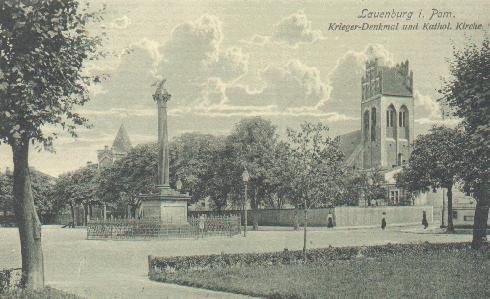
As is sometimes the case, the original source text is not easy to locate online, in this case Sebastian Möler's Prussian chronicle. Brautigam refers to a book from 1837 that clearly places the occurrence in Lauenburg (today Lębork), and not Marienburg (today Malbork), both near Danzig (Gdansk) in Northern Poland. I found a bit on it on p. 53-4 in Reinhold Cramer's Geschichte der Lande Lauenburg und Bütow (1858) (see below), which clearly shows that this has to do with a dead person's corpse that keeps turning up outside the grave, until it is forced to stay there by being punished with a sword and reminded of an oath taken by the deceased while alive. As such, it is certainly farfetched to claim that it is an example of a vampire per se. Unfortunately, Montague Summers's vampiric version set in Tyrol must be considered a figment of his (or charitably, perhaps someone else's) imagination, as Brother (not Dom) Steino von Retten died from the epidemic illness that he tried to flee, not because he had been 'slain by a vampire.'
As Cramer says, this story is so wonderful that it sounds more like a fairy tale than a true story, but must be considered one of the stories concerning Medieval miracula mortuorum that are recounted by various authors, including Dom Calmet.
Those interested in factual background information may find it worth taking a look at the appendices in Cramer's book.
On several occasions, particularly on the periphery of the Habsburg Empire during the 17th and 18th centuries, dead people were suspected of being revenants or vampires, and consequently dug up and destroyed. Some contemporary authors named this phenomenon Magia Posthuma. This blog is dedicated to understanding what happened and why.
Showing posts with label Paul Barber. Show all posts
Sunday, 4 December 2011
Sunday, 6 November 2011
A Matter of Corporeal Evidence
'In the 1990s, a Spanish doctor revealed that, while watching a Dracula film, he began to suspect that the lore came about from people observing the effects of rabies. It's probably only a matter of time before another doctor, watching another movie on television, reveals a connection between the vampire lore and the common cold.
Here we must insist that the movies and the media in general are not good sources of information on vampire folklore, however sound they are in the matter of aliens, crop circles and conspiracy theories. In fact, studying the vampires by watching movies is like studying the Civil War by watching Gone with the Wind, except without all the accuracy.
This observation is even truer now than it was twenty years ago, for the fictional vampire has evolved wonderfully - and this evolution is enlightening. To reacquaint myself with the fiction, I actually bought two vampire movies and watched a third on television. Well, I bought the movies at a yard sale. For fifty cents each. Still, they weren't much of a bargain. Trying to watch one of the movies reminded me of trying to read the novel it was based on. I had several false starts before I got far enough into it to state definitively that it was mining fantasies at some remove from my own. In fact, I started to understand why the average doctor, watching a vampire movie, finds himself making up wild theories in preference to following the plot.'
Paul Barber's preface to the 2010 edition of his Vampires, Burial & Death is certainly one of the more amusing texts on vampires I have read in a while.
At the same time, Barber's preface pays due to the legendary Danish archaeologist who apparently played a key role in developing Barber's interest in vampires: P. V. Glob, author of among other books, Mosefolket, translated into English as The Bog People:
'Many years ago, my wife, an archaeologist, handed me a copy of P. V. Glob's The Bog People and suggested that I might enjoy reading it. She had apparently noticed my interest in things creepy and disgusting, and Glob's book is full of such. It is an account of Iron Age corpses that, steeped in acidic bogs, had stood the test of time and emerged millennia later in remarkably good condition.'
Peter Vilhelm Glob (1911-1985) was involved in examining a number of those 'bog people', bodies found in Danish bogs, and also played an important role at two major Danish museums: Moesgård Museum (where the so-called Grauballe Man is exhibited), and the National Museum.
In his preface, Barber says that 'Glob's book has stood the test of time as well,' although one must remember that a lot has happened during the fifty years since he wrote it. In a recent Danish study of mummified bog bodies, Mumificerede moselig (Høst & Søn, 2002), historian and classical philologist Allan A. Lund dissects the various theories that have been proposed regarding the bog bodies, and it is apparent that also some of the views proposed by Glob are dubious. Barber himself adds that he 'had a few quibbles with' Glob's book:
'It was clear to me, for example, that pinning bodies down in bogs had a practical purpose that Glob seemed unaware of: left to their own devices, bodies tend to pop to the surface of watery areas, simply because, as they decompose, the gases of decomposition alter their specific gravity, turning them into something resembling a buoyant, spooky balloon. Staking them in the bog not only released these gases but physically held the bodies in place.'
Barber clearly linked these considerations to the folklore of vampires: 'What if this phenomenon was the original reason for the staking of the vampires?' Answering this question led to his influential book on vampires, and later on to co-writing a preface to a 2004 reissue of Glob's book:
'In 2004, the New York Review of Books decided to republish the very author whose book had inspired me to write this book. My wife was asked to write an introduction to The Bog People, and she agreed on the condition that we do it together. This led me to reread it. I still admire The Bog People, although now it seems almost understated and tasteful. The bog bodies, pickled in tannic and humid acid, remained quietly and decorously in place throughout their long history, whereas our vampires, always restless, took every opportunity to plague the living. They stayed out late at night, made distressing noises, stank to high heaven and beyond, and often couldn't be counted on to stay dead even after they were staked or decapitated. They didn't have superpowers, but they certainly had staying power.'
Curiously, archaeological finds have rarely been an inspiration for vampire research, as Austrian historian Hagen Schaub notes in his contribution to the vampirism conference in Vienna in 2009, Knochen und Bestattungsriten: Die Bedeutung archäologischer Funde zum Wiedergänger- bzw. Vampirglauben, although there are many relevant cases at hand in the archaeological literature:
'In der durchaus reichhaltigen Literatur zum Thema Vampirismus bzw. Wiedergänger im weitesten Sinn besitzen Abhandlungen zu archäologischen Funden seltsamerweise einen nur geringen Stellenwert. Die meisten Übersichtswerke zu Vampiren befassen sich gar nicht mit den sog "Vampirgräbern", obwohl archäologischen Abhandlungen in durhaus großer Zahl vorhanden sind.'
Schaub's paper is probably the most thorough analysis of various archaeological excavations that might be interpreted as proof of beliefs in vampires or other revenants. Ultimately, he concludes that it is very uncertain if these finds can in fact be connected to revenant beliefs. The archaeological evidence can usually be interpreted in alternative ways than those relating to apotropaics, and in many cases the revenant interpretation relies on the researcher's lack of knowledge of actual revenant beliefs (as was also the case of the Spanish doctor that Barber refers to, in fact Juan Gómez-Alonso).
Recently, archaeological finds have of course been popularly connected with vampires through Matteo Borrini's discovery of a brick in a female skeleton's mouth in Venice. In some respects, we might say that this return to visum et repertum vampire and revenant research brings us full circle with Frombald, Glaser, and Flückinger's dissection of Serbian corpses. In stead of investigating old books, the vampire researchers have returned to study the corporeal remains of persons who may have been suspected of being revenants.
Still, it is difficult to interpret these corporeal remains which, fortunately, only haunt the curiosity of archaeologists and other researchers.
Caroline Arcini of Sweden's National Heritage Board recently studied about 600 cases of skeletons found buried face down, what is known as prone burials, and proposed that these burials were not accidental, but a deliberate and widespread practice of humiliating dead people for deviant deeds done while alive, cf. e.g. National Geographic's news story.
In her article in the June 2009 issue of Current Archaeology, Arcini rules out premature burial as a general explanation, and although individual burials can, perhaps, be explained as examples of e.g. revenant beliefs, she rules it out generally:
'In some cultures it is believed that individuals with supernatural abilities should be laid face down, for fear that their power could escape through the mouth. It has, for example, been adduced as an explanation for one of the 101 African slaves found buried in a 16th to 17th century cemetery in Barbados. The individual in question, a woman, had been placed on her own in the largest burial mound in the cemetery.
However, while several individuals in prone burials have their faces in the earth, the majority have the head turned to one side - in other words, in the same way as many of those who are buried supine. A similar idea is that people might be buried face down to prevent them rising to haunt the living. Both forms of explanation are plausible in relation to isolated graves, but are untenable in relation to concentrations.' (p. 32-3)
In her conclusion, Arcini says that 'the occurence of prone burials indicates that society sanctioned this apparently negative treatment of the dead. Presumably, the grieving relatives had little say in the matter; funerary customs have always been controlled by social mores.
An interesting feature of this study is the possibility of surveying, through archaeology, a form of behaviour that is deeply rooted in humankind. It appears that, whatever the religion, whatever the standards we live by or are compelled to follow, there are reactions - such as the negative response to prone burial - which are deeply rooted and universal. However, lamentable, isolating, and negative it seems to us in modern times, being buried face down is an ancient and global practice.' (p. 35)
It is very hard to evaluate Arcini's view on the basis of her article only. Fellow Swede, Katarina Harrison Lindbergh, is sceptical in her recent book on vampires, Vampyrernas historia (Norstedts, 2011), as she finds Arcini's hypothesis an overinterpretation of the archaeological facts. Sweden, by the way, is the site of the remarkable find of the so-called Bocksten Man, who was 'poled' or staked in a way that all too easily would ignite the imagination of 'vampirologists'.
Archaeology, in any case, provides us with more interesting information than the theories proposed by people like Gómez-Alonso whose knowledge of 'vampires' is based on films or modern novels. However enjoyable and in other ways emotionally or intellectually stimulating such fiction can be, like Barber, 'we must insist that the movies and the media in general are not good sources of information on vampire folklore'. An issue of your local journal of archaeology, on the other hand, might perhaps be a better stimulus and inspiration.
Here we must insist that the movies and the media in general are not good sources of information on vampire folklore, however sound they are in the matter of aliens, crop circles and conspiracy theories. In fact, studying the vampires by watching movies is like studying the Civil War by watching Gone with the Wind, except without all the accuracy.
This observation is even truer now than it was twenty years ago, for the fictional vampire has evolved wonderfully - and this evolution is enlightening. To reacquaint myself with the fiction, I actually bought two vampire movies and watched a third on television. Well, I bought the movies at a yard sale. For fifty cents each. Still, they weren't much of a bargain. Trying to watch one of the movies reminded me of trying to read the novel it was based on. I had several false starts before I got far enough into it to state definitively that it was mining fantasies at some remove from my own. In fact, I started to understand why the average doctor, watching a vampire movie, finds himself making up wild theories in preference to following the plot.'
Paul Barber's preface to the 2010 edition of his Vampires, Burial & Death is certainly one of the more amusing texts on vampires I have read in a while.
At the same time, Barber's preface pays due to the legendary Danish archaeologist who apparently played a key role in developing Barber's interest in vampires: P. V. Glob, author of among other books, Mosefolket, translated into English as The Bog People:
'Many years ago, my wife, an archaeologist, handed me a copy of P. V. Glob's The Bog People and suggested that I might enjoy reading it. She had apparently noticed my interest in things creepy and disgusting, and Glob's book is full of such. It is an account of Iron Age corpses that, steeped in acidic bogs, had stood the test of time and emerged millennia later in remarkably good condition.'
Peter Vilhelm Glob (1911-1985) was involved in examining a number of those 'bog people', bodies found in Danish bogs, and also played an important role at two major Danish museums: Moesgård Museum (where the so-called Grauballe Man is exhibited), and the National Museum.
In his preface, Barber says that 'Glob's book has stood the test of time as well,' although one must remember that a lot has happened during the fifty years since he wrote it. In a recent Danish study of mummified bog bodies, Mumificerede moselig (Høst & Søn, 2002), historian and classical philologist Allan A. Lund dissects the various theories that have been proposed regarding the bog bodies, and it is apparent that also some of the views proposed by Glob are dubious. Barber himself adds that he 'had a few quibbles with' Glob's book:
'It was clear to me, for example, that pinning bodies down in bogs had a practical purpose that Glob seemed unaware of: left to their own devices, bodies tend to pop to the surface of watery areas, simply because, as they decompose, the gases of decomposition alter their specific gravity, turning them into something resembling a buoyant, spooky balloon. Staking them in the bog not only released these gases but physically held the bodies in place.'
Barber clearly linked these considerations to the folklore of vampires: 'What if this phenomenon was the original reason for the staking of the vampires?' Answering this question led to his influential book on vampires, and later on to co-writing a preface to a 2004 reissue of Glob's book:
'In 2004, the New York Review of Books decided to republish the very author whose book had inspired me to write this book. My wife was asked to write an introduction to The Bog People, and she agreed on the condition that we do it together. This led me to reread it. I still admire The Bog People, although now it seems almost understated and tasteful. The bog bodies, pickled in tannic and humid acid, remained quietly and decorously in place throughout their long history, whereas our vampires, always restless, took every opportunity to plague the living. They stayed out late at night, made distressing noises, stank to high heaven and beyond, and often couldn't be counted on to stay dead even after they were staked or decapitated. They didn't have superpowers, but they certainly had staying power.'
Curiously, archaeological finds have rarely been an inspiration for vampire research, as Austrian historian Hagen Schaub notes in his contribution to the vampirism conference in Vienna in 2009, Knochen und Bestattungsriten: Die Bedeutung archäologischer Funde zum Wiedergänger- bzw. Vampirglauben, although there are many relevant cases at hand in the archaeological literature:
'In der durchaus reichhaltigen Literatur zum Thema Vampirismus bzw. Wiedergänger im weitesten Sinn besitzen Abhandlungen zu archäologischen Funden seltsamerweise einen nur geringen Stellenwert. Die meisten Übersichtswerke zu Vampiren befassen sich gar nicht mit den sog "Vampirgräbern", obwohl archäologischen Abhandlungen in durhaus großer Zahl vorhanden sind.'
Schaub's paper is probably the most thorough analysis of various archaeological excavations that might be interpreted as proof of beliefs in vampires or other revenants. Ultimately, he concludes that it is very uncertain if these finds can in fact be connected to revenant beliefs. The archaeological evidence can usually be interpreted in alternative ways than those relating to apotropaics, and in many cases the revenant interpretation relies on the researcher's lack of knowledge of actual revenant beliefs (as was also the case of the Spanish doctor that Barber refers to, in fact Juan Gómez-Alonso).
Recently, archaeological finds have of course been popularly connected with vampires through Matteo Borrini's discovery of a brick in a female skeleton's mouth in Venice. In some respects, we might say that this return to visum et repertum vampire and revenant research brings us full circle with Frombald, Glaser, and Flückinger's dissection of Serbian corpses. In stead of investigating old books, the vampire researchers have returned to study the corporeal remains of persons who may have been suspected of being revenants.
Still, it is difficult to interpret these corporeal remains which, fortunately, only haunt the curiosity of archaeologists and other researchers.
Caroline Arcini of Sweden's National Heritage Board recently studied about 600 cases of skeletons found buried face down, what is known as prone burials, and proposed that these burials were not accidental, but a deliberate and widespread practice of humiliating dead people for deviant deeds done while alive, cf. e.g. National Geographic's news story.
In her article in the June 2009 issue of Current Archaeology, Arcini rules out premature burial as a general explanation, and although individual burials can, perhaps, be explained as examples of e.g. revenant beliefs, she rules it out generally:
'In some cultures it is believed that individuals with supernatural abilities should be laid face down, for fear that their power could escape through the mouth. It has, for example, been adduced as an explanation for one of the 101 African slaves found buried in a 16th to 17th century cemetery in Barbados. The individual in question, a woman, had been placed on her own in the largest burial mound in the cemetery.
However, while several individuals in prone burials have their faces in the earth, the majority have the head turned to one side - in other words, in the same way as many of those who are buried supine. A similar idea is that people might be buried face down to prevent them rising to haunt the living. Both forms of explanation are plausible in relation to isolated graves, but are untenable in relation to concentrations.' (p. 32-3)
In her conclusion, Arcini says that 'the occurence of prone burials indicates that society sanctioned this apparently negative treatment of the dead. Presumably, the grieving relatives had little say in the matter; funerary customs have always been controlled by social mores.
An interesting feature of this study is the possibility of surveying, through archaeology, a form of behaviour that is deeply rooted in humankind. It appears that, whatever the religion, whatever the standards we live by or are compelled to follow, there are reactions - such as the negative response to prone burial - which are deeply rooted and universal. However, lamentable, isolating, and negative it seems to us in modern times, being buried face down is an ancient and global practice.' (p. 35)
It is very hard to evaluate Arcini's view on the basis of her article only. Fellow Swede, Katarina Harrison Lindbergh, is sceptical in her recent book on vampires, Vampyrernas historia (Norstedts, 2011), as she finds Arcini's hypothesis an overinterpretation of the archaeological facts. Sweden, by the way, is the site of the remarkable find of the so-called Bocksten Man, who was 'poled' or staked in a way that all too easily would ignite the imagination of 'vampirologists'.
Archaeology, in any case, provides us with more interesting information than the theories proposed by people like Gómez-Alonso whose knowledge of 'vampires' is based on films or modern novels. However enjoyable and in other ways emotionally or intellectually stimulating such fiction can be, like Barber, 'we must insist that the movies and the media in general are not good sources of information on vampire folklore'. An issue of your local journal of archaeology, on the other hand, might perhaps be a better stimulus and inspiration.
Sunday, 1 June 2008
Books
Recently, the author of one of the books that I have written about sent me an e-mail. I think, he basically wanted to say that: OK, if you're after more information on the historical aspects of vampirism, then my book probably will be of little use, but I am sure that my book is (to quote his e-mail) 'pretty good for what it set out to do'.Returning from a few days away, I found a copy of another book on vampires that I had decided to order: Legends of Blood: The Vampire in History and Myth by Wayne Bartlett and Flavia Idriceanu. Unfortunately, just perusing it for a short while led me to conclude that this too is one of those books that I will gain very little useful from.
Barlett is a management consultant who has worked for some time in Romania and written a number of books on historical topics. Idriceanu is a philologist in Bucharest. Their book is not simply the usual rehash of information on vampires, because they include some chapters on witches and 'the magus', but honestly, I don't get the impression that I will gain much from reading the book. The chapter on 'The Vampire Epidemics' is based on Barber, Frayling, Ronay and a few other well-known authors. In fact, the bibliography is pretty revealing, because it is relatively short and not impressing. It even includes four Harry Potter novels and Tolkien's Lord of the Rings!
No doubt the book is probably a pleasant read for the reader who isn't particularly familiar with the history of vampires, but I feel that my own time is too limited for me to spend a few hours reading this particular book. And I hope that my short posts on books may spare other people from spending time and money on books that may not be worth obtaining if you have an interest in vampires and magia posthuma that is more or less similar to my own.
I did actually find one interesting fact in the bibliography: The book on vampires by Claude Lecouteux has been published in Romania: Vampiri si vampirism. Autopsia unui mit (Bucuresti: Saeculum, 2002).
Sunday, 6 January 2008
Wikipedia
I have found a lot of useful information on the various Wikipedia web sites, particularly the German, but some of the entries on the subject of vampires are quite a mixture of fact and fiction. That certainly has been the case of the Danish language entry, so a friend of mine has continually been asking me to do something about it. Finally, this christmas I gave in and have revised it somewhat. It's still far from satisfactory, but at least it's more precise and the worst nonsense has been removed. Someone has even kindly added a link to this blog...
I also added quite a few books to the bibliography, but as I noted in a recent comment, a lot of these books are not easily accessible in my native country. Even the old books by Montague Summers are only available in a handful of copies at Danish libraries. This might be a good thing, if only some of the best other books were available. The good news is that Paul Barber's Vampires, Burial, and Death is actually available at a few libraries, but otherwise it will require some effort (and probably some money) to get hold of the most useful books.
Monday, 24 December 2007
Merry christmas!
After weeks of silence I have considered how to wish visitors of this blog a merry christmas. Unfortunately, I have not had time to write a longer essay, so I will present you with the gift of a scan of the front page of one the seminal works on vampirism, VISUM REPERTUM ANATOMICO-CHIRURGICUM oder Gründlicher Bericht von den sogenannten Blutsäugern, VAMPIER, oder in der wallachischen Sprache Morie by the well-educated physician Georg Tallar published in Vienna and Leipzig in 1784.

I found this book at The Royal Library in Copenhagen in the mid Eighties, when the book was virtually unknown. At least, it was not mentioned in any bibliography that I knew of, including Dieter Sturm and Klaus Völker's Von denen Vampiren oder Menschensaugern. Later on I noticed that Aribert Schroeder knew of it, when he wrote Vampirismus: Seine Entwicklung vom Thema zum Motiv in 1973, but Schroeder's book was and is for some reason unfortunately very scarce.
Then, in 1988, Tallar turned up a few times in Paul Barber's Vampires, Burial, and Death, and later on he has been quoted by a few other authors, so his investigations are getting their proper place in the history of magia posthuma. Investigations that include interviewing and examining people who claim to be the victims of vampires (or moroi) and the examination of corpses suspected of being vampires.

I found this book at The Royal Library in Copenhagen in the mid Eighties, when the book was virtually unknown. At least, it was not mentioned in any bibliography that I knew of, including Dieter Sturm and Klaus Völker's Von denen Vampiren oder Menschensaugern. Later on I noticed that Aribert Schroeder knew of it, when he wrote Vampirismus: Seine Entwicklung vom Thema zum Motiv in 1973, but Schroeder's book was and is for some reason unfortunately very scarce.
Then, in 1988, Tallar turned up a few times in Paul Barber's Vampires, Burial, and Death, and later on he has been quoted by a few other authors, so his investigations are getting their proper place in the history of magia posthuma. Investigations that include interviewing and examining people who claim to be the victims of vampires (or moroi) and the examination of corpses suspected of being vampires.
Saturday, 21 July 2007
Keyworth and the Uniqueness of the Vampire
Now I have obtained and read a paper by G. David Keyworth, who was mentioned in one of my recent posts. It seems that Keyworth wrote a thesis on 'the socio-religious beliefs and nature of the contemporary vampire subculture' before completing a PhD thesis on 'the unnatural history of troublesome corpses and vampires in Europefrom the medieval period to the twentieth century'. The paper I refer to, Was the Vampire of the Eighteenth Century a Unique Type of Undead-corpse? published in Folklore 117 (December 2006), p. 241-260, is obviously based on his work for the latter thesis.
Augustin Calmet in his Dissertation on revenants and vampires claimed that “in no history do we read anything similar, so common, or so decided, as what is related to us of the vampires of Poland, Hungary, and Moravia.” ("Mais en nulle Histoire on ne lit rien d'aussi commun ni aussi marqué que ce qu'on nous raconte des Vampires de Pologne, de Hongrie & de Moravie." II, vii). In his paper Keyworth aims to “test the validity of Calmet’s notion that eighteenth-century vampires were a unique type of revenant.” Consequently, Keyworth compares and contrasts the vampires of the 18th century with tales and cases of revenants and other 'troublesome corpses' from the 12th century and onwards.
Some of his examples will be well known, e.g. those from William of Newburgh and Henry More, whereas others are more obscure. The older sources are mainly from England, Iceland and parts of northern Europe, and Keyworth seems to be fascinated by the old Norse draugrs. He refers to various writings on the Greek vrykolakas (e.g. Allatius and Tournefourt) before coming to the oupire and vampire of the 18th century, which are described via quotes from Harleian Miscellany, Mercure Argent, the Lettres Juives, and the reports from Kisiljevo and Medvedja.
Further on he refers to writers on theosophy and spiritualism, who had notions of 'astral' and 'posthumous' vampirism. He also mentions von Görres' mystical views in Die Christliche Mystik (1836-42), and finally compares the New England 19th century 'vampires cases' with those of the 18th century.
All in all this makes for an interesting peek into the historical development of notions about revenants.
As for Keyworth's question: 'Were the Vampires of the Eighteenth Century Unique?', he concludes that:
“The Slavic vampire of the eighteenth century remains a unique type of revenant, given its supposed thirst for human blood.” (p. 256)
I feel that the paper is much too biased towards England and northern Europe, whereas in my opinion it is particularly interesting to know if the same trend can be found if you incorporate material from various continental European countries. Quite a few books have been written about the revenants and apparitions of the medieval period, so material should be readily available.
Furthermore, I am a bit wary of the use of e.g. the Harleian Miscellany as evidence, because this text is mainly based on other sources. In general I prefer to try to go to the most original sources, in particular those written by people who were present when examining cases of purported vampirism. Keyworth mentions two examples (and his source is obviously Paul Barber's Vampires, Burial, and Death), but there are others. In particular the military physician Georg Tallar's examination of 'vampire victims' is important.
These sources are also important when considering the 'blood sucking' of 18th century vampires. Were they really supposed to suck blood and how? In many cases the victims complained of other symptoms than losing blood, e.g. suffocation.
Keyworth does however note that the notion of blood sucking could be inferred from the post mortem effects on the human body:
“Slavic culture, however, as we have seen emphasised the apparent accumulation of blood within the organs and bodily cavities of such corpses, this being taken as supposed evidence that the deceased had been sucking the blood of the living.” (p. 257)
But is this enough evidence to claim the uniqueness of the 18th century vampires?
In my opinion there are still unanswered questions. Keyworth touches upon important aspects of the history of vampires and revenants, but I do not feel convinced by his conclusion, or perhaps I just view things from a different perspective? However, now I have even more reason to look forward to reading Keyworth's book!
Augustin Calmet in his Dissertation on revenants and vampires claimed that “in no history do we read anything similar, so common, or so decided, as what is related to us of the vampires of Poland, Hungary, and Moravia.” ("Mais en nulle Histoire on ne lit rien d'aussi commun ni aussi marqué que ce qu'on nous raconte des Vampires de Pologne, de Hongrie & de Moravie." II, vii). In his paper Keyworth aims to “test the validity of Calmet’s notion that eighteenth-century vampires were a unique type of revenant.” Consequently, Keyworth compares and contrasts the vampires of the 18th century with tales and cases of revenants and other 'troublesome corpses' from the 12th century and onwards.
Some of his examples will be well known, e.g. those from William of Newburgh and Henry More, whereas others are more obscure. The older sources are mainly from England, Iceland and parts of northern Europe, and Keyworth seems to be fascinated by the old Norse draugrs. He refers to various writings on the Greek vrykolakas (e.g. Allatius and Tournefourt) before coming to the oupire and vampire of the 18th century, which are described via quotes from Harleian Miscellany, Mercure Argent, the Lettres Juives, and the reports from Kisiljevo and Medvedja.
Further on he refers to writers on theosophy and spiritualism, who had notions of 'astral' and 'posthumous' vampirism. He also mentions von Görres' mystical views in Die Christliche Mystik (1836-42), and finally compares the New England 19th century 'vampires cases' with those of the 18th century.
All in all this makes for an interesting peek into the historical development of notions about revenants.
As for Keyworth's question: 'Were the Vampires of the Eighteenth Century Unique?', he concludes that:
“The Slavic vampire of the eighteenth century remains a unique type of revenant, given its supposed thirst for human blood.” (p. 256)
I feel that the paper is much too biased towards England and northern Europe, whereas in my opinion it is particularly interesting to know if the same trend can be found if you incorporate material from various continental European countries. Quite a few books have been written about the revenants and apparitions of the medieval period, so material should be readily available.
Furthermore, I am a bit wary of the use of e.g. the Harleian Miscellany as evidence, because this text is mainly based on other sources. In general I prefer to try to go to the most original sources, in particular those written by people who were present when examining cases of purported vampirism. Keyworth mentions two examples (and his source is obviously Paul Barber's Vampires, Burial, and Death), but there are others. In particular the military physician Georg Tallar's examination of 'vampire victims' is important.
These sources are also important when considering the 'blood sucking' of 18th century vampires. Were they really supposed to suck blood and how? In many cases the victims complained of other symptoms than losing blood, e.g. suffocation.
Keyworth does however note that the notion of blood sucking could be inferred from the post mortem effects on the human body:
“Slavic culture, however, as we have seen emphasised the apparent accumulation of blood within the organs and bodily cavities of such corpses, this being taken as supposed evidence that the deceased had been sucking the blood of the living.” (p. 257)
But is this enough evidence to claim the uniqueness of the 18th century vampires?
In my opinion there are still unanswered questions. Keyworth touches upon important aspects of the history of vampires and revenants, but I do not feel convinced by his conclusion, or perhaps I just view things from a different perspective? However, now I have even more reason to look forward to reading Keyworth's book!
Saturday, 12 May 2007
Languages and barriers
Gustav Henningsen and Bengt Ankarloo introduce their 1987 anthology on witchcraft, Häxornas Europa 1400-1700 (English translation 1990: Early Modern European Witchcraft, Oxford Univ. Press), by pointing out that:
"The study of early modern European witchcraft has to a great extent been the domain of English and American scholars, and this has affected our general understanding and formulation of problems. Some of the questions in the current debate are simply wrong or have to be redefined because they were raised from an oblique, Anglo-Saxon angle." (p. 1)
Certainly, much of what has been published on vampires during the past hundred years has been dominated by English speaking authors as well. This may have been because of the success of Bram Stoker's Dracula and the subsequent adaptations in various media, but the two volumes by Montague Summers on vampires have also played a key role in establishing the route the literature on vampires has followed during several decades.
Nowadays most of the literature on vampires in the English language seems to focus on either the fictional vampire or the vampire as part of popular culture in general. The vampires of folklore and mythology are usually referred to, but even in longer treatments of the subject the course of attack generally goes along the lines set out by Montague Summers.
However, unlike Summers it is usually quite obvious that most authors and scholars from Great Britain or U.S.A. have not studied the source material in the original languages, but in many cases just copy e.g. Summers, even including his errors. One of the reasons is of course that many authors on the subject patently can not read German. Curiously enough, even if a scholar can read the original, there can be a language barrier.

This is illustrated by reading how Paul Barber characterizes the 1732 Visum et Repertum about the vampire case at the Serbian village Medvedja in his book Vampires, Burial, and Death: Folklore and Reality (Yale Univ. Press, 1988). He writes that it is "a curious document", and continues:
“Hardly a literary masterpiece, it has seldom made its way in complete form into English-language books on the vampire, and this may be because it is difficult to translate: the language is stilted, the author is indifferent to questions of grammatical parallelism, and several versions are extant, each of which, incidentally, gives a different spelling of the author’s name, the most innovative of which (Clickstenger) is to be found in the English translation of Calmet.” (p. 15)
The opposite verdict on the text is offered by the German historian Peter Mario Kreuter in his thesis on the South East European vampire, Der Vampirglaube in Südosteuropa (Weidler Buchverlag, 2001). He writes that the report is “gut formuliert und logisch im Aufbau,” i.e.: “well formulated and logical in construction”.
So obviously the familiarity with the German language greatly affects how the two scholars view the document.
It is quite patent from many other books, that the authors have very little knowledge of the historical, geographical or ethnic context of the vampire cases. In general, in most popular works on the subject there is usually no attempt at establishing a credible connection between the vampire cases and their context, no doubt because the aim is rather to entertain and frighten than to try to understand by asking the essential questions: What happened and why?
Fortunately, a number of Continental scholars and authors are attempting to answer these questions, and with the general integration of those South and East European countries where the Magia Posthuma was observed, hopefully other barriers for our understanding are overcome. It is my hope that this blog can be of some service in this process.
"The study of early modern European witchcraft has to a great extent been the domain of English and American scholars, and this has affected our general understanding and formulation of problems. Some of the questions in the current debate are simply wrong or have to be redefined because they were raised from an oblique, Anglo-Saxon angle." (p. 1)
Certainly, much of what has been published on vampires during the past hundred years has been dominated by English speaking authors as well. This may have been because of the success of Bram Stoker's Dracula and the subsequent adaptations in various media, but the two volumes by Montague Summers on vampires have also played a key role in establishing the route the literature on vampires has followed during several decades.
Nowadays most of the literature on vampires in the English language seems to focus on either the fictional vampire or the vampire as part of popular culture in general. The vampires of folklore and mythology are usually referred to, but even in longer treatments of the subject the course of attack generally goes along the lines set out by Montague Summers.
However, unlike Summers it is usually quite obvious that most authors and scholars from Great Britain or U.S.A. have not studied the source material in the original languages, but in many cases just copy e.g. Summers, even including his errors. One of the reasons is of course that many authors on the subject patently can not read German. Curiously enough, even if a scholar can read the original, there can be a language barrier.
This is illustrated by reading how Paul Barber characterizes the 1732 Visum et Repertum about the vampire case at the Serbian village Medvedja in his book Vampires, Burial, and Death: Folklore and Reality (Yale Univ. Press, 1988). He writes that it is "a curious document", and continues:
“Hardly a literary masterpiece, it has seldom made its way in complete form into English-language books on the vampire, and this may be because it is difficult to translate: the language is stilted, the author is indifferent to questions of grammatical parallelism, and several versions are extant, each of which, incidentally, gives a different spelling of the author’s name, the most innovative of which (Clickstenger) is to be found in the English translation of Calmet.” (p. 15)
The opposite verdict on the text is offered by the German historian Peter Mario Kreuter in his thesis on the South East European vampire, Der Vampirglaube in Südosteuropa (Weidler Buchverlag, 2001). He writes that the report is “gut formuliert und logisch im Aufbau,” i.e.: “well formulated and logical in construction”.
So obviously the familiarity with the German language greatly affects how the two scholars view the document.
It is quite patent from many other books, that the authors have very little knowledge of the historical, geographical or ethnic context of the vampire cases. In general, in most popular works on the subject there is usually no attempt at establishing a credible connection between the vampire cases and their context, no doubt because the aim is rather to entertain and frighten than to try to understand by asking the essential questions: What happened and why?
Fortunately, a number of Continental scholars and authors are attempting to answer these questions, and with the general integration of those South and East European countries where the Magia Posthuma was observed, hopefully other barriers for our understanding are overcome. It is my hope that this blog can be of some service in this process.
Subscribe to:
Posts (Atom)


