Showing posts with label Freud. Show all posts

Saturday, 25 February 2012

Einen schönen Hals hat Eure Frau


'Is this your wife? What a lovely throat!' says the Count in Murnau's Nosferatu (here in this English language version of the script).

I was reminded of this complimentary remark when I saw a documentary video on Danish painter Vilhelm Hammershøi (1864-1916) as part of an exhibition on Hammershøi and Europe at the National Gallery of Denmark. A number of Hammershøi's paintings from the late 19th and early 20th century show a woman in an austere apartment, usually from the back or the side, leaving her face unseen. In the documentary, one of the curators of the exhibition opines that Hammershøi this way indulges in the beauty of the female neck, and that other painters did the same during that period. Well, personally I think that at best this would be a secondary feature of these paintings. Anyhow, Count Orlok certainly had an eye for a beautiful neck, in this case that of Ellen Hutter portrayed by Greta Schröder.


'Einen schönen Hals hat Eure Frau...' is also the title of a new score to Murnau's film composed by Stephan v. Bothmer and performed live in a numbere of places this year, cf. the video below.


Finally, I should mention that the similarities between Hammershøi's paintings and those of other European artists which is a fundamental premise of the current exhibition has been criticised in Danish media, including another feature that may interest some of this blog's readers: A handful of paintings of empty rooms by Hammershøi and De Deuren (The Doors) by Xavier Mellery. Mellery's painting, apparently, is understood in term of Freud's Das Unheimliche, which in this context is translated not as usually: The Uncanny, but more literally as The Non-homely:

'The German word unheimlich is obviously the opposite of heimlich, heimisch, meaning “familiar,” “native,” “belonging to the home”; and we are tempted to conclude thatwhat is “uncanny” is frightening precisely because it is not known and familiar.' (In the original: 'Das deutsche Wort »unheimlich« ist offenbar der Gegensatz zu heimlich, heimisch, vertraut und der Schluß liegt nahe, es sei etwas eben darum schreckhaft, weil es nicht bekannt und vertraut ist'). Cf. e.g. this talk on youtube.

Saturday, 4 February 2012

An inexhaustible theme

''On the Nightmare', another of Jones's essays from the period 1909-10, has also endured. It was expanded into a book in 1926, with a terrifying illustration by the Swiss-born British Romantic painter Henry Fuseli. Jones wrote it as a psychiatrist who had had considerable experience of listening to patients. Unlike clinical doctors, who tend to have short attention spans, Jones was accustomed to spending an hour hearing the random thoughts and dreams of those who consulted him, and they did not always talk about sex. That he understood what fear feels like is apparent from this essay: 'No malady that causes mortal distress to the sufferer, not even seasickness, is viewed by medical science with such complacent indifference as is the one which is the subject of this book.'

His wide reading was displayed in a review of myths and legends of fiends, hags and monsters: 'The modifications which nightmare assumes are infinite; but one passion is almost never absent - that of utter and incomprehensible dread ... In every instance, there is a sense of oppression and helplessness.' The victim 'can neither breathe, nor walk, nor run'. The three cardinal features of the 'malady', in his clinical summary, were '(1) agonizing dread; (2) sense of oppression or weight at the chest which alarmingly interferes with respiration; (3) conviction of helpless paralysis'.

In mid-century the power of his prose reached someone no stranger to terror. In 1956 Sylvia Plath gave Jones's On the Nightmare to her new husband, Ted Hughes, as a present for their first Christmas together. She boldly underlined passages about sadism and sexual curiosity, and also Jones's definition of the essential characteristics of a vampire: 'his origin in a dead person' and 'his habit of sucking blood from a living one'. She starred (less than seven years before her suicide) his pronouncement that 'the interest of the living in the dead, whether in the body or in the spirit, is an inexhaustible theme'.'

Brenda Mannox: Freud's Wizard: Ernest Jones and the Transformation of Psychoanalysis (John Murray, 2006), p. 88-9.

Saturday, 13 August 2011

Of bats, rats, mummified corpses and Schlagobers


The olde blogger spent some days in Vienna this Summer. Actually, we hoped to escape the rain here in Denmark, but on the airplane I read in the Österreich that the Austrians themselves were fleeing the rain to go to Spain and Italy. Anyway, we arrived at our hotel just around the corner from the Stephansdom and Graben, and the Viennese weather was actually quite OK during most of our stay.

This time I got to visit the crypt under the Michaelerkirche, which was a creepy, but in some ways also enlightening experience. Photography was not allowed, so I must refer you to e.g. this web site for a view of the coffins and mumified corpses that are stored there. Much has happened to the human remains over the years, and we were told that the floor we were walking on top of was actually a layer of about 1,5 m of a mix of soil and human bones! Recently they have had problems with a bug (that has somehow come to Austria from New Zealand) which is devouring the old wooden coffins, so they have to cool part of the crypt to make it less attractive to the insects.

Less creepy is the Kaisergruft, where you can see the development of 'sarcophagus fashion' from Baroque, macabre ornaments to more almost plain sarcophagi, most notably in the difference from Maria Theresia to her son Joseph II.
Of particular interest to the subject of posthumous magic, one finds Karl Joseph von Lothringen in the Neue Gruft. He was bishop at Olomouc from 1694 to 1711, and Karl Ferdinand von Schertz dedicated his book Magia Posthuma to him.

I had also hoped to see the burial site of Gerard van Swieten in the Augustinerkirche, but unfortunately could not get access to that part of the church when I was there. I did, however, see the so-called Kaiserstöckl where he lived from 1751 until his death in 1772. This house, which Maria Theresia built for van Swieten, is located at one of Schönbrunn's gates, in Hietzing, a yellow building which is apparently a post office these days.

Apropos of medicine, there is a nice little guide book for those interested in the subject (and this was where I read about Kaiserstöckl): Wien für Mediziner: 15 Spaziergänge durch das alte medizinisches Wien by Wolfgang Regal and Michael Nanut, and it is also available in English as Vienna: A Doctor's Guide).


The zoological gardens at Schönbrunn, Tiergarten, was a particular surprise. I have never seen so large bats before, nor have I ever stood in the midst of a lot of small bats flying all around me. This was in the rain forest house, but there were also bats in a part of the zoo simulating life at night. There is even a detailed exhibition on bats, including the vampire bat, at the Naturhistorisches Museum, and we saw a couple of bats flying around in the Stadtpark one evening. Unfortunately, there was also a great number of rats walking around in the park, although mostly under the trees and bushes.

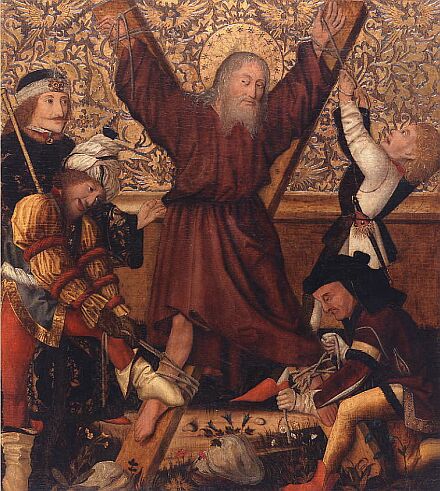
Apart from various zoological creatures, Frankenstein and Boris Karloff turned up in an installation at the Botanical Gardens, and Vlad Tepes lent a helping hand to the crucifixion of St. Andrew in the medieval section of the Unteres Belvedere. And, of course, Fuseli's Nightmare could famously be seen in Sigmund Freud's waiting room in BerggasseErnest Jones, who gave Freud the Nightmare black and white reproduction, was the author of On the Nightmare which includes a chapter on vampires. Considering how influential and recognized Freud was in my own country as well as in so many other places, I was surprised to learn that Freudianism had little impact in Austria until decades after WWII.


Otherwise it was a holiday not too dissimilar to that of other tourists. I saw the Hundertwasserhaus and a few other sights, and I certainly feel that I had enough Schlagobers for some time.


In central Vienna - as in many other large cities - a number of people try to amuse and entertain tourists and shoppers, including the guy in the photo above who appears to defy gravity. This to me shows that, perhaps, almost anything is possible in this city? Vienna is a pleasant place to stay, people are polite, and I haven't encountered any scams like the ones that you find in e.g. Rome and Paris.


Sunday, 18 July 2010

Calmet anno 1976


In 1976, Merlin Verlag published an edition of Calmet's Dissertation, Des Hochwürdigen Herrn Augustini Calmet gelehrte Verhandlung von denen sogenannten Vampiren oder zurückkommenden Verstorbenen as the fourth volume in the series Merlin's Bibliothek der geheimen Wissenschaften und magischen Künste (Merlin's library of the secret sciences and magical arts). In fact, it was only of a modernization of the original German translation of volume II of Calmet's second edition from 1751, i.e. the part that deals with vampires.

Apart from a number of illustrations, the book contains an essay by Dipl.-Psych. Wolfgang Bauer on the early literature on vampires and revenants: Von denen Traktaten. Die historischen Vampirschriften und ihre Verfasser. The essay relies on Ranft, Harenberg and Summers in particular, and seems pretty dated now, not least because Bauer's psychological background clearly leads him to psychoanalyze the vampire, of course quoting from Freud's Totem und Tabu: 'Denn deutet man eine Reihe von abergläubischen Vorstellungen um den Vampir in Zusammenhang näher aus, so ergibt sich, daß diese im Gesamtkonzept eine ausgepr]agte Mutterleibsphantasie konstitueren.' And so forth.

Nowadays, we have the 'ungekürzte Ausgabe' edited by Abraham & Irina Silberschmidt which was published in 2006 by Edition Roter Drache.

More information on Merlin's Bibliothek der geheimen Wissenschaften und magischen Künste can be found in this part of the history of the publisher, Merlin Verlag, and here.

Tuesday, 25 September 2007

Not the ultimate vampire book

"At the outset it appeared helpful to begin any analysis of the vampire not with its earliest appearances in (pre-)Romantic literature, but rather to go back into the folkloristic sources of vampire lore. Some obvious questions to pursue, then, were: Why and where did the idea of modern vampirism (as opposed to the belief in the lamiae and succubi of classical antiquity) spring up? And why has it had such a grip on the public consciousness since the fifteenth century? The outcome of my research yielded the following results: outbreaks of the plague, cannibalism, ancestor worship and human/blood sacrifice, necrophilia, catalepsy, premature burials, body snatching, and the discovery of vampire bats in South and Central America - all these occurrences in one way or another contributed to the belief in and to manefestations of vampirism.

However, I did not see myself in a position to write the ultimate, all-inclusive vampire encyclopedia, and thus I was forced to restrict myself to a more narrowly defined enterprise."


These are parts of the first chapter in a book called Blood Obsession: Vampires, Serial Murder, and the Popular Imagination by Jörg Waltje who is Assistant Professor of Modern Languages and Director of the Language Resource Center at Ohio University. The book was published by Peter Lang Publishing in 2005.

And this certainly is a more narrowly defined enterprise: 157 pages attempting to answer the question: What is it about vampires that fascinates the human imagination?. Well, the author has obviously studied both Freud and Todorov, and he mainly focuses on the fictional vampire, so this is not a book of particular interest for those who are interested in folklore and the history of Magia Posthuma.

"The most important findings of" his inquiry is summarised this way (p. 142):

"1. the vampire functions as a perfect model for generic fiction in general;
2. generic fiction is successful since it caters to the underlying mechanisms of our psyche; and
3. if we can trust Freud at all, human behavior in general is compulsive."


So if this is your thing, and you are intrigued to understand these findings, get the book. Otherwise you will be better off buying another book.

In the meantime we are still looking forward to the ultimate, all-inclusive vampire encyclopedia ...
Related Posts Plugin for WordPress, Blogger...